SUBSCRIBE TO OUR FREE NEWSLETTER
Daily news & progressive opinion—funded by the people, not the corporations—delivered straight to your inbox.
5
#000000
#FFFFFF
To donate by check, phone, or other method, see our More Ways to Give page.
Daily news & progressive opinion—funded by the people, not the corporations—delivered straight to your inbox.
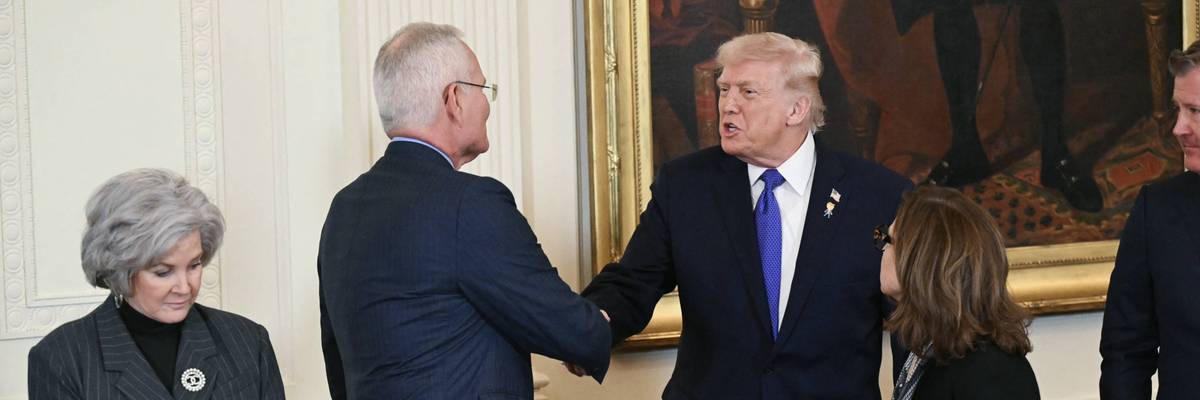
US President Donald Trump shakes hands with ExxonMobil CEO Darren Woods, during a meeting with US oil companies executives in the East Room of the White House in Washington, DC on January 9, 2026.
Where the GOP learned to lie as a matter of course is an interesting question, and as a long-time climate activist I’ve had a front row seat: It’s the climate fight, more than anything else, that taught them to regard reality as optional.
The past stretch of days—say, since the murder of Renee Good—has been marked by brutality, but also by a dishonesty so deep and stupid that it’s begun to finally turn on the liars. Following the execution of Alex Pretti, for instance, various White House officials were quick to start just plain lying: He was an “assassin” and a “domestic terrorist” who "wanted to do maximum damage and massacre law enforcement."
As many videos emerged in the course of the day, those lies were shown for what they were. Pretti was, at worst, trying to help a woman who was being unnecessarily gassed; for his pains he was executed once he’d been disarmed; the only “weapon” he’d “brandished” was a cell phone. Oh, and instead of being a domestic terrorist he was a VA nurse who treated former soldiers with compassion and dignity.
Politicians, it goes without saying, have sometimes engaged in dishonesty, often with hideous consequences. The Gulf of Tonkin “attacks” that gave America an excuse for war in Vietnam were at least in part fabrications; the “weapons of mass destruction” weren’t in Iraq and there was no compelling reason to think they were. Hell, we had a president—Richard Nixon—known as Tricky Dick for the smears and fibs that marked his whole career, from his first congressional race to the last days of Watergate. But the presidents who told those lies generally attempted to manufacture cover stories or cloud them in enough shadows that they might pass for mistakes. By now, however, we’ve reached a point where the president and his party just recite up-is-down lies constantly. Consider this reckoning of President Donald Trump's first term:
When The Washington Post Fact Checker team first started cataloguing President Donald Trump’s false or misleading claims, we recorded 492 suspect claims in the first 100 days of his presidency. On Nov. 2 alone, the day before the 2020 vote, Trump made 503 false or misleading claims as he barnstormed across the country in a desperate effort to win reelection. This astonishing jump in falsehoods is the story of Trump’s tumultuous reign.
By the end of his term, Trump had accumulated 30,573 untruths during his presidency—averaging about 21 erroneous claims a day. What is especially striking is how the tsunami of untruths kept rising the longer he served as president and became increasingly unmoored from the truth. Trump averaged about six claims a day in his first year as president, 16 claims day in his second year, 22 claims day in this third year—and 39 claims a day in his final year.
Put another way, it took him 27 months to reach 10,000 claims and an additional 14 months to reach 20,000. He then exceeded the 30,000 mark less than five months later.
The second term, obviously, is far worse than the first. At this point, it would be far easier for the Post to assign a reporter to list the true things the president says—a list as short as his… temper. (And of course the second-term Post wouldn’t do this, since its owner has castrated one of America’s great papers in an effort to curry favor with the fibber-in-chief). Every lie he tells is then repeated by his satraps in the administration and Congress—the closest they come to shame is when they lie and say that they haven’t heard his latest lies so they don’t have to publicly swallow them. Here at home we’ve gotten so used to this that the lies often barely register—but when Trump went to Davos and gave a speech literally filled with whoppers, European leaders were astonished. He was telling them things that they knew to be absurd—that China has no wind farms, say—and expecting them to go along.
Where the GOP learned to lie as a matter of course is an interesting question, and I’m afraid I’ve had a front row seat. I think it’s the climate fight, more than anything else, that taught them to regard reality as optional. And I think this because I remember the start of it all. When Jim Hansen first testified before the Senate that global warming was real, it caused a society-wide stir; running for the White House, the sitting vice-president George Herbert Walker Bush said he would combat the greenhouse effect with “the White House effect.” He made no attempt to deny it, or pretend it wasn’t a problem; it was reality, he wanted to lead the world, he had to at least pretend to deal with it.
And of course he could have—he could have resurrected Jimmy Carter’s plans (only eight years old) for a rapid solar research and development program, for instance. He seemed like he might; during the campaign he promised to convene a "global conference on the environment at the White House" during his first year in office. That didn’t happen, and it’s fairly easy to figure out why.
At about this same time—1989-1990—the fossil fuel industry was making a fateful decision. They were well aware that global warming was real; as a series of archival documents and whistleblowers have now laid out in excruciating detail, the big oil companies had conducted their own research programs, and reached conclusions just like Hansen’s. (Indeed, Exxon’s internal estimates of how hot the world would be by 2020 turned out to be even more accurate than NASA’s). We know that the executives of these companies believed their scientists—Exxon, for instance, began building drilling rigs higher to compensate for the rise in sea level they knew was coming, and plotting which corners of the Arctic to lease for drilling once it had inevitably melted.
It always has seemed to me that the worst fate would be to walk over this cliff without knowing it was there. Dignity demands understanding.
But they decided, across the industry, that the price of telling the truth would be too high. Inevitably it would mean having to leave at least some of their reserves of coal, gas, and oil in the ground, and those reserves were valued in the tens of trillions of dollars. And so they started forming the coalitions and councils, hiring the veterans of the fights over tobacco and asbestos and even DDT—they started lying.
Their lies were, at first, made concessions to some notion of plausibility. The science was “uncertain.” It was mostly China’s fault. Climate always fluctuates. Computer models are “unreliable.” And so on—these were never good-faith objections, they were always the arguments from selfishness. And as time went on they became more and more outlandish. Before the 1990s were over, the CEO of Exxon was telling a key crowd of Chinese leaders that the Earth was cooling and that it would make no difference if we waited a quarter century to start phasing out fossil fuels. Again, his scientists had assured him that this was nonsense years before.
It took a while for this to filter down through the entire GOP ecosystem. George W. Bush actually ran for president in 2000 promising to officially establish that carbon dioxide was a pollutant and to regulate its emissions. Shortly after taking office, however, his vice-president—oil-patch CEO Dick Cheney—held a series of private meetings with his industry brethren, and before long W. announced that he had made a mistake and that CO2 was not in fact a problem.
That was the signal for the rest of the Republican party—save for a few iconoclasts like John McCain—to fall in line, and by the time he ran for president even McCain had pretty much given up talking about global warming. The biggest donors by far to GOP campaign funds were the Koch brothers and the vast network they had assembled of right-wing billionaires—and the Koch brothers were the biggest oil and gas barons in America, owners of an unrivaled fleet of pipelines and refineries. The efforts of this group of oil-adjacent cronies became ever more extreme—eventually they were funding groups to put up billboards equating climate scientists with Charles Manson.
And eventually, inevitably, it produced a president who felt no compunction about just saying that climate change wasn’t real, and using all the power he could muster to kill off both the scientific effort that had alerted us to the crisis, and the policy effort to do something about it. His crew assisted in this cover-up in all the usual ways—we learned January 30, for instance, that a federal judge had ruled that the Department of Energy’s effort to produce a report pooh-poohing climate danger had violated all manner of federal law.
Judge William Young of the U.S. District Court for the District of Massachusetts said the Energy Department did not deny that it had failed to hold open meetings or assemble a balance of viewpoints, as the law requires, when it created the panel, known as the Climate Working Group.
“These violations are now established as a matter of law,” wrote Judge Young, who was nominated to the bench by Ronald Reagan. He said the Climate Working Group was, in fact, a federal advisory committee designed to inform policy, and not, as the Energy Department claimed, merely “assembled to exchange facts or information.”
What makes this campaign of deception all the more remarkable is that it’s happened even as the actual facts of global warming have become painfully clear. Back in 1988 it was still pretty much theory; now it’s flood and fire, storm and sea-level rise. We live on a planet losing the ice at its poles, and the vast coral reefs in between, where tens of millions of humans are already on the move because their homes can no longer support them. It’s also remarkable because in 1988 the solutions were hard—solar power was still the most expensive energy on Earth. Now it’s the cheapest. Most of the world has recognized these truths, coming together if fitfully to try and least talk about it. But whenever America is in the hands of Republicans it just walks away.
Perhaps, given this long history, I can offer a few hard-earned ideas about how to try and deal with Trump’s many assaults on the truth. They won’t do all that we might hope, but they’re nonetheless important.
I have no idea if I’ll live to see the day when the truth regains a strong footing in our culture, but I do have a certain amount of faith it will happen eventually, if only because reality reality ultimately trumps (not Trumps) political reality. Physics and chemistry are functional truth, despite their liberal bias. I remember the week after Hurricane Sandy hit New York shutting down the financial district, and the cover of Business Week magazine was simply a big block of text: “It’s Global Warming Stupid.” Eventually that message will get through; our job is to see if we can make that happen before the damage is any worse than it has to be.
Oh, and word on the street is that Immigration and Customs Enforcement is going after Springfield Ohio this week—home of the biggest lie of the last election campaign. Haitians are not eating cats and dogs. ICE is killing good people. The last three years are the hottest on record. Pass it on.
Dear Common Dreams reader, It’s been nearly 30 years since I co-founded Common Dreams with my late wife, Lina Newhouser. We had the radical notion that journalism should serve the public good, not corporate profits. It was clear to us from the outset what it would take to build such a project. No paid advertisements. No corporate sponsors. No millionaire publisher telling us what to think or do. Many people said we wouldn't last a year, but we proved those doubters wrong. Together with a tremendous team of journalists and dedicated staff, we built an independent media outlet free from the constraints of profits and corporate control. Our mission has always been simple: To inform. To inspire. To ignite change for the common good. Building Common Dreams was not easy. Our survival was never guaranteed. When you take on the most powerful forces—Wall Street greed, fossil fuel industry destruction, Big Tech lobbyists, and uber-rich oligarchs who have spent billions upon billions rigging the economy and democracy in their favor—the only bulwark you have is supporters who believe in your work. But here’s the urgent message from me today. It's never been this bad out there. And it's never been this hard to keep us going. At the very moment Common Dreams is most needed, the threats we face are intensifying. We need your support now more than ever. We don't accept corporate advertising and never will. We don't have a paywall because we don't think people should be blocked from critical news based on their ability to pay. Everything we do is funded by the donations of readers like you. When everyone does the little they can afford, we are strong. But if that support retreats or dries up, so do we. Will you donate now to make sure Common Dreams not only survives but thrives? —Craig Brown, Co-founder |
The past stretch of days—say, since the murder of Renee Good—has been marked by brutality, but also by a dishonesty so deep and stupid that it’s begun to finally turn on the liars. Following the execution of Alex Pretti, for instance, various White House officials were quick to start just plain lying: He was an “assassin” and a “domestic terrorist” who "wanted to do maximum damage and massacre law enforcement."
As many videos emerged in the course of the day, those lies were shown for what they were. Pretti was, at worst, trying to help a woman who was being unnecessarily gassed; for his pains he was executed once he’d been disarmed; the only “weapon” he’d “brandished” was a cell phone. Oh, and instead of being a domestic terrorist he was a VA nurse who treated former soldiers with compassion and dignity.
Politicians, it goes without saying, have sometimes engaged in dishonesty, often with hideous consequences. The Gulf of Tonkin “attacks” that gave America an excuse for war in Vietnam were at least in part fabrications; the “weapons of mass destruction” weren’t in Iraq and there was no compelling reason to think they were. Hell, we had a president—Richard Nixon—known as Tricky Dick for the smears and fibs that marked his whole career, from his first congressional race to the last days of Watergate. But the presidents who told those lies generally attempted to manufacture cover stories or cloud them in enough shadows that they might pass for mistakes. By now, however, we’ve reached a point where the president and his party just recite up-is-down lies constantly. Consider this reckoning of President Donald Trump's first term:
When The Washington Post Fact Checker team first started cataloguing President Donald Trump’s false or misleading claims, we recorded 492 suspect claims in the first 100 days of his presidency. On Nov. 2 alone, the day before the 2020 vote, Trump made 503 false or misleading claims as he barnstormed across the country in a desperate effort to win reelection. This astonishing jump in falsehoods is the story of Trump’s tumultuous reign.
By the end of his term, Trump had accumulated 30,573 untruths during his presidency—averaging about 21 erroneous claims a day. What is especially striking is how the tsunami of untruths kept rising the longer he served as president and became increasingly unmoored from the truth. Trump averaged about six claims a day in his first year as president, 16 claims day in his second year, 22 claims day in this third year—and 39 claims a day in his final year.
Put another way, it took him 27 months to reach 10,000 claims and an additional 14 months to reach 20,000. He then exceeded the 30,000 mark less than five months later.
The second term, obviously, is far worse than the first. At this point, it would be far easier for the Post to assign a reporter to list the true things the president says—a list as short as his… temper. (And of course the second-term Post wouldn’t do this, since its owner has castrated one of America’s great papers in an effort to curry favor with the fibber-in-chief). Every lie he tells is then repeated by his satraps in the administration and Congress—the closest they come to shame is when they lie and say that they haven’t heard his latest lies so they don’t have to publicly swallow them. Here at home we’ve gotten so used to this that the lies often barely register—but when Trump went to Davos and gave a speech literally filled with whoppers, European leaders were astonished. He was telling them things that they knew to be absurd—that China has no wind farms, say—and expecting them to go along.
Where the GOP learned to lie as a matter of course is an interesting question, and I’m afraid I’ve had a front row seat. I think it’s the climate fight, more than anything else, that taught them to regard reality as optional. And I think this because I remember the start of it all. When Jim Hansen first testified before the Senate that global warming was real, it caused a society-wide stir; running for the White House, the sitting vice-president George Herbert Walker Bush said he would combat the greenhouse effect with “the White House effect.” He made no attempt to deny it, or pretend it wasn’t a problem; it was reality, he wanted to lead the world, he had to at least pretend to deal with it.
And of course he could have—he could have resurrected Jimmy Carter’s plans (only eight years old) for a rapid solar research and development program, for instance. He seemed like he might; during the campaign he promised to convene a "global conference on the environment at the White House" during his first year in office. That didn’t happen, and it’s fairly easy to figure out why.
At about this same time—1989-1990—the fossil fuel industry was making a fateful decision. They were well aware that global warming was real; as a series of archival documents and whistleblowers have now laid out in excruciating detail, the big oil companies had conducted their own research programs, and reached conclusions just like Hansen’s. (Indeed, Exxon’s internal estimates of how hot the world would be by 2020 turned out to be even more accurate than NASA’s). We know that the executives of these companies believed their scientists—Exxon, for instance, began building drilling rigs higher to compensate for the rise in sea level they knew was coming, and plotting which corners of the Arctic to lease for drilling once it had inevitably melted.
It always has seemed to me that the worst fate would be to walk over this cliff without knowing it was there. Dignity demands understanding.
But they decided, across the industry, that the price of telling the truth would be too high. Inevitably it would mean having to leave at least some of their reserves of coal, gas, and oil in the ground, and those reserves were valued in the tens of trillions of dollars. And so they started forming the coalitions and councils, hiring the veterans of the fights over tobacco and asbestos and even DDT—they started lying.
Their lies were, at first, made concessions to some notion of plausibility. The science was “uncertain.” It was mostly China’s fault. Climate always fluctuates. Computer models are “unreliable.” And so on—these were never good-faith objections, they were always the arguments from selfishness. And as time went on they became more and more outlandish. Before the 1990s were over, the CEO of Exxon was telling a key crowd of Chinese leaders that the Earth was cooling and that it would make no difference if we waited a quarter century to start phasing out fossil fuels. Again, his scientists had assured him that this was nonsense years before.
It took a while for this to filter down through the entire GOP ecosystem. George W. Bush actually ran for president in 2000 promising to officially establish that carbon dioxide was a pollutant and to regulate its emissions. Shortly after taking office, however, his vice-president—oil-patch CEO Dick Cheney—held a series of private meetings with his industry brethren, and before long W. announced that he had made a mistake and that CO2 was not in fact a problem.
That was the signal for the rest of the Republican party—save for a few iconoclasts like John McCain—to fall in line, and by the time he ran for president even McCain had pretty much given up talking about global warming. The biggest donors by far to GOP campaign funds were the Koch brothers and the vast network they had assembled of right-wing billionaires—and the Koch brothers were the biggest oil and gas barons in America, owners of an unrivaled fleet of pipelines and refineries. The efforts of this group of oil-adjacent cronies became ever more extreme—eventually they were funding groups to put up billboards equating climate scientists with Charles Manson.
And eventually, inevitably, it produced a president who felt no compunction about just saying that climate change wasn’t real, and using all the power he could muster to kill off both the scientific effort that had alerted us to the crisis, and the policy effort to do something about it. His crew assisted in this cover-up in all the usual ways—we learned January 30, for instance, that a federal judge had ruled that the Department of Energy’s effort to produce a report pooh-poohing climate danger had violated all manner of federal law.
Judge William Young of the U.S. District Court for the District of Massachusetts said the Energy Department did not deny that it had failed to hold open meetings or assemble a balance of viewpoints, as the law requires, when it created the panel, known as the Climate Working Group.
“These violations are now established as a matter of law,” wrote Judge Young, who was nominated to the bench by Ronald Reagan. He said the Climate Working Group was, in fact, a federal advisory committee designed to inform policy, and not, as the Energy Department claimed, merely “assembled to exchange facts or information.”
What makes this campaign of deception all the more remarkable is that it’s happened even as the actual facts of global warming have become painfully clear. Back in 1988 it was still pretty much theory; now it’s flood and fire, storm and sea-level rise. We live on a planet losing the ice at its poles, and the vast coral reefs in between, where tens of millions of humans are already on the move because their homes can no longer support them. It’s also remarkable because in 1988 the solutions were hard—solar power was still the most expensive energy on Earth. Now it’s the cheapest. Most of the world has recognized these truths, coming together if fitfully to try and least talk about it. But whenever America is in the hands of Republicans it just walks away.
Perhaps, given this long history, I can offer a few hard-earned ideas about how to try and deal with Trump’s many assaults on the truth. They won’t do all that we might hope, but they’re nonetheless important.
I have no idea if I’ll live to see the day when the truth regains a strong footing in our culture, but I do have a certain amount of faith it will happen eventually, if only because reality reality ultimately trumps (not Trumps) political reality. Physics and chemistry are functional truth, despite their liberal bias. I remember the week after Hurricane Sandy hit New York shutting down the financial district, and the cover of Business Week magazine was simply a big block of text: “It’s Global Warming Stupid.” Eventually that message will get through; our job is to see if we can make that happen before the damage is any worse than it has to be.
Oh, and word on the street is that Immigration and Customs Enforcement is going after Springfield Ohio this week—home of the biggest lie of the last election campaign. Haitians are not eating cats and dogs. ICE is killing good people. The last three years are the hottest on record. Pass it on.
The past stretch of days—say, since the murder of Renee Good—has been marked by brutality, but also by a dishonesty so deep and stupid that it’s begun to finally turn on the liars. Following the execution of Alex Pretti, for instance, various White House officials were quick to start just plain lying: He was an “assassin” and a “domestic terrorist” who "wanted to do maximum damage and massacre law enforcement."
As many videos emerged in the course of the day, those lies were shown for what they were. Pretti was, at worst, trying to help a woman who was being unnecessarily gassed; for his pains he was executed once he’d been disarmed; the only “weapon” he’d “brandished” was a cell phone. Oh, and instead of being a domestic terrorist he was a VA nurse who treated former soldiers with compassion and dignity.
Politicians, it goes without saying, have sometimes engaged in dishonesty, often with hideous consequences. The Gulf of Tonkin “attacks” that gave America an excuse for war in Vietnam were at least in part fabrications; the “weapons of mass destruction” weren’t in Iraq and there was no compelling reason to think they were. Hell, we had a president—Richard Nixon—known as Tricky Dick for the smears and fibs that marked his whole career, from his first congressional race to the last days of Watergate. But the presidents who told those lies generally attempted to manufacture cover stories or cloud them in enough shadows that they might pass for mistakes. By now, however, we’ve reached a point where the president and his party just recite up-is-down lies constantly. Consider this reckoning of President Donald Trump's first term:
When The Washington Post Fact Checker team first started cataloguing President Donald Trump’s false or misleading claims, we recorded 492 suspect claims in the first 100 days of his presidency. On Nov. 2 alone, the day before the 2020 vote, Trump made 503 false or misleading claims as he barnstormed across the country in a desperate effort to win reelection. This astonishing jump in falsehoods is the story of Trump’s tumultuous reign.
By the end of his term, Trump had accumulated 30,573 untruths during his presidency—averaging about 21 erroneous claims a day. What is especially striking is how the tsunami of untruths kept rising the longer he served as president and became increasingly unmoored from the truth. Trump averaged about six claims a day in his first year as president, 16 claims day in his second year, 22 claims day in this third year—and 39 claims a day in his final year.
Put another way, it took him 27 months to reach 10,000 claims and an additional 14 months to reach 20,000. He then exceeded the 30,000 mark less than five months later.
The second term, obviously, is far worse than the first. At this point, it would be far easier for the Post to assign a reporter to list the true things the president says—a list as short as his… temper. (And of course the second-term Post wouldn’t do this, since its owner has castrated one of America’s great papers in an effort to curry favor with the fibber-in-chief). Every lie he tells is then repeated by his satraps in the administration and Congress—the closest they come to shame is when they lie and say that they haven’t heard his latest lies so they don’t have to publicly swallow them. Here at home we’ve gotten so used to this that the lies often barely register—but when Trump went to Davos and gave a speech literally filled with whoppers, European leaders were astonished. He was telling them things that they knew to be absurd—that China has no wind farms, say—and expecting them to go along.
Where the GOP learned to lie as a matter of course is an interesting question, and I’m afraid I’ve had a front row seat. I think it’s the climate fight, more than anything else, that taught them to regard reality as optional. And I think this because I remember the start of it all. When Jim Hansen first testified before the Senate that global warming was real, it caused a society-wide stir; running for the White House, the sitting vice-president George Herbert Walker Bush said he would combat the greenhouse effect with “the White House effect.” He made no attempt to deny it, or pretend it wasn’t a problem; it was reality, he wanted to lead the world, he had to at least pretend to deal with it.
And of course he could have—he could have resurrected Jimmy Carter’s plans (only eight years old) for a rapid solar research and development program, for instance. He seemed like he might; during the campaign he promised to convene a "global conference on the environment at the White House" during his first year in office. That didn’t happen, and it’s fairly easy to figure out why.
At about this same time—1989-1990—the fossil fuel industry was making a fateful decision. They were well aware that global warming was real; as a series of archival documents and whistleblowers have now laid out in excruciating detail, the big oil companies had conducted their own research programs, and reached conclusions just like Hansen’s. (Indeed, Exxon’s internal estimates of how hot the world would be by 2020 turned out to be even more accurate than NASA’s). We know that the executives of these companies believed their scientists—Exxon, for instance, began building drilling rigs higher to compensate for the rise in sea level they knew was coming, and plotting which corners of the Arctic to lease for drilling once it had inevitably melted.
It always has seemed to me that the worst fate would be to walk over this cliff without knowing it was there. Dignity demands understanding.
But they decided, across the industry, that the price of telling the truth would be too high. Inevitably it would mean having to leave at least some of their reserves of coal, gas, and oil in the ground, and those reserves were valued in the tens of trillions of dollars. And so they started forming the coalitions and councils, hiring the veterans of the fights over tobacco and asbestos and even DDT—they started lying.
Their lies were, at first, made concessions to some notion of plausibility. The science was “uncertain.” It was mostly China’s fault. Climate always fluctuates. Computer models are “unreliable.” And so on—these were never good-faith objections, they were always the arguments from selfishness. And as time went on they became more and more outlandish. Before the 1990s were over, the CEO of Exxon was telling a key crowd of Chinese leaders that the Earth was cooling and that it would make no difference if we waited a quarter century to start phasing out fossil fuels. Again, his scientists had assured him that this was nonsense years before.
It took a while for this to filter down through the entire GOP ecosystem. George W. Bush actually ran for president in 2000 promising to officially establish that carbon dioxide was a pollutant and to regulate its emissions. Shortly after taking office, however, his vice-president—oil-patch CEO Dick Cheney—held a series of private meetings with his industry brethren, and before long W. announced that he had made a mistake and that CO2 was not in fact a problem.
That was the signal for the rest of the Republican party—save for a few iconoclasts like John McCain—to fall in line, and by the time he ran for president even McCain had pretty much given up talking about global warming. The biggest donors by far to GOP campaign funds were the Koch brothers and the vast network they had assembled of right-wing billionaires—and the Koch brothers were the biggest oil and gas barons in America, owners of an unrivaled fleet of pipelines and refineries. The efforts of this group of oil-adjacent cronies became ever more extreme—eventually they were funding groups to put up billboards equating climate scientists with Charles Manson.
And eventually, inevitably, it produced a president who felt no compunction about just saying that climate change wasn’t real, and using all the power he could muster to kill off both the scientific effort that had alerted us to the crisis, and the policy effort to do something about it. His crew assisted in this cover-up in all the usual ways—we learned January 30, for instance, that a federal judge had ruled that the Department of Energy’s effort to produce a report pooh-poohing climate danger had violated all manner of federal law.
Judge William Young of the U.S. District Court for the District of Massachusetts said the Energy Department did not deny that it had failed to hold open meetings or assemble a balance of viewpoints, as the law requires, when it created the panel, known as the Climate Working Group.
“These violations are now established as a matter of law,” wrote Judge Young, who was nominated to the bench by Ronald Reagan. He said the Climate Working Group was, in fact, a federal advisory committee designed to inform policy, and not, as the Energy Department claimed, merely “assembled to exchange facts or information.”
What makes this campaign of deception all the more remarkable is that it’s happened even as the actual facts of global warming have become painfully clear. Back in 1988 it was still pretty much theory; now it’s flood and fire, storm and sea-level rise. We live on a planet losing the ice at its poles, and the vast coral reefs in between, where tens of millions of humans are already on the move because their homes can no longer support them. It’s also remarkable because in 1988 the solutions were hard—solar power was still the most expensive energy on Earth. Now it’s the cheapest. Most of the world has recognized these truths, coming together if fitfully to try and least talk about it. But whenever America is in the hands of Republicans it just walks away.
Perhaps, given this long history, I can offer a few hard-earned ideas about how to try and deal with Trump’s many assaults on the truth. They won’t do all that we might hope, but they’re nonetheless important.
I have no idea if I’ll live to see the day when the truth regains a strong footing in our culture, but I do have a certain amount of faith it will happen eventually, if only because reality reality ultimately trumps (not Trumps) political reality. Physics and chemistry are functional truth, despite their liberal bias. I remember the week after Hurricane Sandy hit New York shutting down the financial district, and the cover of Business Week magazine was simply a big block of text: “It’s Global Warming Stupid.” Eventually that message will get through; our job is to see if we can make that happen before the damage is any worse than it has to be.
Oh, and word on the street is that Immigration and Customs Enforcement is going after Springfield Ohio this week—home of the biggest lie of the last election campaign. Haitians are not eating cats and dogs. ICE is killing good people. The last three years are the hottest on record. Pass it on.