

SUBSCRIBE TO OUR FREE NEWSLETTER
Daily news & progressive opinion—funded by the people, not the corporations—delivered straight to your inbox.
5
#000000
#FFFFFF
To donate by check, phone, or other method, see our More Ways to Give page.
Daily news & progressive opinion—funded by the people, not the corporations—delivered straight to your inbox.
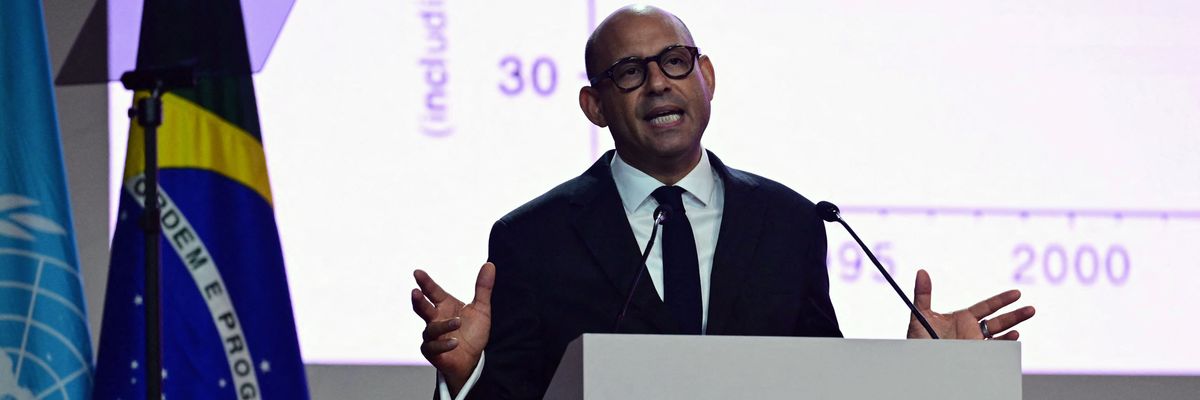
United Nations Framework Convention on Climate Change Executive Secretary Simon Stiell delivers a speech during the UN Climate Change Conference opening ceremony in Belém, Brazil on November 10, 2025.
"We must move much, much, faster on both reductions of emissions and strengthening resilience," Simon Stiell said at COP30 in Brazil.
At the opening of the United Nations summit known as COP30 on Monday, UN Framework Convention on Climate Change Executive Secretary Simon Stiell warned those gathered in Brazil of the "indisputable" dangers of inaction.
"Ten years ago in Paris, we were designing the future—a future that would clearly see the curve of emissions bend downwards," he said, referring to the interntaionl agreement to reduce planet-heating pollution in hopes of keeping temperature rise this century at 1.5°C, relative to preindustrial levels. The global average temperature last year was above that limit.
"The emissions curve has been bent downwards. Because of what was agreed in halls like this, with governments legislating, and markets responding. But I am not sugar-coating it. We have so much more work to do," Stiell stressed. "We must move much, much, faster on both reductions of emissions and strengthening resilience."
"The science is clear: We can and must bring temperatures back down to 1.5°C after any temporary overshoot," he continued. A UN assessment from last week found that under Paris Agreement countries' recently submitted plans, or Nationally Determined Contributions (NDCs), the global temperature could soar to 2.3-2.5°C.
Stiell said: "We find ourselves here in Belém, at the mouth of the Amazon. And we can learn a lot from this mighty river. The Amazon isn't a single entity, rather a vast river system supported and powered by over a thousand tributaries. To accelerate implementation, the COP process must be supported in the same way—powered by the many streams of international cooperation."
"We don't need to wait for late NDCs to slowly trickle in, to spot the gap and design the innovations necessary to tackle it," he noted. "To falter whilst megadroughts wreck national harvests, sending food prices soaring, makes zero sense, economically or politically. To squabble while famines take hold, forcing millions to flee their homelands, this will never be forgotten, as conflicts spread."
"While climate disasters decimate the lives of millions, when we already have the solutions, this will never, ever be forgiven," he argued. "The economics of this transition are as indisputable as the costs of inaction. Solar and wind are now the lowest-cost power in 90% of the world. Renewables overtook coal this year as the world's top energy source. Investment in clean energy and infrastructure will hit another record high this year."
Highlighting a previous agreement to deliver at least $300 billion in climate finance, with developed countries taking the lead, Stiell called for moving toward $1.3 trillion, along with progress on adaptation and inclusive and just transitions. He declared, "In this arena of COP30, your job here is not to fight one another—your job here is to fight this climate crisis, together."
UN Secretary-General António Guterres and Brazilian leaders, including President Luiz Inácio Lula da Silva, also emphasized the importance of collaboration at the summit to take on the fossil fuel-driven climate emergency.
According to the Associated Press:
André Corrêa do Lago, president of this year's conference, emphasized that negotiators must engage in "mutirão," derived from a local Indigenous word that refers to a group uniting for a task.
Complicating those calls is the United States, where President Donald Trump has long denied the existence of climate change. His administration did not send high-level negotiators and is withdrawing for the second time from the 10-year-old Paris Agreement, the first global pact to fight climate change.
As Common Dreams reported last week, Amnesty International secretary general Agnès Callamard urged all governments attending COP30 "to resist aligning with the Trump administration's denial of the accelerating climate crisis and instead demonstrate true climate leadership."
"In the face of President Trump's rejection of science coupled with the intensified lobbying for fossil fuels, global leaders must redouble their efforts to take urgent climate action—with or without the US," Callamard asserted.
An analysis of COP26-COP29 published Friday by Kick Big Polluters Out coalition found that "over 5,350 fossil fuel lobbyists have attended UN climate negotiations in just four years, with 90 of the corporations they represent responsible for nearly 60% of all global oil and gas production."
"Three decades of climate negotiations have failed to justly end fossil fuels, scale up real solutions, and deliver climate action that centers people and the planet, not Big Polluters' profits," the coalition said. "Until the well-evidenced obstruction of the fossil fuel industry is addressed and strong, lasting protections are in place, COP30 and all future COPs are pre-destined to fail."
Dear Common Dreams reader, It’s been nearly 30 years since I co-founded Common Dreams with my late wife, Lina Newhouser. We had the radical notion that journalism should serve the public good, not corporate profits. It was clear to us from the outset what it would take to build such a project. No paid advertisements. No corporate sponsors. No millionaire publisher telling us what to think or do. Many people said we wouldn't last a year, but we proved those doubters wrong. Together with a tremendous team of journalists and dedicated staff, we built an independent media outlet free from the constraints of profits and corporate control. Our mission has always been simple: To inform. To inspire. To ignite change for the common good. Building Common Dreams was not easy. Our survival was never guaranteed. When you take on the most powerful forces—Wall Street greed, fossil fuel industry destruction, Big Tech lobbyists, and uber-rich oligarchs who have spent billions upon billions rigging the economy and democracy in their favor—the only bulwark you have is supporters who believe in your work. But here’s the urgent message from me today. It's never been this bad out there. And it's never been this hard to keep us going. At the very moment Common Dreams is most needed, the threats we face are intensifying. We need your support now more than ever. We don't accept corporate advertising and never will. We don't have a paywall because we don't think people should be blocked from critical news based on their ability to pay. Everything we do is funded by the donations of readers like you. When everyone does the little they can afford, we are strong. But if that support retreats or dries up, so do we. Will you donate now to make sure Common Dreams not only survives but thrives? —Craig Brown, Co-founder |
At the opening of the United Nations summit known as COP30 on Monday, UN Framework Convention on Climate Change Executive Secretary Simon Stiell warned those gathered in Brazil of the "indisputable" dangers of inaction.
"Ten years ago in Paris, we were designing the future—a future that would clearly see the curve of emissions bend downwards," he said, referring to the interntaionl agreement to reduce planet-heating pollution in hopes of keeping temperature rise this century at 1.5°C, relative to preindustrial levels. The global average temperature last year was above that limit.
"The emissions curve has been bent downwards. Because of what was agreed in halls like this, with governments legislating, and markets responding. But I am not sugar-coating it. We have so much more work to do," Stiell stressed. "We must move much, much, faster on both reductions of emissions and strengthening resilience."
"The science is clear: We can and must bring temperatures back down to 1.5°C after any temporary overshoot," he continued. A UN assessment from last week found that under Paris Agreement countries' recently submitted plans, or Nationally Determined Contributions (NDCs), the global temperature could soar to 2.3-2.5°C.
Stiell said: "We find ourselves here in Belém, at the mouth of the Amazon. And we can learn a lot from this mighty river. The Amazon isn't a single entity, rather a vast river system supported and powered by over a thousand tributaries. To accelerate implementation, the COP process must be supported in the same way—powered by the many streams of international cooperation."
"We don't need to wait for late NDCs to slowly trickle in, to spot the gap and design the innovations necessary to tackle it," he noted. "To falter whilst megadroughts wreck national harvests, sending food prices soaring, makes zero sense, economically or politically. To squabble while famines take hold, forcing millions to flee their homelands, this will never be forgotten, as conflicts spread."
"While climate disasters decimate the lives of millions, when we already have the solutions, this will never, ever be forgiven," he argued. "The economics of this transition are as indisputable as the costs of inaction. Solar and wind are now the lowest-cost power in 90% of the world. Renewables overtook coal this year as the world's top energy source. Investment in clean energy and infrastructure will hit another record high this year."
Highlighting a previous agreement to deliver at least $300 billion in climate finance, with developed countries taking the lead, Stiell called for moving toward $1.3 trillion, along with progress on adaptation and inclusive and just transitions. He declared, "In this arena of COP30, your job here is not to fight one another—your job here is to fight this climate crisis, together."
UN Secretary-General António Guterres and Brazilian leaders, including President Luiz Inácio Lula da Silva, also emphasized the importance of collaboration at the summit to take on the fossil fuel-driven climate emergency.
According to the Associated Press:
André Corrêa do Lago, president of this year's conference, emphasized that negotiators must engage in "mutirão," derived from a local Indigenous word that refers to a group uniting for a task.
Complicating those calls is the United States, where President Donald Trump has long denied the existence of climate change. His administration did not send high-level negotiators and is withdrawing for the second time from the 10-year-old Paris Agreement, the first global pact to fight climate change.
As Common Dreams reported last week, Amnesty International secretary general Agnès Callamard urged all governments attending COP30 "to resist aligning with the Trump administration's denial of the accelerating climate crisis and instead demonstrate true climate leadership."
"In the face of President Trump's rejection of science coupled with the intensified lobbying for fossil fuels, global leaders must redouble their efforts to take urgent climate action—with or without the US," Callamard asserted.
An analysis of COP26-COP29 published Friday by Kick Big Polluters Out coalition found that "over 5,350 fossil fuel lobbyists have attended UN climate negotiations in just four years, with 90 of the corporations they represent responsible for nearly 60% of all global oil and gas production."
"Three decades of climate negotiations have failed to justly end fossil fuels, scale up real solutions, and deliver climate action that centers people and the planet, not Big Polluters' profits," the coalition said. "Until the well-evidenced obstruction of the fossil fuel industry is addressed and strong, lasting protections are in place, COP30 and all future COPs are pre-destined to fail."
At the opening of the United Nations summit known as COP30 on Monday, UN Framework Convention on Climate Change Executive Secretary Simon Stiell warned those gathered in Brazil of the "indisputable" dangers of inaction.
"Ten years ago in Paris, we were designing the future—a future that would clearly see the curve of emissions bend downwards," he said, referring to the interntaionl agreement to reduce planet-heating pollution in hopes of keeping temperature rise this century at 1.5°C, relative to preindustrial levels. The global average temperature last year was above that limit.
"The emissions curve has been bent downwards. Because of what was agreed in halls like this, with governments legislating, and markets responding. But I am not sugar-coating it. We have so much more work to do," Stiell stressed. "We must move much, much, faster on both reductions of emissions and strengthening resilience."
"The science is clear: We can and must bring temperatures back down to 1.5°C after any temporary overshoot," he continued. A UN assessment from last week found that under Paris Agreement countries' recently submitted plans, or Nationally Determined Contributions (NDCs), the global temperature could soar to 2.3-2.5°C.
Stiell said: "We find ourselves here in Belém, at the mouth of the Amazon. And we can learn a lot from this mighty river. The Amazon isn't a single entity, rather a vast river system supported and powered by over a thousand tributaries. To accelerate implementation, the COP process must be supported in the same way—powered by the many streams of international cooperation."
"We don't need to wait for late NDCs to slowly trickle in, to spot the gap and design the innovations necessary to tackle it," he noted. "To falter whilst megadroughts wreck national harvests, sending food prices soaring, makes zero sense, economically or politically. To squabble while famines take hold, forcing millions to flee their homelands, this will never be forgotten, as conflicts spread."
"While climate disasters decimate the lives of millions, when we already have the solutions, this will never, ever be forgiven," he argued. "The economics of this transition are as indisputable as the costs of inaction. Solar and wind are now the lowest-cost power in 90% of the world. Renewables overtook coal this year as the world's top energy source. Investment in clean energy and infrastructure will hit another record high this year."
Highlighting a previous agreement to deliver at least $300 billion in climate finance, with developed countries taking the lead, Stiell called for moving toward $1.3 trillion, along with progress on adaptation and inclusive and just transitions. He declared, "In this arena of COP30, your job here is not to fight one another—your job here is to fight this climate crisis, together."
UN Secretary-General António Guterres and Brazilian leaders, including President Luiz Inácio Lula da Silva, also emphasized the importance of collaboration at the summit to take on the fossil fuel-driven climate emergency.
According to the Associated Press:
André Corrêa do Lago, president of this year's conference, emphasized that negotiators must engage in "mutirão," derived from a local Indigenous word that refers to a group uniting for a task.
Complicating those calls is the United States, where President Donald Trump has long denied the existence of climate change. His administration did not send high-level negotiators and is withdrawing for the second time from the 10-year-old Paris Agreement, the first global pact to fight climate change.
As Common Dreams reported last week, Amnesty International secretary general Agnès Callamard urged all governments attending COP30 "to resist aligning with the Trump administration's denial of the accelerating climate crisis and instead demonstrate true climate leadership."
"In the face of President Trump's rejection of science coupled with the intensified lobbying for fossil fuels, global leaders must redouble their efforts to take urgent climate action—with or without the US," Callamard asserted.
An analysis of COP26-COP29 published Friday by Kick Big Polluters Out coalition found that "over 5,350 fossil fuel lobbyists have attended UN climate negotiations in just four years, with 90 of the corporations they represent responsible for nearly 60% of all global oil and gas production."
"Three decades of climate negotiations have failed to justly end fossil fuels, scale up real solutions, and deliver climate action that centers people and the planet, not Big Polluters' profits," the coalition said. "Until the well-evidenced obstruction of the fossil fuel industry is addressed and strong, lasting protections are in place, COP30 and all future COPs are pre-destined to fail."

