SUBSCRIBE TO OUR FREE NEWSLETTER
Daily news & progressive opinion—funded by the people, not the corporations—delivered straight to your inbox.
5
#000000
#FFFFFF
To donate by check, phone, or other method, see our More Ways to Give page.
Daily news & progressive opinion—funded by the people, not the corporations—delivered straight to your inbox.
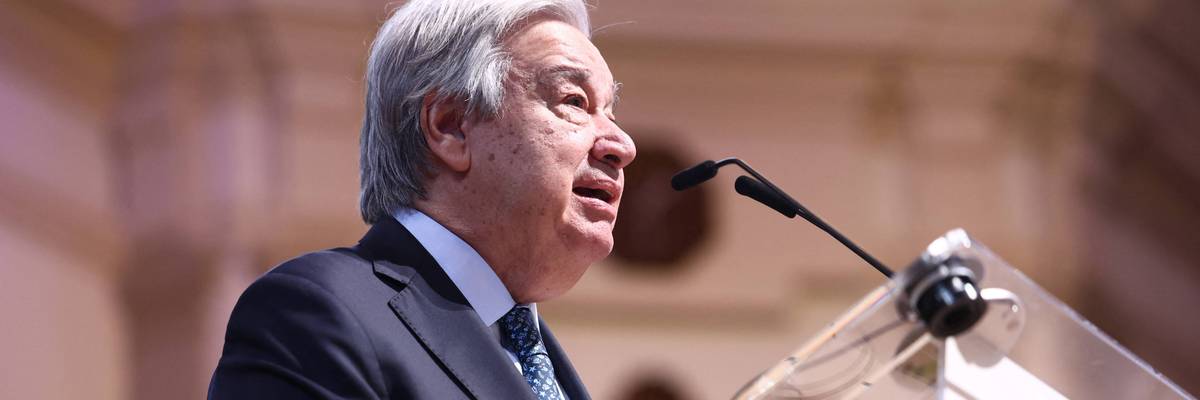
United Nations Secretary-General António Guterres speaks at the UNA-UK conference to mark the 80th anniversary of the founding of the UN, at Methodist Central Hall, the site of the inaugural UN General Assembly, in London on January 17, 2026.
"We see powerful forces lining up to undermine global cooperation," António Guterres said at an event celebrating the UN General Assembly's 80th anniversary.
As the United Nations celebrates the 80th anniversary of its first General Assembly, Secretary-General António Guterres warned that militarism, fossil fuels, and tech-based disruption are threatening its mission of international collaboration at a time when it is urgently needed.
Guterres delivered his remarks on Saturday at the Methodist Central Hall in London, where the first UN General Assembly was held on January 10, 1946. The first UN Security Council meeting was held on January 17 of the same year, also in London.
"We see powerful forces lining up to undermine global cooperation," Guterres said.
He continued: "Last year, the UN reported that global military spending reached $2.7 trillion—over 200 times the UK’s current aid budget, or equivalent to over 70% of Britain’s entire economy. As the planet broke heat records, fossil fuel profits continued to surge. And in cyberspace, algorithms rewarded falsehoods, fueled hatred, and provided authoritarians with powerful tools of control."
"The General Assembly which we celebrate today exists because of a simple truth—humanity is strongest when we stand as one."
Guterres, whose term as secretary-general comes to an end at the close of 2026, reflected on the tumultuous decade he had presided over.
He began his term in 2017, in the wake of President Donald Trump's first electoral victory in the US and the Brexit vote in the United Kingdom. That year, he also spoke in the same location, he said, and warned of the escalation of local conflicts, the rise of artificial intelligence and other new technologies, and how national sovereignty was being used as an excuse to disregard human rights.
"Over the last decade," he said, "all of this and more has unfolded at warp speed. The conflicts in Gaza, Ukraine, and Sudan have been vicious and cruel beyond measure; artificial intelligence has become ubiquitous almost overnight; and the pandemic poured accelerant on the fires of nationalism—stalling progress on development and climate action."
"If this period has taught us anything," he continued, "it is that our challenges are ever more borderless, and ever more interconnected. The only way to address them is together. And that requires a robust, responsive, and well-resourced multilateral system."
But that system, he said, was "under threat."
"2025 was a profoundly challenging year for international cooperation and the values of the UN," he said. "Aid was slashed. Inequalities widened. Climate chaos accelerated. International law was trampled. Crackdowns on civil society intensified. Journalists were killed with impunity. And United Nations staff were repeatedly threatened—or killed—in the line of duty."
While Guterres did not call out any particular country or leader, the Guardian noted that Trump's decision to dramatically slash US humanitarian funding for the UN last year is the leading cause of its budget troubles. Early in 2026, Trump also withdrew the US from key treaties including the UN Framework Convention on Climate Change.
Guterres' remarks came the same day that Trump threatened new tariffs against eight long-time European allies over their opposition to his desire for the US to acquire Greenland, further throwing international alliances into chaos.
The UN leader called on the body to adjust to a shifting global reality without abandoning its mission.
"The world of 2026 is not the world of 1946," he said. "As global centers of power shift, we have the potential to build a future that is either more fair—or more unstable. If we wish to make it more fair, it is critical that the international system reflects today’s reality."
Despite the challenges he described, Guterres called on members of the United Nations Association-UK (UNA-UK), which organized Saturday's meeting, to continue with their work.
"In this moment when the values of multilateralism are being chipped away, it is up to us—in our capacity as professionals, as voters, and as members of organizations like the UNA-UK—to take a stand. More than ever, the world needs civil society movements that are fearless and persistent—that make it impossible for leaders to look away."
"The General Assembly which we celebrate today exists because of a simple truth—humanity is strongest when we stand as one," he continued. "But that unity does not start in the General Assembly—it starts here, with people’s movements like yours."
Dear Common Dreams reader, It’s been nearly 30 years since I co-founded Common Dreams with my late wife, Lina Newhouser. We had the radical notion that journalism should serve the public good, not corporate profits. It was clear to us from the outset what it would take to build such a project. No paid advertisements. No corporate sponsors. No millionaire publisher telling us what to think or do. Many people said we wouldn't last a year, but we proved those doubters wrong. Together with a tremendous team of journalists and dedicated staff, we built an independent media outlet free from the constraints of profits and corporate control. Our mission has always been simple: To inform. To inspire. To ignite change for the common good. Building Common Dreams was not easy. Our survival was never guaranteed. When you take on the most powerful forces—Wall Street greed, fossil fuel industry destruction, Big Tech lobbyists, and uber-rich oligarchs who have spent billions upon billions rigging the economy and democracy in their favor—the only bulwark you have is supporters who believe in your work. But here’s the urgent message from me today. It's never been this bad out there. And it's never been this hard to keep us going. At the very moment Common Dreams is most needed, the threats we face are intensifying. We need your support now more than ever. We don't accept corporate advertising and never will. We don't have a paywall because we don't think people should be blocked from critical news based on their ability to pay. Everything we do is funded by the donations of readers like you. When everyone does the little they can afford, we are strong. But if that support retreats or dries up, so do we. Will you donate now to make sure Common Dreams not only survives but thrives? —Craig Brown, Co-founder |
As the United Nations celebrates the 80th anniversary of its first General Assembly, Secretary-General António Guterres warned that militarism, fossil fuels, and tech-based disruption are threatening its mission of international collaboration at a time when it is urgently needed.
Guterres delivered his remarks on Saturday at the Methodist Central Hall in London, where the first UN General Assembly was held on January 10, 1946. The first UN Security Council meeting was held on January 17 of the same year, also in London.
"We see powerful forces lining up to undermine global cooperation," Guterres said.
He continued: "Last year, the UN reported that global military spending reached $2.7 trillion—over 200 times the UK’s current aid budget, or equivalent to over 70% of Britain’s entire economy. As the planet broke heat records, fossil fuel profits continued to surge. And in cyberspace, algorithms rewarded falsehoods, fueled hatred, and provided authoritarians with powerful tools of control."
"The General Assembly which we celebrate today exists because of a simple truth—humanity is strongest when we stand as one."
Guterres, whose term as secretary-general comes to an end at the close of 2026, reflected on the tumultuous decade he had presided over.
He began his term in 2017, in the wake of President Donald Trump's first electoral victory in the US and the Brexit vote in the United Kingdom. That year, he also spoke in the same location, he said, and warned of the escalation of local conflicts, the rise of artificial intelligence and other new technologies, and how national sovereignty was being used as an excuse to disregard human rights.
"Over the last decade," he said, "all of this and more has unfolded at warp speed. The conflicts in Gaza, Ukraine, and Sudan have been vicious and cruel beyond measure; artificial intelligence has become ubiquitous almost overnight; and the pandemic poured accelerant on the fires of nationalism—stalling progress on development and climate action."
"If this period has taught us anything," he continued, "it is that our challenges are ever more borderless, and ever more interconnected. The only way to address them is together. And that requires a robust, responsive, and well-resourced multilateral system."
But that system, he said, was "under threat."
"2025 was a profoundly challenging year for international cooperation and the values of the UN," he said. "Aid was slashed. Inequalities widened. Climate chaos accelerated. International law was trampled. Crackdowns on civil society intensified. Journalists were killed with impunity. And United Nations staff were repeatedly threatened—or killed—in the line of duty."
While Guterres did not call out any particular country or leader, the Guardian noted that Trump's decision to dramatically slash US humanitarian funding for the UN last year is the leading cause of its budget troubles. Early in 2026, Trump also withdrew the US from key treaties including the UN Framework Convention on Climate Change.
Guterres' remarks came the same day that Trump threatened new tariffs against eight long-time European allies over their opposition to his desire for the US to acquire Greenland, further throwing international alliances into chaos.
The UN leader called on the body to adjust to a shifting global reality without abandoning its mission.
"The world of 2026 is not the world of 1946," he said. "As global centers of power shift, we have the potential to build a future that is either more fair—or more unstable. If we wish to make it more fair, it is critical that the international system reflects today’s reality."
Despite the challenges he described, Guterres called on members of the United Nations Association-UK (UNA-UK), which organized Saturday's meeting, to continue with their work.
"In this moment when the values of multilateralism are being chipped away, it is up to us—in our capacity as professionals, as voters, and as members of organizations like the UNA-UK—to take a stand. More than ever, the world needs civil society movements that are fearless and persistent—that make it impossible for leaders to look away."
"The General Assembly which we celebrate today exists because of a simple truth—humanity is strongest when we stand as one," he continued. "But that unity does not start in the General Assembly—it starts here, with people’s movements like yours."
As the United Nations celebrates the 80th anniversary of its first General Assembly, Secretary-General António Guterres warned that militarism, fossil fuels, and tech-based disruption are threatening its mission of international collaboration at a time when it is urgently needed.
Guterres delivered his remarks on Saturday at the Methodist Central Hall in London, where the first UN General Assembly was held on January 10, 1946. The first UN Security Council meeting was held on January 17 of the same year, also in London.
"We see powerful forces lining up to undermine global cooperation," Guterres said.
He continued: "Last year, the UN reported that global military spending reached $2.7 trillion—over 200 times the UK’s current aid budget, or equivalent to over 70% of Britain’s entire economy. As the planet broke heat records, fossil fuel profits continued to surge. And in cyberspace, algorithms rewarded falsehoods, fueled hatred, and provided authoritarians with powerful tools of control."
"The General Assembly which we celebrate today exists because of a simple truth—humanity is strongest when we stand as one."
Guterres, whose term as secretary-general comes to an end at the close of 2026, reflected on the tumultuous decade he had presided over.
He began his term in 2017, in the wake of President Donald Trump's first electoral victory in the US and the Brexit vote in the United Kingdom. That year, he also spoke in the same location, he said, and warned of the escalation of local conflicts, the rise of artificial intelligence and other new technologies, and how national sovereignty was being used as an excuse to disregard human rights.
"Over the last decade," he said, "all of this and more has unfolded at warp speed. The conflicts in Gaza, Ukraine, and Sudan have been vicious and cruel beyond measure; artificial intelligence has become ubiquitous almost overnight; and the pandemic poured accelerant on the fires of nationalism—stalling progress on development and climate action."
"If this period has taught us anything," he continued, "it is that our challenges are ever more borderless, and ever more interconnected. The only way to address them is together. And that requires a robust, responsive, and well-resourced multilateral system."
But that system, he said, was "under threat."
"2025 was a profoundly challenging year for international cooperation and the values of the UN," he said. "Aid was slashed. Inequalities widened. Climate chaos accelerated. International law was trampled. Crackdowns on civil society intensified. Journalists were killed with impunity. And United Nations staff were repeatedly threatened—or killed—in the line of duty."
While Guterres did not call out any particular country or leader, the Guardian noted that Trump's decision to dramatically slash US humanitarian funding for the UN last year is the leading cause of its budget troubles. Early in 2026, Trump also withdrew the US from key treaties including the UN Framework Convention on Climate Change.
Guterres' remarks came the same day that Trump threatened new tariffs against eight long-time European allies over their opposition to his desire for the US to acquire Greenland, further throwing international alliances into chaos.
The UN leader called on the body to adjust to a shifting global reality without abandoning its mission.
"The world of 2026 is not the world of 1946," he said. "As global centers of power shift, we have the potential to build a future that is either more fair—or more unstable. If we wish to make it more fair, it is critical that the international system reflects today’s reality."
Despite the challenges he described, Guterres called on members of the United Nations Association-UK (UNA-UK), which organized Saturday's meeting, to continue with their work.
"In this moment when the values of multilateralism are being chipped away, it is up to us—in our capacity as professionals, as voters, and as members of organizations like the UNA-UK—to take a stand. More than ever, the world needs civil society movements that are fearless and persistent—that make it impossible for leaders to look away."
"The General Assembly which we celebrate today exists because of a simple truth—humanity is strongest when we stand as one," he continued. "But that unity does not start in the General Assembly—it starts here, with people’s movements like yours."