SUBSCRIBE TO OUR FREE NEWSLETTER
Daily news & progressive opinion—funded by the people, not the corporations—delivered straight to your inbox.
5
#000000
#FFFFFF
To donate by check, phone, or other method, see our More Ways to Give page.
Daily news & progressive opinion—funded by the people, not the corporations—delivered straight to your inbox.
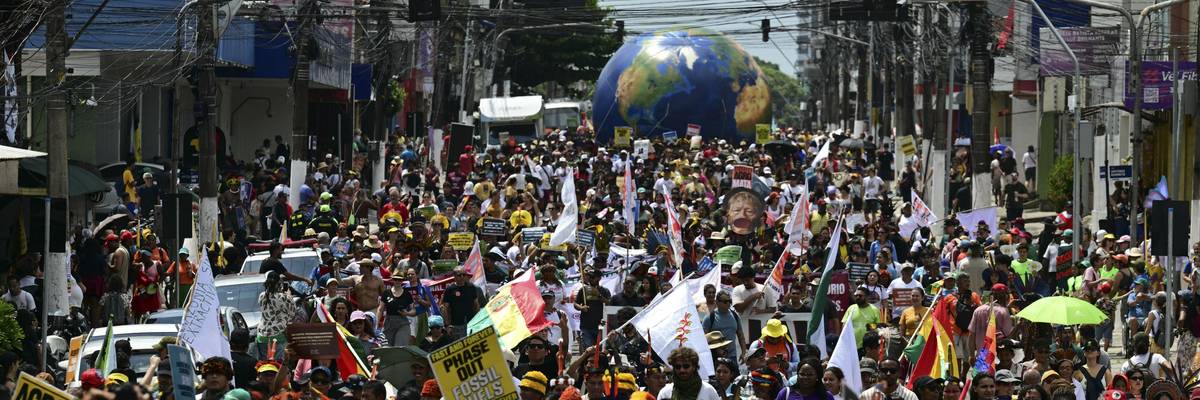
Thousands of people take part in the so-called "Great People's March" in the sidelines of the COP30 UN Climate Change Conference in Belem, Para State, Brazil on November 15, 2025.
As people throughout the globe prepare for the First International Conference for the Phase-Out of Fossil Fuels in Santa Marta, Colombia, in April, a frontline-led just transition must be given center stage.
On February 12, 2026, the US Environmental Protection Agency repealed the Endangerment Finding, a key determination for regulating greenhouse gas emissions under the Clean Air Act. This decision follows the EPA’s January 2026 announcement that air quality protections will be determined based on corporations’ bottom lines, not people’s health. These harmful decisions join a dizzying number of other regulations essential for environmental justice that have been dismantled, deregulated, or destroyed.
In these times, it would be easy to despair about how the tireless movement organizing labor that made these strides possible over many years has now been eroded. However, we cannot accept defeat. My decades of frontline organizing with workers and environmental justice communities toward a just transition shows that transformations come from our collective power. No matter the obstacles, we have the real solutions needed for the crucial work ahead, including during the upcoming Santa Marta conference.
Last year marked a huge moment for just transition. This movement and the principles that inform it often took center stage in grassroots organizing and during the United Nations Climate Summit in Belém, Brazil, in November 2025. The popularity of this concept, practice, and process reveals both promising and harmful co-opted outcomes for Indigenous Peoples, frontline workers, and fenceline communities. The language can be amplified by those most impacted, used to communicate their demands and desires, and it can be used as a tool for trying to undermine the hard work of community organizations and frontline communities.
At COP30, while we welcomed progressive news media coverage and the labor of journalists to cover such an intense few weeks of climate justice and just transition advocacy, we also witnessed reporting by some Global North journalists and news outlets that worked to minimize the credibility of frontline groups and community-based organizations, while amplifying the voices and positions of false solutionists and disaster capitalists.
Unlike some researchers who argue that the negotiations can be improved by using generative artificial intelligence for creating treaty drafts, we know who has the real solutions and who must be centered in building pathways toward just transition.
Much mainstream coverage of COP30 has not adequately addressed the indispensable role of grassroots organizing in pushing toward the successful implementation of a Just Transition Mechanism within the United Nations Framework Convention on Climate Change. Several days before the official start of COP30, the Movimiento de Afectados por Represas held the IV International Encuentro (Meeting) of People Affected by Dams and the Climate Crisis. This global gathering resulted in the launch of an international movement. Similarly, the Peoples’ Summit, including a just transition axis, was integral in building relationships and movement power. These mobilizations and knowledge sharing spaces worked synergistically with the Global Day of Action for Climate Justice, which occurred on November 15, with people of the world overflowing into the streets of Belém. It was these preceding and concurrent gatherings that energized Just Transition cross-constituencies and that shaped the direction of the Just Transition Work Programme negotiations and the resulting Just Transition Mechanism.
Many celebrate the institutionalization of just transition as one of the greatest successes at COP30. However, much work remains in the implementation process for the new mechanism to actually advance a just transition. Without a commitment to and practice of Indigenous Principles of Just Transition and Just Transition Principles, this mechanism will become another failed effort and abuse of the labor of frontline peoples and grassroots groups who have fought so hard for so long.
Unlike some researchers who argue that the negotiations can be improved by using generative artificial intelligence for creating treaty drafts, we know who has the real solutions and who must be centered in building pathways toward just transition. Groups practicing agroecology and Landback, as well as waste pickers and many other frontline workers, are creating collective power that brings together the most affected workers and environmental justice communities, rather than pitting them against each other.
Additionally, as knowledge holders, Indigenous Peoples and Afro-Indigenous Peoples hold inherent and collective rights; accordingly, they should not be conflated as part of “civil society.” We know that Indigenous Peoples and civil society members must be the ones consulted and centered in these key United Nations negotiations and texts, not the corporate profiteers and their political cronies who pollute just transition possibilities at every COP and at many other conferences.
This year marks 35 years since I served on the drafting committee of the Principles of Environmental Justice and 30 years since I contributed to the Jemez Principles for Democratic Organizing. These principles and the relationships and lived experiences that gave them life continue to inform and fortify our movements toward just transition and a livable world where we all can thrive. Let’s not forget these principles and the frontline peoples who made them possible.
Dear Common Dreams reader, It’s been nearly 30 years since I co-founded Common Dreams with my late wife, Lina Newhouser. We had the radical notion that journalism should serve the public good, not corporate profits. It was clear to us from the outset what it would take to build such a project. No paid advertisements. No corporate sponsors. No millionaire publisher telling us what to think or do. Many people said we wouldn't last a year, but we proved those doubters wrong. Together with a tremendous team of journalists and dedicated staff, we built an independent media outlet free from the constraints of profits and corporate control. Our mission has always been simple: To inform. To inspire. To ignite change for the common good. Building Common Dreams was not easy. Our survival was never guaranteed. When you take on the most powerful forces—Wall Street greed, fossil fuel industry destruction, Big Tech lobbyists, and uber-rich oligarchs who have spent billions upon billions rigging the economy and democracy in their favor—the only bulwark you have is supporters who believe in your work. But here’s the urgent message from me today. It's never been this bad out there. And it's never been this hard to keep us going. At the very moment Common Dreams is most needed, the threats we face are intensifying. We need your support now more than ever. We don't accept corporate advertising and never will. We don't have a paywall because we don't think people should be blocked from critical news based on their ability to pay. Everything we do is funded by the donations of readers like you. When everyone does the little they can afford, we are strong. But if that support retreats or dries up, so do we. Will you donate now to make sure Common Dreams not only survives but thrives? —Craig Brown, Co-founder |
On February 12, 2026, the US Environmental Protection Agency repealed the Endangerment Finding, a key determination for regulating greenhouse gas emissions under the Clean Air Act. This decision follows the EPA’s January 2026 announcement that air quality protections will be determined based on corporations’ bottom lines, not people’s health. These harmful decisions join a dizzying number of other regulations essential for environmental justice that have been dismantled, deregulated, or destroyed.
In these times, it would be easy to despair about how the tireless movement organizing labor that made these strides possible over many years has now been eroded. However, we cannot accept defeat. My decades of frontline organizing with workers and environmental justice communities toward a just transition shows that transformations come from our collective power. No matter the obstacles, we have the real solutions needed for the crucial work ahead, including during the upcoming Santa Marta conference.
Last year marked a huge moment for just transition. This movement and the principles that inform it often took center stage in grassroots organizing and during the United Nations Climate Summit in Belém, Brazil, in November 2025. The popularity of this concept, practice, and process reveals both promising and harmful co-opted outcomes for Indigenous Peoples, frontline workers, and fenceline communities. The language can be amplified by those most impacted, used to communicate their demands and desires, and it can be used as a tool for trying to undermine the hard work of community organizations and frontline communities.
At COP30, while we welcomed progressive news media coverage and the labor of journalists to cover such an intense few weeks of climate justice and just transition advocacy, we also witnessed reporting by some Global North journalists and news outlets that worked to minimize the credibility of frontline groups and community-based organizations, while amplifying the voices and positions of false solutionists and disaster capitalists.
Unlike some researchers who argue that the negotiations can be improved by using generative artificial intelligence for creating treaty drafts, we know who has the real solutions and who must be centered in building pathways toward just transition.
Much mainstream coverage of COP30 has not adequately addressed the indispensable role of grassroots organizing in pushing toward the successful implementation of a Just Transition Mechanism within the United Nations Framework Convention on Climate Change. Several days before the official start of COP30, the Movimiento de Afectados por Represas held the IV International Encuentro (Meeting) of People Affected by Dams and the Climate Crisis. This global gathering resulted in the launch of an international movement. Similarly, the Peoples’ Summit, including a just transition axis, was integral in building relationships and movement power. These mobilizations and knowledge sharing spaces worked synergistically with the Global Day of Action for Climate Justice, which occurred on November 15, with people of the world overflowing into the streets of Belém. It was these preceding and concurrent gatherings that energized Just Transition cross-constituencies and that shaped the direction of the Just Transition Work Programme negotiations and the resulting Just Transition Mechanism.
Many celebrate the institutionalization of just transition as one of the greatest successes at COP30. However, much work remains in the implementation process for the new mechanism to actually advance a just transition. Without a commitment to and practice of Indigenous Principles of Just Transition and Just Transition Principles, this mechanism will become another failed effort and abuse of the labor of frontline peoples and grassroots groups who have fought so hard for so long.
Unlike some researchers who argue that the negotiations can be improved by using generative artificial intelligence for creating treaty drafts, we know who has the real solutions and who must be centered in building pathways toward just transition. Groups practicing agroecology and Landback, as well as waste pickers and many other frontline workers, are creating collective power that brings together the most affected workers and environmental justice communities, rather than pitting them against each other.
Additionally, as knowledge holders, Indigenous Peoples and Afro-Indigenous Peoples hold inherent and collective rights; accordingly, they should not be conflated as part of “civil society.” We know that Indigenous Peoples and civil society members must be the ones consulted and centered in these key United Nations negotiations and texts, not the corporate profiteers and their political cronies who pollute just transition possibilities at every COP and at many other conferences.
This year marks 35 years since I served on the drafting committee of the Principles of Environmental Justice and 30 years since I contributed to the Jemez Principles for Democratic Organizing. These principles and the relationships and lived experiences that gave them life continue to inform and fortify our movements toward just transition and a livable world where we all can thrive. Let’s not forget these principles and the frontline peoples who made them possible.
On February 12, 2026, the US Environmental Protection Agency repealed the Endangerment Finding, a key determination for regulating greenhouse gas emissions under the Clean Air Act. This decision follows the EPA’s January 2026 announcement that air quality protections will be determined based on corporations’ bottom lines, not people’s health. These harmful decisions join a dizzying number of other regulations essential for environmental justice that have been dismantled, deregulated, or destroyed.
In these times, it would be easy to despair about how the tireless movement organizing labor that made these strides possible over many years has now been eroded. However, we cannot accept defeat. My decades of frontline organizing with workers and environmental justice communities toward a just transition shows that transformations come from our collective power. No matter the obstacles, we have the real solutions needed for the crucial work ahead, including during the upcoming Santa Marta conference.
Last year marked a huge moment for just transition. This movement and the principles that inform it often took center stage in grassroots organizing and during the United Nations Climate Summit in Belém, Brazil, in November 2025. The popularity of this concept, practice, and process reveals both promising and harmful co-opted outcomes for Indigenous Peoples, frontline workers, and fenceline communities. The language can be amplified by those most impacted, used to communicate their demands and desires, and it can be used as a tool for trying to undermine the hard work of community organizations and frontline communities.
At COP30, while we welcomed progressive news media coverage and the labor of journalists to cover such an intense few weeks of climate justice and just transition advocacy, we also witnessed reporting by some Global North journalists and news outlets that worked to minimize the credibility of frontline groups and community-based organizations, while amplifying the voices and positions of false solutionists and disaster capitalists.
Unlike some researchers who argue that the negotiations can be improved by using generative artificial intelligence for creating treaty drafts, we know who has the real solutions and who must be centered in building pathways toward just transition.
Much mainstream coverage of COP30 has not adequately addressed the indispensable role of grassroots organizing in pushing toward the successful implementation of a Just Transition Mechanism within the United Nations Framework Convention on Climate Change. Several days before the official start of COP30, the Movimiento de Afectados por Represas held the IV International Encuentro (Meeting) of People Affected by Dams and the Climate Crisis. This global gathering resulted in the launch of an international movement. Similarly, the Peoples’ Summit, including a just transition axis, was integral in building relationships and movement power. These mobilizations and knowledge sharing spaces worked synergistically with the Global Day of Action for Climate Justice, which occurred on November 15, with people of the world overflowing into the streets of Belém. It was these preceding and concurrent gatherings that energized Just Transition cross-constituencies and that shaped the direction of the Just Transition Work Programme negotiations and the resulting Just Transition Mechanism.
Many celebrate the institutionalization of just transition as one of the greatest successes at COP30. However, much work remains in the implementation process for the new mechanism to actually advance a just transition. Without a commitment to and practice of Indigenous Principles of Just Transition and Just Transition Principles, this mechanism will become another failed effort and abuse of the labor of frontline peoples and grassroots groups who have fought so hard for so long.
Unlike some researchers who argue that the negotiations can be improved by using generative artificial intelligence for creating treaty drafts, we know who has the real solutions and who must be centered in building pathways toward just transition. Groups practicing agroecology and Landback, as well as waste pickers and many other frontline workers, are creating collective power that brings together the most affected workers and environmental justice communities, rather than pitting them against each other.
Additionally, as knowledge holders, Indigenous Peoples and Afro-Indigenous Peoples hold inherent and collective rights; accordingly, they should not be conflated as part of “civil society.” We know that Indigenous Peoples and civil society members must be the ones consulted and centered in these key United Nations negotiations and texts, not the corporate profiteers and their political cronies who pollute just transition possibilities at every COP and at many other conferences.
This year marks 35 years since I served on the drafting committee of the Principles of Environmental Justice and 30 years since I contributed to the Jemez Principles for Democratic Organizing. These principles and the relationships and lived experiences that gave them life continue to inform and fortify our movements toward just transition and a livable world where we all can thrive. Let’s not forget these principles and the frontline peoples who made them possible.