SUBSCRIBE TO OUR FREE NEWSLETTER
Daily news & progressive opinion—funded by the people, not the corporations—delivered straight to your inbox.
5
#000000
#FFFFFF
To donate by check, phone, or other method, see our More Ways to Give page.
Daily news & progressive opinion—funded by the people, not the corporations—delivered straight to your inbox.
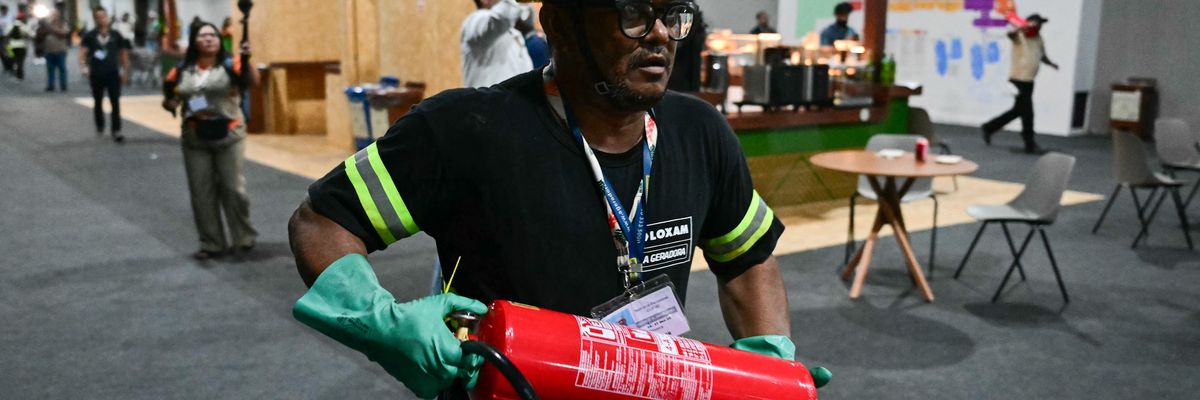
A worker runs carrying a fire extinguisher toward a pavilion after a fire broke out during the COP30 UN Climate Change Conference in Belém, Para state, Brazil on November 20, 2025.
Can the coalition supporting a fossil fuel phaseout successfully put their road map back into the text, or will petrostrates like Saudi Arabia, backed up by the Trump administration, kill the deal?
Sometimes the metaphors are just too on the nose: On Thursday, the venue for the COP30 climate talks here in Belém, Brazil literally caught fire as delegates continued to wrestle with how to stop the climate from burning. I was just down the hallway from the blaze and was caught up in the confusion as people started running from the flames and out of the huge tented structure. Thankfully, volunteers and Brazilian firefighters responded before anyone was seriously injured and the fire was put out soon after it began.
If only the rest of the talks could move so quickly. When it comes to the larger climate fires still raging across the planet, some countries seem content to pretend it isn’t happening, while others are teaming up with the fossil fuel industry to gleefully pour more fuel on the flames.
Thursday night, the presidency released a new draft text that removed any mention of a road map to eliminate fossil fuels, something more than 80 countries, including the host country of Brazil, have pledged their support behind. It’s the equivalent of pointing at the flames and smoke filling the conference venue and saying, “What could that possibly be? We certainly don’t want to say the word fire.”
The pushback to the latest text was swift. Later on Thursday night, 29 countries sent a letter to the Brazilian COP presidency threatening to block any agreement that didn’t include the fossil fuel phaseout road map. Then this morning, Colombia hosted a packed press conference with Panama, the Netherlands, Vanuatu, the Marshall Islands, and others to demand COP produce the road map and a just transition plan.
Whether or not countries can agree to a road map to phase out fossil fuels here in Belém, that’s clearly the journey we’re on.
“Not even Orwell could come up with something as absurd as this: something where the truth is edited out because it offends polluters,” said Panama's lead negotiator Juan Carlos Monterrey to widespread applause.
Colombia also announced that this March it will host the first ever global conference on the phaseout of fossil fuels. The conference is closely connected with the push for a new Fossil Fuel Treaty that would help end the production and distribution of fossil fuels, an effort that 18 countries and thousands of cities, states, and organizations have now endorsed.
We’ll see over the next 24 hours whether the coalition supporting a fossil fuel phaseout, the climate firefighters, can successfully put their road map back into the text, or whether the arsonists, petrostrates like Saudi Arabia, backed up by the Trump administration, can kill the deal.
Having been to a dozen COPs and watched many of these last minute fights, my guess is that we get some weak, compromised language. There will be two ways to look at that outcome, both of them true: On the one hand, it will be an empty promise and pathetic abdication of responsibility, on the other, another step forward in the fight to end fossil fuels, a fight that we’ve always known would take years and a massive global movement to win.
No matter what comes out of the text, I’ve been inspired to see that movement gaining momentum again. The last few years have been tough for the global climate movement. The Covid-19 pandemic squashed much of the energy created by the Global Climate Strikes in 2019. Over the last year, much of civil society has been focused (rightfully) on the genocide in Gaza or the rise of right-wing authoritarianism around the world. With the last three COPs taking place in Egypt, UAE, and Azerbaijan, there’s been little space for demonstrations, let alone mass protests.
And yet, there are green shoots popping up everywhere you look. Last week at COP30, Indigenous leaders marched on the conference center to ensure that their voices and concerns were being heard within the process. Over the weekend, over 70,000 people took the streets of Belém to demand climate justice. Inside the conference venue, there have been dozens of actions, including a big Make Polluters Pay demonstration we helped organize (I got to play a Big Oil CEO and roll around in a sea of dirty money). Back in the US, we saw over 500 events for the Sun Day clean energy day of action this September and millions of people take part in the No Kings demonstrations last month.
Meanwhile, in the real economy, clean energy continues to set records nearly every day. According to the energy think tank Ember, there was no fossil fuel growth in 2025 as clean energy production surged around the world. Whether or not countries can agree to a road map to phase out fossil fuels here in Belém, that’s clearly the journey we’re on.
The question is can we move fast enough. When the COP30 venue caught fire yesterday, I saw people sprinting for the exits while firefighters rushed into action to put out the blaze. We all need that same sense of urgency when it comes to the climate fight ahead. As Greta Thunberg often said, “Act is if your house is on fire.” Maybe seeing the negotiations go up in literal flames will get countries at COP30 to finally take her message to heart.
Dear Common Dreams reader, It’s been nearly 30 years since I co-founded Common Dreams with my late wife, Lina Newhouser. We had the radical notion that journalism should serve the public good, not corporate profits. It was clear to us from the outset what it would take to build such a project. No paid advertisements. No corporate sponsors. No millionaire publisher telling us what to think or do. Many people said we wouldn't last a year, but we proved those doubters wrong. Together with a tremendous team of journalists and dedicated staff, we built an independent media outlet free from the constraints of profits and corporate control. Our mission has always been simple: To inform. To inspire. To ignite change for the common good. Building Common Dreams was not easy. Our survival was never guaranteed. When you take on the most powerful forces—Wall Street greed, fossil fuel industry destruction, Big Tech lobbyists, and uber-rich oligarchs who have spent billions upon billions rigging the economy and democracy in their favor—the only bulwark you have is supporters who believe in your work. But here’s the urgent message from me today. It's never been this bad out there. And it's never been this hard to keep us going. At the very moment Common Dreams is most needed, the threats we face are intensifying. We need your support now more than ever. We don't accept corporate advertising and never will. We don't have a paywall because we don't think people should be blocked from critical news based on their ability to pay. Everything we do is funded by the donations of readers like you. When everyone does the little they can afford, we are strong. But if that support retreats or dries up, so do we. Will you donate now to make sure Common Dreams not only survives but thrives? —Craig Brown, Co-founder |
Sometimes the metaphors are just too on the nose: On Thursday, the venue for the COP30 climate talks here in Belém, Brazil literally caught fire as delegates continued to wrestle with how to stop the climate from burning. I was just down the hallway from the blaze and was caught up in the confusion as people started running from the flames and out of the huge tented structure. Thankfully, volunteers and Brazilian firefighters responded before anyone was seriously injured and the fire was put out soon after it began.
If only the rest of the talks could move so quickly. When it comes to the larger climate fires still raging across the planet, some countries seem content to pretend it isn’t happening, while others are teaming up with the fossil fuel industry to gleefully pour more fuel on the flames.
Thursday night, the presidency released a new draft text that removed any mention of a road map to eliminate fossil fuels, something more than 80 countries, including the host country of Brazil, have pledged their support behind. It’s the equivalent of pointing at the flames and smoke filling the conference venue and saying, “What could that possibly be? We certainly don’t want to say the word fire.”
The pushback to the latest text was swift. Later on Thursday night, 29 countries sent a letter to the Brazilian COP presidency threatening to block any agreement that didn’t include the fossil fuel phaseout road map. Then this morning, Colombia hosted a packed press conference with Panama, the Netherlands, Vanuatu, the Marshall Islands, and others to demand COP produce the road map and a just transition plan.
Whether or not countries can agree to a road map to phase out fossil fuels here in Belém, that’s clearly the journey we’re on.
“Not even Orwell could come up with something as absurd as this: something where the truth is edited out because it offends polluters,” said Panama's lead negotiator Juan Carlos Monterrey to widespread applause.
Colombia also announced that this March it will host the first ever global conference on the phaseout of fossil fuels. The conference is closely connected with the push for a new Fossil Fuel Treaty that would help end the production and distribution of fossil fuels, an effort that 18 countries and thousands of cities, states, and organizations have now endorsed.
We’ll see over the next 24 hours whether the coalition supporting a fossil fuel phaseout, the climate firefighters, can successfully put their road map back into the text, or whether the arsonists, petrostrates like Saudi Arabia, backed up by the Trump administration, can kill the deal.
Having been to a dozen COPs and watched many of these last minute fights, my guess is that we get some weak, compromised language. There will be two ways to look at that outcome, both of them true: On the one hand, it will be an empty promise and pathetic abdication of responsibility, on the other, another step forward in the fight to end fossil fuels, a fight that we’ve always known would take years and a massive global movement to win.
No matter what comes out of the text, I’ve been inspired to see that movement gaining momentum again. The last few years have been tough for the global climate movement. The Covid-19 pandemic squashed much of the energy created by the Global Climate Strikes in 2019. Over the last year, much of civil society has been focused (rightfully) on the genocide in Gaza or the rise of right-wing authoritarianism around the world. With the last three COPs taking place in Egypt, UAE, and Azerbaijan, there’s been little space for demonstrations, let alone mass protests.
And yet, there are green shoots popping up everywhere you look. Last week at COP30, Indigenous leaders marched on the conference center to ensure that their voices and concerns were being heard within the process. Over the weekend, over 70,000 people took the streets of Belém to demand climate justice. Inside the conference venue, there have been dozens of actions, including a big Make Polluters Pay demonstration we helped organize (I got to play a Big Oil CEO and roll around in a sea of dirty money). Back in the US, we saw over 500 events for the Sun Day clean energy day of action this September and millions of people take part in the No Kings demonstrations last month.
Meanwhile, in the real economy, clean energy continues to set records nearly every day. According to the energy think tank Ember, there was no fossil fuel growth in 2025 as clean energy production surged around the world. Whether or not countries can agree to a road map to phase out fossil fuels here in Belém, that’s clearly the journey we’re on.
The question is can we move fast enough. When the COP30 venue caught fire yesterday, I saw people sprinting for the exits while firefighters rushed into action to put out the blaze. We all need that same sense of urgency when it comes to the climate fight ahead. As Greta Thunberg often said, “Act is if your house is on fire.” Maybe seeing the negotiations go up in literal flames will get countries at COP30 to finally take her message to heart.
Sometimes the metaphors are just too on the nose: On Thursday, the venue for the COP30 climate talks here in Belém, Brazil literally caught fire as delegates continued to wrestle with how to stop the climate from burning. I was just down the hallway from the blaze and was caught up in the confusion as people started running from the flames and out of the huge tented structure. Thankfully, volunteers and Brazilian firefighters responded before anyone was seriously injured and the fire was put out soon after it began.
If only the rest of the talks could move so quickly. When it comes to the larger climate fires still raging across the planet, some countries seem content to pretend it isn’t happening, while others are teaming up with the fossil fuel industry to gleefully pour more fuel on the flames.
Thursday night, the presidency released a new draft text that removed any mention of a road map to eliminate fossil fuels, something more than 80 countries, including the host country of Brazil, have pledged their support behind. It’s the equivalent of pointing at the flames and smoke filling the conference venue and saying, “What could that possibly be? We certainly don’t want to say the word fire.”
The pushback to the latest text was swift. Later on Thursday night, 29 countries sent a letter to the Brazilian COP presidency threatening to block any agreement that didn’t include the fossil fuel phaseout road map. Then this morning, Colombia hosted a packed press conference with Panama, the Netherlands, Vanuatu, the Marshall Islands, and others to demand COP produce the road map and a just transition plan.
Whether or not countries can agree to a road map to phase out fossil fuels here in Belém, that’s clearly the journey we’re on.
“Not even Orwell could come up with something as absurd as this: something where the truth is edited out because it offends polluters,” said Panama's lead negotiator Juan Carlos Monterrey to widespread applause.
Colombia also announced that this March it will host the first ever global conference on the phaseout of fossil fuels. The conference is closely connected with the push for a new Fossil Fuel Treaty that would help end the production and distribution of fossil fuels, an effort that 18 countries and thousands of cities, states, and organizations have now endorsed.
We’ll see over the next 24 hours whether the coalition supporting a fossil fuel phaseout, the climate firefighters, can successfully put their road map back into the text, or whether the arsonists, petrostrates like Saudi Arabia, backed up by the Trump administration, can kill the deal.
Having been to a dozen COPs and watched many of these last minute fights, my guess is that we get some weak, compromised language. There will be two ways to look at that outcome, both of them true: On the one hand, it will be an empty promise and pathetic abdication of responsibility, on the other, another step forward in the fight to end fossil fuels, a fight that we’ve always known would take years and a massive global movement to win.
No matter what comes out of the text, I’ve been inspired to see that movement gaining momentum again. The last few years have been tough for the global climate movement. The Covid-19 pandemic squashed much of the energy created by the Global Climate Strikes in 2019. Over the last year, much of civil society has been focused (rightfully) on the genocide in Gaza or the rise of right-wing authoritarianism around the world. With the last three COPs taking place in Egypt, UAE, and Azerbaijan, there’s been little space for demonstrations, let alone mass protests.
And yet, there are green shoots popping up everywhere you look. Last week at COP30, Indigenous leaders marched on the conference center to ensure that their voices and concerns were being heard within the process. Over the weekend, over 70,000 people took the streets of Belém to demand climate justice. Inside the conference venue, there have been dozens of actions, including a big Make Polluters Pay demonstration we helped organize (I got to play a Big Oil CEO and roll around in a sea of dirty money). Back in the US, we saw over 500 events for the Sun Day clean energy day of action this September and millions of people take part in the No Kings demonstrations last month.
Meanwhile, in the real economy, clean energy continues to set records nearly every day. According to the energy think tank Ember, there was no fossil fuel growth in 2025 as clean energy production surged around the world. Whether or not countries can agree to a road map to phase out fossil fuels here in Belém, that’s clearly the journey we’re on.
The question is can we move fast enough. When the COP30 venue caught fire yesterday, I saw people sprinting for the exits while firefighters rushed into action to put out the blaze. We all need that same sense of urgency when it comes to the climate fight ahead. As Greta Thunberg often said, “Act is if your house is on fire.” Maybe seeing the negotiations go up in literal flames will get countries at COP30 to finally take her message to heart.