
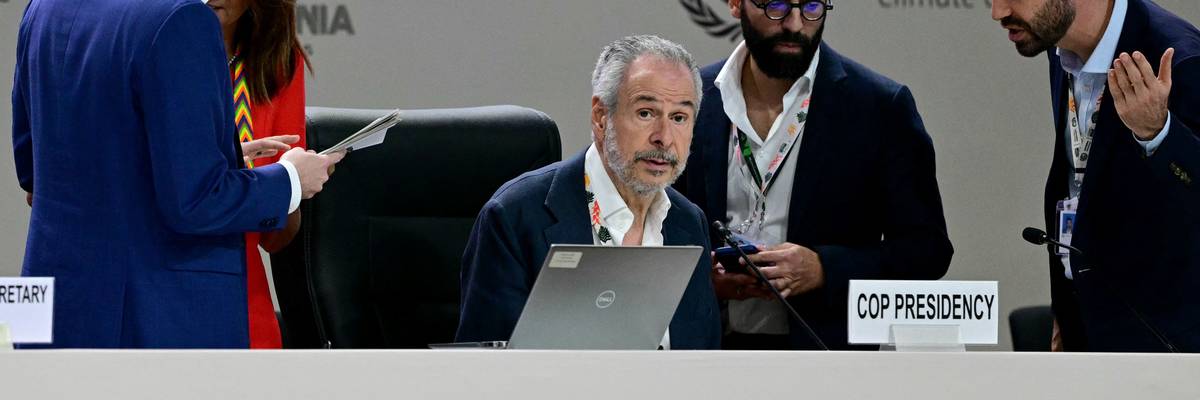
COP30 President Andre Correa do Lago (C) listens to an adviser upon arrival for a plenary session of the COP30 UN Climate Change Conference in Belém, Para State, Brazil on November 21, 2025.
The ‘COP of Truth’ Just Normalized a New Kind of Climate Denialism
The new denialism no longer bellows about hoaxes; it asks for more studies, more modelling, more consultations, always in the service of delay.
Belém promised a “COP of truth.” What unfolded was a courteous unravelling of ambition, as denialism left global climate action wobbling at the moment it needs steel.
As the Chair of the UK’s COP30 youth delegation, I realized within hours that this United Nations climate conference would be defined by its optics—not its outcomes. The venue teemed with political hopefuls more interested in cameras than commitments, and with a record 1,600 fossil fuel and 531 carbon-capture lobbyists, 1 in every 25 attendees served commercial interests.
Then came the negotiations, where delegates quietly diluted the science. References to the Intergovernmental Panel on Climate Change (IPCC), long regarded as the global lodestar of climate knowledge, were either softened into ambiguity or dropped altogether. Several companies went even further, trumpeting improvements in emissions intensity as if they were genuine reductions.
It was greenwashing par excellence, a polite fiction to excuse keeping emissions exactly where they are.
After the failures of COP29 and COP30, the process will only matter again if governments are finally pushed toward honesty and supported by tools that can hold them to it.
So it was no surprise when the negotiations titled toward erasure, governing not just the deal but the language that framed it. The term “fossil fuel” vanished from the final Belém Political Package, replaced with sweeping and unenforceable vows to renewables and adaptation funding.
We should have foreseen how settled climate science would be twisted and spun. After all, one investigation found more than 14,000 pieces of COP-related disinformation in just the three months before Belém. Much of it was generated by AI, including a widely shared fake video that showed the host city swallowed by floods.
This version of climate denialism reveals the moral credibility of climate action is being leveraged to keep emissions frozen in place. It no longer bellows about hoaxes, except by Donald Trump who has happily dragged America back into isolationism. In the diplomatic world it asks for more studies, more modelling, more consultations, always in the service of delay. It is denialism wearing the mask of governance, and it is far more corrosive than the loud bluff it replaced.
The timing could hardly be worse. The IPCC’s carbon budget for a 50% chance of staying below 1.5°C will vanish by 2029 if emissions continue at today’s pace. This is also the first year after the Global Stocktake that mandates governments to draft national plans that will set our course until 2030.
And what happens now determines the shape of the decisive decade. Crossing 1.5°C sharply raises the risk of irreversible cryosphere collapse—rapid ice loss in Antarctica and Greenland which will lock the world into meters of sea-level rise that imperil coastal megacities across every hemisphere. At 2°C, another billion people will face severe water scarcity—especially in the Global South where adaptation capacity is lowest and exposure is highest. This reality is why the deliberate sidelining of climate science is not just exasperating but catastrophic.
And COP30’s lone nod to honesty—the Declaration on Information Integrity—feels painfully thin. The declaration, which promises to counter climate falsehoods, was only signed by 12 countries. And with no sanctions or accountability, it is a gesture at truth in the exact moment truth needed teeth.
We need a global firewall for climate truth: binding rules for climate information, a UN body capable of verifying data with transparent AI, and legal duties on platforms to curb the algorithmic spread of lies. Climate inaction is becoming a matter of legal liability. That burden should fall equally on those who deliberately twist the science.
There must be a counterweight capable of tracing disinformation, naming the culprits of confusion, and dragging the debate back to the science that anchors it. Only then can we hope to restart global climate momentum. And in an irony worthy of our age, the technology that helped generate the mess—AI—may be the only thing sharp enough to cut through it.
According to Sachin Dev Duggal, Britain’s foremost expert on applied artificial intelligence and EY’s Entrepreneur of the Year in 2023, the internet is now a space where reliable information sits beside convincing fabrications, and no amount of earnest climate communication will fix this without tools that can separate accuracy from invention at scale.
AI is already showing what those tools might look like. It can review millions of words in seconds and test claims against established climate data with a consistency no human team can match. We are already seeing this in practice. For example, the machine-learning model ClimateBERT has analysed corporate reports and exposed misleading emissions claims. Another model, CLIMINATOR, has also been trained to hold political and corporate actors to account by checking whether their climate statements align with the evidence or contradict it. And the FactCrisis project, cofounded by the EU, has used AI during heatwaves to track false statistics and identify accounts pushing them, offering a glimpse of what becomes possible when AI and international bodies finally start reinforcing one another.
Duggal argues that the next step is a decentralized verification model. Climate data from satellites, sensors, and national inventories would sit in a shared public ledger that no ministry or corporation can quietly revise. When a government or company makes a claim about progress, anyone could check it against a record that does not bend to convenience. It would make the small acts of creative reporting that feed climate denialism far harder to get away with.
Yet today’s AI carries a flaw that limits its usefulness. Large language models are fluent but ungrounded, reproducing the language of climate science without retaining the facts that give it weight, which makes them unreliable referees in a space awash with motivated distortions. Duggal sees that any serious AI tool must reconnect claims to their evidence, trace where the data came from, and reveal the steps that turned information into a conclusion. This is the direction of his SeKondBrain project, which concentrates on how to build these evidential scaffolds so that an AI system can point to the exact documents, numbers, or assumptions that shaped its judgement. That kind of traceability matters because it gives climate negotiators and regulators something concrete to interrogate. And without systems built to preserve and expose the evidence behind their outputs, AI will remain too opaque to play any serious role in protecting science.
After the failures of COP29 and COP30, the process will only matter again if governments are finally pushed toward honesty and supported by tools that can hold them to it. Without that basic partnership, we may have reached the point where another COP has nothing left to say.
We are at a crossroads
This country and this world are at a monumental crossroads. In a few short weeks, US voters will have an opportunity to beat back the forces of fascism and confront the billionaires who are rigging the economy, our media system, and our democracy, making it increasingly impossible for ordinary people to get by. We’re not just talking about the election. We’re talking about what must be done once these fascist elements are vanquished from power. We need a bolder set of solutions than what either major party has so far been willing to offer and a working-class movement ready to fight like hell for it. Trump didn't emerge from nowhere. The conditions that fueled MAGA authoritarianism were created by decades of radical neoliberal economic policies and a corrupt political system dominated by corporate interests. They slashed taxes on the super-rich, promising that the benefits would trickle down. They said giveaways to the corporate titans would make life more affordable for the rest of us. It was all bullshit. And when a bitter, betrayed populace searches for someone to blame, right-wing demagogues have little trouble finding scapegoats. People know when they're being lied to, but you won't hear any of this from the corporate media. Only independent journalism—powered and funded by people who believe in building a better world—can deliver truly trustworthy daily news. Our Fall Campaign is underway, and we need your help. To power our newsroom through the rest of the year, we need to raise $125,000 by midnight on October 31. So if you share our vision, please contribute whatever you can to sustain our work. |
Belém promised a “COP of truth.” What unfolded was a courteous unravelling of ambition, as denialism left global climate action wobbling at the moment it needs steel.
As the Chair of the UK’s COP30 youth delegation, I realized within hours that this United Nations climate conference would be defined by its optics—not its outcomes. The venue teemed with political hopefuls more interested in cameras than commitments, and with a record 1,600 fossil fuel and 531 carbon-capture lobbyists, 1 in every 25 attendees served commercial interests.
Then came the negotiations, where delegates quietly diluted the science. References to the Intergovernmental Panel on Climate Change (IPCC), long regarded as the global lodestar of climate knowledge, were either softened into ambiguity or dropped altogether. Several companies went even further, trumpeting improvements in emissions intensity as if they were genuine reductions.
It was greenwashing par excellence, a polite fiction to excuse keeping emissions exactly where they are.
After the failures of COP29 and COP30, the process will only matter again if governments are finally pushed toward honesty and supported by tools that can hold them to it.
So it was no surprise when the negotiations titled toward erasure, governing not just the deal but the language that framed it. The term “fossil fuel” vanished from the final Belém Political Package, replaced with sweeping and unenforceable vows to renewables and adaptation funding.
We should have foreseen how settled climate science would be twisted and spun. After all, one investigation found more than 14,000 pieces of COP-related disinformation in just the three months before Belém. Much of it was generated by AI, including a widely shared fake video that showed the host city swallowed by floods.
This version of climate denialism reveals the moral credibility of climate action is being leveraged to keep emissions frozen in place. It no longer bellows about hoaxes, except by Donald Trump who has happily dragged America back into isolationism. In the diplomatic world it asks for more studies, more modelling, more consultations, always in the service of delay. It is denialism wearing the mask of governance, and it is far more corrosive than the loud bluff it replaced.
The timing could hardly be worse. The IPCC’s carbon budget for a 50% chance of staying below 1.5°C will vanish by 2029 if emissions continue at today’s pace. This is also the first year after the Global Stocktake that mandates governments to draft national plans that will set our course until 2030.
And what happens now determines the shape of the decisive decade. Crossing 1.5°C sharply raises the risk of irreversible cryosphere collapse—rapid ice loss in Antarctica and Greenland which will lock the world into meters of sea-level rise that imperil coastal megacities across every hemisphere. At 2°C, another billion people will face severe water scarcity—especially in the Global South where adaptation capacity is lowest and exposure is highest. This reality is why the deliberate sidelining of climate science is not just exasperating but catastrophic.
And COP30’s lone nod to honesty—the Declaration on Information Integrity—feels painfully thin. The declaration, which promises to counter climate falsehoods, was only signed by 12 countries. And with no sanctions or accountability, it is a gesture at truth in the exact moment truth needed teeth.
We need a global firewall for climate truth: binding rules for climate information, a UN body capable of verifying data with transparent AI, and legal duties on platforms to curb the algorithmic spread of lies. Climate inaction is becoming a matter of legal liability. That burden should fall equally on those who deliberately twist the science.
There must be a counterweight capable of tracing disinformation, naming the culprits of confusion, and dragging the debate back to the science that anchors it. Only then can we hope to restart global climate momentum. And in an irony worthy of our age, the technology that helped generate the mess—AI—may be the only thing sharp enough to cut through it.
According to Sachin Dev Duggal, Britain’s foremost expert on applied artificial intelligence and EY’s Entrepreneur of the Year in 2023, the internet is now a space where reliable information sits beside convincing fabrications, and no amount of earnest climate communication will fix this without tools that can separate accuracy from invention at scale.
AI is already showing what those tools might look like. It can review millions of words in seconds and test claims against established climate data with a consistency no human team can match. We are already seeing this in practice. For example, the machine-learning model ClimateBERT has analysed corporate reports and exposed misleading emissions claims. Another model, CLIMINATOR, has also been trained to hold political and corporate actors to account by checking whether their climate statements align with the evidence or contradict it. And the FactCrisis project, cofounded by the EU, has used AI during heatwaves to track false statistics and identify accounts pushing them, offering a glimpse of what becomes possible when AI and international bodies finally start reinforcing one another.
Duggal argues that the next step is a decentralized verification model. Climate data from satellites, sensors, and national inventories would sit in a shared public ledger that no ministry or corporation can quietly revise. When a government or company makes a claim about progress, anyone could check it against a record that does not bend to convenience. It would make the small acts of creative reporting that feed climate denialism far harder to get away with.
Yet today’s AI carries a flaw that limits its usefulness. Large language models are fluent but ungrounded, reproducing the language of climate science without retaining the facts that give it weight, which makes them unreliable referees in a space awash with motivated distortions. Duggal sees that any serious AI tool must reconnect claims to their evidence, trace where the data came from, and reveal the steps that turned information into a conclusion. This is the direction of his SeKondBrain project, which concentrates on how to build these evidential scaffolds so that an AI system can point to the exact documents, numbers, or assumptions that shaped its judgement. That kind of traceability matters because it gives climate negotiators and regulators something concrete to interrogate. And without systems built to preserve and expose the evidence behind their outputs, AI will remain too opaque to play any serious role in protecting science.
After the failures of COP29 and COP30, the process will only matter again if governments are finally pushed toward honesty and supported by tools that can hold them to it. Without that basic partnership, we may have reached the point where another COP has nothing left to say.
- Who Will Prevail at COP30? Climate Firefighters or Climate Arsonists? ›
- Fear of ‘Corporate Capture’ at COP30 as Record 1,600+ Fossil Fuel Lobbyists Swarm ›
- UN Climate Chief: Refusal to Halt Planetary Destruction Will 'Never, Ever Be Forgiven' ›
- Amnesty Urges COP30 Attendees to 'Resist Aligning With' Trump Climate Crisis Denial ›
- Calling Climate Change a 'Public Health Crisis,' Open Letter Urges Action at COP30 ›
- We're on the Verge of Exceeding 1.5°C of Warming, But It's Not Too Late for Action ›
Belém promised a “COP of truth.” What unfolded was a courteous unravelling of ambition, as denialism left global climate action wobbling at the moment it needs steel.
As the Chair of the UK’s COP30 youth delegation, I realized within hours that this United Nations climate conference would be defined by its optics—not its outcomes. The venue teemed with political hopefuls more interested in cameras than commitments, and with a record 1,600 fossil fuel and 531 carbon-capture lobbyists, 1 in every 25 attendees served commercial interests.
Then came the negotiations, where delegates quietly diluted the science. References to the Intergovernmental Panel on Climate Change (IPCC), long regarded as the global lodestar of climate knowledge, were either softened into ambiguity or dropped altogether. Several companies went even further, trumpeting improvements in emissions intensity as if they were genuine reductions.
It was greenwashing par excellence, a polite fiction to excuse keeping emissions exactly where they are.
After the failures of COP29 and COP30, the process will only matter again if governments are finally pushed toward honesty and supported by tools that can hold them to it.
So it was no surprise when the negotiations titled toward erasure, governing not just the deal but the language that framed it. The term “fossil fuel” vanished from the final Belém Political Package, replaced with sweeping and unenforceable vows to renewables and adaptation funding.
We should have foreseen how settled climate science would be twisted and spun. After all, one investigation found more than 14,000 pieces of COP-related disinformation in just the three months before Belém. Much of it was generated by AI, including a widely shared fake video that showed the host city swallowed by floods.
This version of climate denialism reveals the moral credibility of climate action is being leveraged to keep emissions frozen in place. It no longer bellows about hoaxes, except by Donald Trump who has happily dragged America back into isolationism. In the diplomatic world it asks for more studies, more modelling, more consultations, always in the service of delay. It is denialism wearing the mask of governance, and it is far more corrosive than the loud bluff it replaced.
The timing could hardly be worse. The IPCC’s carbon budget for a 50% chance of staying below 1.5°C will vanish by 2029 if emissions continue at today’s pace. This is also the first year after the Global Stocktake that mandates governments to draft national plans that will set our course until 2030.
And what happens now determines the shape of the decisive decade. Crossing 1.5°C sharply raises the risk of irreversible cryosphere collapse—rapid ice loss in Antarctica and Greenland which will lock the world into meters of sea-level rise that imperil coastal megacities across every hemisphere. At 2°C, another billion people will face severe water scarcity—especially in the Global South where adaptation capacity is lowest and exposure is highest. This reality is why the deliberate sidelining of climate science is not just exasperating but catastrophic.
And COP30’s lone nod to honesty—the Declaration on Information Integrity—feels painfully thin. The declaration, which promises to counter climate falsehoods, was only signed by 12 countries. And with no sanctions or accountability, it is a gesture at truth in the exact moment truth needed teeth.
We need a global firewall for climate truth: binding rules for climate information, a UN body capable of verifying data with transparent AI, and legal duties on platforms to curb the algorithmic spread of lies. Climate inaction is becoming a matter of legal liability. That burden should fall equally on those who deliberately twist the science.
There must be a counterweight capable of tracing disinformation, naming the culprits of confusion, and dragging the debate back to the science that anchors it. Only then can we hope to restart global climate momentum. And in an irony worthy of our age, the technology that helped generate the mess—AI—may be the only thing sharp enough to cut through it.
According to Sachin Dev Duggal, Britain’s foremost expert on applied artificial intelligence and EY’s Entrepreneur of the Year in 2023, the internet is now a space where reliable information sits beside convincing fabrications, and no amount of earnest climate communication will fix this without tools that can separate accuracy from invention at scale.
AI is already showing what those tools might look like. It can review millions of words in seconds and test claims against established climate data with a consistency no human team can match. We are already seeing this in practice. For example, the machine-learning model ClimateBERT has analysed corporate reports and exposed misleading emissions claims. Another model, CLIMINATOR, has also been trained to hold political and corporate actors to account by checking whether their climate statements align with the evidence or contradict it. And the FactCrisis project, cofounded by the EU, has used AI during heatwaves to track false statistics and identify accounts pushing them, offering a glimpse of what becomes possible when AI and international bodies finally start reinforcing one another.
Duggal argues that the next step is a decentralized verification model. Climate data from satellites, sensors, and national inventories would sit in a shared public ledger that no ministry or corporation can quietly revise. When a government or company makes a claim about progress, anyone could check it against a record that does not bend to convenience. It would make the small acts of creative reporting that feed climate denialism far harder to get away with.
Yet today’s AI carries a flaw that limits its usefulness. Large language models are fluent but ungrounded, reproducing the language of climate science without retaining the facts that give it weight, which makes them unreliable referees in a space awash with motivated distortions. Duggal sees that any serious AI tool must reconnect claims to their evidence, trace where the data came from, and reveal the steps that turned information into a conclusion. This is the direction of his SeKondBrain project, which concentrates on how to build these evidential scaffolds so that an AI system can point to the exact documents, numbers, or assumptions that shaped its judgement. That kind of traceability matters because it gives climate negotiators and regulators something concrete to interrogate. And without systems built to preserve and expose the evidence behind their outputs, AI will remain too opaque to play any serious role in protecting science.
After the failures of COP29 and COP30, the process will only matter again if governments are finally pushed toward honesty and supported by tools that can hold them to it. Without that basic partnership, we may have reached the point where another COP has nothing left to say.
- Who Will Prevail at COP30? Climate Firefighters or Climate Arsonists? ›
- Fear of ‘Corporate Capture’ at COP30 as Record 1,600+ Fossil Fuel Lobbyists Swarm ›
- UN Climate Chief: Refusal to Halt Planetary Destruction Will 'Never, Ever Be Forgiven' ›
- Amnesty Urges COP30 Attendees to 'Resist Aligning With' Trump Climate Crisis Denial ›
- Calling Climate Change a 'Public Health Crisis,' Open Letter Urges Action at COP30 ›
- We're on the Verge of Exceeding 1.5°C of Warming, But It's Not Too Late for Action ›