SUBSCRIBE TO OUR FREE NEWSLETTER
Daily news & progressive opinion—funded by the people, not the corporations—delivered straight to your inbox.
5
#000000
#FFFFFF
To donate by check, phone, or other method, see our More Ways to Give page.
Daily news & progressive opinion—funded by the people, not the corporations—delivered straight to your inbox.
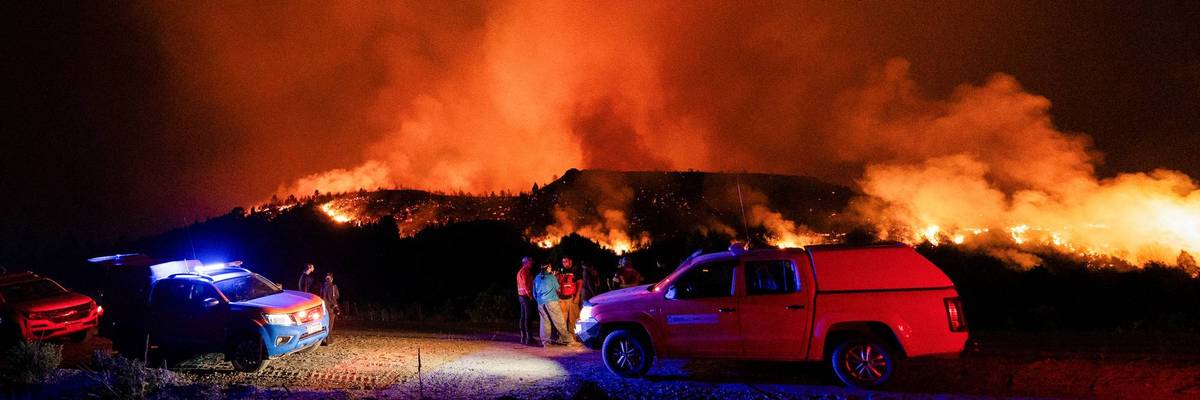
Volunteers and firefighters work to extinguish a forest fire burning in the mountains of the rural area of Epuyen, in the Patagonian region of Chubut province, Argentina, on February 1, 2026.
If the right decisions are not made in the coming years and drastic systemic changes are not implemented, the destruction of planetary habitats can no longer be stopped.
The escalation of the current crisis-ridden conditions in the areas of climate change, the economy, international security, and the development of democracy—leading to dystopian future scenarios—need not occur in this form. However, there is a real possibility that they could occur if humanity fails to bring about a paradigm shift, makes the wrong decisions, and continues its destructive behavior toward the planet.
The construction of negative scenarios in the sense of an anticipated possibility of dystopian development can certainly serve a constructive purpose.
In his book The Imperative of Responsibility, the philosopher Hans Jonas developed what he called a “heuristics of fear,” by which he meant that potential undesirable developments should be recognized in all their severity and menace and described in drastic terms commensurate with their presumed magnitude. According to Jonas (1979/2015, 7), this enables a society to look the potential risks squarely in the eye and thereby resolve to acknowledge its own responsibility for the planet and the fate of future generations:
What can serve as a compass? The anticipated danger itself! In its flash of lightning from the future, in the foreshadowing of its planetary scope and its human depth, the ethical principles from which the new duties of new power can be derived first become apparent.
Of course, this negative vision must be compatible with the developments already analyzed; it must not, therefore, be plucked out of thin air, even if not all the information needed for an assessment is yet available. Heuristics is a creative thought process based on estimates, assumptions, and calculations.
Immersing oneself in a likely future situation and sensing the potential of a future catastrophe can provide insights for preventive action. It is possible that the fear of a catastrophic planetary scenario could lead to a systemic shift in course and to responsible decisions.
From the spectrum of multiple crises—which are certainly interconnected—this article will focus on the disrupted relationship between humanity and nature and heuristically develop it into a negative scenario.
David Spratt and Ian Dunlop (2019, 6) predict that even if the 2015 Paris Climate Agreements were fully implemented, stable climate conditions would still not be expected. In particular, climatic feedback effects would render the Earth largely uninhabitable for human civilization by the end of the century. Even if the Paris climate targets were met, a warming of 5°C would be expected by the year 2100, with devastating consequences for life on Earth.
It must also be taken into account that not all countries have accepted the Paris Agreements or, in some cases—such as the U.S. under Trump—have since withdrawn from them.
A worst-case scenario for such an increasingly hot biosphere must anticipate a rise in wildfires. Vast areas of the Earth will begin to burn. Fire walls driven by massive gusts of wind will devour everything in their path: trees and bushes, houses, animals, and people. Such firestorms are beyond human control and cannot be fought; they depend on heavy rainfall, and it is unclear whether such rain will fall in the burning regions at all due to climate shifts. The result will be the desolation of entire regions, leading to humanitarian, ecological, and financial problems on a global scale. The fires of 2025 and 2026 are already offering a glimpse of what lies ahead for humanity.
Future average temperatures in the Persian Gulf are projected to reach 50-60°C, meaning that for the average person, human life here will no longer be possible—or will only be possible in artificially cooled spaces. Even in the countries of the Global North, mass mortality is beginning due to overheated living environments. Initially, this will affect older people and those who are already ill, and will then spread to people who would otherwise be considered healthy. Circulatory shock, overheating, and dehydration will then also affect younger people.
It is undisputed that sea levels will rise due to the melting of the poles, the warming of seawater, and the accompanying melting of Arctic ice.
However, a potential average rise of 2.5 meters by 2100 does not represent the extreme level of sea-level rise. During storm surges in particular, the rise in sea level can be several times this value and lead to flooding deep into continental areas. This will also affect the Global North.
Islands, coastal regions, and low-lying inland areas will be flooded, destroying living conditions there and, in turn, triggering migration. Not only will island groups disappear, but large parts of countries such as Bangladesh and India will also be flooded, triggering mass exoduses. In this context, the rise in sea level, combined with the monsoon rains in this region—which are already becoming increasingly devastating—will have a particularly dangerous effect.
The thawing of Arctic and Siberian permafrost, through the associated release of carbon dioxide and methane, will lead to a massive increase in global warming and abruptly intensify all related processes.
In other parts of the world, climate shifts are causing air masses with extremely different temperatures to collide, resulting in devastating storms such as tornadoes and hurricanes. Houses, cars, animals, and people are swept up into the air and smashed to pieces. Skyscrapers collapse, and the infrastructure—including electricity, water, and gas lines, as well as the internet—is irreparably destroyed. Radioactivity is released from destroyed nuclear power plants; it circulates in the Earth’s atmosphere, falls as rain, and will lead to increased rates of cancer and birth defects in humans and animals.
Massive migration—in the form of mass exoduses or mass migrations—will be triggered by climate change. Migration to date should be viewed, at best, as the tip of the iceberg in this context, as billions of people will set out as refugees if global warming continues unchecked. It is not difficult to imagine the conflicts—including military confrontations—that will arise from these upheavals in the struggle for ecologically intact regions.
Global warming will lead to massive crop failures and associated famines. The global agricultural food system will collapse. The struggle for food and survival will lead to massive price increases, looting, and military conflicts. The call for a heavy hand, for authoritarian leaders, and for police-state methods will grow louder even in democracies.
Far-right governments will attempt, in the interests of their constituencies, to deny climate change and continue to rely on the exploitation of fossil fuels.
The struggle for drinking water will intensify, on the one hand due to increasing periods of drought and, on the other, due to the growing trend toward profit-driven privatization of water sources. Privatized water sources will be guarded by militarized security forces against raids by groups of thirsty people. In drought-stricken areas, people will die of thirst—especially those who no longer have the financial means to purchase water, a scarce and therefore increasingly expensive commodity.
Spratt and Dunlop (2019, 9) describe the societal consequences of climate change even at the 3°C level. States and societies will be overwhelmed and will face extreme collective stress:
The flooding of coastal communities around the world—particularly in the Netherlands, the United States, South Asia, and China—has the potential to call regional and even national identities into question. Armed conflicts between nations over resources such as the Nile and its tributaries are likely, and a nuclear war is possible. The societal consequences range from heightened religious zeal to utter chaos. In this scenario, climate change triggers a lasting change in humanity’s relationship with nature.
Furthermore, if a UN in need of strengthening fails to dissuade unscrupulous governments from the generationally selfish destruction of the rainforest for the purposes of livestock ranching, soybean cultivation, the search for mineral resources, or land speculation, then this, too, will not only destroy the Earth’s lungs but also bring about a drastic climate shift.
Wars raging globally and emissions from explosions and fires exacerbate climate change while simultaneously preventing the affected regions from taking effective measures against this climatic dystopia. The military in active service is becoming the largest institutional global destroyer of the climate.
These are just a few of the developments addressed so far. Threats such as temperature changes and the resulting diversion of the Gulf Stream, the narrowing of the temperature difference between the North Pole and the equator—which leads to a weakening of the jet stream—the release of methane trapped in the seabed, insect die-offs due to the increased use of pesticides in agriculture, the destruction of clean drinking water due to overfertilization of fields, as well as plastic pollution in the oceans and the demise of all life in increasingly larger marine regions are likely to represent additional ecological tipping points that will further exacerbate the massive problems already mentioned.
The question is when the global situation will reach a point from which there will be no return to ecological balance for many generations to come.
The progression of overpopulation, coupled with unchecked economic growth and rampant consumerism, leads to increased ecological exploitation of the Earth system under the conditions of an increasingly overcrowded planet.
However, it is to be expected that population pressure is not primarily responsible for environmental destruction, but rather, in particular, the irresponsible consumption of resources by the wealthier segment of the world’s population (Roettig 2021).
The “point of no return” is likely to be crossed soon. Once the biosphere’s planetary responses develop an uncontrollable momentum of their own that turns against human civilization and the conditions necessary for all life on Earth, it will be too late—both for prevention and for mitigation.
Over the past 20 years, the planet’s resilience has reached its breaking point; in some areas, it has demonstrably been exceeded.
The Doomsday Clock makes this clear. According to the Doomsday Clock—founded and calculated in 1947 by Albert Einstein, among others—we are already 85 seconds away from the destruction of the planet’s foundations as of February 2026. In 1991, we were still 17 minutes away from destruction.
Violent competition over the use of resources is intensifying as more people’s basic needs—and, in particular, their luxury needs—must be met. Not only the struggle for clean drinking water and food, but also the struggle for lithium, cobalt, uranium, etc., is leading to violent conflicts between different groups of people and regions. German political scientist Hans-Jürgen Burchardt criticizes the fact that the rich industrialized nations are the main contributors to climate change, yet the Global South bears the brunt of its consequences.
Thus, following the phase-out of nuclear power, Germany’s energy transition is also made possible by cheap coal imports from Colombia. There, mining takes place in highly environmentally damaging open-pit mines; entire communities are forcibly displaced for this purpose, and human rights violations are commonplace. Even the much-lauded green economy, which relies on electric mobility, would not be possible without the lithium reserves in the Andes. Locally, however, lithium mining robs residents of their livelihoods.
The war in Ukraine, too, must be viewed not only from a geostrategic perspective but also through an eco-imperialist lens, in which Russia and the US are attempting to divide up Ukraine’s natural resource deposits among themselves.
The outline presented here of a dystopia of planetary development—based on a negative ecological scenario—should have made it very clear: If the right decisions are not made in the coming years and drastic systemic changes are not implemented, the destruction of planetary habitats can no longer be stopped. If, in addition to a biosphere in decline, further stressors arise—such as potentially runaway generative AI, authoritarian and aggressively acting nation-states at war with one another, and the threat of a nuclear inferno—this will likely spell the end of humanity. No more and no less.
The ecological dystopia outlined here does not have to come to pass. Everything depends on how responsibly and competently the current generation—which is currently active in the global centers of power—will act, and on the corrective influence that civil society resistance can exert in this regard.
Dear Common Dreams reader, It’s been nearly 30 years since I co-founded Common Dreams with my late wife, Lina Newhouser. We had the radical notion that journalism should serve the public good, not corporate profits. It was clear to us from the outset what it would take to build such a project. No paid advertisements. No corporate sponsors. No millionaire publisher telling us what to think or do. Many people said we wouldn't last a year, but we proved those doubters wrong. Together with a tremendous team of journalists and dedicated staff, we built an independent media outlet free from the constraints of profits and corporate control. Our mission has always been simple: To inform. To inspire. To ignite change for the common good. Building Common Dreams was not easy. Our survival was never guaranteed. When you take on the most powerful forces—Wall Street greed, fossil fuel industry destruction, Big Tech lobbyists, and uber-rich oligarchs who have spent billions upon billions rigging the economy and democracy in their favor—the only bulwark you have is supporters who believe in your work. But here’s the urgent message from me today. It's never been this bad out there. And it's never been this hard to keep us going. At the very moment Common Dreams is most needed, the threats we face are intensifying. We need your support now more than ever. We don't accept corporate advertising and never will. We don't have a paywall because we don't think people should be blocked from critical news based on their ability to pay. Everything we do is funded by the donations of readers like you. When everyone does the little they can afford, we are strong. But if that support retreats or dries up, so do we. Will you donate now to make sure Common Dreams not only survives but thrives? —Craig Brown, Co-founder |
The escalation of the current crisis-ridden conditions in the areas of climate change, the economy, international security, and the development of democracy—leading to dystopian future scenarios—need not occur in this form. However, there is a real possibility that they could occur if humanity fails to bring about a paradigm shift, makes the wrong decisions, and continues its destructive behavior toward the planet.
The construction of negative scenarios in the sense of an anticipated possibility of dystopian development can certainly serve a constructive purpose.
In his book The Imperative of Responsibility, the philosopher Hans Jonas developed what he called a “heuristics of fear,” by which he meant that potential undesirable developments should be recognized in all their severity and menace and described in drastic terms commensurate with their presumed magnitude. According to Jonas (1979/2015, 7), this enables a society to look the potential risks squarely in the eye and thereby resolve to acknowledge its own responsibility for the planet and the fate of future generations:
What can serve as a compass? The anticipated danger itself! In its flash of lightning from the future, in the foreshadowing of its planetary scope and its human depth, the ethical principles from which the new duties of new power can be derived first become apparent.
Of course, this negative vision must be compatible with the developments already analyzed; it must not, therefore, be plucked out of thin air, even if not all the information needed for an assessment is yet available. Heuristics is a creative thought process based on estimates, assumptions, and calculations.
Immersing oneself in a likely future situation and sensing the potential of a future catastrophe can provide insights for preventive action. It is possible that the fear of a catastrophic planetary scenario could lead to a systemic shift in course and to responsible decisions.
From the spectrum of multiple crises—which are certainly interconnected—this article will focus on the disrupted relationship between humanity and nature and heuristically develop it into a negative scenario.
David Spratt and Ian Dunlop (2019, 6) predict that even if the 2015 Paris Climate Agreements were fully implemented, stable climate conditions would still not be expected. In particular, climatic feedback effects would render the Earth largely uninhabitable for human civilization by the end of the century. Even if the Paris climate targets were met, a warming of 5°C would be expected by the year 2100, with devastating consequences for life on Earth.
It must also be taken into account that not all countries have accepted the Paris Agreements or, in some cases—such as the U.S. under Trump—have since withdrawn from them.
A worst-case scenario for such an increasingly hot biosphere must anticipate a rise in wildfires. Vast areas of the Earth will begin to burn. Fire walls driven by massive gusts of wind will devour everything in their path: trees and bushes, houses, animals, and people. Such firestorms are beyond human control and cannot be fought; they depend on heavy rainfall, and it is unclear whether such rain will fall in the burning regions at all due to climate shifts. The result will be the desolation of entire regions, leading to humanitarian, ecological, and financial problems on a global scale. The fires of 2025 and 2026 are already offering a glimpse of what lies ahead for humanity.
Future average temperatures in the Persian Gulf are projected to reach 50-60°C, meaning that for the average person, human life here will no longer be possible—or will only be possible in artificially cooled spaces. Even in the countries of the Global North, mass mortality is beginning due to overheated living environments. Initially, this will affect older people and those who are already ill, and will then spread to people who would otherwise be considered healthy. Circulatory shock, overheating, and dehydration will then also affect younger people.
It is undisputed that sea levels will rise due to the melting of the poles, the warming of seawater, and the accompanying melting of Arctic ice.
However, a potential average rise of 2.5 meters by 2100 does not represent the extreme level of sea-level rise. During storm surges in particular, the rise in sea level can be several times this value and lead to flooding deep into continental areas. This will also affect the Global North.
Islands, coastal regions, and low-lying inland areas will be flooded, destroying living conditions there and, in turn, triggering migration. Not only will island groups disappear, but large parts of countries such as Bangladesh and India will also be flooded, triggering mass exoduses. In this context, the rise in sea level, combined with the monsoon rains in this region—which are already becoming increasingly devastating—will have a particularly dangerous effect.
The thawing of Arctic and Siberian permafrost, through the associated release of carbon dioxide and methane, will lead to a massive increase in global warming and abruptly intensify all related processes.
In other parts of the world, climate shifts are causing air masses with extremely different temperatures to collide, resulting in devastating storms such as tornadoes and hurricanes. Houses, cars, animals, and people are swept up into the air and smashed to pieces. Skyscrapers collapse, and the infrastructure—including electricity, water, and gas lines, as well as the internet—is irreparably destroyed. Radioactivity is released from destroyed nuclear power plants; it circulates in the Earth’s atmosphere, falls as rain, and will lead to increased rates of cancer and birth defects in humans and animals.
Massive migration—in the form of mass exoduses or mass migrations—will be triggered by climate change. Migration to date should be viewed, at best, as the tip of the iceberg in this context, as billions of people will set out as refugees if global warming continues unchecked. It is not difficult to imagine the conflicts—including military confrontations—that will arise from these upheavals in the struggle for ecologically intact regions.
Global warming will lead to massive crop failures and associated famines. The global agricultural food system will collapse. The struggle for food and survival will lead to massive price increases, looting, and military conflicts. The call for a heavy hand, for authoritarian leaders, and for police-state methods will grow louder even in democracies.
Far-right governments will attempt, in the interests of their constituencies, to deny climate change and continue to rely on the exploitation of fossil fuels.
The struggle for drinking water will intensify, on the one hand due to increasing periods of drought and, on the other, due to the growing trend toward profit-driven privatization of water sources. Privatized water sources will be guarded by militarized security forces against raids by groups of thirsty people. In drought-stricken areas, people will die of thirst—especially those who no longer have the financial means to purchase water, a scarce and therefore increasingly expensive commodity.
Spratt and Dunlop (2019, 9) describe the societal consequences of climate change even at the 3°C level. States and societies will be overwhelmed and will face extreme collective stress:
The flooding of coastal communities around the world—particularly in the Netherlands, the United States, South Asia, and China—has the potential to call regional and even national identities into question. Armed conflicts between nations over resources such as the Nile and its tributaries are likely, and a nuclear war is possible. The societal consequences range from heightened religious zeal to utter chaos. In this scenario, climate change triggers a lasting change in humanity’s relationship with nature.
Furthermore, if a UN in need of strengthening fails to dissuade unscrupulous governments from the generationally selfish destruction of the rainforest for the purposes of livestock ranching, soybean cultivation, the search for mineral resources, or land speculation, then this, too, will not only destroy the Earth’s lungs but also bring about a drastic climate shift.
Wars raging globally and emissions from explosions and fires exacerbate climate change while simultaneously preventing the affected regions from taking effective measures against this climatic dystopia. The military in active service is becoming the largest institutional global destroyer of the climate.
These are just a few of the developments addressed so far. Threats such as temperature changes and the resulting diversion of the Gulf Stream, the narrowing of the temperature difference between the North Pole and the equator—which leads to a weakening of the jet stream—the release of methane trapped in the seabed, insect die-offs due to the increased use of pesticides in agriculture, the destruction of clean drinking water due to overfertilization of fields, as well as plastic pollution in the oceans and the demise of all life in increasingly larger marine regions are likely to represent additional ecological tipping points that will further exacerbate the massive problems already mentioned.
The question is when the global situation will reach a point from which there will be no return to ecological balance for many generations to come.
The progression of overpopulation, coupled with unchecked economic growth and rampant consumerism, leads to increased ecological exploitation of the Earth system under the conditions of an increasingly overcrowded planet.
However, it is to be expected that population pressure is not primarily responsible for environmental destruction, but rather, in particular, the irresponsible consumption of resources by the wealthier segment of the world’s population (Roettig 2021).
The “point of no return” is likely to be crossed soon. Once the biosphere’s planetary responses develop an uncontrollable momentum of their own that turns against human civilization and the conditions necessary for all life on Earth, it will be too late—both for prevention and for mitigation.
Over the past 20 years, the planet’s resilience has reached its breaking point; in some areas, it has demonstrably been exceeded.
The Doomsday Clock makes this clear. According to the Doomsday Clock—founded and calculated in 1947 by Albert Einstein, among others—we are already 85 seconds away from the destruction of the planet’s foundations as of February 2026. In 1991, we were still 17 minutes away from destruction.
Violent competition over the use of resources is intensifying as more people’s basic needs—and, in particular, their luxury needs—must be met. Not only the struggle for clean drinking water and food, but also the struggle for lithium, cobalt, uranium, etc., is leading to violent conflicts between different groups of people and regions. German political scientist Hans-Jürgen Burchardt criticizes the fact that the rich industrialized nations are the main contributors to climate change, yet the Global South bears the brunt of its consequences.
Thus, following the phase-out of nuclear power, Germany’s energy transition is also made possible by cheap coal imports from Colombia. There, mining takes place in highly environmentally damaging open-pit mines; entire communities are forcibly displaced for this purpose, and human rights violations are commonplace. Even the much-lauded green economy, which relies on electric mobility, would not be possible without the lithium reserves in the Andes. Locally, however, lithium mining robs residents of their livelihoods.
The war in Ukraine, too, must be viewed not only from a geostrategic perspective but also through an eco-imperialist lens, in which Russia and the US are attempting to divide up Ukraine’s natural resource deposits among themselves.
The outline presented here of a dystopia of planetary development—based on a negative ecological scenario—should have made it very clear: If the right decisions are not made in the coming years and drastic systemic changes are not implemented, the destruction of planetary habitats can no longer be stopped. If, in addition to a biosphere in decline, further stressors arise—such as potentially runaway generative AI, authoritarian and aggressively acting nation-states at war with one another, and the threat of a nuclear inferno—this will likely spell the end of humanity. No more and no less.
The ecological dystopia outlined here does not have to come to pass. Everything depends on how responsibly and competently the current generation—which is currently active in the global centers of power—will act, and on the corrective influence that civil society resistance can exert in this regard.
The escalation of the current crisis-ridden conditions in the areas of climate change, the economy, international security, and the development of democracy—leading to dystopian future scenarios—need not occur in this form. However, there is a real possibility that they could occur if humanity fails to bring about a paradigm shift, makes the wrong decisions, and continues its destructive behavior toward the planet.
The construction of negative scenarios in the sense of an anticipated possibility of dystopian development can certainly serve a constructive purpose.
In his book The Imperative of Responsibility, the philosopher Hans Jonas developed what he called a “heuristics of fear,” by which he meant that potential undesirable developments should be recognized in all their severity and menace and described in drastic terms commensurate with their presumed magnitude. According to Jonas (1979/2015, 7), this enables a society to look the potential risks squarely in the eye and thereby resolve to acknowledge its own responsibility for the planet and the fate of future generations:
What can serve as a compass? The anticipated danger itself! In its flash of lightning from the future, in the foreshadowing of its planetary scope and its human depth, the ethical principles from which the new duties of new power can be derived first become apparent.
Of course, this negative vision must be compatible with the developments already analyzed; it must not, therefore, be plucked out of thin air, even if not all the information needed for an assessment is yet available. Heuristics is a creative thought process based on estimates, assumptions, and calculations.
Immersing oneself in a likely future situation and sensing the potential of a future catastrophe can provide insights for preventive action. It is possible that the fear of a catastrophic planetary scenario could lead to a systemic shift in course and to responsible decisions.
From the spectrum of multiple crises—which are certainly interconnected—this article will focus on the disrupted relationship between humanity and nature and heuristically develop it into a negative scenario.
David Spratt and Ian Dunlop (2019, 6) predict that even if the 2015 Paris Climate Agreements were fully implemented, stable climate conditions would still not be expected. In particular, climatic feedback effects would render the Earth largely uninhabitable for human civilization by the end of the century. Even if the Paris climate targets were met, a warming of 5°C would be expected by the year 2100, with devastating consequences for life on Earth.
It must also be taken into account that not all countries have accepted the Paris Agreements or, in some cases—such as the U.S. under Trump—have since withdrawn from them.
A worst-case scenario for such an increasingly hot biosphere must anticipate a rise in wildfires. Vast areas of the Earth will begin to burn. Fire walls driven by massive gusts of wind will devour everything in their path: trees and bushes, houses, animals, and people. Such firestorms are beyond human control and cannot be fought; they depend on heavy rainfall, and it is unclear whether such rain will fall in the burning regions at all due to climate shifts. The result will be the desolation of entire regions, leading to humanitarian, ecological, and financial problems on a global scale. The fires of 2025 and 2026 are already offering a glimpse of what lies ahead for humanity.
Future average temperatures in the Persian Gulf are projected to reach 50-60°C, meaning that for the average person, human life here will no longer be possible—or will only be possible in artificially cooled spaces. Even in the countries of the Global North, mass mortality is beginning due to overheated living environments. Initially, this will affect older people and those who are already ill, and will then spread to people who would otherwise be considered healthy. Circulatory shock, overheating, and dehydration will then also affect younger people.
It is undisputed that sea levels will rise due to the melting of the poles, the warming of seawater, and the accompanying melting of Arctic ice.
However, a potential average rise of 2.5 meters by 2100 does not represent the extreme level of sea-level rise. During storm surges in particular, the rise in sea level can be several times this value and lead to flooding deep into continental areas. This will also affect the Global North.
Islands, coastal regions, and low-lying inland areas will be flooded, destroying living conditions there and, in turn, triggering migration. Not only will island groups disappear, but large parts of countries such as Bangladesh and India will also be flooded, triggering mass exoduses. In this context, the rise in sea level, combined with the monsoon rains in this region—which are already becoming increasingly devastating—will have a particularly dangerous effect.
The thawing of Arctic and Siberian permafrost, through the associated release of carbon dioxide and methane, will lead to a massive increase in global warming and abruptly intensify all related processes.
In other parts of the world, climate shifts are causing air masses with extremely different temperatures to collide, resulting in devastating storms such as tornadoes and hurricanes. Houses, cars, animals, and people are swept up into the air and smashed to pieces. Skyscrapers collapse, and the infrastructure—including electricity, water, and gas lines, as well as the internet—is irreparably destroyed. Radioactivity is released from destroyed nuclear power plants; it circulates in the Earth’s atmosphere, falls as rain, and will lead to increased rates of cancer and birth defects in humans and animals.
Massive migration—in the form of mass exoduses or mass migrations—will be triggered by climate change. Migration to date should be viewed, at best, as the tip of the iceberg in this context, as billions of people will set out as refugees if global warming continues unchecked. It is not difficult to imagine the conflicts—including military confrontations—that will arise from these upheavals in the struggle for ecologically intact regions.
Global warming will lead to massive crop failures and associated famines. The global agricultural food system will collapse. The struggle for food and survival will lead to massive price increases, looting, and military conflicts. The call for a heavy hand, for authoritarian leaders, and for police-state methods will grow louder even in democracies.
Far-right governments will attempt, in the interests of their constituencies, to deny climate change and continue to rely on the exploitation of fossil fuels.
The struggle for drinking water will intensify, on the one hand due to increasing periods of drought and, on the other, due to the growing trend toward profit-driven privatization of water sources. Privatized water sources will be guarded by militarized security forces against raids by groups of thirsty people. In drought-stricken areas, people will die of thirst—especially those who no longer have the financial means to purchase water, a scarce and therefore increasingly expensive commodity.
Spratt and Dunlop (2019, 9) describe the societal consequences of climate change even at the 3°C level. States and societies will be overwhelmed and will face extreme collective stress:
The flooding of coastal communities around the world—particularly in the Netherlands, the United States, South Asia, and China—has the potential to call regional and even national identities into question. Armed conflicts between nations over resources such as the Nile and its tributaries are likely, and a nuclear war is possible. The societal consequences range from heightened religious zeal to utter chaos. In this scenario, climate change triggers a lasting change in humanity’s relationship with nature.
Furthermore, if a UN in need of strengthening fails to dissuade unscrupulous governments from the generationally selfish destruction of the rainforest for the purposes of livestock ranching, soybean cultivation, the search for mineral resources, or land speculation, then this, too, will not only destroy the Earth’s lungs but also bring about a drastic climate shift.
Wars raging globally and emissions from explosions and fires exacerbate climate change while simultaneously preventing the affected regions from taking effective measures against this climatic dystopia. The military in active service is becoming the largest institutional global destroyer of the climate.
These are just a few of the developments addressed so far. Threats such as temperature changes and the resulting diversion of the Gulf Stream, the narrowing of the temperature difference between the North Pole and the equator—which leads to a weakening of the jet stream—the release of methane trapped in the seabed, insect die-offs due to the increased use of pesticides in agriculture, the destruction of clean drinking water due to overfertilization of fields, as well as plastic pollution in the oceans and the demise of all life in increasingly larger marine regions are likely to represent additional ecological tipping points that will further exacerbate the massive problems already mentioned.
The question is when the global situation will reach a point from which there will be no return to ecological balance for many generations to come.
The progression of overpopulation, coupled with unchecked economic growth and rampant consumerism, leads to increased ecological exploitation of the Earth system under the conditions of an increasingly overcrowded planet.
However, it is to be expected that population pressure is not primarily responsible for environmental destruction, but rather, in particular, the irresponsible consumption of resources by the wealthier segment of the world’s population (Roettig 2021).
The “point of no return” is likely to be crossed soon. Once the biosphere’s planetary responses develop an uncontrollable momentum of their own that turns against human civilization and the conditions necessary for all life on Earth, it will be too late—both for prevention and for mitigation.
Over the past 20 years, the planet’s resilience has reached its breaking point; in some areas, it has demonstrably been exceeded.
The Doomsday Clock makes this clear. According to the Doomsday Clock—founded and calculated in 1947 by Albert Einstein, among others—we are already 85 seconds away from the destruction of the planet’s foundations as of February 2026. In 1991, we were still 17 minutes away from destruction.
Violent competition over the use of resources is intensifying as more people’s basic needs—and, in particular, their luxury needs—must be met. Not only the struggle for clean drinking water and food, but also the struggle for lithium, cobalt, uranium, etc., is leading to violent conflicts between different groups of people and regions. German political scientist Hans-Jürgen Burchardt criticizes the fact that the rich industrialized nations are the main contributors to climate change, yet the Global South bears the brunt of its consequences.
Thus, following the phase-out of nuclear power, Germany’s energy transition is also made possible by cheap coal imports from Colombia. There, mining takes place in highly environmentally damaging open-pit mines; entire communities are forcibly displaced for this purpose, and human rights violations are commonplace. Even the much-lauded green economy, which relies on electric mobility, would not be possible without the lithium reserves in the Andes. Locally, however, lithium mining robs residents of their livelihoods.
The war in Ukraine, too, must be viewed not only from a geostrategic perspective but also through an eco-imperialist lens, in which Russia and the US are attempting to divide up Ukraine’s natural resource deposits among themselves.
The outline presented here of a dystopia of planetary development—based on a negative ecological scenario—should have made it very clear: If the right decisions are not made in the coming years and drastic systemic changes are not implemented, the destruction of planetary habitats can no longer be stopped. If, in addition to a biosphere in decline, further stressors arise—such as potentially runaway generative AI, authoritarian and aggressively acting nation-states at war with one another, and the threat of a nuclear inferno—this will likely spell the end of humanity. No more and no less.
The ecological dystopia outlined here does not have to come to pass. Everything depends on how responsibly and competently the current generation—which is currently active in the global centers of power—will act, and on the corrective influence that civil society resistance can exert in this regard.