SUBSCRIBE TO OUR FREE NEWSLETTER
Daily news & progressive opinion—funded by the people, not the corporations—delivered straight to your inbox.
5
#000000
#FFFFFF
To donate by check, phone, or other method, see our More Ways to Give page.
Daily news & progressive opinion—funded by the people, not the corporations—delivered straight to your inbox.
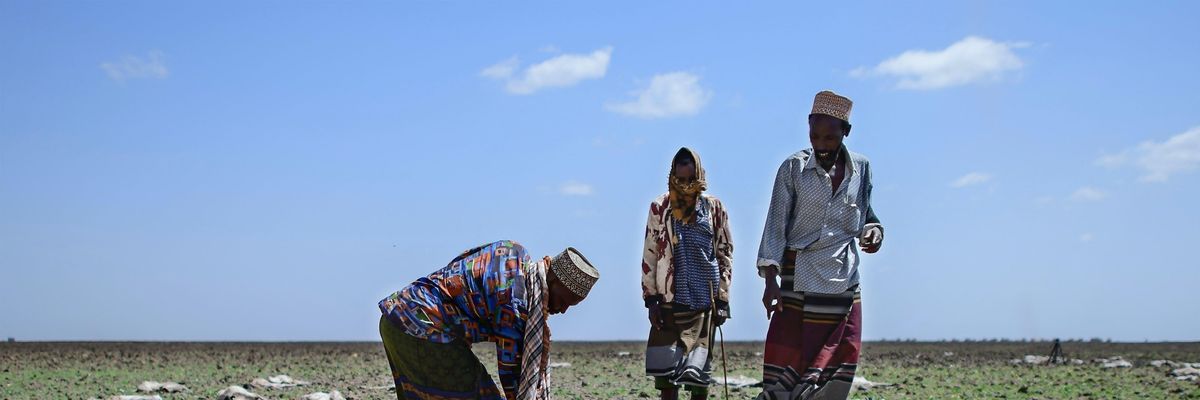
Kenyan pastoralists from the local Gabra community walk among carcasses of some of their sheep and goats on the outskirts of Kambi ya Nyoka in Marsabit County on January 29, 2022. (Photo: Tony Karumba/AFP via Getty Images)
The worst-case outcomes of an unmitigated climate emergency--civilizational collapse or even human extinction--are "dangerously underexplored" scenarios requiring further study, an analysis published Monday asserted.
"There is ample evidence that climate change could become catastrophic. We could enter such 'endgames' at even modest levels of warming."
In a perspective published in the Proceedings of the National Academy of Sciences, climate scientists Luke Kemp, Chi Xu, Joanna Depledge, and Timothy M. Lenton argue that humanity must prepare for what they call the "climate endgame."
"It is time for the scientific community to grapple with the challenge of better understanding catastrophic climate change," the researchers write.
Although climate scientists say such catastrophic consequences are unlikely, the paper's authors caution that "facing a future of accelerating climate change while blind to worst-case scenarios is naive risk management at best and fatally foolish at worst."
"There is ample evidence that climate change could become catastrophic. We could enter such 'endgames' at even modest levels of warming," they warn. "Understanding extreme risks is important for robust decision-making, from preparation to consideration of emergency responses."
"This requires exploring not just higher temperature scenarios but also the potential for climate change impacts to contribute to systemic risk and other cascades," the authors add. "We suggest that it is time to seriously scrutinize the best way to expand our research horizons to cover this field."
The scientists propose a research agenda that seeks to answer four main questions:
"Knowing the worst cases can compel action, as the idea of 'nuclear winter' in 1983 galvanized public concern and nuclear disarmament efforts," the analysis states. "Exploring severe risks and higher-temperature scenarios could cement a recommitment to the 1.5 degC to 2 degC guardrail" that the Paris climate agreement says is imperative to avoid an irreversible climate catastrophe.
"I think it's sane risk management to think about the plausible worst-case scenarios and we do it when it comes to every other situation, we should definitely do when it comes to the fate of the planet and species," study lead author Luke Kemp, a researcher at the University of Cambridge in England, told the BBC.
In a separate interview with The Guardian, Kemp said that "paths to disaster are not limited to the direct impacts of high temperatures, such as extreme weather events. Knock-on effects such as financial crises, conflict, and new disease outbreaks could trigger other calamities."
Study co-author Xu of Nanjing University in China told the BBC that "average annual temperatures of 29degC currently affect around 30 million people in the Sahara and Gulf Coast."
"By 2070, these temperatures and the social and political consequences will directly affect two nuclear powers, and seven maximum containment laboratories housing the most dangerous pathogens," he added. "There is serious potential for disastrous knock-on effects."
Dear Common Dreams reader, It’s been nearly 30 years since I co-founded Common Dreams with my late wife, Lina Newhouser. We had the radical notion that journalism should serve the public good, not corporate profits. It was clear to us from the outset what it would take to build such a project. No paid advertisements. No corporate sponsors. No millionaire publisher telling us what to think or do. Many people said we wouldn't last a year, but we proved those doubters wrong. Together with a tremendous team of journalists and dedicated staff, we built an independent media outlet free from the constraints of profits and corporate control. Our mission has always been simple: To inform. To inspire. To ignite change for the common good. Building Common Dreams was not easy. Our survival was never guaranteed. When you take on the most powerful forces—Wall Street greed, fossil fuel industry destruction, Big Tech lobbyists, and uber-rich oligarchs who have spent billions upon billions rigging the economy and democracy in their favor—the only bulwark you have is supporters who believe in your work. But here’s the urgent message from me today. It's never been this bad out there. And it's never been this hard to keep us going. At the very moment Common Dreams is most needed, the threats we face are intensifying. We need your support now more than ever. We don't accept corporate advertising and never will. We don't have a paywall because we don't think people should be blocked from critical news based on their ability to pay. Everything we do is funded by the donations of readers like you. When everyone does the little they can afford, we are strong. But if that support retreats or dries up, so do we. Will you donate now to make sure Common Dreams not only survives but thrives? —Craig Brown, Co-founder |
The worst-case outcomes of an unmitigated climate emergency--civilizational collapse or even human extinction--are "dangerously underexplored" scenarios requiring further study, an analysis published Monday asserted.
"There is ample evidence that climate change could become catastrophic. We could enter such 'endgames' at even modest levels of warming."
In a perspective published in the Proceedings of the National Academy of Sciences, climate scientists Luke Kemp, Chi Xu, Joanna Depledge, and Timothy M. Lenton argue that humanity must prepare for what they call the "climate endgame."
"It is time for the scientific community to grapple with the challenge of better understanding catastrophic climate change," the researchers write.
Although climate scientists say such catastrophic consequences are unlikely, the paper's authors caution that "facing a future of accelerating climate change while blind to worst-case scenarios is naive risk management at best and fatally foolish at worst."
"There is ample evidence that climate change could become catastrophic. We could enter such 'endgames' at even modest levels of warming," they warn. "Understanding extreme risks is important for robust decision-making, from preparation to consideration of emergency responses."
"This requires exploring not just higher temperature scenarios but also the potential for climate change impacts to contribute to systemic risk and other cascades," the authors add. "We suggest that it is time to seriously scrutinize the best way to expand our research horizons to cover this field."
The scientists propose a research agenda that seeks to answer four main questions:
"Knowing the worst cases can compel action, as the idea of 'nuclear winter' in 1983 galvanized public concern and nuclear disarmament efforts," the analysis states. "Exploring severe risks and higher-temperature scenarios could cement a recommitment to the 1.5 degC to 2 degC guardrail" that the Paris climate agreement says is imperative to avoid an irreversible climate catastrophe.
"I think it's sane risk management to think about the plausible worst-case scenarios and we do it when it comes to every other situation, we should definitely do when it comes to the fate of the planet and species," study lead author Luke Kemp, a researcher at the University of Cambridge in England, told the BBC.
In a separate interview with The Guardian, Kemp said that "paths to disaster are not limited to the direct impacts of high temperatures, such as extreme weather events. Knock-on effects such as financial crises, conflict, and new disease outbreaks could trigger other calamities."
Study co-author Xu of Nanjing University in China told the BBC that "average annual temperatures of 29degC currently affect around 30 million people in the Sahara and Gulf Coast."
"By 2070, these temperatures and the social and political consequences will directly affect two nuclear powers, and seven maximum containment laboratories housing the most dangerous pathogens," he added. "There is serious potential for disastrous knock-on effects."
The worst-case outcomes of an unmitigated climate emergency--civilizational collapse or even human extinction--are "dangerously underexplored" scenarios requiring further study, an analysis published Monday asserted.
"There is ample evidence that climate change could become catastrophic. We could enter such 'endgames' at even modest levels of warming."
In a perspective published in the Proceedings of the National Academy of Sciences, climate scientists Luke Kemp, Chi Xu, Joanna Depledge, and Timothy M. Lenton argue that humanity must prepare for what they call the "climate endgame."
"It is time for the scientific community to grapple with the challenge of better understanding catastrophic climate change," the researchers write.
Although climate scientists say such catastrophic consequences are unlikely, the paper's authors caution that "facing a future of accelerating climate change while blind to worst-case scenarios is naive risk management at best and fatally foolish at worst."
"There is ample evidence that climate change could become catastrophic. We could enter such 'endgames' at even modest levels of warming," they warn. "Understanding extreme risks is important for robust decision-making, from preparation to consideration of emergency responses."
"This requires exploring not just higher temperature scenarios but also the potential for climate change impacts to contribute to systemic risk and other cascades," the authors add. "We suggest that it is time to seriously scrutinize the best way to expand our research horizons to cover this field."
The scientists propose a research agenda that seeks to answer four main questions:
"Knowing the worst cases can compel action, as the idea of 'nuclear winter' in 1983 galvanized public concern and nuclear disarmament efforts," the analysis states. "Exploring severe risks and higher-temperature scenarios could cement a recommitment to the 1.5 degC to 2 degC guardrail" that the Paris climate agreement says is imperative to avoid an irreversible climate catastrophe.
"I think it's sane risk management to think about the plausible worst-case scenarios and we do it when it comes to every other situation, we should definitely do when it comes to the fate of the planet and species," study lead author Luke Kemp, a researcher at the University of Cambridge in England, told the BBC.
In a separate interview with The Guardian, Kemp said that "paths to disaster are not limited to the direct impacts of high temperatures, such as extreme weather events. Knock-on effects such as financial crises, conflict, and new disease outbreaks could trigger other calamities."
Study co-author Xu of Nanjing University in China told the BBC that "average annual temperatures of 29degC currently affect around 30 million people in the Sahara and Gulf Coast."
"By 2070, these temperatures and the social and political consequences will directly affect two nuclear powers, and seven maximum containment laboratories housing the most dangerous pathogens," he added. "There is serious potential for disastrous knock-on effects."