SUBSCRIBE TO OUR FREE NEWSLETTER
Daily news & progressive opinion—funded by the people, not the corporations—delivered straight to your inbox.
5
#000000
#FFFFFF
To donate by check, phone, or other method, see our More Ways to Give page.
Daily news & progressive opinion—funded by the people, not the corporations—delivered straight to your inbox.
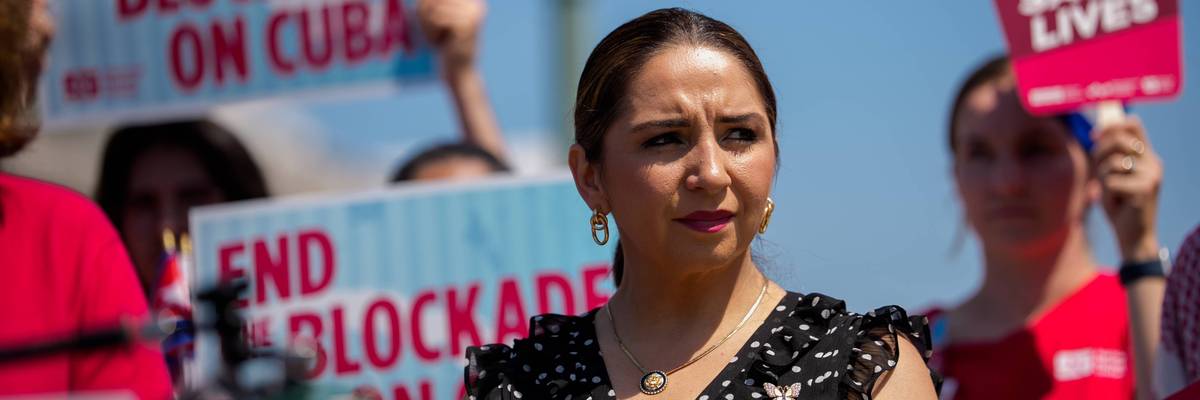
Rep. Delia Ramirez (D-Ill.) attends a news conference calling for the end to the blockade on Cuba on Capitol Hill on June 30, 2026 in Washington, DC.
Four members of Congress returned Monday from an oversight trip to Cuba, which they described as a "silent Gaza."
As the Trump administration announced a new round of sanctions on Cuba's tourism ministry, energy companies, and other entities on Monday, four Democratic members of Congress returned from a trip to the island and described how the oil blockade the US has imposed there for nearly six months "is producing indiscriminate pain for the most vulnerable Cubans."
"As elected lawmakers tasked with oversight of US foreign policy, we traveled to Havana to meet with Cubans of all walks of life and political perspectives to hear about the hardships the Trump administration’s maximum pressure policies are creating for Cuban citizens," said Reps. Delia Ramírez (D-Ill.), Teresa Leger-Fernández (D-NM), Mark Pocan, (D-Wis.), and Maxine Dexter (D-Ore.). “In our meetings with religious leaders, entrepreneurs, civil society organizations, humanitarian groups, medical professionals, and farmers, everybody we heard from... agreed on one thing: that they are being strangled to death under the current executive orders and longstanding economic blockade."
The four Democrats traveled to Cuba last Thursday and spent several days meeting with local leaders, touring the streets of Havana, and speaking with President Miguel Díaz-Canel as the country grapples with the effects of President Donald Trump's January executive order that baselessly claimed Cuba poses an "extraordinary" threat to US national security and threatened tariffs against any country that provides oil to the communist country.
The president had already cut off Cuba's main energy supply by invading Venezuela, abducting its president and charging him with drug trafficking, and taking control of its vast oil reserves.
The lawmakers described how the energy blockade is "contributing to nationwide electrical blackouts—including one during our trip—buildups of trash on street corners; severe shortages of food, medicine, and public transportation; and widening inequality on the island."
Dexter, a physician, noted that Cuba's lauded healthcare system "is buckling under sanctions that the White House has unleashed on the Cuban people. This is creating a humanitarian catastrophe."
“Cuba created a free, universal healthcare system that millions of Cubans and others around the world have come to expect and depend on,” said Dexter. "I will be using all the tools at my disposal to remove the barriers to delivering healthcare to the Cuban people.”
As Common Dreams has reported, the blockade has left hospitals struggling to provide care, with 96,000 people, including 11,000 children, on waitlists for surgeries.
"Over 300 pediatric surgeries per week are compromised by shortages of drugs, oxygen, anesthetics, and consumables," wrote more than 8,000 Italian medical and scientific professionals in an open letter in June.
Leger-Fernández called Trump's policy in Cuba, which has intensified sanctions that have been in place for years, "a siege."
“We’re blocking medical supplies, fuel, and other essential inputs, leading its infant mortality rate to rise nearly 150% in recent years, from 4 to 9.9 per 1,000 live births," said the congresswoman. "I doubt any American wants innocent Cuban babies to die due to our policies.”
Pocan told The Associated Press that one person he spoke to in Cuba called the crisis a "silent Gaza."
“There may not be bombings, but there are certainly conditions that prevent people from going about their daily lives," said Pocan. "They can’t go to work, they can’t preserve their food, they can’t access medical supplies, or live as they did before."
Since imposing the blockade, Trump has repeatedly expressed a desire to take over the island by force and has doubled down on claims that Cuba poses a national security threat to the US.
On Sunday, United Nations Ambassador Michael Waltz claimed in a Fox News interview that China and Russia are "collecting information around our military bases in Cuba." In May, an anonymous White House official told Axios that Cubans were “discussing plans” to launch drones at the US—even as the reporting acknowledged the country was thought to be preparing defensive, not offensive, capabilities.
As the members of Congress returned to the US and reported on the suffering they witnessed in Cuba on Monday, the administration announced a new round of sanctions on the country's Ministry of Tourism, energy firms, a state-owned financial services company, a major foreign trade firm, and a maritime transportation company. Foreign banks, insurers, and companies will be exposed to potential penalties if they work with the entities under the sanctions.
The Trump administration, said Cuban Foreign Affairs Minister Bruno Rodríguez Parrilla, "continues to intensify the war against the people of Cuba, their living conditions, and their sources of livelihood."
"The announcement on July 13 of additional coercive measures is a clear manifestation of the criminal and genocidal intent with which US rulers are determined to punish the entire population of the country," he said.
The sanctions demonstrated the Trump administration's "zeal to strangle our economy," added Díaz-Canel. "They reinforce the aggression in search of greater harm to the people. We are facing a genocidal design plan."
Dear Common Dreams reader, It’s been nearly 30 years since I co-founded Common Dreams with my late wife, Lina Newhouser. We had the radical notion that journalism should serve the public good, not corporate profits. It was clear to us from the outset what it would take to build such a project. No paid advertisements. No corporate sponsors. No millionaire publisher telling us what to think or do. Many people said we wouldn't last a year, but we proved those doubters wrong. Together with a tremendous team of journalists and dedicated staff, we built an independent media outlet free from the constraints of profits and corporate control. Our mission has always been simple: To inform. To inspire. To ignite change for the common good. Building Common Dreams was not easy. Our survival was never guaranteed. When you take on the most powerful forces—Wall Street greed, fossil fuel industry destruction, Big Tech lobbyists, and uber-rich oligarchs who have spent billions upon billions rigging the economy and democracy in their favor—the only bulwark you have is supporters who believe in your work. But here’s the urgent message from me today. It's never been this bad out there. And it's never been this hard to keep us going. At the very moment Common Dreams is most needed, the threats we face are intensifying. We need your support now more than ever. We don't accept corporate advertising and never will. We don't have a paywall because we don't think people should be blocked from critical news based on their ability to pay. Everything we do is funded by the donations of readers like you. When everyone does the little they can afford, we are strong. But if that support retreats or dries up, so do we. Will you donate now to make sure Common Dreams not only survives but thrives? —Craig Brown, Co-founder |
As the Trump administration announced a new round of sanctions on Cuba's tourism ministry, energy companies, and other entities on Monday, four Democratic members of Congress returned from a trip to the island and described how the oil blockade the US has imposed there for nearly six months "is producing indiscriminate pain for the most vulnerable Cubans."
"As elected lawmakers tasked with oversight of US foreign policy, we traveled to Havana to meet with Cubans of all walks of life and political perspectives to hear about the hardships the Trump administration’s maximum pressure policies are creating for Cuban citizens," said Reps. Delia Ramírez (D-Ill.), Teresa Leger-Fernández (D-NM), Mark Pocan, (D-Wis.), and Maxine Dexter (D-Ore.). “In our meetings with religious leaders, entrepreneurs, civil society organizations, humanitarian groups, medical professionals, and farmers, everybody we heard from... agreed on one thing: that they are being strangled to death under the current executive orders and longstanding economic blockade."
The four Democrats traveled to Cuba last Thursday and spent several days meeting with local leaders, touring the streets of Havana, and speaking with President Miguel Díaz-Canel as the country grapples with the effects of President Donald Trump's January executive order that baselessly claimed Cuba poses an "extraordinary" threat to US national security and threatened tariffs against any country that provides oil to the communist country.
The president had already cut off Cuba's main energy supply by invading Venezuela, abducting its president and charging him with drug trafficking, and taking control of its vast oil reserves.
The lawmakers described how the energy blockade is "contributing to nationwide electrical blackouts—including one during our trip—buildups of trash on street corners; severe shortages of food, medicine, and public transportation; and widening inequality on the island."
Dexter, a physician, noted that Cuba's lauded healthcare system "is buckling under sanctions that the White House has unleashed on the Cuban people. This is creating a humanitarian catastrophe."
“Cuba created a free, universal healthcare system that millions of Cubans and others around the world have come to expect and depend on,” said Dexter. "I will be using all the tools at my disposal to remove the barriers to delivering healthcare to the Cuban people.”
As Common Dreams has reported, the blockade has left hospitals struggling to provide care, with 96,000 people, including 11,000 children, on waitlists for surgeries.
"Over 300 pediatric surgeries per week are compromised by shortages of drugs, oxygen, anesthetics, and consumables," wrote more than 8,000 Italian medical and scientific professionals in an open letter in June.
Leger-Fernández called Trump's policy in Cuba, which has intensified sanctions that have been in place for years, "a siege."
“We’re blocking medical supplies, fuel, and other essential inputs, leading its infant mortality rate to rise nearly 150% in recent years, from 4 to 9.9 per 1,000 live births," said the congresswoman. "I doubt any American wants innocent Cuban babies to die due to our policies.”
Pocan told The Associated Press that one person he spoke to in Cuba called the crisis a "silent Gaza."
“There may not be bombings, but there are certainly conditions that prevent people from going about their daily lives," said Pocan. "They can’t go to work, they can’t preserve their food, they can’t access medical supplies, or live as they did before."
Since imposing the blockade, Trump has repeatedly expressed a desire to take over the island by force and has doubled down on claims that Cuba poses a national security threat to the US.
On Sunday, United Nations Ambassador Michael Waltz claimed in a Fox News interview that China and Russia are "collecting information around our military bases in Cuba." In May, an anonymous White House official told Axios that Cubans were “discussing plans” to launch drones at the US—even as the reporting acknowledged the country was thought to be preparing defensive, not offensive, capabilities.
As the members of Congress returned to the US and reported on the suffering they witnessed in Cuba on Monday, the administration announced a new round of sanctions on the country's Ministry of Tourism, energy firms, a state-owned financial services company, a major foreign trade firm, and a maritime transportation company. Foreign banks, insurers, and companies will be exposed to potential penalties if they work with the entities under the sanctions.
The Trump administration, said Cuban Foreign Affairs Minister Bruno Rodríguez Parrilla, "continues to intensify the war against the people of Cuba, their living conditions, and their sources of livelihood."
"The announcement on July 13 of additional coercive measures is a clear manifestation of the criminal and genocidal intent with which US rulers are determined to punish the entire population of the country," he said.
The sanctions demonstrated the Trump administration's "zeal to strangle our economy," added Díaz-Canel. "They reinforce the aggression in search of greater harm to the people. We are facing a genocidal design plan."
As the Trump administration announced a new round of sanctions on Cuba's tourism ministry, energy companies, and other entities on Monday, four Democratic members of Congress returned from a trip to the island and described how the oil blockade the US has imposed there for nearly six months "is producing indiscriminate pain for the most vulnerable Cubans."
"As elected lawmakers tasked with oversight of US foreign policy, we traveled to Havana to meet with Cubans of all walks of life and political perspectives to hear about the hardships the Trump administration’s maximum pressure policies are creating for Cuban citizens," said Reps. Delia Ramírez (D-Ill.), Teresa Leger-Fernández (D-NM), Mark Pocan, (D-Wis.), and Maxine Dexter (D-Ore.). “In our meetings with religious leaders, entrepreneurs, civil society organizations, humanitarian groups, medical professionals, and farmers, everybody we heard from... agreed on one thing: that they are being strangled to death under the current executive orders and longstanding economic blockade."
The four Democrats traveled to Cuba last Thursday and spent several days meeting with local leaders, touring the streets of Havana, and speaking with President Miguel Díaz-Canel as the country grapples with the effects of President Donald Trump's January executive order that baselessly claimed Cuba poses an "extraordinary" threat to US national security and threatened tariffs against any country that provides oil to the communist country.
The president had already cut off Cuba's main energy supply by invading Venezuela, abducting its president and charging him with drug trafficking, and taking control of its vast oil reserves.
The lawmakers described how the energy blockade is "contributing to nationwide electrical blackouts—including one during our trip—buildups of trash on street corners; severe shortages of food, medicine, and public transportation; and widening inequality on the island."
Dexter, a physician, noted that Cuba's lauded healthcare system "is buckling under sanctions that the White House has unleashed on the Cuban people. This is creating a humanitarian catastrophe."
“Cuba created a free, universal healthcare system that millions of Cubans and others around the world have come to expect and depend on,” said Dexter. "I will be using all the tools at my disposal to remove the barriers to delivering healthcare to the Cuban people.”
As Common Dreams has reported, the blockade has left hospitals struggling to provide care, with 96,000 people, including 11,000 children, on waitlists for surgeries.
"Over 300 pediatric surgeries per week are compromised by shortages of drugs, oxygen, anesthetics, and consumables," wrote more than 8,000 Italian medical and scientific professionals in an open letter in June.
Leger-Fernández called Trump's policy in Cuba, which has intensified sanctions that have been in place for years, "a siege."
“We’re blocking medical supplies, fuel, and other essential inputs, leading its infant mortality rate to rise nearly 150% in recent years, from 4 to 9.9 per 1,000 live births," said the congresswoman. "I doubt any American wants innocent Cuban babies to die due to our policies.”
Pocan told The Associated Press that one person he spoke to in Cuba called the crisis a "silent Gaza."
“There may not be bombings, but there are certainly conditions that prevent people from going about their daily lives," said Pocan. "They can’t go to work, they can’t preserve their food, they can’t access medical supplies, or live as they did before."
Since imposing the blockade, Trump has repeatedly expressed a desire to take over the island by force and has doubled down on claims that Cuba poses a national security threat to the US.
On Sunday, United Nations Ambassador Michael Waltz claimed in a Fox News interview that China and Russia are "collecting information around our military bases in Cuba." In May, an anonymous White House official told Axios that Cubans were “discussing plans” to launch drones at the US—even as the reporting acknowledged the country was thought to be preparing defensive, not offensive, capabilities.
As the members of Congress returned to the US and reported on the suffering they witnessed in Cuba on Monday, the administration announced a new round of sanctions on the country's Ministry of Tourism, energy firms, a state-owned financial services company, a major foreign trade firm, and a maritime transportation company. Foreign banks, insurers, and companies will be exposed to potential penalties if they work with the entities under the sanctions.
The Trump administration, said Cuban Foreign Affairs Minister Bruno Rodríguez Parrilla, "continues to intensify the war against the people of Cuba, their living conditions, and their sources of livelihood."
"The announcement on July 13 of additional coercive measures is a clear manifestation of the criminal and genocidal intent with which US rulers are determined to punish the entire population of the country," he said.
The sanctions demonstrated the Trump administration's "zeal to strangle our economy," added Díaz-Canel. "They reinforce the aggression in search of greater harm to the people. We are facing a genocidal design plan."