SUBSCRIBE TO OUR FREE NEWSLETTER
Daily news & progressive opinion—funded by the people, not the corporations—delivered straight to your inbox.
5
#000000
#FFFFFF
To donate by check, phone, or other method, see our More Ways to Give page.
Daily news & progressive opinion—funded by the people, not the corporations—delivered straight to your inbox.

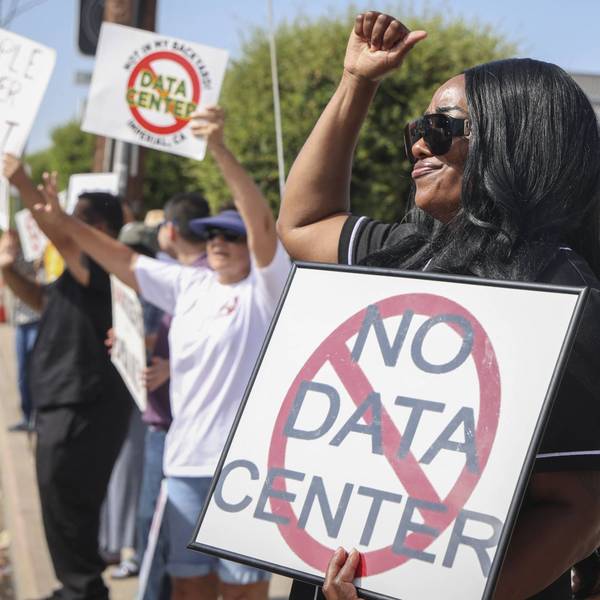
Rural Michigan residents rally against the $7 billion Stargate data center planned on southeast Michigan farmland in Saline, Michigan on December 1, 2025.
To fight back against Big Tech, the movement must articulate a clear diagnosis of the problem, adapt to changing political landscapes, translate early wins into lasting policy, and forge broad alliances.
As data centers sprout across the nation, a new movement is emerging to challenge the tech companies building them. The rapid spread of these facilities raises critical environmental, health, economic, and political questions, positioning health, climate, and social justice activists to play a central role in elevating these questions for the 2028 elections.
To date, the movement against data centers has made impressive gains. In the first four months of 2026, local opposition disrupted at least 75 data center projects worth approximately $130 billion. In June 2026, more than 200 advocacy organizations urged Congress to reject legislation fast-tracking the financing and permitting for large AI data centers. By July, New York State Gov. Kathy Hochul imposed a statewide moratorium on new hyperscale data centers—a model other states and cities are considering. National groups such as Food and Water Watch, the NAACP, Union of Concerned Scientists, and the Democratic Socialists of America have distributed resources to support local campaigns.
Public opposition has shifted dramatically alongside this activism. In August 2025, a poll of 4,000 Americans showed 43% supported having a data center built near their home. Just eight months later, in Spring 2026, support plummeted to 21%—a drop described by the pollster as “a scale of change in public opinion that I didn’t know was still possible in the US.”
However, the movement also faces significant headwinds. Big tech companies like Meta, Google, Microsoft, and Open AI are investing hundreds of billions of dollars to support new data centers to meet AI’s growing computing demands. As Karen Hao explains in Empire of AI, tech owners believe being first and largest will ensure dominance, driving relentless expansion.
Data center and AI activists are raising core questions: Who should decide whether communities allow data centers? Who pays the long-term costs and reaps the benefits?
Earlier environmental movements received some support from presidents seeking environmental legacies, but President Donald Trump provided public subsidies enabling the AI industry to bypass opponents.
Despite widespread local opposition to data centers and bipartisan support for regulation, the movement lacks a comprehensive national narrative to counteract the industry claim that AI will solve all problems. To tell such a story, previous and current movements must articulate a clear diagnosis of the problem, adapt to changing political landscapes, translate early wins into lasting policy, and forge broad alliances. My analysis of past successes of health and environmental movements suggests five strategic pathways emerge for the data center movement.
Successful movements link distinct problems to create multiple paths into activism. The women’s movement brought together advocates for sexual and reproductive healthcare, women of color, working women, lesbians, and people with disabilities. This inclusive alliance built the power needed to expand access to abortion, ban pregnancy discrimination, and protect women from insurance industry bias. Even when differences among its supporters emerged, the movement’s unifying goals provided a framework for common action.
Data center activists have raised health, environmental, and social justice concerns: increasing air pollution, water depletion, and excess noise. One study estimates that by 2028, the annual public health costs of data center air pollution will reach $20 billion. Activists also recognize that data center expansion enables AI and tech companies to deepen surveillance, target harmful social media campaigns, and facilitate harms to mental health.
Organizers can build a unified constituency by addressing both immediate harms (unregulated construction) and systemic issues (AI expansion enriching billionaires at public expense).
Effective movements united diverse groups around shared economic and social interests. The Fight for $15 movement successfully raised the minimum wage to at least $15 an hour, in at least 68 cities, counties, and states, winning more than $150 billion in higher pay for more than 26 million workers. It united low-wage workers, unions with the resources to pay organizers, and activists from Black Lives Matter and #MeToo.
Data centers activists can replicate this coalition approach. They can link residents concerned about the impact of local data centers and workers and labor unions whose jobs will be displaced by the growth of AI. They can enlist advocates for democracy, social justice, and tax reform who object to the political influence and low taxes of tech billionaires.
Movements frequently debate whether to emphasize immediate or long-term goals. In the movement for universal healthcare, organizers argued whether to support the Affordable Care Act as a step forward or to demand Medicare for All to reduce healthcare industry power.
Mark Hannay, from Metro New York Health Care for All, suggested a “both-and framework.” Metro fought for Medicare for All, but also for funding for New York City’s public hospitals and Medicaid and stronger regulation of the healthcare industry.
Data center and AI activists adopt this approach by pairing immediate demands—such as construction moratoria and stronger air and water protections—with long-term systemic reforms, including antitrust enforcement, elimination of corporate subsidies, and higher taxes on tech billionaires.
ACT UP, a leading force in the fight to get the government to respond more effectively and rapidly to the AIDS epidemic, used inside-outside, disruptive and conventional, and litigation and community organizing to achieve its goals. ACT UP found that multiple approaches increased pressure on the government to respond and mobilized more constituencies.
The data center movement has already used community organizing, demonstrations, litigation, legislation, and media campaigns to advance its goals. Maintaining this diversity, aligning its deployment to maximize impact, and developing a strategic plan for 2028 and beyond will help sustain momentum and drive policy wins.
Enduring movements unite people around a vision grounded in shared values. Martin Luther King Jr.’s vision of a world where character triumphed over skin color provide a moral vision for the civil rights movement. For more than a decade, environmental justice activists have proposed that all people have the right to environmental protections and a voice in shaping their communities’ environments. This expansive vision has enabled this movement to win local, state, and national policy changes and bring together environmental, climate, people of color, and women’s activists across the country.
Data center and AI activists are raising core questions: Who should decide whether communities allow data centers? Who pays the long-term costs and reaps the benefits? What role should voters—rather than tech industry executives—have in directing the future of AI?
By offering clear, practical answers and using the experiences of past activist campaigns, the growing data center-AI movement can put these questions on the nation’s electoral and political agenda. In doing so, they can become a powerful force for healthier, safer, and more just communities and a world where AI is used to benefit humanity.
Dear Common Dreams reader, It’s been nearly 30 years since I co-founded Common Dreams with my late wife, Lina Newhouser. We had the radical notion that journalism should serve the public good, not corporate profits. It was clear to us from the outset what it would take to build such a project. No paid advertisements. No corporate sponsors. No millionaire publisher telling us what to think or do. Many people said we wouldn't last a year, but we proved those doubters wrong. Together with a tremendous team of journalists and dedicated staff, we built an independent media outlet free from the constraints of profits and corporate control. Our mission has always been simple: To inform. To inspire. To ignite change for the common good. Building Common Dreams was not easy. Our survival was never guaranteed. When you take on the most powerful forces—Wall Street greed, fossil fuel industry destruction, Big Tech lobbyists, and uber-rich oligarchs who have spent billions upon billions rigging the economy and democracy in their favor—the only bulwark you have is supporters who believe in your work. But here’s the urgent message from me today. It's never been this bad out there. And it's never been this hard to keep us going. At the very moment Common Dreams is most needed, the threats we face are intensifying. We need your support now more than ever. We don't accept corporate advertising and never will. We don't have a paywall because we don't think people should be blocked from critical news based on their ability to pay. Everything we do is funded by the donations of readers like you. When everyone does the little they can afford, we are strong. But if that support retreats or dries up, so do we. Will you donate now to make sure Common Dreams not only survives but thrives? —Craig Brown, Co-founder |
As data centers sprout across the nation, a new movement is emerging to challenge the tech companies building them. The rapid spread of these facilities raises critical environmental, health, economic, and political questions, positioning health, climate, and social justice activists to play a central role in elevating these questions for the 2028 elections.
To date, the movement against data centers has made impressive gains. In the first four months of 2026, local opposition disrupted at least 75 data center projects worth approximately $130 billion. In June 2026, more than 200 advocacy organizations urged Congress to reject legislation fast-tracking the financing and permitting for large AI data centers. By July, New York State Gov. Kathy Hochul imposed a statewide moratorium on new hyperscale data centers—a model other states and cities are considering. National groups such as Food and Water Watch, the NAACP, Union of Concerned Scientists, and the Democratic Socialists of America have distributed resources to support local campaigns.
Public opposition has shifted dramatically alongside this activism. In August 2025, a poll of 4,000 Americans showed 43% supported having a data center built near their home. Just eight months later, in Spring 2026, support plummeted to 21%—a drop described by the pollster as “a scale of change in public opinion that I didn’t know was still possible in the US.”
However, the movement also faces significant headwinds. Big tech companies like Meta, Google, Microsoft, and Open AI are investing hundreds of billions of dollars to support new data centers to meet AI’s growing computing demands. As Karen Hao explains in Empire of AI, tech owners believe being first and largest will ensure dominance, driving relentless expansion.
Data center and AI activists are raising core questions: Who should decide whether communities allow data centers? Who pays the long-term costs and reaps the benefits?
Earlier environmental movements received some support from presidents seeking environmental legacies, but President Donald Trump provided public subsidies enabling the AI industry to bypass opponents.
Despite widespread local opposition to data centers and bipartisan support for regulation, the movement lacks a comprehensive national narrative to counteract the industry claim that AI will solve all problems. To tell such a story, previous and current movements must articulate a clear diagnosis of the problem, adapt to changing political landscapes, translate early wins into lasting policy, and forge broad alliances. My analysis of past successes of health and environmental movements suggests five strategic pathways emerge for the data center movement.
Successful movements link distinct problems to create multiple paths into activism. The women’s movement brought together advocates for sexual and reproductive healthcare, women of color, working women, lesbians, and people with disabilities. This inclusive alliance built the power needed to expand access to abortion, ban pregnancy discrimination, and protect women from insurance industry bias. Even when differences among its supporters emerged, the movement’s unifying goals provided a framework for common action.
Data center activists have raised health, environmental, and social justice concerns: increasing air pollution, water depletion, and excess noise. One study estimates that by 2028, the annual public health costs of data center air pollution will reach $20 billion. Activists also recognize that data center expansion enables AI and tech companies to deepen surveillance, target harmful social media campaigns, and facilitate harms to mental health.
Organizers can build a unified constituency by addressing both immediate harms (unregulated construction) and systemic issues (AI expansion enriching billionaires at public expense).
Effective movements united diverse groups around shared economic and social interests. The Fight for $15 movement successfully raised the minimum wage to at least $15 an hour, in at least 68 cities, counties, and states, winning more than $150 billion in higher pay for more than 26 million workers. It united low-wage workers, unions with the resources to pay organizers, and activists from Black Lives Matter and #MeToo.
Data centers activists can replicate this coalition approach. They can link residents concerned about the impact of local data centers and workers and labor unions whose jobs will be displaced by the growth of AI. They can enlist advocates for democracy, social justice, and tax reform who object to the political influence and low taxes of tech billionaires.
Movements frequently debate whether to emphasize immediate or long-term goals. In the movement for universal healthcare, organizers argued whether to support the Affordable Care Act as a step forward or to demand Medicare for All to reduce healthcare industry power.
Mark Hannay, from Metro New York Health Care for All, suggested a “both-and framework.” Metro fought for Medicare for All, but also for funding for New York City’s public hospitals and Medicaid and stronger regulation of the healthcare industry.
Data center and AI activists adopt this approach by pairing immediate demands—such as construction moratoria and stronger air and water protections—with long-term systemic reforms, including antitrust enforcement, elimination of corporate subsidies, and higher taxes on tech billionaires.
ACT UP, a leading force in the fight to get the government to respond more effectively and rapidly to the AIDS epidemic, used inside-outside, disruptive and conventional, and litigation and community organizing to achieve its goals. ACT UP found that multiple approaches increased pressure on the government to respond and mobilized more constituencies.
The data center movement has already used community organizing, demonstrations, litigation, legislation, and media campaigns to advance its goals. Maintaining this diversity, aligning its deployment to maximize impact, and developing a strategic plan for 2028 and beyond will help sustain momentum and drive policy wins.
Enduring movements unite people around a vision grounded in shared values. Martin Luther King Jr.’s vision of a world where character triumphed over skin color provide a moral vision for the civil rights movement. For more than a decade, environmental justice activists have proposed that all people have the right to environmental protections and a voice in shaping their communities’ environments. This expansive vision has enabled this movement to win local, state, and national policy changes and bring together environmental, climate, people of color, and women’s activists across the country.
Data center and AI activists are raising core questions: Who should decide whether communities allow data centers? Who pays the long-term costs and reaps the benefits? What role should voters—rather than tech industry executives—have in directing the future of AI?
By offering clear, practical answers and using the experiences of past activist campaigns, the growing data center-AI movement can put these questions on the nation’s electoral and political agenda. In doing so, they can become a powerful force for healthier, safer, and more just communities and a world where AI is used to benefit humanity.
As data centers sprout across the nation, a new movement is emerging to challenge the tech companies building them. The rapid spread of these facilities raises critical environmental, health, economic, and political questions, positioning health, climate, and social justice activists to play a central role in elevating these questions for the 2028 elections.
To date, the movement against data centers has made impressive gains. In the first four months of 2026, local opposition disrupted at least 75 data center projects worth approximately $130 billion. In June 2026, more than 200 advocacy organizations urged Congress to reject legislation fast-tracking the financing and permitting for large AI data centers. By July, New York State Gov. Kathy Hochul imposed a statewide moratorium on new hyperscale data centers—a model other states and cities are considering. National groups such as Food and Water Watch, the NAACP, Union of Concerned Scientists, and the Democratic Socialists of America have distributed resources to support local campaigns.
Public opposition has shifted dramatically alongside this activism. In August 2025, a poll of 4,000 Americans showed 43% supported having a data center built near their home. Just eight months later, in Spring 2026, support plummeted to 21%—a drop described by the pollster as “a scale of change in public opinion that I didn’t know was still possible in the US.”
However, the movement also faces significant headwinds. Big tech companies like Meta, Google, Microsoft, and Open AI are investing hundreds of billions of dollars to support new data centers to meet AI’s growing computing demands. As Karen Hao explains in Empire of AI, tech owners believe being first and largest will ensure dominance, driving relentless expansion.
Data center and AI activists are raising core questions: Who should decide whether communities allow data centers? Who pays the long-term costs and reaps the benefits?
Earlier environmental movements received some support from presidents seeking environmental legacies, but President Donald Trump provided public subsidies enabling the AI industry to bypass opponents.
Despite widespread local opposition to data centers and bipartisan support for regulation, the movement lacks a comprehensive national narrative to counteract the industry claim that AI will solve all problems. To tell such a story, previous and current movements must articulate a clear diagnosis of the problem, adapt to changing political landscapes, translate early wins into lasting policy, and forge broad alliances. My analysis of past successes of health and environmental movements suggests five strategic pathways emerge for the data center movement.
Successful movements link distinct problems to create multiple paths into activism. The women’s movement brought together advocates for sexual and reproductive healthcare, women of color, working women, lesbians, and people with disabilities. This inclusive alliance built the power needed to expand access to abortion, ban pregnancy discrimination, and protect women from insurance industry bias. Even when differences among its supporters emerged, the movement’s unifying goals provided a framework for common action.
Data center activists have raised health, environmental, and social justice concerns: increasing air pollution, water depletion, and excess noise. One study estimates that by 2028, the annual public health costs of data center air pollution will reach $20 billion. Activists also recognize that data center expansion enables AI and tech companies to deepen surveillance, target harmful social media campaigns, and facilitate harms to mental health.
Organizers can build a unified constituency by addressing both immediate harms (unregulated construction) and systemic issues (AI expansion enriching billionaires at public expense).
Effective movements united diverse groups around shared economic and social interests. The Fight for $15 movement successfully raised the minimum wage to at least $15 an hour, in at least 68 cities, counties, and states, winning more than $150 billion in higher pay for more than 26 million workers. It united low-wage workers, unions with the resources to pay organizers, and activists from Black Lives Matter and #MeToo.
Data centers activists can replicate this coalition approach. They can link residents concerned about the impact of local data centers and workers and labor unions whose jobs will be displaced by the growth of AI. They can enlist advocates for democracy, social justice, and tax reform who object to the political influence and low taxes of tech billionaires.
Movements frequently debate whether to emphasize immediate or long-term goals. In the movement for universal healthcare, organizers argued whether to support the Affordable Care Act as a step forward or to demand Medicare for All to reduce healthcare industry power.
Mark Hannay, from Metro New York Health Care for All, suggested a “both-and framework.” Metro fought for Medicare for All, but also for funding for New York City’s public hospitals and Medicaid and stronger regulation of the healthcare industry.
Data center and AI activists adopt this approach by pairing immediate demands—such as construction moratoria and stronger air and water protections—with long-term systemic reforms, including antitrust enforcement, elimination of corporate subsidies, and higher taxes on tech billionaires.
ACT UP, a leading force in the fight to get the government to respond more effectively and rapidly to the AIDS epidemic, used inside-outside, disruptive and conventional, and litigation and community organizing to achieve its goals. ACT UP found that multiple approaches increased pressure on the government to respond and mobilized more constituencies.
The data center movement has already used community organizing, demonstrations, litigation, legislation, and media campaigns to advance its goals. Maintaining this diversity, aligning its deployment to maximize impact, and developing a strategic plan for 2028 and beyond will help sustain momentum and drive policy wins.
Enduring movements unite people around a vision grounded in shared values. Martin Luther King Jr.’s vision of a world where character triumphed over skin color provide a moral vision for the civil rights movement. For more than a decade, environmental justice activists have proposed that all people have the right to environmental protections and a voice in shaping their communities’ environments. This expansive vision has enabled this movement to win local, state, and national policy changes and bring together environmental, climate, people of color, and women’s activists across the country.
Data center and AI activists are raising core questions: Who should decide whether communities allow data centers? Who pays the long-term costs and reaps the benefits? What role should voters—rather than tech industry executives—have in directing the future of AI?
By offering clear, practical answers and using the experiences of past activist campaigns, the growing data center-AI movement can put these questions on the nation’s electoral and political agenda. In doing so, they can become a powerful force for healthier, safer, and more just communities and a world where AI is used to benefit humanity.