SUBSCRIBE TO OUR FREE NEWSLETTER
Daily news & progressive opinion—funded by the people, not the corporations—delivered straight to your inbox.
5
#000000
#FFFFFF
To donate by check, phone, or other method, see our More Ways to Give page.
Daily news & progressive opinion—funded by the people, not the corporations—delivered straight to your inbox.
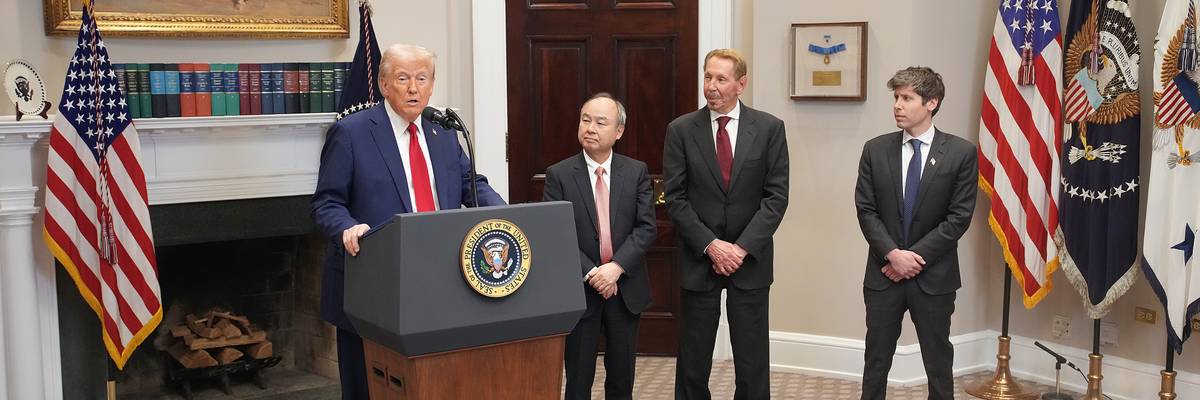
U.S. President Donald Trump speaks in the Roosevelt Room of the White House while SoftBank CEO Masayoshi Son, Oracle CTO Larry Ellison, and OpenAI CEO Sam Altman look on on January 21, 2025 in Washington, DC.
"Even if it turns out to be structured to avoid antitrust law enforcement, it plainly will concentrate power in a small number of corporate hands," said Public Citizen co-president Robert Weissman.
U.S. President Donald Trump on Tuesday highlighted a new private-sector initiative to invest as much as $500 billion over four years into developing infrastructure to support artificial intelligence, starting with a raft of power-intensive data centers in Texas. The move drew swift criticism from one watchdog group on antitrust and environmental grounds.
The initiative, Stargate, is a joint venture of the tech firms OpenAI, Oracle, and SoftBank. Trump hosted the leaders of those companies—OpenAI CEO Sam Altman, Oracle Chairman Larry Ellison, and SoftBank CEO Masayoshi Son—at the White House to announce the initiative just one day after he signed an executive order rolling back a Biden-era executive order implemented in 2023 that sought to put safeguards on AI.
"I think this will be the most important project of this era," said Altman, according to the Washington Post. "We wouldn't be able to do this without you, Mr. President," he added, though both the Post and and the Associated Press noted that the creation of the partnership predated Trump's return to the White House.
Biden's 2023 executive order on AI placed safety obligations on AI developers and called on federal agencies to examine the technology's risks. But Biden, too, was interested in boosting AI infrastructure development. Right before he departed, in early mid-January, Biden signed an executive order directing federal agencies to identify government sites that could be leased to private companies for the construction of AI data centers.
Environmental groups and tech advocacy groups have long advocated for greater safeguards on AI, pointing to the technology's potential impact on the climate emergency.
The average query in the AI-powered chatbot ChatGPT requires 10 times the amount of energy a Google search needs, and "in that difference lies a coming sea change in how the U.S., Europe, and the world at large will consume power—and how much that will cost," according to a 2024 analysis published by the investment firm Goldman Sachs. Goldman Sachs analysts believe that AI will represent about 19% of data center power demand by 2028.
AI infrastructure is also water intensive. Global AI demand is projected to require more water extraction in a year than the country of Denmark by 2027, according to one study.
"The alarming surge in these centers' energy demand is on track to extend the fossil fuel era... [and] it is already increasing costs for some consumers and threatens to bring about a larger affordability crisis, while lining the pockets of Big Tech billionaires," said Karen Orenstein, a director at the environmental group Friends of the Earth, following Biden's January executive order. "For the sake of our planet and its people, we need to rein in Big Tech and regulate AI," she said.
Meanwhile, the joint venture to build out AI infrastructure has also drawn scrutiny from one watchdog group over concerns of corporate concentration.
Public Citizen co-president Robert Weissman said Wednesday that "the new Stargate plan—at minimum—raises massive antitrust concerns. Even if it turns out to be structured to avoid antitrust law enforcement, it plainly will concentrate power in a small number of corporate hands."
"Absent a commitment to bring on new, renewable energy to power an even greater spike in AI power demand, the Stargate build out threatens to worsen the rush to climate catastrophe and to drive up consumer electric bills," he added.
Another observer, Jeffrey Westling of the American Action Forum, remarked on the timing of the announcement.
"Interesting to wait to announce this until the Trump Admin. Assuming its all private investment, maybe they were worried about FTC/DOJ antitrust scrutiny?" he wrote on X Tuesday.
Dear Common Dreams reader, It’s been nearly 30 years since I co-founded Common Dreams with my late wife, Lina Newhouser. We had the radical notion that journalism should serve the public good, not corporate profits. It was clear to us from the outset what it would take to build such a project. No paid advertisements. No corporate sponsors. No millionaire publisher telling us what to think or do. Many people said we wouldn't last a year, but we proved those doubters wrong. Together with a tremendous team of journalists and dedicated staff, we built an independent media outlet free from the constraints of profits and corporate control. Our mission has always been simple: To inform. To inspire. To ignite change for the common good. Building Common Dreams was not easy. Our survival was never guaranteed. When you take on the most powerful forces—Wall Street greed, fossil fuel industry destruction, Big Tech lobbyists, and uber-rich oligarchs who have spent billions upon billions rigging the economy and democracy in their favor—the only bulwark you have is supporters who believe in your work. But here’s the urgent message from me today. It's never been this bad out there. And it's never been this hard to keep us going. At the very moment Common Dreams is most needed, the threats we face are intensifying. We need your support now more than ever. We don't accept corporate advertising and never will. We don't have a paywall because we don't think people should be blocked from critical news based on their ability to pay. Everything we do is funded by the donations of readers like you. When everyone does the little they can afford, we are strong. But if that support retreats or dries up, so do we. Will you donate now to make sure Common Dreams not only survives but thrives? —Craig Brown, Co-founder |
U.S. President Donald Trump on Tuesday highlighted a new private-sector initiative to invest as much as $500 billion over four years into developing infrastructure to support artificial intelligence, starting with a raft of power-intensive data centers in Texas. The move drew swift criticism from one watchdog group on antitrust and environmental grounds.
The initiative, Stargate, is a joint venture of the tech firms OpenAI, Oracle, and SoftBank. Trump hosted the leaders of those companies—OpenAI CEO Sam Altman, Oracle Chairman Larry Ellison, and SoftBank CEO Masayoshi Son—at the White House to announce the initiative just one day after he signed an executive order rolling back a Biden-era executive order implemented in 2023 that sought to put safeguards on AI.
"I think this will be the most important project of this era," said Altman, according to the Washington Post. "We wouldn't be able to do this without you, Mr. President," he added, though both the Post and and the Associated Press noted that the creation of the partnership predated Trump's return to the White House.
Biden's 2023 executive order on AI placed safety obligations on AI developers and called on federal agencies to examine the technology's risks. But Biden, too, was interested in boosting AI infrastructure development. Right before he departed, in early mid-January, Biden signed an executive order directing federal agencies to identify government sites that could be leased to private companies for the construction of AI data centers.
Environmental groups and tech advocacy groups have long advocated for greater safeguards on AI, pointing to the technology's potential impact on the climate emergency.
The average query in the AI-powered chatbot ChatGPT requires 10 times the amount of energy a Google search needs, and "in that difference lies a coming sea change in how the U.S., Europe, and the world at large will consume power—and how much that will cost," according to a 2024 analysis published by the investment firm Goldman Sachs. Goldman Sachs analysts believe that AI will represent about 19% of data center power demand by 2028.
AI infrastructure is also water intensive. Global AI demand is projected to require more water extraction in a year than the country of Denmark by 2027, according to one study.
"The alarming surge in these centers' energy demand is on track to extend the fossil fuel era... [and] it is already increasing costs for some consumers and threatens to bring about a larger affordability crisis, while lining the pockets of Big Tech billionaires," said Karen Orenstein, a director at the environmental group Friends of the Earth, following Biden's January executive order. "For the sake of our planet and its people, we need to rein in Big Tech and regulate AI," she said.
Meanwhile, the joint venture to build out AI infrastructure has also drawn scrutiny from one watchdog group over concerns of corporate concentration.
Public Citizen co-president Robert Weissman said Wednesday that "the new Stargate plan—at minimum—raises massive antitrust concerns. Even if it turns out to be structured to avoid antitrust law enforcement, it plainly will concentrate power in a small number of corporate hands."
"Absent a commitment to bring on new, renewable energy to power an even greater spike in AI power demand, the Stargate build out threatens to worsen the rush to climate catastrophe and to drive up consumer electric bills," he added.
Another observer, Jeffrey Westling of the American Action Forum, remarked on the timing of the announcement.
"Interesting to wait to announce this until the Trump Admin. Assuming its all private investment, maybe they were worried about FTC/DOJ antitrust scrutiny?" he wrote on X Tuesday.
U.S. President Donald Trump on Tuesday highlighted a new private-sector initiative to invest as much as $500 billion over four years into developing infrastructure to support artificial intelligence, starting with a raft of power-intensive data centers in Texas. The move drew swift criticism from one watchdog group on antitrust and environmental grounds.
The initiative, Stargate, is a joint venture of the tech firms OpenAI, Oracle, and SoftBank. Trump hosted the leaders of those companies—OpenAI CEO Sam Altman, Oracle Chairman Larry Ellison, and SoftBank CEO Masayoshi Son—at the White House to announce the initiative just one day after he signed an executive order rolling back a Biden-era executive order implemented in 2023 that sought to put safeguards on AI.
"I think this will be the most important project of this era," said Altman, according to the Washington Post. "We wouldn't be able to do this without you, Mr. President," he added, though both the Post and and the Associated Press noted that the creation of the partnership predated Trump's return to the White House.
Biden's 2023 executive order on AI placed safety obligations on AI developers and called on federal agencies to examine the technology's risks. But Biden, too, was interested in boosting AI infrastructure development. Right before he departed, in early mid-January, Biden signed an executive order directing federal agencies to identify government sites that could be leased to private companies for the construction of AI data centers.
Environmental groups and tech advocacy groups have long advocated for greater safeguards on AI, pointing to the technology's potential impact on the climate emergency.
The average query in the AI-powered chatbot ChatGPT requires 10 times the amount of energy a Google search needs, and "in that difference lies a coming sea change in how the U.S., Europe, and the world at large will consume power—and how much that will cost," according to a 2024 analysis published by the investment firm Goldman Sachs. Goldman Sachs analysts believe that AI will represent about 19% of data center power demand by 2028.
AI infrastructure is also water intensive. Global AI demand is projected to require more water extraction in a year than the country of Denmark by 2027, according to one study.
"The alarming surge in these centers' energy demand is on track to extend the fossil fuel era... [and] it is already increasing costs for some consumers and threatens to bring about a larger affordability crisis, while lining the pockets of Big Tech billionaires," said Karen Orenstein, a director at the environmental group Friends of the Earth, following Biden's January executive order. "For the sake of our planet and its people, we need to rein in Big Tech and regulate AI," she said.
Meanwhile, the joint venture to build out AI infrastructure has also drawn scrutiny from one watchdog group over concerns of corporate concentration.
Public Citizen co-president Robert Weissman said Wednesday that "the new Stargate plan—at minimum—raises massive antitrust concerns. Even if it turns out to be structured to avoid antitrust law enforcement, it plainly will concentrate power in a small number of corporate hands."
"Absent a commitment to bring on new, renewable energy to power an even greater spike in AI power demand, the Stargate build out threatens to worsen the rush to climate catastrophe and to drive up consumer electric bills," he added.
Another observer, Jeffrey Westling of the American Action Forum, remarked on the timing of the announcement.
"Interesting to wait to announce this until the Trump Admin. Assuming its all private investment, maybe they were worried about FTC/DOJ antitrust scrutiny?" he wrote on X Tuesday.