SUBSCRIBE TO OUR FREE NEWSLETTER
Daily news & progressive opinion—funded by the people, not the corporations—delivered straight to your inbox.
5
#000000
#FFFFFF
To donate by check, phone, or other method, see our More Ways to Give page.
Daily news & progressive opinion—funded by the people, not the corporations—delivered straight to your inbox.
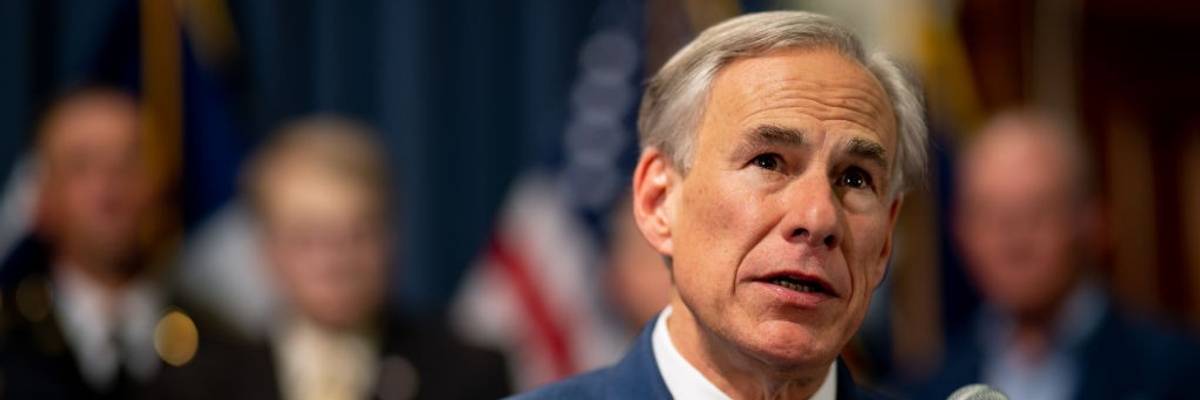
Texas Gov. Greg Abbott speaks during a news conference on June 8, 2023 in Austin, Texas.
"They are realizing how wildly unpopular Big AI’s agenda is with the American people."
Corporate-friendly Republicans who are typically hostile to regulation are attempting to reshape their image in the lead-up to the November midterms in what critics say is a cynical attempt to capitalize on mounting grassroots backlash against artificial intelligence data centers.
Semafor reported Wednesday that prominent Republicans, having "cheered the AI boom," are now "scrambling to find a new identity as middle-ground pragmatists," even as they receive campaign contributions from companies directly involved in or benefiting from data center construction and maintenance. The National Republican Senatorial Committee recognized in an internal memo that data centers have "become a sleeper issue for the entire election cycle."
Semafor noted that "instead of a moratorium on building new facilities, a growing number of GOP candidates have called for 'guardrails' to protect skeptical communities from unchecked AI growth, as well as the rollback of industry tax breaks."
"These Republicans’ rebrand also involves a bid for the high ground by attacking Democrats with more nuanced positions on data centers," the outlet added.
Semafor points specifically to Texas Gov. Greg Abbott's sudden decision in June to "audit tech companies’ use of the electric grid," as well as his vow to work with state lawmakers to repeal the companies' tax breaks. The Houston Chronicle reported last month that "several of the Republican governor’s most generous financial backers are increasingly investing in the boom that has voters in deep-red rural parts of the state up in arms... including "real estate titan Ed Roski, Jr., who gave $1 million in April, and energy executive Kelcy Warren, who gave $500,000 in June."
Abbott is facing state Rep. Gina Hinojosa (D-49) in November. In an ad debuted earlier this week, Hinojosa's campaign said Abbott "took $20 million in campaign donations from data center executives and companies, and he gave them billions in tax breaks."
New entry into the data center wars: @GinaHinojosaTX going after Greg Abbott.
A woman uses an AI chatbot to ask why her electric bill is going up; it answers, Greg Abbott. pic.twitter.com/NohUKGx53o
— David Weigel (@daveweigel) August 18, 2026
Semafor observed Wednesday that the "Republican shift is underway in Michigan, too," but it is "most intense in Wisconsin," where Republican gubernatorial nominee Tom Tiffany is attempting to posture as tough on data centers despite his voting record in the US House and fundraising history.
Tiffany's campaign has tried to label Milwaukee County Executive David Crowley, Wisconsin's Democratic gubernatorial nominee, as "Data Center David."
"Tiffany’s social media posts that clipped Crowley’s answers to data center questions were reshared and condemned by many progressives who had supported [democratic socialist Francesca] Hong," Semafor reported. "That obscured what are in fact minor policy differences between the candidates: Tiffany wanted community input and for data centers to pay for their electricity, and so did Crowley. Like Texas, Wisconsin has passed bipartisan tax breaks to entice companies to do business there and were losing out on revenue when the profits blew away their projections."
Charlie Blaettler, political director of the Guardrails Alliance—a coalition working to expose the AI industry's growing political influence—said in a statement Wednesday that "the Republican Party is panicking because they sold out to the AI industry—a while ago—and they know it."
"But now they are realizing how wildly unpopular Big AI’s agenda is with the American people," said Blaettler. "The GOP and AI’s unaccountable billionaires are scrambling to backtrack and find a new way to pull the wool over the eyes of the public so they can get what they want: a Congress that will do their bidding and an AI future that benefits them, not the many."
Dear Common Dreams reader, It’s been nearly 30 years since I co-founded Common Dreams with my late wife, Lina Newhouser. We had the radical notion that journalism should serve the public good, not corporate profits. It was clear to us from the outset what it would take to build such a project. No paid advertisements. No corporate sponsors. No millionaire publisher telling us what to think or do. Many people said we wouldn't last a year, but we proved those doubters wrong. Together with a tremendous team of journalists and dedicated staff, we built an independent media outlet free from the constraints of profits and corporate control. Our mission has always been simple: To inform. To inspire. To ignite change for the common good. Building Common Dreams was not easy. Our survival was never guaranteed. When you take on the most powerful forces—Wall Street greed, fossil fuel industry destruction, Big Tech lobbyists, and uber-rich oligarchs who have spent billions upon billions rigging the economy and democracy in their favor—the only bulwark you have is supporters who believe in your work. But here’s the urgent message from me today. It's never been this bad out there. And it's never been this hard to keep us going. At the very moment Common Dreams is most needed, the threats we face are intensifying. We need your support now more than ever. We don't accept corporate advertising and never will. We don't have a paywall because we don't think people should be blocked from critical news based on their ability to pay. Everything we do is funded by the donations of readers like you. When everyone does the little they can afford, we are strong. But if that support retreats or dries up, so do we. Will you donate now to make sure Common Dreams not only survives but thrives? —Craig Brown, Co-founder |
Corporate-friendly Republicans who are typically hostile to regulation are attempting to reshape their image in the lead-up to the November midterms in what critics say is a cynical attempt to capitalize on mounting grassroots backlash against artificial intelligence data centers.
Semafor reported Wednesday that prominent Republicans, having "cheered the AI boom," are now "scrambling to find a new identity as middle-ground pragmatists," even as they receive campaign contributions from companies directly involved in or benefiting from data center construction and maintenance. The National Republican Senatorial Committee recognized in an internal memo that data centers have "become a sleeper issue for the entire election cycle."
Semafor noted that "instead of a moratorium on building new facilities, a growing number of GOP candidates have called for 'guardrails' to protect skeptical communities from unchecked AI growth, as well as the rollback of industry tax breaks."
"These Republicans’ rebrand also involves a bid for the high ground by attacking Democrats with more nuanced positions on data centers," the outlet added.
Semafor points specifically to Texas Gov. Greg Abbott's sudden decision in June to "audit tech companies’ use of the electric grid," as well as his vow to work with state lawmakers to repeal the companies' tax breaks. The Houston Chronicle reported last month that "several of the Republican governor’s most generous financial backers are increasingly investing in the boom that has voters in deep-red rural parts of the state up in arms... including "real estate titan Ed Roski, Jr., who gave $1 million in April, and energy executive Kelcy Warren, who gave $500,000 in June."
Abbott is facing state Rep. Gina Hinojosa (D-49) in November. In an ad debuted earlier this week, Hinojosa's campaign said Abbott "took $20 million in campaign donations from data center executives and companies, and he gave them billions in tax breaks."
New entry into the data center wars: @GinaHinojosaTX going after Greg Abbott.
A woman uses an AI chatbot to ask why her electric bill is going up; it answers, Greg Abbott. pic.twitter.com/NohUKGx53o
— David Weigel (@daveweigel) August 18, 2026
Semafor observed Wednesday that the "Republican shift is underway in Michigan, too," but it is "most intense in Wisconsin," where Republican gubernatorial nominee Tom Tiffany is attempting to posture as tough on data centers despite his voting record in the US House and fundraising history.
Tiffany's campaign has tried to label Milwaukee County Executive David Crowley, Wisconsin's Democratic gubernatorial nominee, as "Data Center David."
"Tiffany’s social media posts that clipped Crowley’s answers to data center questions were reshared and condemned by many progressives who had supported [democratic socialist Francesca] Hong," Semafor reported. "That obscured what are in fact minor policy differences between the candidates: Tiffany wanted community input and for data centers to pay for their electricity, and so did Crowley. Like Texas, Wisconsin has passed bipartisan tax breaks to entice companies to do business there and were losing out on revenue when the profits blew away their projections."
Charlie Blaettler, political director of the Guardrails Alliance—a coalition working to expose the AI industry's growing political influence—said in a statement Wednesday that "the Republican Party is panicking because they sold out to the AI industry—a while ago—and they know it."
"But now they are realizing how wildly unpopular Big AI’s agenda is with the American people," said Blaettler. "The GOP and AI’s unaccountable billionaires are scrambling to backtrack and find a new way to pull the wool over the eyes of the public so they can get what they want: a Congress that will do their bidding and an AI future that benefits them, not the many."
Corporate-friendly Republicans who are typically hostile to regulation are attempting to reshape their image in the lead-up to the November midterms in what critics say is a cynical attempt to capitalize on mounting grassroots backlash against artificial intelligence data centers.
Semafor reported Wednesday that prominent Republicans, having "cheered the AI boom," are now "scrambling to find a new identity as middle-ground pragmatists," even as they receive campaign contributions from companies directly involved in or benefiting from data center construction and maintenance. The National Republican Senatorial Committee recognized in an internal memo that data centers have "become a sleeper issue for the entire election cycle."
Semafor noted that "instead of a moratorium on building new facilities, a growing number of GOP candidates have called for 'guardrails' to protect skeptical communities from unchecked AI growth, as well as the rollback of industry tax breaks."
"These Republicans’ rebrand also involves a bid for the high ground by attacking Democrats with more nuanced positions on data centers," the outlet added.
Semafor points specifically to Texas Gov. Greg Abbott's sudden decision in June to "audit tech companies’ use of the electric grid," as well as his vow to work with state lawmakers to repeal the companies' tax breaks. The Houston Chronicle reported last month that "several of the Republican governor’s most generous financial backers are increasingly investing in the boom that has voters in deep-red rural parts of the state up in arms... including "real estate titan Ed Roski, Jr., who gave $1 million in April, and energy executive Kelcy Warren, who gave $500,000 in June."
Abbott is facing state Rep. Gina Hinojosa (D-49) in November. In an ad debuted earlier this week, Hinojosa's campaign said Abbott "took $20 million in campaign donations from data center executives and companies, and he gave them billions in tax breaks."
New entry into the data center wars: @GinaHinojosaTX going after Greg Abbott.
A woman uses an AI chatbot to ask why her electric bill is going up; it answers, Greg Abbott. pic.twitter.com/NohUKGx53o
— David Weigel (@daveweigel) August 18, 2026
Semafor observed Wednesday that the "Republican shift is underway in Michigan, too," but it is "most intense in Wisconsin," where Republican gubernatorial nominee Tom Tiffany is attempting to posture as tough on data centers despite his voting record in the US House and fundraising history.
Tiffany's campaign has tried to label Milwaukee County Executive David Crowley, Wisconsin's Democratic gubernatorial nominee, as "Data Center David."
"Tiffany’s social media posts that clipped Crowley’s answers to data center questions were reshared and condemned by many progressives who had supported [democratic socialist Francesca] Hong," Semafor reported. "That obscured what are in fact minor policy differences between the candidates: Tiffany wanted community input and for data centers to pay for their electricity, and so did Crowley. Like Texas, Wisconsin has passed bipartisan tax breaks to entice companies to do business there and were losing out on revenue when the profits blew away their projections."
Charlie Blaettler, political director of the Guardrails Alliance—a coalition working to expose the AI industry's growing political influence—said in a statement Wednesday that "the Republican Party is panicking because they sold out to the AI industry—a while ago—and they know it."
"But now they are realizing how wildly unpopular Big AI’s agenda is with the American people," said Blaettler. "The GOP and AI’s unaccountable billionaires are scrambling to backtrack and find a new way to pull the wool over the eyes of the public so they can get what they want: a Congress that will do their bidding and an AI future that benefits them, not the many."