SUBSCRIBE TO OUR FREE NEWSLETTER
Daily news & progressive opinion—funded by the people, not the corporations—delivered straight to your inbox.
5
#000000
#FFFFFF
To donate by check, phone, or other method, see our More Ways to Give page.
Daily news & progressive opinion—funded by the people, not the corporations—delivered straight to your inbox.
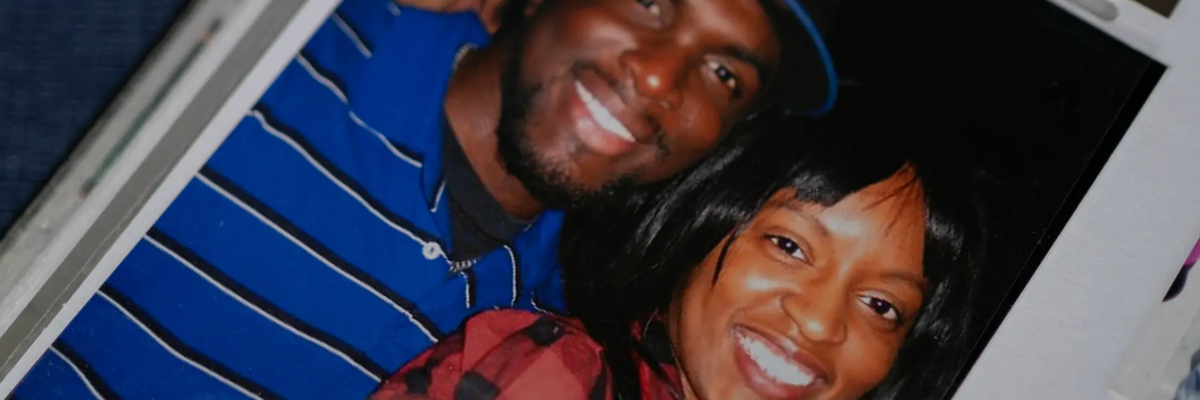
Hope and Porsha Ngumezi are seen in a family photo.
"The only reason she is not with us is because of Donald Trump, Greg Abbott, and every single Republican politician who helped put Texas' abortion ban in place," said one advocacy group.
Friends and family of Porsha Ngumezi, a 35-year-old mother of two in Houston, were stunned last year to learn that she had died in a hospital after suffering a miscarriage when she was 11 weeks pregnant—and medical experts who spoke to the investigative outlet ProPublica on Monday had the same reaction.
"All she needed was a [dilation and curettage]," one friend told Ngumezi's grieving husband, Hope Ngumezi, referring to a standard procedure which is often given to pregnant patients who have first-trimester miscarriages. Commonly called a D&C, it is also diagnose or treat other health conditions and provide abortion care.
Dr. Daniel Grossman, an obstetrics and gynecology professor at University of California, San Francisco, told ProPublica that "at every point" of Ngumezi's visit to Houston Methodist Sugar Land, a hospital outside Houston, medical providers' response to her case was "kind of shocking."
"She is having significant blood loss and the physician didn't move toward aspiration," Grossman told ProPublica.
Like at least two other Texas women—Nevaeh Crain and Josseli Barnica—Ngumezi's death in June 2023 was the result of the abortion ban that went into effect in Texas in 2022, according to medical experts who reviewed her case.
Ngumezi arrived at the hospital on June 11, 2023 after experiencing heavy bleeding 11 weeks into her pregnancy with her third child. Doctors noted that Ngumezi had a blood-clotting disorder and that she was experiencing "significant bleeding" with large clots.
"Doctors assume that a D&C is not standard in Texas anymore, even in cases where it should be recommended. People are afraid: They see D&C as abortion and abortion as illegal."
An ultrasound showed a "sac-like structure," but no fetus or cardiac activity were detected, indicating that she was having a miscarriage.
But instead of providing a D&C, in which a small tube is inserted into the uterus to gently remove any remaining fetal tissue, doctors took a "wait-and-see approach [that] has become more common under abortion bans," according to the medical experts who spoke to ProPublica.
Dr. Gabrielle Taper, who has worked as an OB-GYN in Austin, told ProPublica that since Texas' abortion ban went into effect in 2022—two months after the right-wing majority on the U.S. Supreme Court overturned Roe v. Wade—there has been "much more hesitation [among doctors] about: When can we intervene, do we have enough evidence to say this is a miscarriage, how long are we going to wait, what will we use to feel definitive?"
For Ngumezi, that hesitation meant that Dr. Andrew Ryan Davis, the obstetrician on duty, prescribed misoprostol to help Ngumezi pass the fetal tissue without a D&C.
Dr. Alison Goulding, another OB-GYN in Houston, told ProPublica that because misoprostol can also be used for women in labor or to treat postpartum bleeding, under Texas' abortion ban, "stigma and fear are there for D&Cs in a way that they are not for misoprostol."
"Doctors assume that a D&C is not standard in Texas anymore, even in cases where it should be recommended," Goulding said. "People are afraid: They see D&C as abortion and abortion as illegal."
But more than a dozen doctors told ProPublica that considering Ngumezi's blood-clotting disorder, doctors should have provided a D&C.
"Misoprostol," reported ProPublica, "is an effective method to complete low-risk miscarriages but is not recommended when a patient is unstable."
Some critics who support abortion bans have dismissed Ngumezi's case—and that of other women who have died because of the laws—as the result of medical malpractice that had nothing to do with recently passed state laws. They claim Texas' law protects women who have miscarriages.
But ProPublica noted that Ngumezi had a similar case to one described on social media by podcast host Ryan Hamilton earlier this year. Hamilton's wife experienced bleeding while miscarrying at 13 weeks, and was prescribed misoprostol and sent home after an ultrasound at Surepoint Emergency Center Stephenville showed no fetal cardiac activity. The bleeding got worse, but an emergency doctor told the couple they couldn't provide a D&C because of "the current stance" in Texas.
Greer Donley, a law professor at University of Pittsburgh, said that "the antiabortion movement wants us to blame the doctors and sometimes that is warranted. But abortion bans are the ultimate cause of this harm."
"When life in prison is the penalty for violating a ban, doctors will understandably be risk averse. And that chill in care will cause death," said Donley.
ProPublica reported that "performing a D&C attracts more attention from colleagues, creating a higher barrier in a state where abortion is illegal."
Doctors, added Goulding, "have to convince everyone that it is legal and won't put them at risk [of prosecution]."
In Ngumezi's case, the bleeding continued after she took misoprostol, and her heart stopped three hours later—a "preventable" death, according to the experts.
"The only reason" Ngumezi died, said Reproductive Justice for All, is that Republican politicians including President-elect Donald Trump helped put Texas' abortion ban in place.
"We are heartbroken and enraged by the tragic, preventable death of Porsha Ngumezi," said Planned Parenthood Texas Votes. "This nightmare reality, where political agendas outweigh patients' lives, has left another family shattered."
Dear Common Dreams reader, It’s been nearly 30 years since I co-founded Common Dreams with my late wife, Lina Newhouser. We had the radical notion that journalism should serve the public good, not corporate profits. It was clear to us from the outset what it would take to build such a project. No paid advertisements. No corporate sponsors. No millionaire publisher telling us what to think or do. Many people said we wouldn't last a year, but we proved those doubters wrong. Together with a tremendous team of journalists and dedicated staff, we built an independent media outlet free from the constraints of profits and corporate control. Our mission has always been simple: To inform. To inspire. To ignite change for the common good. Building Common Dreams was not easy. Our survival was never guaranteed. When you take on the most powerful forces—Wall Street greed, fossil fuel industry destruction, Big Tech lobbyists, and uber-rich oligarchs who have spent billions upon billions rigging the economy and democracy in their favor—the only bulwark you have is supporters who believe in your work. But here’s the urgent message from me today. It's never been this bad out there. And it's never been this hard to keep us going. At the very moment Common Dreams is most needed, the threats we face are intensifying. We need your support now more than ever. We don't accept corporate advertising and never will. We don't have a paywall because we don't think people should be blocked from critical news based on their ability to pay. Everything we do is funded by the donations of readers like you. When everyone does the little they can afford, we are strong. But if that support retreats or dries up, so do we. Will you donate now to make sure Common Dreams not only survives but thrives? —Craig Brown, Co-founder |
Friends and family of Porsha Ngumezi, a 35-year-old mother of two in Houston, were stunned last year to learn that she had died in a hospital after suffering a miscarriage when she was 11 weeks pregnant—and medical experts who spoke to the investigative outlet ProPublica on Monday had the same reaction.
"All she needed was a [dilation and curettage]," one friend told Ngumezi's grieving husband, Hope Ngumezi, referring to a standard procedure which is often given to pregnant patients who have first-trimester miscarriages. Commonly called a D&C, it is also diagnose or treat other health conditions and provide abortion care.
Dr. Daniel Grossman, an obstetrics and gynecology professor at University of California, San Francisco, told ProPublica that "at every point" of Ngumezi's visit to Houston Methodist Sugar Land, a hospital outside Houston, medical providers' response to her case was "kind of shocking."
"She is having significant blood loss and the physician didn't move toward aspiration," Grossman told ProPublica.
Like at least two other Texas women—Nevaeh Crain and Josseli Barnica—Ngumezi's death in June 2023 was the result of the abortion ban that went into effect in Texas in 2022, according to medical experts who reviewed her case.
Ngumezi arrived at the hospital on June 11, 2023 after experiencing heavy bleeding 11 weeks into her pregnancy with her third child. Doctors noted that Ngumezi had a blood-clotting disorder and that she was experiencing "significant bleeding" with large clots.
"Doctors assume that a D&C is not standard in Texas anymore, even in cases where it should be recommended. People are afraid: They see D&C as abortion and abortion as illegal."
An ultrasound showed a "sac-like structure," but no fetus or cardiac activity were detected, indicating that she was having a miscarriage.
But instead of providing a D&C, in which a small tube is inserted into the uterus to gently remove any remaining fetal tissue, doctors took a "wait-and-see approach [that] has become more common under abortion bans," according to the medical experts who spoke to ProPublica.
Dr. Gabrielle Taper, who has worked as an OB-GYN in Austin, told ProPublica that since Texas' abortion ban went into effect in 2022—two months after the right-wing majority on the U.S. Supreme Court overturned Roe v. Wade—there has been "much more hesitation [among doctors] about: When can we intervene, do we have enough evidence to say this is a miscarriage, how long are we going to wait, what will we use to feel definitive?"
For Ngumezi, that hesitation meant that Dr. Andrew Ryan Davis, the obstetrician on duty, prescribed misoprostol to help Ngumezi pass the fetal tissue without a D&C.
Dr. Alison Goulding, another OB-GYN in Houston, told ProPublica that because misoprostol can also be used for women in labor or to treat postpartum bleeding, under Texas' abortion ban, "stigma and fear are there for D&Cs in a way that they are not for misoprostol."
"Doctors assume that a D&C is not standard in Texas anymore, even in cases where it should be recommended," Goulding said. "People are afraid: They see D&C as abortion and abortion as illegal."
But more than a dozen doctors told ProPublica that considering Ngumezi's blood-clotting disorder, doctors should have provided a D&C.
"Misoprostol," reported ProPublica, "is an effective method to complete low-risk miscarriages but is not recommended when a patient is unstable."
Some critics who support abortion bans have dismissed Ngumezi's case—and that of other women who have died because of the laws—as the result of medical malpractice that had nothing to do with recently passed state laws. They claim Texas' law protects women who have miscarriages.
But ProPublica noted that Ngumezi had a similar case to one described on social media by podcast host Ryan Hamilton earlier this year. Hamilton's wife experienced bleeding while miscarrying at 13 weeks, and was prescribed misoprostol and sent home after an ultrasound at Surepoint Emergency Center Stephenville showed no fetal cardiac activity. The bleeding got worse, but an emergency doctor told the couple they couldn't provide a D&C because of "the current stance" in Texas.
Greer Donley, a law professor at University of Pittsburgh, said that "the antiabortion movement wants us to blame the doctors and sometimes that is warranted. But abortion bans are the ultimate cause of this harm."
"When life in prison is the penalty for violating a ban, doctors will understandably be risk averse. And that chill in care will cause death," said Donley.
ProPublica reported that "performing a D&C attracts more attention from colleagues, creating a higher barrier in a state where abortion is illegal."
Doctors, added Goulding, "have to convince everyone that it is legal and won't put them at risk [of prosecution]."
In Ngumezi's case, the bleeding continued after she took misoprostol, and her heart stopped three hours later—a "preventable" death, according to the experts.
"The only reason" Ngumezi died, said Reproductive Justice for All, is that Republican politicians including President-elect Donald Trump helped put Texas' abortion ban in place.
"We are heartbroken and enraged by the tragic, preventable death of Porsha Ngumezi," said Planned Parenthood Texas Votes. "This nightmare reality, where political agendas outweigh patients' lives, has left another family shattered."
Friends and family of Porsha Ngumezi, a 35-year-old mother of two in Houston, were stunned last year to learn that she had died in a hospital after suffering a miscarriage when she was 11 weeks pregnant—and medical experts who spoke to the investigative outlet ProPublica on Monday had the same reaction.
"All she needed was a [dilation and curettage]," one friend told Ngumezi's grieving husband, Hope Ngumezi, referring to a standard procedure which is often given to pregnant patients who have first-trimester miscarriages. Commonly called a D&C, it is also diagnose or treat other health conditions and provide abortion care.
Dr. Daniel Grossman, an obstetrics and gynecology professor at University of California, San Francisco, told ProPublica that "at every point" of Ngumezi's visit to Houston Methodist Sugar Land, a hospital outside Houston, medical providers' response to her case was "kind of shocking."
"She is having significant blood loss and the physician didn't move toward aspiration," Grossman told ProPublica.
Like at least two other Texas women—Nevaeh Crain and Josseli Barnica—Ngumezi's death in June 2023 was the result of the abortion ban that went into effect in Texas in 2022, according to medical experts who reviewed her case.
Ngumezi arrived at the hospital on June 11, 2023 after experiencing heavy bleeding 11 weeks into her pregnancy with her third child. Doctors noted that Ngumezi had a blood-clotting disorder and that she was experiencing "significant bleeding" with large clots.
"Doctors assume that a D&C is not standard in Texas anymore, even in cases where it should be recommended. People are afraid: They see D&C as abortion and abortion as illegal."
An ultrasound showed a "sac-like structure," but no fetus or cardiac activity were detected, indicating that she was having a miscarriage.
But instead of providing a D&C, in which a small tube is inserted into the uterus to gently remove any remaining fetal tissue, doctors took a "wait-and-see approach [that] has become more common under abortion bans," according to the medical experts who spoke to ProPublica.
Dr. Gabrielle Taper, who has worked as an OB-GYN in Austin, told ProPublica that since Texas' abortion ban went into effect in 2022—two months after the right-wing majority on the U.S. Supreme Court overturned Roe v. Wade—there has been "much more hesitation [among doctors] about: When can we intervene, do we have enough evidence to say this is a miscarriage, how long are we going to wait, what will we use to feel definitive?"
For Ngumezi, that hesitation meant that Dr. Andrew Ryan Davis, the obstetrician on duty, prescribed misoprostol to help Ngumezi pass the fetal tissue without a D&C.
Dr. Alison Goulding, another OB-GYN in Houston, told ProPublica that because misoprostol can also be used for women in labor or to treat postpartum bleeding, under Texas' abortion ban, "stigma and fear are there for D&Cs in a way that they are not for misoprostol."
"Doctors assume that a D&C is not standard in Texas anymore, even in cases where it should be recommended," Goulding said. "People are afraid: They see D&C as abortion and abortion as illegal."
But more than a dozen doctors told ProPublica that considering Ngumezi's blood-clotting disorder, doctors should have provided a D&C.
"Misoprostol," reported ProPublica, "is an effective method to complete low-risk miscarriages but is not recommended when a patient is unstable."
Some critics who support abortion bans have dismissed Ngumezi's case—and that of other women who have died because of the laws—as the result of medical malpractice that had nothing to do with recently passed state laws. They claim Texas' law protects women who have miscarriages.
But ProPublica noted that Ngumezi had a similar case to one described on social media by podcast host Ryan Hamilton earlier this year. Hamilton's wife experienced bleeding while miscarrying at 13 weeks, and was prescribed misoprostol and sent home after an ultrasound at Surepoint Emergency Center Stephenville showed no fetal cardiac activity. The bleeding got worse, but an emergency doctor told the couple they couldn't provide a D&C because of "the current stance" in Texas.
Greer Donley, a law professor at University of Pittsburgh, said that "the antiabortion movement wants us to blame the doctors and sometimes that is warranted. But abortion bans are the ultimate cause of this harm."
"When life in prison is the penalty for violating a ban, doctors will understandably be risk averse. And that chill in care will cause death," said Donley.
ProPublica reported that "performing a D&C attracts more attention from colleagues, creating a higher barrier in a state where abortion is illegal."
Doctors, added Goulding, "have to convince everyone that it is legal and won't put them at risk [of prosecution]."
In Ngumezi's case, the bleeding continued after she took misoprostol, and her heart stopped three hours later—a "preventable" death, according to the experts.
"The only reason" Ngumezi died, said Reproductive Justice for All, is that Republican politicians including President-elect Donald Trump helped put Texas' abortion ban in place.
"We are heartbroken and enraged by the tragic, preventable death of Porsha Ngumezi," said Planned Parenthood Texas Votes. "This nightmare reality, where political agendas outweigh patients' lives, has left another family shattered."