SUBSCRIBE TO OUR FREE NEWSLETTER
Daily news & progressive opinion—funded by the people, not the corporations—delivered straight to your inbox.
5
#000000
#FFFFFF
To donate by check, phone, or other method, see our More Ways to Give page.
Daily news & progressive opinion—funded by the people, not the corporations—delivered straight to your inbox.
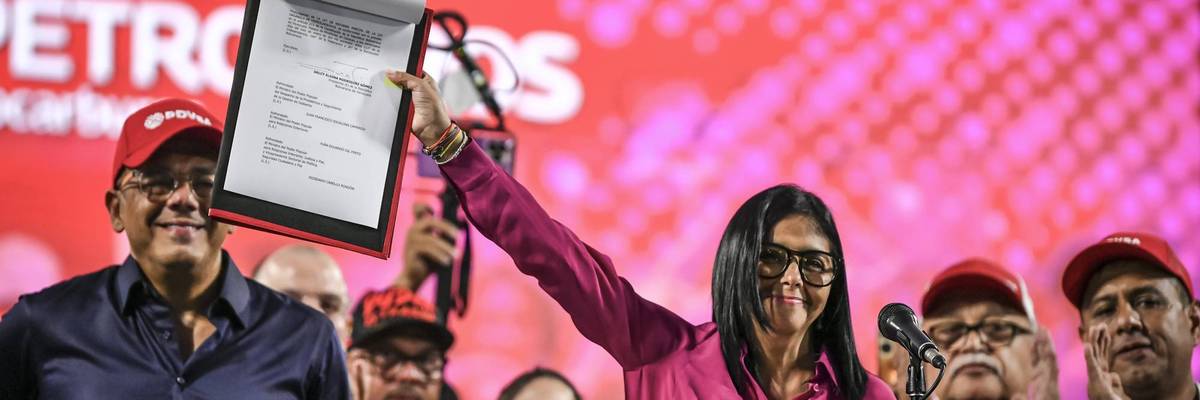
The acting president of Venezuela, Delcy Rodríguez, holds the new oil reform law during an event at Miraflores Palace on January 29, 2026 in Caracas.
"Trump is deploying drone and gunboat diplomacy to coerce Venezuela into serving up its oil resources to Big Oil," said one US watchdog group.
Venezuelan scholars and a US watchdog group were among those expressing concern on Thursday after Venezuela's government caved to pressure from President Donald Trump and signed a bill opening up the South American country's nationalized oil industry to privatization.
After US forces abducted Venezuelan President Nicolás Maduro and his wife, Cilia Flores—who have both pleaded not guilty to federal narco-terrorism charges—the Trump administration installed the deposed leader's former deputy, Delcy Rodríguez, as acting president.
On Thursday, Venezuela's National Assembly—which is led by the acting president's brother, Jorge Rodríguez—approved and Delcy Rodríguez signed legislation that "promises to give private companies control over the production and sale of oil and allow for independent arbitration of disputes," according to the Associated Press.
As AP reported:
Rodríguez's government expects the changes to serve as assurances for major US oil companies that have so far hesitated about returning to the volatile country. Some of those companies lost investments when the ruling party enacted the existing law two decades ago to favor Venezuela's state-run oil company, Petróleos de Venezuela SA, or PDVSA.
The revised law would modify extraction taxes, setting a royalty cap rate of 30% and allowing the executive branch to set percentages for every project based on capital investment needs, competitiveness, and other factors.
It also removes the mandate for disputes to be settled only in Venezuelan courts, which are controlled by the ruling party. Foreign investors have long viewed the involvement of independent courts as crucial to guard against future expropriation.
Malfred Gerig, a sociologist from Central University of Venezuela, said on social media that the Rodríguez siblings' United Socialist Party of Venezuela (PSUV) "has just approved the most anti-nationalist and damaging oil law since, at least, 1943. The absolute surrender of the state as an oil producer and a sudden conversion of the property rights of the Venezuelan nation into private rights of foreign companies."
Victor Lovera, an economics professor at Andres Bello Catholic University in Caracas, said that "it must be really fucking tough for the Rodríguez siblings to end up as the empire's lapdogs and open up the oil sector, taking us back to the 1970s, before the nationalization of oil. All just to cling to power for a few more months."
Trump—who returned to office a year ago with help from Big Oil's campaign cash—has made clear that his aggressive policy toward Venezuela is focused on the country's petroleum reserves, which critics have blasted as a clear effort to further enrich his donors and himself.
"Trump is deploying drone and gunboat diplomacy to coerce Venezuela into serving up its oil resources to Big Oil," said Robert Weissman, co-president of the US watchdog group Public Citizen, in a Thursday statement.
"Imperfectly, Venezuela has for most of the last century sought to manage its oil and gas reserves to advance its national interest, rather than that of outside investors," he noted. "Brutal sanctions and the threat of still more military action from the Trump regime are now forcing Venezuela to turn from that history and make its oil available to Big Oil at discount rates and to agree that investor disputes should be resolved at corporate-friendly international tribunals."
"This is imperial policy to benefit Big Oil, not Americans—and certainly not Venezuelans," Weissman stressed. "Even still, US oil companies are likely to be reluctant to invest heavily in Venezuela without US government guarantees—a likely next step in Trump’s oil imperialism, unless Congress moves proactively to block it."
Both chambers of the US Congress are narrowly controlled by Trump's Republican Party, and they have so far failed to pass war powers resolutions aimed at stopping more military action in Venezuela and the administration's bombings of boats allegedly smuggling drugs in international waters—all of which some American lawmakers and other experts have argued are illegal.
When Trump's secretary of state and acting national security adviser, Marco Rubio, testified before the Senate Foreign Relations Committee—on which he previously served—on Wednesday, he insisted that the president wasn’t planning for any more military action in Venezuela, but would take it, potentially without congressional authorization, in "self-defense."
Rubio also laid out how the United States intends to continue controlling Venezuelan oil and related profits, telling senators that Venezuela's government will submit periodic budgets, and as long as they comply with preset restrictions, the Trump administration will release funds from a US Treasury blocked account.
After the legislation passed Thursday, the Trump administration began easing sanctions on Venezuela's oil industry, with the Treasury issuing a general license authorizing certain activities involving Venezuelan-origin oil.
Dear Common Dreams reader, It’s been nearly 30 years since I co-founded Common Dreams with my late wife, Lina Newhouser. We had the radical notion that journalism should serve the public good, not corporate profits. It was clear to us from the outset what it would take to build such a project. No paid advertisements. No corporate sponsors. No millionaire publisher telling us what to think or do. Many people said we wouldn't last a year, but we proved those doubters wrong. Together with a tremendous team of journalists and dedicated staff, we built an independent media outlet free from the constraints of profits and corporate control. Our mission has always been simple: To inform. To inspire. To ignite change for the common good. Building Common Dreams was not easy. Our survival was never guaranteed. When you take on the most powerful forces—Wall Street greed, fossil fuel industry destruction, Big Tech lobbyists, and uber-rich oligarchs who have spent billions upon billions rigging the economy and democracy in their favor—the only bulwark you have is supporters who believe in your work. But here’s the urgent message from me today. It's never been this bad out there. And it's never been this hard to keep us going. At the very moment Common Dreams is most needed, the threats we face are intensifying. We need your support now more than ever. We don't accept corporate advertising and never will. We don't have a paywall because we don't think people should be blocked from critical news based on their ability to pay. Everything we do is funded by the donations of readers like you. When everyone does the little they can afford, we are strong. But if that support retreats or dries up, so do we. Will you donate now to make sure Common Dreams not only survives but thrives? —Craig Brown, Co-founder |
Venezuelan scholars and a US watchdog group were among those expressing concern on Thursday after Venezuela's government caved to pressure from President Donald Trump and signed a bill opening up the South American country's nationalized oil industry to privatization.
After US forces abducted Venezuelan President Nicolás Maduro and his wife, Cilia Flores—who have both pleaded not guilty to federal narco-terrorism charges—the Trump administration installed the deposed leader's former deputy, Delcy Rodríguez, as acting president.
On Thursday, Venezuela's National Assembly—which is led by the acting president's brother, Jorge Rodríguez—approved and Delcy Rodríguez signed legislation that "promises to give private companies control over the production and sale of oil and allow for independent arbitration of disputes," according to the Associated Press.
As AP reported:
Rodríguez's government expects the changes to serve as assurances for major US oil companies that have so far hesitated about returning to the volatile country. Some of those companies lost investments when the ruling party enacted the existing law two decades ago to favor Venezuela's state-run oil company, Petróleos de Venezuela SA, or PDVSA.
The revised law would modify extraction taxes, setting a royalty cap rate of 30% and allowing the executive branch to set percentages for every project based on capital investment needs, competitiveness, and other factors.
It also removes the mandate for disputes to be settled only in Venezuelan courts, which are controlled by the ruling party. Foreign investors have long viewed the involvement of independent courts as crucial to guard against future expropriation.
Malfred Gerig, a sociologist from Central University of Venezuela, said on social media that the Rodríguez siblings' United Socialist Party of Venezuela (PSUV) "has just approved the most anti-nationalist and damaging oil law since, at least, 1943. The absolute surrender of the state as an oil producer and a sudden conversion of the property rights of the Venezuelan nation into private rights of foreign companies."
Victor Lovera, an economics professor at Andres Bello Catholic University in Caracas, said that "it must be really fucking tough for the Rodríguez siblings to end up as the empire's lapdogs and open up the oil sector, taking us back to the 1970s, before the nationalization of oil. All just to cling to power for a few more months."
Trump—who returned to office a year ago with help from Big Oil's campaign cash—has made clear that his aggressive policy toward Venezuela is focused on the country's petroleum reserves, which critics have blasted as a clear effort to further enrich his donors and himself.
"Trump is deploying drone and gunboat diplomacy to coerce Venezuela into serving up its oil resources to Big Oil," said Robert Weissman, co-president of the US watchdog group Public Citizen, in a Thursday statement.
"Imperfectly, Venezuela has for most of the last century sought to manage its oil and gas reserves to advance its national interest, rather than that of outside investors," he noted. "Brutal sanctions and the threat of still more military action from the Trump regime are now forcing Venezuela to turn from that history and make its oil available to Big Oil at discount rates and to agree that investor disputes should be resolved at corporate-friendly international tribunals."
"This is imperial policy to benefit Big Oil, not Americans—and certainly not Venezuelans," Weissman stressed. "Even still, US oil companies are likely to be reluctant to invest heavily in Venezuela without US government guarantees—a likely next step in Trump’s oil imperialism, unless Congress moves proactively to block it."
Both chambers of the US Congress are narrowly controlled by Trump's Republican Party, and they have so far failed to pass war powers resolutions aimed at stopping more military action in Venezuela and the administration's bombings of boats allegedly smuggling drugs in international waters—all of which some American lawmakers and other experts have argued are illegal.
When Trump's secretary of state and acting national security adviser, Marco Rubio, testified before the Senate Foreign Relations Committee—on which he previously served—on Wednesday, he insisted that the president wasn’t planning for any more military action in Venezuela, but would take it, potentially without congressional authorization, in "self-defense."
Rubio also laid out how the United States intends to continue controlling Venezuelan oil and related profits, telling senators that Venezuela's government will submit periodic budgets, and as long as they comply with preset restrictions, the Trump administration will release funds from a US Treasury blocked account.
After the legislation passed Thursday, the Trump administration began easing sanctions on Venezuela's oil industry, with the Treasury issuing a general license authorizing certain activities involving Venezuelan-origin oil.
Venezuelan scholars and a US watchdog group were among those expressing concern on Thursday after Venezuela's government caved to pressure from President Donald Trump and signed a bill opening up the South American country's nationalized oil industry to privatization.
After US forces abducted Venezuelan President Nicolás Maduro and his wife, Cilia Flores—who have both pleaded not guilty to federal narco-terrorism charges—the Trump administration installed the deposed leader's former deputy, Delcy Rodríguez, as acting president.
On Thursday, Venezuela's National Assembly—which is led by the acting president's brother, Jorge Rodríguez—approved and Delcy Rodríguez signed legislation that "promises to give private companies control over the production and sale of oil and allow for independent arbitration of disputes," according to the Associated Press.
As AP reported:
Rodríguez's government expects the changes to serve as assurances for major US oil companies that have so far hesitated about returning to the volatile country. Some of those companies lost investments when the ruling party enacted the existing law two decades ago to favor Venezuela's state-run oil company, Petróleos de Venezuela SA, or PDVSA.
The revised law would modify extraction taxes, setting a royalty cap rate of 30% and allowing the executive branch to set percentages for every project based on capital investment needs, competitiveness, and other factors.
It also removes the mandate for disputes to be settled only in Venezuelan courts, which are controlled by the ruling party. Foreign investors have long viewed the involvement of independent courts as crucial to guard against future expropriation.
Malfred Gerig, a sociologist from Central University of Venezuela, said on social media that the Rodríguez siblings' United Socialist Party of Venezuela (PSUV) "has just approved the most anti-nationalist and damaging oil law since, at least, 1943. The absolute surrender of the state as an oil producer and a sudden conversion of the property rights of the Venezuelan nation into private rights of foreign companies."
Victor Lovera, an economics professor at Andres Bello Catholic University in Caracas, said that "it must be really fucking tough for the Rodríguez siblings to end up as the empire's lapdogs and open up the oil sector, taking us back to the 1970s, before the nationalization of oil. All just to cling to power for a few more months."
Trump—who returned to office a year ago with help from Big Oil's campaign cash—has made clear that his aggressive policy toward Venezuela is focused on the country's petroleum reserves, which critics have blasted as a clear effort to further enrich his donors and himself.
"Trump is deploying drone and gunboat diplomacy to coerce Venezuela into serving up its oil resources to Big Oil," said Robert Weissman, co-president of the US watchdog group Public Citizen, in a Thursday statement.
"Imperfectly, Venezuela has for most of the last century sought to manage its oil and gas reserves to advance its national interest, rather than that of outside investors," he noted. "Brutal sanctions and the threat of still more military action from the Trump regime are now forcing Venezuela to turn from that history and make its oil available to Big Oil at discount rates and to agree that investor disputes should be resolved at corporate-friendly international tribunals."
"This is imperial policy to benefit Big Oil, not Americans—and certainly not Venezuelans," Weissman stressed. "Even still, US oil companies are likely to be reluctant to invest heavily in Venezuela without US government guarantees—a likely next step in Trump’s oil imperialism, unless Congress moves proactively to block it."
Both chambers of the US Congress are narrowly controlled by Trump's Republican Party, and they have so far failed to pass war powers resolutions aimed at stopping more military action in Venezuela and the administration's bombings of boats allegedly smuggling drugs in international waters—all of which some American lawmakers and other experts have argued are illegal.
When Trump's secretary of state and acting national security adviser, Marco Rubio, testified before the Senate Foreign Relations Committee—on which he previously served—on Wednesday, he insisted that the president wasn’t planning for any more military action in Venezuela, but would take it, potentially without congressional authorization, in "self-defense."
Rubio also laid out how the United States intends to continue controlling Venezuelan oil and related profits, telling senators that Venezuela's government will submit periodic budgets, and as long as they comply with preset restrictions, the Trump administration will release funds from a US Treasury blocked account.
After the legislation passed Thursday, the Trump administration began easing sanctions on Venezuela's oil industry, with the Treasury issuing a general license authorizing certain activities involving Venezuelan-origin oil.