

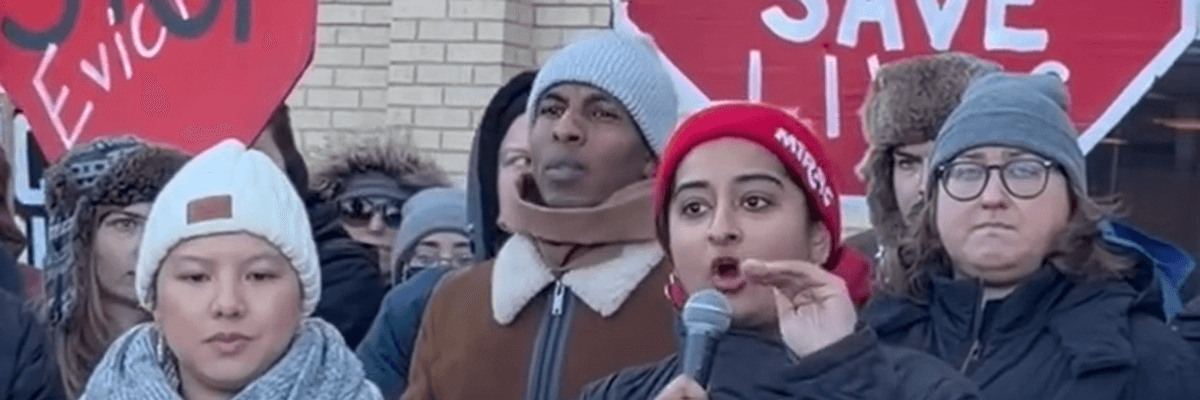
Minneapolis City Council Member Aisha Chughtai speaks at a rally outside the Minneapolis Public Housing Authority alongside labor and tenant organizers in support of a statewide eviction moratorium on January 31, 2026 in Minneapolis.
Twin Cities Unions Planning ‘Largest US Rent Strike in 100+ Years’ as ICE Occupation Drives Eviction Crisis
"Tenants in Minnesota are in a crisis," said Minneapolis City Council Member Aisha Chughtai. "The federal invasion forced many of our neighbors to stay home and devastated our local economy."
Tenant and labor unions in Minneapolis and St. Paul have announced plans to carry out what they said would be the "largest rent strike in the United States in the last 100 years."
Beginning on March 1, if Democratic Minnesota Gov. Tim Walz does not meet their urgent demands for an eviction moratorium and rent relief, a coalition of nearly 26,000 workers has pledged to withhold rent, which they said could create a massive economic disruption.
The plans were announced on Tuesday by the tenants union Twin Cities Tenants, which is joined by five labor unions: Service Employees International Union (SEIU) Local 26, SEIU Healthcare Minnesota/Iowa, UNITE HERE Local 17, the Amalgamated Transit Union (ATU) 1005, and Communication Workers of America (CWA) 7250.
They argued that a freeze on rents is desperately needed after "nearly three months of federal occupation" under President Donald Trump's "Operation Metro Surge," which sent nearly 3,000 Immigration and Customs Enforcement (ICE) and other immigration agents to the area, resulting in multiple fatal shootings and a wave of civil rights violations, including explicit racial profiling.
The unions said the daily presence of militarized agents "has taken a painful economic toll on poor and working-class tenants across the Twin Cities."
"Over 35,000 low-income Twin Cities households were already unable to afford the rent before the federal siege," they said. "Estimates show over $47 million in lost wages among people who have not been safe to go to work, and at least $15.7 million in additional rental assistance needed due to lost household income—leaving many of those households at imminent risk of eviction."
Evictions in Hennepin County spiked by 45% between this January and last, while requests for financial assistance have nearly doubled, according to a report this month from the Minnesota Spokesman-Recorder.
As the federal siege wore on and immigrants remained trapped in their homes, community members raised tens of thousands of dollars through GoFundMe campaigns. But it proved far too little to help the thousands of families suddenly at risk of losing their homes.
On January 30, tenant organizers, union members, and other local activists staged a sit-in at the Minneapolis Public Housing Authority and called for an immediate halt to evictions. Another group gathered outside the governor's mansion in St. Paul.
“We’re here today because federal immigration enforcement, eviction courts, and the police power of the state are converging to terrorize the same families,” said Jess Zarik, co-executive director of HOME Line. “Housing instability is being used as a weapon, and the scale of this crisis is unlike anything we’ve seen in our 34-year history.”
While city and state leaders have fought back rhetorically against the Trump administration's highest-profile abuses—including the shootings of Renee Good and Alex Pretti by agents last month—and called for accountability, organizers said they've been slow to remedy the wider effects it has had on working-class residents across the Twin Cities.
“A lot of people just can’t get to and from work because ICE has been stopping random cars on the road, largely based on what they think the skin color of the driver is,” said Klyde Warren, a Minneapolis renter and Twin Cities Tenants organizer. “How are you supposed to go to work and make money to pay your rent in those conditions? The answer is a lot of people just can’t right now, but the eviction courts are still operating as if things are normal and they’re not normal.”
Last week, Walz's office told Axios that the governor "does not currently have the legal authority to enact an eviction moratorium."
Walz enacted an eviction moratorium in early spring 2020, which tenant organizers said allowed renters to stay home safely to avoid risks from the Covid-19 pandemic. He did this using what is known as a "peacetime emergency" declaration, which allows the governor to circumvent typical rulemaking procedures during extraordinary circumstances.
The city councils of both Minneapolis and St. Paul voted unanimously last month for nonbinding resolutions calling on Walz to take similar action to protect vulnerable residents from displacement.
"Tenants in Minnesota are in a crisis. The federal invasion forced many of our neighbors to stay home and devastated our local economy," said Minneapolis City Council Member Aisha Chughtai (D-10). "We need real solutions for the cliff of the rental crisis we are facing on March 1."
"I will be going on rent strike on March 1, and I call on my constituents to join me, until we can get a real solution from our state government for this crisis," she said.
Even as ICE's operation draws to a close, some agents are still deployed and arresting Twin Cities residents. Organizers said that even after the surge itself ends, the economic fallout will need to be addressed.
"We absolutely need an eviction moratorium," said Geof Paquette, the internal organizing director at UNITE HERE Local 17. "Our members were struggling to keep up with housing costs before ICE occupied our streets. It has now become an emergency as many of our members are behind in their rent. It's well past time for some relief."
The unions have estimated that if just 10,000 of their members withheld their rent, it could cause $15 million in economic disruption and pressure the city and state government into action.
"The people of Minneapolis and St. Paul have shown the way, fighting a federal invasion and caring for their neighbors; their fight and their care continue in this historic rent strike," said Tara Raghuveer, director of the Tenant Union Federation. "Tenants and workers have decided that... they have no other choice but to strike. In taking this step, they join a storied tradition of struggle. The struggle can end whenever the governor steps in to do what's right."
We are at a crossroads
This country and this world are at a monumental crossroads. In a few short weeks, US voters will have an opportunity to beat back the forces of fascism and confront the billionaires who are rigging the economy, our media system, and our democracy, making it increasingly impossible for ordinary people to get by. We’re not just talking about the election. We’re talking about what must be done once these fascist elements are vanquished from power. We need a bolder set of solutions than what either major party has so far been willing to offer and a working-class movement ready to fight like hell for it. Trump didn't emerge from nowhere. The conditions that fueled MAGA authoritarianism were created by decades of radical neoliberal economic policies and a corrupt political system dominated by corporate interests. They slashed taxes on the super-rich, promising that the benefits would trickle down. They said giveaways to the corporate titans would make life more affordable for the rest of us. It was all bullshit. And when a bitter, betrayed populace searches for someone to blame, right-wing demagogues have little trouble finding scapegoats. People know when they're being lied to, but you won't hear any of this from the corporate media. Only independent journalism—powered and funded by people who believe in building a better world—can deliver truly trustworthy daily news. Our Fall Campaign is underway, and we need your help. To power our newsroom through the rest of the year, we need to raise $125,000 by midnight on October 31. So if you share our vision, please contribute whatever you can to sustain our work. |
Tenant and labor unions in Minneapolis and St. Paul have announced plans to carry out what they said would be the "largest rent strike in the United States in the last 100 years."
Beginning on March 1, if Democratic Minnesota Gov. Tim Walz does not meet their urgent demands for an eviction moratorium and rent relief, a coalition of nearly 26,000 workers has pledged to withhold rent, which they said could create a massive economic disruption.
The plans were announced on Tuesday by the tenants union Twin Cities Tenants, which is joined by five labor unions: Service Employees International Union (SEIU) Local 26, SEIU Healthcare Minnesota/Iowa, UNITE HERE Local 17, the Amalgamated Transit Union (ATU) 1005, and Communication Workers of America (CWA) 7250.
They argued that a freeze on rents is desperately needed after "nearly three months of federal occupation" under President Donald Trump's "Operation Metro Surge," which sent nearly 3,000 Immigration and Customs Enforcement (ICE) and other immigration agents to the area, resulting in multiple fatal shootings and a wave of civil rights violations, including explicit racial profiling.
The unions said the daily presence of militarized agents "has taken a painful economic toll on poor and working-class tenants across the Twin Cities."
"Over 35,000 low-income Twin Cities households were already unable to afford the rent before the federal siege," they said. "Estimates show over $47 million in lost wages among people who have not been safe to go to work, and at least $15.7 million in additional rental assistance needed due to lost household income—leaving many of those households at imminent risk of eviction."
Evictions in Hennepin County spiked by 45% between this January and last, while requests for financial assistance have nearly doubled, according to a report this month from the Minnesota Spokesman-Recorder.
As the federal siege wore on and immigrants remained trapped in their homes, community members raised tens of thousands of dollars through GoFundMe campaigns. But it proved far too little to help the thousands of families suddenly at risk of losing their homes.
On January 30, tenant organizers, union members, and other local activists staged a sit-in at the Minneapolis Public Housing Authority and called for an immediate halt to evictions. Another group gathered outside the governor's mansion in St. Paul.
“We’re here today because federal immigration enforcement, eviction courts, and the police power of the state are converging to terrorize the same families,” said Jess Zarik, co-executive director of HOME Line. “Housing instability is being used as a weapon, and the scale of this crisis is unlike anything we’ve seen in our 34-year history.”
While city and state leaders have fought back rhetorically against the Trump administration's highest-profile abuses—including the shootings of Renee Good and Alex Pretti by agents last month—and called for accountability, organizers said they've been slow to remedy the wider effects it has had on working-class residents across the Twin Cities.
“A lot of people just can’t get to and from work because ICE has been stopping random cars on the road, largely based on what they think the skin color of the driver is,” said Klyde Warren, a Minneapolis renter and Twin Cities Tenants organizer. “How are you supposed to go to work and make money to pay your rent in those conditions? The answer is a lot of people just can’t right now, but the eviction courts are still operating as if things are normal and they’re not normal.”
Last week, Walz's office told Axios that the governor "does not currently have the legal authority to enact an eviction moratorium."
Walz enacted an eviction moratorium in early spring 2020, which tenant organizers said allowed renters to stay home safely to avoid risks from the Covid-19 pandemic. He did this using what is known as a "peacetime emergency" declaration, which allows the governor to circumvent typical rulemaking procedures during extraordinary circumstances.
The city councils of both Minneapolis and St. Paul voted unanimously last month for nonbinding resolutions calling on Walz to take similar action to protect vulnerable residents from displacement.
"Tenants in Minnesota are in a crisis. The federal invasion forced many of our neighbors to stay home and devastated our local economy," said Minneapolis City Council Member Aisha Chughtai (D-10). "We need real solutions for the cliff of the rental crisis we are facing on March 1."
"I will be going on rent strike on March 1, and I call on my constituents to join me, until we can get a real solution from our state government for this crisis," she said.
Even as ICE's operation draws to a close, some agents are still deployed and arresting Twin Cities residents. Organizers said that even after the surge itself ends, the economic fallout will need to be addressed.
"We absolutely need an eviction moratorium," said Geof Paquette, the internal organizing director at UNITE HERE Local 17. "Our members were struggling to keep up with housing costs before ICE occupied our streets. It has now become an emergency as many of our members are behind in their rent. It's well past time for some relief."
The unions have estimated that if just 10,000 of their members withheld their rent, it could cause $15 million in economic disruption and pressure the city and state government into action.
"The people of Minneapolis and St. Paul have shown the way, fighting a federal invasion and caring for their neighbors; their fight and their care continue in this historic rent strike," said Tara Raghuveer, director of the Tenant Union Federation. "Tenants and workers have decided that... they have no other choice but to strike. In taking this step, they join a storied tradition of struggle. The struggle can end whenever the governor steps in to do what's right."
Tenant and labor unions in Minneapolis and St. Paul have announced plans to carry out what they said would be the "largest rent strike in the United States in the last 100 years."
Beginning on March 1, if Democratic Minnesota Gov. Tim Walz does not meet their urgent demands for an eviction moratorium and rent relief, a coalition of nearly 26,000 workers has pledged to withhold rent, which they said could create a massive economic disruption.
The plans were announced on Tuesday by the tenants union Twin Cities Tenants, which is joined by five labor unions: Service Employees International Union (SEIU) Local 26, SEIU Healthcare Minnesota/Iowa, UNITE HERE Local 17, the Amalgamated Transit Union (ATU) 1005, and Communication Workers of America (CWA) 7250.
They argued that a freeze on rents is desperately needed after "nearly three months of federal occupation" under President Donald Trump's "Operation Metro Surge," which sent nearly 3,000 Immigration and Customs Enforcement (ICE) and other immigration agents to the area, resulting in multiple fatal shootings and a wave of civil rights violations, including explicit racial profiling.
The unions said the daily presence of militarized agents "has taken a painful economic toll on poor and working-class tenants across the Twin Cities."
"Over 35,000 low-income Twin Cities households were already unable to afford the rent before the federal siege," they said. "Estimates show over $47 million in lost wages among people who have not been safe to go to work, and at least $15.7 million in additional rental assistance needed due to lost household income—leaving many of those households at imminent risk of eviction."
Evictions in Hennepin County spiked by 45% between this January and last, while requests for financial assistance have nearly doubled, according to a report this month from the Minnesota Spokesman-Recorder.
As the federal siege wore on and immigrants remained trapped in their homes, community members raised tens of thousands of dollars through GoFundMe campaigns. But it proved far too little to help the thousands of families suddenly at risk of losing their homes.
On January 30, tenant organizers, union members, and other local activists staged a sit-in at the Minneapolis Public Housing Authority and called for an immediate halt to evictions. Another group gathered outside the governor's mansion in St. Paul.
“We’re here today because federal immigration enforcement, eviction courts, and the police power of the state are converging to terrorize the same families,” said Jess Zarik, co-executive director of HOME Line. “Housing instability is being used as a weapon, and the scale of this crisis is unlike anything we’ve seen in our 34-year history.”
While city and state leaders have fought back rhetorically against the Trump administration's highest-profile abuses—including the shootings of Renee Good and Alex Pretti by agents last month—and called for accountability, organizers said they've been slow to remedy the wider effects it has had on working-class residents across the Twin Cities.
“A lot of people just can’t get to and from work because ICE has been stopping random cars on the road, largely based on what they think the skin color of the driver is,” said Klyde Warren, a Minneapolis renter and Twin Cities Tenants organizer. “How are you supposed to go to work and make money to pay your rent in those conditions? The answer is a lot of people just can’t right now, but the eviction courts are still operating as if things are normal and they’re not normal.”
Last week, Walz's office told Axios that the governor "does not currently have the legal authority to enact an eviction moratorium."
Walz enacted an eviction moratorium in early spring 2020, which tenant organizers said allowed renters to stay home safely to avoid risks from the Covid-19 pandemic. He did this using what is known as a "peacetime emergency" declaration, which allows the governor to circumvent typical rulemaking procedures during extraordinary circumstances.
The city councils of both Minneapolis and St. Paul voted unanimously last month for nonbinding resolutions calling on Walz to take similar action to protect vulnerable residents from displacement.
"Tenants in Minnesota are in a crisis. The federal invasion forced many of our neighbors to stay home and devastated our local economy," said Minneapolis City Council Member Aisha Chughtai (D-10). "We need real solutions for the cliff of the rental crisis we are facing on March 1."
"I will be going on rent strike on March 1, and I call on my constituents to join me, until we can get a real solution from our state government for this crisis," she said.
Even as ICE's operation draws to a close, some agents are still deployed and arresting Twin Cities residents. Organizers said that even after the surge itself ends, the economic fallout will need to be addressed.
"We absolutely need an eviction moratorium," said Geof Paquette, the internal organizing director at UNITE HERE Local 17. "Our members were struggling to keep up with housing costs before ICE occupied our streets. It has now become an emergency as many of our members are behind in their rent. It's well past time for some relief."
The unions have estimated that if just 10,000 of their members withheld their rent, it could cause $15 million in economic disruption and pressure the city and state government into action.
"The people of Minneapolis and St. Paul have shown the way, fighting a federal invasion and caring for their neighbors; their fight and their care continue in this historic rent strike," said Tara Raghuveer, director of the Tenant Union Federation. "Tenants and workers have decided that... they have no other choice but to strike. In taking this step, they join a storied tradition of struggle. The struggle can end whenever the governor steps in to do what's right."