SUBSCRIBE TO OUR FREE NEWSLETTER
Daily news & progressive opinion—funded by the people, not the corporations—delivered straight to your inbox.
5
#000000
#FFFFFF
To donate by check, phone, or other method, see our More Ways to Give page.
Daily news & progressive opinion—funded by the people, not the corporations—delivered straight to your inbox.
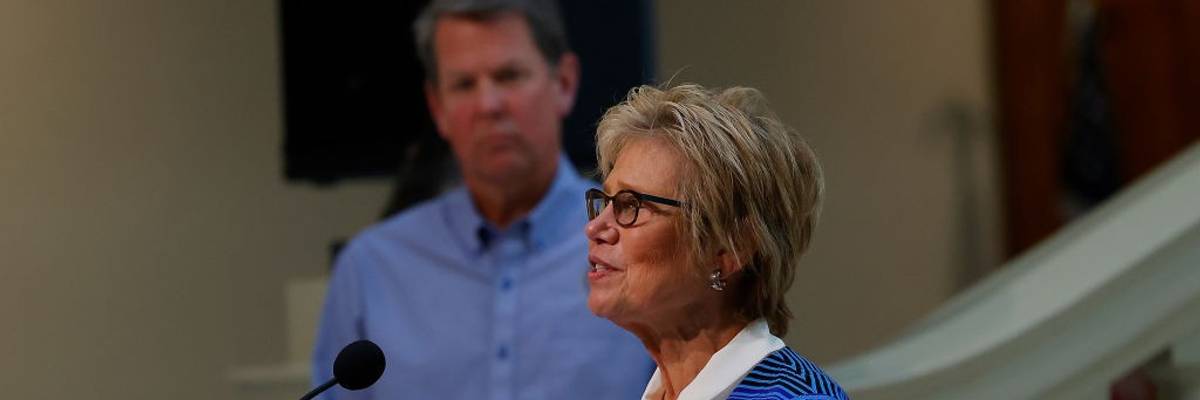
Georgia Department of Public Health Commissioner Dr. Kathleen Toomey answers questions during a press conference at the State Capitol on April 27, 2020 in Atlanta.
"This is how they cover up what abortion bans do—fire anyone who helps tell the stories of harm," said one journalist. "Everyone who is or can be pregnant will pay the price."
Georgia officials fired everyone on the Maternal Mortality Review Committee after ProPublica reported that the panel found the deaths of two women whose care was restricted by the state's abortion ban were preventable, the news outlet revealed Thursday.
ProPublica first exposed the committee's findings for Amber Nicole Thurman and Candi Miller in September, sparking a flood of criticism directed at abortion care restrictions and the primarily Republican politicians who impose them. Democratic Vice President Kamala Harris, who was running for the White House, even traveled to Atlanta to pay tribute to the two women.
"They didn't like that reporters found out that the state's ban killed two women."
Thurman and Miller's stories, as the news outlet acknowledged Thursday, "became a central discussion" in not only the presidential contest—ultimately won by Republican President-elect Donald Trump, who has bragged about the role he played in reversing Roe v. Wade—but also ballot initiatives to protect abortion rights in 10 states, seven of which succeeded.
In a November 8 letter obtained by ProPublica, Georgia Department of Public Health Commissioner Dr. Kathleen Toomey wrote that an "investigation was unable to uncover which individual(s) disclosed confidential information" despite state law and confidential agreements signed by panel members barring such disclosures.
Toomey explained that the committee was immediately "disbanded," a replacement panel will be formed through a new application process, and additional procedures are under consideration regarding confidentiality, oversight, and organizational structure.
ProPublica reported that the office of Republican Gov. Brian Kemp—who appointed Toomey—declined to comment and referred questions to the health department, whose spokesperson also declined to comment, saying that the letter, "speaks for itself."
As the outlet detailed:
Reproductive rights advocates say Georgia's decision to dismiss and restructure its committee also could have a chilling effect on the committee's work, potentially dissuading its members from delving as deeply as they have into the circumstances of pregnant women's deaths if it could be politically sensitive.
"They did what they were supposed to do. This is why we need them," said Monica Simpson, executive director of SisterSong, one of the groups challenging Georgia's abortion ban in court. "To have this abrupt disbandment, my concern is what we are going to lose in the process, in terms of time and data?"
Other reproductive rights advocates and journalists were similarly critical in response to the new reporting from ProPublica—which has also covered the deaths of two women in Texas: Josseli Barnica and Nevaeh Crain.
"Women died because they received no life-saving care as they were having miscarriages in Georgia and the state responded by simply eradicating the committee that investigated deaths of pregnant women," declared writer and organizer Hannah Riley.
The National Institute for Reproductive Health, an advocacy group, asserted that "when anti-abortion politicians find FACTS inconvenient, they dismantle the systems meant to hold them accountable."
New York magazine senior correspondent Irin Carmon, whose forthcoming book is about pregnancy in the United States, similarly said: "This is how they cover up what abortion bans do—fire anyone who helps tell the stories of harm. Everyone who is or can be pregnant will pay the price."
Jessica Valenti, author of the newsletter Abortion, Every Day and the book Abortion, also argued that Georgia officials fired the panel members because "they didn't like that reporters found out that the state's ban killed two women."
"I wrote about this in my book—this is how they cover up our deaths," Valenti continued. "In Idaho, they disbanded the Maternal Mortality Review Committee altogether; in Texas, they put a well-known anti-abortion activist on there to skew the data."
"I guarantee you that when Georgia replaces those seats on the Maternal Mortality Review Committee, they're going to put anti-abortion activists on there," she added. "Just watch."
Dear Common Dreams reader, It’s been nearly 30 years since I co-founded Common Dreams with my late wife, Lina Newhouser. We had the radical notion that journalism should serve the public good, not corporate profits. It was clear to us from the outset what it would take to build such a project. No paid advertisements. No corporate sponsors. No millionaire publisher telling us what to think or do. Many people said we wouldn't last a year, but we proved those doubters wrong. Together with a tremendous team of journalists and dedicated staff, we built an independent media outlet free from the constraints of profits and corporate control. Our mission has always been simple: To inform. To inspire. To ignite change for the common good. Building Common Dreams was not easy. Our survival was never guaranteed. When you take on the most powerful forces—Wall Street greed, fossil fuel industry destruction, Big Tech lobbyists, and uber-rich oligarchs who have spent billions upon billions rigging the economy and democracy in their favor—the only bulwark you have is supporters who believe in your work. But here’s the urgent message from me today. It's never been this bad out there. And it's never been this hard to keep us going. At the very moment Common Dreams is most needed, the threats we face are intensifying. We need your support now more than ever. We don't accept corporate advertising and never will. We don't have a paywall because we don't think people should be blocked from critical news based on their ability to pay. Everything we do is funded by the donations of readers like you. When everyone does the little they can afford, we are strong. But if that support retreats or dries up, so do we. Will you donate now to make sure Common Dreams not only survives but thrives? —Craig Brown, Co-founder |
Georgia officials fired everyone on the Maternal Mortality Review Committee after ProPublica reported that the panel found the deaths of two women whose care was restricted by the state's abortion ban were preventable, the news outlet revealed Thursday.
ProPublica first exposed the committee's findings for Amber Nicole Thurman and Candi Miller in September, sparking a flood of criticism directed at abortion care restrictions and the primarily Republican politicians who impose them. Democratic Vice President Kamala Harris, who was running for the White House, even traveled to Atlanta to pay tribute to the two women.
"They didn't like that reporters found out that the state's ban killed two women."
Thurman and Miller's stories, as the news outlet acknowledged Thursday, "became a central discussion" in not only the presidential contest—ultimately won by Republican President-elect Donald Trump, who has bragged about the role he played in reversing Roe v. Wade—but also ballot initiatives to protect abortion rights in 10 states, seven of which succeeded.
In a November 8 letter obtained by ProPublica, Georgia Department of Public Health Commissioner Dr. Kathleen Toomey wrote that an "investigation was unable to uncover which individual(s) disclosed confidential information" despite state law and confidential agreements signed by panel members barring such disclosures.
Toomey explained that the committee was immediately "disbanded," a replacement panel will be formed through a new application process, and additional procedures are under consideration regarding confidentiality, oversight, and organizational structure.
ProPublica reported that the office of Republican Gov. Brian Kemp—who appointed Toomey—declined to comment and referred questions to the health department, whose spokesperson also declined to comment, saying that the letter, "speaks for itself."
As the outlet detailed:
Reproductive rights advocates say Georgia's decision to dismiss and restructure its committee also could have a chilling effect on the committee's work, potentially dissuading its members from delving as deeply as they have into the circumstances of pregnant women's deaths if it could be politically sensitive.
"They did what they were supposed to do. This is why we need them," said Monica Simpson, executive director of SisterSong, one of the groups challenging Georgia's abortion ban in court. "To have this abrupt disbandment, my concern is what we are going to lose in the process, in terms of time and data?"
Other reproductive rights advocates and journalists were similarly critical in response to the new reporting from ProPublica—which has also covered the deaths of two women in Texas: Josseli Barnica and Nevaeh Crain.
"Women died because they received no life-saving care as they were having miscarriages in Georgia and the state responded by simply eradicating the committee that investigated deaths of pregnant women," declared writer and organizer Hannah Riley.
The National Institute for Reproductive Health, an advocacy group, asserted that "when anti-abortion politicians find FACTS inconvenient, they dismantle the systems meant to hold them accountable."
New York magazine senior correspondent Irin Carmon, whose forthcoming book is about pregnancy in the United States, similarly said: "This is how they cover up what abortion bans do—fire anyone who helps tell the stories of harm. Everyone who is or can be pregnant will pay the price."
Jessica Valenti, author of the newsletter Abortion, Every Day and the book Abortion, also argued that Georgia officials fired the panel members because "they didn't like that reporters found out that the state's ban killed two women."
"I wrote about this in my book—this is how they cover up our deaths," Valenti continued. "In Idaho, they disbanded the Maternal Mortality Review Committee altogether; in Texas, they put a well-known anti-abortion activist on there to skew the data."
"I guarantee you that when Georgia replaces those seats on the Maternal Mortality Review Committee, they're going to put anti-abortion activists on there," she added. "Just watch."
Georgia officials fired everyone on the Maternal Mortality Review Committee after ProPublica reported that the panel found the deaths of two women whose care was restricted by the state's abortion ban were preventable, the news outlet revealed Thursday.
ProPublica first exposed the committee's findings for Amber Nicole Thurman and Candi Miller in September, sparking a flood of criticism directed at abortion care restrictions and the primarily Republican politicians who impose them. Democratic Vice President Kamala Harris, who was running for the White House, even traveled to Atlanta to pay tribute to the two women.
"They didn't like that reporters found out that the state's ban killed two women."
Thurman and Miller's stories, as the news outlet acknowledged Thursday, "became a central discussion" in not only the presidential contest—ultimately won by Republican President-elect Donald Trump, who has bragged about the role he played in reversing Roe v. Wade—but also ballot initiatives to protect abortion rights in 10 states, seven of which succeeded.
In a November 8 letter obtained by ProPublica, Georgia Department of Public Health Commissioner Dr. Kathleen Toomey wrote that an "investigation was unable to uncover which individual(s) disclosed confidential information" despite state law and confidential agreements signed by panel members barring such disclosures.
Toomey explained that the committee was immediately "disbanded," a replacement panel will be formed through a new application process, and additional procedures are under consideration regarding confidentiality, oversight, and organizational structure.
ProPublica reported that the office of Republican Gov. Brian Kemp—who appointed Toomey—declined to comment and referred questions to the health department, whose spokesperson also declined to comment, saying that the letter, "speaks for itself."
As the outlet detailed:
Reproductive rights advocates say Georgia's decision to dismiss and restructure its committee also could have a chilling effect on the committee's work, potentially dissuading its members from delving as deeply as they have into the circumstances of pregnant women's deaths if it could be politically sensitive.
"They did what they were supposed to do. This is why we need them," said Monica Simpson, executive director of SisterSong, one of the groups challenging Georgia's abortion ban in court. "To have this abrupt disbandment, my concern is what we are going to lose in the process, in terms of time and data?"
Other reproductive rights advocates and journalists were similarly critical in response to the new reporting from ProPublica—which has also covered the deaths of two women in Texas: Josseli Barnica and Nevaeh Crain.
"Women died because they received no life-saving care as they were having miscarriages in Georgia and the state responded by simply eradicating the committee that investigated deaths of pregnant women," declared writer and organizer Hannah Riley.
The National Institute for Reproductive Health, an advocacy group, asserted that "when anti-abortion politicians find FACTS inconvenient, they dismantle the systems meant to hold them accountable."
New York magazine senior correspondent Irin Carmon, whose forthcoming book is about pregnancy in the United States, similarly said: "This is how they cover up what abortion bans do—fire anyone who helps tell the stories of harm. Everyone who is or can be pregnant will pay the price."
Jessica Valenti, author of the newsletter Abortion, Every Day and the book Abortion, also argued that Georgia officials fired the panel members because "they didn't like that reporters found out that the state's ban killed two women."
"I wrote about this in my book—this is how they cover up our deaths," Valenti continued. "In Idaho, they disbanded the Maternal Mortality Review Committee altogether; in Texas, they put a well-known anti-abortion activist on there to skew the data."
"I guarantee you that when Georgia replaces those seats on the Maternal Mortality Review Committee, they're going to put anti-abortion activists on there," she added. "Just watch."