SUBSCRIBE TO OUR FREE NEWSLETTER
Daily news & progressive opinion—funded by the people, not the corporations—delivered straight to your inbox.
5
#000000
#FFFFFF
To donate by check, phone, or other method, see our More Ways to Give page.
Daily news & progressive opinion—funded by the people, not the corporations—delivered straight to your inbox.

Today, Accountable Pharma released a new report outlining the more than $250 million in insider stock sales by executives and directors at five major drug companies producing vaccines with taxpayer support, including $105 million in new profits from insider sales between September and mid-November.
"Drug company executives continue shamelessly shoveling eye-popping amounts of money into their pockets after pumping share prices up with announcements that would have never been possible without taxpayer investments," said Eli Zupnick, spokesman for Accountable Pharma. "The Trump Administration should have included clear anti-profiteering provisions in the contracts handing billions of dollars to these drug companies, but since they didn't, we are calling on the companies to freeze all insider stock sales until the SEC can investigate their legality and propriety."
This new report builds on a previous report from Accountable Pharma that compiled executive trading data from the launch of Operation Warp Speed on May 15 through August 31, 2020 and found they made stock transactions valued at a net profit of more than $145 million.
On November 17th, SEC Chairman Jay Clayton called on drug companies to enact a "cooling off period" on their insider stock sale plans and make other changes to avoid potential insider trading and make sure companies are acting with "transparency and rigorous governance." Accountable Pharma has called for an SEC investigation and for freezes on insider stock sales at Moderna and Pfizer to prevent the kind of insider profiteering off of initial positive news that we've seen across the industry over the last few months.
Key points from report (read full report HERE):
From September To Mid-November, Execs At Four Drug Companies Involved In Operation Warp Speed Have Made Net Profit Of More Than $105M Dumping Their Companies' Stock. According to SEC filings, from the beginning of September through November 15, 2020, executives and directors at four of the companies receiving COVID vaccine funding through Operation Warp Speed have made stock transactions valued at a net profit of more than $105 million. NOTE: Johnson & Johnson did not report any new individual insider transactions during this period.
| Company | Net Profit |
| Emergent BioSolutions | $18,860,527.37 |
| Moderna | $50,406,146.77 |
| Novavax | $29,037,668.05 |
| Pfizer | $7,388,569.80 |
| Total | $105,692,911.99 |
Additional background
CNN: Pfizer and Moderna could score $32 billion in COVID-19 vaccine sales in 2021 alone: The imminent authorization of Pfizer's Covid-19 vaccine in the United States is a momentous occasion for science, the economy and humanity. The milestone is also a major moneymaker for the companies that developed the vaccines. Wall Street analysts are projecting Pfizer and Moderna will generate $32 billion in Covid-19 vaccine revenue -- next year alone..."It is absolutely wrong for drug companies like Pfizer and Moderna to profiteer, and for their executives to make egregious personal fortunes, off of Covid-19 vaccines that have been so heavily subsidized and supported by American taxpayers," said Eli Zupnick, a spokesman for Accountable.US, a progressive watchdog and patient advocacy group. [CNN, 12/11/20]
LA Times: Good vaccine news and a flurry of stock sales by executives. There's a pattern, study finds: As they raced to develop vaccines against COVID-19, executives at some pharmaceutical companies collected huge windfalls by selling stock around the time their companies announced positive news about the vaccines..The Washington, D.C.-based progressive watchdog group Accountable has also called on the SEC to investigate the Pfizer and Moderna trades. [LA Times, 12/7/20]
CBS: Watchdog urges SEC to investigate vaccine maker Moderna: An anti-corruption watchdog group is urging the U.S. Securities and Exchange Commission to investigate top executives at Moderna, the biotech firm developing a promising coronavirus vaccine, for allegedly manipulating the stock market. "This misconduct was particularly egregious because it involved not only financial fraud and manipulation of the financial markets, but also because it exploited widespread fears surrounding the ongoing COVID-19 pandemic," wrote Kyle Herrig, who heads Accountable.US, in a letter to the SEC. "I strongly urge the SEC to investigate these matters." [CBS, 6/3/20]
Reuters: Exclusive: Novavax executives could get big payday even if vaccine fails: One of the leading U.S. firms developing a coronavirus vaccine, Novavax Inc NVAX.O, has awarded executives stock options that could pay out tens of millions of dollars even if its efforts fail..."Drug companies like Novavax are getting billions of dollars from taxpayers to develop a COVID-19 vaccine, so it's certainly concerning to see their executives get massive payouts before we know if the vaccine actually works," said Eli Zupnick, a spokesman for consumer watchdog Patients Over Pharma. [Reuters, 7/22/20]
CBS: Moderna executives hiked their stock sales after announcing positive vaccine trial: Moderna CEO Stephane Bancel more than tripled the number of his company shares to be sold through an executive stock plan that was changed just days after the biotech in May announced positive early results for its coronavirus vaccine. ...the fact that the plans were changed during the pandemic as news was emerging about the company's closely watched coronavirus vaccine raises new questions about how Moderna executives have pocketed millions of dollars in recent months. "Once again, drug company executives have been caught playing games with their stock options," Kyle Herrig, who heads the government watchdog group Accountable.US, said in an email to CBS MoneyWatch.The group last month urged the SEC to investigate top executives at Moderna for allegedly manipulating the stock market. "The SEC needs to investigate these stock-plan changes," Herrig said. [CBS, 7/21/20]
Salon: Pharma execs dumped millions in stock for huge profits after getting pandemic contracts: Pharmaceutical executives continued to dump millions of dollars in stock in August despite criticism that they were profiting from big taxpayer-funded contracts awarded amid the coronavirus pandemic. Stock prices have soared for pharmaceutical companies like Moderna, which is developing a leading vaccine candidate, in no small part thanks to contracts awarded by the Trump administration. The top five executives at Moderna sold more than $89 million in stock in the first five months of the year, with about three times as many stock transactions as in all of 2019, according to Stat News...."It certainly doesn't inspire much confidence to see drug company executives feverishly dumping their stock options and cashing out fortunes for themselves after stock prices were inflated by the billions of dollars the Trump administration shoveled into drug company coffers," Eli Zupnick, a spokesman for the progressive watchdog group Accountable Pharma, told Salon. [Salon, 8/27/20]
Accountable.US is a nonpartisan watchdog that exposes corruption in public life and holds government officials and corporate special interests accountable by bringing their influence and misconduct to light. In doing so, we make way for policies that advance the interests of all Americans, not just the rich and powerful.
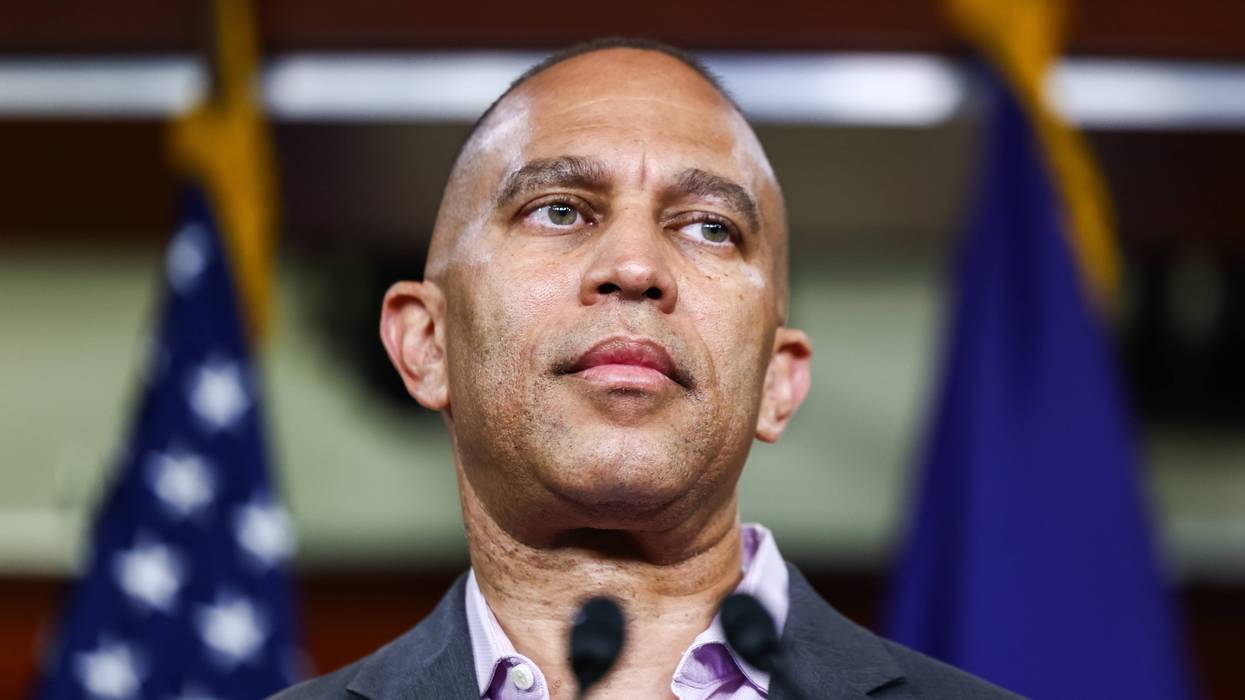
"Republicans don’t give a damn about the American people and will continue to make your life more expensive," said House Democratic leader Hakeem Jeffries (D-NY) in response.
White House National Economic Council Director Kevin Hassett caused a stir on Tuesday when he indicated that the prospect of US consumers getting hurt by a protracted conflict with Iran was not of particular concern to the administration.
During an interview on CNBC, Hassett dismissed concerns about the Iran war, which is now in its third week, dragging on indefinitely.
"The US economy is fundamentally sound," Hassett claimed. "And if [the war] were to be extended, it wouldn't really disrupt the US economy much at all. It would hurt consumers, and we'd have to think about, you know, if that continued, what we would have to do about that, but that's, like, really the last of our concerns right now... because we're very confident that this thing is going ahead of schedule."
Hassett: "If the war were to be extended, it wouldn't really disrupt the US economy very much at all. It would hurt consumers, and we'd have to think about what we'd have to do about that, but that's really the last of our concerns right now." pic.twitter.com/PVr63QO9Iv
— Aaron Rupar (@atrupar) March 17, 2026
In fact, US consumers are already hurting financially from the effects of the Iran war, which has caused the price of both oil and gasoline to skyrocket. Petroleum industry analyst Patrick De Haan reported on Tuesday that the average price of gas in the US has reached $3.80 per gallon, while the average price for diesel fuel has reached $5.03 per gallon.
The war's impact on oil and gas prices has been exacerbated by Iran closing down the Strait of Hormuz to shipping, and so far there is no indication that it will be reopening anytime soon.
Democratic lawmakers quickly pounced on Hassett's admission that pain for US consumers was "the last of our concerns right now."
"The Trump administration is saying the quiet part out loud," said Sen. Elizabeth Warren (D-Mass.), "the higher costs you're paying are the LAST of their concern."
"Trump's team of Epstein class advisors says it out loud more often than you’d think: 'consumers are the last of our concern right now,'" commented Sen. Chris Murphy (D-Conn.).
"Well I’m not some sort of political expert but this feels like an unhelpful thing to say," remarked Sen. Brian Schatz (D-Hawaii).
"Trump economic advisor says consumer pain is the last of their concerns," commented Sen. Ruben Gallego (D-Ariz.). "Tell that to Americans paying almost twice as much for gas as they were a month ago."
"The Trump administration has once again said the quiet part out loud," said House Democratic leader Hakeem Jeffries (D-NY). "Republicans don’t give a damn about the American people and will continue to make your life more expensive. You deserve better."
"American families don't need a report to tell them that the president has broken his campaign promise to slash energy costs."
Over two weeks into President Donald Trump and Israel's illegal war on Iran, which is driving up oil prices around the world, Democrats on the congressional Joint Economic Committee revealed Tuesday that the average US electric bill increased by $110, or 6.4%, last year.
The Democratic JEC staff compared monthly data from the federal Energy Information Administration for 2024, when Trump was campaigning to return to office against then-Democratic Vice President Kamala Harris, and 2025, when the Republican returned to power, having repeatedly promised to cut electric bills in half.
The JEC report highlights that last year's national average was "even higher than the increase the committee projected last November," plus "annual electricity costs were higher in 2025 in nearly every state, and were at least 10% higher in 12 states and DC."
The states with the highest bills were Connecticut and Hawaii, which each had an average of $2,490 for 2025. They were followed by Alabama at $2,230, Maryland at $2,220, Massachusetts at $2,190, Texas at $2,080, and Florida at $2,010.
In terms of the largest increases last year, the District of Columbia saw the biggest jump: a 23.5% rise from $1,360 to $1,680. New Jersey led all states with a 16.9% hike from $1,540 to $1,800, followed by Illinois at 15.9%, Pennsylvania at 12.1%, Kentucky at 11.8%, Maryland and Tennessee at 11.6%, New York at 11.4%, Ohio at 11.1%, and Missouri at 11%.
"American families don't need a report to tell them that the president has broken his campaign promise to slash energy costs; they already feel the impact of President Trump's actions every single day," said Sen. Maggie Hassan (D-NH), the panel's ranking member. "But this report is yet another indication that sky-high costs are continuing to rise—and are continuing to hurt American families."
Throughout last year, lawmakers and other experts warned of various policies expected to drive up utility bills, including the Republican budget package, or so-called One Big Beautiful Bill Act, which eliminated tax credits for solar and wind energy.
"Trump and Republicans are accelerating their self-inflicted energy crisis with continued project cancellations," the group Climate Power declared in a December report that blamed the administration for hurting "projects that would have produced enough electricity to power the equivalent of 13 million homes."
The Trump administration is also advocating for the construction of artificial intelligence data centers, despite warnings that the unregulated buildup of such facilities is causing local electricity costs to soar, plus threatening nearby communities and the global climate.
There's also US liquefied natural gas (LNG) exports, which are not only exacerbating the fossil fuel-driven climate emergency but also pushing up energy prices for Americans, as Public Citizen detailed in a December report. The watchdog noted that "1 in 6 Americans—21 million households—are behind on their energy bills," which "are rising at twice the rate of inflation."
"Energy Secretary Chris Wright and Interior Secretary Doug Burgum have acted as global gas salesmen, traveling to Europe to push exports and gut European methane regulations while attacking mainstream climate science," Tyson Slocum, report author and director of the Public Citizen's Energy Program, said at the time. "Meanwhile, Trump has done nothing to keep prices down at home."
The report preceded Big Oil-backed Trump launching a war on Iran without congressional authorization. While causing oil prices to skyrocket, his Operation Epic Fury is expected to boost the US LNG industry, with one expert projecting earlier this month that American companies could see up to $20 billion per month in windfall profits if the global market is deprived of Qatari gas until the summer.
"The State Department is threatening Zambia with an embargo on essential medicines in order to plunder its minerals," said one HIV prevention advocate.
The US State Department is threatening to strip HIV/AIDS and other disease prevention funds for more than a million people in the African nation of Zambia in a bid to extort the country for greater access to its mineral wealth.
The New York Times reported Monday on the draft of a memo prepared for Secretary of State Marco Rubio, which states that "we will only secure our priorities by demonstrating willingness to publicly take support away from Zambia on a massive scale."
The Trump administration is considering whether to "significantly cut assistance" from the President’s Emergency Plan for AIDS Relief (PEPFAR), which provides daily HIV treatment to around 1.3 million Zambians and other funds for tuberculosis and malaria medications that save tens of thousands of lives each year.
At the time that PEPFAR was created, under the administration of President George W. Bush, HIV was killing around 90,000 people per year in Zambia. That number had been reduced to 16,000 in 2024, according to data from the Joint United Nations Program on HIV/AIDS (UNAIDS).
"Things are not okay," said Justin Wolfers, an economics professor at the University of Michigan and a Brookings Institution fellow.
Threats to cut PEPFAR are part of a broader push by the Trump administration to wield desperately needed foreign medical aid as a tool of coercion against impoverished nations, whose health systems have been thrown into turmoil by the Trump administration's massive cuts to the US Agency for International Development (USAID) last year.
According to the Times, 24 African nations have signed memoranda of understanding (MOU) under the Trump administration's so-called "America First Global Health Strategy" in order to unlock some US funding that has been cut.
Many of the deals require nations to increase their own health spending in order to restore just a fraction of what the US previously provided:
"According to an analysis by the nonprofit Partners in Health, health funding under the agreements would drop by 69% to Rwanda, 61% to Madagascar, 42% to Liberia, and 34% to Eswatini, where a quarter of adults live with HIV," the Times reported in January.
Meanwhile, the deals have come with other, often ideological, strings attached. Kenya's memorandum requires it to provide data guaranteeing that no funding is being used for abortion care, and to direct funds to certain Christian faith-based providers, even though they refuse services like HIV care to LGBTQ+ people.
Nigeria's agreement likewise requires more than $200 million to over 900 Christian faith-based healthcare facilities across the country and emphasizes protecting Christian victims of violence from the Islamist group Boko Haram, even though the majority of the group's victims are Muslim.
Some countries have rejected the deals, calling them one-sided and exploitative. Last month, Zimbabwe walked away from a deal that would have provided $367 million over five years because it required the country to give the US unfettered access to citizens' health data and biological samples.
The deal offered to Zambia is similar to those offered to other countries in that it requires the government to commit $340 million in health spending in exchange for $1 billion from the US over five years, less than half of what it received under previous US administrations. It also demands that Zambia provide citizens' health data to the US for 10 years, longer than the deals agreed to by other nations.
But the deal also stipulates that, to receive any funding, Zambia must provide US corporations with easier access to the nation's vast mineral wealth.
Zambia has some of the world's largest reserves of minerals such as copper, lithium, and cobalt, which are essential to green energy technology. The Trump administration says the country has given China greater access to its mines than it has given to the US.
Zambia would also be required to share mining databases with US experts and renegotiate a massive 2024 contract with the Millennium Challenge Corporation, a US-based foreign assistance agency, to reduce mining regulations.
After the terms of the deal leaked to The Guardian last month, Asia Russell, director of the HIV advocacy organisation Health GAP, derided it as a proposal for the "shameless exploitation" of Zambia.
In February, Zambia rejected the deal, with a spokesperson for the Ministry of Health saying it "did not align with the position and interests of Zambia."
Now the Trump administration is using HIV treatment funding in an effort to force its leaders back to the table and make an example of them for other countries that may seek to go their own way.
The memo describes threats to AIDS funding as a way to demonstrate the "use of sticks" to other countries with which it seeks to negotiate.
If Zambia refuses to sign, it says, “sharp public cuts to American foreign assistance would significantly demonstrate to aid-receiving countries the seriousness of our interest in collaboration and our insistence on tangible benefits under our America First foreign policy."
Zambia has already been stripped of more than half its annual PEPFAR funding from the US since the Trump administration returned to power last year through a combination of foreign aid freezes, rescissions, and budget cuts that stripped billions from the program.
A survey of 76 HIV clinics across 32 mostly African countries that received PEPFAR funds, conducted by the International Epidemiology Databases to Evaluate AIDS (IeDEA) consortium, found that, as a result of cuts, many experienced disruptions to testing and treatment, including drug shortages and staff layoffs.
Citing modeling studies, the researchers estimated that funding disruptions to PEPFAR just last year "resulted in more than 120,000 deaths by November 2025, including more than 13,000 child deaths."
Another study by Imperial College London predicted that just the three-month disruption at the beginning of President Donald Trump's second term would result in more than 37,400 excess deaths by 2060.
In a statement posted to social media on Monday, Republicans on the House Foreign Affairs Committee defended the threats to cut PEPFAR, saying that "Just like every other country, Zambia is free to walk away from these negotiations." The REpublicans said it was "ridiculous to assume the United States should fund entire health systems for countries that turn around and give priority access to critical supply chains to China."
Russell said that "the State Department is threatening Zambia with an embargo on essential medicines in order to plunder its minerals."
While she said "Zambia’s MOU text is the first we know of that explicitly ties exploitation of mineral wealth," she noted that similar "exploitative conditions" are reportedly part of other nations' memoranda as well, but that information is scarce because they have been "negotiated in secret" and texts have not been made public.
Julius Kachidza, the chair of Zambia’s Civil Society Self-Coordinating Mechanism, said that yet another massive cut in US government funding “would be apocalyptic. It could be quite a disaster, especially to me. And the majority of people living with HIV in Zambia.”