SUBSCRIBE TO OUR FREE NEWSLETTER
Daily news & progressive opinion—funded by the people, not the corporations—delivered straight to your inbox.
5
#000000
#FFFFFF
To donate by check, phone, or other method, see our More Ways to Give page.
Daily news & progressive opinion—funded by the people, not the corporations—delivered straight to your inbox.
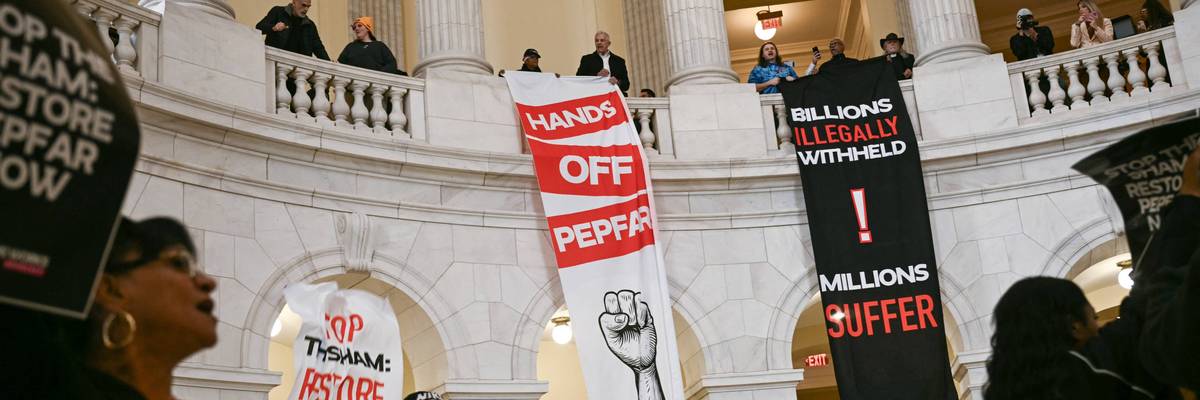
HIV activists protest to demand that the Trump administration and Congress fully restore the President's Emergency Plan for AIDS Relief (PEPFAR) programming in the lobby of the Cannon House Office Building on Capitol Hill in Washington, DC, on March 5, 2026.
"The State Department is threatening Zambia with an embargo on essential medicines in order to plunder its minerals," said one HIV prevention advocate.
The US State Department is threatening to strip HIV/AIDS and other disease prevention funds for more than a million people in the African nation of Zambia in a bid to extort the country for greater access to its mineral wealth.
The New York Times reported Monday on the draft of a memo prepared for Secretary of State Marco Rubio, which states that "we will only secure our priorities by demonstrating willingness to publicly take support away from Zambia on a massive scale."
The Trump administration is considering whether to "significantly cut assistance" from the President’s Emergency Plan for AIDS Relief (PEPFAR), which provides daily HIV treatment to around 1.3 million Zambians and other funds for tuberculosis and malaria medications that save tens of thousands of lives each year.
At the time that PEPFAR was created, under the administration of President George W. Bush, HIV was killing around 90,000 people per year in Zambia. That number had been reduced to 16,000 in 2024, according to data from the Joint United Nations Program on HIV/AIDS (UNAIDS).
"Things are not okay," said Justin Wolfers, an economics professor at the University of Michigan and a Brookings Institution fellow.
Threats to cut PEPFAR are part of a broader push by the Trump administration to wield desperately needed foreign medical aid as a tool of coercion against impoverished nations, whose health systems have been thrown into turmoil by the Trump administration's massive cuts to the US Agency for International Development (USAID) last year.
According to the Times, 24 African nations have signed memoranda of understanding (MOU) under the Trump administration's so-called "America First Global Health Strategy" in order to unlock some US funding that has been cut.
Many of the deals require nations to increase their own health spending in order to restore just a fraction of what the US previously provided:
"According to an analysis by the nonprofit Partners in Health, health funding under the agreements would drop by 69% to Rwanda, 61% to Madagascar, 42% to Liberia, and 34% to Eswatini, where a quarter of adults live with HIV," the Times reported in January.
Meanwhile, the deals have come with other, often ideological, strings attached. Kenya's memorandum requires it to provide data guaranteeing that no funding is being used for abortion care, and to direct funds to certain Christian faith-based providers, even though they refuse services like HIV care to LGBTQ+ people.
Nigeria's agreement likewise requires more than $200 million to over 900 Christian faith-based healthcare facilities across the country and emphasizes protecting Christian victims of violence from the Islamist group Boko Haram, even though the majority of the group's victims are Muslim.
Some countries have rejected the deals, calling them one-sided and exploitative. Last month, Zimbabwe walked away from a deal that would have provided $367 million over five years because it required the country to give the US unfettered access to citizens' health data and biological samples.
The deal offered to Zambia is similar to those offered to other countries in that it requires the government to commit $340 million in health spending in exchange for $1 billion from the US over five years, less than half of what it received under previous US administrations. It also demands that Zambia provide citizens' health data to the US for 10 years, longer than the deals agreed to by other nations.
But the deal also stipulates that, to receive any funding, Zambia must provide US corporations with easier access to the nation's vast mineral wealth.
Zambia has some of the world's largest reserves of minerals such as copper, lithium, and cobalt, which are essential to green energy technology. The Trump administration says the country has given China greater access to its mines than it has given to the US.
Zambia would also be required to share mining databases with US experts and renegotiate a massive 2024 contract with the Millennium Challenge Corporation, a US-based foreign assistance agency, to reduce mining regulations.
After the terms of the deal leaked to The Guardian last month, Asia Russell, director of the HIV advocacy organisation Health GAP, derided it as a proposal for the "shameless exploitation" of Zambia.
In February, Zambia rejected the deal, with a spokesperson for the Ministry of Health saying it "did not align with the position and interests of Zambia."
Now the Trump administration is using HIV treatment funding in an effort to force its leaders back to the table and make an example of them for other countries that may seek to go their own way.
The memo describes threats to AIDS funding as a way to demonstrate the "use of sticks" to other countries with which it seeks to negotiate.
If Zambia refuses to sign, it says, “sharp public cuts to American foreign assistance would significantly demonstrate to aid-receiving countries the seriousness of our interest in collaboration and our insistence on tangible benefits under our America First foreign policy."
Zambia has already been stripped of more than half its annual PEPFAR funding from the US since the Trump administration returned to power last year through a combination of foreign aid freezes, rescissions, and budget cuts that stripped billions from the program.
A survey of 76 HIV clinics across 32 mostly African countries that received PEPFAR funds, conducted by the International Epidemiology Databases to Evaluate AIDS (IeDEA) consortium, found that, as a result of cuts, many experienced disruptions to testing and treatment, including drug shortages and staff layoffs.
Citing modeling studies, the researchers estimated that funding disruptions to PEPFAR just last year "resulted in more than 120,000 deaths by November 2025, including more than 13,000 child deaths."
Another study by Imperial College London predicted that just the three-month disruption at the beginning of President Donald Trump's second term would result in more than 37,400 excess deaths by 2060.
In a statement posted to social media on Monday, Republicans on the House Foreign Affairs Committee defended the threats to cut PEPFAR, saying that "Just like every other country, Zambia is free to walk away from these negotiations." The Republicans said it was "ridiculous to assume the United States should fund entire health systems for countries that turn around and give priority access to critical supply chains to China."
Russell said that "the State Department is threatening Zambia with an embargo on essential medicines in order to plunder its minerals."
While she said "Zambia’s MOU text is the first we know of that explicitly ties exploitation of mineral wealth," she noted that similar "exploitative conditions" are reportedly part of other nations' memoranda as well, but that information is scarce because they have been "negotiated in secret" and texts have not been made public.
Julius Kachidza, the chair of Zambia’s Civil Society Self-Coordinating Mechanism, said that yet another massive cut in US government funding “would be apocalyptic. It could be quite a disaster, especially to me. And the majority of people living with HIV in Zambia.”
Dear Common Dreams reader, It’s been nearly 30 years since I co-founded Common Dreams with my late wife, Lina Newhouser. We had the radical notion that journalism should serve the public good, not corporate profits. It was clear to us from the outset what it would take to build such a project. No paid advertisements. No corporate sponsors. No millionaire publisher telling us what to think or do. Many people said we wouldn't last a year, but we proved those doubters wrong. Together with a tremendous team of journalists and dedicated staff, we built an independent media outlet free from the constraints of profits and corporate control. Our mission has always been simple: To inform. To inspire. To ignite change for the common good. Building Common Dreams was not easy. Our survival was never guaranteed. When you take on the most powerful forces—Wall Street greed, fossil fuel industry destruction, Big Tech lobbyists, and uber-rich oligarchs who have spent billions upon billions rigging the economy and democracy in their favor—the only bulwark you have is supporters who believe in your work. But here’s the urgent message from me today. It's never been this bad out there. And it's never been this hard to keep us going. At the very moment Common Dreams is most needed, the threats we face are intensifying. We need your support now more than ever. We don't accept corporate advertising and never will. We don't have a paywall because we don't think people should be blocked from critical news based on their ability to pay. Everything we do is funded by the donations of readers like you. When everyone does the little they can afford, we are strong. But if that support retreats or dries up, so do we. Will you donate now to make sure Common Dreams not only survives but thrives? —Craig Brown, Co-founder |
The US State Department is threatening to strip HIV/AIDS and other disease prevention funds for more than a million people in the African nation of Zambia in a bid to extort the country for greater access to its mineral wealth.
The New York Times reported Monday on the draft of a memo prepared for Secretary of State Marco Rubio, which states that "we will only secure our priorities by demonstrating willingness to publicly take support away from Zambia on a massive scale."
The Trump administration is considering whether to "significantly cut assistance" from the President’s Emergency Plan for AIDS Relief (PEPFAR), which provides daily HIV treatment to around 1.3 million Zambians and other funds for tuberculosis and malaria medications that save tens of thousands of lives each year.
At the time that PEPFAR was created, under the administration of President George W. Bush, HIV was killing around 90,000 people per year in Zambia. That number had been reduced to 16,000 in 2024, according to data from the Joint United Nations Program on HIV/AIDS (UNAIDS).
"Things are not okay," said Justin Wolfers, an economics professor at the University of Michigan and a Brookings Institution fellow.
Threats to cut PEPFAR are part of a broader push by the Trump administration to wield desperately needed foreign medical aid as a tool of coercion against impoverished nations, whose health systems have been thrown into turmoil by the Trump administration's massive cuts to the US Agency for International Development (USAID) last year.
According to the Times, 24 African nations have signed memoranda of understanding (MOU) under the Trump administration's so-called "America First Global Health Strategy" in order to unlock some US funding that has been cut.
Many of the deals require nations to increase their own health spending in order to restore just a fraction of what the US previously provided:
"According to an analysis by the nonprofit Partners in Health, health funding under the agreements would drop by 69% to Rwanda, 61% to Madagascar, 42% to Liberia, and 34% to Eswatini, where a quarter of adults live with HIV," the Times reported in January.
Meanwhile, the deals have come with other, often ideological, strings attached. Kenya's memorandum requires it to provide data guaranteeing that no funding is being used for abortion care, and to direct funds to certain Christian faith-based providers, even though they refuse services like HIV care to LGBTQ+ people.
Nigeria's agreement likewise requires more than $200 million to over 900 Christian faith-based healthcare facilities across the country and emphasizes protecting Christian victims of violence from the Islamist group Boko Haram, even though the majority of the group's victims are Muslim.
Some countries have rejected the deals, calling them one-sided and exploitative. Last month, Zimbabwe walked away from a deal that would have provided $367 million over five years because it required the country to give the US unfettered access to citizens' health data and biological samples.
The deal offered to Zambia is similar to those offered to other countries in that it requires the government to commit $340 million in health spending in exchange for $1 billion from the US over five years, less than half of what it received under previous US administrations. It also demands that Zambia provide citizens' health data to the US for 10 years, longer than the deals agreed to by other nations.
But the deal also stipulates that, to receive any funding, Zambia must provide US corporations with easier access to the nation's vast mineral wealth.
Zambia has some of the world's largest reserves of minerals such as copper, lithium, and cobalt, which are essential to green energy technology. The Trump administration says the country has given China greater access to its mines than it has given to the US.
Zambia would also be required to share mining databases with US experts and renegotiate a massive 2024 contract with the Millennium Challenge Corporation, a US-based foreign assistance agency, to reduce mining regulations.
After the terms of the deal leaked to The Guardian last month, Asia Russell, director of the HIV advocacy organisation Health GAP, derided it as a proposal for the "shameless exploitation" of Zambia.
In February, Zambia rejected the deal, with a spokesperson for the Ministry of Health saying it "did not align with the position and interests of Zambia."
Now the Trump administration is using HIV treatment funding in an effort to force its leaders back to the table and make an example of them for other countries that may seek to go their own way.
The memo describes threats to AIDS funding as a way to demonstrate the "use of sticks" to other countries with which it seeks to negotiate.
If Zambia refuses to sign, it says, “sharp public cuts to American foreign assistance would significantly demonstrate to aid-receiving countries the seriousness of our interest in collaboration and our insistence on tangible benefits under our America First foreign policy."
Zambia has already been stripped of more than half its annual PEPFAR funding from the US since the Trump administration returned to power last year through a combination of foreign aid freezes, rescissions, and budget cuts that stripped billions from the program.
A survey of 76 HIV clinics across 32 mostly African countries that received PEPFAR funds, conducted by the International Epidemiology Databases to Evaluate AIDS (IeDEA) consortium, found that, as a result of cuts, many experienced disruptions to testing and treatment, including drug shortages and staff layoffs.
Citing modeling studies, the researchers estimated that funding disruptions to PEPFAR just last year "resulted in more than 120,000 deaths by November 2025, including more than 13,000 child deaths."
Another study by Imperial College London predicted that just the three-month disruption at the beginning of President Donald Trump's second term would result in more than 37,400 excess deaths by 2060.
In a statement posted to social media on Monday, Republicans on the House Foreign Affairs Committee defended the threats to cut PEPFAR, saying that "Just like every other country, Zambia is free to walk away from these negotiations." The Republicans said it was "ridiculous to assume the United States should fund entire health systems for countries that turn around and give priority access to critical supply chains to China."
Russell said that "the State Department is threatening Zambia with an embargo on essential medicines in order to plunder its minerals."
While she said "Zambia’s MOU text is the first we know of that explicitly ties exploitation of mineral wealth," she noted that similar "exploitative conditions" are reportedly part of other nations' memoranda as well, but that information is scarce because they have been "negotiated in secret" and texts have not been made public.
Julius Kachidza, the chair of Zambia’s Civil Society Self-Coordinating Mechanism, said that yet another massive cut in US government funding “would be apocalyptic. It could be quite a disaster, especially to me. And the majority of people living with HIV in Zambia.”
The US State Department is threatening to strip HIV/AIDS and other disease prevention funds for more than a million people in the African nation of Zambia in a bid to extort the country for greater access to its mineral wealth.
The New York Times reported Monday on the draft of a memo prepared for Secretary of State Marco Rubio, which states that "we will only secure our priorities by demonstrating willingness to publicly take support away from Zambia on a massive scale."
The Trump administration is considering whether to "significantly cut assistance" from the President’s Emergency Plan for AIDS Relief (PEPFAR), which provides daily HIV treatment to around 1.3 million Zambians and other funds for tuberculosis and malaria medications that save tens of thousands of lives each year.
At the time that PEPFAR was created, under the administration of President George W. Bush, HIV was killing around 90,000 people per year in Zambia. That number had been reduced to 16,000 in 2024, according to data from the Joint United Nations Program on HIV/AIDS (UNAIDS).
"Things are not okay," said Justin Wolfers, an economics professor at the University of Michigan and a Brookings Institution fellow.
Threats to cut PEPFAR are part of a broader push by the Trump administration to wield desperately needed foreign medical aid as a tool of coercion against impoverished nations, whose health systems have been thrown into turmoil by the Trump administration's massive cuts to the US Agency for International Development (USAID) last year.
According to the Times, 24 African nations have signed memoranda of understanding (MOU) under the Trump administration's so-called "America First Global Health Strategy" in order to unlock some US funding that has been cut.
Many of the deals require nations to increase their own health spending in order to restore just a fraction of what the US previously provided:
"According to an analysis by the nonprofit Partners in Health, health funding under the agreements would drop by 69% to Rwanda, 61% to Madagascar, 42% to Liberia, and 34% to Eswatini, where a quarter of adults live with HIV," the Times reported in January.
Meanwhile, the deals have come with other, often ideological, strings attached. Kenya's memorandum requires it to provide data guaranteeing that no funding is being used for abortion care, and to direct funds to certain Christian faith-based providers, even though they refuse services like HIV care to LGBTQ+ people.
Nigeria's agreement likewise requires more than $200 million to over 900 Christian faith-based healthcare facilities across the country and emphasizes protecting Christian victims of violence from the Islamist group Boko Haram, even though the majority of the group's victims are Muslim.
Some countries have rejected the deals, calling them one-sided and exploitative. Last month, Zimbabwe walked away from a deal that would have provided $367 million over five years because it required the country to give the US unfettered access to citizens' health data and biological samples.
The deal offered to Zambia is similar to those offered to other countries in that it requires the government to commit $340 million in health spending in exchange for $1 billion from the US over five years, less than half of what it received under previous US administrations. It also demands that Zambia provide citizens' health data to the US for 10 years, longer than the deals agreed to by other nations.
But the deal also stipulates that, to receive any funding, Zambia must provide US corporations with easier access to the nation's vast mineral wealth.
Zambia has some of the world's largest reserves of minerals such as copper, lithium, and cobalt, which are essential to green energy technology. The Trump administration says the country has given China greater access to its mines than it has given to the US.
Zambia would also be required to share mining databases with US experts and renegotiate a massive 2024 contract with the Millennium Challenge Corporation, a US-based foreign assistance agency, to reduce mining regulations.
After the terms of the deal leaked to The Guardian last month, Asia Russell, director of the HIV advocacy organisation Health GAP, derided it as a proposal for the "shameless exploitation" of Zambia.
In February, Zambia rejected the deal, with a spokesperson for the Ministry of Health saying it "did not align with the position and interests of Zambia."
Now the Trump administration is using HIV treatment funding in an effort to force its leaders back to the table and make an example of them for other countries that may seek to go their own way.
The memo describes threats to AIDS funding as a way to demonstrate the "use of sticks" to other countries with which it seeks to negotiate.
If Zambia refuses to sign, it says, “sharp public cuts to American foreign assistance would significantly demonstrate to aid-receiving countries the seriousness of our interest in collaboration and our insistence on tangible benefits under our America First foreign policy."
Zambia has already been stripped of more than half its annual PEPFAR funding from the US since the Trump administration returned to power last year through a combination of foreign aid freezes, rescissions, and budget cuts that stripped billions from the program.
A survey of 76 HIV clinics across 32 mostly African countries that received PEPFAR funds, conducted by the International Epidemiology Databases to Evaluate AIDS (IeDEA) consortium, found that, as a result of cuts, many experienced disruptions to testing and treatment, including drug shortages and staff layoffs.
Citing modeling studies, the researchers estimated that funding disruptions to PEPFAR just last year "resulted in more than 120,000 deaths by November 2025, including more than 13,000 child deaths."
Another study by Imperial College London predicted that just the three-month disruption at the beginning of President Donald Trump's second term would result in more than 37,400 excess deaths by 2060.
In a statement posted to social media on Monday, Republicans on the House Foreign Affairs Committee defended the threats to cut PEPFAR, saying that "Just like every other country, Zambia is free to walk away from these negotiations." The Republicans said it was "ridiculous to assume the United States should fund entire health systems for countries that turn around and give priority access to critical supply chains to China."
Russell said that "the State Department is threatening Zambia with an embargo on essential medicines in order to plunder its minerals."
While she said "Zambia’s MOU text is the first we know of that explicitly ties exploitation of mineral wealth," she noted that similar "exploitative conditions" are reportedly part of other nations' memoranda as well, but that information is scarce because they have been "negotiated in secret" and texts have not been made public.
Julius Kachidza, the chair of Zambia’s Civil Society Self-Coordinating Mechanism, said that yet another massive cut in US government funding “would be apocalyptic. It could be quite a disaster, especially to me. And the majority of people living with HIV in Zambia.”