SUBSCRIBE TO OUR FREE NEWSLETTER
Daily news & progressive opinion—funded by the people, not the corporations—delivered straight to your inbox.
5
#000000
#FFFFFF
To donate by check, phone, or other method, see our More Ways to Give page.
Daily news & progressive opinion—funded by the people, not the corporations—delivered straight to your inbox.
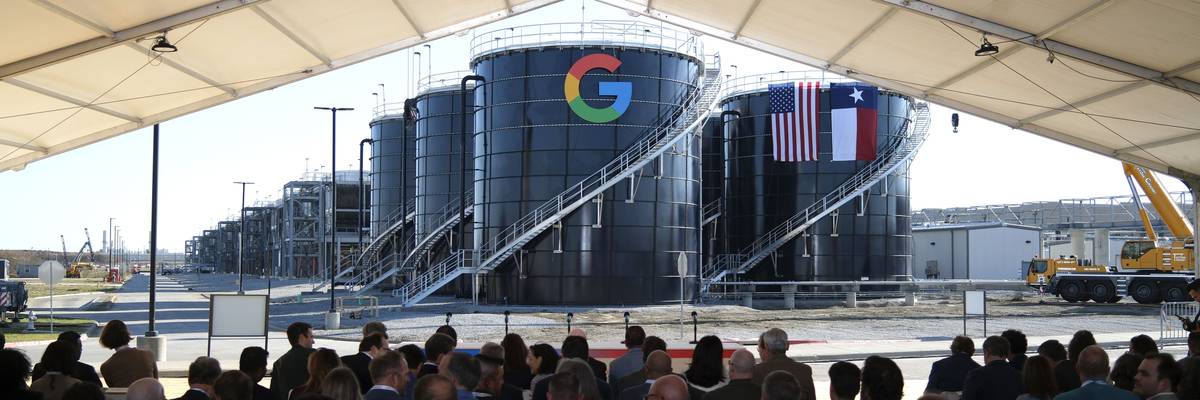
Attendees await the arrival of Texas Gov. Greg Abbott and Alphabet and Google CEO Sundar Pichai at the Google Midlothian Data Center on November 14, 2025, in Midlothian, Texas.
“Tech giants are cutting backroom deals with utilities and government officials to build massive data centers at breakneck speed, while passing the costs onto working families," said the author of a new Public Citizen report.
As the construction of artificial intelligence data centers expands across the nation largely unregulated, experts warn that the unrestrained buildup of these facilities is causing electricity costs to skyrocket, accelerating the climate crisis, and putting the economy at risk.
A new report out Thursday from the consumer advocacy group Public Citizen highlights the "unchecked expansion" of these data centers, often with little oversight, input from communities, or even financial responsibility on the part of the Big Tech firms profiting.
“We’re watching Big Tech overlords write their own rules in real time,” said Deanna Noël, Public Citizen's climate campaigns director and one of the report's authors. “Tech giants are cutting backroom deals with utilities and government officials to build massive data centers at breakneck speed, while passing the costs onto working families through higher electricity bills, polluted air and water, and false claims about job creation."
A forecast published earlier this week by Bloomberg New Energy Finance projected that the power demand for AI facilities will hit 106 gigawatts by 2035—a 36% jump from what it predicted back in April.
That dramatic increase, it said, can be attributed not just to the more rapid buildup of AI facilities, but also to the size of the ones being constructed: "Of the nearly 150 new data center projects BNEF added to its tracker in the last year, nearly a quarter exceed 500 megawatts," it found.
This faster-than-expected expansion has come with massive consequences for the people living near the power-sucking behemoths. Public Citizen's report found:
Residents’ electricity costs in some data center-dense areas have surged over 250% in just five years. At PJM—the world’s largest power market—capacity auction prices spiked 800% in 2024, in part due to data center growth. That same year, consumers across seven PJM states paid $4.3 billion more in electricity costs to cover data centers’ new transmission infrastructure.
On Wednesday, CNBC reported on findings from a watchdog report that PJM's 65 million consumers will pay a total of $16.6 billion to secure future power supplies needed to meet demand from AI data centers from now until 2027, approximately $255 per person on average.
In some of the states with the most data centers, residential electricity prices have spiked considerably over the past year. In September, they were up 20% in Illinois, 12% in Ohio, and 9% in Virginia, according to data from the federal Energy Information Administration.
The massive surge in electricity usage is also fueling the climate crisis. As of March 2025, 56% of the electricity used to power data centers came from fossil fuels, a share that is likely to increase now that the Trump administration has pushed to expand the extraction of coal and other planet-heating energy sources in order to power them.
"At the very moment we must rapidly phase out fossil fuels," Noël said, "the Trump administration is doing the opposite—fast-tracking data center development powered by coal, oil, and gas."
Tech companies like Amazon, Meta, and Google that benefit from these projects rarely have to bear the full economic cost, instead passing some of it onto taxpayers, often without public debate due to nondisclosure agreements that keep the details of proposals under wraps until deals are finalized.
"In the race to attract large data centers, states are forfeiting hundreds of millions of dollars in tax revenue," a June CNBC investigation found. The report determined that 42 states provide full or partial sales tax exemptions to data centers or have no sales tax at all. Thirty-seven of those states have legislation specifically granting sales tax exemptions for data centers.
While these exemptions are often granted following promises of economic growth and job creation, as the Public Citizen report argues: "They rarely deliver on these promises. Data centers create few permanent, high-paying jobs, and generous tax breaks deprive communities of critical revenue needed to fund schools, infrastructure, and other public services."
Data centers have increasingly faced pushback from local communities. On Wednesday night in Howell, Michigan, over 150 people assembled at a town hall in opposition to a proposed $1 billion "hyperscale" data center project backed by Meta, following days of protest.
“Already we have started to see many regions (across the country) realizing that the huge spike in electricity demand from data centers is straining the grid, and this is only going to get worse as the growth of data centers increases based on the projected and planned investments,” said one of the panelists, Ben Green, an assistant professor of information and public policy at the University of Michigan.
Economic analysts, meanwhile, remain skeptical about whether the rapid buildup of AI infrastructure will be sustainable in the long term, given the extraordinary energy demand.
In November, Morgan Stanley projected AI-related data center spending will total $2.9 trillion cumulatively from 2025 to 2028, with roughly half requiring external financing.
Abe Silverman, general counsel for the public utility board in New Jersey, pointed out to CNBC the unease communities are feeling about "paying money today for a data center tomorrow."
“We’re in a bit of a bubble,” he warned. “There is no question that data center developers are coming out of the woodwork, putting in massive numbers of new requests. It’s impossible to say exactly how many of them are speculative versus real.”
Cathy Kunkel, a consultant at the Institute for Energy Economics and Financial Analysis, said, "It does tend to be consumers—residential, commercial, and other industrial ratepayers—that end up paying for overbuilt electrical infrastructure."
The health of the entire US economy, it turns out, may be hitched to this "bubble." As the Wall Street Journal reported in late November, "business investment in AI might have accounted for as much as half of the growth in gross domestic product, adjusted for inflation, in the first six months of the year."
OpenAI founder Sam Altman raised eyebrows last month when he suggested that if the bubble bursts, his company is too big to fail, and would likely receive a large taxpayer-funded federal bailout: "When something gets sufficiently huge... the federal government is kind of the insurer of last resort as we've seen in various financial crises," Altman said. "So I guess given the magnitude of what I expect AI economic impact to look like, sort of I do think the government ends up as like the insurer of last resort."
A looming financial bubble related to AI's rapid growth, alongside the various other concerns related to the data center buildout, is why Public Citizen says policymakers must understand the gravity the situation and be willing to push back against an industry that has built an army of lobbyists to press its interests on Capitol Hill.
"Policymakers at all levels of government must act with urgency to rein in Big Tech’s unchecked expansion," Noël said. "By demanding transparency and accountability, enforcing strong community protections, and requiring clean and cheap renewable energy, policymakers can shield consumers from soaring electricity costs, reduce emissions to protect public health, and align this buildout with the clean energy transition.
"Without urgent intervention," she said, "Big Tech will continue getting a free ride while more neighborhoods are turned into sacrifice zones for Silicon Valley’s tech tycoons—fueled by the fossil fuel industry.”
Dear Common Dreams reader, It’s been nearly 30 years since I co-founded Common Dreams with my late wife, Lina Newhouser. We had the radical notion that journalism should serve the public good, not corporate profits. It was clear to us from the outset what it would take to build such a project. No paid advertisements. No corporate sponsors. No millionaire publisher telling us what to think or do. Many people said we wouldn't last a year, but we proved those doubters wrong. Together with a tremendous team of journalists and dedicated staff, we built an independent media outlet free from the constraints of profits and corporate control. Our mission has always been simple: To inform. To inspire. To ignite change for the common good. Building Common Dreams was not easy. Our survival was never guaranteed. When you take on the most powerful forces—Wall Street greed, fossil fuel industry destruction, Big Tech lobbyists, and uber-rich oligarchs who have spent billions upon billions rigging the economy and democracy in their favor—the only bulwark you have is supporters who believe in your work. But here’s the urgent message from me today. It's never been this bad out there. And it's never been this hard to keep us going. At the very moment Common Dreams is most needed, the threats we face are intensifying. We need your support now more than ever. We don't accept corporate advertising and never will. We don't have a paywall because we don't think people should be blocked from critical news based on their ability to pay. Everything we do is funded by the donations of readers like you. When everyone does the little they can afford, we are strong. But if that support retreats or dries up, so do we. Will you donate now to make sure Common Dreams not only survives but thrives? —Craig Brown, Co-founder |
As the construction of artificial intelligence data centers expands across the nation largely unregulated, experts warn that the unrestrained buildup of these facilities is causing electricity costs to skyrocket, accelerating the climate crisis, and putting the economy at risk.
A new report out Thursday from the consumer advocacy group Public Citizen highlights the "unchecked expansion" of these data centers, often with little oversight, input from communities, or even financial responsibility on the part of the Big Tech firms profiting.
“We’re watching Big Tech overlords write their own rules in real time,” said Deanna Noël, Public Citizen's climate campaigns director and one of the report's authors. “Tech giants are cutting backroom deals with utilities and government officials to build massive data centers at breakneck speed, while passing the costs onto working families through higher electricity bills, polluted air and water, and false claims about job creation."
A forecast published earlier this week by Bloomberg New Energy Finance projected that the power demand for AI facilities will hit 106 gigawatts by 2035—a 36% jump from what it predicted back in April.
That dramatic increase, it said, can be attributed not just to the more rapid buildup of AI facilities, but also to the size of the ones being constructed: "Of the nearly 150 new data center projects BNEF added to its tracker in the last year, nearly a quarter exceed 500 megawatts," it found.
This faster-than-expected expansion has come with massive consequences for the people living near the power-sucking behemoths. Public Citizen's report found:
Residents’ electricity costs in some data center-dense areas have surged over 250% in just five years. At PJM—the world’s largest power market—capacity auction prices spiked 800% in 2024, in part due to data center growth. That same year, consumers across seven PJM states paid $4.3 billion more in electricity costs to cover data centers’ new transmission infrastructure.
On Wednesday, CNBC reported on findings from a watchdog report that PJM's 65 million consumers will pay a total of $16.6 billion to secure future power supplies needed to meet demand from AI data centers from now until 2027, approximately $255 per person on average.
In some of the states with the most data centers, residential electricity prices have spiked considerably over the past year. In September, they were up 20% in Illinois, 12% in Ohio, and 9% in Virginia, according to data from the federal Energy Information Administration.
The massive surge in electricity usage is also fueling the climate crisis. As of March 2025, 56% of the electricity used to power data centers came from fossil fuels, a share that is likely to increase now that the Trump administration has pushed to expand the extraction of coal and other planet-heating energy sources in order to power them.
"At the very moment we must rapidly phase out fossil fuels," Noël said, "the Trump administration is doing the opposite—fast-tracking data center development powered by coal, oil, and gas."
Tech companies like Amazon, Meta, and Google that benefit from these projects rarely have to bear the full economic cost, instead passing some of it onto taxpayers, often without public debate due to nondisclosure agreements that keep the details of proposals under wraps until deals are finalized.
"In the race to attract large data centers, states are forfeiting hundreds of millions of dollars in tax revenue," a June CNBC investigation found. The report determined that 42 states provide full or partial sales tax exemptions to data centers or have no sales tax at all. Thirty-seven of those states have legislation specifically granting sales tax exemptions for data centers.
While these exemptions are often granted following promises of economic growth and job creation, as the Public Citizen report argues: "They rarely deliver on these promises. Data centers create few permanent, high-paying jobs, and generous tax breaks deprive communities of critical revenue needed to fund schools, infrastructure, and other public services."
Data centers have increasingly faced pushback from local communities. On Wednesday night in Howell, Michigan, over 150 people assembled at a town hall in opposition to a proposed $1 billion "hyperscale" data center project backed by Meta, following days of protest.
“Already we have started to see many regions (across the country) realizing that the huge spike in electricity demand from data centers is straining the grid, and this is only going to get worse as the growth of data centers increases based on the projected and planned investments,” said one of the panelists, Ben Green, an assistant professor of information and public policy at the University of Michigan.
Economic analysts, meanwhile, remain skeptical about whether the rapid buildup of AI infrastructure will be sustainable in the long term, given the extraordinary energy demand.
In November, Morgan Stanley projected AI-related data center spending will total $2.9 trillion cumulatively from 2025 to 2028, with roughly half requiring external financing.
Abe Silverman, general counsel for the public utility board in New Jersey, pointed out to CNBC the unease communities are feeling about "paying money today for a data center tomorrow."
“We’re in a bit of a bubble,” he warned. “There is no question that data center developers are coming out of the woodwork, putting in massive numbers of new requests. It’s impossible to say exactly how many of them are speculative versus real.”
Cathy Kunkel, a consultant at the Institute for Energy Economics and Financial Analysis, said, "It does tend to be consumers—residential, commercial, and other industrial ratepayers—that end up paying for overbuilt electrical infrastructure."
The health of the entire US economy, it turns out, may be hitched to this "bubble." As the Wall Street Journal reported in late November, "business investment in AI might have accounted for as much as half of the growth in gross domestic product, adjusted for inflation, in the first six months of the year."
OpenAI founder Sam Altman raised eyebrows last month when he suggested that if the bubble bursts, his company is too big to fail, and would likely receive a large taxpayer-funded federal bailout: "When something gets sufficiently huge... the federal government is kind of the insurer of last resort as we've seen in various financial crises," Altman said. "So I guess given the magnitude of what I expect AI economic impact to look like, sort of I do think the government ends up as like the insurer of last resort."
A looming financial bubble related to AI's rapid growth, alongside the various other concerns related to the data center buildout, is why Public Citizen says policymakers must understand the gravity the situation and be willing to push back against an industry that has built an army of lobbyists to press its interests on Capitol Hill.
"Policymakers at all levels of government must act with urgency to rein in Big Tech’s unchecked expansion," Noël said. "By demanding transparency and accountability, enforcing strong community protections, and requiring clean and cheap renewable energy, policymakers can shield consumers from soaring electricity costs, reduce emissions to protect public health, and align this buildout with the clean energy transition.
"Without urgent intervention," she said, "Big Tech will continue getting a free ride while more neighborhoods are turned into sacrifice zones for Silicon Valley’s tech tycoons—fueled by the fossil fuel industry.”
As the construction of artificial intelligence data centers expands across the nation largely unregulated, experts warn that the unrestrained buildup of these facilities is causing electricity costs to skyrocket, accelerating the climate crisis, and putting the economy at risk.
A new report out Thursday from the consumer advocacy group Public Citizen highlights the "unchecked expansion" of these data centers, often with little oversight, input from communities, or even financial responsibility on the part of the Big Tech firms profiting.
“We’re watching Big Tech overlords write their own rules in real time,” said Deanna Noël, Public Citizen's climate campaigns director and one of the report's authors. “Tech giants are cutting backroom deals with utilities and government officials to build massive data centers at breakneck speed, while passing the costs onto working families through higher electricity bills, polluted air and water, and false claims about job creation."
A forecast published earlier this week by Bloomberg New Energy Finance projected that the power demand for AI facilities will hit 106 gigawatts by 2035—a 36% jump from what it predicted back in April.
That dramatic increase, it said, can be attributed not just to the more rapid buildup of AI facilities, but also to the size of the ones being constructed: "Of the nearly 150 new data center projects BNEF added to its tracker in the last year, nearly a quarter exceed 500 megawatts," it found.
This faster-than-expected expansion has come with massive consequences for the people living near the power-sucking behemoths. Public Citizen's report found:
Residents’ electricity costs in some data center-dense areas have surged over 250% in just five years. At PJM—the world’s largest power market—capacity auction prices spiked 800% in 2024, in part due to data center growth. That same year, consumers across seven PJM states paid $4.3 billion more in electricity costs to cover data centers’ new transmission infrastructure.
On Wednesday, CNBC reported on findings from a watchdog report that PJM's 65 million consumers will pay a total of $16.6 billion to secure future power supplies needed to meet demand from AI data centers from now until 2027, approximately $255 per person on average.
In some of the states with the most data centers, residential electricity prices have spiked considerably over the past year. In September, they were up 20% in Illinois, 12% in Ohio, and 9% in Virginia, according to data from the federal Energy Information Administration.
The massive surge in electricity usage is also fueling the climate crisis. As of March 2025, 56% of the electricity used to power data centers came from fossil fuels, a share that is likely to increase now that the Trump administration has pushed to expand the extraction of coal and other planet-heating energy sources in order to power them.
"At the very moment we must rapidly phase out fossil fuels," Noël said, "the Trump administration is doing the opposite—fast-tracking data center development powered by coal, oil, and gas."
Tech companies like Amazon, Meta, and Google that benefit from these projects rarely have to bear the full economic cost, instead passing some of it onto taxpayers, often without public debate due to nondisclosure agreements that keep the details of proposals under wraps until deals are finalized.
"In the race to attract large data centers, states are forfeiting hundreds of millions of dollars in tax revenue," a June CNBC investigation found. The report determined that 42 states provide full or partial sales tax exemptions to data centers or have no sales tax at all. Thirty-seven of those states have legislation specifically granting sales tax exemptions for data centers.
While these exemptions are often granted following promises of economic growth and job creation, as the Public Citizen report argues: "They rarely deliver on these promises. Data centers create few permanent, high-paying jobs, and generous tax breaks deprive communities of critical revenue needed to fund schools, infrastructure, and other public services."
Data centers have increasingly faced pushback from local communities. On Wednesday night in Howell, Michigan, over 150 people assembled at a town hall in opposition to a proposed $1 billion "hyperscale" data center project backed by Meta, following days of protest.
“Already we have started to see many regions (across the country) realizing that the huge spike in electricity demand from data centers is straining the grid, and this is only going to get worse as the growth of data centers increases based on the projected and planned investments,” said one of the panelists, Ben Green, an assistant professor of information and public policy at the University of Michigan.
Economic analysts, meanwhile, remain skeptical about whether the rapid buildup of AI infrastructure will be sustainable in the long term, given the extraordinary energy demand.
In November, Morgan Stanley projected AI-related data center spending will total $2.9 trillion cumulatively from 2025 to 2028, with roughly half requiring external financing.
Abe Silverman, general counsel for the public utility board in New Jersey, pointed out to CNBC the unease communities are feeling about "paying money today for a data center tomorrow."
“We’re in a bit of a bubble,” he warned. “There is no question that data center developers are coming out of the woodwork, putting in massive numbers of new requests. It’s impossible to say exactly how many of them are speculative versus real.”
Cathy Kunkel, a consultant at the Institute for Energy Economics and Financial Analysis, said, "It does tend to be consumers—residential, commercial, and other industrial ratepayers—that end up paying for overbuilt electrical infrastructure."
The health of the entire US economy, it turns out, may be hitched to this "bubble." As the Wall Street Journal reported in late November, "business investment in AI might have accounted for as much as half of the growth in gross domestic product, adjusted for inflation, in the first six months of the year."
OpenAI founder Sam Altman raised eyebrows last month when he suggested that if the bubble bursts, his company is too big to fail, and would likely receive a large taxpayer-funded federal bailout: "When something gets sufficiently huge... the federal government is kind of the insurer of last resort as we've seen in various financial crises," Altman said. "So I guess given the magnitude of what I expect AI economic impact to look like, sort of I do think the government ends up as like the insurer of last resort."
A looming financial bubble related to AI's rapid growth, alongside the various other concerns related to the data center buildout, is why Public Citizen says policymakers must understand the gravity the situation and be willing to push back against an industry that has built an army of lobbyists to press its interests on Capitol Hill.
"Policymakers at all levels of government must act with urgency to rein in Big Tech’s unchecked expansion," Noël said. "By demanding transparency and accountability, enforcing strong community protections, and requiring clean and cheap renewable energy, policymakers can shield consumers from soaring electricity costs, reduce emissions to protect public health, and align this buildout with the clean energy transition.
"Without urgent intervention," she said, "Big Tech will continue getting a free ride while more neighborhoods are turned into sacrifice zones for Silicon Valley’s tech tycoons—fueled by the fossil fuel industry.”