February, 13 2018, 02:30pm EDT

In PA Common Cause Wants Equitable, Fair, Transparent Maps
Statements of Micah C.T. Sims, Executive Director of Common Cause PA & Kathay Feng, Common Cause National Redistricting Director.
WASHINGTON
Common Cause and Common Cause Pennsylvania issued the following statements today after Gov. Tom Wolf officially rejected the maps that Republican leadership submitted Friday to redraw the commonwealth's 18 congressional districts in response to a state Supreme Court ruling in January that found the legislative borders to be unconstitutionally gerrymandered:
"State leaders so far have missed a grand opportunity to work cooperatively to ensure every Pennsylvanian has fair representation. We continue to hope that a bipartisan consensus will emerge to give residents what they want --- the end to gerrymandered districts and legislative boundaries that are more reflective of our diverse state," said Micah Sims, Executive Director of Common Cause Pennsylvania. "At the end of the day, no matter who draws the maps --- whether it's the legislature, the governor or the courts --- Pennsylvanians deserve legislative districts that are fair to all voters, that are produced with complete transparency with respect to the data they used to draw boundaries, and that maintain racial equity for communities of color throughout the commonwealth."
"In a victory for the Commonwealth, the courts struck down the old political maps and ordered new ones that give all Pennsylvanians fair representation. Unfortunately, old habits die hard and the Legislature has proposed new districts that benefit the political insiders at the expense of everyday people," said Kathay Feng, Common Cause National Redistricting Director. "Pennsylvanians deserve fair representation. We look forward to a redistricting process managed by the court that will create fair and equal representation of every Pennsylvanian, regardless of their party affiliation."
In redrawing the districts, Common Cause Pennsylvania focused on two key issues, along with the neutral redistricting criteria: equity and transparency. For instance, ensuring that communities of color in southeastern Pennsylvania, and Philadelphia specifically, have districts that allow people of color to elect candidates of their choice is a priority. Further, to regain voter confidence, mapmakers from both parties must disclose the data they use to draw district lines. Voters need to be certain that politicians are not drawing districts to give their party an unfair advantage.
For more information at the Common Cause Pennsylvania website, click here.
To read this release online, click here.
Common Cause is a nonpartisan, grassroots organization dedicated to upholding the core values of American democracy. We work to create open, honest, and accountable government that serves the public interest; promote equal rights, opportunity, and representation for all; and empower all people to make their voices heard in the political process.
(202) 833-1200LATEST NEWS
'Dangerous and Shameful': 42 House Democrats Help GOP Send Trump Spying Bill to Senate
"It was these Democrats' responsibility to stand up against this administration, and they voted to stand down instead," said one campaigner.
Apr 29, 2026
Dozens of Democrats in the Republican-controlled US House of Representatives helped the GOP send a key spying bill to the Senate on Wednesday, earning sharp condemnation from the diverse movement that has called for privacy reforms.
The House voted 235-191 in favor of the bill released last week by Speaker Mike Johnson (R-La.), who has been trying for months to get an extension of Section 702 of the Foreign Intelligence Surveillance Act (FISA) to President Donald Trump's desk.
FISA's Section 702 allows the US government to surveil electronic communications of noncitizens located outside the United States to acquire foreign intelligence information, without a warrant. However, Americans' data is also swept up, and civil society, along with some lawmakers from both major parties, has demanded reforms to prevent further abuse by federal agencies.
In the lead-up to the vote, progressives such as Rep. Ilhan Omar (D-Minn.) warned that "this bill has no meaningful reforms to stop warrantless surveillance, directly undermining the Fourth Amendment" to the US Constitution, which is supposed to protect Americans against unreasonable searches and seizures.
Another "Squad" member, Rep. Rashida Tlaib (D-Mich.), took to the House floor to blast Section 702 as "a dangerous mass surveillance tool" that "has been used to spy on Black Lives Matter protesters, members of Congress, journalists, and more."
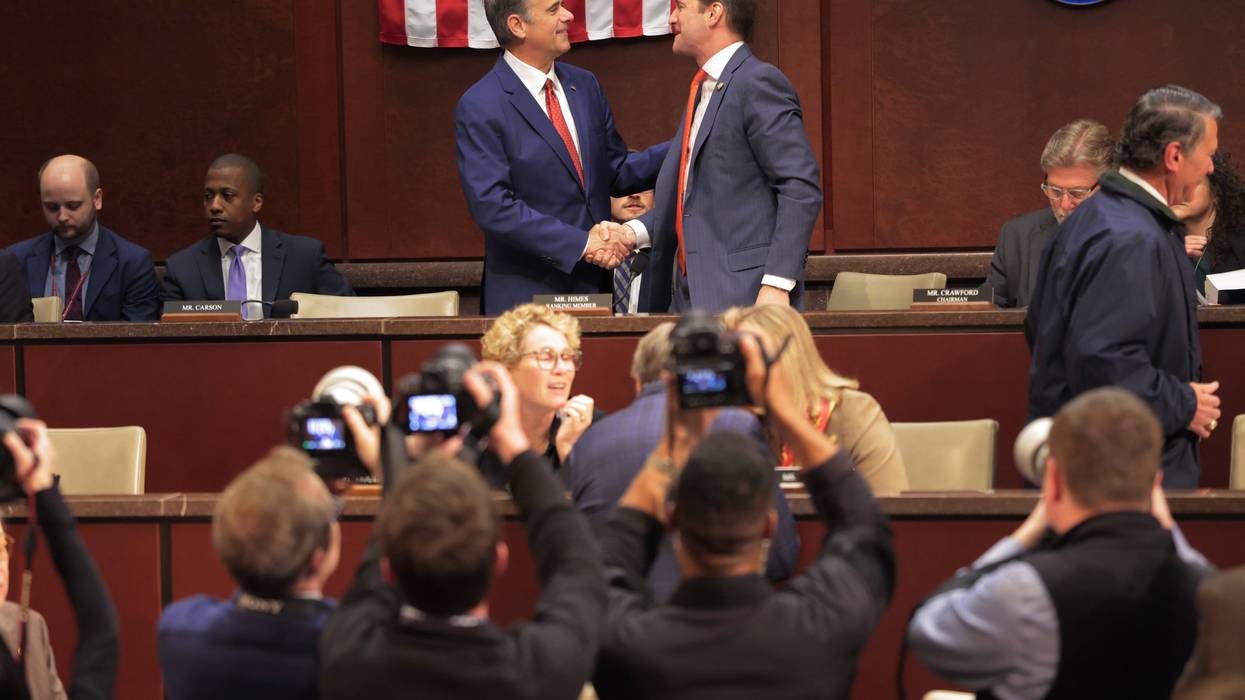
However, 42 Democrats—including House Permanent Select Committee on Intelligence Ranking Member Jim Himes (Conn.)—still joined most House Republicans in advancing the legislation.
"It's incredibly disappointing the House approved this measure," said Jake Laperruque, deputy director of the Center for Democracy and Technology's Security and Surveillance Project, in a statement. "This bill is empty calories through and through. It contains no warrant for querying Americans' messages, and no meaningful reforms of any kind. The razor-thin procedural vote this afternoon makes clear that there's an appetite for reform, but House leadership took meaningful reforms off the menu."
"There is nothing in this bill that would have prevented the abuses of FISA 702 we've already seen—snooping on lawmakers, protesters, and campaign donors—and there is nothing that would stop even worse abuses in the future. A vote for this bill was a vote to give the FBI and other intelligence agencies a three-year blank check for surveillance abuse."
Hajar Hammado, senior policy adviser at Demand Progress—which helped convene over 100 artificial intelligence, civil rights, and other progressive groups pressuring Congress to include privacy protections in any renewal bill for the spying power—took aim at the House Democrats who supported the legislation.
"The 42 Democratic votes to advance Speaker Johnson and Donald Trump's surveillance agenda are dangerous and shameful," she declared. "These Democrats defied their constituents and common sense to undercut meaningful privacy reforms in the House and instead voted to hand over sweeping spy powers to the Trump administration," she stressed. "This means continuing warrantless backdoor searches and allowing an increasing number of federal agencies to exploit the data broker loophole to supercharge AI and fuel mass domestic surveillance."
Hammado said that "their vote today has major consequences, as even 22 Republicans put principles over politics and voted against renewing FISA without warrant protections. It was these Democrats' responsibility to stand up against this administration and they voted to stand down instead."
While stressing that "no administration should have these powers," Free Press Action advocacy director Jenna Ruddock directed attention at "the champions for a clean extension of Section 702 in the Trump administration in particular," including the president's homeland security adviser, Stephen Miller.
"Stephen Miller has advocated against reforms to Section 702, claiming it is critical to his and Trump’s homeland security agenda, even as members of the administration refer to political opponents as 'enemies within,'" she noted. "Today, 42 Democrats joined 192 Republicans to co-sign Donald Trump and Stephen Miller's domestic surveillance agenda, jeopardizing the civil rights and liberties of every person in the United States."
Zeteo News reporter Prem Thakker pointed out that House "Democratic leadership did not whip their members, enabling them to vote with Republicans and give Trump the surveillance powers."
While calling out the House Democrats who backed the bill, campaigners also set their sights on the Senate, where Punchbowl News reporter Anthony Adragna predicted that "it's DOA," or dead on arrival. Republicans have a slim majority in the chamber and, due to its rules, need at least some Democratic support to pass most bills, including this one.
A key issue is the central bank digital currency ban included in the House bill. Senate Majority Leader John Thune (R-SD) told reporters on Wednesday that he may try to pass a 45-day extension instead. After a recent short-term extension, the spying authority is set to expire Thursday night.
"Now the fight moves to the Senate, where privacy champions in both parties are gearing up to try and stop this reckless giveaway to the surveillance state," Hammado said. She urged members of the upper chamber to join "bipartisan reformers" like Sens. Dick Durbin (D-Ill.), Mike Lee (R-Utah), Rand Paul (R-Ky.), and Ron Wyden (D-Ore.) "in voting against any FISA measure that lacks real reforms like a warrant requirement to close the backdoor search and data broker loopholes."
Laperruque similarly said that "we hope senators will stand strong and reject this dangerous proposal."
Ruddock highlighted that "there is bipartisan legislation already introduced in both the House and Senate that would make desperately needed reforms to government surveillance powers."
"The Senate should reject the fake reforms in the current House bill and demand a vote on real reforms to Section 702, including a warrant requirement, and closing the data broker loophole," she said. "Our constitutional rights depend on it."
Keep ReadingShow Less
Heinrich, Booker Push 'No Immunity for Glyphosate' Bill as Supreme Court Weighs Monsanto Case
Sen. Cory Booker said it "will overturn President Trump's executive order that prioritizes pesticide company profits over public health and ensure that people who have gotten cancer from glyphosate can seek justice."
Apr 29, 2026
On the heels of the US Supreme Court hearing arguments in Monsanto Company v. Durnell, Sens. Martin Heinrich and Cory Booker on Wednesday introduced legislation intended to overturn President Donald Trump's executive order mandating production of the highly contentious weedkiller at the center of that case.
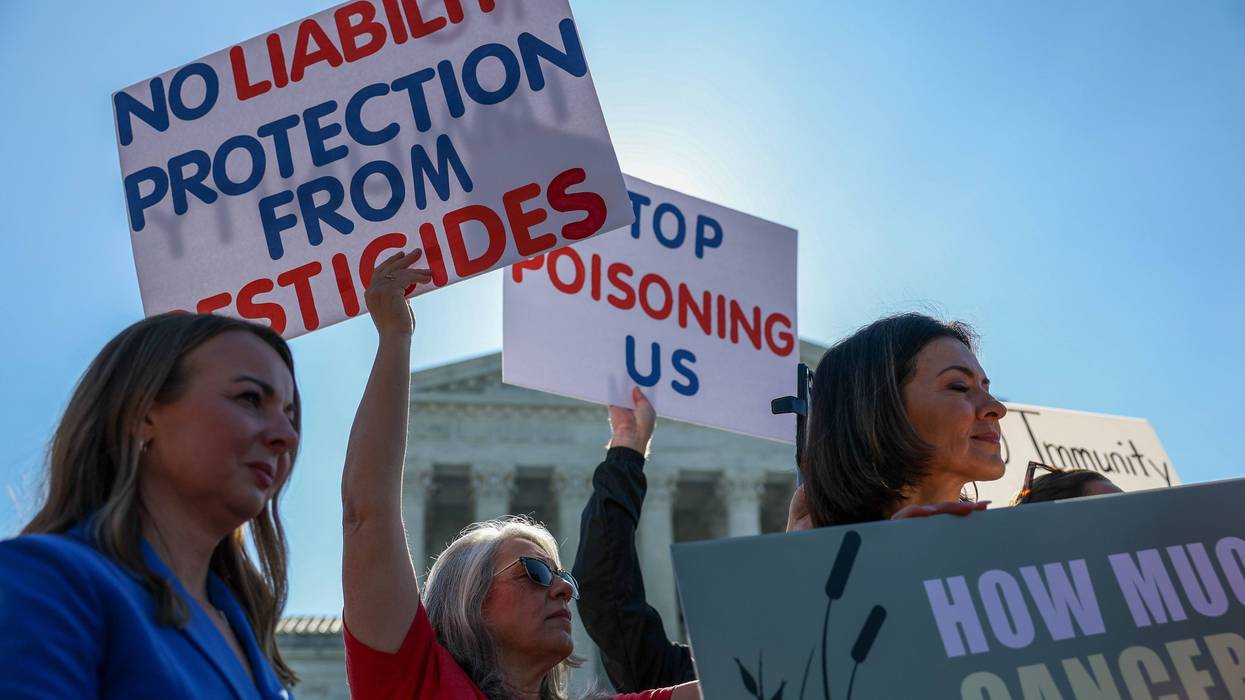
"Since my time serving as a City Council member in Newark, I have seen firsthand the devastating harm caused by toxic chemicals in our communities," Booker (D-NJ) said in a statement. "That is why, this week at a rally in front of the Supreme Court, I stood with cancer survivors, activists, and Make America Healthy Again advocates to protest against providing a liability shield to foreign corporations that are poisoning the American people."
"It is why I filed an amicus brief to the Supreme Court supporting Americans who developed cancer after using a toxic pesticide in a case that will determine whether thousands harmed by glyphosate can have their day in court—and why I am a proud co-sponsor of the No Immunity for Glyphosate Act," he added, "legislation that will overturn President Trump's executive order that prioritizes pesticide company profits over public health and ensure that people who have gotten cancer from glyphosate can seek justice in federal court."
Despite Trump's campaign promise to "Make America Healthy Again," he has frequently served the pesticide industry, including by siding with Bayer—which bought Monsanto in 2018—in the case before the high court, and by signing the February order invoking the Defense Production Act for glyphosate, the active ingredient in Monsanto's Roundup.
Specifically, Trump directed US Secretary of Agriculture Brooke Rollins to ensure "a continued and adequate supply of elemental phosphorus and glyphosate-based herbicides." He also noted that domestic producers are required to comply with his order, and under the federal law he invoked, those doing so have broad legal immunity.
Just before Trump's order, Bayer announced a proposed settlement for the tens of thousands of people who say exposure to Roundup caused their cancer. Still, the company and the US Environmental Protection Agency (EPA) continue to claim glyphosate is safe, despite the World Health Organization's International Agency for Research on Cancer classifying it as probably carcinogenic to humans over a decade ago.
The case before the Supreme Court stems from a lawsuit and a resulting verdict in favor of John Durnell, a Missouri man whose blood cancer is in remission after multiple rounds of chemotherapy. The justices' decision could determine whether many others are able to continue pursuing cases against Bayer. Republicans are also pushing to include a "liability shield" for pesticide manufacturers in the next Farm Bill.
Meanwhile, Booker and Heinrich's bill states that "no federal funds may be obligated or expended to implement, administer, or enforce" Trump's glyphosate order, and "any person, or the estate, survivors, or legal representative of such person, who suffers or has suffered physical injury, illness, disease, or death caused, in whole or in part, by exposure to elemental phosphorus or a glyphosate-based herbicide manufactured, distributed, sold, or supplied within the United States, may bring a civil action in an appropriate district court of the United States against any covered entity."
Heinrich said Wednesday that "juries across the country are looking at the evidence and delivering verdicts: Exposure to glyphosate can cause cancer. The Supreme Court cannot and should not allow these verdicts to be overturned."
"My constituents' health and safety comes first. And I will not stand by while President Trump gives immunity to those who put my constituents' health and safety at risk," he added. "That’s why I’m proud to lead the No Immunity for Glyphosate Act, legislation that will restore accountability, uphold court rulings, and protect the health and well-being of families in New Mexico and across the country."
The bill is also backed by Sens. Ed Markey (D-Mass.), Jeff Merkley (D-Ore.), and Peter Welch (D-Vt.). Reps. Thomas Massie (R-Ky.) and Chellie Pingree (D-Maine) introduced companion legislation in February, just after Trump's order. The lead sponsors in the House of Representatives also are working to strip the immunity shield from the Farm Bill and joined Booker at "The People v. Poison" rally outside the Supreme Court on Monday.
The next day, another House Democrat, Rep. Alexandria Ocasio-Cortez (NY), questioned EPA Administrator Lee Zeldin about the immunity shield in Trump's order, as well as his meeting with Bayer's CEO last year and some related internal emails.
"AOC smoked him in there," Drop Site News reporter Julian Andreone said on social media. "Red-handed."
Keep ReadingShow Less
Citing 'Irreversible Harm,' 100+ Groups Urge Congress to Reject Rushed Data Center Approvals
"Congress must not let Big Tech block oversight and hide data centers’ real harms from the public, including their immense energy and water use, dangerous pollution, and rising local costs," said one campaigner.
Apr 29, 2026
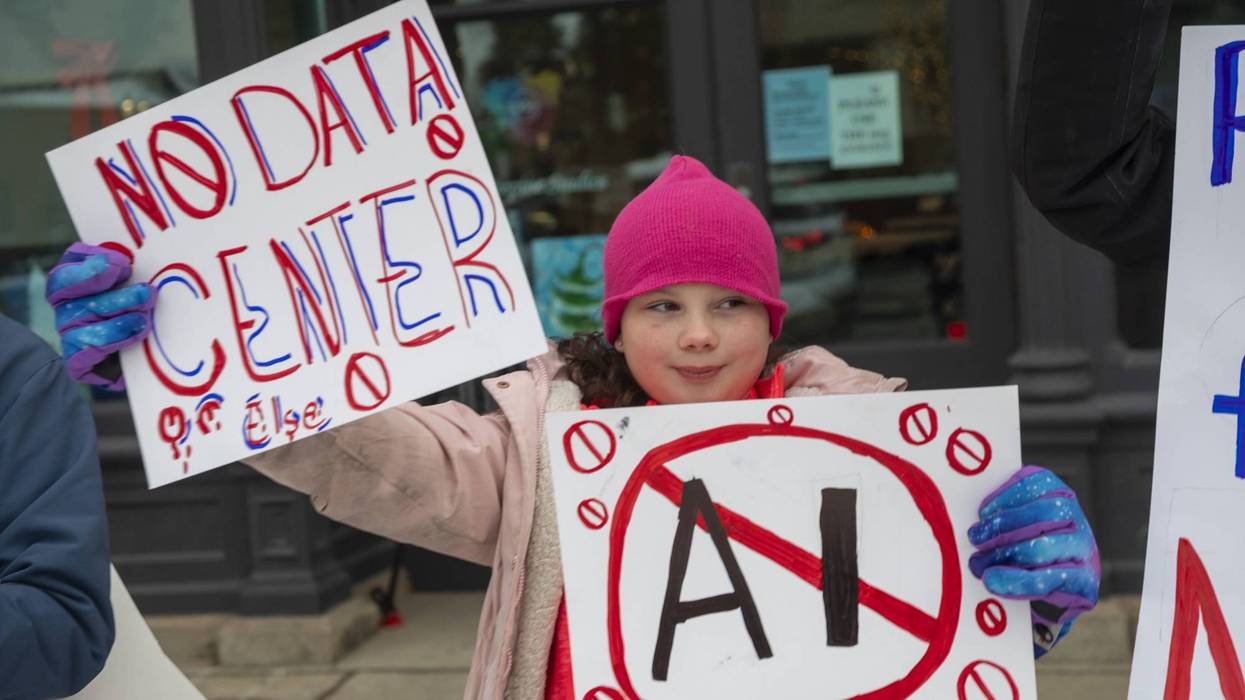
Nearly 120 civil society groups on Wednesday urged US lawmakers to reject Republican-led efforts to fast-track approval of artificial intelligence and conventional data centers, including by slipping provisions for these facilities into permitting reform legislation or "must-pass" bills.
Fossil fuel companies "are pushing to fast-track data center build-outs while ignoring the impacts on communities and the environment," the groups said in a letter to congressional leaders. "Proposals disguised as 'commonsense' reforms would weaken the National Environmental Policy Act (NEPA), the Clean Water Act, the Clean Air Act, and the Endangered Species Act, while also stripping residents of their right to participate in decisions affecting their health, water, and air."
"Congress cannot allow these industries to externalize costs while claiming progress," the letter states. "Lawmakers must prioritize public health, environmental sustainability, and community resilience, and reject rollbacks that hand corporations unchecked control over land, energy, and local resources."
If Joni Mitchell's iconic "Big Yellow Taxi" was written today the lyrics would say, "they paved paradise and put up a data center."We'd like to preserve paradise. So, the Center and our allies just urged Congress to reject fast-tracking harmful data centers. More info: biodiv.us/4cHWF4g
— Center for Biological Diversity (@biologicaldiversity.org) April 29, 2026 at 11:23 AM
The groups further called on lawmakers to eschew inclusion of data center provisions in "must-pass" legislation such as appropriations bills, the National Defense Authorization Act, Water Resources Development Act, and Farm Bill.
“Our democratic process was sidelined when our most powerful leaders both elected and unelected championed a data center while community voices were shut out,” said LaTricea Adams, CEO and president of Young, Gifted & Green, a national civil and environmental justice group that signed the letter.
Young, Gifted & Green is one of the frontline groups fighting Colossus, an enormous Memphis data center operated by Elon Musk's xAI to train its Grok AI chatbot using over 100,000 Nvidia H100 graphics processing units. The NAACP and Southern Environmental Law Center are suing xAI for alleged violations of the Clean Air Act related to the massive facility.
“What happens in Memphis can happen in cities and states across the country," Adams said. "We need the US Congress to do its job now to preserve and protect our rights as constituents and fight for our democracy.”
The letter's signers include 350.org, the Center for Biological Diversity, CodePink, Food and Water Watch, Friends of the Earth, Greenpeace USA, Oil Change International, Third Act, Turtle Island Restoration Network, Waterkeeper Alliance, and more than 100 other organizations.
The groups' letter comes as more and more communities are successfully opposing the proliferation of data centers across the nation. In Maine, state lawmakers recently passed legislation that would have enacted the nation’s first statewide moratorium on AI data centers had Democratic Gov. Janet Mills not vetoed the move.
Developers want to build 51 data warehouses, each the size of a Walmart Supercenter, in a Pennsylvania town of just 7,000.And they are refusing to tell the community what technology firms will occupy the buildings.Is it any wonder why a nationwide backlash against AI data centers is brewing?
[image or embed]
— Robert Reich (@rbreich.bsky.social) April 27, 2026 at 9:58 AM
At the federal level, Sen. Bernie Sanders (I-Vt.) and Rep. Alexandria Ocasio-Cortez (D-NY) last month introduced a bill for a national moratorium on AI data centers “until strong national safeguards are in place to protect workers, consumers, and communities, defend privacy and civil rights, and ensure these technologies do not harm our environment.”
Center for Biological Diversity senior climate and energy policy specialist Camden Weber said in a statement Wednesday that "Congress must not let Big Tech block oversight and hide data centers’ real harms from the public, including their immense energy and water use, dangerous pollution, and rising local costs."
“Data center giants spend consumers’ money to gut regulations, buy up utilities, and avoid accountability, enriching billionaires while shifting risks to everyone else," Weber added. "Members of Congress are supposed to represent their communities, not strip the people who elected them of the power to protect themselves from these massive operations moving into their neighborhoods.”
Keep ReadingShow Less
Most Popular