SUBSCRIBE TO OUR FREE NEWSLETTER
Daily news & progressive opinion—funded by the people, not the corporations—delivered straight to your inbox.
5
#000000
#FFFFFF
To donate by check, phone, or other method, see our More Ways to Give page.


Daily news & progressive opinion—funded by the people, not the corporations—delivered straight to your inbox.

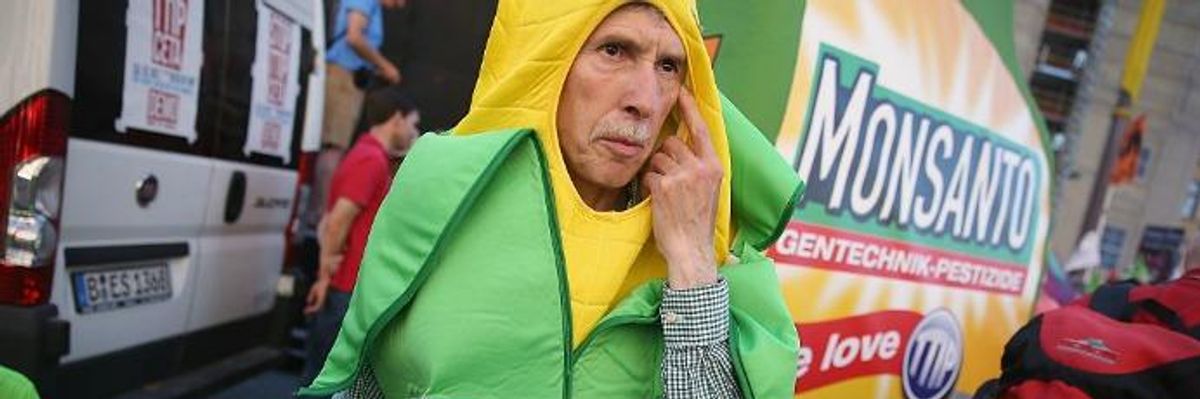
An activist dressed as an ear of corn and protesting against the U.S. agriculture company Monsanto attends a rally following a protest march attended by approximately 30,000 people against the upcoming G7 summit on June 4, 2015 in Munich, Germany. (Photo: Sean Gallup/Getty Images)
Monsanto may soon be dead in name, but its "toxic legacy" lives on.
That's how Friends of the Earth responded to the German pharmaceutical giant Bayer's announcement on Monday that it will ditch the name "Monsanto" after its merger with the globally reviled agrochemical giant is finalized later this week.
" Bayer will become Monsanto in all but name unless it takes drastic measures to distance itself from the U.S. chemical giant's controversial past," Adrian Bebb, a food and farming campaigner at Friends of the Earth Europe, said in a statement responding to Bayer's decision. "If it continues to peddle dangerous pesticides and unwanted GMOs then it will quickly find itself dealing with the same global resistance that Monsanto did."
Food safety groups and environmentalists have argued Bayer and Monsanto's "merger from hell"--which won approval from President Donald Trump's Justice Department last week--will tighten the stranglehold a few powerful corporations have on the global agriculture market, endangering people and the planet.
"This merger will create the world's biggest and most powerful agribusiness corporation, which will try to force its genetically modified seeds and toxic pesticides into our food and countryside," Bebb told the Guardian on Monday. "The coming together of these two is a marriage made in hell--bad for farmers, bad for consumers and bad for our countryside."
After Bayer's $62.5 billion purchase of Monsanto is complete, the company will be named simply "Bayer."
Dear Common Dreams reader, It’s been nearly 30 years since I co-founded Common Dreams with my late wife, Lina Newhouser. We had the radical notion that journalism should serve the public good, not corporate profits. It was clear to us from the outset what it would take to build such a project. No paid advertisements. No corporate sponsors. No millionaire publisher telling us what to think or do. Many people said we wouldn't last a year, but we proved those doubters wrong. Together with a tremendous team of journalists and dedicated staff, we built an independent media outlet free from the constraints of profits and corporate control. Our mission has always been simple: To inform. To inspire. To ignite change for the common good. Building Common Dreams was not easy. Our survival was never guaranteed. When you take on the most powerful forces—Wall Street greed, fossil fuel industry destruction, Big Tech lobbyists, and uber-rich oligarchs who have spent billions upon billions rigging the economy and democracy in their favor—the only bulwark you have is supporters who believe in your work. But here’s the urgent message from me today. It's never been this bad out there. And it's never been this hard to keep us going. At the very moment Common Dreams is most needed, the threats we face are intensifying. We need your support now more than ever. We don't accept corporate advertising and never will. We don't have a paywall because we don't think people should be blocked from critical news based on their ability to pay. Everything we do is funded by the donations of readers like you. When everyone does the little they can afford, we are strong. But if that support retreats or dries up, so do we. Will you donate now to make sure Common Dreams not only survives but thrives? —Craig Brown, Co-founder |
Monsanto may soon be dead in name, but its "toxic legacy" lives on.
That's how Friends of the Earth responded to the German pharmaceutical giant Bayer's announcement on Monday that it will ditch the name "Monsanto" after its merger with the globally reviled agrochemical giant is finalized later this week.
" Bayer will become Monsanto in all but name unless it takes drastic measures to distance itself from the U.S. chemical giant's controversial past," Adrian Bebb, a food and farming campaigner at Friends of the Earth Europe, said in a statement responding to Bayer's decision. "If it continues to peddle dangerous pesticides and unwanted GMOs then it will quickly find itself dealing with the same global resistance that Monsanto did."
Food safety groups and environmentalists have argued Bayer and Monsanto's "merger from hell"--which won approval from President Donald Trump's Justice Department last week--will tighten the stranglehold a few powerful corporations have on the global agriculture market, endangering people and the planet.
"This merger will create the world's biggest and most powerful agribusiness corporation, which will try to force its genetically modified seeds and toxic pesticides into our food and countryside," Bebb told the Guardian on Monday. "The coming together of these two is a marriage made in hell--bad for farmers, bad for consumers and bad for our countryside."
After Bayer's $62.5 billion purchase of Monsanto is complete, the company will be named simply "Bayer."
Monsanto may soon be dead in name, but its "toxic legacy" lives on.
That's how Friends of the Earth responded to the German pharmaceutical giant Bayer's announcement on Monday that it will ditch the name "Monsanto" after its merger with the globally reviled agrochemical giant is finalized later this week.
" Bayer will become Monsanto in all but name unless it takes drastic measures to distance itself from the U.S. chemical giant's controversial past," Adrian Bebb, a food and farming campaigner at Friends of the Earth Europe, said in a statement responding to Bayer's decision. "If it continues to peddle dangerous pesticides and unwanted GMOs then it will quickly find itself dealing with the same global resistance that Monsanto did."
Food safety groups and environmentalists have argued Bayer and Monsanto's "merger from hell"--which won approval from President Donald Trump's Justice Department last week--will tighten the stranglehold a few powerful corporations have on the global agriculture market, endangering people and the planet.
"This merger will create the world's biggest and most powerful agribusiness corporation, which will try to force its genetically modified seeds and toxic pesticides into our food and countryside," Bebb told the Guardian on Monday. "The coming together of these two is a marriage made in hell--bad for farmers, bad for consumers and bad for our countryside."
After Bayer's $62.5 billion purchase of Monsanto is complete, the company will be named simply "Bayer."