SUBSCRIBE TO OUR FREE NEWSLETTER
Daily news & progressive opinion—funded by the people, not the corporations—delivered straight to your inbox.
5
#000000
#FFFFFF
To donate by check, phone, or other method, see our More Ways to Give page.
Daily news & progressive opinion—funded by the people, not the corporations—delivered straight to your inbox.
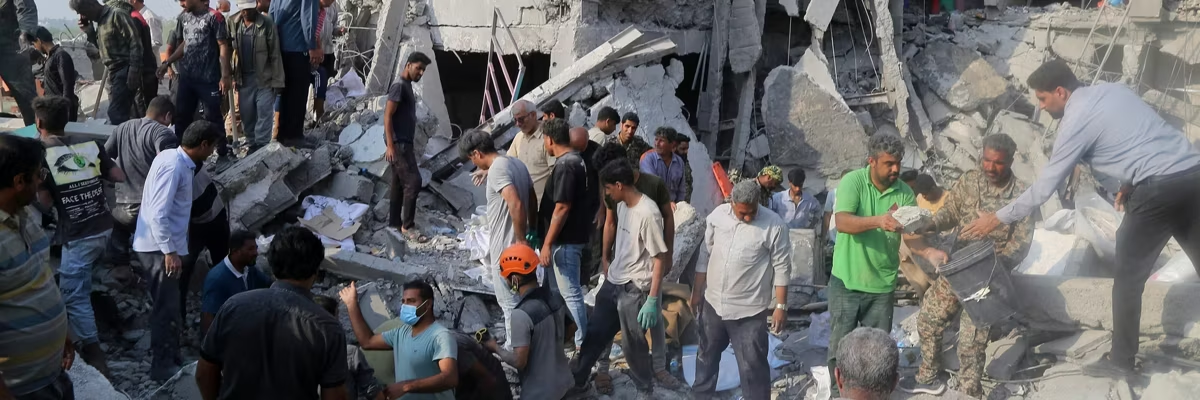
People are seen at the site of the February 28, 2026 bombing of the Shajareh Tayyebeh girls’ elementary school in Minab, Iran.
"This harrowing attack on a school, with classrooms full of children, is a sickening illustration of the catastrophic and entirely predictable price civilians are paying during this armed conflict."
Amnesty International on Monday published an investigation that found the United States violated international humanitarian law by failing to take measures to avoid harming civilians before bombing a girls' school in southern Iran last month and killing around 175 people, most of them children.
Evidence gathered by Amnesty "indicates that the school building was directly struck, alongside 12 other structures in an adjacent Islamic Revolutionary Guard Corps (IRGC) compound, with guided weapons," the group said. "This points to a failure by US forces to take feasible precautions to avoid civilian harm in carrying out the attack, which is a serious breach of international humanitarian law."
"The fact that the school building was directly targeted and was previously part of the IRGC compound raises concerns that US forces may have relied on outdated intelligence and failed in their obligation to do everything feasible to verify that the intended target was a military objective," Amnesty added.
NEW: Our in-depth investigation finds that US has violated international humanitarian law by failing to take all feasible precautions to avoid civilian harm. US is responsible for deadly attack on school in #Minab packed full of children.
[image or embed]
— Amnesty International (@amnesty.org) March 16, 2026 at 8:26 AM
Satellite imagery analyses confirmed eyewitness accounts that the February 28 attack on the Shajareh Tayyebeh girls’ elementary school in Minab was a "triple-tap" airstrike, in which an initial bombing was followed up with two additional strikes meant to kill survivors and rescue workers.
Fragments of a Tomahawk cruise missile found at the school and marked with the names of US weapons companies, a Pentagon contract number, and "Made in USA" added to the body of evidence pointing to the United States as the perpetrator of what numerous experts have called a likely war crime.
President Donald Trump, who initially blamed Iran for the attack, later said he is "willing to live with" whatever the military's investigation concludes.
"US authorities must ensure that the investigation they have announced is impartial, independent, and transparent," Amnesty said. "Investigations into the strike must consider the intelligence gathering and assessments, targeting decisions, and precautions taken, as well as how artificial intelligence may have been employed in each of these steps, to evaluate how targeting decisions were made. The results of the investigation should be made public."
Both the US and Israel have increasingly relied upon artificial intelligence systems to select bombing targets, with the Israel Defense Forces (IDF) having first used Gaza as what on expert called "a live-fire, live-ordnance lab experiment on people." Proponents of these systems note that they can select targets and approve strikes exponentially faster than humans, enabling more strikes, but critics warn such targeting methods are inherently more dangerous, pointing to higher error rates which translate to more civilian casualties and less accountability.
In the case of the Minab strike, Amnesty said, "Where sufficient evidence exists, competent authorities should prosecute any person suspected of criminal responsibility. Victims and their families have the right to truth and justice and should receive full reparation, including restitution, rehabilitation, and compensation for civilian harm."
Erika Guevara-Rosas—Amnesty International’s senior director of research, advocacy, policy and campaigns—said in a statement Monday that “this harrowing attack on a school, with classrooms full of children, is a sickening illustration of the catastrophic and entirely predictable price civilians are paying during this armed conflict."
"Schools must be places of safety and learning for children," she said. "Instead, this school in Minab became a site of mass killing. The US authorities could, and should, have known it was a school building. Targeting a protected civilian object, such as a school, is strictly prohibited under international humanitarian law."
"If the attackers failed to identify the building as a school and nevertheless proceeded with the attack, this would indicate gross negligence in the planning of the attack and would point to a shameful intelligence failure on the part of the US military and a serious violation of international humanitarian law," Guevara-Rosas continued.
"On the other hand," she said, "if the US was aware that the school was adjacent to the IRGC compound and proceeded to attack without taking all feasible precautions, such as striking at night when the school would have been empty, or giving effective advance warning to civilians likely to be affected, this would amount to recklessly launching an indiscriminate attack which killed and injured civilians and must be investigated as a war crime."
“For their part, Iranian authorities must immediately remove, to the extent feasible, civilians from the vicinity of military objectives and allow independent monitors into the country," Guevara-Rosas added. "They must also restore internet access to ensure that the 92 million people in Iran have access to life-saving information and be able to contact their loved ones.”
Amnesty joins other organizations—including the United Nations Human Rights Office, Human Rights Watch, Euro-Mediterranean Human Rights Monitor—in urging accountability for the officials responsible for planning and executing the school strike.
Dear Common Dreams reader, It’s been nearly 30 years since I co-founded Common Dreams with my late wife, Lina Newhouser. We had the radical notion that journalism should serve the public good, not corporate profits. It was clear to us from the outset what it would take to build such a project. No paid advertisements. No corporate sponsors. No millionaire publisher telling us what to think or do. Many people said we wouldn't last a year, but we proved those doubters wrong. Together with a tremendous team of journalists and dedicated staff, we built an independent media outlet free from the constraints of profits and corporate control. Our mission has always been simple: To inform. To inspire. To ignite change for the common good. Building Common Dreams was not easy. Our survival was never guaranteed. When you take on the most powerful forces—Wall Street greed, fossil fuel industry destruction, Big Tech lobbyists, and uber-rich oligarchs who have spent billions upon billions rigging the economy and democracy in their favor—the only bulwark you have is supporters who believe in your work. But here’s the urgent message from me today. It's never been this bad out there. And it's never been this hard to keep us going. At the very moment Common Dreams is most needed, the threats we face are intensifying. We need your support now more than ever. We don't accept corporate advertising and never will. We don't have a paywall because we don't think people should be blocked from critical news based on their ability to pay. Everything we do is funded by the donations of readers like you. When everyone does the little they can afford, we are strong. But if that support retreats or dries up, so do we. Will you donate now to make sure Common Dreams not only survives but thrives? —Craig Brown, Co-founder |
Amnesty International on Monday published an investigation that found the United States violated international humanitarian law by failing to take measures to avoid harming civilians before bombing a girls' school in southern Iran last month and killing around 175 people, most of them children.
Evidence gathered by Amnesty "indicates that the school building was directly struck, alongside 12 other structures in an adjacent Islamic Revolutionary Guard Corps (IRGC) compound, with guided weapons," the group said. "This points to a failure by US forces to take feasible precautions to avoid civilian harm in carrying out the attack, which is a serious breach of international humanitarian law."
"The fact that the school building was directly targeted and was previously part of the IRGC compound raises concerns that US forces may have relied on outdated intelligence and failed in their obligation to do everything feasible to verify that the intended target was a military objective," Amnesty added.
NEW: Our in-depth investigation finds that US has violated international humanitarian law by failing to take all feasible precautions to avoid civilian harm. US is responsible for deadly attack on school in #Minab packed full of children.
[image or embed]
— Amnesty International (@amnesty.org) March 16, 2026 at 8:26 AM
Satellite imagery analyses confirmed eyewitness accounts that the February 28 attack on the Shajareh Tayyebeh girls’ elementary school in Minab was a "triple-tap" airstrike, in which an initial bombing was followed up with two additional strikes meant to kill survivors and rescue workers.
Fragments of a Tomahawk cruise missile found at the school and marked with the names of US weapons companies, a Pentagon contract number, and "Made in USA" added to the body of evidence pointing to the United States as the perpetrator of what numerous experts have called a likely war crime.
President Donald Trump, who initially blamed Iran for the attack, later said he is "willing to live with" whatever the military's investigation concludes.
"US authorities must ensure that the investigation they have announced is impartial, independent, and transparent," Amnesty said. "Investigations into the strike must consider the intelligence gathering and assessments, targeting decisions, and precautions taken, as well as how artificial intelligence may have been employed in each of these steps, to evaluate how targeting decisions were made. The results of the investigation should be made public."
Both the US and Israel have increasingly relied upon artificial intelligence systems to select bombing targets, with the Israel Defense Forces (IDF) having first used Gaza as what on expert called "a live-fire, live-ordnance lab experiment on people." Proponents of these systems note that they can select targets and approve strikes exponentially faster than humans, enabling more strikes, but critics warn such targeting methods are inherently more dangerous, pointing to higher error rates which translate to more civilian casualties and less accountability.
In the case of the Minab strike, Amnesty said, "Where sufficient evidence exists, competent authorities should prosecute any person suspected of criminal responsibility. Victims and their families have the right to truth and justice and should receive full reparation, including restitution, rehabilitation, and compensation for civilian harm."
Erika Guevara-Rosas—Amnesty International’s senior director of research, advocacy, policy and campaigns—said in a statement Monday that “this harrowing attack on a school, with classrooms full of children, is a sickening illustration of the catastrophic and entirely predictable price civilians are paying during this armed conflict."
"Schools must be places of safety and learning for children," she said. "Instead, this school in Minab became a site of mass killing. The US authorities could, and should, have known it was a school building. Targeting a protected civilian object, such as a school, is strictly prohibited under international humanitarian law."
"If the attackers failed to identify the building as a school and nevertheless proceeded with the attack, this would indicate gross negligence in the planning of the attack and would point to a shameful intelligence failure on the part of the US military and a serious violation of international humanitarian law," Guevara-Rosas continued.
"On the other hand," she said, "if the US was aware that the school was adjacent to the IRGC compound and proceeded to attack without taking all feasible precautions, such as striking at night when the school would have been empty, or giving effective advance warning to civilians likely to be affected, this would amount to recklessly launching an indiscriminate attack which killed and injured civilians and must be investigated as a war crime."
“For their part, Iranian authorities must immediately remove, to the extent feasible, civilians from the vicinity of military objectives and allow independent monitors into the country," Guevara-Rosas added. "They must also restore internet access to ensure that the 92 million people in Iran have access to life-saving information and be able to contact their loved ones.”
Amnesty joins other organizations—including the United Nations Human Rights Office, Human Rights Watch, Euro-Mediterranean Human Rights Monitor—in urging accountability for the officials responsible for planning and executing the school strike.
Amnesty International on Monday published an investigation that found the United States violated international humanitarian law by failing to take measures to avoid harming civilians before bombing a girls' school in southern Iran last month and killing around 175 people, most of them children.
Evidence gathered by Amnesty "indicates that the school building was directly struck, alongside 12 other structures in an adjacent Islamic Revolutionary Guard Corps (IRGC) compound, with guided weapons," the group said. "This points to a failure by US forces to take feasible precautions to avoid civilian harm in carrying out the attack, which is a serious breach of international humanitarian law."
"The fact that the school building was directly targeted and was previously part of the IRGC compound raises concerns that US forces may have relied on outdated intelligence and failed in their obligation to do everything feasible to verify that the intended target was a military objective," Amnesty added.
NEW: Our in-depth investigation finds that US has violated international humanitarian law by failing to take all feasible precautions to avoid civilian harm. US is responsible for deadly attack on school in #Minab packed full of children.
[image or embed]
— Amnesty International (@amnesty.org) March 16, 2026 at 8:26 AM
Satellite imagery analyses confirmed eyewitness accounts that the February 28 attack on the Shajareh Tayyebeh girls’ elementary school in Minab was a "triple-tap" airstrike, in which an initial bombing was followed up with two additional strikes meant to kill survivors and rescue workers.
Fragments of a Tomahawk cruise missile found at the school and marked with the names of US weapons companies, a Pentagon contract number, and "Made in USA" added to the body of evidence pointing to the United States as the perpetrator of what numerous experts have called a likely war crime.
President Donald Trump, who initially blamed Iran for the attack, later said he is "willing to live with" whatever the military's investigation concludes.
"US authorities must ensure that the investigation they have announced is impartial, independent, and transparent," Amnesty said. "Investigations into the strike must consider the intelligence gathering and assessments, targeting decisions, and precautions taken, as well as how artificial intelligence may have been employed in each of these steps, to evaluate how targeting decisions were made. The results of the investigation should be made public."
Both the US and Israel have increasingly relied upon artificial intelligence systems to select bombing targets, with the Israel Defense Forces (IDF) having first used Gaza as what on expert called "a live-fire, live-ordnance lab experiment on people." Proponents of these systems note that they can select targets and approve strikes exponentially faster than humans, enabling more strikes, but critics warn such targeting methods are inherently more dangerous, pointing to higher error rates which translate to more civilian casualties and less accountability.
In the case of the Minab strike, Amnesty said, "Where sufficient evidence exists, competent authorities should prosecute any person suspected of criminal responsibility. Victims and their families have the right to truth and justice and should receive full reparation, including restitution, rehabilitation, and compensation for civilian harm."
Erika Guevara-Rosas—Amnesty International’s senior director of research, advocacy, policy and campaigns—said in a statement Monday that “this harrowing attack on a school, with classrooms full of children, is a sickening illustration of the catastrophic and entirely predictable price civilians are paying during this armed conflict."
"Schools must be places of safety and learning for children," she said. "Instead, this school in Minab became a site of mass killing. The US authorities could, and should, have known it was a school building. Targeting a protected civilian object, such as a school, is strictly prohibited under international humanitarian law."
"If the attackers failed to identify the building as a school and nevertheless proceeded with the attack, this would indicate gross negligence in the planning of the attack and would point to a shameful intelligence failure on the part of the US military and a serious violation of international humanitarian law," Guevara-Rosas continued.
"On the other hand," she said, "if the US was aware that the school was adjacent to the IRGC compound and proceeded to attack without taking all feasible precautions, such as striking at night when the school would have been empty, or giving effective advance warning to civilians likely to be affected, this would amount to recklessly launching an indiscriminate attack which killed and injured civilians and must be investigated as a war crime."
“For their part, Iranian authorities must immediately remove, to the extent feasible, civilians from the vicinity of military objectives and allow independent monitors into the country," Guevara-Rosas added. "They must also restore internet access to ensure that the 92 million people in Iran have access to life-saving information and be able to contact their loved ones.”
Amnesty joins other organizations—including the United Nations Human Rights Office, Human Rights Watch, Euro-Mediterranean Human Rights Monitor—in urging accountability for the officials responsible for planning and executing the school strike.