SUBSCRIBE TO OUR FREE NEWSLETTER
Daily news & progressive opinion—funded by the people, not the corporations—delivered straight to your inbox.
5
#000000
#FFFFFF
To donate by check, phone, or other method, see our More Ways to Give page.
Daily news & progressive opinion—funded by the people, not the corporations—delivered straight to your inbox.
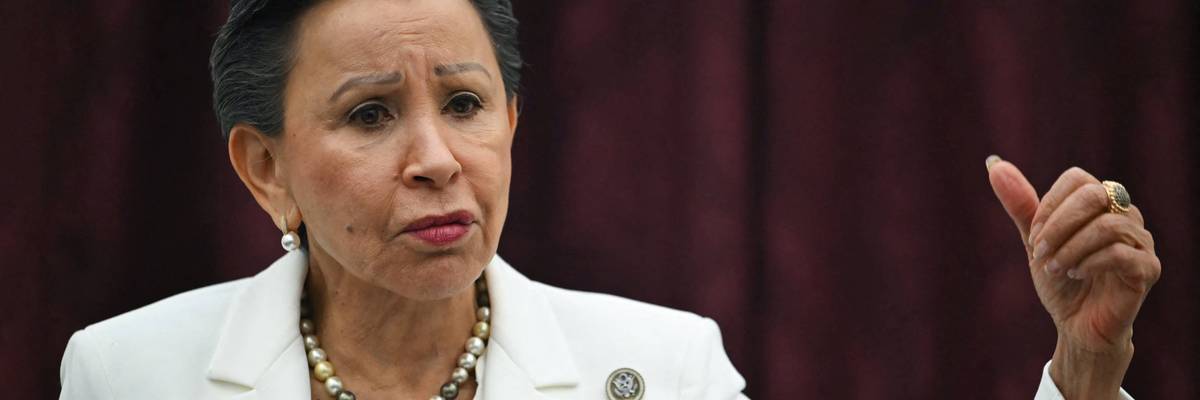
Congresswoman Nydia Velázquez (D-NY) speaks during a February 10, 2026 press conference on Capitol Hill in Washington, DC.
“This administration is rushing toward another disastrous war, putting countless American and foreign lives at risk," said Rep. Nydia Velázquez. "Congress must reassert its constitutional authority."
With US military forces prepared to launch an unprovoked attack on Cuba, a group of congressional Democrats on Wednesday introduced a new war powers resolution in a bid to block President Donald Trump from launching yet another illegal war of choice.
Reps. Nydia Velázquez and Gregory Meeks, both of New York, introduced the resolution, which would bar US forces from hostilities within or against Cuba without congressional authorization, as required under the 1973 War Powers Act. The measure is cosponsored by Reps. Jim McGovern of Massachusetts and Joaquin Castro of Texas.
“Donald Trump's belligerent foreign policy is creating new wars and conflicts across the world. As our country is already embroiled in a new war with Iran, the president has now set his sights on regime change in Cuba,” Velázquez said in a statement. “This administration is rushing toward another disastrous war, putting countless American and foreign lives at risk. Congress must reassert its constitutional authority if the president continues down this illegal path.”
Meeks, the ranking member of the House Foreign Affairs Committee, said that “the Trump administration and Republicans in Congress are hellbent on starting another war, this time with Cuba, to distract from the president’s failure in Iran, weak economy, and mass deportation of 500,000 Cubans legally in the United States."
It is the second Cuba war powers resolution introduced by lawmakers since Trump began threatening to attack and "take" the island earlier this year. Last month, senators voted 51-47—with Democratic Sen. John Fetterman joining all but two of his Republican colleagues, Sens. Susan Collins of Maine and Rand Paul of Kentucky—to block a war powers resolution introduced in March by Sens. Tim Kaine (D-Va.), Adam Schiff (D-Calif.), and Ruben Gallego (D-Ariz.).
The new resolution's introduction follows months of escalating aggression against Cuba by the Trump administration, including preparation and threats to attack, an oil blockade that critics say is causing the deaths of infants and sick people, and last week's Department of Justice (DOJ) indictment of former President Raúl Castro for his alleged role in the 1996 shoot-down of planes operated by a hostile US-based counterrevolutionary group following repeated warnings that they had violated Cuban airspace.
On Wednesday, Secretary of State Marco Rubio—who has falsely claimed that his parents fled communism in Cuba when they actually emigrated during an earlier US-backed dictatorship—said that the island is "in a lot of trouble."
“Having a failed state 90 miles from our shores is a threat to the national security of the United States," Rubio added.
An article published Wednesday by Politico highlighted US military preparations for various war scenarios for Cuba, including bombing, an invasion, or a mission to enforce the DOJ indictmebnt by kidnapping Castro in a manner similar to January's illegal abduction of Venezuelan President Nicolás Maduro.
According to Politico's Paul McLeary:
The armada in the region is slightly smaller than it was in January when the US captured Maduro. But the USS Nimitz aircraft carrier strike group entered the Caribbean in May, along with several guided missile destroyers and cruisers that can launch precision missiles at targets onshore. An array of advanced American drones and surveillance aircraft have also circled Cuba for months, according to flight tracking sites. The USS Kearsarge amphibious ships and escorts, which carry 2,500 Marines, are off the coast of Virginia preparing for a new deployment, and could replace some ships heading home.
The surge provides a variety of military options, although the Pentagon would need additional troops for a massive ground invasion.
The Politico piece drew fierce rebuke from Havana.
"There are politicians in the United States pushing the drumbeat of war against Cuba, trying to fabricate excuses, trying to portray Cuba as a threat, and trying to push the US president to take military action, even with the understanding that military action would lead to bloodshed, mostly of Cubans, but also of Americans," Deputy Foreign Minister Carlos Fernández de Cossío told The Los Angeles Times.
"The question is: How does a government convince American citizens that it is in their interest to cause death, cause destruction and suffering to a neighboring nation simply to satisfy the ambitions of a small cabal of wealthy, influential people who enjoy the ear of politicians and powerful people in Washington?" Fernández added.
Cuba has been shoring up international support amid the growing threat of US attack. On Tuesday, Cuban Foreign Minister Bruno Rodríguez met with United Nations Secretary-General António Guterres, who said earlier this month that “there is no military solution to be sought for Cuba."
On Wednesday, Chinese Foreign Minister Wang Yi said during a meeting with Rodríguez at United Nations headquarters in New York that "China will continue to uphold justice and speak up for Cuba, support the Cuban people’s just cause, and contribute to Cuba’s economic development and people’s livelihood."
Also on Wednesday, the Caribbean Community (CARICOM) Council for Foreign and Community Relations issued a statement affirming "Cuba’s sovereign right to import and receive fuel" and condemning "the obstruction of energy supplies to Cuba, which has precipitated a grave humanitarian crisis."
"Cuba poses no threat to any nation... it stands as a peaceful and cooperative member of the international community... [and] the continued application of these unilateral coercive measures constitutes an unjustifiable violation of human rights, the principles of free trade, and the fundamental norms governing relations among sovereign states," the council stated.
If the US launches military action against Cuba, it will be the 12th country attacked during Trump’s two terms in office. The president—who has repeatedly said that he deserves a Nobel Peace Prize—has ordered attacks on Afghanistan, Ecuador, Iran, Iraq, Libya, Nigeria, Pakistan, Somalia, Syria, Venezuela, and Yemen, and has bombed dozens of boats accused without evidence of transporting drugs in international waters in the Caribbean Sea and Pacific Ocean.
Last week, tens of thousands of Cubans rallied in Havana to denounce the indictment of Castro and US aggression against their homeland, which dates back to the revolution that overthrew Fulgencio Batista, one in a series of dictators backed by the United States after it granted Cuba conditional independence after conquering the island along with Puerto Rico, the Philippines, and Guam during an 1898 war against Spain waged on a dubious pretext.
Since then, the United States has tried to assassinate former Cuban President Fidel Castro, backed the ill-fated Bay of Pigs invasion, served as a base for perpetrators of some of the hemisphere’s worst terror attacks, and even hatched a plan to detonate a nuclear bomb high above the island to convince its people that the return of Jesus Christ was nigh and the only thing standing in the way of the long-awaited “Second Coming” was Castro.
Cuba has endured this aggression and more without retaliating against the United States. Despite this, the Trump administration has responded by inflicting more and more pain upon people it claims it is trying to liberate from oppression.
“If Donald Trump and Marco Rubio are serious about a new relationship with the Cuban people," Meeks said Wednesday, "they would reverse 65 years of failed US policy toward Cuba, end the oil blockade and the humanitarian crisis it caused, and work with Congress to modify the draconian and outdated US sanctions that disproportionately harm the Cuban people.”
Dear Common Dreams reader, It’s been nearly 30 years since I co-founded Common Dreams with my late wife, Lina Newhouser. We had the radical notion that journalism should serve the public good, not corporate profits. It was clear to us from the outset what it would take to build such a project. No paid advertisements. No corporate sponsors. No millionaire publisher telling us what to think or do. Many people said we wouldn't last a year, but we proved those doubters wrong. Together with a tremendous team of journalists and dedicated staff, we built an independent media outlet free from the constraints of profits and corporate control. Our mission has always been simple: To inform. To inspire. To ignite change for the common good. Building Common Dreams was not easy. Our survival was never guaranteed. When you take on the most powerful forces—Wall Street greed, fossil fuel industry destruction, Big Tech lobbyists, and uber-rich oligarchs who have spent billions upon billions rigging the economy and democracy in their favor—the only bulwark you have is supporters who believe in your work. But here’s the urgent message from me today. It's never been this bad out there. And it's never been this hard to keep us going. At the very moment Common Dreams is most needed, the threats we face are intensifying. We need your support now more than ever. We don't accept corporate advertising and never will. We don't have a paywall because we don't think people should be blocked from critical news based on their ability to pay. Everything we do is funded by the donations of readers like you. When everyone does the little they can afford, we are strong. But if that support retreats or dries up, so do we. Will you donate now to make sure Common Dreams not only survives but thrives? —Craig Brown, Co-founder |
With US military forces prepared to launch an unprovoked attack on Cuba, a group of congressional Democrats on Wednesday introduced a new war powers resolution in a bid to block President Donald Trump from launching yet another illegal war of choice.
Reps. Nydia Velázquez and Gregory Meeks, both of New York, introduced the resolution, which would bar US forces from hostilities within or against Cuba without congressional authorization, as required under the 1973 War Powers Act. The measure is cosponsored by Reps. Jim McGovern of Massachusetts and Joaquin Castro of Texas.
“Donald Trump's belligerent foreign policy is creating new wars and conflicts across the world. As our country is already embroiled in a new war with Iran, the president has now set his sights on regime change in Cuba,” Velázquez said in a statement. “This administration is rushing toward another disastrous war, putting countless American and foreign lives at risk. Congress must reassert its constitutional authority if the president continues down this illegal path.”
Meeks, the ranking member of the House Foreign Affairs Committee, said that “the Trump administration and Republicans in Congress are hellbent on starting another war, this time with Cuba, to distract from the president’s failure in Iran, weak economy, and mass deportation of 500,000 Cubans legally in the United States."
It is the second Cuba war powers resolution introduced by lawmakers since Trump began threatening to attack and "take" the island earlier this year. Last month, senators voted 51-47—with Democratic Sen. John Fetterman joining all but two of his Republican colleagues, Sens. Susan Collins of Maine and Rand Paul of Kentucky—to block a war powers resolution introduced in March by Sens. Tim Kaine (D-Va.), Adam Schiff (D-Calif.), and Ruben Gallego (D-Ariz.).
The new resolution's introduction follows months of escalating aggression against Cuba by the Trump administration, including preparation and threats to attack, an oil blockade that critics say is causing the deaths of infants and sick people, and last week's Department of Justice (DOJ) indictment of former President Raúl Castro for his alleged role in the 1996 shoot-down of planes operated by a hostile US-based counterrevolutionary group following repeated warnings that they had violated Cuban airspace.
On Wednesday, Secretary of State Marco Rubio—who has falsely claimed that his parents fled communism in Cuba when they actually emigrated during an earlier US-backed dictatorship—said that the island is "in a lot of trouble."
“Having a failed state 90 miles from our shores is a threat to the national security of the United States," Rubio added.
An article published Wednesday by Politico highlighted US military preparations for various war scenarios for Cuba, including bombing, an invasion, or a mission to enforce the DOJ indictmebnt by kidnapping Castro in a manner similar to January's illegal abduction of Venezuelan President Nicolás Maduro.
According to Politico's Paul McLeary:
The armada in the region is slightly smaller than it was in January when the US captured Maduro. But the USS Nimitz aircraft carrier strike group entered the Caribbean in May, along with several guided missile destroyers and cruisers that can launch precision missiles at targets onshore. An array of advanced American drones and surveillance aircraft have also circled Cuba for months, according to flight tracking sites. The USS Kearsarge amphibious ships and escorts, which carry 2,500 Marines, are off the coast of Virginia preparing for a new deployment, and could replace some ships heading home.
The surge provides a variety of military options, although the Pentagon would need additional troops for a massive ground invasion.
The Politico piece drew fierce rebuke from Havana.
"There are politicians in the United States pushing the drumbeat of war against Cuba, trying to fabricate excuses, trying to portray Cuba as a threat, and trying to push the US president to take military action, even with the understanding that military action would lead to bloodshed, mostly of Cubans, but also of Americans," Deputy Foreign Minister Carlos Fernández de Cossío told The Los Angeles Times.
"The question is: How does a government convince American citizens that it is in their interest to cause death, cause destruction and suffering to a neighboring nation simply to satisfy the ambitions of a small cabal of wealthy, influential people who enjoy the ear of politicians and powerful people in Washington?" Fernández added.
Cuba has been shoring up international support amid the growing threat of US attack. On Tuesday, Cuban Foreign Minister Bruno Rodríguez met with United Nations Secretary-General António Guterres, who said earlier this month that “there is no military solution to be sought for Cuba."
On Wednesday, Chinese Foreign Minister Wang Yi said during a meeting with Rodríguez at United Nations headquarters in New York that "China will continue to uphold justice and speak up for Cuba, support the Cuban people’s just cause, and contribute to Cuba’s economic development and people’s livelihood."
Also on Wednesday, the Caribbean Community (CARICOM) Council for Foreign and Community Relations issued a statement affirming "Cuba’s sovereign right to import and receive fuel" and condemning "the obstruction of energy supplies to Cuba, which has precipitated a grave humanitarian crisis."
"Cuba poses no threat to any nation... it stands as a peaceful and cooperative member of the international community... [and] the continued application of these unilateral coercive measures constitutes an unjustifiable violation of human rights, the principles of free trade, and the fundamental norms governing relations among sovereign states," the council stated.
If the US launches military action against Cuba, it will be the 12th country attacked during Trump’s two terms in office. The president—who has repeatedly said that he deserves a Nobel Peace Prize—has ordered attacks on Afghanistan, Ecuador, Iran, Iraq, Libya, Nigeria, Pakistan, Somalia, Syria, Venezuela, and Yemen, and has bombed dozens of boats accused without evidence of transporting drugs in international waters in the Caribbean Sea and Pacific Ocean.
Last week, tens of thousands of Cubans rallied in Havana to denounce the indictment of Castro and US aggression against their homeland, which dates back to the revolution that overthrew Fulgencio Batista, one in a series of dictators backed by the United States after it granted Cuba conditional independence after conquering the island along with Puerto Rico, the Philippines, and Guam during an 1898 war against Spain waged on a dubious pretext.
Since then, the United States has tried to assassinate former Cuban President Fidel Castro, backed the ill-fated Bay of Pigs invasion, served as a base for perpetrators of some of the hemisphere’s worst terror attacks, and even hatched a plan to detonate a nuclear bomb high above the island to convince its people that the return of Jesus Christ was nigh and the only thing standing in the way of the long-awaited “Second Coming” was Castro.
Cuba has endured this aggression and more without retaliating against the United States. Despite this, the Trump administration has responded by inflicting more and more pain upon people it claims it is trying to liberate from oppression.
“If Donald Trump and Marco Rubio are serious about a new relationship with the Cuban people," Meeks said Wednesday, "they would reverse 65 years of failed US policy toward Cuba, end the oil blockade and the humanitarian crisis it caused, and work with Congress to modify the draconian and outdated US sanctions that disproportionately harm the Cuban people.”
With US military forces prepared to launch an unprovoked attack on Cuba, a group of congressional Democrats on Wednesday introduced a new war powers resolution in a bid to block President Donald Trump from launching yet another illegal war of choice.
Reps. Nydia Velázquez and Gregory Meeks, both of New York, introduced the resolution, which would bar US forces from hostilities within or against Cuba without congressional authorization, as required under the 1973 War Powers Act. The measure is cosponsored by Reps. Jim McGovern of Massachusetts and Joaquin Castro of Texas.
“Donald Trump's belligerent foreign policy is creating new wars and conflicts across the world. As our country is already embroiled in a new war with Iran, the president has now set his sights on regime change in Cuba,” Velázquez said in a statement. “This administration is rushing toward another disastrous war, putting countless American and foreign lives at risk. Congress must reassert its constitutional authority if the president continues down this illegal path.”
Meeks, the ranking member of the House Foreign Affairs Committee, said that “the Trump administration and Republicans in Congress are hellbent on starting another war, this time with Cuba, to distract from the president’s failure in Iran, weak economy, and mass deportation of 500,000 Cubans legally in the United States."
It is the second Cuba war powers resolution introduced by lawmakers since Trump began threatening to attack and "take" the island earlier this year. Last month, senators voted 51-47—with Democratic Sen. John Fetterman joining all but two of his Republican colleagues, Sens. Susan Collins of Maine and Rand Paul of Kentucky—to block a war powers resolution introduced in March by Sens. Tim Kaine (D-Va.), Adam Schiff (D-Calif.), and Ruben Gallego (D-Ariz.).
The new resolution's introduction follows months of escalating aggression against Cuba by the Trump administration, including preparation and threats to attack, an oil blockade that critics say is causing the deaths of infants and sick people, and last week's Department of Justice (DOJ) indictment of former President Raúl Castro for his alleged role in the 1996 shoot-down of planes operated by a hostile US-based counterrevolutionary group following repeated warnings that they had violated Cuban airspace.
On Wednesday, Secretary of State Marco Rubio—who has falsely claimed that his parents fled communism in Cuba when they actually emigrated during an earlier US-backed dictatorship—said that the island is "in a lot of trouble."
“Having a failed state 90 miles from our shores is a threat to the national security of the United States," Rubio added.
An article published Wednesday by Politico highlighted US military preparations for various war scenarios for Cuba, including bombing, an invasion, or a mission to enforce the DOJ indictmebnt by kidnapping Castro in a manner similar to January's illegal abduction of Venezuelan President Nicolás Maduro.
According to Politico's Paul McLeary:
The armada in the region is slightly smaller than it was in January when the US captured Maduro. But the USS Nimitz aircraft carrier strike group entered the Caribbean in May, along with several guided missile destroyers and cruisers that can launch precision missiles at targets onshore. An array of advanced American drones and surveillance aircraft have also circled Cuba for months, according to flight tracking sites. The USS Kearsarge amphibious ships and escorts, which carry 2,500 Marines, are off the coast of Virginia preparing for a new deployment, and could replace some ships heading home.
The surge provides a variety of military options, although the Pentagon would need additional troops for a massive ground invasion.
The Politico piece drew fierce rebuke from Havana.
"There are politicians in the United States pushing the drumbeat of war against Cuba, trying to fabricate excuses, trying to portray Cuba as a threat, and trying to push the US president to take military action, even with the understanding that military action would lead to bloodshed, mostly of Cubans, but also of Americans," Deputy Foreign Minister Carlos Fernández de Cossío told The Los Angeles Times.
"The question is: How does a government convince American citizens that it is in their interest to cause death, cause destruction and suffering to a neighboring nation simply to satisfy the ambitions of a small cabal of wealthy, influential people who enjoy the ear of politicians and powerful people in Washington?" Fernández added.
Cuba has been shoring up international support amid the growing threat of US attack. On Tuesday, Cuban Foreign Minister Bruno Rodríguez met with United Nations Secretary-General António Guterres, who said earlier this month that “there is no military solution to be sought for Cuba."
On Wednesday, Chinese Foreign Minister Wang Yi said during a meeting with Rodríguez at United Nations headquarters in New York that "China will continue to uphold justice and speak up for Cuba, support the Cuban people’s just cause, and contribute to Cuba’s economic development and people’s livelihood."
Also on Wednesday, the Caribbean Community (CARICOM) Council for Foreign and Community Relations issued a statement affirming "Cuba’s sovereign right to import and receive fuel" and condemning "the obstruction of energy supplies to Cuba, which has precipitated a grave humanitarian crisis."
"Cuba poses no threat to any nation... it stands as a peaceful and cooperative member of the international community... [and] the continued application of these unilateral coercive measures constitutes an unjustifiable violation of human rights, the principles of free trade, and the fundamental norms governing relations among sovereign states," the council stated.
If the US launches military action against Cuba, it will be the 12th country attacked during Trump’s two terms in office. The president—who has repeatedly said that he deserves a Nobel Peace Prize—has ordered attacks on Afghanistan, Ecuador, Iran, Iraq, Libya, Nigeria, Pakistan, Somalia, Syria, Venezuela, and Yemen, and has bombed dozens of boats accused without evidence of transporting drugs in international waters in the Caribbean Sea and Pacific Ocean.
Last week, tens of thousands of Cubans rallied in Havana to denounce the indictment of Castro and US aggression against their homeland, which dates back to the revolution that overthrew Fulgencio Batista, one in a series of dictators backed by the United States after it granted Cuba conditional independence after conquering the island along with Puerto Rico, the Philippines, and Guam during an 1898 war against Spain waged on a dubious pretext.
Since then, the United States has tried to assassinate former Cuban President Fidel Castro, backed the ill-fated Bay of Pigs invasion, served as a base for perpetrators of some of the hemisphere’s worst terror attacks, and even hatched a plan to detonate a nuclear bomb high above the island to convince its people that the return of Jesus Christ was nigh and the only thing standing in the way of the long-awaited “Second Coming” was Castro.
Cuba has endured this aggression and more without retaliating against the United States. Despite this, the Trump administration has responded by inflicting more and more pain upon people it claims it is trying to liberate from oppression.
“If Donald Trump and Marco Rubio are serious about a new relationship with the Cuban people," Meeks said Wednesday, "they would reverse 65 years of failed US policy toward Cuba, end the oil blockade and the humanitarian crisis it caused, and work with Congress to modify the draconian and outdated US sanctions that disproportionately harm the Cuban people.”