SUBSCRIBE TO OUR FREE NEWSLETTER
Daily news & progressive opinion—funded by the people, not the corporations—delivered straight to your inbox.
5
#000000
#FFFFFF
To donate by check, phone, or other method, see our More Ways to Give page.
Daily news & progressive opinion—funded by the people, not the corporations—delivered straight to your inbox.
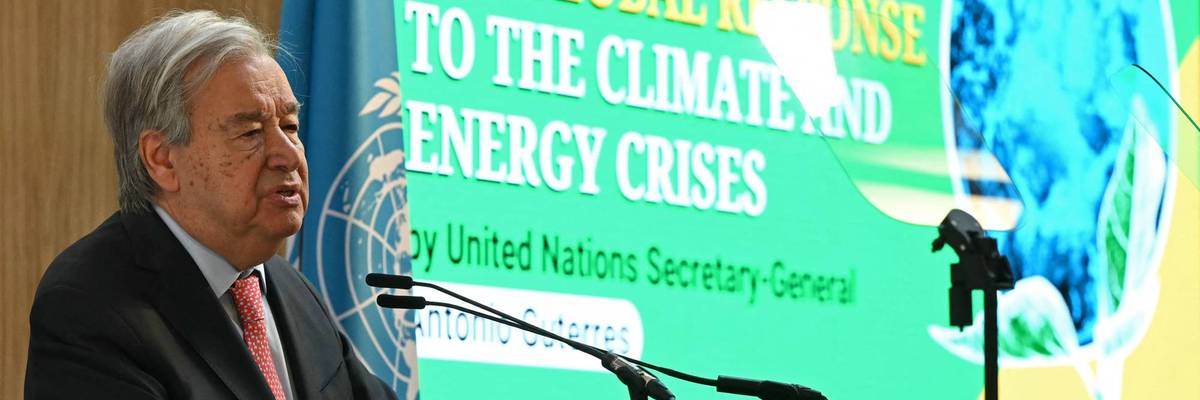
United Nations Secretary-General António Guterres delivers a speech during the Climate Innovation Forum, part of London Climate Action Week, at the Guildhall on June 23, 2026.
"The companies driving climate chaos cannot continue profiting from the destruction while vulnerable countries struggle."
As world leaders face mounting pressure to tax the windfall profits of fossil fuel giants that are wrecking the planet, United Nations Secretary-General António Guterres pushed for such policies in a pair of speeches at London Climate Action Week, arguing that "polluters must pay."
Since assuming his post nearly a decade ago, the UN chief has repeatedly sounded the alarm about the fossil fuel-driven climate emergency and demanded that rich countries and companies responsible for the crisis contribute financially to adaptation and mitigation efforts, particularly in the Global South.
Just months away from the end of his term, Guterres on Tuesday highlighted the latest warnings from the World Meteorological Organization (WMO) and that "climate disasters are becoming more frequent, more destructive, and more costly." He also flagged key tipping points—including melting ice sheets driving sea-level rise, shifts in conditions of the Amazon rainforest, and the weakening of major ocean circulation systems.
"Here in London—the city of Dickens—it is clear that our world is facing a Tale of Two Crises," he said. "A climate crisis pushing us deeper toward higher temperatures and closer to catastrophic tipping points. And an energy crisis exposing the folly of a world hooked on hydrocarbons."
"On the surface, these crises may seem separate. But they share the same destructive origin: fossil fuels," he continued. "And they demand the same answer: a fast, fair transition to clean energy—and a surge in adaptation, resilience, and climate justice for those already facing climate harm."
The UN leader stressed that "renewables are the cheapest, fastest, and most scalable source of new electricity in most of the world."
"Since 2010, the cost of solar has plummeted by almost 90%, onshore wind by more than 70%, and battery storage by 95%," he pointed out. "More than 90% of new renewable power added globally is already cheaper than the lowest-cost fossil fuel alternatives."
While outlining several essential steps for ending fossil fuel dependence, Guterres issued various calls, such as urging "far greater urgency" to limit any overshoot of the Paris Agreement's 1.5°C temperature goal for this century, and action in response to the exploding energy demands from artificial intelligence data centers.
Data centers have been met with fierce pushback from communities around the world concerned about water, land, and climate impacts. Guterres said that "by 2030, they could use more power than all but five countries—and enough water to meet the basic needs of all 1.3 billion residents of sub‑Saharan Africa for an entire year."
He proposed the AI Environmental Transparency Initiative, "calling on every major AI company to measure and publicly disclose the full environmental impact of its systems—carbon, water, and land footprints—and to commit to power every data center with renewable energy by 2030."
"No more hidden costs. No more shifting the burden onto those least able to bear it," explained Guterres. "It is time to come clean. If AI is to help build a better future, it must be honest about what it costs us now."
As data centers are sucking up massive amounts of power, he acknowledged that "families feeling the strain with higher bills, greater uncertainty, a sense that the system is not working for them—while fossil fuel giants continue to reap extraordinary profits."
"The eight largest fossil fuel companies reported pocketing an extra $6.5 billion in the first quarter of this year alone—and that only includes one month of the Middle East crisis, as oil prices continued to climb and profits to rise," Guterres said.
Without directly mentioning how the US-Israeli war on Iran—which Guterres has criticized—has driven up oil prices around the world, the UN leader said that "these are windfall gains born of pain—of instability, hardship and dependence. I urge governments to tax them."
"Let me conclude where I began—with Dickens," he said. "For the climate agenda, this is indeed the best of times and the worst of times. The worst—because climate impacts are intensifying, tipping points are looming, and the energy crisis has exposed the deep risks of dependence on fossil fuels."
"But also the best—because the renewables revolution is well underway," he added. "A revolution of clean power, electrification, falling costs, rising ambition—and vast opportunity."
Following his special address on Tuesday, Guterres spoke Wednesday at the Climate & Development Financial Forum, where he emphasized that "the countries facing the greatest climate impacts are those who contributed least to causing them."
In addition to arguing that the international community has to "recognize that climate risk is economic risk," "global financial systems must recognize the value of resilience," and "we need better preparation before disasters strike," the UN chief spotlighted the necessity of closing "the finance gap" in terms of adaptation.
He called for developed countries to triple adaptation finance, replenish multilateral climate funds, and prioritize grant-based and predictable finance, and for multilateral development banks to "use their expanded lending capacity to aggressively scale up investment in resilience."
He also reiterated his call for governments "to tax windfall profits from fossil fuel companies to help finance adaptation and climate related losses and damages," declaring that "the companies driving climate chaos cannot continue profiting from the destruction while vulnerable countries struggle."
Dear Common Dreams reader, It’s been nearly 30 years since I co-founded Common Dreams with my late wife, Lina Newhouser. We had the radical notion that journalism should serve the public good, not corporate profits. It was clear to us from the outset what it would take to build such a project. No paid advertisements. No corporate sponsors. No millionaire publisher telling us what to think or do. Many people said we wouldn't last a year, but we proved those doubters wrong. Together with a tremendous team of journalists and dedicated staff, we built an independent media outlet free from the constraints of profits and corporate control. Our mission has always been simple: To inform. To inspire. To ignite change for the common good. Building Common Dreams was not easy. Our survival was never guaranteed. When you take on the most powerful forces—Wall Street greed, fossil fuel industry destruction, Big Tech lobbyists, and uber-rich oligarchs who have spent billions upon billions rigging the economy and democracy in their favor—the only bulwark you have is supporters who believe in your work. But here’s the urgent message from me today. It's never been this bad out there. And it's never been this hard to keep us going. At the very moment Common Dreams is most needed, the threats we face are intensifying. We need your support now more than ever. We don't accept corporate advertising and never will. We don't have a paywall because we don't think people should be blocked from critical news based on their ability to pay. Everything we do is funded by the donations of readers like you. When everyone does the little they can afford, we are strong. But if that support retreats or dries up, so do we. Will you donate now to make sure Common Dreams not only survives but thrives? —Craig Brown, Co-founder |
As world leaders face mounting pressure to tax the windfall profits of fossil fuel giants that are wrecking the planet, United Nations Secretary-General António Guterres pushed for such policies in a pair of speeches at London Climate Action Week, arguing that "polluters must pay."
Since assuming his post nearly a decade ago, the UN chief has repeatedly sounded the alarm about the fossil fuel-driven climate emergency and demanded that rich countries and companies responsible for the crisis contribute financially to adaptation and mitigation efforts, particularly in the Global South.
Just months away from the end of his term, Guterres on Tuesday highlighted the latest warnings from the World Meteorological Organization (WMO) and that "climate disasters are becoming more frequent, more destructive, and more costly." He also flagged key tipping points—including melting ice sheets driving sea-level rise, shifts in conditions of the Amazon rainforest, and the weakening of major ocean circulation systems.
"Here in London—the city of Dickens—it is clear that our world is facing a Tale of Two Crises," he said. "A climate crisis pushing us deeper toward higher temperatures and closer to catastrophic tipping points. And an energy crisis exposing the folly of a world hooked on hydrocarbons."
"On the surface, these crises may seem separate. But they share the same destructive origin: fossil fuels," he continued. "And they demand the same answer: a fast, fair transition to clean energy—and a surge in adaptation, resilience, and climate justice for those already facing climate harm."
The UN leader stressed that "renewables are the cheapest, fastest, and most scalable source of new electricity in most of the world."
"Since 2010, the cost of solar has plummeted by almost 90%, onshore wind by more than 70%, and battery storage by 95%," he pointed out. "More than 90% of new renewable power added globally is already cheaper than the lowest-cost fossil fuel alternatives."
While outlining several essential steps for ending fossil fuel dependence, Guterres issued various calls, such as urging "far greater urgency" to limit any overshoot of the Paris Agreement's 1.5°C temperature goal for this century, and action in response to the exploding energy demands from artificial intelligence data centers.
Data centers have been met with fierce pushback from communities around the world concerned about water, land, and climate impacts. Guterres said that "by 2030, they could use more power than all but five countries—and enough water to meet the basic needs of all 1.3 billion residents of sub‑Saharan Africa for an entire year."
He proposed the AI Environmental Transparency Initiative, "calling on every major AI company to measure and publicly disclose the full environmental impact of its systems—carbon, water, and land footprints—and to commit to power every data center with renewable energy by 2030."
"No more hidden costs. No more shifting the burden onto those least able to bear it," explained Guterres. "It is time to come clean. If AI is to help build a better future, it must be honest about what it costs us now."
As data centers are sucking up massive amounts of power, he acknowledged that "families feeling the strain with higher bills, greater uncertainty, a sense that the system is not working for them—while fossil fuel giants continue to reap extraordinary profits."
"The eight largest fossil fuel companies reported pocketing an extra $6.5 billion in the first quarter of this year alone—and that only includes one month of the Middle East crisis, as oil prices continued to climb and profits to rise," Guterres said.
Without directly mentioning how the US-Israeli war on Iran—which Guterres has criticized—has driven up oil prices around the world, the UN leader said that "these are windfall gains born of pain—of instability, hardship and dependence. I urge governments to tax them."
"Let me conclude where I began—with Dickens," he said. "For the climate agenda, this is indeed the best of times and the worst of times. The worst—because climate impacts are intensifying, tipping points are looming, and the energy crisis has exposed the deep risks of dependence on fossil fuels."
"But also the best—because the renewables revolution is well underway," he added. "A revolution of clean power, electrification, falling costs, rising ambition—and vast opportunity."
Following his special address on Tuesday, Guterres spoke Wednesday at the Climate & Development Financial Forum, where he emphasized that "the countries facing the greatest climate impacts are those who contributed least to causing them."
In addition to arguing that the international community has to "recognize that climate risk is economic risk," "global financial systems must recognize the value of resilience," and "we need better preparation before disasters strike," the UN chief spotlighted the necessity of closing "the finance gap" in terms of adaptation.
He called for developed countries to triple adaptation finance, replenish multilateral climate funds, and prioritize grant-based and predictable finance, and for multilateral development banks to "use their expanded lending capacity to aggressively scale up investment in resilience."
He also reiterated his call for governments "to tax windfall profits from fossil fuel companies to help finance adaptation and climate related losses and damages," declaring that "the companies driving climate chaos cannot continue profiting from the destruction while vulnerable countries struggle."
As world leaders face mounting pressure to tax the windfall profits of fossil fuel giants that are wrecking the planet, United Nations Secretary-General António Guterres pushed for such policies in a pair of speeches at London Climate Action Week, arguing that "polluters must pay."
Since assuming his post nearly a decade ago, the UN chief has repeatedly sounded the alarm about the fossil fuel-driven climate emergency and demanded that rich countries and companies responsible for the crisis contribute financially to adaptation and mitigation efforts, particularly in the Global South.
Just months away from the end of his term, Guterres on Tuesday highlighted the latest warnings from the World Meteorological Organization (WMO) and that "climate disasters are becoming more frequent, more destructive, and more costly." He also flagged key tipping points—including melting ice sheets driving sea-level rise, shifts in conditions of the Amazon rainforest, and the weakening of major ocean circulation systems.
"Here in London—the city of Dickens—it is clear that our world is facing a Tale of Two Crises," he said. "A climate crisis pushing us deeper toward higher temperatures and closer to catastrophic tipping points. And an energy crisis exposing the folly of a world hooked on hydrocarbons."
"On the surface, these crises may seem separate. But they share the same destructive origin: fossil fuels," he continued. "And they demand the same answer: a fast, fair transition to clean energy—and a surge in adaptation, resilience, and climate justice for those already facing climate harm."
The UN leader stressed that "renewables are the cheapest, fastest, and most scalable source of new electricity in most of the world."
"Since 2010, the cost of solar has plummeted by almost 90%, onshore wind by more than 70%, and battery storage by 95%," he pointed out. "More than 90% of new renewable power added globally is already cheaper than the lowest-cost fossil fuel alternatives."
While outlining several essential steps for ending fossil fuel dependence, Guterres issued various calls, such as urging "far greater urgency" to limit any overshoot of the Paris Agreement's 1.5°C temperature goal for this century, and action in response to the exploding energy demands from artificial intelligence data centers.
Data centers have been met with fierce pushback from communities around the world concerned about water, land, and climate impacts. Guterres said that "by 2030, they could use more power than all but five countries—and enough water to meet the basic needs of all 1.3 billion residents of sub‑Saharan Africa for an entire year."
He proposed the AI Environmental Transparency Initiative, "calling on every major AI company to measure and publicly disclose the full environmental impact of its systems—carbon, water, and land footprints—and to commit to power every data center with renewable energy by 2030."
"No more hidden costs. No more shifting the burden onto those least able to bear it," explained Guterres. "It is time to come clean. If AI is to help build a better future, it must be honest about what it costs us now."
As data centers are sucking up massive amounts of power, he acknowledged that "families feeling the strain with higher bills, greater uncertainty, a sense that the system is not working for them—while fossil fuel giants continue to reap extraordinary profits."
"The eight largest fossil fuel companies reported pocketing an extra $6.5 billion in the first quarter of this year alone—and that only includes one month of the Middle East crisis, as oil prices continued to climb and profits to rise," Guterres said.
Without directly mentioning how the US-Israeli war on Iran—which Guterres has criticized—has driven up oil prices around the world, the UN leader said that "these are windfall gains born of pain—of instability, hardship and dependence. I urge governments to tax them."
"Let me conclude where I began—with Dickens," he said. "For the climate agenda, this is indeed the best of times and the worst of times. The worst—because climate impacts are intensifying, tipping points are looming, and the energy crisis has exposed the deep risks of dependence on fossil fuels."
"But also the best—because the renewables revolution is well underway," he added. "A revolution of clean power, electrification, falling costs, rising ambition—and vast opportunity."
Following his special address on Tuesday, Guterres spoke Wednesday at the Climate & Development Financial Forum, where he emphasized that "the countries facing the greatest climate impacts are those who contributed least to causing them."
In addition to arguing that the international community has to "recognize that climate risk is economic risk," "global financial systems must recognize the value of resilience," and "we need better preparation before disasters strike," the UN chief spotlighted the necessity of closing "the finance gap" in terms of adaptation.
He called for developed countries to triple adaptation finance, replenish multilateral climate funds, and prioritize grant-based and predictable finance, and for multilateral development banks to "use their expanded lending capacity to aggressively scale up investment in resilience."
He also reiterated his call for governments "to tax windfall profits from fossil fuel companies to help finance adaptation and climate related losses and damages," declaring that "the companies driving climate chaos cannot continue profiting from the destruction while vulnerable countries struggle."