SUBSCRIBE TO OUR FREE NEWSLETTER
Daily news & progressive opinion—funded by the people, not the corporations—delivered straight to your inbox.
5
#000000
#FFFFFF
To donate by check, phone, or other method, see our More Ways to Give page.
Daily news & progressive opinion—funded by the people, not the corporations—delivered straight to your inbox.
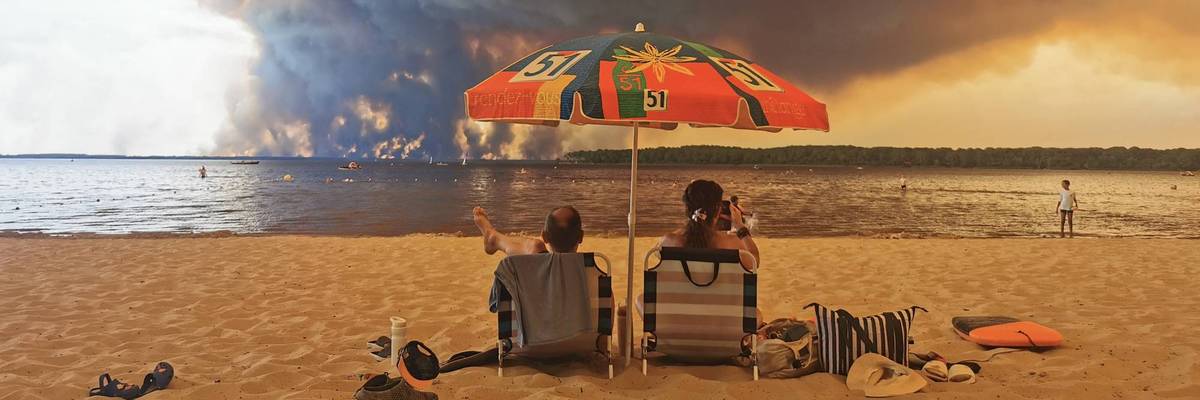
Beach goers rest on the beach of Moutchic on the shore of Lake Lacanau (Etang de Lacanau) in Lacanau , southwestern France on July 24, 2026, as clouds of smoke rise into the sky from the Gironde wildfire.
As the consequences build, the pressure on decent politicians to act will grow.
The climate fight moves in stages. A decade ago, we got to the pledge stage. First, governments signed the Paris accords, and then, under pressure from Greta Thunberg’s movement, banks and corporations did the same. Leaders don’t mind making pledges; the hard part is always a few years away, and the pledge itself takes off some of the pressure.
Then other stuff intervened: Covid-19, the invasion of Ukraine, AI, the high prices that those things caused, the fascists that were elected on the back of those high prices. So politicians and corporations began to abandon their climate pledges, in favor of other priorities.
But what do you know, now something else is happening: a global outbreak of extremely high temperatures, and with them all the disasters we’ve come to expect. The question is, will that provide pressure enough to get climate action back on course? We’re going to find out over the next year, and I think we’re going to find out first on the other side of the Atlantic
This spring and summer have been horrific in Europe and the UK. A wavering jet stream—the product of a melting Arctic—has brought heat dome after heat dome to the continent, producing bouts of extraordinarily high temperature. Records have been smashed left and right, and now that heat is producing vast fires, centered in Spain and France, but spreading far afield to the UK, Belgium, and elsewhere.
Why would you recommend a Mediterranean climate at the precise moment that the countries that ring the Med are on fire?
I want to start the account by saying: These are not the worst heatwaves underway in the world. It’s hit 127°F in Iran, even as the bombs are falling; India has seen another brutal spring and summer, and as Hannah Ellis-Petersen and Aakash Hassan write from Andhra Pradesh, the toll on very poor people is unbearable. They describe Mahalaxmi, paid by a government scheme to join with other women in digging a new reservoir by hand:
By 11:00 am, the first shift of their day was over. The women headed home, exchanging few words due to their exhaustion. Mahalaxmi did not speak when she got home, but went straight to the bedroom where she collapsed in apparent sleep.
Unable to rouse her hours later, her husband, Palli Shyam Sundha Rao, rushed to find a doctor. Examining her lifeless body, the doctor concluded Mahalaxmi had died from heatstroke.
“It was such a shock to all of us,” said Purilla. “She always seemed so strong. If the heat can take her like this, then it could take any of us.”
So let that serve as a baseline. Scary as what’s happening in Europe and the US is, we retain some wealth to buffer our lives and our communities. That’s not true elsewhere. Still, it’s been wildly hard in Europe. As Mark Landler and Chico Harlan reported on Thursday:
Ravenous fires. Searing heatwaves. Freakish storms. The summer of 2026 has already shattered meteorological records in several European countries. On a continent that has weathered centuries of upheaval—ruinous wars, deadly pandemics—it is the weather itself that now has Europe feeling close to a breaking point.
It has displaced more than 300,000 people in France and Spain, where the largest fires in those countries’ modern history have led to their largest peacetime evacuations, with villages destroyed and hundreds of thousands of acres incinerated. It has left millions more desperate for relief from temperatures that routinely soar above 40°C, or 104°F.
And there is absolutely no doubt how connected all this is to global warming—that is, to our longstanding habit of burning coal and gas and oil. Raymond Zhong, writing in the Times, says new research makes that clear:
For central Spain, the scientists found that the intense heat and dryness in July had roughly a 17% probability of occurring in a given year in the present-day climate. In the preindustrial world, however, the likelihood of such conditions would have been one-twentieth as high, the researchers estimated.
In fact, we can say with increasing specificity what happened, and it’s very similar to things we’ve seen elsewhere, and that I described a few weeks ago in an interview with University of California climate scientist Daniel Swain. What we’re seeing is what he calls “weather whiplash,” when the extreme rains that climate change produces cause a massive growth of vegetation in the spring, only to see these new high temperatures produce “flash droughts” that turn those green grasses and shrubs into tinder, waiting for lightning to strike. The folks at Yale Environment 360 quoted:
Francesca Di Giuseppe, fire forecast coordinator at the European Centre for Medium-Range Weather Forecasts, who said the “rebound” from a wet winter to a dry summer was a key factor. After an exceptionally rainy winter spurred the growth of vegetation, an unusual summer drought turned that new growth to tinder.
The results have been brutal. I won’t bother cataloguing deaths and dollars—if we’re “lucky,” the former will be measured in the many tens of thousands, and the latter in the hundreds of billions—but I do want to give some small sense of what life is like. Madeline Schwartz, editor of the international journal the Dial, writes from Paris that:
This summer has unleashed a special kind of hell on France: not just several heatwaves with temperatures reaching as high as 112°F, but drought and forest fires, some right next to Paris. On my street, the leaves have already turned brown; a once lush lawn now looks like burned straw. Across the country, farmers are reporting that crops have withered in the blistering conditions.
The British paper The Express reports that signs in grocery stores warn produce buyers about high prices and unavailable items:
“Produce such as carrots, onions, and potatoes will likely be hit the hardest due to dry soil shrinking crop sizes, while leeks, cabbage and cauliflower could also become harder to find.”
Salad crops such as lettuce may also face a price hike, as they could be replaced by pricier imports due to the heavy irrigation required.
Cupboard essentials such as bread, pasta, and cereal could be affected too, as wheat and barley crops come under heat stress.
Pippa Neill describes the stress on farmers:
“The vines are dying. The grass is yellow and now we can smell the smoke,” Uyen Do, an organic farmer in the Dordogne region of France says, almost in tears. “It’s already very difficult to survive economically and now with climate change it’s becoming a struggle that I’m not sure we’re capable of going through.”
But British farmer Brian King says drought is just one part of the problem. During the recent heatwaves, which saw several days where temperatures exceeded 30°C, “the environment was so hostile that the plants are so stressed they want to die because they just can’t take it”.
Drought has pushed the Rhine River to its lowest recorded levels, stranding the barges that normally carry coal and gas. As Eamon Farhat reports:
The cost to ship diesel from Rotterdam to Karlsruhe—further inland from the closely watched Kaub chokepoint—has climbed to the highest since Bloomberg began compiling the data in 2009.
“With every centimeter it’s getting more difficult,” said Florian Krekel at Germany’s WSV, which manages the country’s waterways. “There’s no rain in sight.”
As river levels fall, Hungary and France are having to shut some nuclear power plants because they can no longer safely cool them; oh, and a sunken Nazi warship has reappeared along the dwindling Danube in Serbia, so that’s nice. The Royal Horticultural Society, meanwhile, may have to move its hydrangea garden to the north of England
But it’s the fires that have really left their mark on this European summer. As Margherita Stancati, Noemie Bisserbe, and Ed Ballard wrote in The Wall Street Journal last week, the continent has never seen anything on this scale before:
In Spain, the fires have destroyed more than 370,000 acres so far this year. Isabel Díaz Ayuso, the leader of Madrid’s local government, earlier this week described the Madrid wildfires as perhaps “the worst natural catastrophe in Spain’s history.”
The intensity of the fires has created large, fire-fueled thunderstorms, known as pyrocumulonimbus clouds, for the first time in France’s recent history. The clouds, which have been observed during wildfires in Canada and Australia, are created by intense heat that lifts hot smoky air and causes the water vapor to condense into ash. The clouds can generate lightning, further spreading the fires.
The US is so vast that sometimes we barely notice things happening in the other corner: There are big wildfires burning in Oregon right now, for instance, (and the chance for many more over the course of a windy weekend). But we forget how compact European countries are. France is among the largest of its nations, but the Tour de France had to be shortened on its final day in order to free up policemen to go help with firefighting in other regions of the country. So there’s no escaping the smoke, or its political meaning. And that’s what we need to talk about.
All this comes after a period of what American politicians have called “climate-hushing,” when even non-MAGA leaders have been backing away from the steps needed to speed up the energy transition. That’s been true in other places too. Bill McGuire, a climate researcher at University College London, wrote that:
Such is the astonishing scale of the wildfires burning at the gates of Bordeaux and Madrid, that if they had happened 20—even 10—years back, they may well have shocked the world into taking action on the climate crisis. But like the proverbial frog in a pot of slowly heating water, we have become inured; not only to the ever more devastating impacts of climate breakdown, but increasingly to the actions needed to bring global heating to heel.
Even as more than 35,000 wildfires rage across the surface of our world, and as we continue to rewind our planet’s climate so it resembles hotter episodes from its distant past, governments and trading blocs are very deliberately turning away from climate action.
The latest evidence that we are not only doing too little but actually doing less as time goes by is provided by the climate action media platform, We Don’t Have Time. It reported last week that the 12 months to July this year saw the reversal across the world of 45 climate policies. The retreat on climate action is global, but Europe—previously seen as a leader in emissions reductions—is in the vanguard, weakening measures across the board, including in the areas of carbon pricing, methane emissions, and the phasing out of petrol and diesel vehicles.
There are even some who are seizing on the new disasters to urge… less action. In a truly remarkable essay for Britain’s conservative Telegraph, pundit Allister Heath used the fires to say that the “war against global warming has been lost” and hence it was time to
accept this sobering reality, cut our losses, cease tilting at (and building) windmills, ditch the despicable con that is net zero, and learn to cope with, and even enjoy, a warmer, drier, more volatile Mediterranean climate.
This is monumentally stupid on several different levels, and Alan Rusbridger, former editor of The Guardian now proprietor the the British magazine the Prospect outlines a number of them in a (highly enjoyable) takedown. But mainly: Why would you recommend a Mediterranean climate at the precise moment that the countries that ring the Med are on fire? And of course it’s not as if you get to choose even the current, fiery Mediterranean climate. If you abandon “net zero,” or the other attempts to rapidly build out solar panels and windmills, you’ll get an ever hotter version.
That hasn’t stopped Britain’s Conservatives from purging party members who want to continue the energy transition, and there are at least some signs that England’s new prime minister, Labour’s Andy Burnham, is tilting in somewhat the same direction. The Murdoch tabloids have been mounting a crusade to open up new oil wells in the North Sea, and Burnham said this week that the country needed to be “pragmatic” in the face of rising energy costs, never mind that the global price of energy won’t budge one pence with whatever new supply can be found in the dwindling deposits off the UK coast.
But my guess is that Burnham may well decide to stand up to Murdoch et al. and turn his back on more drilling, simply because the heat and the smoke have made the case for climate action so wildly clear. As Fiona Harvey and a team at The Guardian reported yesterday, a rebellion is brewing because many Labour parliamentarians
are increasingly worried about how support for expanded drilling will play with an electorate alarmed by the worst drought since 1976, soaring temperatures, wildfires, and climate-related food inflation and potential supply shortages.
They worry about losing more voters to the Greens: Zack Polanski’s party has stressed its opposition to further new licences for the North Sea, including the Jackdaw gasfield in the North Sea and the Rosebank oilfield, west of Shetland. A decision to go ahead with the projects could trigger a new surge in defectors from Labour.
Rachael Maskell, the Labour MP for York Central, urged ministers to “keep carbon in the ground”, and watch the recent national emergency climate briefing. She added: “We’re seeing ice caps melting, seas warming up, hotter and hotter summers. This summer has been a warning that we have to go towards a sustainable future fast.”
Clive Lewis, the Labour MP for Norwich South, said there was “no legitimate reason” to press ahead with Jackdaw because it would make only a negligible difference to energy prices while sending the wrong signal internationally as Europe experienced record heat.
Lewis said approving the field would show Burnham was “not looking at the evidence” and that Labour risked adding “the stain of the climate crisis” to the party’s record, alongside Gaza.
Indeed, Britain’s brand new Foreign Minister Ed Miliband, who had been its energy and climate minister until last week, has already issued a joint communique with his Spanish counterpart calling for deeper climate action:
At a time when Europe is facing record heatwaves and terrible wildfires as a consequence of the climate crisis, the two Ministers agreed that this summer’s wildfires demonstrated that climate change was now a national security emergency facing Europe and threatening our way of life.
Both parties agreed that tackling the climate crisis was an urgent policy priority for all countries—to tackle the cost of living, protect health and well-being, and to ensure European economic and energy security. The two Ministers noted that climate action was essential to protect not just current generations, but our children and grandchildren too.
The two Ministers underscored the priority they attach to combating climate change within their foreign policy and agreed on the need to co-lead the green transition, convinced that decarbonisation, energy security, environmental protection, and resilience are inseparable from our security and the prosperity and competitiveness of our economies.
I think that this is a good sign—and I think it’s a dry run for what the whole world is going to go through over the next 12 months. The signs keep mounting that the El Niño building in the Pacific is going to be massive in scale. As United Nations Secretary General Antonio Guterres said last Friday:
This is only a warm-up act. El Niño is strengthening, adding fuel to a planet already on fire.
As the consequences build, the pressure on decent politicians to act will grow. Obviously the Trump administration, and its fascist friends elsewhere, will continue to coddle the fossil fuel industry—but it will be harder and harder for others to turn aside renewed climate fears. I’d be willing to bet that climate will be a key issue in the Democratic primaries (and campaigning for those will be well underway by this time next year).
In fact, there’s already an effort underway—the veteran campaigner Margie Alt is helping lead a Climate Action Campaign this summer to get the issue back on the political… front burner.
Actions began on Thursday and will take a variety of forms. In Michigan, participants will demonstrate against the Republican representative Bill Huizenga who voted for Trump’s so-called big beautiful bill, which boosted planet-heating fossil fuels.
In Arizona, young activists will meet with the Democratic representative Adelita Shirley Grijalva, a climate champion, and encourage her to continue talking about global warming. In other districts, organizers have circulated petitions calling on the House Democratic leader, Hakeem Jeffries, and Senate Democratic leader, Chuck Schumer, to prioritize climate issues or plan to call on their representatives to connect the climate crisis to recent heatwaves.
I have no doubt it will annoy some Democrats—and no one is saying the issue should dominate the midterms, which must be fought on the value of democracy and the cost of living. But every politician worth her salt should at every opportunity at least mention the anti-renewables jihad that the Trump administration has launched—the number of Americans who support shutting down 90% finished wind farms is tiny, and the rest of us are truly annoyed.
And in many ways this generation of politicians is the luckiest yet, because they have a tool to call on that make those pledges relatively easy to fulfill. With ever-cheaper power from the sun, wind, and batteries, this ultimate cycle of the climate fight will look different than the ones before. We’re going to get a last chance to get this crisis at least a little right. We dare not lose it.
Dear Common Dreams reader, It’s been nearly 30 years since I co-founded Common Dreams with my late wife, Lina Newhouser. We had the radical notion that journalism should serve the public good, not corporate profits. It was clear to us from the outset what it would take to build such a project. No paid advertisements. No corporate sponsors. No millionaire publisher telling us what to think or do. Many people said we wouldn't last a year, but we proved those doubters wrong. Together with a tremendous team of journalists and dedicated staff, we built an independent media outlet free from the constraints of profits and corporate control. Our mission has always been simple: To inform. To inspire. To ignite change for the common good. Building Common Dreams was not easy. Our survival was never guaranteed. When you take on the most powerful forces—Wall Street greed, fossil fuel industry destruction, Big Tech lobbyists, and uber-rich oligarchs who have spent billions upon billions rigging the economy and democracy in their favor—the only bulwark you have is supporters who believe in your work. But here’s the urgent message from me today. It's never been this bad out there. And it's never been this hard to keep us going. At the very moment Common Dreams is most needed, the threats we face are intensifying. We need your support now more than ever. We don't accept corporate advertising and never will. We don't have a paywall because we don't think people should be blocked from critical news based on their ability to pay. Everything we do is funded by the donations of readers like you. When everyone does the little they can afford, we are strong. But if that support retreats or dries up, so do we. Will you donate now to make sure Common Dreams not only survives but thrives? —Craig Brown, Co-founder |
The climate fight moves in stages. A decade ago, we got to the pledge stage. First, governments signed the Paris accords, and then, under pressure from Greta Thunberg’s movement, banks and corporations did the same. Leaders don’t mind making pledges; the hard part is always a few years away, and the pledge itself takes off some of the pressure.
Then other stuff intervened: Covid-19, the invasion of Ukraine, AI, the high prices that those things caused, the fascists that were elected on the back of those high prices. So politicians and corporations began to abandon their climate pledges, in favor of other priorities.
But what do you know, now something else is happening: a global outbreak of extremely high temperatures, and with them all the disasters we’ve come to expect. The question is, will that provide pressure enough to get climate action back on course? We’re going to find out over the next year, and I think we’re going to find out first on the other side of the Atlantic
This spring and summer have been horrific in Europe and the UK. A wavering jet stream—the product of a melting Arctic—has brought heat dome after heat dome to the continent, producing bouts of extraordinarily high temperature. Records have been smashed left and right, and now that heat is producing vast fires, centered in Spain and France, but spreading far afield to the UK, Belgium, and elsewhere.
Why would you recommend a Mediterranean climate at the precise moment that the countries that ring the Med are on fire?
I want to start the account by saying: These are not the worst heatwaves underway in the world. It’s hit 127°F in Iran, even as the bombs are falling; India has seen another brutal spring and summer, and as Hannah Ellis-Petersen and Aakash Hassan write from Andhra Pradesh, the toll on very poor people is unbearable. They describe Mahalaxmi, paid by a government scheme to join with other women in digging a new reservoir by hand:
By 11:00 am, the first shift of their day was over. The women headed home, exchanging few words due to their exhaustion. Mahalaxmi did not speak when she got home, but went straight to the bedroom where she collapsed in apparent sleep.
Unable to rouse her hours later, her husband, Palli Shyam Sundha Rao, rushed to find a doctor. Examining her lifeless body, the doctor concluded Mahalaxmi had died from heatstroke.
“It was such a shock to all of us,” said Purilla. “She always seemed so strong. If the heat can take her like this, then it could take any of us.”
So let that serve as a baseline. Scary as what’s happening in Europe and the US is, we retain some wealth to buffer our lives and our communities. That’s not true elsewhere. Still, it’s been wildly hard in Europe. As Mark Landler and Chico Harlan reported on Thursday:
Ravenous fires. Searing heatwaves. Freakish storms. The summer of 2026 has already shattered meteorological records in several European countries. On a continent that has weathered centuries of upheaval—ruinous wars, deadly pandemics—it is the weather itself that now has Europe feeling close to a breaking point.
It has displaced more than 300,000 people in France and Spain, where the largest fires in those countries’ modern history have led to their largest peacetime evacuations, with villages destroyed and hundreds of thousands of acres incinerated. It has left millions more desperate for relief from temperatures that routinely soar above 40°C, or 104°F.
And there is absolutely no doubt how connected all this is to global warming—that is, to our longstanding habit of burning coal and gas and oil. Raymond Zhong, writing in the Times, says new research makes that clear:
For central Spain, the scientists found that the intense heat and dryness in July had roughly a 17% probability of occurring in a given year in the present-day climate. In the preindustrial world, however, the likelihood of such conditions would have been one-twentieth as high, the researchers estimated.
In fact, we can say with increasing specificity what happened, and it’s very similar to things we’ve seen elsewhere, and that I described a few weeks ago in an interview with University of California climate scientist Daniel Swain. What we’re seeing is what he calls “weather whiplash,” when the extreme rains that climate change produces cause a massive growth of vegetation in the spring, only to see these new high temperatures produce “flash droughts” that turn those green grasses and shrubs into tinder, waiting for lightning to strike. The folks at Yale Environment 360 quoted:
Francesca Di Giuseppe, fire forecast coordinator at the European Centre for Medium-Range Weather Forecasts, who said the “rebound” from a wet winter to a dry summer was a key factor. After an exceptionally rainy winter spurred the growth of vegetation, an unusual summer drought turned that new growth to tinder.
The results have been brutal. I won’t bother cataloguing deaths and dollars—if we’re “lucky,” the former will be measured in the many tens of thousands, and the latter in the hundreds of billions—but I do want to give some small sense of what life is like. Madeline Schwartz, editor of the international journal the Dial, writes from Paris that:
This summer has unleashed a special kind of hell on France: not just several heatwaves with temperatures reaching as high as 112°F, but drought and forest fires, some right next to Paris. On my street, the leaves have already turned brown; a once lush lawn now looks like burned straw. Across the country, farmers are reporting that crops have withered in the blistering conditions.
The British paper The Express reports that signs in grocery stores warn produce buyers about high prices and unavailable items:
“Produce such as carrots, onions, and potatoes will likely be hit the hardest due to dry soil shrinking crop sizes, while leeks, cabbage and cauliflower could also become harder to find.”
Salad crops such as lettuce may also face a price hike, as they could be replaced by pricier imports due to the heavy irrigation required.
Cupboard essentials such as bread, pasta, and cereal could be affected too, as wheat and barley crops come under heat stress.
Pippa Neill describes the stress on farmers:
“The vines are dying. The grass is yellow and now we can smell the smoke,” Uyen Do, an organic farmer in the Dordogne region of France says, almost in tears. “It’s already very difficult to survive economically and now with climate change it’s becoming a struggle that I’m not sure we’re capable of going through.”
But British farmer Brian King says drought is just one part of the problem. During the recent heatwaves, which saw several days where temperatures exceeded 30°C, “the environment was so hostile that the plants are so stressed they want to die because they just can’t take it”.
Drought has pushed the Rhine River to its lowest recorded levels, stranding the barges that normally carry coal and gas. As Eamon Farhat reports:
The cost to ship diesel from Rotterdam to Karlsruhe—further inland from the closely watched Kaub chokepoint—has climbed to the highest since Bloomberg began compiling the data in 2009.
“With every centimeter it’s getting more difficult,” said Florian Krekel at Germany’s WSV, which manages the country’s waterways. “There’s no rain in sight.”
As river levels fall, Hungary and France are having to shut some nuclear power plants because they can no longer safely cool them; oh, and a sunken Nazi warship has reappeared along the dwindling Danube in Serbia, so that’s nice. The Royal Horticultural Society, meanwhile, may have to move its hydrangea garden to the north of England
But it’s the fires that have really left their mark on this European summer. As Margherita Stancati, Noemie Bisserbe, and Ed Ballard wrote in The Wall Street Journal last week, the continent has never seen anything on this scale before:
In Spain, the fires have destroyed more than 370,000 acres so far this year. Isabel Díaz Ayuso, the leader of Madrid’s local government, earlier this week described the Madrid wildfires as perhaps “the worst natural catastrophe in Spain’s history.”
The intensity of the fires has created large, fire-fueled thunderstorms, known as pyrocumulonimbus clouds, for the first time in France’s recent history. The clouds, which have been observed during wildfires in Canada and Australia, are created by intense heat that lifts hot smoky air and causes the water vapor to condense into ash. The clouds can generate lightning, further spreading the fires.
The US is so vast that sometimes we barely notice things happening in the other corner: There are big wildfires burning in Oregon right now, for instance, (and the chance for many more over the course of a windy weekend). But we forget how compact European countries are. France is among the largest of its nations, but the Tour de France had to be shortened on its final day in order to free up policemen to go help with firefighting in other regions of the country. So there’s no escaping the smoke, or its political meaning. And that’s what we need to talk about.
All this comes after a period of what American politicians have called “climate-hushing,” when even non-MAGA leaders have been backing away from the steps needed to speed up the energy transition. That’s been true in other places too. Bill McGuire, a climate researcher at University College London, wrote that:
Such is the astonishing scale of the wildfires burning at the gates of Bordeaux and Madrid, that if they had happened 20—even 10—years back, they may well have shocked the world into taking action on the climate crisis. But like the proverbial frog in a pot of slowly heating water, we have become inured; not only to the ever more devastating impacts of climate breakdown, but increasingly to the actions needed to bring global heating to heel.
Even as more than 35,000 wildfires rage across the surface of our world, and as we continue to rewind our planet’s climate so it resembles hotter episodes from its distant past, governments and trading blocs are very deliberately turning away from climate action.
The latest evidence that we are not only doing too little but actually doing less as time goes by is provided by the climate action media platform, We Don’t Have Time. It reported last week that the 12 months to July this year saw the reversal across the world of 45 climate policies. The retreat on climate action is global, but Europe—previously seen as a leader in emissions reductions—is in the vanguard, weakening measures across the board, including in the areas of carbon pricing, methane emissions, and the phasing out of petrol and diesel vehicles.
There are even some who are seizing on the new disasters to urge… less action. In a truly remarkable essay for Britain’s conservative Telegraph, pundit Allister Heath used the fires to say that the “war against global warming has been lost” and hence it was time to
accept this sobering reality, cut our losses, cease tilting at (and building) windmills, ditch the despicable con that is net zero, and learn to cope with, and even enjoy, a warmer, drier, more volatile Mediterranean climate.
This is monumentally stupid on several different levels, and Alan Rusbridger, former editor of The Guardian now proprietor the the British magazine the Prospect outlines a number of them in a (highly enjoyable) takedown. But mainly: Why would you recommend a Mediterranean climate at the precise moment that the countries that ring the Med are on fire? And of course it’s not as if you get to choose even the current, fiery Mediterranean climate. If you abandon “net zero,” or the other attempts to rapidly build out solar panels and windmills, you’ll get an ever hotter version.
That hasn’t stopped Britain’s Conservatives from purging party members who want to continue the energy transition, and there are at least some signs that England’s new prime minister, Labour’s Andy Burnham, is tilting in somewhat the same direction. The Murdoch tabloids have been mounting a crusade to open up new oil wells in the North Sea, and Burnham said this week that the country needed to be “pragmatic” in the face of rising energy costs, never mind that the global price of energy won’t budge one pence with whatever new supply can be found in the dwindling deposits off the UK coast.
But my guess is that Burnham may well decide to stand up to Murdoch et al. and turn his back on more drilling, simply because the heat and the smoke have made the case for climate action so wildly clear. As Fiona Harvey and a team at The Guardian reported yesterday, a rebellion is brewing because many Labour parliamentarians
are increasingly worried about how support for expanded drilling will play with an electorate alarmed by the worst drought since 1976, soaring temperatures, wildfires, and climate-related food inflation and potential supply shortages.
They worry about losing more voters to the Greens: Zack Polanski’s party has stressed its opposition to further new licences for the North Sea, including the Jackdaw gasfield in the North Sea and the Rosebank oilfield, west of Shetland. A decision to go ahead with the projects could trigger a new surge in defectors from Labour.
Rachael Maskell, the Labour MP for York Central, urged ministers to “keep carbon in the ground”, and watch the recent national emergency climate briefing. She added: “We’re seeing ice caps melting, seas warming up, hotter and hotter summers. This summer has been a warning that we have to go towards a sustainable future fast.”
Clive Lewis, the Labour MP for Norwich South, said there was “no legitimate reason” to press ahead with Jackdaw because it would make only a negligible difference to energy prices while sending the wrong signal internationally as Europe experienced record heat.
Lewis said approving the field would show Burnham was “not looking at the evidence” and that Labour risked adding “the stain of the climate crisis” to the party’s record, alongside Gaza.
Indeed, Britain’s brand new Foreign Minister Ed Miliband, who had been its energy and climate minister until last week, has already issued a joint communique with his Spanish counterpart calling for deeper climate action:
At a time when Europe is facing record heatwaves and terrible wildfires as a consequence of the climate crisis, the two Ministers agreed that this summer’s wildfires demonstrated that climate change was now a national security emergency facing Europe and threatening our way of life.
Both parties agreed that tackling the climate crisis was an urgent policy priority for all countries—to tackle the cost of living, protect health and well-being, and to ensure European economic and energy security. The two Ministers noted that climate action was essential to protect not just current generations, but our children and grandchildren too.
The two Ministers underscored the priority they attach to combating climate change within their foreign policy and agreed on the need to co-lead the green transition, convinced that decarbonisation, energy security, environmental protection, and resilience are inseparable from our security and the prosperity and competitiveness of our economies.
I think that this is a good sign—and I think it’s a dry run for what the whole world is going to go through over the next 12 months. The signs keep mounting that the El Niño building in the Pacific is going to be massive in scale. As United Nations Secretary General Antonio Guterres said last Friday:
This is only a warm-up act. El Niño is strengthening, adding fuel to a planet already on fire.
As the consequences build, the pressure on decent politicians to act will grow. Obviously the Trump administration, and its fascist friends elsewhere, will continue to coddle the fossil fuel industry—but it will be harder and harder for others to turn aside renewed climate fears. I’d be willing to bet that climate will be a key issue in the Democratic primaries (and campaigning for those will be well underway by this time next year).
In fact, there’s already an effort underway—the veteran campaigner Margie Alt is helping lead a Climate Action Campaign this summer to get the issue back on the political… front burner.
Actions began on Thursday and will take a variety of forms. In Michigan, participants will demonstrate against the Republican representative Bill Huizenga who voted for Trump’s so-called big beautiful bill, which boosted planet-heating fossil fuels.
In Arizona, young activists will meet with the Democratic representative Adelita Shirley Grijalva, a climate champion, and encourage her to continue talking about global warming. In other districts, organizers have circulated petitions calling on the House Democratic leader, Hakeem Jeffries, and Senate Democratic leader, Chuck Schumer, to prioritize climate issues or plan to call on their representatives to connect the climate crisis to recent heatwaves.
I have no doubt it will annoy some Democrats—and no one is saying the issue should dominate the midterms, which must be fought on the value of democracy and the cost of living. But every politician worth her salt should at every opportunity at least mention the anti-renewables jihad that the Trump administration has launched—the number of Americans who support shutting down 90% finished wind farms is tiny, and the rest of us are truly annoyed.
And in many ways this generation of politicians is the luckiest yet, because they have a tool to call on that make those pledges relatively easy to fulfill. With ever-cheaper power from the sun, wind, and batteries, this ultimate cycle of the climate fight will look different than the ones before. We’re going to get a last chance to get this crisis at least a little right. We dare not lose it.
The climate fight moves in stages. A decade ago, we got to the pledge stage. First, governments signed the Paris accords, and then, under pressure from Greta Thunberg’s movement, banks and corporations did the same. Leaders don’t mind making pledges; the hard part is always a few years away, and the pledge itself takes off some of the pressure.
Then other stuff intervened: Covid-19, the invasion of Ukraine, AI, the high prices that those things caused, the fascists that were elected on the back of those high prices. So politicians and corporations began to abandon their climate pledges, in favor of other priorities.
But what do you know, now something else is happening: a global outbreak of extremely high temperatures, and with them all the disasters we’ve come to expect. The question is, will that provide pressure enough to get climate action back on course? We’re going to find out over the next year, and I think we’re going to find out first on the other side of the Atlantic
This spring and summer have been horrific in Europe and the UK. A wavering jet stream—the product of a melting Arctic—has brought heat dome after heat dome to the continent, producing bouts of extraordinarily high temperature. Records have been smashed left and right, and now that heat is producing vast fires, centered in Spain and France, but spreading far afield to the UK, Belgium, and elsewhere.
Why would you recommend a Mediterranean climate at the precise moment that the countries that ring the Med are on fire?
I want to start the account by saying: These are not the worst heatwaves underway in the world. It’s hit 127°F in Iran, even as the bombs are falling; India has seen another brutal spring and summer, and as Hannah Ellis-Petersen and Aakash Hassan write from Andhra Pradesh, the toll on very poor people is unbearable. They describe Mahalaxmi, paid by a government scheme to join with other women in digging a new reservoir by hand:
By 11:00 am, the first shift of their day was over. The women headed home, exchanging few words due to their exhaustion. Mahalaxmi did not speak when she got home, but went straight to the bedroom where she collapsed in apparent sleep.
Unable to rouse her hours later, her husband, Palli Shyam Sundha Rao, rushed to find a doctor. Examining her lifeless body, the doctor concluded Mahalaxmi had died from heatstroke.
“It was such a shock to all of us,” said Purilla. “She always seemed so strong. If the heat can take her like this, then it could take any of us.”
So let that serve as a baseline. Scary as what’s happening in Europe and the US is, we retain some wealth to buffer our lives and our communities. That’s not true elsewhere. Still, it’s been wildly hard in Europe. As Mark Landler and Chico Harlan reported on Thursday:
Ravenous fires. Searing heatwaves. Freakish storms. The summer of 2026 has already shattered meteorological records in several European countries. On a continent that has weathered centuries of upheaval—ruinous wars, deadly pandemics—it is the weather itself that now has Europe feeling close to a breaking point.
It has displaced more than 300,000 people in France and Spain, where the largest fires in those countries’ modern history have led to their largest peacetime evacuations, with villages destroyed and hundreds of thousands of acres incinerated. It has left millions more desperate for relief from temperatures that routinely soar above 40°C, or 104°F.
And there is absolutely no doubt how connected all this is to global warming—that is, to our longstanding habit of burning coal and gas and oil. Raymond Zhong, writing in the Times, says new research makes that clear:
For central Spain, the scientists found that the intense heat and dryness in July had roughly a 17% probability of occurring in a given year in the present-day climate. In the preindustrial world, however, the likelihood of such conditions would have been one-twentieth as high, the researchers estimated.
In fact, we can say with increasing specificity what happened, and it’s very similar to things we’ve seen elsewhere, and that I described a few weeks ago in an interview with University of California climate scientist Daniel Swain. What we’re seeing is what he calls “weather whiplash,” when the extreme rains that climate change produces cause a massive growth of vegetation in the spring, only to see these new high temperatures produce “flash droughts” that turn those green grasses and shrubs into tinder, waiting for lightning to strike. The folks at Yale Environment 360 quoted:
Francesca Di Giuseppe, fire forecast coordinator at the European Centre for Medium-Range Weather Forecasts, who said the “rebound” from a wet winter to a dry summer was a key factor. After an exceptionally rainy winter spurred the growth of vegetation, an unusual summer drought turned that new growth to tinder.
The results have been brutal. I won’t bother cataloguing deaths and dollars—if we’re “lucky,” the former will be measured in the many tens of thousands, and the latter in the hundreds of billions—but I do want to give some small sense of what life is like. Madeline Schwartz, editor of the international journal the Dial, writes from Paris that:
This summer has unleashed a special kind of hell on France: not just several heatwaves with temperatures reaching as high as 112°F, but drought and forest fires, some right next to Paris. On my street, the leaves have already turned brown; a once lush lawn now looks like burned straw. Across the country, farmers are reporting that crops have withered in the blistering conditions.
The British paper The Express reports that signs in grocery stores warn produce buyers about high prices and unavailable items:
“Produce such as carrots, onions, and potatoes will likely be hit the hardest due to dry soil shrinking crop sizes, while leeks, cabbage and cauliflower could also become harder to find.”
Salad crops such as lettuce may also face a price hike, as they could be replaced by pricier imports due to the heavy irrigation required.
Cupboard essentials such as bread, pasta, and cereal could be affected too, as wheat and barley crops come under heat stress.
Pippa Neill describes the stress on farmers:
“The vines are dying. The grass is yellow and now we can smell the smoke,” Uyen Do, an organic farmer in the Dordogne region of France says, almost in tears. “It’s already very difficult to survive economically and now with climate change it’s becoming a struggle that I’m not sure we’re capable of going through.”
But British farmer Brian King says drought is just one part of the problem. During the recent heatwaves, which saw several days where temperatures exceeded 30°C, “the environment was so hostile that the plants are so stressed they want to die because they just can’t take it”.
Drought has pushed the Rhine River to its lowest recorded levels, stranding the barges that normally carry coal and gas. As Eamon Farhat reports:
The cost to ship diesel from Rotterdam to Karlsruhe—further inland from the closely watched Kaub chokepoint—has climbed to the highest since Bloomberg began compiling the data in 2009.
“With every centimeter it’s getting more difficult,” said Florian Krekel at Germany’s WSV, which manages the country’s waterways. “There’s no rain in sight.”
As river levels fall, Hungary and France are having to shut some nuclear power plants because they can no longer safely cool them; oh, and a sunken Nazi warship has reappeared along the dwindling Danube in Serbia, so that’s nice. The Royal Horticultural Society, meanwhile, may have to move its hydrangea garden to the north of England
But it’s the fires that have really left their mark on this European summer. As Margherita Stancati, Noemie Bisserbe, and Ed Ballard wrote in The Wall Street Journal last week, the continent has never seen anything on this scale before:
In Spain, the fires have destroyed more than 370,000 acres so far this year. Isabel Díaz Ayuso, the leader of Madrid’s local government, earlier this week described the Madrid wildfires as perhaps “the worst natural catastrophe in Spain’s history.”
The intensity of the fires has created large, fire-fueled thunderstorms, known as pyrocumulonimbus clouds, for the first time in France’s recent history. The clouds, which have been observed during wildfires in Canada and Australia, are created by intense heat that lifts hot smoky air and causes the water vapor to condense into ash. The clouds can generate lightning, further spreading the fires.
The US is so vast that sometimes we barely notice things happening in the other corner: There are big wildfires burning in Oregon right now, for instance, (and the chance for many more over the course of a windy weekend). But we forget how compact European countries are. France is among the largest of its nations, but the Tour de France had to be shortened on its final day in order to free up policemen to go help with firefighting in other regions of the country. So there’s no escaping the smoke, or its political meaning. And that’s what we need to talk about.
All this comes after a period of what American politicians have called “climate-hushing,” when even non-MAGA leaders have been backing away from the steps needed to speed up the energy transition. That’s been true in other places too. Bill McGuire, a climate researcher at University College London, wrote that:
Such is the astonishing scale of the wildfires burning at the gates of Bordeaux and Madrid, that if they had happened 20—even 10—years back, they may well have shocked the world into taking action on the climate crisis. But like the proverbial frog in a pot of slowly heating water, we have become inured; not only to the ever more devastating impacts of climate breakdown, but increasingly to the actions needed to bring global heating to heel.
Even as more than 35,000 wildfires rage across the surface of our world, and as we continue to rewind our planet’s climate so it resembles hotter episodes from its distant past, governments and trading blocs are very deliberately turning away from climate action.
The latest evidence that we are not only doing too little but actually doing less as time goes by is provided by the climate action media platform, We Don’t Have Time. It reported last week that the 12 months to July this year saw the reversal across the world of 45 climate policies. The retreat on climate action is global, but Europe—previously seen as a leader in emissions reductions—is in the vanguard, weakening measures across the board, including in the areas of carbon pricing, methane emissions, and the phasing out of petrol and diesel vehicles.
There are even some who are seizing on the new disasters to urge… less action. In a truly remarkable essay for Britain’s conservative Telegraph, pundit Allister Heath used the fires to say that the “war against global warming has been lost” and hence it was time to
accept this sobering reality, cut our losses, cease tilting at (and building) windmills, ditch the despicable con that is net zero, and learn to cope with, and even enjoy, a warmer, drier, more volatile Mediterranean climate.
This is monumentally stupid on several different levels, and Alan Rusbridger, former editor of The Guardian now proprietor the the British magazine the Prospect outlines a number of them in a (highly enjoyable) takedown. But mainly: Why would you recommend a Mediterranean climate at the precise moment that the countries that ring the Med are on fire? And of course it’s not as if you get to choose even the current, fiery Mediterranean climate. If you abandon “net zero,” or the other attempts to rapidly build out solar panels and windmills, you’ll get an ever hotter version.
That hasn’t stopped Britain’s Conservatives from purging party members who want to continue the energy transition, and there are at least some signs that England’s new prime minister, Labour’s Andy Burnham, is tilting in somewhat the same direction. The Murdoch tabloids have been mounting a crusade to open up new oil wells in the North Sea, and Burnham said this week that the country needed to be “pragmatic” in the face of rising energy costs, never mind that the global price of energy won’t budge one pence with whatever new supply can be found in the dwindling deposits off the UK coast.
But my guess is that Burnham may well decide to stand up to Murdoch et al. and turn his back on more drilling, simply because the heat and the smoke have made the case for climate action so wildly clear. As Fiona Harvey and a team at The Guardian reported yesterday, a rebellion is brewing because many Labour parliamentarians
are increasingly worried about how support for expanded drilling will play with an electorate alarmed by the worst drought since 1976, soaring temperatures, wildfires, and climate-related food inflation and potential supply shortages.
They worry about losing more voters to the Greens: Zack Polanski’s party has stressed its opposition to further new licences for the North Sea, including the Jackdaw gasfield in the North Sea and the Rosebank oilfield, west of Shetland. A decision to go ahead with the projects could trigger a new surge in defectors from Labour.
Rachael Maskell, the Labour MP for York Central, urged ministers to “keep carbon in the ground”, and watch the recent national emergency climate briefing. She added: “We’re seeing ice caps melting, seas warming up, hotter and hotter summers. This summer has been a warning that we have to go towards a sustainable future fast.”
Clive Lewis, the Labour MP for Norwich South, said there was “no legitimate reason” to press ahead with Jackdaw because it would make only a negligible difference to energy prices while sending the wrong signal internationally as Europe experienced record heat.
Lewis said approving the field would show Burnham was “not looking at the evidence” and that Labour risked adding “the stain of the climate crisis” to the party’s record, alongside Gaza.
Indeed, Britain’s brand new Foreign Minister Ed Miliband, who had been its energy and climate minister until last week, has already issued a joint communique with his Spanish counterpart calling for deeper climate action:
At a time when Europe is facing record heatwaves and terrible wildfires as a consequence of the climate crisis, the two Ministers agreed that this summer’s wildfires demonstrated that climate change was now a national security emergency facing Europe and threatening our way of life.
Both parties agreed that tackling the climate crisis was an urgent policy priority for all countries—to tackle the cost of living, protect health and well-being, and to ensure European economic and energy security. The two Ministers noted that climate action was essential to protect not just current generations, but our children and grandchildren too.
The two Ministers underscored the priority they attach to combating climate change within their foreign policy and agreed on the need to co-lead the green transition, convinced that decarbonisation, energy security, environmental protection, and resilience are inseparable from our security and the prosperity and competitiveness of our economies.
I think that this is a good sign—and I think it’s a dry run for what the whole world is going to go through over the next 12 months. The signs keep mounting that the El Niño building in the Pacific is going to be massive in scale. As United Nations Secretary General Antonio Guterres said last Friday:
This is only a warm-up act. El Niño is strengthening, adding fuel to a planet already on fire.
As the consequences build, the pressure on decent politicians to act will grow. Obviously the Trump administration, and its fascist friends elsewhere, will continue to coddle the fossil fuel industry—but it will be harder and harder for others to turn aside renewed climate fears. I’d be willing to bet that climate will be a key issue in the Democratic primaries (and campaigning for those will be well underway by this time next year).
In fact, there’s already an effort underway—the veteran campaigner Margie Alt is helping lead a Climate Action Campaign this summer to get the issue back on the political… front burner.
Actions began on Thursday and will take a variety of forms. In Michigan, participants will demonstrate against the Republican representative Bill Huizenga who voted for Trump’s so-called big beautiful bill, which boosted planet-heating fossil fuels.
In Arizona, young activists will meet with the Democratic representative Adelita Shirley Grijalva, a climate champion, and encourage her to continue talking about global warming. In other districts, organizers have circulated petitions calling on the House Democratic leader, Hakeem Jeffries, and Senate Democratic leader, Chuck Schumer, to prioritize climate issues or plan to call on their representatives to connect the climate crisis to recent heatwaves.
I have no doubt it will annoy some Democrats—and no one is saying the issue should dominate the midterms, which must be fought on the value of democracy and the cost of living. But every politician worth her salt should at every opportunity at least mention the anti-renewables jihad that the Trump administration has launched—the number of Americans who support shutting down 90% finished wind farms is tiny, and the rest of us are truly annoyed.
And in many ways this generation of politicians is the luckiest yet, because they have a tool to call on that make those pledges relatively easy to fulfill. With ever-cheaper power from the sun, wind, and batteries, this ultimate cycle of the climate fight will look different than the ones before. We’re going to get a last chance to get this crisis at least a little right. We dare not lose it.