SUBSCRIBE TO OUR FREE NEWSLETTER
Daily news & progressive opinion—funded by the people, not the corporations—delivered straight to your inbox.
5
#000000
#FFFFFF
To donate by check, phone, or other method, see our More Ways to Give page.
Daily news & progressive opinion—funded by the people, not the corporations—delivered straight to your inbox.
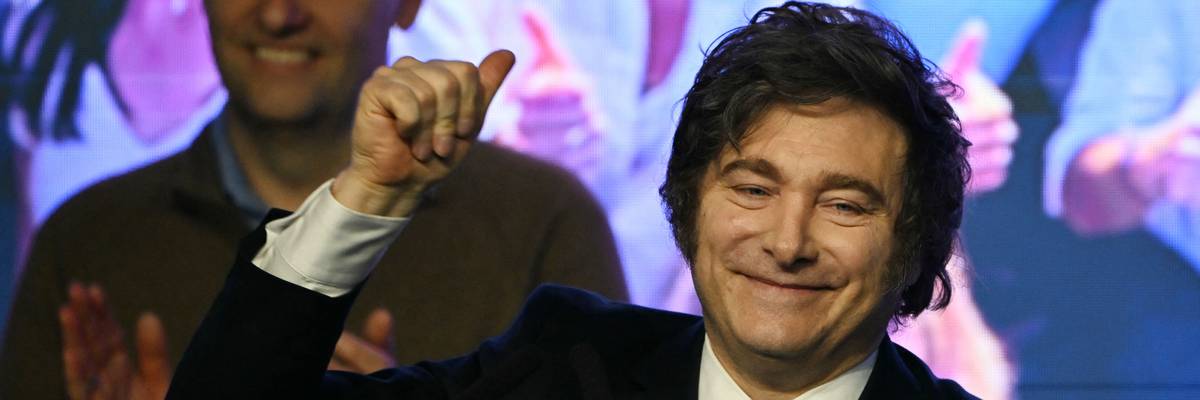
Argentine President Javier Milei waves to supporters next to the spokesperson for the Presidency Manuel Adorni at the ruling party's La Libertad Avanza headquarters in Buenos Aires on October 26, 2025.
"When powerful people don’t want accountability, they attack those who ask questions and use whatever is at their disposal to monitor, control, and repress."
Amnesty International on Wednesday released a report detailing how the Argentine government under the leadership of right-wing President Javier Milei has created a massive artificial intelligence surveillance state that the human rights group described as "a techno-authoritarian infrastructure of social control."
According to Amnesty, Argentina's Military of National Security invested in several pieces of surveillance technology between 2024 and 2025, including licenses for Maltego, an open-source investigator platform that collects and organizes data from "social media, websites, the dark web, personal data, technical infrastructure, and other open sources"; and Clearview AI, a facial recognition platform with "a widely known track record of mass exploitation of biometric data without sufficient legal grounds."
The government also procured drones equipped with automated tracking capabilities and thermal cameras capable of providing real-time image transmission, Amnesty found.
This surveillance state, Amnesty said, has created a "chilling effect" across the country that has reduced participation in protests and forced activists to reduce their public exposure and take further precautions when planning demonstrations.
Ana Tapia, an activist who has been protesting against pension cuts made by Milei's government, described the government's aggressive surveillance tactics against herself and her fellow demonstrators.
"We’ve all been fully identified for a long time now," Tapia explained. "Sometimes as you’re walking... and suddenly you see the drone hovering just above your head. Sometimes within six feet. Why so close? Why is it so invasive?”
Matías Darabós, an activist who documents police abuses, similarly described the omnipresence of the surveillance state.
"There is a very strong feeling that you are being controlled and watched," said Darabós. "In fact, when we go to marches to record what goes on, they are constantly pointing at us or filming us."
Journalists described being subjected to what they believe are coordinated harassment campaigns in which they are swarmed with violent rhetoric and threats which they believe are related to increased state surveillance.
Paula Cejas, director of the Latin America Office of the International Federation of Journalists (IFJ), told Amnesty that "social media and the streets are no longer a safe space for journalists."
"Even I myself think about what I’m going to post to the IFJ account," Cejas explained, "what language to use so that I’m not put on a list and get us all harassed."
Another journalist who spoke anonymously with Amnesty similarly said she had grown incredibly careful of what she posts on social media compared to the past.
"Before, I used to comment and give my opinion on everything, now I just use it recreationally," the journalist said. "I think a lot about the words I use, I moderated my rhetoric and reduced my interaction 100%, especially on Twitter," the platform Elon Musk renamed X.
Paola Garcia Ray, deputy director of Amnesty International Argentina, summed up the report by arguing that "pervasive surveillance is being used against Argentinians in both physical and digital spaces, to devastating effect" on civil society.
"These technologies have become an integral part of the infrastructure of state control, targeting dissent, deterring protest movements, and harassing marginalized groups, among other authoritarian practices,” Garcia Ray emphasized. "When powerful people don’t want accountability, they attack those who ask questions and use whatever is at their disposal to monitor, control, and repress."
Milei is a political ally of US tech billionaire Peter Thiel, a co-founder of AI surveillance company Palantir whose presence in Argentina has resulted in protests demanding his ouster from the country.
Dear Common Dreams reader, It’s been nearly 30 years since I co-founded Common Dreams with my late wife, Lina Newhouser. We had the radical notion that journalism should serve the public good, not corporate profits. It was clear to us from the outset what it would take to build such a project. No paid advertisements. No corporate sponsors. No millionaire publisher telling us what to think or do. Many people said we wouldn't last a year, but we proved those doubters wrong. Together with a tremendous team of journalists and dedicated staff, we built an independent media outlet free from the constraints of profits and corporate control. Our mission has always been simple: To inform. To inspire. To ignite change for the common good. Building Common Dreams was not easy. Our survival was never guaranteed. When you take on the most powerful forces—Wall Street greed, fossil fuel industry destruction, Big Tech lobbyists, and uber-rich oligarchs who have spent billions upon billions rigging the economy and democracy in their favor—the only bulwark you have is supporters who believe in your work. But here’s the urgent message from me today. It's never been this bad out there. And it's never been this hard to keep us going. At the very moment Common Dreams is most needed, the threats we face are intensifying. We need your support now more than ever. We don't accept corporate advertising and never will. We don't have a paywall because we don't think people should be blocked from critical news based on their ability to pay. Everything we do is funded by the donations of readers like you. When everyone does the little they can afford, we are strong. But if that support retreats or dries up, so do we. Will you donate now to make sure Common Dreams not only survives but thrives? —Craig Brown, Co-founder |
Amnesty International on Wednesday released a report detailing how the Argentine government under the leadership of right-wing President Javier Milei has created a massive artificial intelligence surveillance state that the human rights group described as "a techno-authoritarian infrastructure of social control."
According to Amnesty, Argentina's Military of National Security invested in several pieces of surveillance technology between 2024 and 2025, including licenses for Maltego, an open-source investigator platform that collects and organizes data from "social media, websites, the dark web, personal data, technical infrastructure, and other open sources"; and Clearview AI, a facial recognition platform with "a widely known track record of mass exploitation of biometric data without sufficient legal grounds."
The government also procured drones equipped with automated tracking capabilities and thermal cameras capable of providing real-time image transmission, Amnesty found.
This surveillance state, Amnesty said, has created a "chilling effect" across the country that has reduced participation in protests and forced activists to reduce their public exposure and take further precautions when planning demonstrations.
Ana Tapia, an activist who has been protesting against pension cuts made by Milei's government, described the government's aggressive surveillance tactics against herself and her fellow demonstrators.
"We’ve all been fully identified for a long time now," Tapia explained. "Sometimes as you’re walking... and suddenly you see the drone hovering just above your head. Sometimes within six feet. Why so close? Why is it so invasive?”
Matías Darabós, an activist who documents police abuses, similarly described the omnipresence of the surveillance state.
"There is a very strong feeling that you are being controlled and watched," said Darabós. "In fact, when we go to marches to record what goes on, they are constantly pointing at us or filming us."
Journalists described being subjected to what they believe are coordinated harassment campaigns in which they are swarmed with violent rhetoric and threats which they believe are related to increased state surveillance.
Paula Cejas, director of the Latin America Office of the International Federation of Journalists (IFJ), told Amnesty that "social media and the streets are no longer a safe space for journalists."
"Even I myself think about what I’m going to post to the IFJ account," Cejas explained, "what language to use so that I’m not put on a list and get us all harassed."
Another journalist who spoke anonymously with Amnesty similarly said she had grown incredibly careful of what she posts on social media compared to the past.
"Before, I used to comment and give my opinion on everything, now I just use it recreationally," the journalist said. "I think a lot about the words I use, I moderated my rhetoric and reduced my interaction 100%, especially on Twitter," the platform Elon Musk renamed X.
Paola Garcia Ray, deputy director of Amnesty International Argentina, summed up the report by arguing that "pervasive surveillance is being used against Argentinians in both physical and digital spaces, to devastating effect" on civil society.
"These technologies have become an integral part of the infrastructure of state control, targeting dissent, deterring protest movements, and harassing marginalized groups, among other authoritarian practices,” Garcia Ray emphasized. "When powerful people don’t want accountability, they attack those who ask questions and use whatever is at their disposal to monitor, control, and repress."
Milei is a political ally of US tech billionaire Peter Thiel, a co-founder of AI surveillance company Palantir whose presence in Argentina has resulted in protests demanding his ouster from the country.
Amnesty International on Wednesday released a report detailing how the Argentine government under the leadership of right-wing President Javier Milei has created a massive artificial intelligence surveillance state that the human rights group described as "a techno-authoritarian infrastructure of social control."
According to Amnesty, Argentina's Military of National Security invested in several pieces of surveillance technology between 2024 and 2025, including licenses for Maltego, an open-source investigator platform that collects and organizes data from "social media, websites, the dark web, personal data, technical infrastructure, and other open sources"; and Clearview AI, a facial recognition platform with "a widely known track record of mass exploitation of biometric data without sufficient legal grounds."
The government also procured drones equipped with automated tracking capabilities and thermal cameras capable of providing real-time image transmission, Amnesty found.
This surveillance state, Amnesty said, has created a "chilling effect" across the country that has reduced participation in protests and forced activists to reduce their public exposure and take further precautions when planning demonstrations.
Ana Tapia, an activist who has been protesting against pension cuts made by Milei's government, described the government's aggressive surveillance tactics against herself and her fellow demonstrators.
"We’ve all been fully identified for a long time now," Tapia explained. "Sometimes as you’re walking... and suddenly you see the drone hovering just above your head. Sometimes within six feet. Why so close? Why is it so invasive?”
Matías Darabós, an activist who documents police abuses, similarly described the omnipresence of the surveillance state.
"There is a very strong feeling that you are being controlled and watched," said Darabós. "In fact, when we go to marches to record what goes on, they are constantly pointing at us or filming us."
Journalists described being subjected to what they believe are coordinated harassment campaigns in which they are swarmed with violent rhetoric and threats which they believe are related to increased state surveillance.
Paula Cejas, director of the Latin America Office of the International Federation of Journalists (IFJ), told Amnesty that "social media and the streets are no longer a safe space for journalists."
"Even I myself think about what I’m going to post to the IFJ account," Cejas explained, "what language to use so that I’m not put on a list and get us all harassed."
Another journalist who spoke anonymously with Amnesty similarly said she had grown incredibly careful of what she posts on social media compared to the past.
"Before, I used to comment and give my opinion on everything, now I just use it recreationally," the journalist said. "I think a lot about the words I use, I moderated my rhetoric and reduced my interaction 100%, especially on Twitter," the platform Elon Musk renamed X.
Paola Garcia Ray, deputy director of Amnesty International Argentina, summed up the report by arguing that "pervasive surveillance is being used against Argentinians in both physical and digital spaces, to devastating effect" on civil society.
"These technologies have become an integral part of the infrastructure of state control, targeting dissent, deterring protest movements, and harassing marginalized groups, among other authoritarian practices,” Garcia Ray emphasized. "When powerful people don’t want accountability, they attack those who ask questions and use whatever is at their disposal to monitor, control, and repress."
Milei is a political ally of US tech billionaire Peter Thiel, a co-founder of AI surveillance company Palantir whose presence in Argentina has resulted in protests demanding his ouster from the country.