SUBSCRIBE TO OUR FREE NEWSLETTER
Daily news & progressive opinion—funded by the people, not the corporations—delivered straight to your inbox.
5
#000000
#FFFFFF
To donate by check, phone, or other method, see our More Ways to Give page.
After finding last fall that a majority of voters believe life in the United States is getting worse, and many are "extremely worried" about issues including cost of living, division, authoritarianism, wealth inequality, and the climate crisis, the polling firm Data for Progress decided to have Americans name the "bad actors" most responsible for the country's concerning conditions.
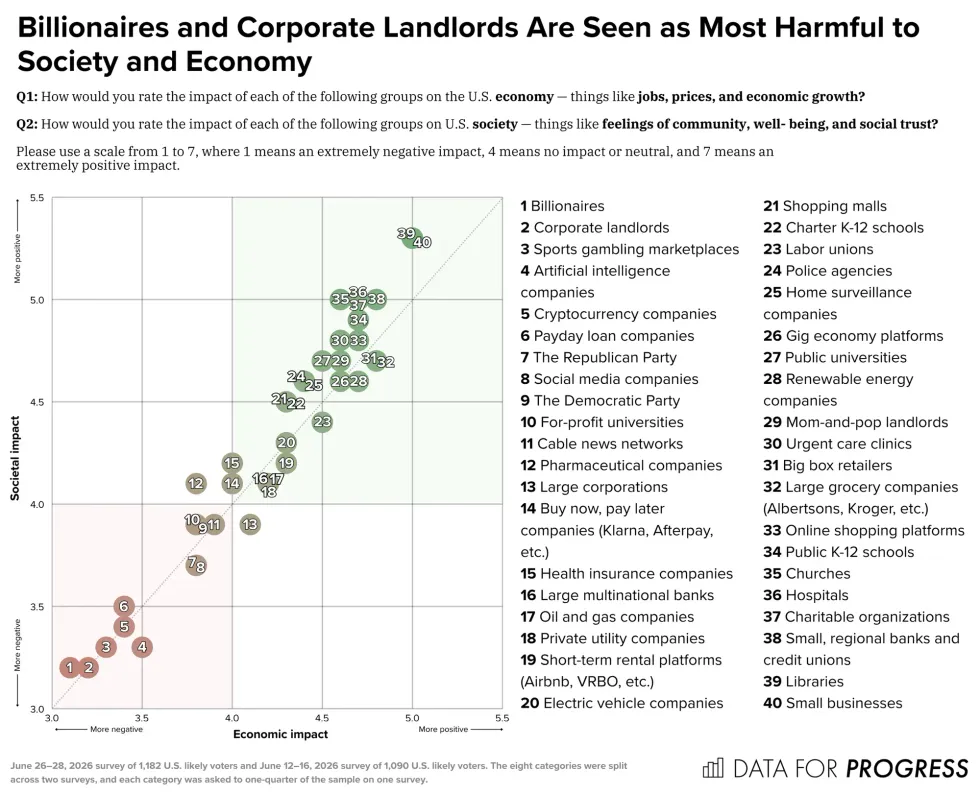
In a pair of surveys conducted last month, Data for Progress asked more than 2,000 Americans to rate the impact of various groups or industries on the US economy—"things like jobs, prices, and economic growth"—as well as American society, or "things like feelings of community, well-being, and social trust."
The top villains, according to respondents, are the nation's nearly 1,000 billionaires, then corporate landlords. Rounding out the top 10 were sports gambling marketplaces, artificial intelligence companies, cryptocurrency firms, payday lenders, the Republican Party, social media giants, the Democratic Party, and for-profit universities.
Respondents were asked to rank each group or industry on a seven-point scale from "extremely negative" to "extremely positive."
Those with the most positive views were small businesses, libraries, regional banks and credit unions, charitable organizations, hospitals, churches, public K-12 schools, online shopping platforms, large grocery companies, big box retailers, and urgent care clinics.
"Within categories, we see some meaningful differences between individual actors—mom-and-pop landlords, small regional banks, public K-12 schools, and renewable energy companies are viewed more positively than their counterparts: corporate landlords, multinational banks, charter K-12 schools, and oil and gas companies," the progressive polling firm noted.
With the November midterm elections just four months away, and Democrats trying to seize control of both chambers of Congress as progressives within the party notch key wins over more moderate candidates, Data for Progress executive director Ryan O'Donnell said that "effective populist messaging requires calling out the actors actually making life worse for Americans, and right now, that includes Big Tech and the billionaires behind it."
"As AI continues to impact people's lives directly—whether it's a data center in their backyard or a job replaced by automation—AI companies and tech billionaires are setting themselves up to be the next big villains in American politics," he added.
Earlier this week, as the US Supreme Court's right-wing supermajority "gave their blessing for billionaires to buy even more influence over the politicians who represent us," the watchdog Public Citizen released a report about soaring corporate political spending since the 2010 Citizens United v. Federal Election Commission ruling, including $517 million in this cycle so far.
Some of the top villains from Thursday's polling were key contributors to that figure: "Cryptocurrency, artificial intelligence, Big Tech, and online betting corporations have collectively spent $294 million to influence federal elections in the 2026 midterm cycle."
Blasting the corporate spending as "a disaster for democracy," the report's author, Rick Claypool, said that "if the current, broken campaign finance system remains unchallenged—and corporate spending is allowed to drown out the voices of real voters and real people—these corporate campaigns will keep multiplying, even as voting rights for individual Americans face escalating attacks."
That report and the Data for Progress polling were notably published as more than 250 million people across the United States faced high temperatures tied to the fossil fuel-driven climate emergency—and, as Common Dreams reported earlier Thursday, residents of communities with data centers are being asked to make sacrifices due to strained power grids.
Americans are also awaiting the fate of the bipartisan 21st Century ROAD to Housing Act—which includes a ban on corporate investors buying single-family homes to rent out—because Republican President Donald Trump has refused to sign it in an effort to bully GOP lawmakers into passing a legislative attack on voting rights.
In a comment that multiple congressional Democrats said shows Trump "does not care" about Americans' cost of living concerns, Trump on Monday called the affordable housing bill a "big yawn" compared with the Safeguard American Voter Eligibility, or SAVE America, Act that he wants Congress to send to his desk.
After finding last fall that a majority of voters believe life in the United States is getting worse, and many are "extremely worried" about issues including cost of living, division, authoritarianism, wealth inequality, and the climate crisis, the polling firm Data for Progress decided to have Americans name the "bad actors" most responsible for the country's concerning conditions.
In a pair of surveys conducted last month, Data for Progress asked more than 2,000 Americans to rate the impact of various groups or industries on the US economy—"things like jobs, prices, and economic growth"—as well as American society, or "things like feelings of community, well-being, and social trust."
The top villains, according to respondents, are the nation's nearly 1,000 billionaires, then corporate landlords. Rounding out the top 10 were sports gambling marketplaces, artificial intelligence companies, cryptocurrency firms, payday lenders, the Republican Party, social media giants, the Democratic Party, and for-profit universities.
Respondents were asked to rank each group or industry on a seven-point scale from "extremely negative" to "extremely positive."
Those with the most positive views were small businesses, libraries, regional banks and credit unions, charitable organizations, hospitals, churches, public K-12 schools, online shopping platforms, large grocery companies, big box retailers, and urgent care clinics.
"Within categories, we see some meaningful differences between individual actors—mom-and-pop landlords, small regional banks, public K-12 schools, and renewable energy companies are viewed more positively than their counterparts: corporate landlords, multinational banks, charter K-12 schools, and oil and gas companies," the progressive polling firm noted.
With the November midterm elections just four months away, and Democrats trying to seize control of both chambers of Congress as progressives within the party notch key wins over more moderate candidates, Data for Progress executive director Ryan O'Donnell said that "effective populist messaging requires calling out the actors actually making life worse for Americans, and right now, that includes Big Tech and the billionaires behind it."
"As AI continues to impact people's lives directly—whether it's a data center in their backyard or a job replaced by automation—AI companies and tech billionaires are setting themselves up to be the next big villains in American politics," he added.
Earlier this week, as the US Supreme Court's right-wing supermajority "gave their blessing for billionaires to buy even more influence over the politicians who represent us," the watchdog Public Citizen released a report about soaring corporate political spending since the 2010 Citizens United v. Federal Election Commission ruling, including $517 million in this cycle so far.
Some of the top villains from Thursday's polling were key contributors to that figure: "Cryptocurrency, artificial intelligence, Big Tech, and online betting corporations have collectively spent $294 million to influence federal elections in the 2026 midterm cycle."
Blasting the corporate spending as "a disaster for democracy," the report's author, Rick Claypool, said that "if the current, broken campaign finance system remains unchallenged—and corporate spending is allowed to drown out the voices of real voters and real people—these corporate campaigns will keep multiplying, even as voting rights for individual Americans face escalating attacks."
That report and the Data for Progress polling were notably published as more than 250 million people across the United States faced high temperatures tied to the fossil fuel-driven climate emergency—and, as Common Dreams reported earlier Thursday, residents of communities with data centers are being asked to make sacrifices due to strained power grids.
Americans are also awaiting the fate of the bipartisan 21st Century ROAD to Housing Act—which includes a ban on corporate investors buying single-family homes to rent out—because Republican President Donald Trump has refused to sign it in an effort to bully GOP lawmakers into passing a legislative attack on voting rights.
In a comment that multiple congressional Democrats said shows Trump "does not care" about Americans' cost of living concerns, Trump on Monday called the affordable housing bill a "big yawn" compared with the Safeguard American Voter Eligibility, or SAVE America, Act that he wants Congress to send to his desk.
After finding last fall that a majority of voters believe life in the United States is getting worse, and many are "extremely worried" about issues including cost of living, division, authoritarianism, wealth inequality, and the climate crisis, the polling firm Data for Progress decided to have Americans name the "bad actors" most responsible for the country's concerning conditions.
In a pair of surveys conducted last month, Data for Progress asked more than 2,000 Americans to rate the impact of various groups or industries on the US economy—"things like jobs, prices, and economic growth"—as well as American society, or "things like feelings of community, well-being, and social trust."
The top villains, according to respondents, are the nation's nearly 1,000 billionaires, then corporate landlords. Rounding out the top 10 were sports gambling marketplaces, artificial intelligence companies, cryptocurrency firms, payday lenders, the Republican Party, social media giants, the Democratic Party, and for-profit universities.
Respondents were asked to rank each group or industry on a seven-point scale from "extremely negative" to "extremely positive."
Those with the most positive views were small businesses, libraries, regional banks and credit unions, charitable organizations, hospitals, churches, public K-12 schools, online shopping platforms, large grocery companies, big box retailers, and urgent care clinics.
"Within categories, we see some meaningful differences between individual actors—mom-and-pop landlords, small regional banks, public K-12 schools, and renewable energy companies are viewed more positively than their counterparts: corporate landlords, multinational banks, charter K-12 schools, and oil and gas companies," the progressive polling firm noted.
With the November midterm elections just four months away, and Democrats trying to seize control of both chambers of Congress as progressives within the party notch key wins over more moderate candidates, Data for Progress executive director Ryan O'Donnell said that "effective populist messaging requires calling out the actors actually making life worse for Americans, and right now, that includes Big Tech and the billionaires behind it."
"As AI continues to impact people's lives directly—whether it's a data center in their backyard or a job replaced by automation—AI companies and tech billionaires are setting themselves up to be the next big villains in American politics," he added.
Earlier this week, as the US Supreme Court's right-wing supermajority "gave their blessing for billionaires to buy even more influence over the politicians who represent us," the watchdog Public Citizen released a report about soaring corporate political spending since the 2010 Citizens United v. Federal Election Commission ruling, including $517 million in this cycle so far.
Some of the top villains from Thursday's polling were key contributors to that figure: "Cryptocurrency, artificial intelligence, Big Tech, and online betting corporations have collectively spent $294 million to influence federal elections in the 2026 midterm cycle."
Blasting the corporate spending as "a disaster for democracy," the report's author, Rick Claypool, said that "if the current, broken campaign finance system remains unchallenged—and corporate spending is allowed to drown out the voices of real voters and real people—these corporate campaigns will keep multiplying, even as voting rights for individual Americans face escalating attacks."
That report and the Data for Progress polling were notably published as more than 250 million people across the United States faced high temperatures tied to the fossil fuel-driven climate emergency—and, as Common Dreams reported earlier Thursday, residents of communities with data centers are being asked to make sacrifices due to strained power grids.
Americans are also awaiting the fate of the bipartisan 21st Century ROAD to Housing Act—which includes a ban on corporate investors buying single-family homes to rent out—because Republican President Donald Trump has refused to sign it in an effort to bully GOP lawmakers into passing a legislative attack on voting rights.
In a comment that multiple congressional Democrats said shows Trump "does not care" about Americans' cost of living concerns, Trump on Monday called the affordable housing bill a "big yawn" compared with the Safeguard American Voter Eligibility, or SAVE America, Act that he wants Congress to send to his desk.