

SUBSCRIBE TO OUR FREE NEWSLETTER
Daily news & progressive opinion—funded by the people, not the corporations—delivered straight to your inbox.
5
#000000
#FFFFFF
To donate by check, phone, or other method, see our More Ways to Give page.
Daily news & progressive opinion—funded by the people, not the corporations—delivered straight to your inbox.

Lindsay Meiman, US Communications Manager 350.org, lindsay@350.org, +1-347-460-9082
Hoda Baraka, Global Communications Manager 350.org, hoda@350.org, +1-347-453-6600
Starting today, a global wave of peaceful direct actions lasting for 12 days will take place across six continents targeting the world's most dangerous fossil fuel projects, under the banner of Break Free.
2015 was the hottest year ever recorded and the impacts of climate change are already hitting communities around the world. From rising sea levels to extreme storms, the need to act on climate change has never been more urgent. Added to that, the fossil fuel industry faces an unprecedented crisis -- from collapsing prices, massive divestments, a new global climate deal, and an ever-growing movement calling for change. The time has never been better for a just transition to a clean energy system.
To harness the moment, activists and concerned citizens committed to addressing climate change - from international groups to local communities to individual citizens - will unite to ensure that strong pressure is maintained to force energy providers, as well as local and national governments, to implement the policies and additional investments needed to completely break free from fossil fuels.
People worldwide are providing the much needed leadership by intensifying actions through peaceful civil disobedience on a global scale as so much remains to be done in order to lessen the effects of the climate crisis. This includes demanding governments move past the commitments made as part of the Paris agreement signed last month.
In order to address the current climate crisis and keep global warming below 1.5C, fossil fuel projects need to be shelved and existing infrastructure needs to be replaced now that renewable energy is more affordable and widespread than ever before. The only way to achieve this is by keeping coal, oil and gas in the ground and accelerating the just transition to 100% renewable energy. During Break Free people worldwide are rising up to make sure this is the case.
Actions taking place between 3-15 May include:
QUOTE SHEET:
"By backing campaigns and mass actions aimed at stopping the world's most dangerous fossil-fuel projects - from coal plants in Turkey and the Philippines, to mines in Germany and Australia, to fracking in Brazil and oil wells in Nigeria - Break Free hopes to eliminate the power and pollution of the fossil-fuel industry, and propel the world toward a sustainable future," May Boeve, Executive Director 350.org
"There's never been a bigger, more concerted wave of actions against the plans of the fossil fuel industry to overheat our earth--and for the just, fair, and sustainable world we can now envision. In the hottest year on record, we're determined to turn up the political heat on the planet's worst polluters," Bill McKibben, co-founder 350.org
"Communities on the front lines of climate change aren't waiting for governments to act. They are taking bold action, and the world needs to listen. The Paris agreement was only possible because millions of people spent years fighting for climate justice. Now that governments have committed to action, we must make sure they follow the science and deliver on their words. The only way to survive climate change is through a rapid just transition to 100% renewable energy, keeping oil, coal and gas in the ground," Jennifer Morgan, Executive Director of Greenpeace International
"Communities all over the Philippines are demanding that the government cancel all plans, permits and construction efforts for new coal power plants and coal mines in the Philippines, and to take decisive steps towards the phase out of existing ones. We need to take major steps in order to break free from fossil fuels and all harmful sources energy. A complete transition to renewable energy is not only possible, but urgent," Lidy Nacpil, Coordinator of the Asian Peoples Movement on Debt and Development (APMDD) and Co-Coordinator of the Global Campaign to Demand Climate Justice
"Breaking free from fossil fuels is a vote for life and for the planet. The Paris Agreement signed by world leaders ignored the fact that burning fossil fuels is the major culprit in global warming. In these actions the peoples of the world will insist that we must come clean of the fossil fuels addiction. In Nigeria we will in addition raise our voices to demand a clean up of the extreme pollution caused by oil companies operating in the Niger Delta," Nnimmo Bassey, Nigerian activist from the Health of Mother Earth Foundation
"We are currently at a crossroads in humanity where we must choose either to continue down a destructive path of extracting fossil fuels or transition to sustainable ways of living. What we need is ambitious renewable energy projects, not more tar sands pipelines. These pipelines don't have the support of local communities and the Indigenous nations they will impact. If we continue to build fossil fuel infrastructure, we are breaking our promise to do our part in Canada to stem a global climate crisis that is already being felt by communities all over the planet," Melina Laboucan-Massimo, Lubicon Cree First Nation, Greenpeace Canada Climate & Energy Campaigner and 350.org Board member
"The global climate justice movement is rising fast. But so are the oceans. So are global temperatures. This is a race against time. Our movement is stronger than ever, but to beat the odds, we have to grow stronger," Naomi Klein, award winning journalist/author
" People power in our cities, in our villages and on the frontlines of climate change have brought us to a point where we have a global climate deal - but we do not stop now, we need more action and faster. Civil society is set to rise up again, to fight for our societies to break free from fossil fuels, to propel them even faster towards a just future powered by 100% renewable energy," Wael Hmaidan, Director of Climate Action Network
"Fossil fuel plants cause extreme harm to local communities and ecosystems, they are also a danger to the country and the whole planet since they are a major contributor to climate change. It is immoral to burden future generations with the cost of mistaken energy choices made today. It is time to end the age of fossil fuels," Archbishop Ramon Arguelles, Archbishop of the Roman Catholic Archdiocese of Lipa in the Philippines.
"No government has a workable plan to protect a stable climate. Nature won't wait, and mass disobedience is the only tool proven to bring about rapid social change. Breaking free from fossil fuels and ensuring a just transition is going to be hard, but not doing so would have unthinkable consequences," Ahmed Gaya, Rising Tide Seattle, Break Free Pacific Northwest Action
"In my community, where my church has been for 65 years, the African American and Hispanic community has been overlooked for a long time as political forces worked to improve other areas of the city. These oil trains, carrying toxic and explosive oil, have been snuck into our community with little oversight and little public disclosure. Now is the time to turn the tables, and for us to stand together to say that this can't go on," Associate Pastor Marc Johnson, Greater St. John's C.O.G.I.C., Break Free Albany, NY Action
"We are marching in Los Angeles because the city is ground zero for neighborhood oil drilling. Fossil fuel extraction is happening in our backyards. Communities live next door to active oil drilling sites, exposing children and families to various health risks like headaches, nosebleeds, and respiratory problems including asthma. We are marching because this is an injustice not only to our climate, but to communities in Los Angeles and throughout the state of California, which disproportionately are low-income and communities of color," Monic Uriarte, STAND-LA, Break Free LA Action
"When the oil tides rolled in, back in 2010, coastal communities across the Gulf witnessed the devastating gambles taken to harvest fossil fuels off our shores and in our waters. We are on the front lines, witnessing the side effects of extreme extraction, ranging from rising sea levels to tainted waters to more violent and unpredictable weather. That's why we are calling on President Obama to refuse any new leases in his offshore drilling plan and protect the Alaskan Arctic and Gulf South waters, wildlife and ways of life. It is time we break free from fossil fuels and build the just transition to renewable and sustainable solutions," Monique Verdin, Citizen of the United Houma Nation; resident of St. Bernard Parish, Louisiana; Interdisciplinary Artist; Break Free DC Action
350 is building a future that's just, prosperous, equitable and safe from the effects of the climate crisis. We're an international movement of ordinary people working to end the age of fossil fuels and build a world of community-led renewable energy for all.

Data released by the University of Michigan and Gallup this week showed US consumer sentiment cratering even as stock markets hit record highs.
Multiple polls and surveys released in recent days have shown US consumer sentiment cratering—and all the while, the US stock market keeps hitting record highs.
The Kobeissi Letter, a financial newsletter, posted a graphic Saturday that matched consumer sentiment as measured by the University of Michigan's Surveys of Consumers with the performance of the S&P 500 stock index over a 30-year span.
The graphic shows that, up until around 2020, consumer sentiment matched stock market performance closely, although there was a large divergence between the two leading up to the 2008 financial crisis, where stocks briefly outperformed consumer sentiment before crashing downward as the housing bubble burst.
But throughout the last six years, the graphic shows, the S&P 500 has produced an almost continuous upward surge even as consumer sentiment spirals downward.
Absolutely incredible:
Over the last 6 years, the S&P 500 has risen +130% while US Consumer Sentiment has collapsed by -55%, to its lowest since data began in 1952.
We are witnessing the formation of the biggest wealth divide in modern history. https://t.co/XGMR6DfuNc pic.twitter.com/2w7cRvn7ok
— The Kobeissi Letter (@KobeissiLetter) May 23, 2026
"Absolutely incredible," commented Kobeissi Letter. "Over the last six years, the S&P 500 has risen +130% while US Consumer Sentiment has collapsed by -55%, to its lowest since data began in 1952. We are witnessing the formation of the biggest wealth divide in modern history."
Kobeissi Letter produced the graphic one day after the University of Michigan's latest survey found consumer sentiment hitting the lowest level on record.
Joanne Hsu, director of the survey, observed that "the cost of living continues to be a first-order concern, with 57% of consumers spontaneously mentioning that high prices were eroding their personal finances, up from 50% last month."
On the same day, Gallup published new data showing that Americans' economic confidence has fallen to its lowest level since October 2022, with just 16% of Americans rating the economy as excellent or good, and nearly half describing it as poor.
Axios reported on Saturday that even Republicans have been growing sour on the US economy, citing a recent poll from The Associated Press showing GOP approval of President Donald Trump on the economy to be at around 60%, down from 80% just three months ago.
"The growing GOP gloom could hardly come at a worse time for Trump and the party," Axios noted, "less than six months out from a midterm election that's likely to turn on the economy."
The gap between overall consumer sentiment and stock market performance also lines up with recent consumer spending trends. Data published by The Financial Times earlier this year showed that the top 10% of earners in the US now account for nearly half of all consumer spending, while the bottom 80% of earners now account for less than 40% of all consumer spending.
A February report from TD Economics economist Ksenia Bushmeneva noted that “the economic divide between America’s households at the top of the income spectrum and everyone else continued to widen last year,” as “upper-income households benefited from the still-robust wage growth, strong gains in equity markets, and better access to consumer credit.”
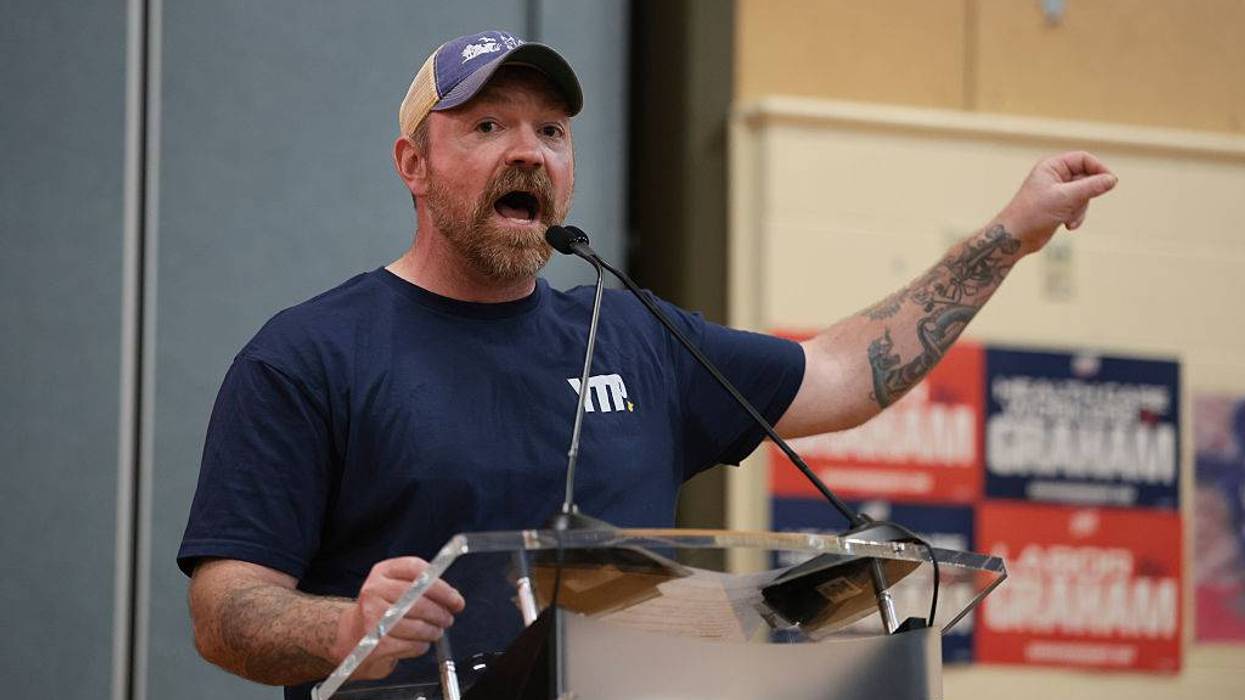
"Private equity is destroying our favorite baseball team, stripping them for parts," Democratic US Senate candidate Platner said in an ad that aired on the New England Sports Network.
Maine Democratic US Senate candidate Graham Platner on Saturday said that a campaign ad that aired during a Boston Red Sox game was "taken down" after it took aim at the team's ownership.
The ad in question features Platner discussing the role that private equity firms play in the US economy, including sports teams.
"Private equity is destroying our favorite baseball team, stripping them for parts," Platner says at the start of the ad. "Private equity is buying up our homes, our sports, and our lives. I will reverse the private equity curse."
Private equity is taking our homes. It's taking our hospitals. It's taking beloved local businesses and stripping them for parts.
And now private equity is running the Red Sox into the ground.
Our new ad ⬇️ pic.twitter.com/w7LapElpdA
— Graham Platner for Senate (@grahamformaine) May 22, 2026
Platner concludes the ad by saying that he approves this message "because I miss Mookie Betts," the star player whom the Red Sox traded to the Los Angeles Dodgers in 2020 in a deal that was widely decried by local fans as a salary dump.
According to Platner, his campaign began airing the ad Friday on the New England Sports Network (NESN), the cable TV station owned partially by Fenway Sports Group, the conglomerate that owns the Red Sox.
However, he said that "midway through the game the ad was taken down" by NESN, after which the Red Sox proceeded to blow a 4-0 lead, losing to the Minnesota Twins by a final score of 8-6.
Platner, an oyster farmer and upstart candidate who has never before held political office, became the Democratic Party's presumptive nominee for the 2026 US Senate race in Maine last month after his top rival, Democratic Maine Gov. Janet Mills, dropped out of the race.
In recent weeks, Platner has pivoted to challenging incumbent Sen. Susan Collins (R-Maine), who has held the seat since 1996 and is now running for her sixth term in office.

The policy change means "we could have families separated for months or years," said one expert.
Critics are slamming the Trump administration for implementing a new rule that foreigners who apply for green cards must do so from abroad.
US Citizenship and Immigration Services (USCIS) on Friday announced that foreigners currently in the US who want to establish permanent legal residency must first return to their countries of origin to apply for a green card.
This announcement broke with decades of US immigration policy, which made it possible for immigrants in the US to obtain green cards without having to leave the country.
Doug Rand, a former senior advisor at USCIS under President Joe Biden, said in an interview with The Associated Press that "the goal of this policy is very explicit," which is to block a path to citizenship "for as many people as possible."
Sarah Pierce, a former USCIS policy analyst, told The New York Times that the rule change could have particularly dire consequences to foreigners who are married to US citizens and will now have to apply for permanent residency from overseas.
"Our consular processing system through which they would have to apply is already overburdened," Pierce explained. "So that means we could have families separated for months or years."
Aaron Reichlin-Melnick, senior fellow at the American Immigration Council, similarly noted that the new policy "could force people to leave their jobs, homes, and families for weeks or months, all at their own expense" just to stay in a country where they have already established roots.
Reichlin-Melnick said that the full scope of the policy isn't yet clear because there are several unknown details about how broadly it will be applied, but added that "in the meantime, hundreds of thousands of immigrants now have to worry about upending their lives to get a legal status that they are entitled to under our laws."
Drop Site News reporter Ryan Grim argued that the new policy rips the mask off Trump administration claims that they aren't opposed to all immigration, they simply want to reduce undocumented immigration.
"The talking point that we do want legal immigration, we just want people to get in line and follow the rules, is BS," Grim commented. "This is an attempt to blow up the line, blow up the rules, and make it insanely difficult to immigrate legally."
Rep. Chuy García (D-Ill.) echoed Grim's comments by pointing out that the new policy shows the Trump administration's disdain for immigration overall.
"This new policy will force thousands of LEGAL immigrants, including spouses of US citizens, to leave their homes, families, and jobs for weeks or even months to get their green card outside the US," said García. "This is an absurd and cruel policy."
Rep. Adriano Espaillat (D-NY), chairman of the Congressional Hispanic Caucus, condemned the new policy for targeting "students, scientists, entrepreneurs, spouses of US citizens, and other individuals following legal immigration processes."
"Aspiring lawful permanent residents are valued members of our communities, workforce, and economy," Espaillat emphasized. "I will continue fighting to protect the rights of aspiring green card holders and immigrant families."