SUBSCRIBE TO OUR FREE NEWSLETTER
Daily news & progressive opinion—funded by the people, not the corporations—delivered straight to your inbox.
5
#000000
#FFFFFF
To donate by check, phone, or other method, see our More Ways to Give page.


Daily news & progressive opinion—funded by the people, not the corporations—delivered straight to your inbox.

The decapitated body of Mexican journalist Jose Moises Sanchez Cerezo was found early Saturdayin Veracruz state, according to a statement from the state attorney general's office. The journalist and owner of the newspaper La Union had been missing since January 2.
On Tuesday night, the attorney general's office said DNA results showed the victim was Sanchez. But the journalist's son, Jorge Sanchez, told CPJ today that he would wait for DNA tests from the federal attorney general's office because he doubted that the body was really his father's. "We don't trust the local authorities here," Jorge Sanchez said. "There have been irregularities. With the body, I don't agree that it's him."
Local civil society groups have also called on the special prosecutor for crimes against freedom of expression to investigate the case, citing doubts about "the transparency and fairness" of the state authorities, according to news reports.
"In a state with a deplorable record of violence against the press, and given allegations of local political and police involvement, it is doubtful that local authorities can be trusted to achieve justice for the murder of Jose Moises Sanchez Cerezo," said Carlos Lauria, CPJ's senior program coordinator for the Americas, from New York. "Federal authorities have the power to take jurisdiction of this case. They should do so immediately."
Sanchez was kidnapped from his home in the municipality of Medellin de Bravo on January 2 and his computer, camera, and other electronic materials were seized, according to news reports. The journalist had founded La Union, a small weekly print and online newspaper that often criticized city authorities, particularly the mayor, Omar Cruz Reyes, and denounced local criminal activity as well as the poor quality of basic services like garbage pickup and the absence of street lights.
The state attorney general told MVS Radio on Monday that he had evidence pointing toward the mayor. "I have elements for having the probable certainty of the mayor's participation," Veracruz state attorney general Luis Angel Bravo said.
The state attorney general's office said a former Veracruz police officer turned drug trafficker, Noe Rodriguez, confessed to carrying out the abduction and murder, along with five other suspects. The suspects allegedly acted on the orders of the deputy police chief of Medellin, Martin Lopez Meneses, who was also the driver and bodyguard of Mayor Cruz, according to the attorney general's office's statement. Lopez was being held in preventive detention.
Rodriguez alleged that Cruz requested he and the other suspects kill Sanchez, according to news reports. In exchange, the reports said, Cruz would allow the criminal gang to deal drugs in the area. Cruz has denied involvement in the crime and maintained that he had no disagreements with Sanchez, according to news reports.
Cruz cannot be officially charged because he is granted immunity from prosecution as an elected official, according to news reports. Prosecutors have asked the state legislature to strip the mayor of his immunity.
In the days before Sanchez was kidnapped, he posted on Facebook several photographs of protests against the governor, Javier Duarte de Ochoa, as well as links to articles about a recent murder. On December 13 and 14, he posted several articles, press releases, and a video regarding the formation of a neighborhood watch self-defense group in response to local crime. It wasn't clear whether Sanchez, who was also active in the group, was the author of any of the materials posted on Facebook.
A local journalist who asked to remain anonymous told CPJ that information about self-defense groups was particularly sensitive for local officials who sought to downplay shortcomings in local law enforcement. Jorge Sanchez told CPJ that his father had been threatened by the mayor in connection with his coverage of the groups.
In the days after the kidnapping, Governor Duarte referred to Sanchez as an "activist and taxi driver," which drew complaints from local journalists that the governor was trying to minimize Sanchez's work as journalist.
Veracruz is one of the most dangerous states in Mexico for the press. Sanchez would be the fourth journalist to be killed in Veracruz in direct relation to his work since 2011, according to CPJ research. CPJ is investigating the deaths of at least six others in unclear circumstances. At least three journalists have disappeared in the state in the same time period. In the past, Governor Duarte's government has sought to dismiss any possible link between journalists' murders and their profession.
Violence tied to drug trafficking has made Mexico one of the most dangerous countries in the world for the press, according to CPJ research. More than 50 journalists have been killed or have disappeared since 2007. The country was ranked seventh on CPJ's 2014 Impunity Index, which spotlights countries where journalists are slain and the killers go free.
The Committee to Protect Journalists is an independent, nonprofit organization that promotes press freedom worldwide. We defend the right of journalists to report the news safely and without fear of reprisal.
(212) 465-1004Thiel in the past has also speculated that AI critics are doing the bidding of the Antichrist.
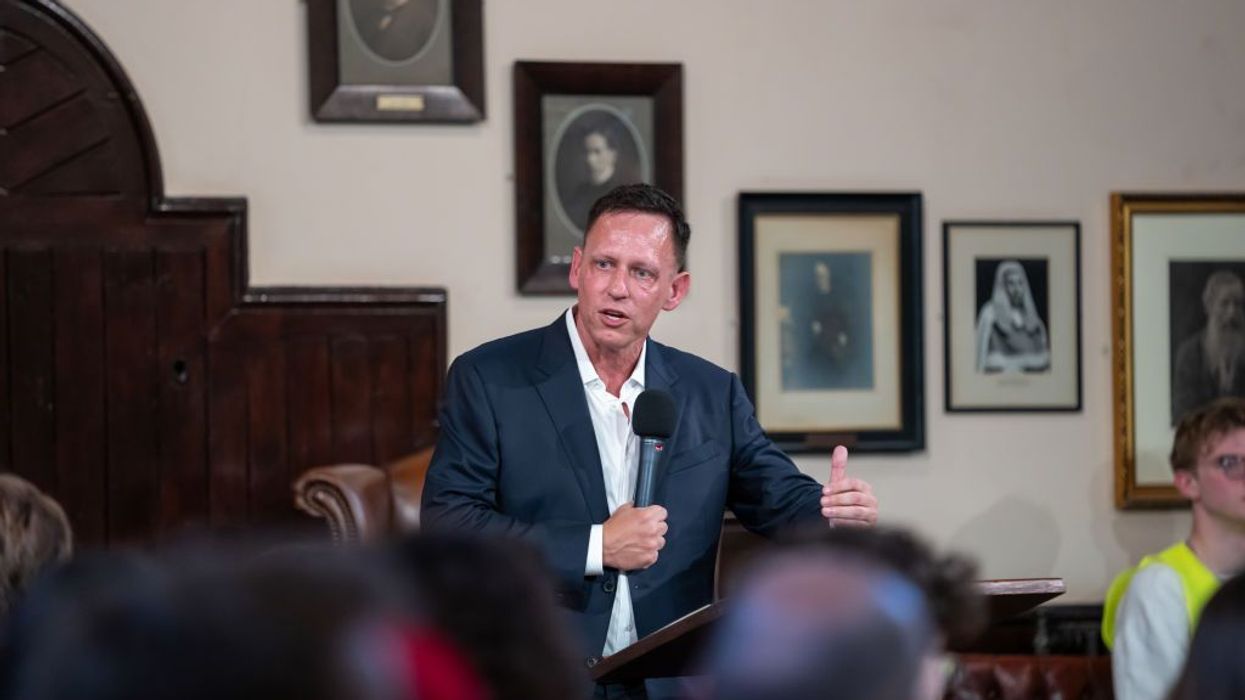
Right-wing tech billionaire Peter Thiel is accusing Pope Leo XIV of doing the work of the Chinese Communist Party with his criticisms of artificial intelligence.
According to a Thursday report from CNN, Thiel told the Aspen Ideas Festival in Colorado on Tuesday that the pope was inadvertently serving as a "Chinese communist agent" when he released a 42,000-word encyclical that called for strict regulation of AI, a technology that the pontiff said heightens the "risk of dehumanization" throughout the world.
Thiel argued that this sort of thinking was dangerous, CNN reported, because it could result in the US losing the "race" to build more advanced AI to China. Because of this, Thiel continued, the pope is essentially "working for the Chinese communists" by trying to tap the brakes on AI development.
Thiel, a co-founder of PayPal and Palantir, has long decried AI critics in harsh terms. Over the last year, he has been delivering a series of lectures in which he has said that opponents of AI development are working as agents for the Antichrist.
Journalist Christopher Hale, who writes the Letters From Leo newsletter, noted on Friday that Thiel in the past has even speculated that Pope Leo could be "a manifestation of the Antichrist."
Thiel has said that he instructed Vice President JD Vance, a longtime political ally who received major funding from the tech billionaire for his 2022 Senate campaign, to ignore the pope's moral guidance despite influencing Vance to convert to Catholicism, Hale added.
"Thiel seeded the vice president’s Catholic faith," Hale wrote, "and he now tells wealthy festival audiences that the leader of that faith works for a communist government."
In addition to his attacks on the pope, Thiel also warned about "a democratic-socialist takeover of the Democratic Party," pointing to recent victories in New York and Colorado of candidates backed by the Democratic Socialists of America.
Thiel said that this "takeover" would doom the US, arguing that "when the Democratic Party goes, this country is over," according to CNN.
The New York Times reported in May that Thiel has grown so concerned about the political situation in the US that he's created a "foothold" for himself in Argentina, which is currently being governed by ideologically likeminded libertarian President Javier Milei.
"Thiel, who has a history of collecting backup countries as he hedges his bets against the United States, is considering making Argentina another Plan B," the Times reported. "Born in Germany and raised in the United States, he received citizenship in New Zealand in 2011, and applied for a passport in Malta in 2022."
"I can't recall a government as terrified of peace as the one running Israel," said one analyst.
Trump administration officials reportedly believed that the Israeli government intended to assassinate Iran's top negotiators—including the country's foreign minister—during peace talks with the US in an effort to sabotage diplomatic progress.
The New York Times reported Thursday that "American concerns about the targeting of two particular Iranian officials—Abbas Araghchi, Iran’s foreign minister, and Mohammad Bagher Ghalibaf, the speaker of the Parliament—spiked during delicate ceasefire negotiations that began in April." In response, the US "went so far as to ask other countries in the region to warn Iran about the possibility Israel could target the two officials," according to the Times, which cited unnamed current and former American officials.
The US and Israel have killed dozens of top Iranian officials since launching their illegal joint war in late February. But the allied countries reportedly removed Araghchi and Ghalibaf from their target list in late March, opening the possibility of high-level negotiations to end the war.
But Israel remained bent on targeting the negotiators, according to the Times, whose reporting was later corroborated by The Washington Post.
The Times detailed one dramatic incident in April, when Ghalibaf was planning to travel to Pakistan's capital to meet with US Vice President JD Vance:
Pakistani fighter jets escorted the Iranian airplanes carrying a delegation of more than 70 Iranians from the border of Iran to Islamabad and back again when the session was over.
But on the way back to Tehran, an Israeli security threat emerged.
Iran’s security forces notified the plane carrying Mr. Ghalibaf back to Tehran that they had picked up intelligence that Israel planned to attack the plane and that two Israeli fighter jets had entered Iran’s airspace from its western border near Iraq, the two officials said.
Mahdi Mohammadi, a senior adviser for Mr. Ghalibaf, who accompanied him to Islamabad, confirmed this account on his social media page. The plane made an emergency landing in the city of Mashhad, Iran’s closest airport to the Pakistani border, and the Iranian delegation traveled some eight hours by land back to Tehran, Mr. Mohammadi and the two officials said.
The Post reported that "cracks emerged" between the US and Israeli approaches to the war following Israel's assassination of top Iranian national security official Ali Larijani in March.
"They’ve wiped out everybody," Trump told reporters in late March, suggesting Israel's assassination campaign was making it difficult to find potential negotiating partners.
Trita Parsi, executive vice president of the Quincy Institute for Responsible Statecraft, wrote in response to the new reporting that "Israel is a state that, on paper, is a US partner, but in reality is so extreme in its obsession to undermine US diplomacy that it even tries to assassinate those the US engages with in crucial negotiations."
"I can't recall a government as terrified of peace as the one running Israel," Parsi added.
At present, the Israeli government—led by Prime Minister Benjamin Netanyahu—is endangering tenuous US-Iran peace talks with its continued occupation of and assault on Lebanon, which Iran has highlighted as a key factor in the negotiations.
Visiting occupied southern Lebanon earlier this week, Netanyahu declared to Israeli troops that "our insistence is that we will not leave... until the threat is removed."
Parsi wrote earlier this week that "beyond his long-standing desire to use American force to subjugate Iran to Israeli domination and achieve a regional balance favorable to Israel," Netanyahu "now also has stark political and personal reasons to restart the war" with Iran.
"The [US and Iran's memorandum of understanding] has come at a steep political cost for Netanyahu," wrote Parsi. "His prospects for reelection in October are weaker than they have been in months. Once seen as the Israeli leader uniquely capable of delivering President Trump, he now confronts the prospect that both the war and the ensuing diplomacy will leave Israel in a strategically weaker position—undermining the very case he has made for his leadership."
"And of course," Parsi added, "if he loses the elections, he will likely spend the next few years in jail, as he will lose his immunity as prime minister and face trial over corruption charges."
"Effective populist messaging requires calling out the actors actually making life worse for Americans, and right now, that includes Big Tech and the billionaires behind it," said the head of Data for Progress.
After finding last fall that a majority of voters believe life in the United States is getting worse, and many are "extremely worried" about issues including cost of living, division, authoritarianism, wealth inequality, and the climate crisis, the polling firm Data for Progress decided to have Americans name the "bad actors" most responsible for the country's concerning conditions.
In a pair of surveys conducted last month, Data for Progress asked more than 2,000 Americans to rate the impact of various groups or industries on the US economy—"things like jobs, prices, and economic growth"—as well as American society, or "things like feelings of community, well-being, and social trust."
The top villains, according to respondents, are the nation's nearly 1,000 billionaires, then corporate landlords. Rounding out the top 10 were sports gambling marketplaces, artificial intelligence companies, cryptocurrency firms, payday lenders, the Republican Party, social media giants, the Democratic Party, and for-profit universities.
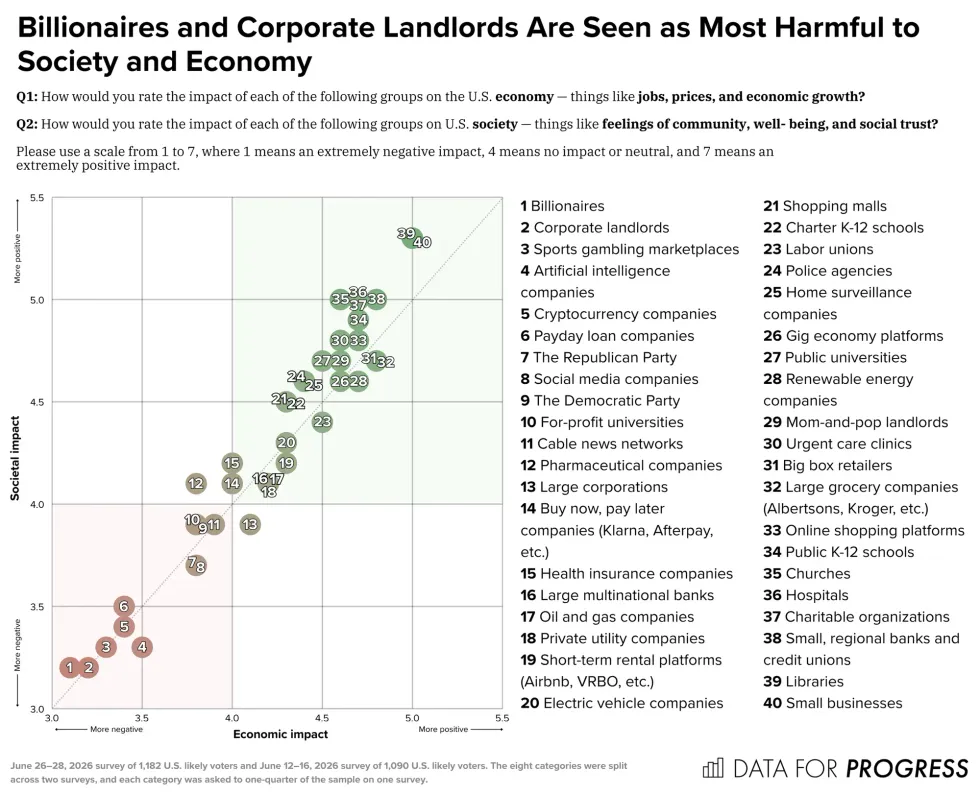
Respondents were asked to rank each group or industry on a seven-point scale from "extremely negative" to "extremely positive."
Those with the most positive views were small businesses, libraries, regional banks and credit unions, charitable organizations, hospitals, churches, public K-12 schools, online shopping platforms, large grocery companies, big box retailers, and urgent care clinics.
"Within categories, we see some meaningful differences between individual actors—mom-and-pop landlords, small regional banks, public K-12 schools, and renewable energy companies are viewed more positively than their counterparts: corporate landlords, multinational banks, charter K-12 schools, and oil and gas companies," the progressive polling firm noted.
With the November midterm elections just four months away, and Democrats trying to seize control of both chambers of Congress as progressives within the party notch key wins over more moderate candidates, Data for Progress executive director Ryan O'Donnell said that "effective populist messaging requires calling out the actors actually making life worse for Americans, and right now, that includes Big Tech and the billionaires behind it."
"As AI continues to impact people's lives directly—whether it's a data center in their backyard or a job replaced by automation—AI companies and tech billionaires are setting themselves up to be the next big villains in American politics," he added.
Earlier this week, as the US Supreme Court's right-wing supermajority "gave their blessing for billionaires to buy even more influence over the politicians who represent us," the watchdog Public Citizen released a report about soaring corporate political spending since the 2010 Citizens United v. Federal Election Commission ruling, including $517 million in this cycle so far.
Some of the top villains from Thursday's polling were key contributors to that figure: "Cryptocurrency, artificial intelligence, Big Tech, and online betting corporations have collectively spent $294 million to influence federal elections in the 2026 midterm cycle."
Blasting the corporate spending as "a disaster for democracy," the report's author, Rick Claypool, said that "if the current, broken campaign finance system remains unchallenged—and corporate spending is allowed to drown out the voices of real voters and real people—these corporate campaigns will keep multiplying, even as voting rights for individual Americans face escalating attacks."
That report and the Data for Progress polling were notably published as more than 250 million people across the United States faced high temperatures tied to the fossil fuel-driven climate emergency—and, as Common Dreams reported earlier Thursday, residents of communities with data centers are being asked to make sacrifices due to strained power grids.
Americans are also awaiting the fate of the bipartisan 21st Century ROAD to Housing Act—which includes a ban on corporate investors buying single-family homes to rent out—because Republican President Donald Trump has refused to sign it in an effort to bully GOP lawmakers into passing a legislative attack on voting rights.
In a comment that multiple congressional Democrats said shows Trump "does not care" about Americans' cost of living concerns, Trump on Monday called the affordable housing bill a "big yawn" compared with the Safeguard American Voter Eligibility, or SAVE America, Act that he wants Congress to send to his desk.