

SUBSCRIBE TO OUR FREE NEWSLETTER
Daily news & progressive opinion—funded by the people, not the corporations—delivered straight to your inbox.
5
#000000
#FFFFFF
To donate by check, phone, or other method, see our More Ways to Give page.
Daily news & progressive opinion—funded by the people, not the corporations—delivered straight to your inbox.
Amnesty International today called the situation in the Niger Delta
a "human rights tragedy," saying that the people of the Niger Delta
have seen their human rights abused by oil companies that their
government cannot or will not hold to account.
Amnesty International today called the situation in the Niger Delta
a "human rights tragedy," saying that the people of the Niger Delta
have seen their human rights abused by oil companies that their
government cannot or will not hold to account.
"The Niger Delta provides a stark example of the lack of
accountability of a government to its people, and of multinational
companies' almost total lack of accountability when it comes to the
impact of their operations on human rights," said Audrey Gaughran,
Amnesty International's Head of Business and Human Rights and co-author
of a major new report, Petroleum, Pollution and Poverty in the Niger
Delta, released today at a press conference in Abuja.
The report examines oil spills, gas flaring, waste dumping and other
environmental impacts of the oil industry. The majority of the evidence
on pollution and environment damage gathered by Amnesty International,
and contained in its new report, relates to the operations of Shell,
the main oil company operating on land in the Niger Delta.
"People living in the Niger Delta have to drink, cook with and wash
in polluted water. They eat fish contaminated with oil and other toxins
- if they are lucky enough to be able to still find fish. The land they
farm on is being destroyed. After oil spills the air they breathe
smells of oil, gas and other pollutants. People complain of breathing
problems and skin lesions - and yet neither the government nor the oil
companies monitor the human impacts of oil pollution," said Audrey
Gaughran.
The human rights impact of pollution in the Niger Delta is greatly
under-reported. The majority of people in the Niger Delta depend on the
natural environment for their food and livelihood, particularly through
agriculture and fisheries.
"The Nigerian government is aware of the risks that oil-related
pollution poses for human rights, but has failed to take measures to
ensure those rights are not harmed. Despite the widespread pollution of
the Niger Delta's land, rivers and creeks - and the many complaints
from people living in the region - we could find almost no government
data on the impact on humans of any aspect of oil pollution in the
Niger Delta."
Amnesty International said that government regulation of the oil industry has been wholly inadequate.
"The Nigerian government is failing in its obligation to respect and
protect the rights of people in the Niger Delta to food, water, health
and livelihood," said Audrey Gaughran. "Some oil companies, for their
part, have taken advantage of this government failure, and have shown a
shocking disregard for the human impact of their activities."
There have been some recent signs of improvement, however. The
recently-established National Oil Spill Detection and Response Agency
(NOSDRA) appears to have a more robust approach.
"We welcome the more pro-active approach NOSDRA appears to want to take - but it needs more resources," said Audrey Gaughran.
"The government must address the human impact of oil industry
pollution. They have a duty to protect their citizens from human rights
abuse or harm by businesses - and they are failing in that duty."
The organization also accused the Nigerian government of effectively
placing substantial responsibility for remedying human rights abuses in
the hands of the very actors responsible for the abuse - the oil
companies. As a result, remedies are often ineffective.
However, in its report, Amnesty International does not lay the blame solely on the Nigerian government.
"A government's failure to protect the human rights of its people
does not absolve companies from responsibility for their actions," said
Audrey Gaughran. "Oil companies such as Shell are not free to ignore
the consequences of their actions just because the government has
failed to hold them to account. The international standard is not
'whatever a company can get away with' - there are international
standards for oil industry operations, and in relation to environmental
and social impacts, that oil companies in the Niger Delta are very well
aware of."
"Despite its public claims to be a socially and environmentally
responsible corporation, Shell continues to directly harm human rights
through its failure to adequately prevent and mitigate pollution and
environmental damage in the Niger Delta," said Audrey Gaughran.
Shell and other companies also do no adequate monitoring of - or
disclosure of information on - the human impacts of oil operations.
Communities in the Niger Delta frequently do not have access to even
basic information about the impact the oil industry has on their lives
- even when they are the "host" community. This lack of information
feeds fears and insecurity within communities, contributes to conflict
and fundamentally undermines human rights.
Amnesty International said that clean-up processes in the Niger
Delta frequently fail to meet any expert understanding of good
practice, with some companies negligently allowing unqualified staff to
clean up oil spills, resulting in ongoing contamination of land and
water.
Almost every community visited by Amnesty International recounted
that creeks, ponds or rivers had been damaged by oil spills or other
oil-related pollution - often more than once, leading to community
anger.
Communities and armed groups in the Niger Delta have also
contributed to the problem of pollution, by vandalizing oil
infrastructure and the theft of oil. But the scale of this problem is
not clear.
"The Nigerian government desperately wants to see an end to the
conflict in the Niger Delta," said Audrey Gaughran. "But the poverty
and conflict that continues to scar the Niger Delta will not be
resolved until underlying causes - including decades of environmental
damage - and impunity for abuses of the environment and human rights
ends, and until the Nigerian government garners sufficient political
will and the means to deal with the oil company activities that cause
widespread damage to human rights."
Note to editors:
On 1 July 2009 Mr Peter Voser will take over as the new Chief
Executive of Royal Dutch Shell. As the new Chief Executive he inherits
the legacy Shell's failures and poor practice in the Niger Delta. This
legacy is - in significant part - the result of Shell's failure to
effectively prevent and address environmental damage and pollution
caused by its operations. Amnesty International has sent Mr. Voser a
copy of its report, and called on him to make cleaning up Shell's
operations in the Niger Delta a top priority. As a first step - Amnesty
International has joined colleagues from the Niger Delta to ask Mr
Voser to 'come clean' on Shell's impact on human rights by disclosing
critical information and making a public commitment to assessing the
social and human rights impact of Shell's operations.
Amnesty International is a worldwide movement of people who campaign for internationally recognized human rights for all. Our supporters are outraged by human rights abuses but inspired by hope for a better world - so we work to improve human rights through campaigning and international solidarity. We have more than 2.2 million members and subscribers in more than 150 countries and regions and we coordinate this support to act for justice on a wide range of issues.

"Destroying a drinking water facility is not an attack on a target of war, but a mafia-style operation designed to harm the Iranian people," said one academic.
As temperatures in the village of Bemani, Iran, near the Strait of Hormuz, reached above 100°F this week, two water facilities were struck by bombs, cutting off the drinking water supply for 20,000 people in the area.
An analysis by The New York Times late Wednesday indicated that the attack on the drinking-water storage facilities appeared to be a precision strike by the US, raising questions about whether the Trump administration intentionally attacked civilian infrastructure, which would constitute a war crime under international law.
As the provincial water authority in the area reported that two storage tanks had been destroyed in an attack early Wednesday, US Central Command said on social media that the US Air Force and Navy had used "precision munitions" to strike "Iranian air defense, ground control stations, and surveillance radar sites near the Strait of Hormuz."
Esmaeil Baqaei, a spokesperson for the Iranian Ministry of Foreign Affairs, posted a video of damage to one of the facilities, whose light blue pipes were consistent with water infrastructure.
"As part of its aggression against Iran, the US military has deliberately struck vital civilian water infrastructure in Sirik, Hormozgan, destroying two reservoirs with a combined capacity of 2,500 cubic meters," said Baqaei. "These facilities supplied drinking water to more than 20,000 residents across ten villages. This is not collateral damage—it is a calculated war crime and a flagrant violation of human rights and international humanitarian law. The US must be held accountable for committing such systematic brutal attacks on civilian life-sustaining infrastructure."
The analysis of the strikes came as the US waged more attacks Wednesday night and early Thursday, including on an oil tanker in the Gulf of Oman and against Iranian radars and air defenses.
In its analysis, the Times said commercial satellite imagery showed two water facilities in Bemani whose descriptions matched those given by Abdolhamid Hamzehpour, the chief executive of the province’s water authority, on Wednesday, when he reported the structures had been damaged by missiles.
Hamzehpour said in a statement that the high temperatures in the area were “unbearable” for residents without drinking water, and said that mobile water tanks had been deployed to nearby villages.
The roof of one of the facilities collapsed, according to videos released by Iranian state media, and the center of the roof of the other structure appeared to have been struck by a bomb.
The Times noted that both buildings were remotely located, with no other infrastructure located in the immediate vicinity, suggesting a likely precision strike.
Tasnim, a semiofficial news agency in Iran, released photos of bomb fragments that it said were recovered from the site. Researchers with the Open Source Munitions Portal identified the fragments as parts of a GBU-39 bomb, which is used by the US Air Force.
The precision-guided bomb was "consistent with the damage shown in the footage of the damaged building: a clean hole punched through the building’s roof and limited blast damage around it," reported the Times.
Alleged U.S. airstrikes overnight hit two water storage reservoirs in Iran's Sirik County, Hormozgan Province, reportedly leaving many without water.Images of remnants posted by Iranian media show the remains of a U.S.-made GBU-39 air-delivered bomb.osmp.ngo/osmp2336/
[image or embed]
— Open Source Munitions Portal (@munitionsportal.bsky.social) June 10, 2026 at 3:30 PM
The bombing came as President Donald Trump complained that Tehran was taking too long to finalize a peace deal. The US and Iran have each carried out attacks this week, raising doubts about a ceasefire deal that was reached in April following Trump's threats to wipe out Iran's civilization.
"Trump is so angry that Iran will not give him a deal that he is telling the US military to commit war crimes," said Phillips P. O'Brien, a professor of strategic studies at the University of St. Andrews. "Destroying a drinking water facility is not an attack on a target of war, but a mafia-style operation designed to harm the Iranian people."
“The new Gilded Age won’t end itself," said Oxfam America. "This is a trillion-dollar alarm bell that should wake governments up to the need to take action."
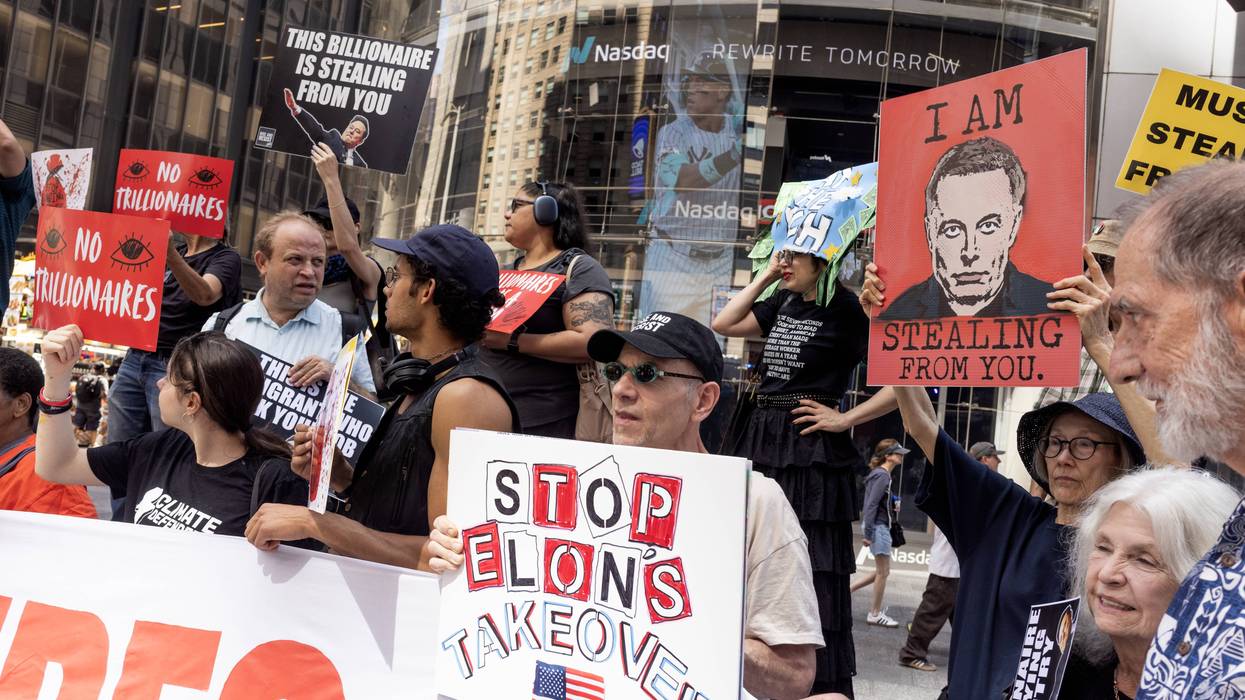
With Elon Musk's SpaceX set to go public on Friday, the world's richest man could soon become the first-ever trillionaire—an achievement that one leading humanitarian group called "a new pinnacle of oligarchy and a dark day for democracy."
Whether Musk reaches trillionaire status in the coming days will depend on the success of SpaceX's initial public offering (IPO), which critics warn is a potentially massive threat to market stability and Americans' retirement savings. The company plans to sell 555,555,555 shares at a price of $135 each, aiming for a staggering $1.75 trillion valuation. Musk, who is the company's board chair and owns 42% of its common stock along with options, will see his net worth skyrocket if SpaceX achieves its IPO targets.
Oxfam America noted in an analysis released Thursday that a $1 trillion net worth would mean that it would take Musk 2,740 years to spend $1 trillion if he spent $1 million per day. The group estimated that a 10% tax on $1 trillion "could end global extreme poverty for a year, lifting over 800 million people above the extreme poverty line."
Nabil Ahmed, senior director of economic justice at Oxfam America, said in a statement that "this moment of dramatically concentrated wealth was not inevitable."
"Musk will be a government-backed trillionaire whose fortune was fueled by an era of regressive public policy choices—decisions rigged by a tiny few to fuel their fortunes, and overwhelmingly supported by political leaders," said Ahmed. "A trillion dollars in the hands of one man is incompatible not only with an affordable economy, but also with a healthy democracy. Economic inequality begets political inequality, and ordinary people bear the brunt while billionaires continue to write the rules for their own benefit."
“The new Gilded Age won’t end itself," he added. "This is a trillion-dollar alarm bell that should wake governments up to the need to take action. Never has it been more urgent to curb the accumulation of extreme wealth—overhauling the economic policies that have created not just trillionaires, but billionaires and the obscene inequality we see today."
Oxfam highlighted Musk's brief but immensely destructive tenure in the US federal government at the Department of Government Efficiency, or DOGE, which took a sledgehammer to foreign aid programs and assailed the Social Security Administration, among other actions whose consequences are expected to reverberate for years to come. Oxfam has warned that the Musk-led decimation of the US Agency for International Development means that "a child under 5 could die every 40 seconds by 2030."
Musk was given the role at DOGE after using a tiny fraction of his wealth to boost President Donald Trump and Republican candidates in the 2024 election. Musk is spending big again to boost the GOP in the 2026 midterms.
"Musk’s ability to pour money into elections allowed him to use his wealth and power in ways that embody the corrosive effects of billionaire control," Oxfam said Thursday.
The group's statement came amid mounting anxiety about the impact of SpaceX's IPO, beyond potentially pushing Musk's wealth past the trillion-dollar mark.
In a letter to the US Securities and Exchange Commission earlier this week, Sen. Elizabeth Warren (D-Mass.) raised "extreme concern" about the possibility that the IPO could flop. Major stock index providers, she observed, are "rewriting their rules to fast-track SpaceX’s entry into their indexes—and into the investment funds that power millions of Americans’ retirement savings."
"The net result could be disastrous," Warren wrote, "a scenario where retirees’ and families’ investment accounts take a hit if SpaceX’s valuation falters, with little recourse for any corporate misconduct, while the wealthiest man on earth becomes even wealthier due to a lack of oversight."

One human rights expert noted that the president's complaint about the drawn-out talks came "even though he is the one who ripped up an entirely effective deal... and in February ended negotiations to start bombing."
US President Donald Trump bombed Iran for the second consecutive night on Wednesday after complaining on social media that Tehran has taken too long on peace negotiations and vowing to respond to the downing of an American military helicopter.
US Central Command said Tuesday that CENTCOM "forces began launching self-defense strikes against Iran at 5:00 pm ET today at the commander in chief's direction, in response to yesterday's downing of a US Army Apache helicopter. The mission is a proportional response to unjustified Iranian aggression."
Trump took to his Truth Social platform just after 7:00 am ET Wednesday, writing that "Iran's Military is a complete and total mess. Much of it, like their Navy and Air Force, doesn't even exist anymore—They have been completely defeated. Iran is all talk and no action. The Bully of the Middle East is DEAD!!! They've taken too long to negotiate a deal that would have been great for them, now they will have to pay the price!!!"
Ken Roth, a visiting professor at Princeton University and the former longtime executive director of Human Rights Watch, noted that Trump's complaint about the drawn-out talks with Iran came "even though he is the one who ripped up an entirely effective deal... and in February ended negotiations to start bombing."
Trump unilaterally ended the Iran nuclear deal negotiated by the Obama administration, formally called the Joint Comprehensive Plan of Action, during his first term. There has been no agreement in place since.
After Trump's strikes on Tuesday night, Iran fired at Bahrain, Kuwait, and Jordan, which all host US troops. The recent exchanges cast further doubt on the ceasefire deal negotiated in April, after the American president's genocidal threat against Iran.
Later Wednesday, CENTCOM announced that US "forces began launching additional self-defense strikes today at 5:15 pm ET against multiple targets in Iran at the commander in chief's direction. The strikes are in response to Iran’s unwarranted and continued aggression."
Drop Site News reported that "as the strikes were announced, Iranian media reported a series of explosions across Hormozgan province, the southern Iranian province that borders the Strait of Hormuz," a key trade route through which Iran has largely restricted ship traffic since Iran and Israel began bombing the country in late February.
As Drop Site detailed:
Trita Parsi, co-founder and executive vice president of the Quincy Institute for Responsible Statecraft and an expert on US-Iranian relations, said, "It appears the US/Israel-Iran war has started again... or perhaps more accurately, it never really ended."
Fox News' Trey Yingst reported on air late Wednesday that "President Trump told me that Iran called him tonight. Top Iranian officials and President Trump spoke directly, according to the commander in chief tonight, as the president was sitting in the Situation Room, and he told me that the Iranians asked them to stop bombing, and the president said to me, 'The bombing will stop shortly.'"
According to Reuters, Iran's media contradicted that reporting, with an unnamed senior Iranian official saying, "Trump's false claim that Iranian officials contacted him is a cover to evade war with Iran."
Asked by Yingst what will happen if the Iranians don't sign a new deal soon, Trump reportedly responded, "We'll bomb the shit out of them tomorrow night."