

SUBSCRIBE TO OUR FREE NEWSLETTER
Daily news & progressive opinion—funded by the people, not the corporations—delivered straight to your inbox.
5
#000000
#FFFFFF
To donate by check, phone, or other method, see our More Ways to Give page.
Daily news & progressive opinion—funded by the people, not the corporations—delivered straight to your inbox.
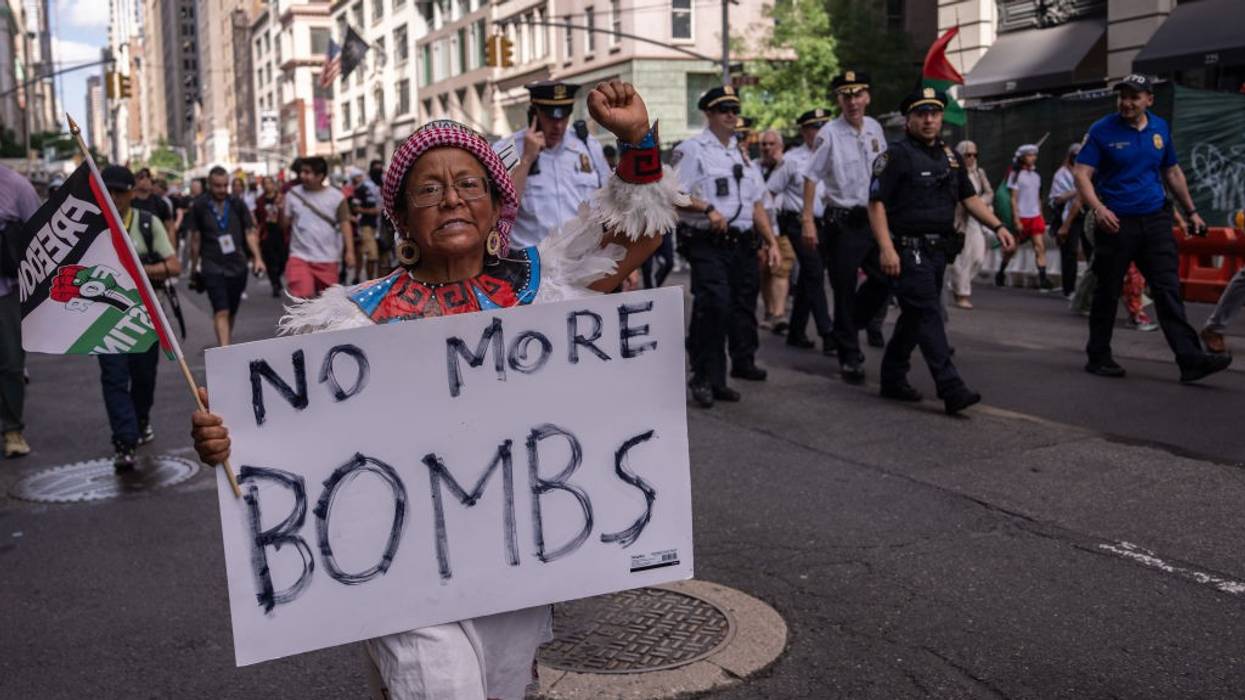
"Gotta love America—celebrating Indigenous Peoples Day today while arming, funding, and supporting the occupation, ethnic cleansing, and genocide of the Indigenous Palestinian people abroad," said one critic.
Human rights defenders on Monday underscored the links between the decolonization struggles of Native Americans and Palestinians—and the hypocrisy of celebrating Indigenous Peoples Day while the United States provides military aid and diplomatic support for Israel as it wages a war on Gaza for which it is on trial for genocide at the International Court of Justice.
"Several years ago Native activists successfully rallied their city councils to replace Columbus Day, the day that honors the Italian explorer who was a destroyer of Native worlds, with Indigenous Peoples Day, a holiday that celebrates the Natives who have resisted colonial oppression for over 500 years, since the arrival of Christopher Columbus," Jewish American scholar Benay Blend wrote for The Palestine Chronicle.
"It is also a good time to highlight Indigenous solidarity within the Americas as well as with other Indigenous people, including the Palestinians," Blend said. "Indeed, both people share a similar story of resistance to colonization, while the colonizers—the United States and Israel—share similar origin stories and tactics used to sever the Native people from their land."
Citing Steven Salaita—the Palestinian American professor of American Indian studies whose offer of a tenured position at the University of Illinois Champaign-Urbana was rescinded in 2014 over his criticism of Israeli bombing of Gaza—Blend noted that "both Israel and North America share similar rhetoric that justifies their origins."
"Infused with biblical references to 'salvation, redemption, and destiny,' settlers in both countries believed that they had reached the Promised Land, where God commanded them to eliminate the Indigenous populations to make way for more fertile land that had previously been 'underused and unappreciated by the natives,'" she added.
In a social media post that included video footage of Israel's bombing on Monday of a displaced people's encampment on the grounds of the al-Aqsa Martyrs Hospital in Deir al-Balah in central Gaza, Uahikea Maile—a Native Hawaiian professor of race, diaspora, and indigenity at the University of Chicago—said on social media that "Indigenous Peoples Day is about commemorating our survival and endurance despite settler colonialism—resisting annihilation as distinct people."
"If your celebration doesn't condemn Israel's wanton destruction of Palestinian life, then it recklessly shores up settler colonization," he added.
Samoan poet and educator Terisa Siagatonu stressed that "Palestinians are an Indigenous people" and "a free Palestine is an Indigenous struggle."
"I'm saying this over and over again as clear as I can because I don't believe people are contending with this enough, and you need to," she added.
Nick Estes, a Lakota community organizer and University of Minnesota historian, asserted that "the cynical 'celebration' of Indigenous Peoples Day by a settler state backing another settler state's genocide against Palestinians and Lebanese shows us nothing is sacred, not even our own survival, until we bury colonialism once and for all."
Responding to an Indigenous Peoples Day proclamation by U.S. President Joe Biden "respecting tribal sovereignty and self-determination," labor historian, author, and Empire State University professor Jeff Schuhrke took a swipe at those "commemorating Indigenous Peoples Day while simultaneously facilitating the real-time colonial extermination of Palestine's Indigenous people."
The U.S. direct action group Jewish Voice for Peace chose Indigenous Peoples Day to stage a protest at which more than 200 activists were arrested while demanding an end to U.S. military aid to Israel. Sumaya Awad, a Palestinian American spokesperson for the event and member of Adalah Justice Project, told The Indypendent that "the fact that the United States claims to stand with and honor Indigenous people... while they're actively funding and financially backing the ethnic cleansing of an Indigenous population in Palestine is contradictory to their statements."
Rick Tabenunaka, a member of the Comanche Nation and leftist organizer who hosts the "Decolonized Buffalo" podcast, said on social media, "I find it ironic that settlers will claim that Indigenous peoples on the North 'American' continent aren't doing enough to fight against settler colonialism."
"Yet," he lamented, "these same settlers spent a whole year watching their colonial government support genocide in Palestine and did nothing."
More than a year after firing Dr. Steven Salaita from a tenured faculty position for publishing personal tweets critical of Israel's 2014 military assault on Gaza, the University of Illinois at Urbana-Champaign (UIUC) has agreed to settle the professor's free speech and breach of contract lawsuits for nearly a million dollars.
Announced Thursday by the Center for Constitutional Rights (CCR) and co-counsel Loevy & Loevy, the deal falls short of reinstating the professor to the American Indian Studies Department--a demand that has been issued by students, faculty, and Salaita himself. Salaita's job offer was revoked after he signed an employment contract with the university in July 2014.
Heralding the settlement as a "vindication" for himself, Salaita explained the much more important victory was "for academic freedom and the First Amendment."
"The petitions, demonstrations, and investigations, as well as the legal case, have reinvigorated American higher education as a place of critical thinking and rigorous debate, and I am deeply grateful to all who have spoken out," Salaita said.
A vibrant campus movement led by advocates for Palestinian human rights, worker justice, and free speech advocates forced Salaita's firing into the international limelight. In addition to student and faculty walkouts, a successful boycott of UIUC garnered the backing of thousands of academics and students worldwide and led to the cancellation of dozens of lectures and conferences at the university.
These efforts forced a shake-up in the university administration, prompting vote of "no confidence" in the university administration by 16 UIUC departments, as well as public censure by the American Association of University Professors and the Modern Language Association.
When a federal judge ruled in favor of allowing Salaita's breach of contract case to proceed in August, Chancellor Phyllis Wise--who initially served Salaita papers rescinding his job offer--resigned from her position.
Then, a resultant transparency scandal prompted Provost Ilesanmi Adesida to do the same.
What's more, Freedom of Information Act requests that were filed in response to Salaita's ouster revealed that well-heeled donors inappropriately intervened to press for Salaita's firing.
In exchange for the sum of $875,000, Salaita agreed to drop his multiple lawsuits against the university. The lawsuit does not, however, address the academic freedom implications of the case--which impact the campus community far beyond Salaita.
It is not immediately clear whether the settlement will prompt the AAUP to remove UIUC from its list of censured universities.
Meanwhile, Palestinian rights advocates continue to face retaliation and intimidation in universities and colleges across the United States.
A report released in September by CCR and Palestine Legal revealed that, in in 2014 alone, the latter organization responded to 152 incidents of "censorship, punishment, or other burdening of advocacy for Palestinian rights and received 68 additional requests for legal assistance in anticipation of such actions." Just halfway through 2015, the organization had responded to 140 such incidents, marking a considerable increase.
"This is an important victory, even if the bigger fight isn't over," Salaita wrote on his Facebook page on Thursday. "At this point I am ready to move beyond this particular matter and continue doing what I love--teaching, writing, organizing, and contributing in whatever way I can to struggles for justice."
Salaita added on Twitter:
Professor Steven Salaita, a Palestinian-American professor of Indigenous studies whose offer of a tenured position at the University of Illinois at Urbana-Champaign was rescinded last year because of his tweets criticizing the Israeli government's bombing of Gaza, has filed a civil rights suit against the school and its top officials and donors, saying that his termination violated his First Amendment right to free speech and other constitutional rights, as well as basic principles of academic freedom.
"Like any American citizen, I have the right to express my opinion on pressing human rights concerns, including Israeli government actions, without fear of censorship or punishment," Salaita said in a statement. "The University's actions have cost me the pinnacle of academic achievement--a tenured professorship, with the opportunity to write and think freely. What makes this worse is that in my case the University abandoned fundamental principles of academic freedom and shared governance, crucial to fostering critical thought, that should be at the core of the university mission."
"Only donor pressure, or sheer pride, can explain the administration's stubborn refusal to revisit a decision that has done so much harm to Dr. Salaita and to constitutional and other principles that academics hold dear."
--Anand Swaminathan, Loevy & Loevy
Salaita, who is being represented by the Center for Constitutional Rights along with the Chicago civil rights law firm of Loevy & Loevy, filed the lawsuit Thursday in a U.S. federal court in Chicago.
The complaint (pdf) alleges that university officials, including the chancellor and university trustees, violated Salaita's constitutional rights to free speech and due process of law, and breached an employment contract with him. According to CCR, the suit is also against university donors who, based on emails made public, unlawfully threatened future donations to the university if it did not fire Salaita on account of his political views.
As Common Dreams reported in September, Salaita had been awarded the tenured position in fall 2013 and was scheduled to begin on August 16, 2014--just two weeks after Chancellor Phyllis Wise rescinded the offer. University documents released in response to a public-records request revealed that Wise had been pressured by numerous pro-Israel students, parents, alumni, and big-money donors to abort his appointment. These demands followed critical comments by Salaita regarding Israel's most recent attack on Gaza, during which thousands of Palestinians, including hundreds of children, were killed.
The university's action, which Wise explained was taken because Salaita's speech lacked "civility," spurred protests from within the university as well as the academic community at-large. Sixteen academic departments of the university have voted no confidence in the university administration, and prominent academic organizations, including the American Association of University Professors, the Modern Language Association, and the Society of American Law Teachers have publicly condemned the university's actions.
"The use of 'civility' as cover for violating Professor Salaita's rights must be challenged, as it threatens the very notion of a University as a place for free inquiry and open debate," said Maria LaHood, a senior attorney with the Center for Constitutional Rights. "There is neither a 'civility' exception nor a 'Palestine' exception to the First Amendment."
According to CCR, the lawsuit seeks Salaita's reinstatement and monetary relief that includes compensation for the economic hardship and reputational damage he suffered as a result of the university's actions.
"Only donor pressure, or sheer pride, can explain the administration's stubborn refusal to revisit a decision that has done so much harm to Dr. Salaita and to constitutional and other principles that academics hold dear," said Anand Swaminathan of Loevy & Loevy. "The administration has something to hide, and through this lawsuit we intend to expose it."
Finally breaking its silence, the University of Illinois at Urbana-Champaign on Friday claimed that the firing of Steven Salaita was "was not influenced in any way by his positions on the conflict in the Middle East nor his criticism of Israel."
Rather, it was, in effect, a pre-empetive firing based on the assumption that his tweets would make him a bad teacher.
This transparent use of "civility" as a cover to fire a professor with outspoken views on Israel is almost identical to the pretext that was given by DePaul University in 2007 to deny tenure to Norman Finkelstein.
In that case, DePaul denied Finkelstein tenure on the vague grounds that he lacked "collegiality."
In a lengthy mass email to the university community (full text below), UIUC Chancellor Phyllis Wise makes the following statements that amount to pre-emptive accusations against Salaita without providing any specifics about what he was accused of and no due process to defend himself:
What we cannot and will not tolerate at the University of Illinois are personal and disrespectful words or actions that demean and abuse either viewpoints themselves or those who express them. We have a particular duty to our students to ensure that they live in a community of scholarship that challenges their assumptions about the world but that also respects their rights as individuals.
As chancellor, it is my responsibility to ensure that all perspectives are welcome and that our discourse, regardless of subject matter or viewpoint, allows new concepts and differing points of view to be discussed in and outside the classroom in a scholarly, civil and productive manner.
A Jewish student, a Palestinian student, or any student of any faith or background must feel confident that personal views can be expressed and that philosophical disagreements with a faculty member can be debated in a civil, thoughtful and mutually respectful manner. Most important, every student must know that every instructor recognizes and values that student as a human being. If we have lost that, we have lost much more than our standing as a world-class institution of higher education.
When Finkelstein was denied tenure, the Illinois branch of the Association of American University Professors (AAUP) wrote that "collegiality" was a vague, baseless and impermissible criterion in making such decisions.
Already in Salaita's case, the national AAUP stated that it "has long objected to using criteria of civility and collegiality in faculty evaluation because we view this as a threat to academic freedom. It stands to reason that this objection should extend as well to decisions about hiring, especially about hiring to a tenured position."
At the blog Academe, a publication of AAUP, John K. Wilson points out the absurdity of Wise's claim that not just people but "viewpoints" must not be "demeaned":
Of course, this standard is ridiculous: individuals should be free to say personal and "disrespectful" things about others (for example, everyone should be free to say that Wise's argument here is both stupid and evil, without facing punishment from the respect police). Respect is not a fundamental value of any university, and being "disrespectful" is not an academic crime. But it's notable that Salaita really didn't say anything personal about anyone. So here Wise greatly expands the concept, declaring that not only persons but "viewpoints themselves" must be protected from any disrespectful words. I am puzzled as to exactly how a free university could possibly operate when no one is allowed to be disrespectful toward any viewpoint. Presumably, Wise will quickly act to fire anyone who has ever disrespected or demeaned Nazism, terrorism, racism, sexism, and homophobia. Since all "viewpoints" are protected, then biology professors must be fired for disrespecting creationism as false, along with any other professor who is found to believe or know anything.
The decision to fire Salaita has prompted a growing boycott of UIUC, with more than 2,400 scholars from around the country pledging not to engage with the university.
In a concrete manifestation of this, the Education Justice Project at the University of Illinois at Urbana-Champaign has announced that it is canceling an upcoming conference.
Mass email from Phyllis Wise :
22 August 2014
Dear Colleagues:
As you may be aware, Vice President Christophe Pierre and I wrote to Prof. Steven Salaita on Aug. 1, informing him of the university's decision not to recommend further action by the Board of Trustees concerning his potential appointment to the faculty of the University of Illinois at Urbana-Champaign. Since this decision, many of you have expressed your concern about its potential impact on academic freedom. I want to assure you in the strongest possible terms that all of us - my administration, the university administration and I - absolutely are committed to this bedrock principle. I began my career as a scientist challenging accepted ideas and pre-conceived notions, and I have continued during my career to invite and encourage such debates in all aspects of university life.
A pre-eminent university must always be a home for difficult discussions and for the teaching of diverse ideas. One of our core missions is to welcome and encourage differing perspectives. Robust - and even intense and provocative - debate and disagreement are deeply valued and critical to the success of our university.
As a university community, we also are committed to creating a welcoming environment for faculty and students alike to explore the most difficult, contentious and complex issues facing our society today. Our Inclusive Illinois initiative is based on the premise that education is a process that starts with our collective willingness to search for answers together - learning from each other in a respectful way that supports a diversity of worldviews, histories and cultural knowledge.
The decision regarding Prof. Salaita was not influenced in any way by his positions on the conflict in the Middle East nor his criticism of Israel. Our university is home to a wide diversity of opinions on issues of politics and foreign policy. Some of our faculty are critical of Israel, while others are strong supporters. These debates make us stronger as an institution and force advocates of all viewpoints to confront the arguments and perspectives offered by others. We are a university built on precisely this type of dialogue, discourse and debate. What we cannot and will not tolerate at the University of Illinois are personal and disrespectful words or actions that demean and abuse either viewpoints themselves or those who express them. We have a particular duty to our students to ensure that they live in a community of scholarship that challenges their assumptions about the world but that also respects their rights as individuals.
As chancellor, it is my responsibility to ensure that all perspectives are welcome and that our discourse, regardless of subject matter or viewpoint, allows new concepts and differing points of view to be discussed in and outside the classroom in a scholarly, civil and productive manner. A Jewish student, a Palestinian student, or any student of any faith or background must feel confident that personal views can be expressed and that philosophical disagreements with a faculty member can be debated in a civil, thoughtful and mutually respectful manner. Most important, every student must know that every instructor recognizes and values that student as a human being. If we have lost that, we have lost much more than our standing as a world-class institution of higher education.
As a member of the faculty, I firmly believe that a tenured faculty position at the University of Illinois is a tremendous honor and a unique privilege. Tenure also brings with it a heavy responsibility to continue the traditions of scholarship and civility upon which our university is built.
I am committed to working closely with you to identify how the campus administration can support our collective duty to inspire and facilitate thoughtful consideration of diverse opinions and discourse on challenging issues.
Sincerely,
Phyllis M. Wise Chancellor