

SUBSCRIBE TO OUR FREE NEWSLETTER
Daily news & progressive opinion—funded by the people, not the corporations—delivered straight to your inbox.
5
#000000
#FFFFFF
To donate by check, phone, or other method, see our More Ways to Give page.
Daily news & progressive opinion—funded by the people, not the corporations—delivered straight to your inbox.
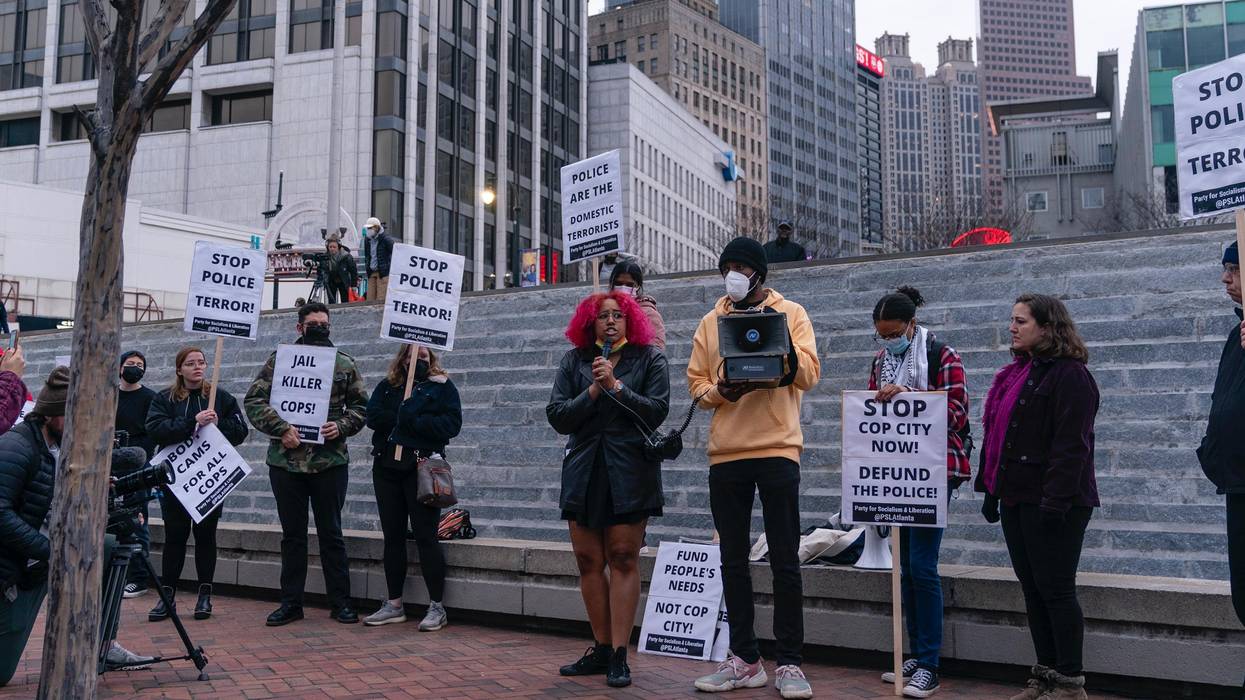
A week of action in Atlanta this March showcases widespread opposition to a planned police training center, which would be the largest in the nation. An organizer explains what's at stake.
Atlanta is a city built inside a forest, one that Indigenous Muscogee people call the Weelaunee Forest. In recent years, the Atlanta Police Foundation, a private nonprofit organization, has led an effort to build what would be the nation’s largest police training center on hundreds of acres of that forest land. The move sparked the creation of a broad coalition to protest the project, some opposed to forest destruction and others against police expansion. Together, these organizers are calling on Atlanta’s mayor, Andre Dickens, and the city council to “Stop Cop City.”
Authorities have cracked down on the protests with mass arrests and, in some cases, are charging organizers with domestic terrorism. In January 2023, police raided an area where protesters were camping in the Weelaunee Forest, killing an environmental justice protester named Tortuguita.
"We have to get back out in the streets. We have to continue organizing. And that is the way that we fight back against police violence and police terror"
Organizers designated March 4–11, 2023, a week of action in Atlanta aimed at shutting down Cop City. Kamau Franklin, the founder and director of the Atlanta-based grassroots organization Community Movement Builders, has been involved in the protests, pressuring city officials and organizing events. The organization’s website says, “CMB has been the leading Black organization on the ground fighting to StopCopCity since its construction was announced.” On March 7, Franklin spoke with YES! Racial Justice Editor Sonali Kolhatkar about the organizing efforts and the police crackdown, and why the effort to Stop Cop City is a story of national significance.
This interview has been edited for clarity.
Sonali Kolhatkar: Tell me about this facility. The official name isn’t “Cop City”—that’s what it’s been sort of dubbed. It has a rather benign title of the Atlanta Public Safety Training Center—that’s what the Atlanta Police Foundation calls it, which I imagine you consider a euphemism?
Kamau Franklin: [Laughing] Sorry, you caught me off guard there!
Yeah. Yes, we do consider [it] a euphemism for a militarized training center, which is meant to continue to over-police, particularly Black communities here in Atlanta, and, what we believe, is meant to train the police on how to stop and to criminalize social justice movements—particularly movements against police violence.
So, the very adoption of this idea of a militarized training center came after the 2020 uprisings, and that’s when Atlanta decided that it needed this sprawling militarized training center to be built in a forest in order to, again in our estimation, stop movements and continue to over-police Black and Brown communities.
Kolhatkar: So, this training center, if it is built, will it be something that just Atlanta-area police are trained in? Or, is it something that police from outside Atlanta, and even outside Georgia, are going to be invited into? Why would it be the nation’s largest police training center? Why does Atlanta need that?
Franklin: Exactly. Atlanta doesn’t need it. In fact, the Atlanta police are no bigger than the 20th-largest police department in the whole country. And so, why it needs the largest police training center is beyond me—except for the fact that this is part of a larger national strategy, we believe, around training police officers in common tactics and strategies, in essence, the building of some sort of nationalized police force.
Through documents released through the Freedom of Information Act, we’ve received information that the Atlanta Police Foundation, in its attempt to receive additional funding for this site, has [specified] that up to 43% of the police officers to be trained will be from outside of Georgia. So, this site is not just for Atlanta police, but this site is going to be a place of training for police officers across the country.
In addition, Georgia already has a program where it works directly with the Israeli police force. And so, what we tell people is that the training and tactics and strategies that the Israeli Police use against Palestinians are going to be exported here to the United States against Black communities, and that the training, tactics, and strategies used against Black communities are going to be exported to Palestine to be used against Palestinians.
And so, we know that this is not just a local effort, but the scope and size of this, the additional officers that are being trained from around the country, this is truly a national effort to train police—again, what we think coming out of 2020—to train police to stop movements, particularly to stop movements against police violence.
Kolhatkar: Let’s talk about what’s happened with the resistance. In January, there was a lot of activism against “Cop City,” and, in fact, tragically, police killed a person who went by the name Tortuguita. Tell me about who they were, why they were killed, and who killed them.
Franklin: Yeah, Tortuguita was one of the “Forest Defenders” who was camping in Weelaunee Forest to try to prevent, as an act of civil disobedience, the police foundation from going forward and cutting down nearly a hundred acres of forest.
We should state that, again through another Freedom of Information Act, we became aware, months before the killing of Tortuguita, that there was a task force that was formed—a task force of policing agencies including the Atlanta police, the DeKalb County police, the Georgia Bureau of Investigation, the Federal Bureau of Investigation, and even Homeland Security—that this task force got together to talk through bringing state terrorism charges against protesters who are opposed to Cop City. That these charges were something, that this state law had never been used before, but yet they were putting out the idea of doing this against organizers and activists.
In December, these different policing agencies made their first raid in the forest and arrested approximately six organizers, or six Forest Defenders, and charged them with the charge of domestic terrorism. As you mentioned, on Jan. 18, they made a second raid in the forest, and during that raid, they arrested another seven activists and charged them with domestic terrorism. And it was during that raid that they killed the young Forest Defender Tortuguita, claiming that that person took one shot at them and that they responded back in kind.
From other information we’ve received from people in the community, it has become obvious to us that that police narrative cannot be trusted and it’s basically a lie. The police narrative fell apart instantly when people in the community said that they heard a sudden burst of gunfire. And later, that was backed up by videotape evidence that was released by the Georgia Bureau of Investigation, that in the background you could hear a sudden burst of fire, and the police themselves remarked, who weren’t on the scene, that that was “suppressed fire,” which [is] code for cop fire.
We find it incredibly difficult to believe that of all the different agencies that I named earlier—Atlanta police, DeKalb County police, Georgia Bureau of Investigation, Georgia troopers, interagency SWAT teams, and, by some news accounts, even the FBI—that no agency had body cameras on during the time of their confrontation with Tortuguita.
They had other body camera images that could be seen in different places, but somehow, over a dozen police officers surrounding a tent did not have one body camera on to film the incident.
They expect us to believe that someone sitting in a cloth tent—that they described as “barricaded”—that someone sitting in a cloth tent decided to shoot once at the police, and then the police returned fire.
Tortuguita was shot over 13 times. So many times was the young person shot that the autopsy, which was done by the family, couldn’t determine the exact amount [of shots], because [you] couldn’t tell what was an entry wound and what was an exit wound.
So, we feel that this obviously needs an independent investigation. But more importantly, this is the first time that a Forest Defender, a climate justice activist, has been killed by the police in the United States.
And this very violence is one of the reasons why we oppose Cop City, because it’s these militarized actions which lead to the death of not only protesters, but people out in the street, who are going about their daily business when they interact with the police.
Kolhatkar: So, tell me about the coalition that has formed to resist Cop City. Tortuguita considered themselves a Forest Defender. A lot of people outside Atlanta don’t know this—I didn’t realize this—that Atlanta is actually a city in a forest. It’s called the Atlanta Forest. Indigenous folks call it the Weelaunee Forest. So, there’s been a coalition of many different kinds of progressive groups coming together to oppose this Cop City from various angles, who are united with one goal, right?
Franklin: Yes, I mean, there’s folks who are climate justice activists and organizers, environmental organizations, civil rights groups, groups like ours that are grassroots organizers, folks of many different ideological persuasions, autonomous organizers, anarchist organizers. There has been a great amount of ideological and ethnic and racial diversity in terms of what this movement has been.
And so, when folks try to suggest that this is a movement of outsiders, it’s because they’ve never seen that the homegrown Atlanta organizers, or the people who’ve lived here for over 10, 15, 20 years, are the people who are centered in this movement to stop Cop City.
This movement has gone on for over two years. And it invites folks to come in from outside, right? We don’t buy into the “outside agitator” narrative that the police and the political class like to throw on us. We invite organizers and activists to come from around the country, in fact, from around the world, to take part in these demonstrations. We see that as part of the history, or historical roots of organizing and activism.
Let’s just remember that people like Dr. King were called “outside agitators,” people in the civil rights movement were called “outside agitators.” Anytime people fight for justice, the politicians of the status quo usually like to call people “outside agitators” when they’re fighting for justice. And so, this has been a diverse movement, a movement of many, many, many different stripes, and it’s one that’s continuing to this day.
Kolhatkar: So, this week is a week of action, but it began with more arrests on Sunday, and also what seemed like a really aggressive action, if you will, by activists? Tell me what happened on Sunday—there was one vehicle that was set on fire, and, of course, usually when there’s any kind of property destruction, the police like to cast this as equivalent to when human bodies and human beings are harmed. And so, the groups, the activists participating in that, and, by extension, everybody else has been cast as “violent” and “aggressive.” So, what actually happened this past weekend?
Franklin: Sure. Well, you know, the actual week of organizing started on the Saturday, and on that Saturday, there was a large demonstration. People took walks through the forest, actually went to the place where Tortuguita was killed. And then on Sunday, there was a music concert that had been planned where many different artists came out to perform.
There were some who decided to engage in a direct action that didn’t start at the music festival. That direct action went straight to the campsite that’s been blocked off by the police. And in that action, which was meant to destroy the property that’s going to be used to build Cop City, there were police agents already there. There was a back and forth between the police and the organizers and activists. The police called for more backup. At the scene, to our knowledge, there weren’t many, if any, arrests.
But what the police did was that they decided to go break up the music festival and begin to make additional arrests there. And so there were 35 arrests in total. Twenty-three of those were charged with domestic terrorism. That’s in addition to the other 19 who were previously charged with domestic terrorism.
We must make sure that we’re clear: The overwhelming majority of people who’ve been arrested with the charge of domestic terrorism have been people who’ve been either sitting in trees and tree huts or people who’ve been sitting in tents.
And even [for] those people who are actively engaged [in] acts of civil disobedience, so direct action, it’s one thing to charge people with assault, or vandalism, or trespassing, or even arson. It’s another thing to label folks and to then charge them with domestic terrorist accusations. That is meant to criminalize the movement, that is meant to harm the movement in general, and basically to squash dissent.
So that is part of what we are really, really rallying around—that we understand at the state agencies, this is not about them charging people with certain crimes. This is about them overcharging and trying to present the movement as violent so that people will look the other way and allow them to build this militarized center.
Kolhatkar: So, in other words, they’re using the resistance to Cop City as justification for Cop City. What about Atlanta’s mayor Andre Dickens and Georgia’s Gov. Brian Kemp? How have leaders in Georgia and Atlanta responded to what seems to be widespread resistance to this training center?
Franklin: I think basically what’s happened is that these leaders, these so-called leaders, have doubled down on their aggressive tactics. And so, what we have here in Atlanta is that you have a moderate-to-liberal Black Democratic mayor who has teamed up with a right-wing white supremacist Republican governor to stomp out activism and organizing around Cop City. Because the one thing that both of these leaders agree with—and they’ve even gotten support, of course, from the moderate Democratic presidential administration through the FBI and the Justice Department, and Homeland Security—so all of these different political elites support the police. All of these different political elites support or get support from the corporations that support the police. And so, they have been continually aligned in their opposition to the movement to Stop Cop City.
In addition to that, here in Atlanta, in the northern part of Atlanta, we have a place called Buckhead, which has threatened to secede from Atlanta and to form its own city on a false narrative of there being a crime wave. If Buckhead was its own city, it would be the 12th-safest city in the country. But what this city is doing—and this is a majority-white part of the city—is putting pressure on Republicans to support its secession bid.
Basically, the governor of Georgia told the mayor of Atlanta—and again, these are through emails—that he likes the job that he’s doing on policing, i.e., he likes the job that he’s doing by responding to Buckhead, and he likes the job he’s doing by pushing forward Cop City.
And so recently, in the State Assembly, the Republicans basically put down the vote to have Buckhead secede. So basically, the governor is promising the mayor that as long as you continue to do the job that I think is good in terms of over-policing, you have my support in keeping Buckhead, which is basically the economic engine of Atlanta, connected to Atlanta.
And so, these folks again are working hand in hand to build this militarized operation because it fits their political interests and their political needs, and they don’t care that the city itself, the majority of the city—remember, when this vote was taken to bring forth police, 70% of the people who called in said they were opposed to Cop City—but yet the city council and the mayor went ahead anyway and voted this in and have tried to move this forward.
Kolhatkar: One of the signs that I’m seeing in images coming out of the resistance to Cop City is a slogan, “No Hollywood dystopia.” What does that mean?
Franklin: Well, in addition to the building of Cop City, there was another attempt to build a movie studio in Weelaunee Forest. At the time, it was called Blackhall Studios. And so, in addition to the 300 acres which were rented to the Atlanta Police Foundation, a private foundation, to do the training for a public entity, another, over 200 to 300 acres, was designated to be used to build Blackhall Studios.
And so, the “Hollywood dystopia” conversation is that at the same time they’re ripping apart a forest to build this militarized training center, they’re also ripping apart a part of the forest to build a Hollywood studio. And so, apparently, the forest is no good to anybody, in terms of these elite circles, unless it’s torn down.
Kolhatkar: Maybe there’s an interesting symbolism there, because Hollywood has been, for decades, the perpetrator of “copaganda,” and you just pointed out the liberal mayor, Dickens, who is, like President Biden, very much pro-police. So, liberal forces and Hollywood have lined up behind police in spite of whatever lip service they paid to Black Lives Matter in summer 2020. So finally, let’s wrap up this conversation with looking at why you think this ought to be a national story and how people outside of Atlanta can express solidarity, especially those who got activated in the summer of 2020 in the largest mass movement in American history.
Franklin: Yeah, well, we think this is a national and international story because of some of the points made earlier. The idea of Cop City is basically the idea of training police all around the country with connections to police departments all around the world in tactical and strategic ways, we think, to shut down movements.
This idea was birthed after the 2020 uprisings when the Atlanta policing establishment, and the political establishment, and the corporate establishment felt that Atlanta did not control protest here. And this is the outcome: to militarize the police further and give them a place to train for that militarized outlook that they can bring back on the community.
And again, this will continue the over-policing of Black and Brown communities. And so, nothing was solved in 2020. This issue is still alive. Instead of talking about defunding, or talking about abolition of the police, or alternatives to public safety, the city of Atlanta has doubled down on its policing tactics and has invited other policing agencies to come here and train with them.
So, this is very much a national issue. We want people to get involved wherever they are. They can get involved—you know, we’re doing this week of action—by coming here to Atlanta. They can get involved where they’re located, on the website of CommunityMovementBuilders.org. We have a “Stop Cop City” page, which lists some of the actions that people can take: everything from calling and chastising these corporations, to calling and chastising these developers who are actually working on the building of Cop City, calling the mayor, calling the city council.
We have petitions. We’re going to start a fight soon to stop the DNC from coming to Atlanta, to stop FIFA, the World Cup, from coming to Atlanta. We must make Atlanta pay a political price for their actions, and we can only do that through a national effort.
And so, we welcome those who were part of the 2020 struggle who have to understand that that struggle was not completed. In fact, it was diverted into mass elections, into political elections. And we have to get back out in the streets. We have to continue organizing. And that is the way that we fight back against police violence and police terror.
Baltimore City state's attorney Marilyn Mosby announced late Thursday afternoon that all six police officers have been indicted in the death of Freddie Gray.
The officers will be arraigned on July 2, said Mosby.
The Associated Press reports:
The charges returned by the grand jury were similar to the charges Mosby announced about three weeks ago.
Mosby has said Gray's neck was broken because he was injured while being handcuffed, shackled and placed head-first into a police van. She says his pleas for medical attention were repeatedly ignored.
Gray, a 25-year-old black man, died brutally last month after his spine was almost completely severed while in police custody.
His death has become a symbol of police violence against black people and sparked angry protests in Baltimore.
Update, 3:30pm:
Friday's news that six Baltimore police officers will face criminal charges in the death of Freddie Gray elicited cheers from city residents grateful for some modicum of accountability for police brutality, and mixed reactions from those who said the announcement was only a first step toward justice.
The ACLU of Maryland called the development a "historic moment" brought about by "the tireless efforts of families who have lost loved ones to police violence--here in Baltimore, throughout Maryland, and all across America."
"They persistently have called attention to the double standards of our criminal justice system," said Susan Goering, executive director of the Maryland ACLU.
However, Goering continued, "We know that today's announcement is only a first step in a state that has historically prosecuted less than two percent of police-involved deaths, while prosecuting thousands of African-Americans for petty offenses. Our systems of justice have been far more willing to treat officers as innocent until proven guilty than they are the communities who are being policed -- communities where people are presumed guilty and stopped, searched, and arrested without cause... We hope this marks the beginning of a nationwide awakening to the many injustices and inequalities that we have allowed to continue for far too long."
State's Attorney Marilyn Mosby, meanwhile, has emerged as a crusader for civil rights.
"I heard your call for 'no justice, no peace,'" Mosby told the people of Baltimore on Friday. "Your peace is sincerely needed as I work to deliver justice on behalf of this young man."
Speaking with MSNBC's Andrea Mitchell, Sherrilyn Ifill of the NAACP Legal Defense Fund praised Mosby for her "courage" in bringing charges against the officers.
Friday's news, Ifill said, shows "what prosecutors can do to really undermine the culture of impunity that has existed for far too long as it relates to police assaults and killings of unarmed African Americans."
But Ifill noted that many, including herself, are "celebrating something that should have happened as a matter of course."
"Look at what we're doing today," she pointed out. "This is 'breaking news'--that police officers would be held accountable by a prosecutor for the homicide of an innocent 25-year-old African American man. That's an indictment of where we are in this country around policing. It's a wake-up call and it's a reminder that this is not going to be resolved by one prosecution...this is a nationwide problem."
According to news reports, all six of the officers were in custody as of Friday afternoon.
Earlier...
Six Baltimore police officers involved in the arrest of Freddie Gray will face criminal charges, including manslaughter and murder, in the death of the 25-year-old black man, the city's chief prosecutor said on Friday.
In making her announcement, State's Attorney Marilyn Mosby said Gray, who died a week after his April 12 arrest, asked for medical attention twice during a ride between the site where he was taken into custody and a police booking center. Mosby also said Gray was improperly arrested that day because officers had no probable cause to detain him.
Gray's death, Mosby added, is believed to be the result of an injury he sustained while riding in the van without a seat belt.
"Mr. Gray's death was a homicide," she declared (see video below).
The Baltimore Police Department handed over its initial investigation into the case to the State's Attorney's office on Thursday.
According to the Baltimore Sun:
Officer Caesar Goodson Jr., 45, who was the driver of a police van that carried Gray through the streets of Baltimore, was charged with second-degree murder, assault, manslaughter, misconduct and other charges.
Officer William Porter, 25, and Lt. Brian Rice, 41, were charged with involuntary manslaughter.
Sgt. Alicia White, 30, was charged with manslaughter and involuntary manslaughter. Officer Edward Nero, 29, and Officer Garrett Miller, 26, were charged with assault and misconduct.
News sources reported that the Baltimore police officers union says the six officers charged in the Freddie Gray investigation aren't responsible for his death. Fraternal Order of Police Lodge 3 President Gene Ryan asked Mosby in a letter to appoint a special independent prosecutor. But after announcing the charges Friday, Mosby said she would not turn the case over to a special prosecutor.
The Associated Press profiled Mosby, who has been on the job just four months, in a piece published Friday.
Watch the press conference below:
Owing likely to the diligence of a clerk, the Maryland District Court records on Freddie Gray already have been updated. The disposition of Case No. 5B02287290, in which Gray was charged with attempted distribution of an unspecified illegal drug, appears capitalized and in boldface: ABATED BY DEATH.
Someone made the change Tuesday, just three days after the 25-year-old Gray died at Shock Trauma of injuries sustained during his arrest in West Baltimore a week earlier.
Another drug case against Gray, scheduled for Baltimore Circuit Court in May, remains on active status. But certainly the court clerks will find their way to updating that record, too.
"Some people will say his record is irrelevant to the central issues -- how he died while in the custody of Baltimore police, and why the police pursued him on April 12 to begin with -- and I agree. But I mention his record because his encounters with the law stemmed from the enforcement of our drug laws."
Overall, the record on Freddie Gray reveals a young man who had frequent encounters with police as they carried out local operations in America's longest war: the war on drugs.
The record also suggests that, as the years went by, Gray became harder to convict of a drug crime. Police kept arresting him. Prosecutors kept putting him on dockets. But after he was convicted of illegal drug possession when he was 18, Gray mostly avoided jail time.
Court records show not-guilty verdicts, cases dropped, closed or put on the inactive docket. There's one "probation after conviction" for a drug charge last August. Those are pretty typical outcomes for someone police frequently suspect of being a street-level drug dealer.
Most of the charges against Gray were for possession of "controlled dangerous substances," or possession with "intent to distribute" them. That means they thought he was selling drugs -- and, most of the time, the record shows, his alleged product was something other than marijuana.
One time last year, police charged Gray with having "gaming cards, dice." That case was dropped.
In the first three months of this year, Gray was accused of marijuana possession, fourth-degree burglary, second-degree assault, malicious destruction of property and trespassing.
The assault is the only thing on the record that suggests violence, and it was a charge, not a conviction. Though police say Gray had a switchblade-like knife on him when they arrested him April 12, he had never been accused of possessing a weapon.
So, generally speaking, Gray was a low-level, nonviolent offender.
Some people will say his record is irrelevant to the central issues -- how he died while in the custody of Baltimore police, and why the police pursued him on April 12 to begin with -- and I agree.
But I mention his record because his encounters with the law stemmed from the enforcement of our drug laws.
Such encounters occur constantly throughout the country.
Polls show that most Americans think the war on drugs has been a failure, but four decades on,it's still going strong. We still have prohibition instead of regulated commerce, and we still ask cops and federal agents every dayto arrest people who possess or sell illegal narcotics.We still emphasize punishment over treatment and rehabilitation. We still mostly attack the supply of heroin and cocaine, and not the demand for it.
The war on drugs has helped the United States lead the world in per-capita incarceration. It was the driving force of that, but there were other factors, too -- post-Willie Horton, tough-on-crime politics and the push toward zero-tolerance policing.
During the time Martin O'Malley was mayor, he emphasized the need to reduce crime, and his approach, adopted from New York City, was characterized accurately as zero-tolerance. Police made thousands of arrests -- more than 100,000 in 2005 alone -- and violent crime fell, and O'Malley claimed a correlation.
Of course, after he was elected Maryland's governor and left Baltimore, his successors changedthe strategy to one of targeted enforcement ("Bad guys with guns") and away from mass arrests for so-called quality-of-life crimes, and violence fell even further. Homicides dropped to a three-decade-low of 197 in 2011, five years after O'Malley left City Hall.
Now, as he tries to gain national attention as a potential Democratic candidate for president, O'Malley brags about crime reduction in Baltimore, as he's entitled to. But he does not acknowledge the costs. The city paid $870,000 in 2010 to settle a lawsuit with the ACLU and NAACP over the arrests of thousands of people -- mostly young black men -- without probable cause during O'Malley's zero-tolerance days.
But there was another cost in how citizens, particularly people who live in the most distressed neighborhoods, regarded the police -- and vice versa. There's no way to precisely measure the effects of a strategy from a decade ago, but certainly it was something O'Malley's successor, Sheila Dixon, and her successor, Stephanie Rawlings-Blake, felt needed to be fixed. They rejected zero-tolerance. They brought in police commissioners who took a very different approach. They stressed quality over quantity in arrests. They spoke of restoring trust and gaining the cooperation of citizens in fighting crime.
Still, even with that change, we have the war on drugs. It goes on, day after day, constantly creating needless encounters between police and people like Freddie Gray.
Update 3:15 PM (EST): Missouri Governor Issues State of Emergency Order in Ferguson Ahead of Indictment Decision
Missouri Governor Jay Nixon on Monday issued an Executive Order declaring a State of Emergency in Ferguson, Missouri.
"Regardless of the outcomes of federal and state criminal investigations, there is the possibility of expanded unrest," Nixon declares, citing the pending announcement over the indictment of Ferguson police officer Darren Wilson for the shooting death of black teenager Michael Brown.
The order, which lasts for thirty days, directs that the "St. Louis County Police Department shall have command and operational control over security in the City of Ferguson relating to areas of protests, acts of civil disobedience and conduct otherwise arising from such activities."
Further, it opens the doors for the U.S. National Guard to be called in at any time in order to "take such action and employ such equipment as may be necessary to carry out requests processed through the Missouri State Highway Patrol and ordered by the Governor of the state to protect life and property and support civilian authorities."
Organizers and community members have called for a peaceful response should the no-indictment ruling come. However, as observers note, this preemptive move by Nixon sets the stage for a strong police crackdown to any community response to the grand jury decision.
Earlier 11:30 AM (EST): In Ferguson, A Community Braces for 'System Failure'
Expressing little hope in the U.S. system of justice, the community of Ferguson is bracing for the fallout if Ferguson police officer Darren Wilson is not indicted for the shooting death of unarmed black teenager Michael Brown in August of this year.
A video communique released on Sunday by local activists and organizers shows a community prepared for the worst, with boarded up shops, spray painted with signs that read: "Open for Business. Ferguson Proud. Pray for Peace and Progress." A grand jury is expected to hand down their decision any day.
"All these preparations are being made with the expectation that a system that's supposed to work for everyone is going to fail, once again, for black people in America," says one of the interviewees. Put forth by the local group HandsUpUnited.org, the video features exclusive interviews with a wide cross-section of community members, organizers and Ferguson residents, including Mayor James Knowles III.
Sunday marked 100 days since 18-year-old Michael Brown was shot at close range by Wilson and left dead in the street for over four hours, spurring months of widespread protests and outrage. The violent police response to the largely peaceful demonstrations further ignited the community's call for an overhaul of what they say is a deeply prejudiced system, as well as for justice for Michael Brown.
While activists are calling for a peaceful response, St. Louis police have indicated that they are preparing for a battle. Missouri Governor Jay Nixon said last week that the Missouri National Guard was part of the state's "multiforce contingency plan" in order to "support local law enforcement" in the wake of the announcement.
On-the-ground organizers are accepting donations for goods, such as blankets and food, for community "sanctuary spaces" and are distributing protest information including "Rules of Engagement" should the no-indictment ruling come.
"Nobody's asking for Darren Wilson to be killed. Nobody's asking for him to be shot in the street. Nobody's asking for him to be strung up--like we have been for every decade in every century that we've been here," activist and actor Jesse Williams said in the comminque. "We're asking for him to be charged for the crime that he committed in front of witnesses."
The activists portrayed in the video say that the interesting thing about Ferguson is that it's "nothing unique. Cops kill black people." The difference is that "Ferguson decided they had enough."
"No indictment is a declaration of war," added artist and HandsUpUnited.org cofounder Tef Poe, "from the state, from the police, from the system itself issued to black and brown oppressed people, poor people of all creeds."
On Friday, the St. Louis Post Dispatch reported new details of police audio recordings which showed that Brown had been killed only 61 seconds after Wilson had told the dispatcher he had stopped Brown and a friend. According to an attorney for Brown's family, the recording demonstrates that Brown's shooting "had nothing to do" with an earlier convenience store robbery, which Wilson and the Ferguson Police Department had alleged that Wilson was responding to.
"The murders of unarmed people in our communities has reached epidemic numbers."
This is the warning that kicks off a national call (via video) from the Dream Defenders--the group that grabbed the national media spotlight last year when its members launched protests against Stand Your Ground Laws, including by occupying the office of Florida Governor Rick Scott.
Now, to honor the lives of Mike Brown, John Crawford, Eric Garner, Ezell Ford, and others across the country who have fallen victim to deadly violence at police hands, they are calling for a national campaign--Hands Up, Don't Shoot. "We are prisoners of a war being waged on communities of color and the poor," states the campaign website. "We are filled to the brim with frustration, passion and anger as we stand on the frontlines. Police are literally killing our communities and we must take action."
The Dream Defenders are demanding, in their own words:
1. Obama: "Do the right thing." Go to Ferguson and meet with local black and brown youth.
2. Eric Holder: Meet with local black and brown youth across the country who are dealing with "zero tolerance" and "broken windows" policing.
3. Ensure transparency, accountability, and safety of our communities by requiring front-facing cameras on police departments with records of racial disparity in stops, arrests, killings, and excessive force complaints.
4. Cops need consequences too. Police officers who discharge their weapon on an unarmed person should be suspended without pay pending further investigation, and their name and policing histories should be made available to the public.
5. Tanks and tear gas don't ever belong in our communities. America should not be going to war with its citizens. Demilitarize all police departments.
6. Police should be representative of the communities they are tasked to protect and serve and community members should have real power in citizen review boards.
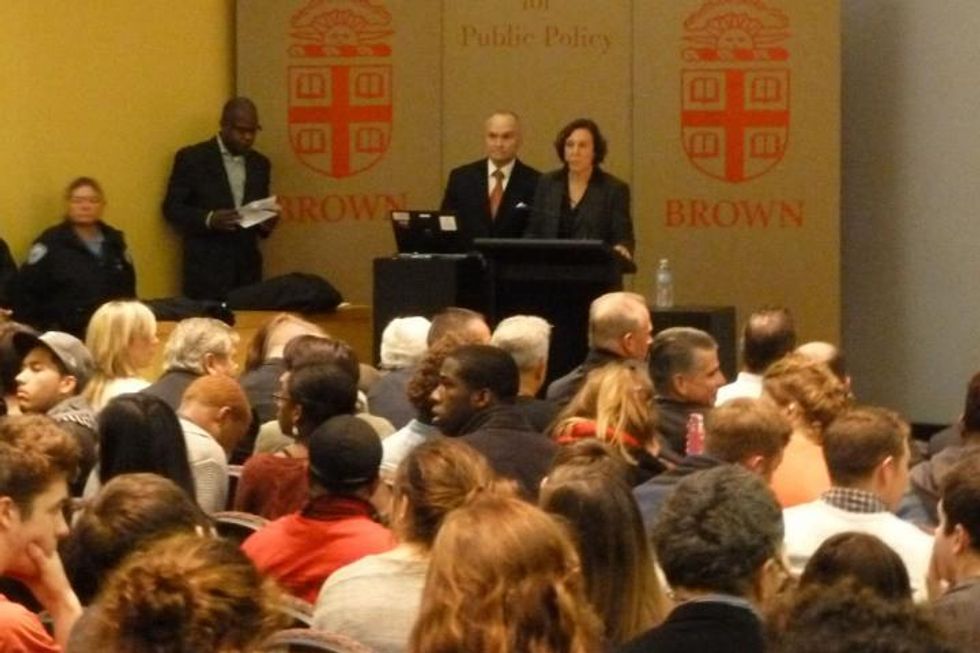
New York Police Commissioner Ray Kelly was booed and heckled so vigorously at a Tuesday speaking engagement at Brown University that he was forced off the stage.
Kelly, known for implementing and vigorously defending the stop-and-frisk policies of the NYPD, was slated to give a talk for Brown's Taubman Center for Public Policy and American Institutions entitled "Proactive Policing in America's Biggest City." Students say there's nothing redeeming about the city's widely criticized stop-and-frisk program, which was ruled unconstitutional by a federal court earlier this year for codifying and worsening already-rampant racial profiling by the NYPD.
Over 100 students showed up to declare that they do not approve of their school being used as a platform for Kelly's ideas, and from the moment the speech began protesters filled the lecture hall with shouts and chants.
"You are the terrorist, terrorizing our people," one person shouted, according to Twitter reports.
When an administrator asked attendees to reserve comments for the question-and-answer session, the audience responded with cries of "Racism is not up for debate."
When the protests did not let up, the administration called off the talk and cleared out the lecture hall.
Brown students had previously circulated a petition demanding that the talk be canceled and Kelly's hefty honorarium instead be donated to non-profit organizations working against police brutality in New York City.
"We believe that allowing a platform for Commissioner Kelly to speak sends the resounding message that the Taubman Center, as well as Brown University, condones policies, such as Stop and Frisk, that are proven to be harmful and unconstitutional," the petition reads.
The university refused to meet the students' demands.
Jenny Li, a Brown student who helped organize the protest, told the Huffington Post, "[W]e decided to cancel it for them."
Video footage captured the scene that unfolded:
Ray Kelly at Brown University - WPRONYPD's Ray Kelly shouted down at Brown University. Video by WPRO's Steve Klamkin; News Talk 630 and 99.7 FM WPRO.
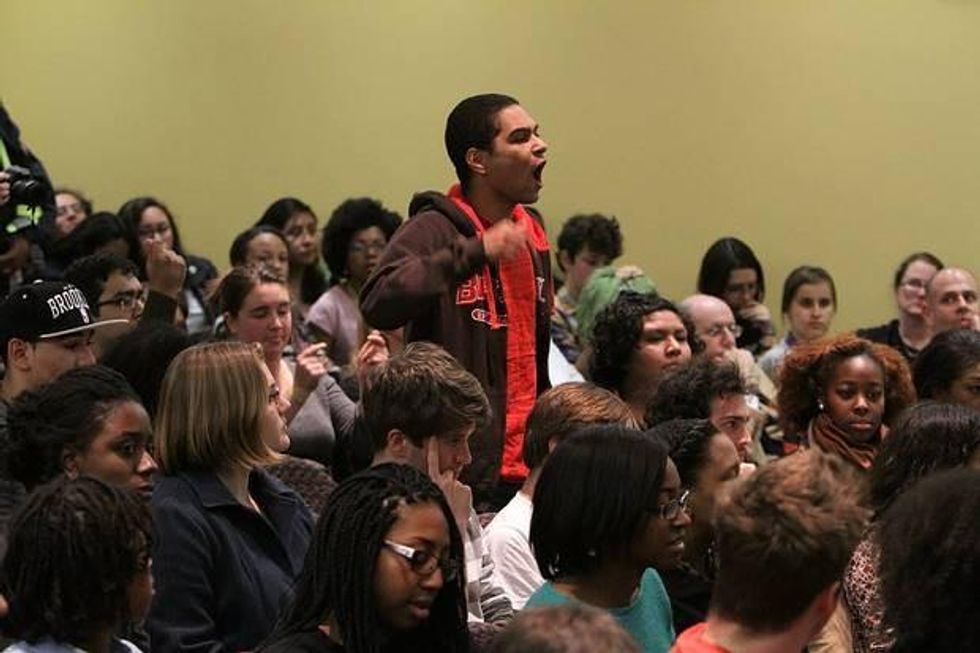
A member of the audience is pictured speaking out against NYPD Commissioner Ray Kelly:
Police sent infiltrators and agent provocateurs into crowds of protesters in Rio de Janeiro Monday--the first day of the Pope's visit to Brazil-- as extensive video footage and witness testimony strongly suggests.
One of the two suspected infiltrators captured on film may have thrown the Molotov cocktail that was used as pretext for police to charge on hundreds of demonstrators with water cannons, tear gas, and rubber bullets and attack protesters and journalists alike with blunt force objects.
Military police released a video shortly after the police crackdown, allegedly showing that the repression was a direct response to protesters' violence. Yet, the video was mysteriously removed when photo and video evidence emerged suggesting that the person pictured throwing the Molotov cocktail, and his associate, were police officers.
The Lede blog of the New York Times compiles extensive video evidence from journalists and demonstrators that suggests the presence of at least two police infiltrators.
One clip, recorded by a witness, shows, "the two men were briefly stopped by a uniformed officer who seemed to take them for protesters before one of them pulled out some form of identification and said, "It's the police, dude."" the Lede reports. The footage can be seen here:
FLAGRANTE: Policiais infiltrados são confundidos com manifestantes pela PMERJPoliciais infiltrados (P2) causam tumulto ao passar pelo meio da própria polícia militar, não sendo previamente reconhecidos ...
While the Lede says there is "little doubt" that video evidence shows at least two infiltrators, it claims there is insufficient evidence to prove that the Molotov cocktail was thrown by one of them. However, Brazilian activists compiled evidence they say shows that the Molotov thrower was an agent provocateur, including an annotated video by a Brazilian blogger.
Police appeared to target journalists and videographers who were recording Monday's events, bludgeoning the head of an AFP photographer and arresting at least two journalists with the Midia Ninja media collective.
In an online statement, one of the Midia Ninja journalists who was arrested said that protesters rallied outside of the police station to support those on the inside, and the outpouring of solidarity left him "with the confidence that tomorrow will be greater."
Demonstrators were protesting the $53 million allocated towards funding the Pope's visit at a time when public services are being gutted and unemployment and poverty plaguing the country.
Mass mobilizations throughout Brazil--touched off by a March bus fare hike that swelled anger about diversion of public resources towards mass spectacles, like soccer matches and Pope visits, rather than vital services--have been met with severe police violence, and images of gas attacks on unarmed protesters have gone viral.
The tactic of sending police agent provocateurs into protests and communities to justify repression and violence is employed by police departments across the world, and is prevalent in the US.