SUBSCRIBE TO OUR FREE NEWSLETTER
Daily news & progressive opinion—funded by the people, not the corporations—delivered straight to your inbox.
5
#000000
#FFFFFF
To donate by check, phone, or other method, see our More Ways to Give page.
The technology comes from a company called Persistent Surveillance Systems. Its president, Ross McNutt, developed a similar tool for the Pentagon while working for the U.S. Air Force in 2006. Over time, he modified the technology for commercial use. McNutt eventually pitched the service to the BPD after his company had faltered in finding a department for a long-term contract. He opened his office in Baltimore in January, above a parking garage, denoted only by a piece of paper taped to his door that reads, "Community Support Program."
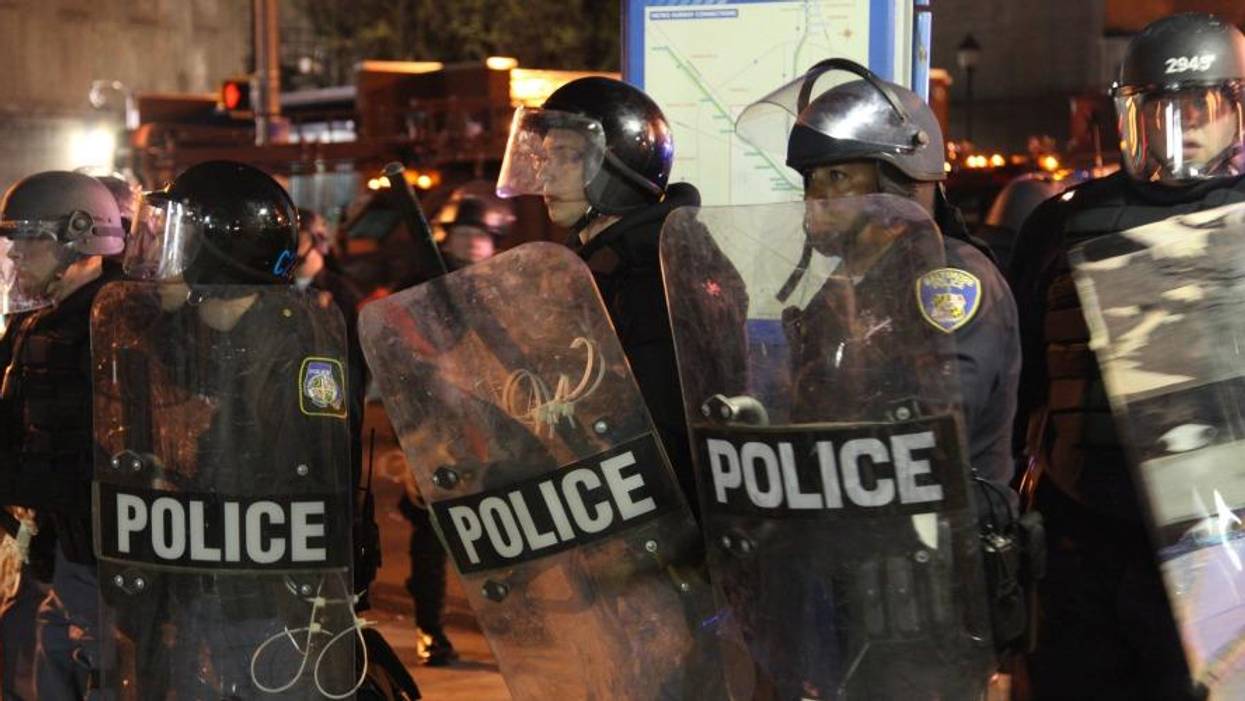
The Cessna used for the surveillance project circled overhead crowds of protesters chanting for justice after the death of 25-year-old black Baltimore resident Freddie Gray, whose spine was severed in police custody, on the day the verdict came in not guilty for Caesar Goodson--the only officer involved in Gray's death facing a murder charge.
Reel described the day of June 23, when it became clear that a protest over Goodson's verdict would not break out: McNutt became "frustrated," Reel wrote. "He wanted to please the cops."

The BPD became the first police department to contract with McNutt, but it was not the first to test drive the technology. The Los Angeles County Sheriff's office approved a nine-day trial run in 2012 in Compton, California, a majority-black city near Los Angeles, but would not sign a contract over concerns about image quality. The secret program led to outcry from residents, as well as the mayor, when they finally found out about their constant surveillance--a year later.
"There is nothing worse than believing you are being observed by a third party unnecessarily," Compton Mayor Aja Brown told the Los Angeles Times in 2014.
After Compton came Dayton, Ohio, as McNutt improved the technology. Finally, Bloomberg reports, there was Baltimore:
[In 2015] McNutt got an e-mail on behalf of Texas-based philanthropists Laura and John Arnold. John is a former Enron trader whose hedge fund, Centaurus Advisors, made billions before he retired in 2012. Since then, the Arnolds have funded a variety of hot-button causes, including advocating for public pension rollbacks and charter schools. The Arnolds told McNutt that if he could find a city that would allow the company to fly for several months, they would donate the money to keep the plane in the air. McNutt had met the lieutenant in charge of Baltimore's ground-based camera system on the trade-show circuit, and they'd become friendly. "We settled in on Baltimore because it was ready, it was willing, and it was just post-Freddie Gray," McNutt says. The Arnolds donated the money to the Baltimore Community Foundation, a nonprofit that administers donations to a wide range of local civic causes.
Reel's revelations come as the city is already grappling with a damning report from the U.S. Department of Justice (DOJ) which found "systemic deficiencies" at the BPD that included explicitly discriminatory directives, such as orders to "arrest all the black hoodies" in a certain neighborhood, and a pattern of targeting black and minority residents for unwarranted stops and searches.
And just a week ago, a coalition of civil rights groups filed a complaint with the Federal Communications Commission (FCC) that said the BPD's unlicensed use of a different surveillance technology known as the Stingray, which tricks mobile devices into connecting with it by mimicking a cell phone tower, is racially discriminatory and willfully impedes emergency calls.
Despite all this, according to Reel, the rest of the city, from officials to residents, was not even aware that they were being spied on from the air.
Reel concludes: "McNutt says he's sure his system can withstand a public unveiling and that the more people know about what his cameras can--and can't--do, the fewer worries they'll have. But the police ultimately decide who and what should be tracked. In a city that's struggled to convince residents that its police can be trusted, the arguments are now Baltimore's to make."
According to flight logs, evidence logs, and internal memos, the FBI helped local law enforcement watch protests between April 29 and May 3 by making 10 flights over the area, comprising a total of 36.2 hours.
In a blog post on Friday, ACLU staff attorney Nathan Freed Wessler acknowledged that "in its Domestic Investigations and Operations Guide, the FBI takes the position that no Fourth Amendment protections apply to 'aerial surveillance conducted from navigable airspace'."
However, Wessler argued, "While that is an accurate statement of Supreme Court precedent when it comes to visual observation and use of normal cameras from a plane, it fails to grapple with the effect of advances in surveillance technology."
"Use of infrared and night-vision camera technology changes the equation by raising the potential for invasions of privacy," he continued. "The capabilities of the surveillance gear matter. If the infrared camera is capable of observing information about the inside of private homes and offices, for example, the Supreme Court has already explained that the Fourth Amendment's warrant requirement applies."
Friday's revelations raise additional questions about what kind of surveillance equipment the FBI was using, what data the agency gathered and saved, with whom that information is being shared, and "whether aerial surveillance has the effect of chilling First Amendment-protected speech and assembly," said Wessler, who works with the ACLU's Speech, Privacy & Technology Project.
"It also raises concerns about whether the intelligence gathered could lead to racial profiling of the protesters, who were predominantly people of color," he added.
As Ars Technica pointed out:
The records show that the FBI not only provided live video intelligence to the Baltimore police, but also collected and saved high-resolution video footage of hundreds of people participating in protests on the streets of Baltimore--footage that may be used in the future to build profiles on those people.
FBI Director James Comey told a U.S. House Judiciary Committee hearing last week that the agency also used its aircraft above Ferguson, Missouri, last year to help local law enforcement keep track of unrest on the ground.
"There undoubtedly are times when aerial surveillance is an appropriate law enforcement tool for public safety or investigative purposes," wrote Wessler.
"But it is essential that accurate information about such surveillance be available to the public, and that strict rules be in place to protect against unjustified mass surveillance or warrantless collection of private information," he said. "As the government's technological capabilities improve, we must ensure that old legal rules from the pre-digital era are not blindly applied to newer and more powerful forms of digital surveillance."