

SUBSCRIBE TO OUR FREE NEWSLETTER
Daily news & progressive opinion—funded by the people, not the corporations—delivered straight to your inbox.
5
#000000
#FFFFFF
To donate by check, phone, or other method, see our More Ways to Give page.
Daily news & progressive opinion—funded by the people, not the corporations—delivered straight to your inbox.
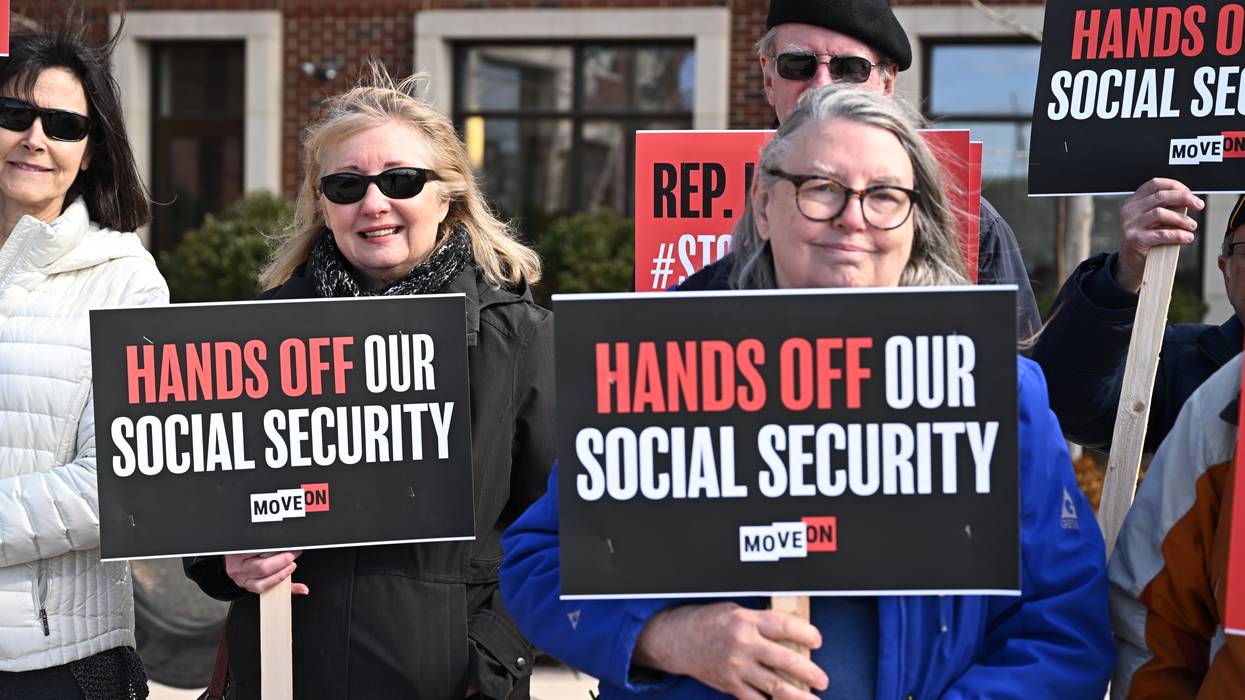
"He is dusting off the old Republican playbook and bringing back the strategy known informally as 'Starve the Beast,'" said one advocate. "In this case, Social Security is the beast."
Amid new reporting that former U.S. President Donald Trump's economic advisers are urging him to cut the federal payroll tax, a key revenue source for Social Security and Medicare, advocates on Thursday urged voters to remember that the presumptive Republican presidential nominee has long threatened to do just that.
"Don't be fooled," said Nancy Altman, president of Social Security Works, which lobbies to strengthen the social safety net for retired Americans. "At the end of his term in office, Trump delayed Social Security's dedicated revenue paid from workers and their employers. He was quite explicit that, if reelected, he would convert that delay into a permanent cut."
Altman was referring to an executive order Trump signed in August 2020, allowing companies to delay payroll tax payments—an option most companies declined to take as the Treasury Department made clear they would have to pay all of the deferred taxes the following year and that employees would see smaller paychecks as a result of the program.
Trump promised to make the payroll tax cut permanent, and as Reuters reported late Wednesday, the former president is discussing the proposal with economic advisers including Fox News host and former National Economic Council Director Larry Kudlow and right-wing commentator Stephen Moore.
The former president is weighing cuts to Social Security's revenue stream even as Republicans complain that the popular program is unaffordable and push to raise the retirement age to delay Americans' use of the funds.
The GOP has long claimed Social Security is headed toward insolvency and pushed to privatize the program or cut benefits, but last year's Social Security trustees report found that the program's trust fund currently has a $2.85 trillion surplus and could pay 80% of benefits for the next 75 years even if Congress takes no action to expand it—as long as it continues to be funded through taxes.
"Social Security can only pay benefits if it has sufficient dedicated revenue to pay its costs. That is why it doesn't contribute even a penny to the deficit," said Altman. "If Trump succeeds in slashing that dedicated revenue so that it is no longer sufficient to fully cover the cost, it will result in an automatic benefit reduction. This would happen without any Republicans having to vote for the cuts, or Trump having to sign them into law."
"He is dusting off the old Republican playbook and bringing back the strategy known informally as 'Starve the Beast,'" said Altman of Trump. "In this case, Social Security is the beast."
Along with cutting payroll taxes, which are paid by workers and employees and amount to 7.65% of each employee's gross pay in order to fund senior citizens' post-retirement income, Trump has proposed extending the 2017 Tax Cuts and Jobs Act, the vast majority of which benefited the wealthiest Americans, according to the Economic Policy Institute and the Center for Popular Democracy.
Altman noted the contrast between Trump's tax proposals and those of President Joe Biden, who has proposed strengthening Social Security and extending its solvency by requiring people with wealth over $100 million to pay at least 25% in income taxes, raising the corporate tax rate to 28%, and quadrupling the stock buyback tax to disincentive companies lavishing their shareholders with their profits instead of investing in their workforce.
"The choice this election is clear: Trump and the Republicans will cut Social Security and give tax breaks to millionaires and billionaires," said Altman. "The Democrats will expand Social Security, paid for by requiring millionaires and billionaires to pay their fair share."

"Ninety-four percent of Americans contribute to Social Security all year long, but the wealthy stop paying after their first $168,600 in wage income."
Most Americans contribute to Social Security year-round, but U.S. millionaires will stop paying into the critical program on March 2—just over two months into 2024.
That's because Social Security's payroll tax doesn't apply to earned income above a certain level. For 2024, the cut-off is $168,600, and capital gains—such as stock appreciation—are not subject to the payroll levy at all. Elon Musk, the CEO of Tesla and the world's richest man, pays nothing into Social Security because he doesn't take a salary.
Emma Curchin, domestic outreach and research assistant at the Center for Economic and Policy Research (CEPR), noted Thursday that with the $168,600 payroll tax cap in place, a millionaire's effective Social Security tax rate "is less than 1%."
"This is compared to the 6.2% that any worker making less than $168,600 pays," Curchin wrote. "The burden of paying for Social Security rests on working class people in this country."
CEPR on Thursday released a calculator that allows users to see when people with certain annual incomes stop contributing to Social Security, which keeps more people out of poverty in the U.S. than any other program.
The calculator shows that a CEO with a $20 million annual salary stopped paying into Social Security just three days into 2024—and contributed just as much to the program for the year as someone who makes $168,600.
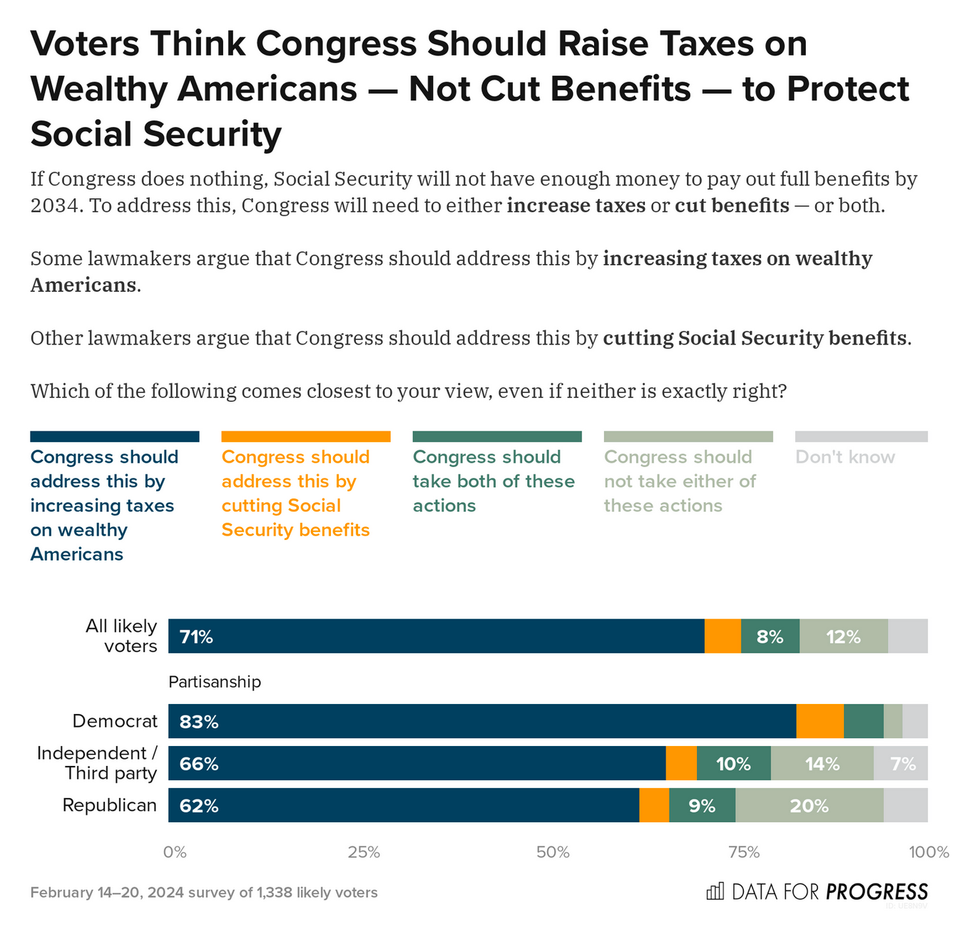
The tool was released as a new survey by Data for Progress showed that 71% of likely U.S. voters want Congress to guarantee Social Security's solvency "by increasing taxes on wealthy Americans" rather than by cutting benefits.
Progressive lawmakers have long supported lifting the Social Security payroll tax cap to force rich Americans to contribute more to the program.
Rep. John Larson's (D-Conn.) Social Security 2100 Act, for example, would expand the program's benefits by applying the payroll tax to annual earnings above $400,000.
"Ninety-four percent of Americans contribute to Social Security all year long, but the wealthy stop paying after their first $168,600 in wage income, and they don't pay in at all on their unearned investment income," Larson and Social Security Works president Nancy Altman wrote in an op-ed for Data for Progress on Thursday.
"The best part about the Social Security 2100 Act? There's no need for a closed-door commission to pass it into law, because it's what the American people want to do," they added.

"It is not enough to point out the reactionary, anti-worker vision of the Republican Party," the democratic socialist senator stressed. "We have to present a positive, pro-worker alternative."
In a previously unreported discussion, U.S. Sen. Bernie Sanders urged President Joe Biden to ensure Social Security is fully funded through the end of the century by increasing taxes on wealthier Americans, according to a report published Thursday.
During the hourlong meeting on January 25—which took place before Biden and Sanders (I-Vt.) shot a video together about student debt—the democratic socialist senator pushed the president to expand payroll taxes on high-income Americans, The Washington Post reports. Currently, only the first $160,000 in earnings is subject to payroll tax.
Sanders reportedly asked Biden to support his plan—which is highly unlikely to gain congressional approval—to expand Social Security benefits by $2,400 annually for each recipient. Biden was noncommittal, according to the senator.
"Extending the solvency of Social Security for 75 years and increasing benefits should be a no-brainer."
Earlier this month, Sanders and Sen. Elizabeth Warren (D-Mass.) unveiled legislation, with a similar bill introduced in the House, to increase Social Security benefits by at least $200 per month.
"It is not enough to point out the reactionary, anti-worker vision of the Republican Party. We have to present a positive, pro-worker alternative," Sanders said. "The truth is that Social Security does have a solvency problem, and we have got to address that."
As the Post's Jeff Stein wrote:
Biden has for weeks leaned into the simple message that he is determined to block GOP efforts to cut Social Security and Medicare for millions of seniors. Left unanswered in these attacks is what Biden, himself, wants to do to address the massive funding shortfalls facing the programs, which face catastrophic benefit reductions within a decade if lawmakers take no action.
"Extending the solvency of Social Security for 75 years and increasing benefits should be a no-brainer," tweeted Stephanie Quilao, a California-based vegan climate activist and 2016 Sanders delegate. "It's an issue that most Americans agree with across the political spectrum. Scrap the cap only impacts the very wealthy, no one in the working class."
The advocacy group Social Security Works noted that "President Biden has pledged to protect Social Security and veto any legislation that cuts the program."
"That's a great first step," the group argued. "Now, he should release a plan to expand benefits."
The economic justice group Patriotic Millionaires wrote on Twitter that "Sen. Sanders is right—it's essential that Biden take a firm stand in support of Social Security, especially if that distinguishes Democrats from the GOP."
"Our seniors deserve a comfortable retirement," the group added, "and the GOP is not their friend."
Meanwhile, Republicans—despite howling protestations to the contrary—keep signaling their openness to slashing Social Security. Earlier this week, former Vice President Mike Pence, a potential 2024 GOP presidential hopeful, appeared on MSNBC and said that "we all know where the real issue is in terms of long-term debt for the United States."
"I respect the speaker's commitment to take Social Security and Medicare off the table for the debt ceiling negotiations," said Pence, referring to House Speaker Kevin McCarthy's (R-Calif.) spot pledge to preserve the crucial social programs during Biden's State of the Union address, "[but] we've got to put them on the table in the long term."
In an opinion piece published by Common Dreams on Thursday, Social Security Works president Nancy Altman asserted that "poll after poll shows that such a potential Biden expansion plan would be extremely popular."
"Because Social Security is so important, painting the contrast—Democrats want to expand Social Security, Republicans want to cut it—is a much more powerful message than simply attacking Republicans, polling reveals," she continued.
"If the debate over cutting or expanding Social Security is a major issue in 2024, Democrats will be in a strong position to retain the White House and the Senate, while retaking the House," Altman added. "They will then be able to hold votes on Social Security—in the sunshine, not behind closed doors."
Few political advisers would suggest running on a platform of open hostility toward the elderly. Most families include an older person, after all, and everyone who lives long enough will become older themselves someday.
Seniors vote in greater numbers, too.
That may be why the GOP isn't openly presenting itself as the anti-elderly party. But how else are we to interpret its deeds and actions? Its leading presidential candidates are pushing cuts to Social Security, while its congressional budgets would end Medicare as we know it.
Most older Americans would lose out under these proposals. But billionaires would make out very well indeed.
Wisconsin Governor Scott Walker became the latest Republican to jump on the anti-Social Security bandwagon this week, and he did so in a somewhat inartful way: by suggesting that benefits cuts should be applied to anybody born later than ... Scott Walker.
"We'll talk about reform," Walker said, "but only for those -- I was born on November 2, 1967 -- for anybody older than me, we're not touching Social Security."
("Reform," in case you haven't noticed, is a euphemism some people are fond of using when discussing Social Security or Medicare. It means "cuts.")
Walker foreshadowed his anti-Social Security stance back in April, when he deployed some standard-issue fearmongering in a comment to Talking Points Memo. "Absent significant reforms," said Walker, "these programs will go bankrupt and the people who have paid into them will be left out in the cold."
Here's the reality: Congress could address any long-term funding issues by lifting the current cap on the payroll tax that funds Social Security. That cap exempts all annual income above $118,500 - including that of millionaires and billionaires.
Why wouldn't Republicans even mention such a simple solution? Perhaps it's because so many of their financial backers are millionaires and billionaires - most of whom, unsurprisingly, dislike it.
Most of the GOP candidates have tried to present their Social Security cuts in the most palatable and least obvious way possible: as an increase in the retirement age. But, as the Center for Economic Policy and Research has noted, boosting the retirement age is a benefit cut, no matter how it's spun.
So far, only Mike Huckabee has said he opposes Social Security cuts. As for the other candidates:
* Sen. Ted Cruz has called Social Security a "Ponzi scheme," proposing an increase in the retirement age and other types of benefit cuts. He also wants to privatize the program, as George W. Bush and his fellow Republicans attempted to do in 2005.
* Sen. Marco Rubio agrees that it would be a good idea to raise the retirement age and impose other cuts, saying that younger generations must accept that "that our Social Security and our Medicare is still going to be the best in the world, but it's going to look different than our parents' Social Security and their Medicare."
About that "best in the world" part: It isn't true. Social Security's benefits are already close to the bottom when compared to those of other developed countries, and will fare even worse if the Republicans' cuts are imposed.
* Jeb Bush also says he wants to push the retirement age back to 69 or 70 (while displaying a woeful lack of knowledge about the current retirement age).
* Chris Christie has proposed increasing the minimum retirement age as well - from 62 to 64. Christie's plan would reduce Social Security benefits for seniors making more than $80,000 per year and eliminate them altogether for those who make more than $200,000 per year.
That may sound like fair play, or even like populism. It's neither. Eliminating Social Security benefits would barely affect millionaires' or billionaires' overall income after retirement, and wouldn't affect it at all beforehand. And the savings would be miniscule. Christie's proposal is nothing more than sleight of hand, meant to distract us from a better alternative: asking the wealthy to pay the same percentage in payroll taxes as other Americans.
Then there's Medicare. The Republican House has repeatedly approved budgets that would cut Medicare's budget and replace it with a voucher system for purchasing private insurance. That would impose severe financial hardship on the average enrollee.
There are alternatives to Medicare cuts. We can reduce the perverse incentives of the profit motive in U.S. healthcare, for example, and allow Medicare to negotiate prices with Big Pharma. But here, too, the Republicans ignore the best solutions.
There's a through-line between the GOP's embrace of Social Security cuts and its attempts to cut and privatize Medicare. In both cases, benefit reductions are being offered to distract voters from a simpler and fairer approach. And in both cases, private interests would profit: Wall Street would have more retirement income to manage (for a costly fee), and health insurers would receive a flood of new customers.
Both moves would cost retirees dearly, at a time when they can least afford it. A new report from the U.S. General Accounting Office (GAO), conducted at the request of Sen. Bernie Sanders, found that "about half of households age 55 and older have no retirement savings and that "many older households without retirement savings have few other resources, such as a defined benefit (DB) plan or nonretirement savings, to draw on in retirement.
This retirement crisis comes after decades of wealth shifting from the middle class to the wealthy. Wage stagnation has left many Americans living from paycheck to paycheck and unable to save. At the same time, large employers have cut back on traditional pension plans. As a result, the GAO finds that "Social Security provides most of the income for about half of households age 65 and older."
Many Americans are already facing a retirement crisis. Social Security compares poorly to similar programs in most developed countries. And yet Republicans want to cut its benefits, while at the same time increasing out-of-pocket medical costs for seniors. They want to protect high earners and help corporations at the expense of ordinary retired people.
That's the anti-elderly, pro-wealth agenda of today's Republican Party.