

SUBSCRIBE TO OUR FREE NEWSLETTER
Daily news & progressive opinion—funded by the people, not the corporations—delivered straight to your inbox.
5
#000000
#FFFFFF
To donate by check, phone, or other method, see our More Ways to Give page.

Daily news & progressive opinion—funded by the people, not the corporations—delivered straight to your inbox.
"It put its students first and preserved the social fabric of its university life," said Amnesty International USA. "We hope other universities will follow suit."
The Massachusetts Institute of Technology on Friday became the first university to reject President Donald Trump's "Compact for Academic Excellence in Higher Education," which critics have called an "extortion" agreement for federal funding.
MIT and eight other schools—the University of Arizona, Brown University, Dartmouth College, the University of Pennsylvania, the University of Southern California, the University of Texas, Vanderbilt University, and the University of Virginia—were invited to sign the pledge earlier this month.
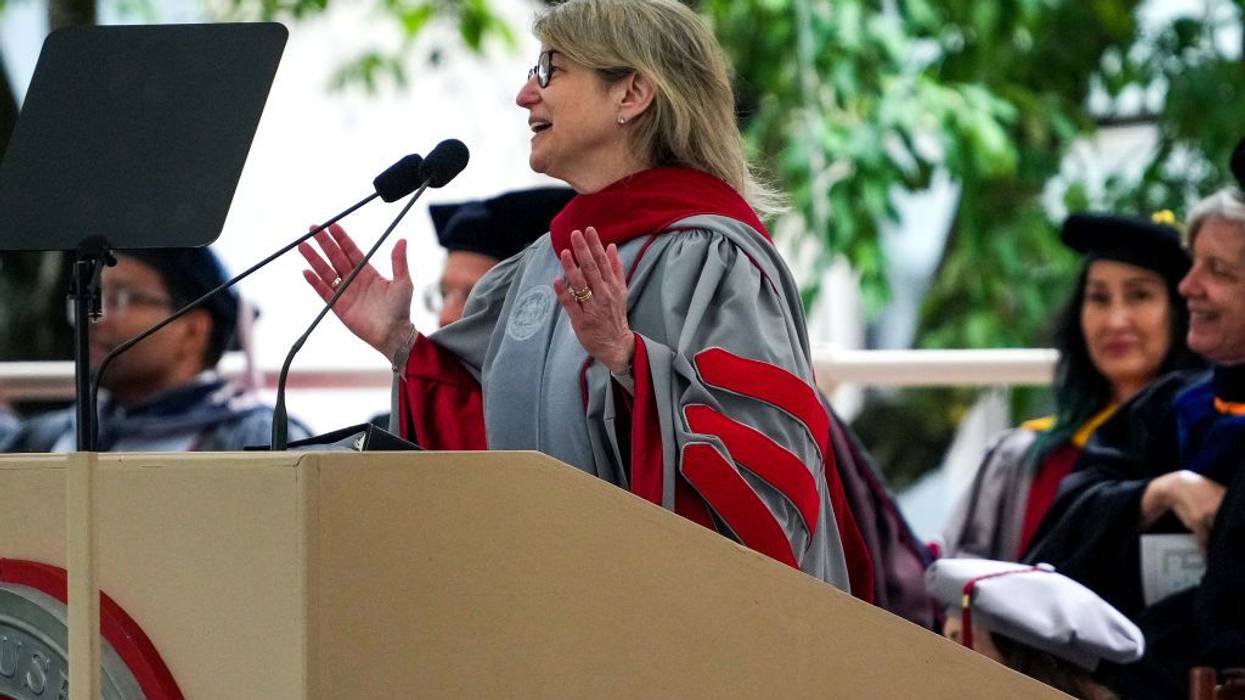
Sally Kornbluth, MIT's president, met with US Education Secretary Linda McMahon earlier this year and on Friday published her response to the administration's letter on the school's website.
"The institute's mission of service to the nation directs us to advance knowledge, educate students, and bring knowledge to bear on the world's great challenges. We do that in line with a clear set of values, with excellence above all," Kornbluth wrote. MIT "prides itself on rewarding merit" and "opens its doors to the most talented students," and "we value free expression."
Kornbluth continued
These values and other MIT practices meet or exceed many standards outlined in the document you sent. We freely choose these values because they're right, and we live by them because they support our mission—work of immense value to the prosperity, competitiveness, health, and security of the United States. And of course, MIT abides by the law.
The document also includes principles with which we disagree, including those that would restrict freedom of expression and our independence as an institution. And fundamentally, the premise of the document is inconsistent with our core belief that scientific funding should be based on scientific merit alone.
In our view, America’s leadership in science and innovation depends on independent thinking and open competition for excellence. In that free marketplace of ideas, the people of MIT gladly compete with the very best, without preferences. Therefore, with respect, we cannot support the proposed approach to addressing the issues facing higher education.
"As you know, MIT's record of service to the nation is long and enduring," she concluded. "Eight decades ago, MIT leaders helped invent a scientific partnership between America's research universities and the US government that has delivered extraordinary benefits for the American people. We continue to believe in the power of this partnership to serve the nation."
The decision to reject the compact was praised by current members of the university community, alumni, and others—including Amnesty International USA, which said on social media: "We commend MIT in its decision to reject President Trump's proposed 'compact.' In refusing to cave to political pressures, MIT has upheld the very ideals higher education is built on—freedom of thought, expression, and discourse."
"The federal government must not infringe on what students can read, discuss, and learn in school," the human rights group continued. "It is a violation of their academic freedom. MIT did the right thing: It put its students first and preserved the social fabric of its university life. We hope other universities will follow suit."
MIT's response to the Trump admin's proposed "compact" is excellent and should be a model for other universities. orgchart.mit.edu/letters/rega...
[image or embed]
— Jameel Jaffer (@jameeljaffer.bsky.social) October 10, 2025 at 10:14 AM
American Association of University Professors president Todd Wolfson similarly said in a statement to The New York Times that "the ability to teach and study freely is the bedrock of American higher education."
"We applaud MIT for standing up for academic freedom and institutional autonomy rejecting Trump's 'loyalty oath' compact," he added. "We urge all institutions targeted by the administration’s bribery attempt to do the same."
According to the Boston Globe:
MIT faculty are "relieved" by the school's position, said Ariel White, a political science professor and vice president of MIT's American Association of University Professors chapter. But they expect to see Trump employ his whole-of-government approach against the university in response.
"This offer looked like an invitation, but it wasn't," she said. "It was a ransom note. Now there is some risk that we will face reprisal."
What form that reprisal could take is not immediately clear. But White House spokesperson Liz Huston said Friday that "any university that refuses this once-in-a-lifetime opportunity to transform higher education isn't serving students or their parents—they’re bowing to radical, left-wing bureaucrats."
"The truth is, the best science can't thrive in institutions that have abandoned merit, free inquiry, and the pursuit of truth,” Huston's statement continued. "President Trump encourages universities to join us in restoring academic excellence and commonsense policies."
As Common Dreams reported earlier this week, campus activist groups at various schools are organizing against Trump's proposed compact, and the national legal organization Democracy Forward launched an investigation into the effort to strong-arm universities—which is part of a broader agenda targeting any entities or individuals not aligned with the administration.
Last month, 94% of new vehicles sold in the oil-producing nation were electric.
In what's believed to be a global milestone, electric vehicles now outnumber gasoline-fueled automobiles on Norway's roads, as the overwhelming bulk of new cars sold in recent months have been battery-powered.
Norway's Road Information Council (OFV) said Tuesday that electric vehicles (EVs) made up 754,303, or 26.6%, of the 2.8 million passenger automobiles registered in the Nordic nation. That's slightly more than the 753,905 registered gasoline-powered vehicles, but far fewer than the 999,715 diesel-burning ones.
Last month, a record 94.3% of all new vehicles sold in Norway were EVs, with Tesla's Model Y as the top seller.
"This is historic. A milestone few saw coming 10 years ago," said OFV director Øyvind Solberg Thorsen. "The electrification of the passenger car fleet is keeping a high pace, and Norway is making rapid strides towards becoming the first country in the world with a passenger car fleet dominated by electric cars."
"But it will take some time before we get there, because there are still 1 million registered passenger cars with diesel engines in the country," Thorsen noted. "The pace we are seeing in the replacement of the passenger car fleet now may indicate that in 2026 we will also have more electric cars than diesel cars."
According to OFV, there could be as many as 3.1 million EVs registered in Norway by the end of the decade.
"The rate of change in the passenger car units is difficult to predict," Thorsen cautioned. "Economic fluctuations in relation to car taxes, prices, interest rates, and other factors affect new car sales—both for private individuals and companies. And tax changes have a big impact on which cars we choose."
Norway—which is ironically Europe's second-largest oil producer—incentivizes EV purchases with generous tax rebates.
In stark contrast with Norway, electric car sales have been lagging in most of the rest of Europe, where EVs make up just 12.3% of new cars sold, according to The Guardian.
Experts say that in order for countries to fulfill their obligations under the Paris climate agreement, zero-emission vehicles—which include EVs and hydrogen-powered automobiles—must account for around 40% of the global car and light truck fleet by 2030.
Researchers at the Massachusetts Institute of Technology's Joint Program on the Science and Policy of Global Change and MIT Energy Initiative forecast in 2021 that the global EV fleet will grow from just over 10 million to 95-105 million by 2030, and 585-823 million by 2050.
"Fossil fuel companies have embedded themselves in universities across the U.S., U.K., Canada, Australia, and beyond."
The fossil fuel industry seeks to obstruct climate action by using money to influence research and establish ties at Western universities, raising concerns about academic independence and the integrity of scientific inquiry, according to a study published Thursday.
The study, published in the peer-reviewed journal WIREs Climate Change, was authored by researchers at six universities who conducted the first-ever literature review of academic papers and civil society investigations into Big Oil's links to higher education.
"We find that universities are an established yet under-researched vehicle of climate obstruction by the fossil fuel industry," the authors wrote.
"Fossil fuel companies have embedded themselves in universities across the U.S., U.K., Canada, Australia, and beyond," they concluded.
"Everything that's been done so far by researchers on this indicates an emerging consensus... that this is a really serious and significant problem that needs to be taken a lot more seriously," Geoffrey Supran, director of the Climate Accountability Lab at the University of Miami and a co-author of the review, told Financial Times.
Jennie Stephens, a professor at the ICARUS Climate Research Center at Maynooth University in Ireland who also co-authored the study, told DeSmog that "when you pull it all together, you realize how pervasive a strategy this has been."
"The science has been telling us that fossil fuel phaseout is the number one thing that we need to focus on, but within our universities, there's very little research on how to do fossil fuel phaseout," Stephens told The Guardian. "This provides some explanation for why society has been so ineffective and inadequate in our responses to the climate crisis."
NEW: In @WIREs_Reviews today, our latest peer-reviewed research shows fossil fuel companies have systematically infiltrated academia, threatening to bias research and undermine meaningful climate action. THREAD.
📰Open access: https://t.co/S2Kzaq6HGt
— Geoffrey Supran (@GeoffreySupran) September 5, 2024
Research on the links between Big Oil and universities in the U.S., U.K., Canada, and Australia has indeed been limited. The authors could only find 14 peer-reviewed papers and 21 civil society reports published in English between 2003 and 2023.
The studies they did find document the strong influence of the industry on institutions of higher education. They cite a number of examples, many of which are from elite universities. BP contributed between $2.1 million and $2.6 million to Princeton University's Carbon Mitigation Initiative between 2012 and 2017 and remains a sponsor. In 2017, a public relations firm working with BP wrote in an internal memo that partnership with Princeton was a way of "authenticating BP's commitment to low carbon."
An influential 2011 study by industry-linked researchers at the Massachusetts Institute of Technology's Energy Initiative helped persuade policymakers that natural gas was a helpful "bridge" fuel—which effectively became Obama administration policy. Lead author Ernest Moniz became the U.S. Secretary of Energy in 2013.
These outcomes indicated the success of an industry strategy to influence university research and debate. A leaked 1998 internal memo from American Petroleum Institute, a lobby group, the subject matter of which was "build[ing] a case against precipitous action on climate change," recommended fostering "cooperative relationships with all major scientists whose research in this field supports our position."
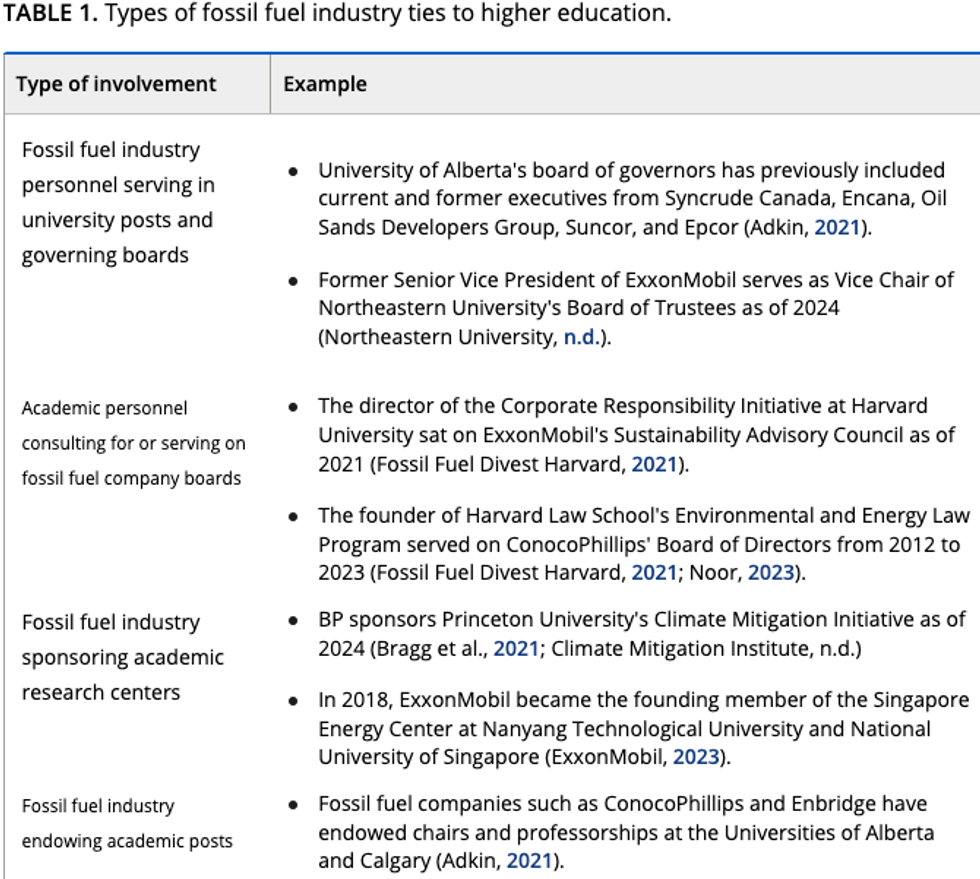
Fossil fuel industry influence hasn't been studied nearly as thoroughly as other potential conflicts of interest or sources of bias in the research process, the authors wrote. Their literature review found that many academics had drawn comparisons to tobacco and pharmaceutical meddling in academia. They wrote:
The studies reviewed here revealed parallels between fossil fuel industry strategies and those of industries like tobacco and pharmaceuticals. For example, fossil fuel companies have supported research that had commercial applications (e.g., hydraulic fracturing) or was otherwise favorable to their legal and policy positions (e.g., anti-punitive-damages law review articles)... Previous [conflict of interest] research has noted how the pharmaceutical industry stands out for arguing that it produces beneficial products, whereas industries like tobacco and lead seek to minimize the apparent harms of their products. The fossil fuel industry today appears to do both, and notably positions itself as an innovator of purportedly beneficial climate solutions, such as natural gas and carbon capture and storage.
The authors of the review also drew attention to universities' opacity in dealings with Big Oil, writing that there's a "widespread lack of transparency on funding ties, amounts, and contract details."
They wrote that, though academics have not devoted much attention to industry influence on higher education, some activists and NGOs have long tried to raise the issue. Campaigners seconded that fact in responding to the study on Thursday.
"This literature review confirms what students in our movement have known for years," said Jake Lowe, executive director of Campus Climate Network, told The Guardian. "Big Oil has infiltrated academia in order to gain undue credibility and obstruct climate action."
Lowe's group is one of many that's calling for universities to "dissociate" from fossil fuel interests—a movement that Supran, the Miami professor, called "basically divestment 2.0."
The problem is by no means limited to English-speaking countries. An investigation by Investigate Europe and openDemocracy last year found that European universities are also rife with Big Oil influence.
"So many thousands of people have stories about how he has changed their lives," said one admirer. "He certainly changed mine."
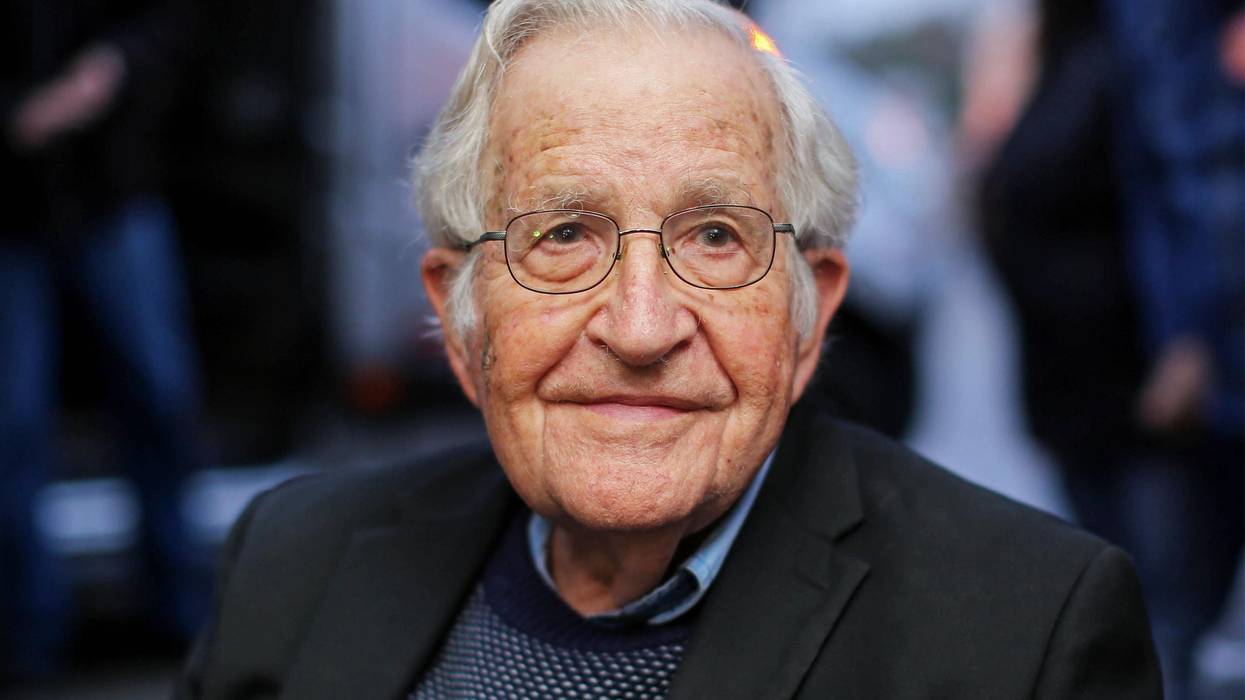
News that renowned American linguist, dissident, and author Noam Chomsky is hospitalized in Brazil following a massive stroke he suffered last year was met with an avalanche of accolades and well wishes from members of the international left on Wednesday.
Valeria Chomsky told The Associated Press that her 95-year-old husband—a laureate professor at the University of Arizona and professor emeritus at Massachusetts Institute of Technology (MIT)—is currently in a São Paulo hospital. She took him there on an ambulance jet with two nurses after he was able to travel from the United States following his June 2023 stroke.
Chomsky told Folha de São Paulo that although her husband has difficulty speaking and the right side of his body is numb from the stroke, he follows the news and "when he sees images of the war in Gaza, he raises his left arm in a gesture of lament and anger." She said his condition has improved significantly, and he is seeing a neurologist, speech therapist, and pulmonologist daily.
However, people close to Chomsky say he is unlikely to return to public life.
"Noam is the most influential U.S. intellectual ever. Period," Rutgers School of Communications Professor Andrew Kennis—whose book Digital Age Resistance contains a foreword co-authored by Chomsky—told Common Dreams.
"He has been the largest influence on my life in any way, personal or professional" Kennis added. "As for movements, no other thinker helped positively shape and mold anti-imperialsm analysis and criticism of the U.S. bullying the world on behalf of Wall Street and Silicon Valley better and more effectively than him."
"His work has defined the terms of countless debates and he's been a tireless advocate for—and guide on the path to—a better future."
U.S. journalist and political analyst Anand Giridharadas hailed Chomsky—whom he interviewed in 2020—as a "lion of the left."
"It would be difficult to overestimate the impact Chomsky's work has had," Giridharadas wrote for The.Ink Wednsday. "Beyond the total transformation of his academic field (he's widely acknowledged as the father of modern linguistics and the main force behind the cognitive turn in the sciences), his political impact has been immeasurable."
"As a writer, activist, analyst, and critic of power, and likely the most visible left public intellectual of the late 20th and early 21st centuries, his work has defined the terms of countless debates and he's been a tireless advocate for—and guide on the path to—a better future," he added.
Of the more than 100 books published by Chomsky—who was once voted the world's top public intellectual in an international poll—four are specifically about Israel and Palestine. He has been conspicuously absent from the debate over Israel's current assault on Gaza, which is the subject of an International Court of Justice genocide case.
Current Affairs founder and editor Nathan Robinson—who is the co-author of Chomsky's forthcoming book, The Myth of American Idealism: How U.S. Foreign Policy Endangers the World—said earlier this week on social media that "Chomsky has been unbelievably kind over the years I've known him."
"He treats everyone as an equal. Doesn't care who you are," he continued. "He would give as much of his time to a high school student as some celebrity or New York Times reporter. And devoted himself to attacking cruelty and injustice."
"When I started a tiny lefty magazine with only a few subscribers, he bought a subscription, blurbed us, and would email if his copy didn't show up," Robinson recalled. "He provided countless generous blurbs to authors publishing with tiny presses, giving them a boost that could really help them."
"So many thousands of people have stories about how he has changed their lives," he added. "He certainly changed mine."
Determined to stay "as long as it takes," students at the Massachusetts Institute of Technology on Thursday are staging a sit-in outside the president's office to demand that the university heed the call of thousands of its students and a presidential advisory committee by divesting from fossil fuels.
Sparking the direct action was a five-year climate action plan (pdf) issued Wednesday by MIT President L. Rafael Reif shuns divestment and stresses the need to "bring [the fossil fuel] industry closer."
| Tweets about #DivestMIT OR #ScientistsSitIn |
Referencing the announcement last week by CEOs of ten of the world's fossil fuel giants in support of the UN's climate goals, the plan states: "We believe we have greater power to build on such momentum not by distancing ourselves from fossil fuel companies, but by bringing them closer to us."
"The plan is too little, too late," PhD student Geoffrey Supran, a member of the president climate advisory committee and of the student group Fossil Free MIT, told Common Dreams. "When it comes to divestment, the president chooses to ignore all the voices calling for climate action and does the opposite and brings the industry closer," he said as he took part in the sit-in.
The sit-in is "really about bearing witness to the failure of leadership at MIT to respond to those specific calls," he said.
Those voices include over 3,500 MIT students who've signed a petition calling on President Reif to divest the university's holdings from the fossil fuel industry, as well as the support stated (pdf) in June by three-quarters of the president's climate advisory committee for divestment from companies engaged in coal and tar sands extraction.
"That's what we most urgently want to see," Supran continued. "The beginning of divestment from fossil fuel companies starting with coal and tar sands." He added that another main concern was to have MIT divest from climate change-denying corporations.
"Divestment from coal and tar sands is a no-brainer and would have unified rather than ostracized MIT's community," Supran explained in a media statement. "With $2.6 trillion of precedent--including at Stanford, Oxford, and UC--divestment from coal and tar sands is financially prudent, scientifically consistent, morally right, and politically effective."
MIT's ties to the industry are "tremendous," Supran said. Yet, as PhD student Jeremy Poindexter explained in a statement, "What have MIT's decades of inside access to fossil fuel interests gotten us? The answer is an industry that has lied about climate science, pours hundreds of millions of dollars every year into lobbying against renewables, and spends hundreds of billions of dollars pursuing a business model scientifically incompatible with holding back catastrophic climate change. And yet MIT has decided to continue investing more than half a billion dollars in this industry, undermining our own work."
The number of those taking part in the sit-in fluctuated between 8 and 12, Supran said, with one faculty member, philosophy professor Kieran Setiya, already joining in.
The action-- forced "because MIT has put money before morals and its students' futures"--was not taken lightly, as Supran said it definitely brought the engineers and scientists out of their comfort zone in the lab. However, after three years of failed negotiations with the president, Supran said, "We have nothing else but our bodies" to make our point. "They forced our hand."