

SUBSCRIBE TO OUR FREE NEWSLETTER
Daily news & progressive opinion—funded by the people, not the corporations—delivered straight to your inbox.
5
#000000
#FFFFFF
To donate by check, phone, or other method, see our More Ways to Give page.
Daily news & progressive opinion—funded by the people, not the corporations—delivered straight to your inbox.
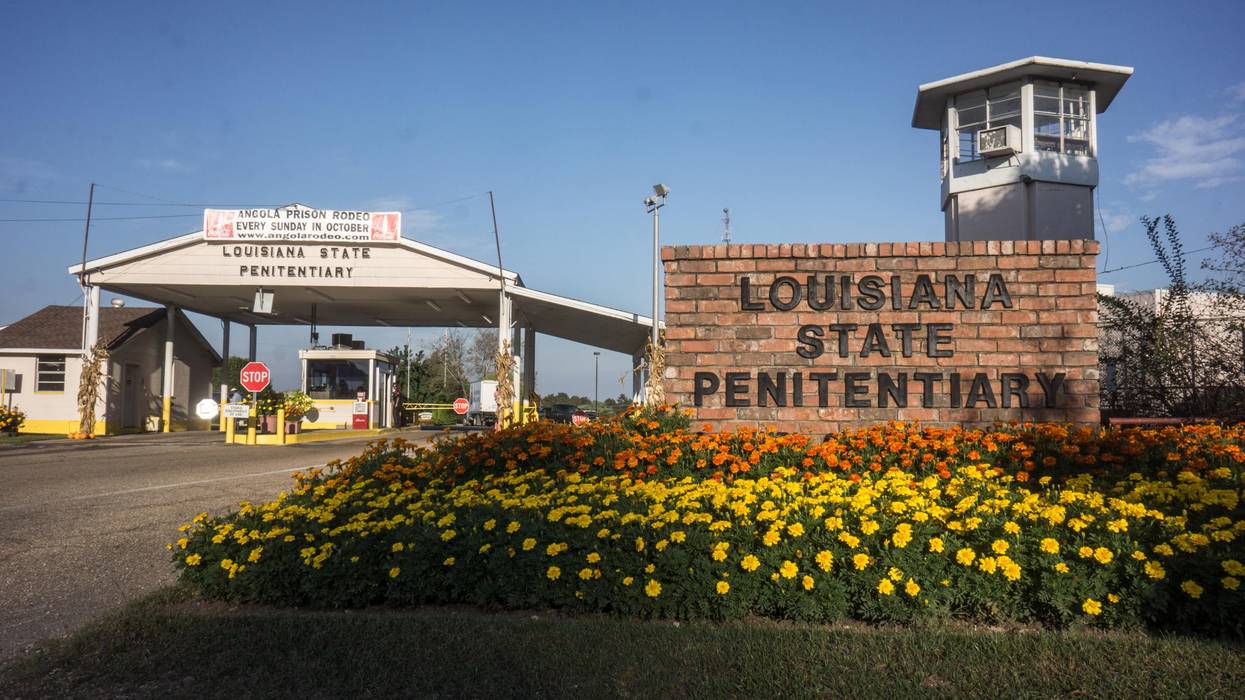
"It has been dangerously hot in Angola so far this summer," said one medical expert. "Confining children for all or most of the day to concrete and cement buildings without air conditioning is foolhardy and perilous."
The ACLU and other legal advocacy groups on Monday issued an emergency plea for a federal court to order the transfer of children incarcerated at the Louisiana State Penitentiary—better known as the notorious Angola prison—in potentially deadly temperatures exceeding 130°F on the heat index without air conditioning.
Scores of teenagers imprisoned on Angola's former death row were locked in windowless cells without air conditioning for nearly 24 hours a day for several days this month as temperatures soared, the groups claim. At least 13 people in Texas and Louisiana have died from the scorching heat in recent weeks.
It's getting worse. On Tuesday, the mercury topped 97°F at the prison, with high temperatures forecast to approach 100°F later this week. The heat index makes it feel even hotter—as hot as 133°F, according to The Appeal.
"I would not dare to keep my dog in these conditions for fear of my dog dying," Dr. Susi U. Vassallo, a medical expert for the prisoners, wrote in a statement to the U.S. District Court for the Middle District of Louisiana. "It has been dangerously hot in Angola so far this summer. Confining children for all or most of the day to concrete and cement buildings without air conditioning is foolhardy and perilous."
"My personal knowledge of the unconstitutional and inadequate medical care provided to adults at Angola heightens my fear that a child will deteriorate or die at Angola due to the conditions and the poor health care provided at the prison," Vassallo added.
According to The Appeal:
The ACLU and other legal advocates sued in August to stop the transfers to Angola due to what they said were inhumane conditions inside the facility. But a federal judge let the plan commence after [Louisiana Office of Juvenile Justice] promised it would provide children with education, programs, and services at the facility.
But David Utter, lead counsel in the lawsuit and executive director of the Fair Fight Initiative, told The Appeal in an interview that the agency has failed to deliver in the months since.
"What the state promised that they were going to do before they put any young people in that facility has not happened, and it's time to stop taking the state at his word," Utter said. "The trauma that the state is inflicting on these young people is immeasurable."
The civil rights groups' emergency filing claims child prisoners at Angola are locked up in solitary confinement for 72 hours straight, and that they're confined to their cells for 23 hours a day as punishment and only allowed out to shower or to a recreation area while handcuffed and shackled.
While state officials say the youth unit at Angola will be closed this autumn, critics say the teens can't wait that long. Many also question why children—most of them Black—are imprisoned on the former death row of one of the country's most infamous penitentiaries, which was built on the site of a former slave plantation.
Last year, Chief U.S. District Judge Shelly Dick, an appointee of former President Barack Obama, ruled that minors could be imprisoned at Angola, even though she found Louisiana's plan to do so "disturbing."
"You're sending Black kids to this facility and you're calling it something else," Antonio Travis, youth organizing manager and the New Orleans chapter lead for the group Families and Friends of Louisiana's Incarcerated Children, told The Appeal. "You're calling it something different as if it's not what it is. It's Angola."
Albert Woodfox turned 69 years old on Friday. He also was released from prison that day after serving 43 years in solitary confinement, more time than anyone in U.S. history. "Quite a birthday gift," Woodfox told us during the "Democracy Now!" news hour in his first televised interview after gaining his freedom. Woodfox is a living testament to the resilience of the human spirit when subjected to the cruel and unusual punishment of solitary. His case also serves as a stark reminder of the injustice that pervades the American criminal justice system.
Woodfox was in his early 20s when he was imprisoned for armed robbery in 1971. He was sent to the notorious Louisiana State Penitentiary, known as Angola, a sprawling prison complex with 5,000 prisoners located in rural Louisiana on the site of a former slave plantation. It gets its name, "Angola," from the country of origin of many slaves.
Conditions in Angola in 1971 were so violent and appalling that Woodfox, along with another prisoner, Herman Wallace, formed one of the first prison chapters of the Black Panther Party. In 1972, Woodfox and Wallace were charged with the murder of prison guard Brent Miller. No physical evidence linked the men to the crime. A bloody fingerprint at the murder scene, which matched neither Wallace's nor Woodfox's, was ignored by authorities. Robert King, another prisoner who joined their Black Panther chapter, was charged with a separate crime in the prison. The three were sent to solitary confinement, where they remained for decades, always maintaining they were innocent of the charges.
Albert Woodfox recalled those early days of organizing inside of Angola when we spoke with him just days after his release: "The saddest thing in the world is to see a human spirit crushed. And that's basically what happened with these young kids coming to Angola. And we decided that if we truly believed in what we were trying to do, it was worth taking whatever measures necessary to try to stop this."
Even back then, the Angola 3, as they became known, were well aware of the potential impacts of solitary confinement. Woodfox recalled during our interview, "When we were first put in CCR [closed cell restriction] in '72, myself, Herman Wallace, and Robert King, we knew that if we had any chance of maintaining our sanity and not allowing the prison system to break us, that we had to keep our focus on society and not become institutionalized." When I asked Woodfox what he read in prison, he told me, "History books, books on Malcolm X, Dr. Martin Luther King, Frantz Fanon, James Baldwin."
A movement grew, globally, to free the Angola 3, with Amnesty International and other organizations calling for their release. Documentaries were made about the case. In one, the widow of Brent Miller joined the call, saying in 2010, "These men, I mean, if they did not do this--and I believe that they didn't--they have been living a nightmare for 36 years."
Two major impediments to their freedom were prison warden Burl Cain and Louisiana Attorney General James "Buddy" Caldwell. Cain was the key decision-maker in keeping the men in solitary. In a 2008 deposition in Woodfox's case, Cain admitted, "I still know that he is still trying to practice Black Pantherism." And while Woodfox's case was overturned on three separate occasions, with a federal judge ordering his release, Attorney General Caldwell insisted on repeatedly retrying the case. Cain resigned in December, facing state ethics violations and a criminal probe for business dealings during his reign as the longest-serving warden in Angola's history. Caldwell lost re-election to fellow Republican Jeff Landry, who allowed Woodfox to leave prison on the condition that he plead "no contest" to manslaughter.
Woodfox squinted into the camera as he spoke on "Democracy Now!." The years of confinement in a six by nine foot cell had damaged his vision. He is proud of his activism. "We've put this solitary-confinement issue before American people, before the people of the world, and it just started building," he said. "It got to the point where it wasn't just about the Angola 3, but it was about solitary confinement."
Robert King was released in 2001, his conviction overturned after serving 29 years in solitary confinement. Herman Wallace was freed in 2013, only after a federal judge threatened to jail Cain if he refused to release him. Wallace died one day later of liver cancer. On Monday, we asked Albert Woodfox about his plans: "I've been locked up so long in a prison within a prison. So, for me, it's just about learning how to live as a free person," he told us. "I'm just trying to learn how to be free."
Albert Woodfox, the last of the men known as the Angola 3, was released from a Louisiana prison on Friday.
He had spent over four decades in solitary confinement at the notorious Louisiana State Penitentiary known as "Angola."
WBRZ Reporter Michael Vinsanau tweeted this photo of Woodfox as he walked out of prison:
His release, on his 69th birthday, comes after he pleaded no contest to charges of manslaughter and aggravated burglary in the 1972 death of a prison guard. Though his previous convictions of murder for the death were previously thrown out, the state had blocked his release. He had always maintained his innocence.
As Amy Goodman previously wrote, Woodfox and the other members of the Angola 3, Robert King Wilkerson and Herman Wallace, believe the decades they spent locked in solitary were "retaliation for forming the first prison chapter of the Black Panthers in 1971. They were targeted for organizing against segregation, inhumane working conditions, and the systemic rape and sexual slavery inflicted on many imprisoned at Angola."
Woodfox issued this statement to supporters ahead of his release: "Although I was looking forward to proving my innocence at a new trial, concerns about my health and age have caused me to resolve this case now and obtain my release with this no-contest plea to lesser charges. I hope the events of today will bring closure to many."
His "release is long overdue and undeniably just," stated Jasmine Heiss, Senior Campaigner at Amnesty International USA's Individuals and Risk Campaign.
"Nothing will truly repair the cruel, inhuman, and degrading solitary confinement that the state of Louisiana inflicted upon him. But this belated measure of justice, on Woodfox's 69th birthday, is something he has been seeking for more than half his life," she stated. "His release should also be put in the wider context of the continued practice of solitary confinement," Heiss added.
"Today should also mark a pivotal new chapter in reforming the use of prolonged solitary confinement in U.S. prisons and jails. Moving forward, Woodfox's case must serve as a tragic reminder of the cruelty inflicted by the prison system at its most extreme. Louisiana must commit to making urgent reforms to solitary confinement and chart a course toward doing its part in ending the overall crisis of mass incarceration."
The International Coalition to Free the Angola 3 said that his release "should motivate us to stand up and demand even more fervently that long-term solitary confinement be abolished, and all the innocent and wrongfully incarcerated be freed."
A United Nations expert has said that solitary confinement, such as when it is used "indefinitely or for a prolonged period," can amount to torture.

Albert Woodfox, the last remaining inmate of the "Angola 3," whose 43-year sentence in solitary confinement has drawn international condemnation from human rights groups, will not be freed from a Louisiana prison on Friday despite a court ruling earlier this week that called for his unconditional release.
Louisiana Attorney General Buddy Caldwell appealed U.S. District Judge James Brady's ruling and asked a three-panel court for an emergency stay, blocking Woodfox's release.
The Fifth Circuit Court of Appeals granted an order that will keep Woodfox, 68, in prison while the state appeals for him to be retried over the 1972 murder of a guard at Louisiana State Penitentiary, then known as Angola. Woodfox's convictions were previously overturned twice.
The other two members of the Angola 3, Robert King and Herman Wallace, were set free in 2001 and 2013, respectively. Wallace died the day after his release.
According to The Advocate, "The 10-page decision, written by Judge Jerry Smith, notes that 'no showing has been made that any state retrial (or any appeal) will be improperly handled.' Smith said further proceedings would be expedited."
As Common Dreams previously reported:
The state's case against the [Angola 3] has long been scrutinized for its inconsistencies, lost evidence, and the special favors paid between prison officials and inmates, as well as investigators and jury members. Woodfox has continuously denied his involvement in the death of Officer Brent Miller, maintaining that he and the other men were targeted because of their activism in the Black Panther party, which they said angered the Angola guards, and for their demonstrations demanding better conditions at the notorious facility.
Brady's ruling barred prosecutors from retrying Woodfox for a third time and said that the "only just remedy" in the case is Woodfox's immediate release from prison.
Twelve days after his 22nd birthday, Kalief Browder wrapped an air-conditioner power cord around his neck and hanged himself. In 2010, at the age of 16, he was arrested after being accused of stealing a backpack. He would spend three years in New York City's Rikers Island prison, more than two of those years in solitary confinement. He was beaten by prison guards and inmates alike. He was not serving a sentence; he was in pretrial detention. He declined all plea bargains. He wanted his day in court, to prove his innocence. A judge finally dismissed the case against him. After his release, Kalief Browder tried to reclaim his life. In the end, the nightmare he lived through overwhelmed him. Two years after his release, he committed suicide.
Albert Woodfox also knows the torment of solitary confinement. Woodfox has the distinction of being the prisoner in the United States who has spent the most time in solitary confinement, now well over 42 years. For most of that time, he was locked up in the notorious maximum-security Louisiana State Penitentiary known as "Angola," built on the site of a former plantation worked by slaves from the African country of Angola.
Woodfox is one of the "Angola Three," three prisoners who served more than a century--that's right, more than 100 years--of solitary confinement between them. They believe the isolation was retaliation for forming the first prison chapter of the Black Panthers in 1971. They were targeted for organizing against segregation, inhumane working conditions and the systemic rape and sexual slavery inflicted on many imprisoned at Angola.
Woodfox and another of the Angola 3, the late Herman Wallace, were convicted for the 1972 murder of prison guard Brent Miller. The case against them had significant flaws, and their convictions were later overturned. On Oct. 1, 2013, Herman Wallace was freed, but only after a federal judge threatened to arrest the warden if he did not release him. Wallace was suffering from advanced liver cancer, and died, surrounded by family and friends, several days later.
A federal judge has just issued a similarly urgent order for Albert Woodfox's release, but the state of Louisiana has appealed to a federal appeals court. Woodfox's conviction has been overturned not once but twice. Even the murdered guard's widow, Teenie Verret, has said she doesn't believe the men killed her husband. Nevertheless, Louisiana's Attorney General "Buddy" Caldwell would like to subject Woodfox, who is now 68, to a third trial for the same crime. Federal Judge James Brady is determined to set Woodfox free, once and for all.
Brady ordered, "Mr. Woodfox's age and poor health ... this Court's lack of confidence in the State to provide a fair third trial, the prejudice done onto Mr. Woodfox by spending over forty years in solitary confinement, and finally the very fact that Mr. Woodfox has already been tried twice and would otherwise face his third trial for a crime that occurred over forty years ago ... the only just remedy is an unconditional writ of habeas corpus barring retrial of Mr. Albert Woodfox and releasing Mr. Woodfox from custody immediately."
The warden of Angola, Burl Cain, said he had to keep Woodfox and the Angola 3 in solitary confinement because of their "Black Pantherism." Woodfox, speaking over a prison phone, said, "I thought that my cause, then and now, was noble. ... So they might bend me a little bit, they may cause me a lot of pain, they may even take my life; but they will never be able to break me."
Kalief Browder, sadly, was broken. Jennifer Gonnerman of The New Yorker magazine, who wrote eloquently about Kalief's case while he was alive, wrote on the day after his death, "He wanted the public to know what he had gone through, so that nobody else would have to endure the same ordeals." New York City Mayor Bill de Blasio has ended solitary confinement for 16- and 17-year olds on Rikers Island, and hopes to end it soon for those under 21. After learning of the suicide, de Blasio said: "A lot of the changes we are making at Rikers Island right now are a result of the example of Kalief Browder. So I wish, I deeply wish we hadn't lost him, but he did not die in vain."
There are an estimated 80,000-100,000 prisoners held in some form of solitary confinement in the United States. The United Nations says the practice often amounts to torture. It is cruel and unusual punishment, and must be abolished, once and for all.
Denis Moynihan contributed research to this column.