

SUBSCRIBE TO OUR FREE NEWSLETTER
Daily news & progressive opinion—funded by the people, not the corporations—delivered straight to your inbox.
5
#000000
#FFFFFF
To donate by check, phone, or other method, see our More Ways to Give page.
Daily news & progressive opinion—funded by the people, not the corporations—delivered straight to your inbox.
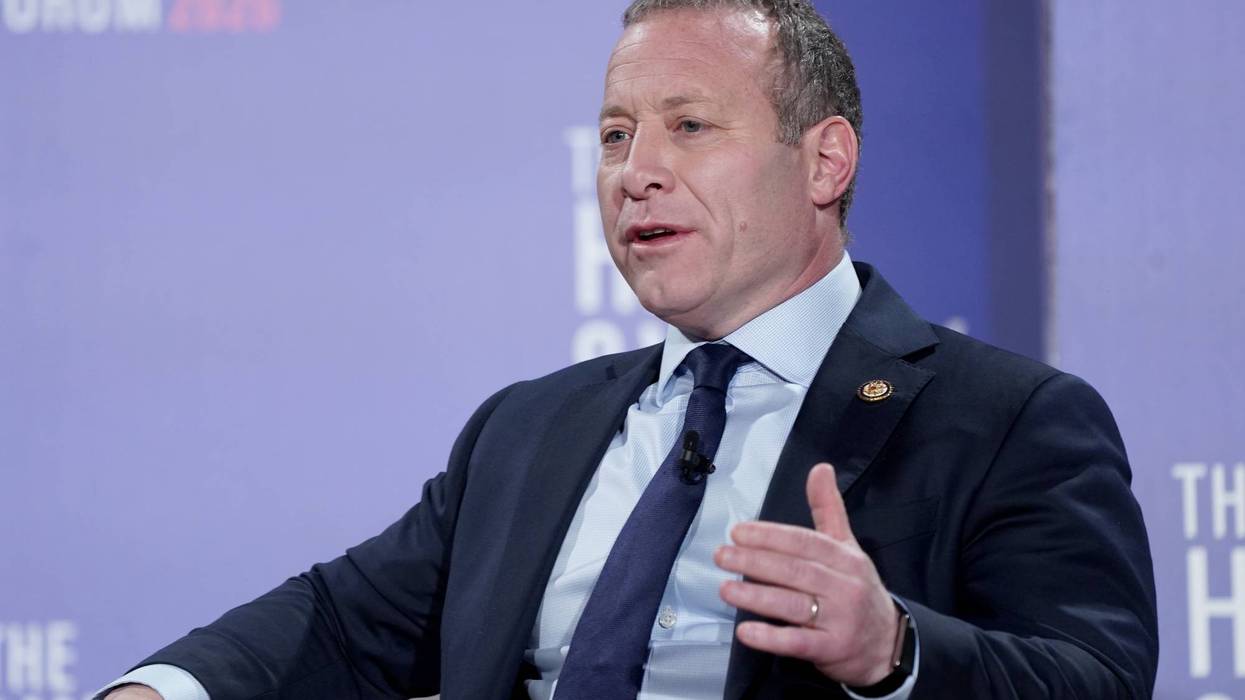
Despite catastrophic warnings from AI industry insiders, Congress has adjourned until after the midterms without passing any laws to regulate the technology.
Despite increasingly urgent calls to regulate artificial intelligence, including from industry insiders who warn of potentially catastrophic consequences, the US Congress has continued to drag its feet on meaningful legislation.
A report released Friday by Sludge may shed some light on one potential roadblock. It found that 1 in 5 members of Congress has household investments in AI companies or those producing the infrastructure behind the technology.
Sludge revealed that:
At least 105 members of Congress have disclosed that they, their spouse, or their dependent children hold stocks or other investments in AI developers, chipmakers, cloud infrastructure providers, data center companies, and specialized AI firms, with a total value of between $75 million and $287 million.
Most of the money is invested in large tech companies like Nvidia, Meta, and Alphabet. But lawmakers also report their households holding and trading shares in smaller publicly traded AI companies like BigBear.ai, Tempus AI, and C3 AI, as well as little-known private startups whose shares are unavailable to ordinary investors.
Of the lawmakers reporting investments, at least 44 sit on committees with jurisdiction over legislation dealing with AI safety, consumer protections, semiconductor policy, and trade with China.
The report identifies several lawmakers in positions of influence over Congress' AI policy whose households simultaneously have deep investments in the industry.
One of them is Rep. Josh Gottheimer (D-NJ), the co-chair of the House Democratic Commission on AI and the Innovation Economy—created to help direct the party's legislative agenda around the emerging technology.
According to Sludge, Gottheimer's household has investments in several key chipmaking and semiconductor companies, and he has regularly traded in AI stocks while in Congress.
The report draws attention to the "scores of sales" he made on April 9, 2025, when President Donald Trump announced a surprise 90-day pause on his "Liberation Day" tariffs, an announcement that led stocks for many AI companies to surge in value. Gottheimer has previously told Sludge that his investments are managed by a third party and that he does not make the decisions himself.
Gottheimer is one of the Democrats helping shape the party's approach to regulating AI. Earlier this month, amid concerns about the growing capability of "superintelligent" AI agents that can exceed human capability, he joined with Rep. Mike Lawler (R-NY) to introduce the Stop Rogue AI Act.
This bill would direct the National Institute of Standards and Technology (NIST) to adopt a series of standards and best practices that AI companies could implement to track the behavior of agents. However, critics have argued that the bill's voluntary guidelines fall short of what is necessary to rein in the industry.
Gottheimer's proposal is one of several measures Democrats have proposed in recent weeks following warnings from Anthropic researchers Jacob Coxon and Evan Hubinger that AI systems could wipe out humanity if allowed to escape human control.
Others include a more muscular bill proposed earlier this month by Sen. Bernie Sanders (I-Vt.) and Rep. Greg Casar (D-Texas) that would permanently ban the development of superintelligent AI and pause the development of advanced AI until a federal regulatory body can be established.
Some members of Congress whose households are heavily invested in AI stocks have nonetheless supported stronger regulation. According to Sludge, Rep. Ro Khanna (D-Calif.) disclosed between $3.4 million and $8.4 million worth of stock owned by his wife in AI companies, including Nvidia and chipmaker Broadcom.
Khanna has said he does not personally trade stocks and has pushed for a congressional ban on stock trading. Despite his household's millions of dollars worth of AI investments, he has also voiced support for blocking the development of superintelligent AI until stronger safeguards are in place, broadly aligning him with the Sanders-Casar proposal.
Sludge found that investments in AI stocks are not concentrated in either party. Among the lawmakers who reported AI-related investments, 62 were Republicans, and 43 were Democrats.
One of the largest portfolios is held by the husband of former House Speaker Nancy Pelosi (D-Calif.), who plans to retire at the end of the term.
Paul Pelosi, a venture capitalist, reported holdings in Alphabet, Amazon, Microsoft, Nvidia, Broadcom, and Tempus AI worth between $28.4 million and $134.9 million, while also buying an estimated $1.3 million to $2.6 million in Alphabet, Amazon, Nvidia, and Tempus shares in 2026 and up to $12 million in Bloom Energy, which stands to benefit from the AI data-center buildout.
On the Republican side, the report singles out Rep. Lisa McClain (Mich.), the chair of the House Republican Conference and the fourth highest-ranking member of House GOP leadership. Since December, her household has invested as much as $515,000 in AI companies, including private stakes in Elon Musk's company xAI, as well as Apptronik and Saronic.
Rep. Diana Harshbarger (R-Tenn.), meanwhile, disclosed holdings in Alphabet, Amazon, Meta, Microsoft, Nvidia, and Oracle. She serves on the House Energy and Commerce Committee’s Energy Subcommittee, which has authority to legislate on energy issues related to the controversial buildout of data centers around the country.
The report comes as members of Congress head home for a seven-week recess that will last until after November's midterm elections.
On Wednesday, more than 100 Democrats—including Gottheimer, Khanna, and Pelosi—sent a letter to House Speaker Mike Johnson (R-La.) urging him to postpone the recess until Congress passes AI safety legislation.
"AI experts and leading companies agree that the United States can lead the world in artificial intelligence while establishing reasonable safeguards that protect Americans and our national security. We can—and must—do both," the lawmakers wrote. "While AI safety experts and Americans increasingly urge action to confront this conflagration of risk, Congress fiddles."
"The House should remain in session until Congress advances meaningful, bipartisan AI safeguards," the letter concluded. "To our children who will have read a post-apocalyptic history, 'Why Congress Slept'—likely written by agentic AI—our inaction will be inexplicable and unforgivable."
Johnson, who has rejected calls for AI regulation and said companies should be in charge of regulating themselves, ignored the request and adjourned the House on Wednesday.

"UNRWA is vital to keeping hundreds of thousands of the most vulnerable Palestinians alive."
Human rights advocates are raising alarm about a bipartisan bill in the US House of Representatives aimed at abolishing the United Nations Relief and Works Agency for Palestine Refugees in the Near East, which they say will help Israel in its efforts to starve Palestinians in the occupied territories of food and medical aid.
Across Gaza, the West Bank, and other surrounding areas, UNRWA provides emergency food or cash assistance to roughly 2.6 million people and records about 10.5 million primary-care visits annually, according to UN Secretary-General António Guterres.
But since the genocide in Gaza began, Israel has waged a multifront campaign to dismantle the agency, legally banning it from operating in Israeli territory, blocking it from bringing desperately needed aid and staff into Gaza, and pressuring nations around the world to cut off funding based on unfounded allegations that the organization is controlled by Hamas, which dissolved Gaza's governing body earlier this month as part of the ceasefire agreement with Israel.
The bill introduced in the US House on Wednesday by Reps. Mike Lawler (R-NY) and Josh Gottheimer (D-NJ) would require the State Department to "dismantle" and transition its services to other nongovernmental organizations.
"UNRWA has been corrupted by Hamas for years, with documented ties to terrorism," claimed Lawler, the chair of the House Foreign Affairs Subcommittee on the Middle East and North Africa. "That’s why [Rep. Gottheimer] and I have introduced the bipartisan Replace UNRWA with Real Humanitarian Assistance Act to abolish UNRWA and replace it with trusted partners that will deliver aid to those who need it, without empowering terrorist organizations."
Gottheimer added that UNRWA "employs Hamas terrorists involved in the October 7 [2023] attack," echoing a claim that has been presented by Israel in its assault on the agency.
In 2024, Israel accused 19 of UNRWA's more than 13,000 employees in Gaza of having taken part in the attack, which resulted in the death of about 1,200 Israelis.
A UN investigation found that nine of the 19 employees may have been involved in the attack. Investigators found insufficient evidence to support involvement in nine cases and obtained no evidence in one case. UNRWA said the employment of the nine implicated staff members would be terminated.
Israeli officials have continued to portray UNRWA as a "civilian arm" of Hamas, alleging that hundreds of militants lurk among its ranks, but independent reviews have uncovered no evidence of this.
Nevertheless, many nations have taken Israel's claims at face value, initially cutting off funds and creating an existential funding crisis for the agency. While many have since resumed funding, its largest contributor, the US—which provided around a third of the agency's budget—has not, and the agency has been forced to scale back services for vulnerable refugees.
"This bill would be a death sentence for thousands of Palestinians who depend on UNRWA services," said Matt Duss, the executive vice president at the Center for International Policy (CIP) and a former foreign policy adviser to Sen. Bernie Sanders (I-Vt.). "What's really going on here: using the false claim that 'UNRWA equals Hamas' to advance the Israeli right's goal of removing the Palestinian refugee issue from the agenda."
Adil Haque, a law professor at Rutgers University, raised concerns about what sort of NGO might replace UNRWA if it were fully dismantled.
"This is how we ended up with the Gaza Humanitarian Foundation (GHF) and daily mass shootings of starving civilians," he said, referring to the US-Israeli nonprofit that supplanted UNRWA as the primary distributor of aid before shutting down after the October 2025 "ceasefire."
The organization consolidated aid distribution to a small number of sites under Israeli military control, where soldiers routinely fired into massive crowds of starving people. At least 859 people were killed near GHF sites in less than two months in 2025, and thousands more were wounded, according to a UN report.
Lawler and Gottheimer's bill has 23 co-sponsors, all of whom are Republicans. However, a majority of Democrats in both the House and Senate voted for a spending package in March 2024 that defunded the agency. Some Democrats have since sponsored legislation aimed at restoring the funds.
"UNRWA is vital to keeping hundreds of thousands of the most vulnerable Palestinians alive," said Dylan Williams, the vice president for government affairs at CIP, in response to a post by Lawler promoting the legislation. "Your attempt to kill it unconscionably compounds Israel’s genocide in Gaza."

As the US House prepared to vote Thursday on a war powers resolution aimed at ending President Donald Trump's assault on Iran and Democratic leaders whip votes in support of the measure, progressive organizers ramped up pressure on lawmakers to side with the vast majority of the party's voters and support the resolution—or face consequences in upcoming elections.
Usamah Andrabi, a spokesperson for Justice Democrats, told Axios Wednesday after Senate Republicans—and Democratic Sen. John Fetterman of Pennsylvania—voted down a companion resolution, that "any Democrat that votes against war powers is supporting Trump's war on Iran and deserves to be primaried because all voters across the political spectrum are wholeheartedly against it."
A poll released by Reuters/Ipsos this week found that just 25% of voters support Trump's decision to join Israel in launching airstrikes across Iran, which have so far killed more than 1,000 Iranian civilians. At least six US service members have also died or been killed since the unprovoked assault began over the weekend.
Only 7% of Democratic voters support "Operation Epic Fury," as the administration is calling the attacks, while 74% oppose it. A small majority of Republicans, 55%, said they approved of the White House's war on Iran, which the administration has justified with conflicting reasons—none of them convincing experts who say the attacks are a clear violation of international law.
After warning that "the American people will remember who voted to keep our service members in danger by supporting this dangerous, unnecessary, unpopular war" following the Senate vote on Wednesday, the advocacy group Demand Progress urged Americans to call their representatives in Congress and demand they support the war powers resolution introduced in the House by Reps. Ro Khanna (D-Calif.) and Thomas Massie (R-Ky.).
The measure is expected to fail due to the GOP majority; Republicans hold 218 seats in the House while Democrats control 214; Massie and one other Republican, Rep. Warren Davidson (R-Ohio), have indicated support.
Groups are "organizing calls into their districts to make sure that every Democrat votes for" the bipartisan resolution, one House progressive told the outlet.
Organizers are directing particular ire at House Democrats who have a history of staunchly backing Israel and have unveiled a resolution that would allow Trump to continue striking Iran for 30 days.
That resolution was introduced by Reps. Josh Gottheimer (NJ), Jim Costa (Calif.), Henry Cuellar (Texas), Jared Golden (Maine), Greg Landsman (Ohio), and Jimmy Panetta (Calif.) and would authorize the attacks for roughly the same length of time the president has said he believes they'll last, although Defense Secretary Pete Hegseth said Wednesday that the war could take twice as long and that, ultimately, there would be no timeline placed on the war.
Cavan Kharrazian, a senior policy adviser for Demand Progress, told The Intercept Wednesday that for "any representative that is actually against the war," the resolution introduced by Khanna and Massie is "the vehicle they should be voting for now, and not attempting to give Trump a blank check for 30 days."
“We have already seen in the past four days the death and destruction and escalation with this war. I can’t even imagine what things look like in 30 days," said Kharrazian.
Golden is not seeking reelection this year; the other five co-sponsors of the alternative war powers resolution are up for reelection and facing primaries in the coming months.
Axios asked other lawmakers including Reps. Tom Suozzi (D-NY) and Jared Moskowitz (D-Fla.) how they plan to vote on Khanna and Massie's resolution, but did not receive clear answers, with Suozzi saying only that he was "going to do the right thing."
Moskowitz told The Hill that he has "decided" how he'll vote but is "not ready to say what my vote is."
Oliver Larkin, a democratic socialist running against Moskowitz in the primary, seized on the congressman's comment.
Britt Jacovich, a spokesperson for the grassroots advocacy group MoveOn, told Axios that the organization's members "have no plans to throw their support behind members of Congress who refused to do their job and stop Trump from expanding his war. All options are on the table to make sure that our members' voices are heard loud and clear."
MoveOn also said Wednesday that any lawmaker who supports a $50 billion supplemental funding package "should expect to hear from our members."
"MoveOn members consider a vote for the supplemental a vote in favor of Donald Trump's war," said the group.
In a private Democratic caucus meeting on Wednesday, Rep. Gregory Meeks (D-NY), the House Foreign Affairs Committee ranking member, and Rep. Jim Himes (D-Conn.), made an "emphatic" case for Khanna and Massie's resolution, and House Minority Whip Katherine Clark (D-Mass.) has been leading efforts to whip votes.
One anonymous progressive House Democrat told Axios that a vote against the resolution would be "politically perilous" for any Democrat.
Advocacy groups are "already preparing" to organize primary challenges against Democrats who break ranks or vote to allow Trump to attack Iran for a 30-day window, said the lawmaker.
"If the filing deadline has passed, they'll do it in '28," they told Axios. "It's basically inviting a primary challenge."
Paco Fabian, a spokesperson for Our Revolution, told Axios that "when elected officials... fail to stand with working people demanding peace and accountability, they risk losing the trust of the voters who put them in office."
"And when that trust is broken," he said, "voters often begin looking for leaders who will fight for them."
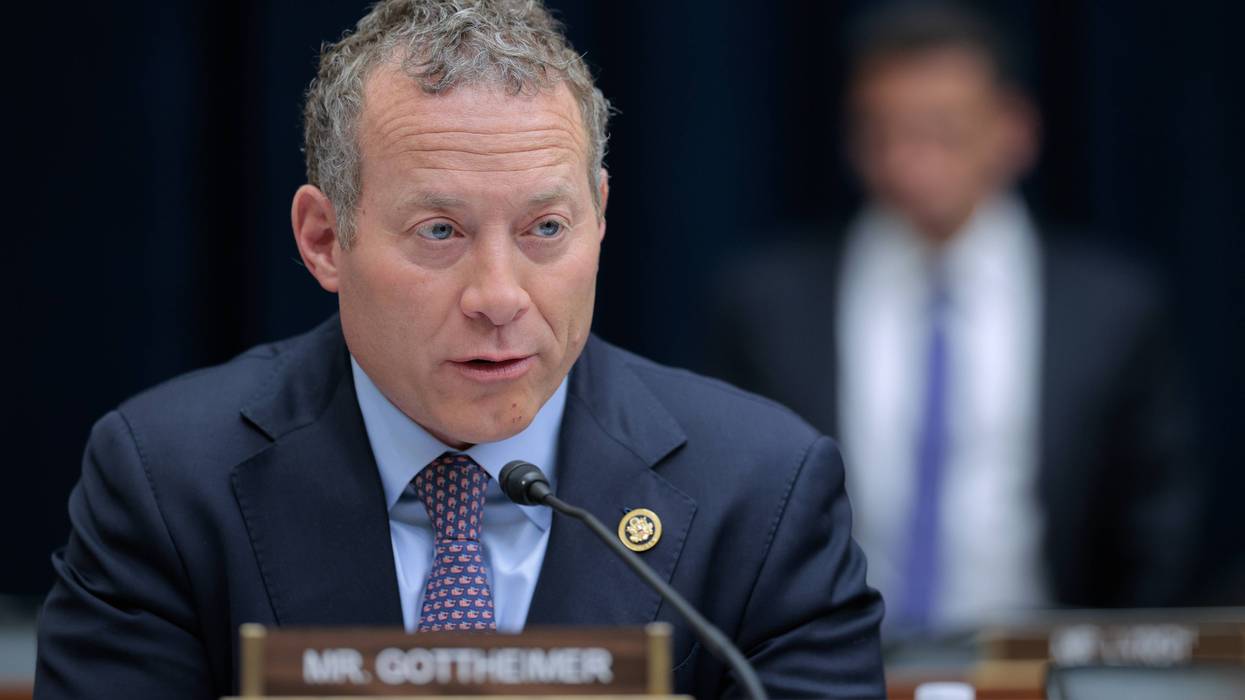
"The American people are firmly against this war and will see straight through this ruse," said one campaigner.
As the House of Representatives faces mounting pressure to pass Congressmen Ro Khanna and Thomas Massie's war powers resolution to end the US-Israeli assault on Iran, six right-wing Democrats on Tuesday introduced a competing bill that would give President Donald Trump a green light to keep waging war in the Middle East for the next month.
Khanna (D-Calif.) and Thomas Massie (R-Ky.) have been pushing for their H.Con.Res.38 since shortly before Trump bombed Iranian nuclear facilities last June. Trump and Israeli Prime Minister Benjamin Netanyahu's Saturday attack has ramped up demands for Congress to pass that resolution, along with S.J.Res.59, introduced last year by Sen. Tim Kaine (D-Va.).
Those resolutions, expected to receive votes this week, were already facing uphill battles in both Republican-controlled chambers, and all-but-certain vetoes if they ever made it to Trump, whose administration claims "Operation Epic Fury" is about preventing a nuclear-armed Iran, while critics around the world accuse him and Netanyahu of engaging in an illegal regime change war.
At least six US service members and hundreds of Iranians are now dead. Despite the rising death toll, the Democrats behind the new proposal—Reps. Jim Costa (Calif.), Henry Cuellar (Texas), Jared Golden (Maine), Josh Gottheimer (NJ), Greg Landsman (Ohio), and Jimmy Panetta (Calif.)—made clear that they oppose a swift end to the conflict.
"There is a concern that the Khanna-Massie war powers resolution currently requires the immediate withdrawal of US forces, even while Iran is actively targeting American troops, assets, embassies, and our allies across the region," they said in a statement. "It is vital that we allow for a safe transition, that protects our service members, embassies, and allies, not a potentially precarious withdrawal."
While proposing a 30-day window for ending the conflict—absent an authorization for the use of military force or a formal declaration of war from Congress—the six Democrats also said that "an open-ended commitment by the administration and the recent implication from the secretary of defense that ground troops may be engaged are both unacceptable."
Politico called the new measure "a sign of how some Democrats are struggling to reconcile their opposition to the Trump administration's military action with a desire to appear hawkish on national security—even in a largely symbolic capacity."
The outlet also noted that when asked about the latest proposal during a Tuesday news conference, House Minority Leader Hakeem Jeffries (D-NY) said that "our focus is on the resolution that will be on the floor this week."
"We'll continue to make the strongest possible case," Jeffries added. "There is going to be very strong Democratic support for the war powers resolution across the ideological spectrum."
Cavan Kharrazian, a senior policy adviser at the grassroots group Demand Progress, was far more critical, declaring that "of course Democrats who raced to applaud Trump's illegal war in Iran, and in one case was pardoned by him, would draft a pro-war war powers resolution meant to sabotage the real war powers resolution receiving a vote this week."
"This Trojan horse resolution attempts to give Trump a free pass to continue waging an unauthorized war in Iran for a whole month—exactly the amount of time that Trump has said he expects the war to last," he warned. "The American people are firmly against this war and will see straight through this ruse."
"Representatives need to ignore this bad-faith distraction," Kharrazian argued, "and vote for the bipartisan Khanna-Massie resolution that will actually stop this illegal war and bring our troops home."
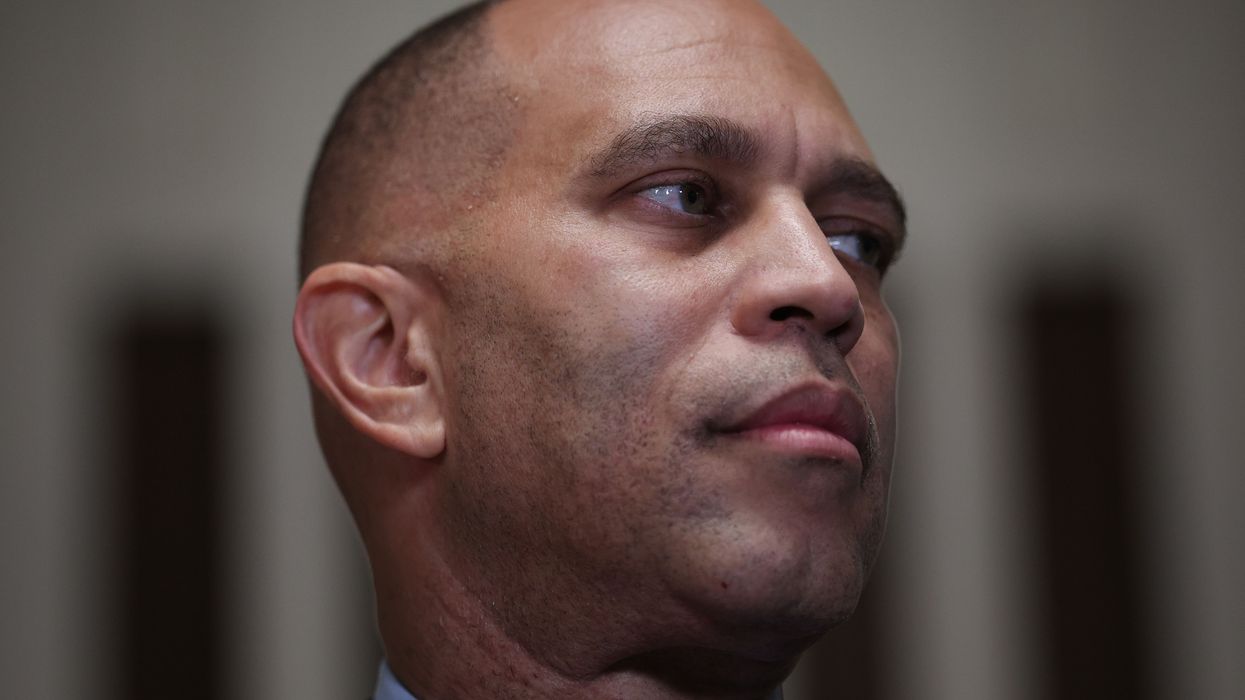
"This is the most populist moment of voter rage I've ever seen, and the leading Democrats are absolutely hostile to the idea of doing anything to address Silicon Valley's massive power," said one anti-monopoly expert.
At a time when the American public, and especially Democratic voters, express overwhelming distrust of artificial intelligence and Big Tech, the top House Democrat is being accused of failing to meet the moment.
On Tuesday, in preparation for an executive order to be signed this week by President Donald Trump, which would seek to block states from implementing new AI regulations, House Minority Leader Hakeem Jeffries (D-NY) unveiled his own effort to cozy up to the industry, whose major players have set aside more than $200 million to push out anti-AI politicians during the 2026 midterms, according to the New York Times.
Jeffries announced the creation of a “House Democratic Commission on AI and the Innovation Economy,” which will “develop policy expertise in partnership with the innovation community, relevant stakeholders, and committees of jurisdiction.”
What immediately caught the eye of critics was the list of fellow Democrats Jeffries picked to serve on the commission. It will be co-chaired by Reps. Ted Lieu (Calif.), Josh Gottheimer (NJ), and Valerie Foushee (NC), with Reps. Zoe Lofgren (Calif.) and Frank Pallone (NJ) serving as ex officio co-chairs.
As Sludge reported Tuesday: "The panel’s leaders rank among the House Democrats with the deepest ties to Big Tech and AI, from holding millions of dollars in tech stock to the contributions they’ve raised for their campaigns and the Republican-backed deregulation bills they've signed onto."
In July, Gottheimer introduced a bill along with Rep. French Hill (R-Ark.) "that would require financial regulators to create 'AI Innovation Labs' where firms could experiment with AI-driven financial products under looser regulations and without the normal threats of enforcement actions."
Gottheimer is also a major stakeholder in Microsoft, which has invested tens of millions of dollars into AI and nearly $7.5 million on lobbying in 2025 so far. Beyond the almost $100,000 in contributions Gottheimer has received from Microsoft, he is also a former executive who received anywhere from $1 million to $5 million last year from his stock holdings in the company, according to financial disclosure forms. He also frequently trades in other AI power players like Amazon, Meta, and Dell.
Lofgren, meanwhile, has accepted more money from the Internet industry over the course of her career than all but one other current House Democrat—including $265,000 from Google, $115,000 from Apple, and $110,000 from Meta, according to data from OpenSecrets.
In September 2024, Lofgren co-sponsored a bill introduced by Rep. Jay Abernolte (R-Calif.) which "would create a federal 'center for AI advancement and reliability' that it would instruct to work closely with private companies and other stakeholders on developing 'voluntary best practices and technical standards for evaluating the reliability, robustness, resilience, security, and safety of artificial intelligence systems.'"
Foushee, a member of the corporate-backed New Democrat Coalition, rode to Congress in 2022 with more than $1 million from the Protect Our Future political action committee, which was backed by former FTX CEO and convicted fraudster Sam Bankman-Fried.
In response to Trump's industry-friendly "AI Action Plan" in July, Foushee and the New Democrats unveiled their own "Innovation Agenda," which called for federal tax credits to companies that "reskill" workers and perform private research and development as well as federal investments in apprenticeships and "labor market data modernization."
Jeffries has neglected to take a position on Trump's proposal to preempt state regulations. Last Monday, he told reporters, "That conversation hasn't been brought to the leadership level yet."
In his statement announcing the Democratic commission on Tuesday, Jeffries said, "It is important that American companies continue to thrive" in the arena of AI, while "at the same time, Congress must consider what policies are needed to prevent bad actors from exploiting this transformative technology and inflicting harm upon the American people." However, he did not specifically mention Trump's pending block on state regulations.
A poll released Friday by the progressive group Demand Progress showed that Americans across the political spectrum are unsettled by AI's influence in Washington: 68% of respondents overall said they were more worried that "the US government will not regulate artificial intelligence enough," as opposed to just 21% who feared too much regulation. While Democrats and independents were somewhat more concerned about underregulation at 71%, Republicans largely shared those fears, with 62% saying they feared the government would not regulate AI enough.
The consensus was even stronger regarding Big Tech's power over AI policy, with 78% of respondents overall saying it had too much influence. This included 81% of Democrats and independents and 74% of Republicans.
With this in mind, many critics were puzzled by Jeffries' decision to stack his AI commission with some of the industry's top allies.
As Aaron Regunberg wrote in the New Republic last month, harnessing anger against the rapid, largely unregulated expansion of expensive, energy-sucking AI data centers was an essential part of Democrats' victories across the board in November's off-year elections:
In New Jersey, Gov.-elect Mikie Sherrill’s closing argument was a pledge to freeze electricity rates, which have soared because of data-center demand.
In Virginia, Gov.-elect Abigail Spanberger won after pledging to make data centers “pay their own way,” and many Democrats went even further.
At least one candidate, John McAuliff, flipped a seat in the House of Delegates by focusing almost entirely on tying his Republican opponent to the “unchecked growth” of data centers, with an ad that asked, “Do you want more of these in your backyard?”
And in Georgia, Democrats won their first nonfederal statewide races in decades, earning 60% of the vote against two Republican members of the Public Service Commission by criticizing Big Tech “sweetheart deals” and campaigning for policies “to ensure that the communities that they’re extracting from” don’t end up with their “water supplies … tapped out or their energy … maxed out.”
"This is the most populist moment of voter rage I've ever seen, and the leading Democrats are absolutely hostile to the idea of doing anything to address Silicon Valley's massive power," said Matt Stoller, an anti-monopoly expert.
Matt Duss, a former adviser to Sen. Bernie Sanders (I-Vt.), added: "Anticorruption is one of the strongest arguments with the broadest appeal in American politics right now, but the Democratic leadership simply refuses to stop tanking it."
Author Zachary D. Carter said: "I have never seen a gulf this wide between Democratic leadership and the party writ large. The top is corrupt, the base is raging against corruption."
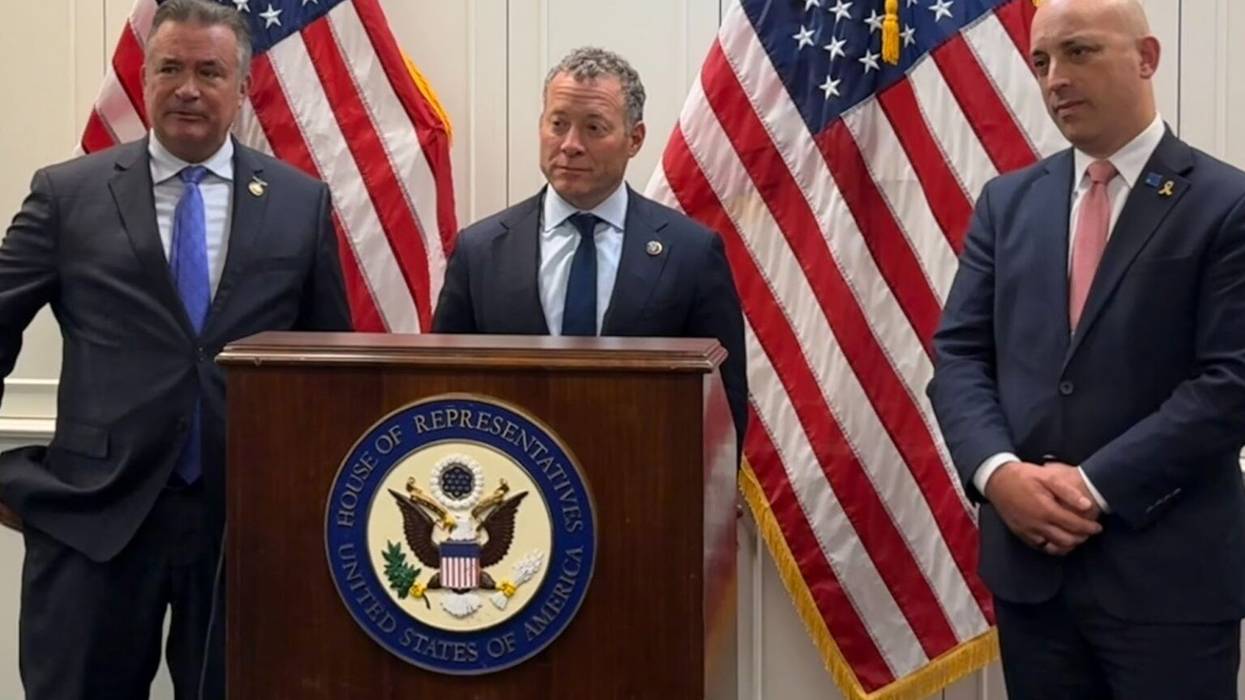
The bill’s lead sponsors described it as part of an effort to prevent antisemitic hate. But their comments during a press conference on the measure suggest it will also target critics of Israel.
Free speech advocates are raising concerns that a new bipartisan bill would force social media companies to censor criticism of Israel on their platforms.
Reps. Josh Gottheimer (D-N.J.) and Don Bacon (R-Neb.) rolled out the bill, called the Stopping Terrorists Online Presence and Holding Accountable Tech Entities (STOP HATE) Act, at a press conference Wednesday, alongside Jonathan Greenblatt, the CEO of the Anti-Defamation League (ADL).
The bill would mandate that social media companies work with the federal government to implement moderation policies that curb the speech of groups the government designates as "terrorists." They'd be required to provide regular reports to the U.S. attorney general. Those that don't comply would be fined $5 million each day they refuse.
The lawmakers justified the measure by citing some recent examples of overt antisemitism and calls for violence on social media.
"We've seen an explosion of disinformation and antisemitic hate online in America and around the world," Gottheimer said. "After the shooting outside the Capital Jewish Museum, anti-Zionist extremists used social media to call for further violence, posting messages like 'may all Zionists burn.' Even AI platforms like Grok have posted deeply disturbing content, praising Adolf Hitler and Nazism."
Bacon said, "We want to be in a country that makes clear that antisemitism or any kind of racism is repugnant, unacceptable, not allowed in an online space, and that we have zero tolerance for it."
However, other statements from the lawmakers make clear that their definition of "antisemitism" goes far beyond expressions of hatred or calls for violence against Jewish people.
As Matthew Petti wrote for the libertarian magazine Reason: "The specific idea that Bacon had in mind was antisemitism, and he made clear that it includes criticism of the State of Israel in his book."
At the press conference, Bacon explicitly referenced recent protests against Israel's policy of starvation in Gaza.
"I saw protests out here the last two days, they were vile, right?," he said. "They were...you can see the antisemitism in their comments and how they were treating some of our members of Congress who are Jewish. I saw that firsthand."
Bacon did not specify what specific comments he was referring to. However, Petti noted:
Protesters stormed the congressional cafeteria on July 1 to call for food aid to Gaza, and interrupted Rep. Randy Fine (R–Fla.)—who has called for Palestinians to "starve away"—during a hearing on campus antisemitism last week.
Bacon also suggested that merely stating opposition to pro-Israel congresspeople, including himself, constitutes antisemitism.
"I even saw an article today. It was about me, but talking about we have to oppose congressmen who are pro-Zionists, right?" said Bacon, who is notably not Jewish. "It's all over our social media and it's unacceptable."
Gottheimer, meanwhile, said the policy was not just about combating terrorism, but about halting a "massive disinformation campaign influencing us every day."
Independent journalist Glenn Greenwald—a critic of government efforts to regulate "misinformation"—suggested that the bill flies in the face of the right's supposed commitments to free speech.
"There was [a] full consensus on the Right for the last decade that Big Tech censorship was a great evil, especially if pressured and demanded by the U.S. government," he said on X. "All that changed [when] it came time to censor for Israel."
In a statement released Friday, the American‑Arab Anti‑Discrimination Committee (ADC) likewise described the STOP HATE Act as part of "the continuous efforts by lawmakers to silence, censor, and chill freedom of speech and expression in this country at the behest of Israel."
They warned that the bill gives the government, in tandem with pro-Israel groups like the ADL, "unfettered powers to police private social media companies, attack lawful expression, and levy fines of up to five million dollars each day if companies fail to silence and censor users."
This is not the first time Gottheimer and Bacon have introduced the STOP HATE Act. A similar version, introduced in 2023, died in committee.
When introducing that version of the bill, they were more explicit in their calls for government regulation of media—calling on the Department of Justice to require the news outlets Al Jazeera and its subsidiary AJ+, which are sponsored by the Qatari government, to register as foreign agents.
The two congressmen were also at the forefront of calls for the U.S. government to ban TikTok, which Gottheimer said was being used by the Chinese Communist Party to "boost anti-Israel and pro-Hamas videos in the United States." They have also introduced legislation that would criminalize efforts to boycott Israeli products.
Greenblatt, who spoke alongside the two legislators on Wednesday, has explicitly said that "Anti-Zionism is antisemitism." Though he's faced criticism for this stance, including from members of the ADL itself, he has only continued to double down.
In one infamous exchange during the outbreak of pro-Palestine protests on college campuses in 2024, Greenblatt suggested that students wearing keffiyehs—a kind of scarf commonly worn by Palestinians—were doing the equivalent of wearing a swastika armband.
More recently, he endorsed Immigration and Customs Enforcement's warrantless abduction of pro-Palestine organizer Mahmoud Khalil, who he accused—along with other pro-Palestine demonstrators—of being an asset of foreign governments and likened to Middle Eastern terrorist groups.
Wednesday's press release from the legislators on the STOP HATE Act cites the ADL's 2024 "Social Media Scorecard," as evidence that "the five major social media platforms—Facebook, Instagram, TikTok, YouTube, and X—routinely failed to act on antisemitic hate reported to them."
That Scorecard page features a quote from Greenblatt, who said, "Social media platforms are still falling far too short when it comes to moderating antisemitic and anti-Israel content."
After the October 7, 2023 attacks led by Hamas, the ADL changed its methodology to categorize antisemitic incidents to not only include hate speech or threats directed at Jewish people, but also language expressing "opposition to Zionism."
The proposed STOP HATE Act comes at a time when American public opinion has dramatically shifted against Israel's genocidal actions in Gaza. According to a CNN poll conducted by SSRS, released last Friday:
Only 23% of Americans say Israel’s actions have been fully justified, a 27-point drop from a[n] October 2023 poll taken shortly after Hamas’ October 7 attacks. Another 27% now say those actions have been partially justified and 22% say that they have not been justified at all. In October 2023, just 8% said Israel’s actions were not justified at all.
In recent weeks, Israeli leaders have openly called for the mass displacement of two million Palestinians to make room for Jewish settlers. Meanwhile, at least 115 Palestinians—including more than 80 children—have reportedly starved due to Israel's restrictions on aid entering the Gaza Strip. Over 1,000 aid seekers have been killed, often by Israel Defense Forces soldiers, at aid sites jointly administered by the U.S. and Israel.
"The First Amendment is supposed to be the cornerstone of American democracy—our shield against censorship and government overreach," said Abed Ayoub, ADC's national executive director. "When members of Congress and state lawmakers start compromising our freedoms to satisfy the demands of a foreign government, we lose what makes this country free. We must reject any legislation that threatens our speech, our conscience, and our right to dissent."
"This is far from the first time he and other members of Congress have engaged in such dangerous anti-Muslim rhetoric," said the Council on American-Islamic Relations.
The largest Muslim civil rights group in the United States on Thursday called for a censure vote over Rep. Randy Fine's latest Islamophobic attacks on progressive Muslim lawmakers—and noting that the Democratic Party's tepid response to Islamophobia has fostered an environment where politicians from both sides of the aisle seem comfortable expressing anti-Muslim bigotry.
The Council on American-Islamic Relations (CAIR) issued an action alert, urging voters to pressure their Democratic representatives in the House to support a censure vote against Fine (R-Fla.), who responded Tuesday night to Rep. Ilhan Omar's (D-Minn.) criticism of Israeli Prime Minister Benjamin Netanyahu with Islamophobic remarks that have become commonplace for the first-term congressman.
"I'm sure it is difficult to see us welcome the killer of so many of your fellow Muslim terrorists," said Fine after Omar said it was "shameful" for Congress and the Trump administration to welcome Netanyahu's third visit to Washington, D.C. this year.
He doubled down on the comments Thursday night in an interview with Chris Cuomo on NewsNation, saying that "when you adopt the policies that Ilhan Omar has adopted, when you support Hamas in the way that she has, you're supporting terrorism."
Omar has not expressed support for Hamas and unequivocally condemned the group's attack on Israel in October 2023.
Fine also called Rep. Rashida Tlaib (D-Mich.) and New York City mayoral candidate and state Rep. Zohran Mamdani (D-36) "Muslim terrorists" last week.
CAIR said in a letter to House Minority Leader Hakeem Jeffries (D-N.Y.) that it welcomed a statement released by Jeffries, Minority Whip Katherine Clark (D-Mass.), and Democratic Caucus Chair Pete Aguilar (D-Calif.) a day after Fine posted the attack against Omar on the social media platform X. In their statement, the Democratic leaders called Fine's comments "unhinged, racist, and Islamophobic" as well as "bigoted and disgusting," and demanded an apology—but made no mention of formally condemning him through a House censure vote.
"We appreciate the joint statement," wrote Robert McCaw, director of CAIR's government affairs department, and Basim Elkarra, executive director of CAIR Action, the group's advocacy arm. "However, we must be honest: Rep. Fine will never apologize, this is far from the first time he and other members of Congress have engaged in such dangerous anti-Muslim rhetoric, and our community has been deeply concerned by the House leadership's failure to consistently and strongly counter various other attacks."
That failure, Elkarra and McCaw suggested, has allowed anti-Muslim views to fester within both the Republican and Democratic parties—as evidenced by other recent comments by lawmakers.
CAIR pointed to Rep. Brian Mast's (R-Fla.) statement on the House floor in November 2023—in the first weeks of Israel's U.S.-backed assault on civilians in Gaza—that "there are very few Palestinian civilians." While Rep. Sara Jacobs (D-Calif.) proposed censuring Mast, CAIR noted that House leaders—who continue to insist that Israel's killing of more than 57,000 Palestinians has been the result of attacks targeting Hamas and that Israel is acting in self defense—"never spoke up against Rep. Mast's remarks."
The letter also noted Rep. Brandon Gill's (R-Texas) "hateful" remarks about Mamdani in late June, after the progressive lawmaker stunned the political establishment by winning the Democratic mayoral primary. Gill criticized Mamdani for the common South Asian cultural practice of eating with his hands, saying that "civilized people in America don't eat like this"—expressing bigotry not only toward the mayoral candidate himself but also millions of people in the U.S. whose families are from parts of the Middle East, Asia, and Africa.
Republican lawmakers are not alone in expressing Islamophobic, xenophobic bigotry, CAIR emphasized, pointing to Rep. Josh Gottheimer's (D-N.J.) reported comment in a closed-door Democratic caucus meeting in October 2023 that Muslim members of Congress were excluded from a vigil for victims of Hamas' attack on Israel and Israel's attacks on Gaza "because they're all guilty." Some lawmakers reported that Gottheimer's exact words were, "They should feel guilty."
Democratic leaders did not condemn Gottheimer's comments.
"When such sentiments go unchallenged by Democratic caucus leadership, they further normalize the dehumanization of Muslim Americans at a time of rising hate and violence," said Elkarra and McCaw, who noted that CAIR received 8,658 complaints of anti-Muslim attacks and bias last year—the highest number since it began tracking civil rights violations.
Although a censure vote in the Republican-controlled House would likely fail, wrote Elkarra and McCaw, "the introduction and advocacy for the resolution will send a message that House Democratic leadership takes bigotry seriously and that no member of Congress can smear and threaten Muslim and Palestinian members of Congress without facing consequences"—with the message hopefully getting not only to Fine but all federal lawmakers.
Zeteo journalist Prem Thakker reported that as of Thursday, five Democrats had signaled they would support a censure vote: Reps. Ayanna Pressley (D-Mass.), Yassamin Ansari (D-Ariz.), Pat Ryan (D-N.Y.), Ritchie Torres (D-N.Y.), and Dan Goldman (D-N.Y.).
The latter three lawmakers said they would vote to censure Fine after Zeteo contacted them; Ryan, Torres, and Goldman were among 22 Democrats who voted in favor of censuring Tlaib in 2023 for her use of the phrase "from the river to the sea"—a call for Palestinian liberation from the Israeli government's illegal occupation.
Thakker emphasized that the stark difference between the response to Tlaib's and Fine's comments from both political parties "is not just about hypocrisy or consistency." He wrote:
On one hand, Tlaib was punished for warning of the mass suffering that would come to her people, and pleading for the government she is part of not to be complicit in it.
She wasn't listened to. And then 2 million of her people were displaced. More than 50,000 were murdered.
On the other hand, Fine has thus far been unpunished by the same people who castigated Tlaib, while he has vilified an entire religion and demonized his colleagues—all under the flag of cheering for that same genocidal violence that has afflicted the people Tlaib was trying to defend.
The unequal treatment is doubly so, given that one member's humanity is punished while another's inhumanity is tolerated, even celebrated.
In their letter, Elkarra and McCaw urged Democratic leaders to publicly affirm their support and solidarity with all Muslim members of Congress and ensure Capitol Police is providing them with sufficient security and to "commit to institutional measures to combat Islamophobia in Congress."
"This moment is a defining moral test for the Democratic Party in Congress," said CAIR. "No member should endure slander, incitement, or threats without a strong defense from their leadership. This moment will be remembered."
"American Muslims are watching," the group added. "So are millions who believe that justice and safety must be defended for all, not only for some. The choice before your caucus is whether to meet this moment with courage or allow hate to go unchallenged."
"If Congress wants to wash itself of conflicts of interest it can start by passing a stock trading ban."
Dozens of U.S. lawmakers and their families bought or sold up to $113 million worth of shares in top Pentagon contractors this year, an analysis published on Wednesday revealed.
The Quincy Institute for Responsible Statecraft found that at least 37 members of Congress and their relatives traded between $24-113 million worth of stock in companies listed on Defense and Security Monitor's Top 100 Defense Contractors index.
As the Quincy Institute noted: "Eight of these members even simultaneously held positions on the Armed Services and Foreign Affairs Committees, the committees overseeing defense policy and foreign relations. Members of Congress that oversee the annual defense bill and are privy to intelligence briefings have an upper hand in predicting future stock prices."
The analysis found that one Democratic congressman accounted for the vast bulk of defense stock trading in 2024.
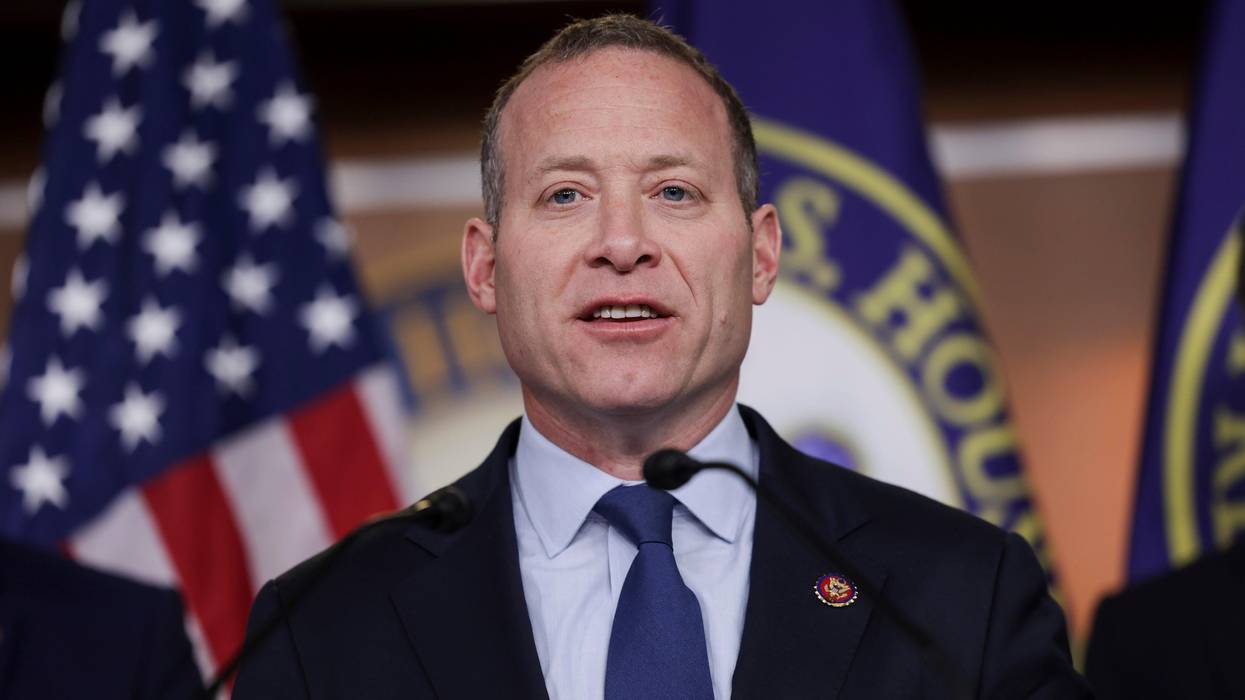
Rep. Josh Gottheimer of New Jersey traded at least $22 million and as much as $104 million worth of shares in companies on the index, including Microsoft, Northrop Grumman, and IBM. Gottheimer—who said his trades are handled by a third-party firm—sits on both the House Permanent Select Committee on Intelligence and the National Security subcommittee of the Committee on Financial Services.
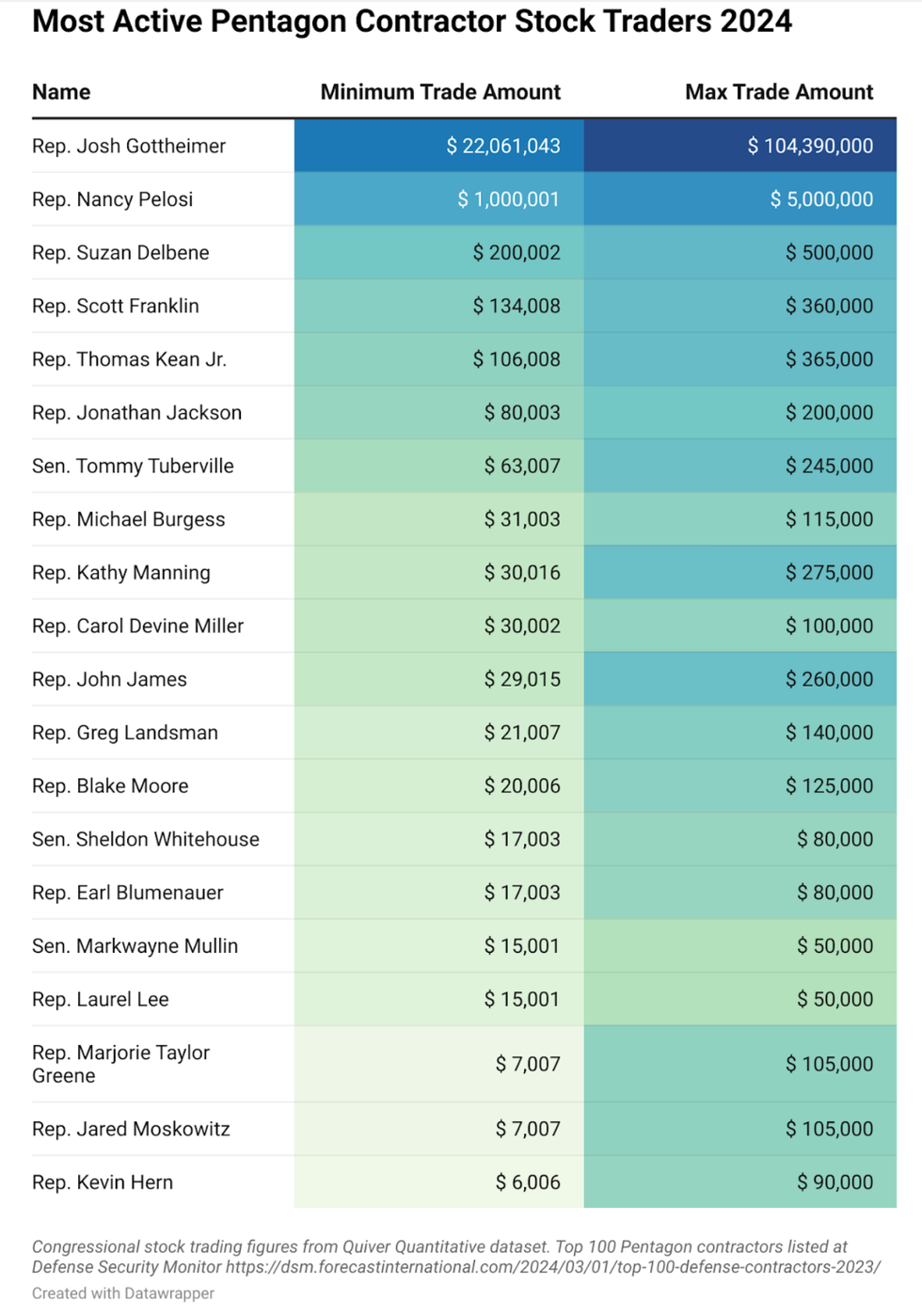 (Image: Quincy Institute for Responsible Statecraft/Datawrapper)
Next on the list in distant second place is former House Speaker Nancy Pelosi (D-Calif.), who has defended stock trading by lawmakers, and according to Quincy, "sold over $1 million worth of Microsoft stock in late July."
"The timing of Pelosi's Microsoft trades in the past have garnered attention, too; in March 2021, she bought Microsoft call options less than two weeks before the Army announced a $22 billion contract with the software company to supply augmented reality headsets," the analysis states.
"Pelosi had the most profitable 2024 of any lawmaker, netting an estimated $38.6 million from all stock trading activity, according to Quiver Quantitative," the report adds.
Pelosi was followed by Reps. Suzan DelBene (D-Wash.), Scott Franklin (R-Fla.), and Thomas Keane Jr. (R-N.J.).
The Quincy Institute asserted: "If Congress wants to wash itself of conflicts of interest it can start by passing a stock trading ban. The Ending Trading and Holdings in Congressional Stocks Act, or ETHICS Act, would prohibit members of Congress from trading individual stocks."
The ETHICS Act was approved by the Democrat-controlled Senate Committee on Homeland Security and Government Affairs in July. The full Senate—which will be GOP-controlled starting next month—has yet to vote on the bill.
Earlier this month, U.S. President Joe Bide n was applauded by progressive lawmakers for backing a ban on congressional stock trading and asserting that "nobody in the Congress should be able to make money in the stock market while they're in the Congress."
On Monday, Biden signed the $895 billion Servicemember Quality of Life Improvement and National Defense Authorization Act for Fiscal Year 2025. As Sen. Bernie Sanders (I-Vt.) has highlighted, "Of that nearly $1 trillion dollars... about half will go to a handful of hugely profitable defense contractors."
Congresswoman Rashida Tlaib (D-Mich.) decried both the enormity of the military budget, as well as the fact that some of her colleagues have profited from investments in the military-industrial complex.
Tlaib has introduced the Stop Politicians Profiting from War Act, which would ban members of Congress, their spouses, and their dependent children from trading defense stocks or having financial interests in companies that do business with the U.S. Department of Defense.
In 2012, Congress passed the Stop Trading on Congressional Knowledge (STOCK) Act, legislation that has been panned as
weak and ineffective.
"Instead of funding more bombs with American taxpayer dollars," said Rep. Rashida Tlaib, "our leaders should be calling for a ceasefire now, before this violence claims thousands more lives."
A dozen House Democrats on Thursday evening joined with nearly every Republican in the chamber to approve legislation that would provide $14.3 in military aid to Israel while cutting an equal amount from IRS funding that would be used to target wealthy individuals who avoid taxes—a cut to the agency that would act as a revenue destroyer, not an offset.
Despite the bill being dead-on-arrival in the U.S. Senate, it passed the House in a 226-196 vote, with 12 Democrats voting in favor along with 214 Republicans, and just two Republicans voting with the 194 Democrats who said nay. President Joe Biden has also vowed to veto the bill if it reaches his desk.
Dubbing the House Democrats who crossed the aisle as the "Tax Cheat Twelve," David Dayen of The American Prospect detailed in his coverage how the group "received a combined $8 million in campaign support from [pro-Israel lobby group] AIPAC and its affiliates last year."
"Not only do some of my colleagues want to send more weapons to carry out war crimes and violations of international law, but they want to do it by providing tax breaks to billionaires and undermining crucial investments in our communities."
—Rep. Rashida Tlaib
The Democrats who voted with Republicans are: Reps. Josh Gottheimer (N.J.), Jared Moskowitz (Fla.), Debbie Wasserman Schultz (Fla.), Lois Frankel (Fla.), Jared Golden (Me.), Juan Vargas (Calif.), Angie Craig (Minn.), Darren Soto (Fla.), Haley Stevens (Mich.), Frederica Wilson (Fla.), Don Davis (N.C.) and Greg Landsman (Ohio).
While the bill has little or no chance of becoming law, Dayen observed that the group "stuck to their principles" by joining with the Republicans anyway.
Defenders of Palestinian rights horrified by the ongoing onslaught in Gaza criticized all those who voted in favor of the bill.
Progressive Democrats—including Reps. Tashida Tlaib (D-Mich.), Cori Bush (D-Mo.), and Summer Lee (D-Pa.)—spoke out forcefully against funding Israeli military operations at a time the IDF is bombing the besieged Gaza Strip without mercy following the Hamas attacks on Oct. 7 that claimed as many as 1,400 lives. Latest figures put the Palestinian death toll in Gaza well above 9,000 people, including nearly 4,000 children, with thousands more wounded or missing under the rubble.
"The American people do not support funding for war crimes—like the use of white phosphorus bombs—and are calling for a ceasefire," Tlaib said in a statement following Thursday night's vote.
"As the Israeli government carries out ethnic cleansing in Gaza, President Biden is cheering on Netanyahu, whose own citizens are protesting his refusal to support a ceasefire," she continued. "We must be laser focused on saving lives, no matter their faith or ethnicity. The number of children killed in Gaza in just three weeks has surpassed the annual number of children killed across the world's conflict zones since 2019—yet instead of helping end this violence, President Biden baselessly casts doubt on the Palestinian death toll."
Earlier this week, as Common Dreams reported, a CBO score of the proposal showed that the $14.3 billion cut to the IRS would actually slash federal revenues by $27 billion.
Explaining her no vote, Congresswoman Bush tweeted, "I was sent to Congress to save lives, I was not sent to Congress to have my constituent's tax dollars buy bombs to kill thousands of innocent Palestinian men, women, and children. We choose peace and love."
And Rep. Summer Lee said: "I refuse to spend more money on weapons of war and tax breaks for the ultra-wealthy at the expense of children in Pennsylvania, Gaza, and Israel when what is needed now is investment in American families, de-escalation of violence, diplomacy, and humanitarian aid."
According to Tlaib, increased U.S. military aid for the Israel while it carries out the attack on Gaza, with no humanitarian conditions, takes "us farther away from ending the violence and reaching peace" in the region.
"Achieving a just and lasting peace requires lifting the blockade, ending the occupation, and dismantling the dehumanizing system of apartheid," Tlaib said. "Not only do some of my colleagues want to send more weapons to carry out war crimes and violations of international law, but they want to do it by providing tax breaks to billionaires and undermining crucial investments in our communities. Instead of funding more bombs with American taxpayer dollars, our leaders should be calling for a ceasefire now, before this violence claims thousands more lives."
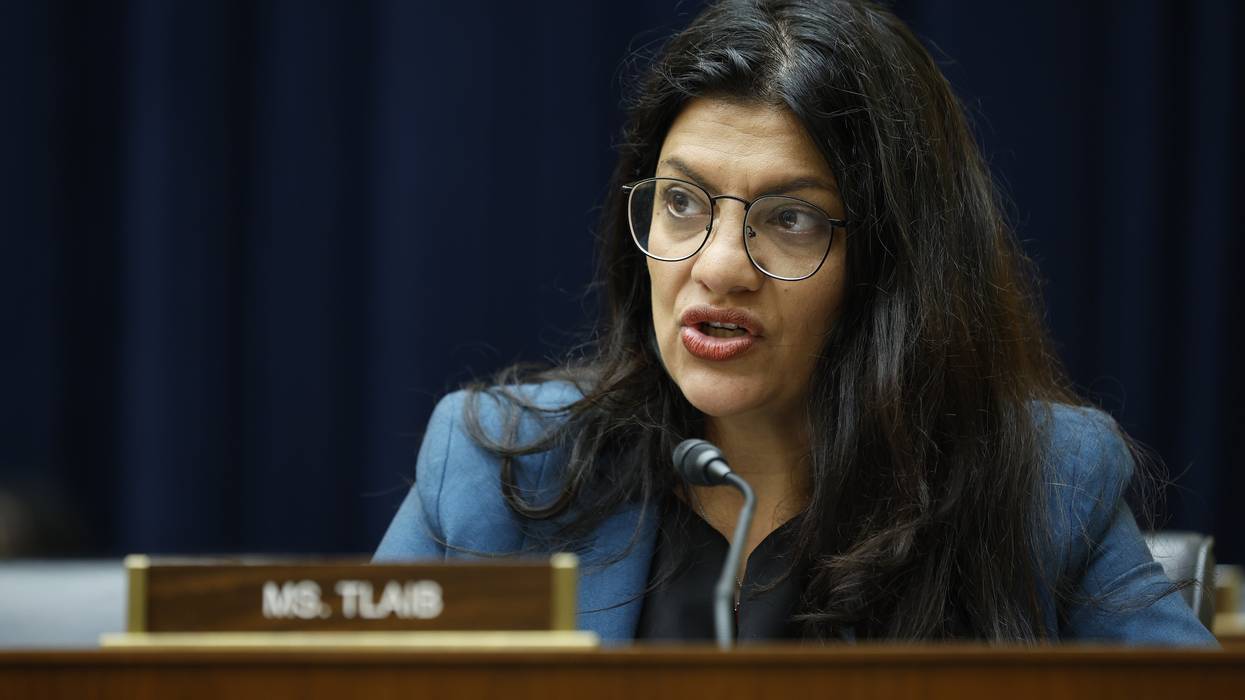
"I'm the only Palestinian voice right now in Congress. If anything, my voice is needed here more than ever."
Facing attacks by fellow Democrats and a censure motion from a Republican congressman from her home state of Michigan, Rep. Rashida Tlaib on Wednesday accused her critics of intentionally misportraying her as a Hamas sympathizer due to her condemnation of Israeli war crimes in Palestine.
Rep. Jack Bergman (R-Mich.)—whose third-biggest campaign contributor during the 2022 election cycle was the American Israel Public Affairs Committee (AIPAC)—on Wednesday introduced a motion to censure Tlaib, the only Palestinian American member of Congress, for what he called "her antisemitism and disgraceful response to the attacks on our ally, Israel."
On Saturday, Hamas and other militants infiltrated Israel from Gaza in a wave of attacks that have since killed more than 1,300 Israeli soldiers and civilians, including many women and children. Israel responded by bombarding Gaza, targeting civilian infrastructure and killing over 1,400 Palestinians—including at least 447 children—while cutting off power and water and trapping 2.3 million people in the besieged enclave.
"Much of what I'm hearing from Jack and a number of other colleagues is rooted in bigotry, that somehow because of my ethnicity and my faith that I support terrorism."
On Sunday, Tlaib issued a statement mourning the "Palestinian and Israeli lives lost," while asserting that the path to a peaceful future must include lifting Israel's blockade of Gaza, ending its illegal occupation of Palestine, "and dismantling the apartheid system that creates the suffocating, dehumanizing conditions that can lead to resistance."
Tlaib's statement also asserted that the "heartbreaking cycle of violence" would continue until the United States stopped giving "billions in unconditional funding" to support Israel's apartheid government.
Citing unverified claims that Hamas "beheaded infants," Bergman's resolution—which was joined by Rep. Morgan Luttrell (R-Texas), another beneficiary of AIPAC's largesse—called Tlaib's statement "disturbing and evil."
Responding to Bergman's motion, Tlaib told the Detroit Free Press on Wednesday that "I'm the only Palestinian voice right now in Congress. If anything, my voice is needed here more than ever."
"This is an attempt to silence my voice because I want the violence to stop, no matter whether it's toward Israelis or toward Palestinians," she asserted. "Much of what I'm hearing from Jack and a number of other colleagues is rooted in bigotry, that somehow because of my ethnicity and my faith that I support terrorism."
Tlaib and other "Squad" members including Reps. Ilhan Omar (D-Minn.) and Cori Bush (D-Mo.)—who condemned the killing of civilians on both sides while urging an end to U.S. support for "Israeli military occupation and apartheid"—also faced harsh rebuke from fellow Democrats in the Biden administration and Congress.
White House Press Secretary Karine Jean-Pierre called their comments "disgraceful" and "repugnant," while pro-Israel congressional Democrats piled on the condemnation.
"It sickens me that while Israelis clean the blood of their family members shot in their homes, they believe Congress should strip U.S. funding to our democratic ally and allow innocent civilians to suffer," Rep. Josh Gottheimer (D-N.J.) said of Tlaib and her Squad colleagues in a Tuesday interview with Jewish Insider.
"U.S. aid to Israel is and should be unconditional, and never more so than in this moment of critical need," Rep. Ritchie Torres (D-N.Y.) told Jewish Insider. "Shame on anyone who glorifies as 'resistance' the largest single-day mass murder of Jews since the Holocaust. It is reprehensible and repulsive."
AIPAC was by far Gottheimer's largest contributor in the 2022 electoral cycle, donating more than $216,000 to his campaign. The same goes for Torres, who received over $141,000 from the group during the same period.
The Nation's John Nichols noted Thursday that Tlaib, Bush, and Omar are being condemned "for saying what prominent Israelis are saying."
Nichols cited Israeli human rights lawyer and rules-of-war expert Michael Sfard, who said: "Hamas committed abominable war crimes for which there can be no forgiveness. But the laws of war weren't meant only for situations in which our blood is cool, or when there is no justified anger or understandable desire for revenge."
He also quotes Israeli journalist Amira Hass, daughter of Holocaust survivors, who wrote in Haaretz that "in a few days Israelis went through what Palestinians have experienced as a matter of routine for decades, and are still experiencing."
"Therefore, this must be said once again—we told you so," Hass added. "Ongoing oppression and injustice explode at unexpected times and places. Bloodshed knows no borders."
Critics have noted that Israelis can freely express truths that, when voiced by Americans, result in condemnation, ostracism, and even loss of employment.
This isn't the first time Tlaib and other progressive Democrats have faced possible censure for defending Palestinians' human rights and criticizing U.S. support for Israeli apartheid, occupation, illegal settler colonization, and other crimes. In 2021, a trio of GOP lawmakers tried and failed to censure Tlaib and Omar—the first two Muslim women elected to Congress—and other Squad members for comments criticizing Israel.
In February, Republicans removed Omar from the House Foreign Affairs Committee in what Jewish Voice for Peace called a "racist attack by the far-right to silence progressives in Congress who speak up for a human rights-centered foreign policy, including Palestinian human rights."
Tlaib and Omar have also received death threats for expressing their views, and have been targeted by a vast international fake news operation exploiting far-right social media accounts to spread Islamophobia.
Undaunted, Tlaib told the Free Press Wednesday that she will continue to remind her congressional colleagues that "a Palestinian life is just as important as an Israeli life," and that, like Hamas, the Israeli government "has to be held accountable for some of its atrocities."