
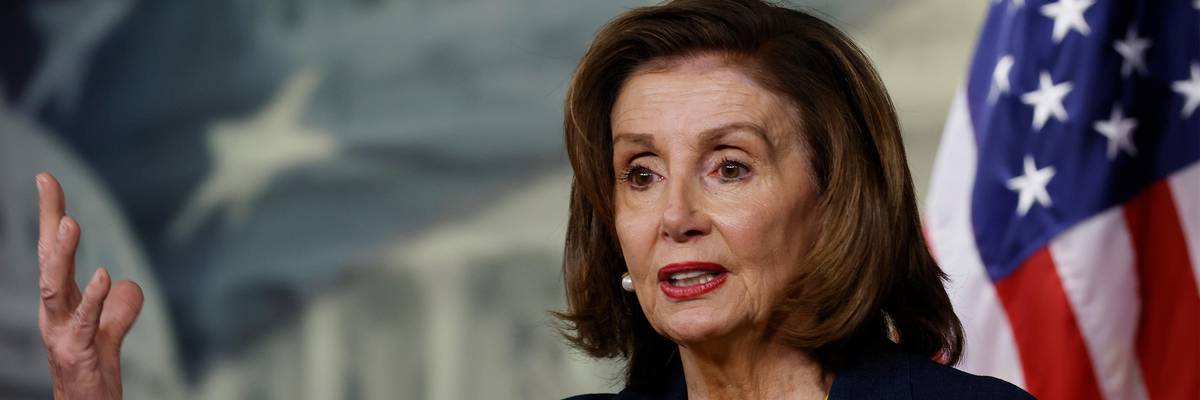
House Speaker Nancy Pelosi (D-Calif.) talks to reporters during her weekly news conference at the U.S. Capitol on December 15, 2021 in Washington, D.C. (Photo: Chip Somodevilla/Getty Images)
'Are They Trying to Lose?' Critics Ask After Pelosi Defends Stock Trading by Lawmakers
"Letting the child tax credit disappear, making people pay back student loans, mocking the idea of at-home Covid tests, and now defending members of Congress trading stocks. It's getting harder and harder to convince me the Democrats want to win," said one critic.
Progressives and government watchdog groups on Wednesday condemned House Speaker Nancy Pelosi's defense of individual stock trading by members of Congress, days after an extensive report revealed dozens of conflicts of interest by lawmakers who own stocks related to the healthcare industry and other sectors Congress is supposed to regulate.
After being asked by Business Insider at her weekly press conference whether members of Congress and their spouses should be barred from trading stocks, Pelosi said the practice should be permitted to continue because "we are a free market economy."
Speaking to Business Insider after the press conference, Pelosi's spokesperson said the STOCK Act--which was passed in 2012 and requires members to disclose security transactions and ensure they don't make individual stock trades based on knowledge they gain as lawmakers--prevents members of Congress from insider trading.
"It's not 'participating in the free market' for some of our nation's most powerful to benefit financially from inside information."
But the outlet's "Conflicted Congress" investigation released Monday, showed that at least 49 lawmakers and 182 senior congressional staffers have violated the STOCK Act, including dozens whose stock holdings may have allowed them to benefit from the coronavirus pandemic.
At least 11 senators and 34 representatives held shares of Pfizer, the manufacturer of one of the Covid-19 vaccines. The investigation also found stocks held by lawmakers from both major political parties in 3M, which makes personal protective equipment; Quest Diagnostics, which provides Covid-19 tests; and Regeneron Pharmaceuticals, the maker of a treatment for the disease.
As Common Dreams reported in April 2020, in the weeks before the pandemic, members of Congress made nearly 1,500 stock transactions worth up to $158 million--in many cases buying stocks in companies that might see a boost during the crisis and selling stocks that seemed likely to decrease in value.
When asked about the lack of compliance with the STOCK Act at her news conference, the speaker said only that members of Congress "should be" reporting their holdings.
The Project on Government Oversight (POGO) was among the first watchdog groups to respond forcefully to Pelosi's comments.
"Members of Congress should not be able to trade stocks because it's not 'participating in the free market' for some of our nation's most powerful to benefit financially from inside information," the group tweeted. "It's a conflict of interest, plain and simple, and it needs to stop."
Dylan Hedtler-Gaudette, government affairs manager for the group, added that lawmakers' ability to trade individual stocks--and Pelosi's vehement defense of the practice--could significantly damage the public's perception of Congress and the federal government.
Progressive lawmakers including Rep. Alexandria Ocasio-Cortez (D-N.Y.) and Sen. Elizabeth Warren (D-Mass.) have spoken out about the issue, with Warren telling Business Insider on Wednesday, "The American people should never have to guess whether or not an elected official is advancing an issue or voting on a bill based on what's good for the country or what's good for their own personal financial interests."
Some critics suggested Pelosi defended stock trading on Capitol Hill because she has personally benefited from the practice; her husband, venture capitalist Paul Pelosi, trades corporate stocks and in 2020 owned shares worth as much as $25 million in Apple, Amazon, and Visa. The couple's net worth grew by $16.7 million last year.
Others noted that Pelosi's defensive comments came just as it was reported that the Democratic Party is planning to shelve the Build Back Better Act--the $1.75 trillion reconciliation package that would invest in climate action and anti-poverty measures--due to objections to the Child Tax Credit from right-wing Democratic Sen. Joe Manchin of West Virginia--and as the Biden administration is preparing to force millions of Americans to restart payments of the student debt, leading to questions about how the party will inspire voter turnout in 2022 and beyond.
"Are they trying to lose?" asked journalist Kate Aronoff.
We are at a crossroads
This country and this world are at a monumental crossroads. In a few short weeks, US voters will have an opportunity to beat back the forces of fascism and confront the billionaires who are rigging the economy, our media system, and our democracy, making it increasingly impossible for ordinary people to get by. We’re not just talking about the election. We’re talking about what must be done once these fascist elements are vanquished from power. We need a bolder set of solutions than what either major party has so far been willing to offer and a working-class movement ready to fight like hell for it. Trump didn't emerge from nowhere. The conditions that fueled MAGA authoritarianism were created by decades of radical neoliberal economic policies and a corrupt political system dominated by corporate interests. They slashed taxes on the super-rich, promising that the benefits would trickle down. They said giveaways to the corporate titans would make life more affordable for the rest of us. It was all bullshit. And when a bitter, betrayed populace searches for someone to blame, right-wing demagogues have little trouble finding scapegoats. People know when they're being lied to, but you won't hear any of this from the corporate media. Only independent journalism—powered and funded by people who believe in building a better world—can deliver truly trustworthy daily news. Our Fall Campaign is underway, and we need your help. To power our newsroom through the rest of the year, we need to raise $125,000 by midnight on October 31. So if you share our vision, please contribute whatever you can to sustain our work. |
Progressives and government watchdog groups on Wednesday condemned House Speaker Nancy Pelosi's defense of individual stock trading by members of Congress, days after an extensive report revealed dozens of conflicts of interest by lawmakers who own stocks related to the healthcare industry and other sectors Congress is supposed to regulate.
After being asked by Business Insider at her weekly press conference whether members of Congress and their spouses should be barred from trading stocks, Pelosi said the practice should be permitted to continue because "we are a free market economy."
Speaking to Business Insider after the press conference, Pelosi's spokesperson said the STOCK Act--which was passed in 2012 and requires members to disclose security transactions and ensure they don't make individual stock trades based on knowledge they gain as lawmakers--prevents members of Congress from insider trading.
"It's not 'participating in the free market' for some of our nation's most powerful to benefit financially from inside information."
But the outlet's "Conflicted Congress" investigation released Monday, showed that at least 49 lawmakers and 182 senior congressional staffers have violated the STOCK Act, including dozens whose stock holdings may have allowed them to benefit from the coronavirus pandemic.
At least 11 senators and 34 representatives held shares of Pfizer, the manufacturer of one of the Covid-19 vaccines. The investigation also found stocks held by lawmakers from both major political parties in 3M, which makes personal protective equipment; Quest Diagnostics, which provides Covid-19 tests; and Regeneron Pharmaceuticals, the maker of a treatment for the disease.
As Common Dreams reported in April 2020, in the weeks before the pandemic, members of Congress made nearly 1,500 stock transactions worth up to $158 million--in many cases buying stocks in companies that might see a boost during the crisis and selling stocks that seemed likely to decrease in value.
When asked about the lack of compliance with the STOCK Act at her news conference, the speaker said only that members of Congress "should be" reporting their holdings.
The Project on Government Oversight (POGO) was among the first watchdog groups to respond forcefully to Pelosi's comments.
"Members of Congress should not be able to trade stocks because it's not 'participating in the free market' for some of our nation's most powerful to benefit financially from inside information," the group tweeted. "It's a conflict of interest, plain and simple, and it needs to stop."
Dylan Hedtler-Gaudette, government affairs manager for the group, added that lawmakers' ability to trade individual stocks--and Pelosi's vehement defense of the practice--could significantly damage the public's perception of Congress and the federal government.
Progressive lawmakers including Rep. Alexandria Ocasio-Cortez (D-N.Y.) and Sen. Elizabeth Warren (D-Mass.) have spoken out about the issue, with Warren telling Business Insider on Wednesday, "The American people should never have to guess whether or not an elected official is advancing an issue or voting on a bill based on what's good for the country or what's good for their own personal financial interests."
Some critics suggested Pelosi defended stock trading on Capitol Hill because she has personally benefited from the practice; her husband, venture capitalist Paul Pelosi, trades corporate stocks and in 2020 owned shares worth as much as $25 million in Apple, Amazon, and Visa. The couple's net worth grew by $16.7 million last year.
Others noted that Pelosi's defensive comments came just as it was reported that the Democratic Party is planning to shelve the Build Back Better Act--the $1.75 trillion reconciliation package that would invest in climate action and anti-poverty measures--due to objections to the Child Tax Credit from right-wing Democratic Sen. Joe Manchin of West Virginia--and as the Biden administration is preparing to force millions of Americans to restart payments of the student debt, leading to questions about how the party will inspire voter turnout in 2022 and beyond.
"Are they trying to lose?" asked journalist Kate Aronoff.
Progressives and government watchdog groups on Wednesday condemned House Speaker Nancy Pelosi's defense of individual stock trading by members of Congress, days after an extensive report revealed dozens of conflicts of interest by lawmakers who own stocks related to the healthcare industry and other sectors Congress is supposed to regulate.
After being asked by Business Insider at her weekly press conference whether members of Congress and their spouses should be barred from trading stocks, Pelosi said the practice should be permitted to continue because "we are a free market economy."
Speaking to Business Insider after the press conference, Pelosi's spokesperson said the STOCK Act--which was passed in 2012 and requires members to disclose security transactions and ensure they don't make individual stock trades based on knowledge they gain as lawmakers--prevents members of Congress from insider trading.
"It's not 'participating in the free market' for some of our nation's most powerful to benefit financially from inside information."
But the outlet's "Conflicted Congress" investigation released Monday, showed that at least 49 lawmakers and 182 senior congressional staffers have violated the STOCK Act, including dozens whose stock holdings may have allowed them to benefit from the coronavirus pandemic.
At least 11 senators and 34 representatives held shares of Pfizer, the manufacturer of one of the Covid-19 vaccines. The investigation also found stocks held by lawmakers from both major political parties in 3M, which makes personal protective equipment; Quest Diagnostics, which provides Covid-19 tests; and Regeneron Pharmaceuticals, the maker of a treatment for the disease.
As Common Dreams reported in April 2020, in the weeks before the pandemic, members of Congress made nearly 1,500 stock transactions worth up to $158 million--in many cases buying stocks in companies that might see a boost during the crisis and selling stocks that seemed likely to decrease in value.
When asked about the lack of compliance with the STOCK Act at her news conference, the speaker said only that members of Congress "should be" reporting their holdings.
The Project on Government Oversight (POGO) was among the first watchdog groups to respond forcefully to Pelosi's comments.
"Members of Congress should not be able to trade stocks because it's not 'participating in the free market' for some of our nation's most powerful to benefit financially from inside information," the group tweeted. "It's a conflict of interest, plain and simple, and it needs to stop."
Dylan Hedtler-Gaudette, government affairs manager for the group, added that lawmakers' ability to trade individual stocks--and Pelosi's vehement defense of the practice--could significantly damage the public's perception of Congress and the federal government.
Progressive lawmakers including Rep. Alexandria Ocasio-Cortez (D-N.Y.) and Sen. Elizabeth Warren (D-Mass.) have spoken out about the issue, with Warren telling Business Insider on Wednesday, "The American people should never have to guess whether or not an elected official is advancing an issue or voting on a bill based on what's good for the country or what's good for their own personal financial interests."
Some critics suggested Pelosi defended stock trading on Capitol Hill because she has personally benefited from the practice; her husband, venture capitalist Paul Pelosi, trades corporate stocks and in 2020 owned shares worth as much as $25 million in Apple, Amazon, and Visa. The couple's net worth grew by $16.7 million last year.
Others noted that Pelosi's defensive comments came just as it was reported that the Democratic Party is planning to shelve the Build Back Better Act--the $1.75 trillion reconciliation package that would invest in climate action and anti-poverty measures--due to objections to the Child Tax Credit from right-wing Democratic Sen. Joe Manchin of West Virginia--and as the Biden administration is preparing to force millions of Americans to restart payments of the student debt, leading to questions about how the party will inspire voter turnout in 2022 and beyond.
"Are they trying to lose?" asked journalist Kate Aronoff.