

SUBSCRIBE TO OUR FREE NEWSLETTER
Daily news & progressive opinion—funded by the people, not the corporations—delivered straight to your inbox.
5
#000000
#FFFFFF
To donate by check, phone, or other method, see our More Ways to Give page.
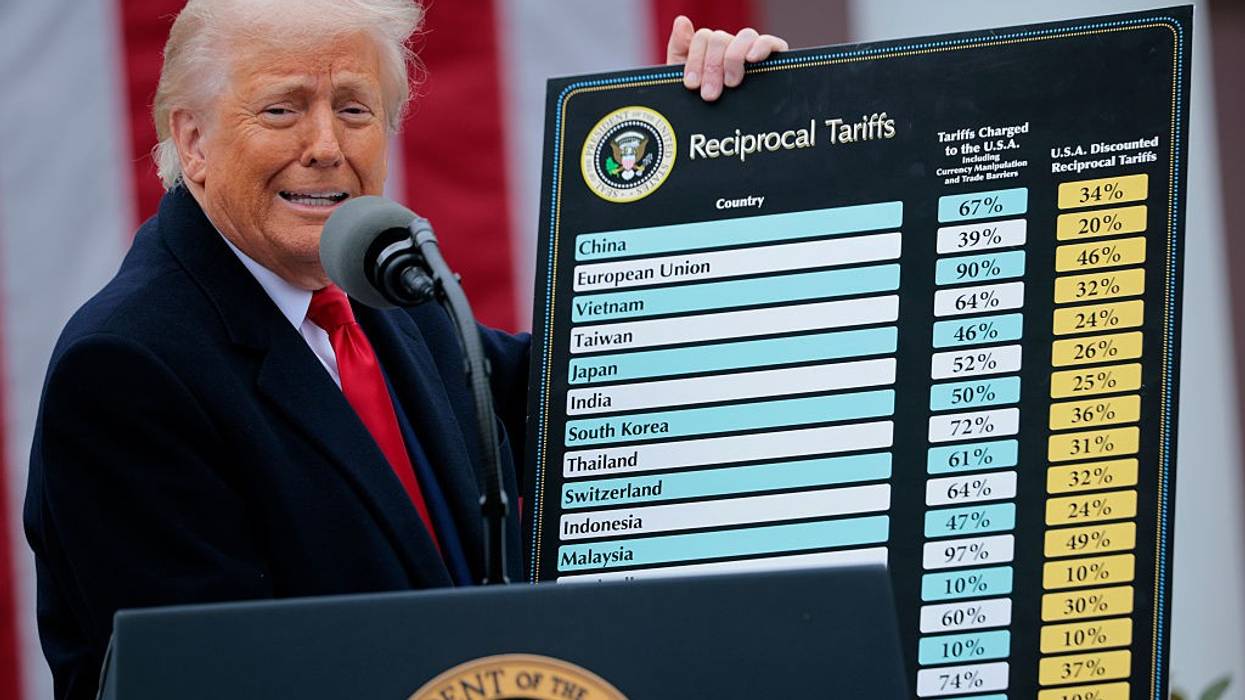
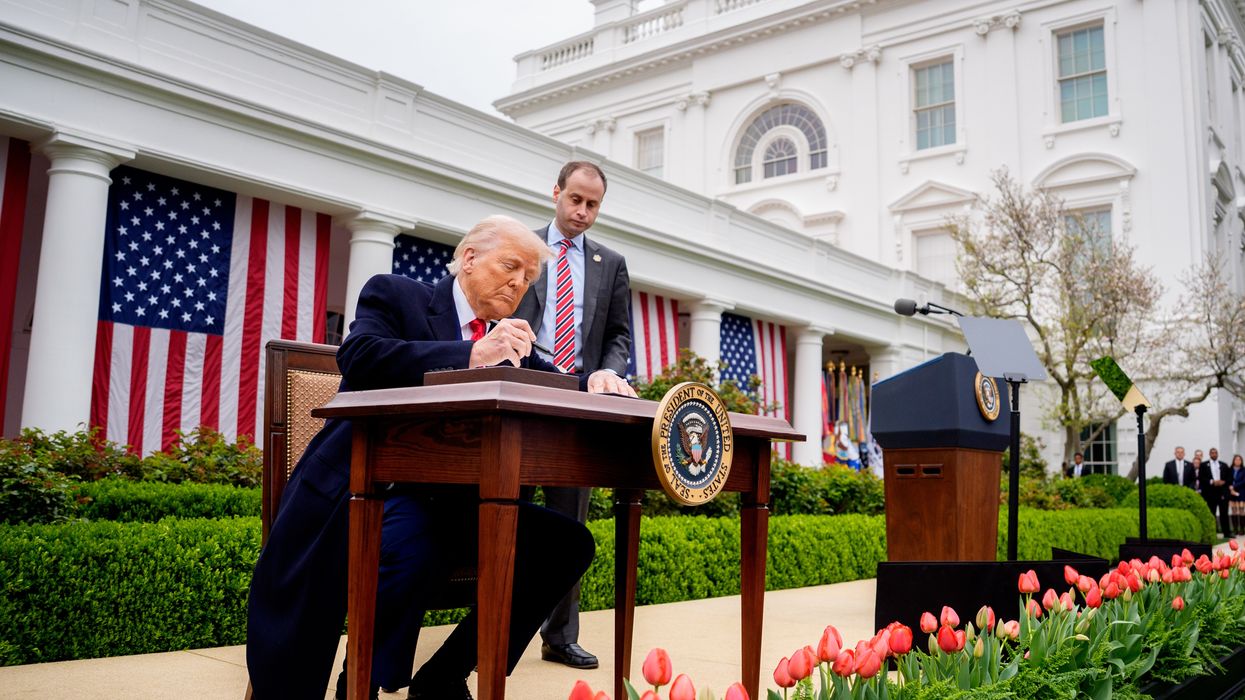

Weirdly, Trump may be doing the Democrats a favor by taking this position, and I don’t mean the possibility that he’ll wreck the economy and thus his party’s chances in 2026 and 2028 (although that’s real, too).
Tariffs can be a good thing for a country, if done right.
Tariff-free trade was a central cornerstone of former President Ronald Reagan’s neoliberal agenda; he and George H.W. Bush wrote the NAFTA agreement that Bill Clinton later signed, for example. I lay this out in considerable detail in The Hidden History of Neoliberalism: How Reaganism Gutted America. Tragically, Bill Clinton and his Larry Sommers/Robert Rubin crew embraced neoliberalism with gusto, putting the final nail in the meaningful use of tariffs to protect American manufacturing and the jobs associated with it.
Democrats like Sens. Bernie Sanders (I-Vt.) and Elizabeth Warren (D-Mass.) have been working for years to pull the Democratic Party back from the neoliberal free trade brink, and if Trump pushes through his tariffs in a big way it may help shatter what’s left of the neoliberal consensus (at least with regard to trade) in the Democratic Party. That would be a Very Good Thing, both for the Party and for the nation.
Tariffs can be a good thing for a country, if done right. People who grew up in the Midwest (like me) know all about tariffs; we learned about them as children (I remember 5th Grade civics!).
Trump, however, did them so badly last time that they backfired, cost us a fortune, and forced the federal government to subsidize Midwestern farmers. Odds are, if he keeps to his current rhetoric, he’ll do the same, and Democrats should be ready with reasonable talking points; this could end up working tremendously to their advantage if they’re willing to embrace reasonable tariffs and other trade protections to bring manufacturing back to the U.S.
So, let’s reexamine how tariffs can work when done right, their role in American history, and why we should be discussing them now without hysterics.
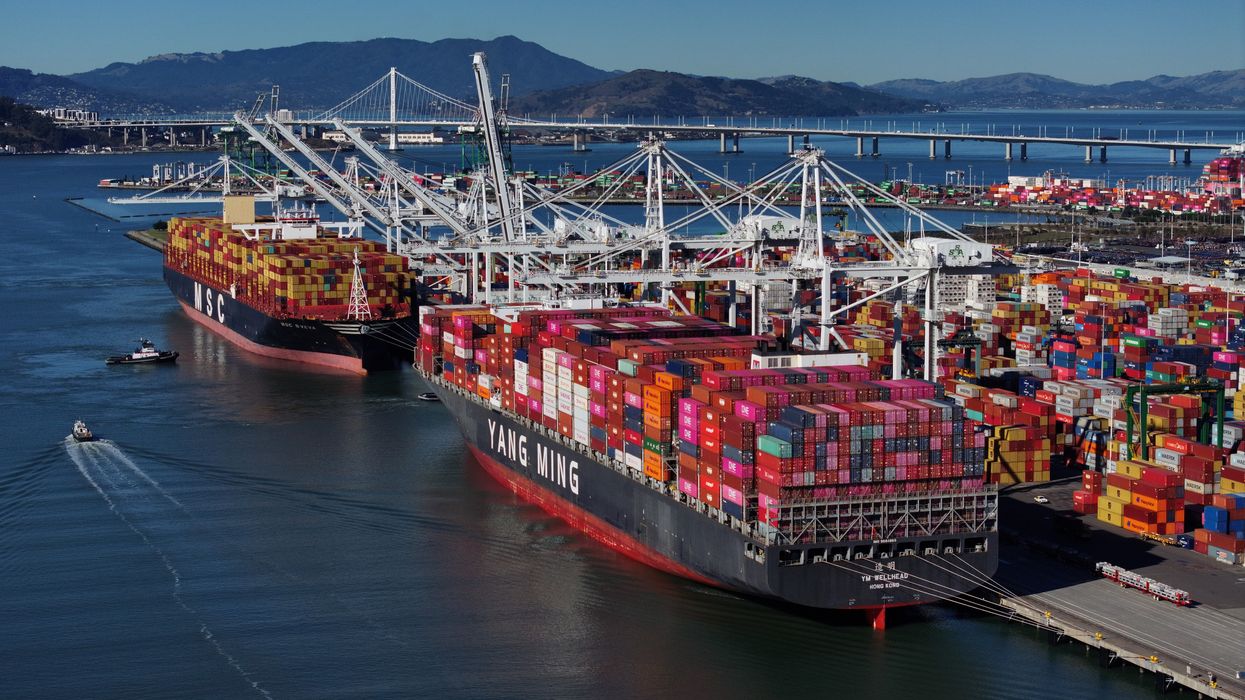
Tariffs are taxes paid to the federal government on imported goods. And, like all taxes, they have two purposes: to raise revenue and to alter behavior. In the case of import tariffs, the second purpose (changing behavior, in this case encouraging entrepreneurs to start manufacturing companies aka factories here in America) is far more important than the first.
It all began here in America when General Henry Knox rode up to Mount Vernon in the late summer of 1789 to tell George Washington that Congress had just elected him as the first president of the United States. Washington took the news, and had two requests for his old friend.
First, he asked Knox to let folks know he’d be delayed by a few days because he wanted to say goodbye to his mother, who was elderly and ailing (turned out, it was the last time he saw her alive).
Second, Washington asked General Knox to ride all the way up to Connecticut to visit Daniel Hinsdale, a man who’d been secretly manufacturing black-market American-made fine men’s clothing in defiance of British law for decades. Knox took Washington’s measurements and then, a month later, brought to New York (where the swearing-in took place on what is now Wall Street) a fine American-made suit, which Washington proudly wore. (The suit was brown; the black suit of his later, famous painting was British formal wear.)
This incident highlighted the manufacturing crisis facing our new nation, and Washington was acutely aware of it.
The British, for two centuries, had been extracting wealth from the American colonies by forbidding us from manufacturing everything from fine clothing (thus Hinsdale’s illegal business) to weaponry to sophisticated machinery: All such items had to be imported from British manufacturers. We sold England cheap raw cotton, for example, and they forced us to buy back expensive fine cotton clothing manufactured on the looms of British cities. (Homespun was still legal in the colonies.)
They also forced us to buy tea—then the primary American beverage—from the East India Company, an outrage that led directly to the Boston Tea Party of 1773, which arguably kicked off the American Revolution. Thus, when Washington came into office, the first challenge he faced was how to build an American manufacturing base that wasn’t dependent on British imports.
Thirteen years before Washington’s inauguration, British economist Adam Smith had made worldwide headlines with his bestselling 1776 book An Inquiry into the Nature and Causes of the Wealth of Nations, proposing that the main thing that made a country rich was independence in manufacturing.
The process of converting raw materials of little value into finished products with a high value (manufacturing) was, to Smith’s mind, the best and only practical way a nation could grow wealthy without overseas conquest and plunder.
A tree limb laying on the forest floor, for example, had no monetary value, but when labor and the tool of a knife were applied to it and it was turned into an axe-handle—a process called manufacturing—it now had a value that could be passed down through generations.
Smith called that wealth. That axe-handle became part of the aggregate wealth of the entire nation, and even if it was sold overseas that wealth would still remain here because its value was simply converted into currency which stayed in America.
This understanding led President Washington to commission his Treasury Secretary, Alexander Hamilton, to propose to Congress in 1791 an 11-step Report on the Subject of Manufactures, also known as The American Plan.
At the core of Hamilton’s plan were protective tariffs on goods that were then being imported but could be easily made in the USA. The tariffs would increase the price of the imported goods so much that they’d encourage American entrepreneurs to start factories to make the same things here.
(Hamilton’s plan also included government subsidies for companies that wanted to move manufacturing to the U.S., federal subsidies for the development of new technologies, a massive investment in infrastructure [particularly roads and water-power systems] to support industry, and a requirement that the U.S. government purchase only American-made products whenever possible.)
Within two decades, Congress and the Washington, Adams, and Jefferson administrations had put nearly all of Hamilton’s plan into effect, and major parts of it stood all the way up until Reagan’s neoliberal revolution kicked off in 1981.
Today, you’ll search for hours to find a single made-in-America product in most big-box stores.
Hamilton’s plan was such a successful and important part of how America became the wealthiest nation on Earth, and produced so much revenue, that virtually 100% of the cost of operating our federal government—from our founding until the Civil War—came from tariffs. The salary of every president from George Washington to Abraham Lincoln was paid by tariffs (some were domestic interstate tariffs, like on alcohol), as was the salary of every federal official and the cost of everything else the federal government did.
Fully two-thirds of federal government revenue came from tariffs from the end of the Civil War until the World War I era and the 1913 passage of the 16th Amendment (the income tax); a third of federal government revenue came from tariffs between WWI and WWII.
Today, however, it is under 2%.
Prior to Reagan, American manufacturing—kept on this continent by the force of tariffs—was at the core of the American Dream, with good union manufacturing jobs offering stability and prosperity to a growing American middle class from the 19th century until the 1990s. Tariffs also made America the technological leader of the entire planet.
The concept was simple: If a product could be made for $70 with cheap Chinese labor, but cost $100 to make with U.S. labor, we’d put a $30 tariff on it to equalize the labor costs. Ditto if overseas manufacturing was subsidized by governments or by a lack of expensive pollution controls or worker safety protections: we’d match those cost advantages with tariffs.
There was still a heck of a lot of trade going on in the world when tariffs were common. As late as 1975, our imports and exports were pretty much in balance (we had a $12 billion surplus).
And then came the neoliberal sales pitch of the 1980s, as I lay out in detail in The Hidden History of Neoliberalism: How Reaganism Gutted America.
If only we could get rid of those nasty tariffs—we had over 20,000 categories of products with specified tariffs—by reducing them to zero or very, very low numbers, Reagan, Bush, and Clinton told us, then American consumers would benefit because big retailers like Walmart could buy products made with cheap labor from overseas instead of from higher-paid American workers. Prices, in other words, would be lower for consumers.
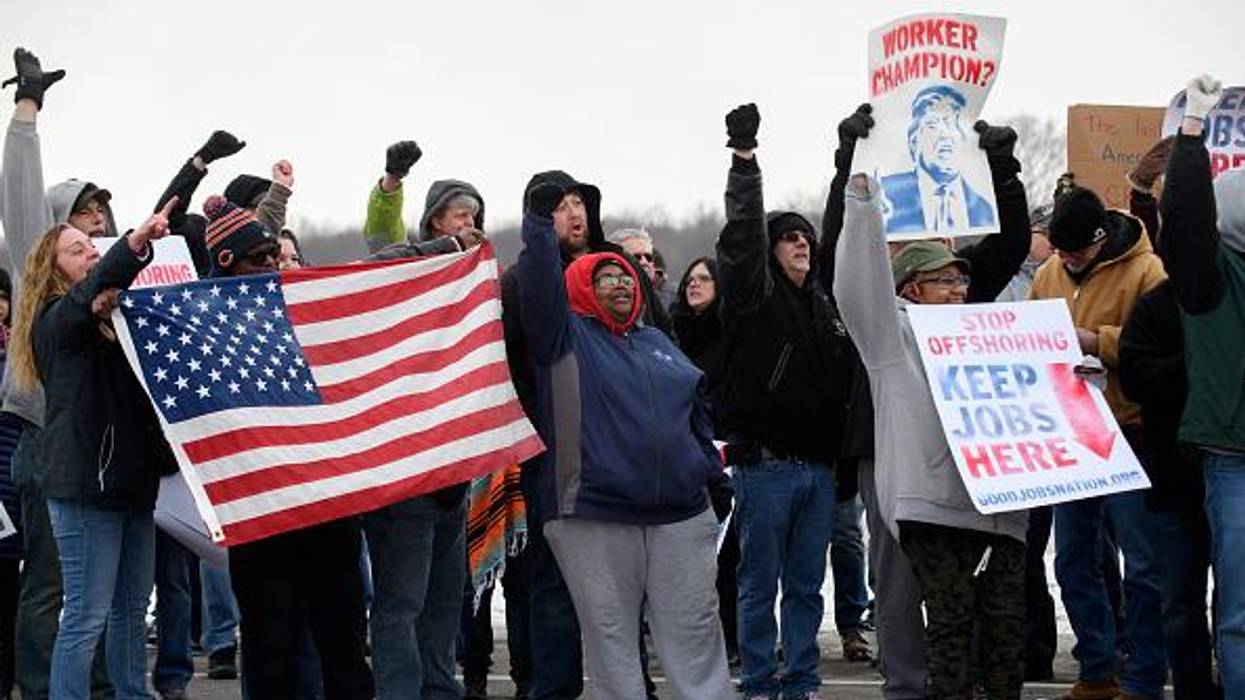
The result has been the shuttering of over 70,000 U.S. factories and the loss of around 8 million good often-unionized manufacturing jobs. It typically takes companies between one and two decades to shift manufacturing overseas, given how large a logistical operation it involves, and reversing the process will probably also take a decade or two.
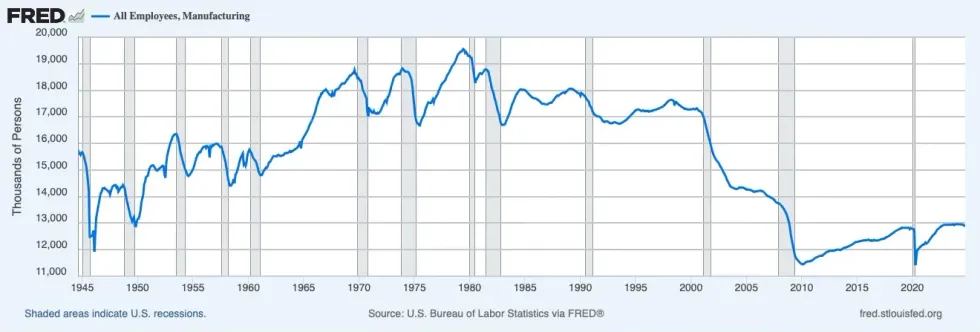
Entire regions of America were wiped out, producing a swath of our country now referred to as the “rust belt.” The situation was compounded by the Bush administration’s and the Supreme Court’s hostility to union rights.
Since Reagan’s “free trade” we’ve had nothing but annual trade deficits, each representing trillions in American worker’s wealth that’s been shifted to overseas manufacturing countries.
Sam Walton’s autobiography, titled Made in America, epitomized the situation prior to Reaganism when Walmart stores had big “100% Made In America” banners hanging over their front doors. Today, you’ll search for hours to find a single made-in-America product in most big-box stores.
How do we bring back tariffs and how do we avoid a trade war disaster like Trump caused during his first presidency?
Around that same time, another rationale for corporations seeking cheap labor and easy pollution regulations overseas began to take hold in the minds of the neoliberal intelligentsia: “Free trade,” they said, was so magical it could even bring about world peace!
The argument was simple, the neoliberals told us: History showed, they said, that countries that traded heavily with each other rarely went to war with each other. The example most often cited was that no two countries with MacDonald’s burger outlets had ever, at that time, gone to war (although they have since: see Russia and Ukraine).
Thomas Friedman jumped into the act at the end of the 20th century, promoting the MacDonalds’ Peace Theory and the transfer of American manufacturing overseas with his now-discredited 1999 book The Lexus and the Olive Tree.
Its impact, along with major campaigns encouraging “free trade” funded by American industrial and retail giants and their billionaire owners, echoed across American manufacturing and foreign policy for the next 20 years, as America continued to hemorrhage jobs along with the middle class “American Dream” wealth that accompanied them.
As a vast proportion of American manufacturing shifted to China, that nation—just like Hamilton predicted and proved with the U.S.—underwent the most rapid transformation from Third World poverty to First World affluence in the history of the world.
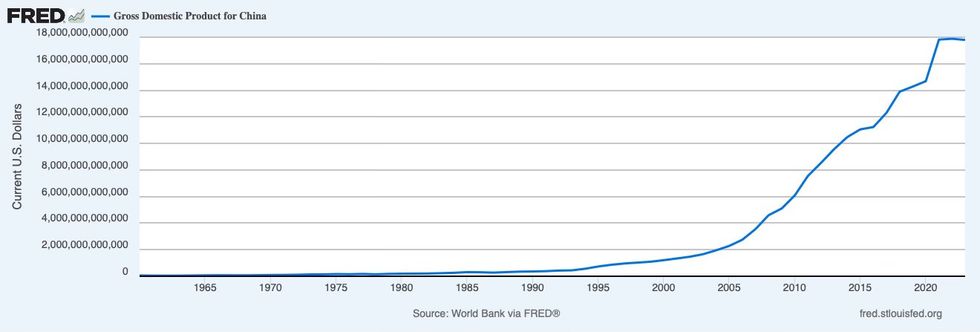
All because the “wealth” of America was transferred to China every time a cash-register rang at Walmart, an Apple Store, or in pretty much any other American retail outlet. And continues to this day.
So, how do we bring back tariffs and how do we avoid a trade war disaster like Trump caused during his first presidency?
The main goal of an import tariff is to encourage Americans to buy the products of domestic—rather than foreign—manufacturing. For that to work, companies that may consider investing billions in factories here in the U.S. need to know that the tariffs aren’t just a whim or election stunt like they were with Trump, but will be around for the coming years or even decades necessary to recover their initial billion-dollar investments in new manufacturing facilities.
Just because Trump was conceptually right about tariffs (but terribly wrong in how he executed them) doesn’t mean Democrats should freak out at any mention of them.
Tariffs also need to be brought in on an item-by-item basis, organically, with each imported item that we want to put a tariff onto examined for the tariff’s impact, both on domestic inflation and international relations.
We really have no need to put a tariff on, for example, imported artwork from Mexico or moose-skin jackets from Canada; there’s no competing domestic industry here. It’s why Trump’s proposed “across-the-board” tariffs are so stupid.
But the manufacture of cars, steel, chips, computers, toys, clothes, pharmaceuticals, and hundreds of other products and categories of goods can be brought back to the U.S. by appropriate tariffs, introduced gradually and predictably, done in a way that allows both foreign companies and U.S. entrepreneurs to adjust without major disruptions.
There’s also a national security aspect to this. Right now, it’s nearly impossible for the U.S. to manufacture a battleship or advanced aircraft without parts from overseas. Because tariffs had kept virtually all manufacturing here in the U.S. prior to WWII, shifting to a war-based manufacturing economy in the 1940s, before Reagan’s neoliberal “reforms,” was easy. Today it would be extremely difficult.
On top of that, we no longer make most therapeutic drugs here in America. China makes many of the raw ingredients for the drugs we use here, and most pharmaceuticals used in America are manufactured there and in India.
One result is that often drugs we take are contaminated because they’re made in plants outside the U.S.; an old friend got cancer from taking a drug contaminated by a toxic chemical, and my father got bladder cancer from taking a drug contaminated in India with N-nitrosodimethylamine (NDMA).
Also alarming, if we got into a serious conflict with China (for example) and they cut us off from all their manufactured goods, our economy would collapse overnight and we’d find it very, very difficult to manufacture some of our most important weaponry and telecommunications equipment. Not to mention the crisis of a massive drug shortage.
Thus, tariffs have to be put into place intelligently; after all, we’re reversing a neoliberal free trade process that took 44 years to get as bad as it is today.
We don’t want to start trade wars—like Trump did the first time with his tariff stunt and is threatening to do again in January—or wipe out people in poor countries (like Bangladesh or Malaysia, where much of our clothing is made), but we do want the “wealth of [our] nation” to be built and kept here.
We do this by having Congress openly discuss and debate tariffs, apply them gradually, and accompany them with supports for the poorer parts of the world that may be harmed by them, assisting them in developing sustainable domestic industries to replace their export losses.
This is not a radical idea.
China uses tariffs (and dozens of other trade restrictions) to protect its domestic industries. The European Union imposes tariffs on agricultural products to protect its farmers (averaging around 11.4%) as well as industrial goods (averaging around 4.1%). Some industries, like dairy products (38.4% E.U. tariffs) and confectionery products (24.6%), have asked for and gotten even higher E.U. tariffs to keep them viable domestically.
And, of course, that’s how America became the richest country in the world, and the loss of tariffs is a major part of why our standard of living has slipped so badly over these past 44 years of our neoliberal Reaganism experiment. Our wealth, along with our manufacturing and jobs, was simply shipped overseas—and now we must begin the process of bringing it back home.
Democrats know this, even if they’re unwilling to talk about it. The Biden administration took some good steps in this direction by imposing or maintaining multiple tariffs, and they’re already increased American prosperity, particularly for working people.
President Joe Biden increased tariffs on steel and aluminum products from 7.5% to 25% this year; tariffs on semiconductors will rise to 50% by 2025; tariffs on electric vehicles (EVs) hit 100% this year; tariffs on lithium-ion EV batteries and magnets for EV motors will go up by 25% by 2026. After the Covid-19 crisis, the Biden administration put a 50% tariff on syringes and needles to jump-start domestic production, and personal protective equipment (PPE) tariffs went up 25%.
This is not a black-and-white issue. Yes, tariffs are a tax and, until domestic manufacturing replaces foreign imports, they’re a tax that’s mostly passed along to consumers, resulting in higher prices for goods.
But when done right and gradually, those higher prices open the door for American companies to again become competitive, to manufacture goods here—and thus keep our jobs and our “wealth” here—while raising the wages and standard of living of American workers and people around the world.
Just because Trump was conceptually right about tariffs (but terribly wrong in how he executed them) doesn’t mean Democrats should freak out at any mention of them. They’re an important part—as Alexander Hamilton and George Washington taught us—of creating and maintaining wealth and independence for our nation.
And voters in the Rust Belt states know all this already.
As Trump behaves like a bull in a china shop, ready to slap punitive and politically-motivated tariffs on our top trading partners, expect considerable market and overall economic dislocation; a recession is a probable outcome.
But as he shatters the neoliberal tariff consensus, Democrats should rise to the occasion and argue for rational, targeted, and gradual tariffs, taking the Party back to its pre-1980s positions on trade.
And then they’ll be well positioned to both exploit the issue and rescue the American economy in 2026 and 2028 after Trump’s done his worst.
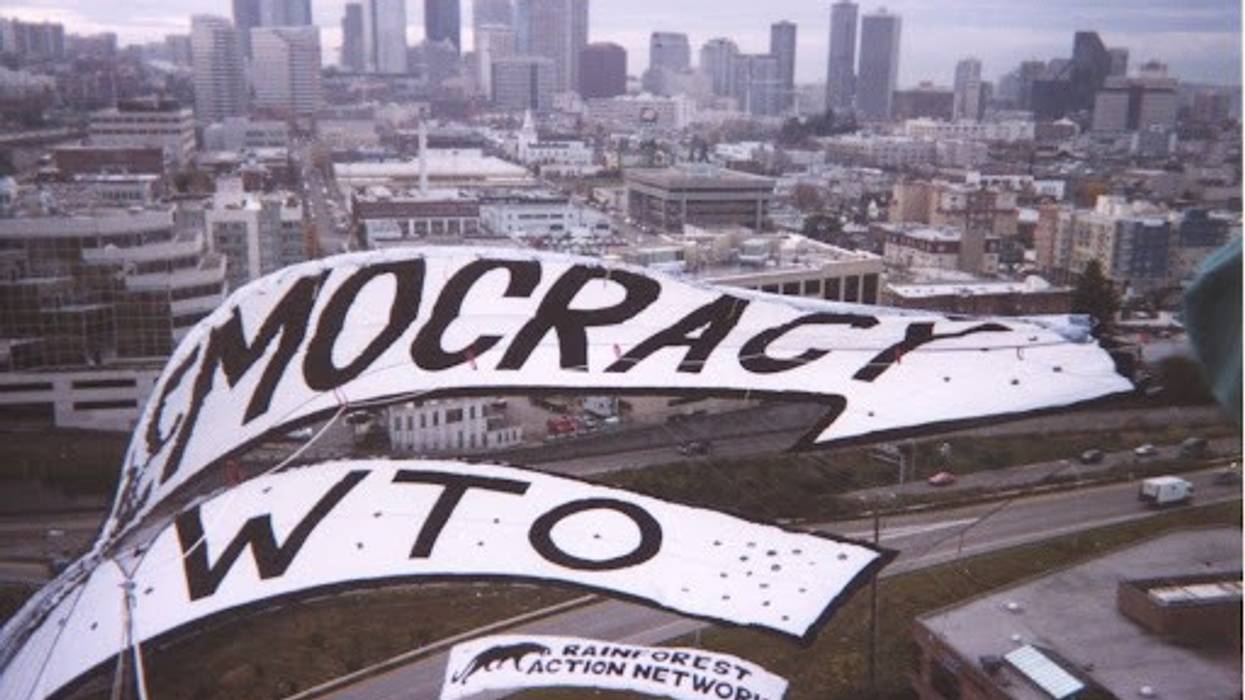
On November 30, 1999, a public uprising shut down the World Trade Organization and transformed downtown Seattle into a festival of resistance. Tens of thousands of people joined the nonviolent direct action blockade which encircled the WTO conference site, completely preventing conference meetings from dawn till dusk. We held the blockade in the face of an army of federal, state, and local police making extensive use of tear gas, pepper spray, rubber, plastic and wooden bullets, concussion grenades, and armored vehicles. After five days of protests and resistance, the talks at the WTO conference collapsed in failure.
25 years ago, for the six months leading up to the World Trade Organization (WTO) summit in Seattle in 1999, I met Deborah in organizing meetings to prepare. Today, while many of us continue our efforts for a better world in many different places and movements, for 25 years Deborah has remained in constant combat with the WTO, together with global movements as part of the Our World is Not for Sale network. I asked if they could share insights on the impacts of the Seattle WTO confrontation and the current threat of the WTO–including obstruction of the needed transition off fossil fuels and the growing domination of Big Tech.
David Solnit: What impact did the 1999 mass nonviolent direct action shut down and protest have on the WTO and plans for the global economy?
Deborah James: If the round of negotiations to expand the WTO, the so-called Millennium round that WTO proponents tried to launch in Seattle, had concluded, the world would be a much more unequal, exploitative, and ecologically devastated place. We actually stopped a terrible, no-good institution from getting even worse. This is the legacy that I have tried to uphold in the subsequent 25 years of focusing my life: stopping the expansion of the World Trade Organization.
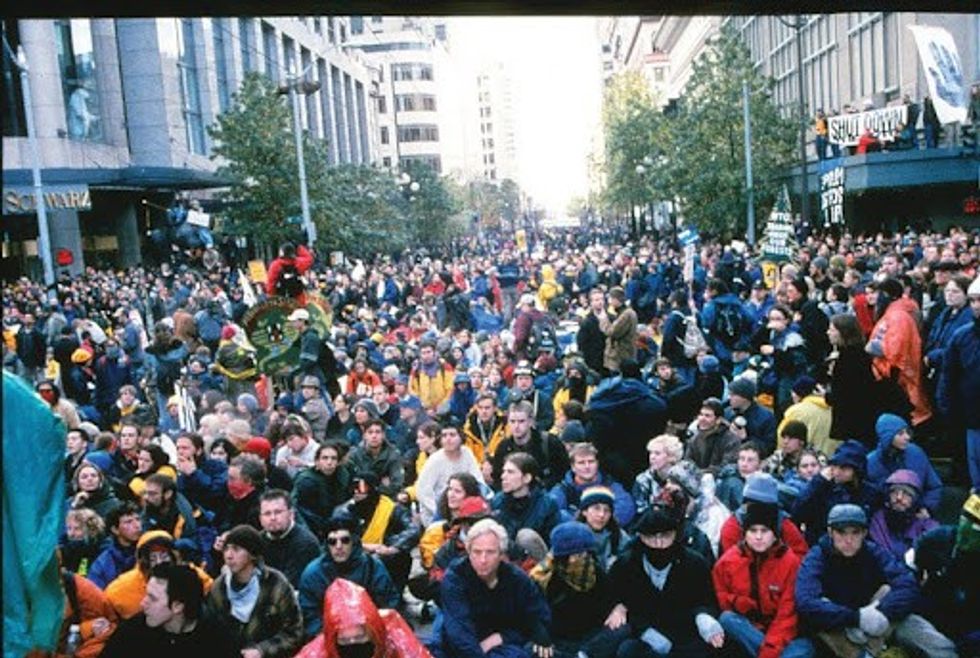 Seattle mass blockades shut down the WTO on November 30, 1999. (Photo: Dana Schuerholz)
What happened after Seattle, when developing countries rose up and put a stop to another round of neoliberal expansion, is extremely important. Developing countries had realized that they had gotten a bad deal at the founding of the WTO, that it was actually a deal written by the big corporate interests of the U.S. and Europe for their mutual benefit and for the exclusion of developing countries from the gains of trade.
After Seattle, neoliberal proponents realized that they would have to compromise with developing countries if they wanted to launch a WTO expansion.
Since 2001, developed countries have never agreed to a single one of the demands of developing countries for flexibilities to the existing harmful rules; that was envisioned as the core of the Doha round. In fact, around 2015, the United States stated that it would no longer participate in any negotiations under the framework of the development agenda. Many other countries followed suit. Nevertheless, WTO developing country members never agreed to give up the development mandate that their ministers set in 2001, and reaffirmed many times since. Instead, most negotiations in the WTO have centered on the developed countries agenda of WTO expansion, in agriculture, non-agriculture market access, services, and more.
In one instant, the cops asked her, "Where to next?" I responded, "To Starbucks!" A few minutes later I was on top of a van, microphone in hand, leading a protest against Starbucks for carrying sweatshop coffee.
As terrible as the WTO is, it could be a lot worse. Without this ability to hold a strong defensive line of the development agenda, which directly followed the Seattle collapse, WTO members would have significantly expanded the WTO in the last 25 years. For example, at the time of the founding of the WTO, most developing countries found the radical deregulatory rules of the "General Agreement on Trade in Services (GATS)" to represent far too big of a sellout to foreign giant services corporations than they envisioned for their domestic economies with regards to services.
Most developing countries kept services like education, healthcare, water and electricity distribution, municipal services, environmental services, financial services, and many others out of the GATS. Giant services corporations, such as the financial industry, pushed extremely hard for developing countries to agree to "bind" more of their services sectors to the WTO deregulatory and privatization agenda. They mostly failed. This means that developing countries still have much of that regulatory space that they preserved. Unless, of course, they gave it up through a bilateral or regional trade agreement.
One important gain won by developing countries was that domestic food security programs, which largely do not affect trade, can be exempt from WTO disciplines under certain conditions. The program is far too limited to really scale back the way that WTO rules exacerbate hunger and the impoverishment of farmers, but it was a very hard-won step in the right direction for countries to be able to guarantee the Right to Food of their citizens. We are still fighting to expand this agreement to cover more crops, to be available to more countries, and with fewer conditions that make it extremely difficult to use.
DS: What are some lessons do you carry with you today?
Deborah James: I carry a lot of lessons from those days.
One, that real organizing of that scale takes a lot of resources, a lot of time, but it also takes a lot of dedication from thousands of people who have a sense that what is going on is so outrageous, that they are willing to put their own time and talent and resources into doing something about it. And that they believe that their investment is worth the time because it is multiplied by the power of collective action toward a common goal.
In 1999, I started the national movement for Fair Trade certified coffee. The certification agency, Transfair USA, had just begun operations that summer. I worked to get dozens of college campuses started with their first campaigns to demand Fair Trade certified coffee on campus. In addition, we decided to launch a campaign against Starbucks, to pressure them to carry Fair Trade certified coffee. Starbucks was already hated by many in Seattle. A local group had convened a protest at one of the shops downtown at the beginning of the week. In the lead-up to the opening of the WTO ministerial, my colleague Leila had organized a large demonstration against the Gap. Her demo seemed to be winding down. In one instant, the cops asked her, "Where to next?" I responded, "To Starbucks!" A few minutes later I was on top of a van, microphone in hand, leading a protest against Starbucks for carrying sweatshop coffee, and demanding that they carry Fair Trade certified coffee instead. It was an object lesson in seizing the moment: doing one's homework, preparing the field, and then, surrounded by the support of your allies and colleagues, having the courage to up your game when the moment arrived.
Countries are free under WTO rules to subsidize their fossil fuel industries to the extent they please, while their subsidies for climate-friendly energy production are severely curtailed.
Another is that you need to have both an "inside game" and an "outside game." "Inside" to me are the people that track the issue—that know what's going on in the nitty-gritty in Geneva: the players, the issues, the texts, the potential impacts. "Outside" are the people who have the ability to hold their governments accountable. It doesn't just mean protests, but it definitely includes that aspect; it could also mean putting pressure through media or other mechanisms; the specter of electoral results; or, in the case of some governments, progressive lobbying. In the WTO, the decisions are made in the capitals—that's where the pressure from affected communities is most important. But it's also important to have a strong game in the negotiations, which are usually in Geneva at the WTO, and then occur every two years (more or less) at ministerials. You've got to have both.
DS: What is the impact of the WTO in communities' lives?
Deborah James: The WTO is the largest rulemaking institution in the global economy, and its rules are binding. When the United states, the E.U., and other neoliberal proponents invented the WTO, they set it outside of the existing system of global governance, which is the United Nations. As a treaty-based institution with 164 members, its rules are extremely difficult to change.
Let's take a few examples—and these are just two of myriad agreements in the WTO!
AGRICULTURE: In agriculture, we can imagine a set of global trade rules that ensures: the rights of citizens to adequate and nutritious food, guaranteed as a human right by their governments; agricultural practices and markets that ensure a decent living for farmers around the world; and the ability of countries to preserve and support rural development. Unfortunately, most of the rules regulating agriculture in the WTO do quite the opposite.
At the time of the founding of the WTO, the Europeans and the U.S. did not want agriculture to be part of the WTO, because these advanced economies are not competitive in international agricultural markets without their subsidies and protectionist tariffs. The E.U. and U.S. agreed to cap these tariffs and subsidies at existing levels, and to reduce them over time. However, they have never made the reductions, so the United States still subsidizes its large agribusiness industrial production to the tens of billions of dollars, while poor countries are largely prohibited from using such subsidies. At the same time the European Union is still able to use tools like tariff escalation, which allows them access to cheap, slave-labor produced cocoa from West Africa, while ensuring that all of the value add of making fine chocolate stays within the E.U.
INTELLECTUAL PROPERTY (aka BIG PHARMA PROFITEERS KILL!): WTO rules on intellectual property are some of the most damaging. It is important to note that the entire basis of industrial production in the United States was based on the combination of slave labor and of stolen industrial designs from England. However as the U.S. and E.U., along with countries like Switzerland and Japan, became industrial powerhouses, they sought to use patents, copyrights, and other intellectual property protections as a way to prevent competition, reduce consumer choice, and raise prices. This is the exact opposite of free trade.
The extremely protectionist system that the U.S. successfully exported into the WTO at the time of its founding, under the agreement on "Trade Related-Aspects of Intellectual Property Rights (TRIPS)" has instituted a worldwide system of monopolization, harmful incentives, and restrictions on access to medicine that has resulted in the unnecessary death and sickness of hundreds of millions of people. Patents severely curtail access to existing medicines that could otherwise be obtained for pennies on the dollar. It has led to the financialization of the pharmaceutical industry, in which Americans drastically overpay for medicines while people in developing countries cannot afford to get access to life-saving treatments, diagnostics, and vaccines. The many-year campaign for a waiver on TRIPS rules for Covid-19 vaccines, diagnostics, and treatments exposed how the WTO rules protect the rights of big pharma to profit over the lives of billions of people around the world. The intransigence of patent-protecting states clearly resulted in millions of deaths that could have been avoided.
DS: What about WTO's impact on climate change and the needed just transition from fossil fuels?
Deborah James: At the time of the founding of the WTO, major oil producers were successful in excluding fossil fuel subsidies from WTO rules. At the same time, modern, more climate-friendly technologies such as solar and wind production are subject to WTO rules on domestic subsidies. These include the fact that countries are not allowed to give subsidies for domestic production that they do not make available to other WTO members. In the WTO, this is called "non-discrimination." What this means, in effect, is that countries are free under WTO rules to subsidize their fossil fuel industries to the extent they please, while their subsidies for climate-friendly energy production are severely curtailed in the WTO, especially if they try to use those subsidies to not only address climate change but to also create domestic jobs. WTO rules, in a word, blocks a just transition.
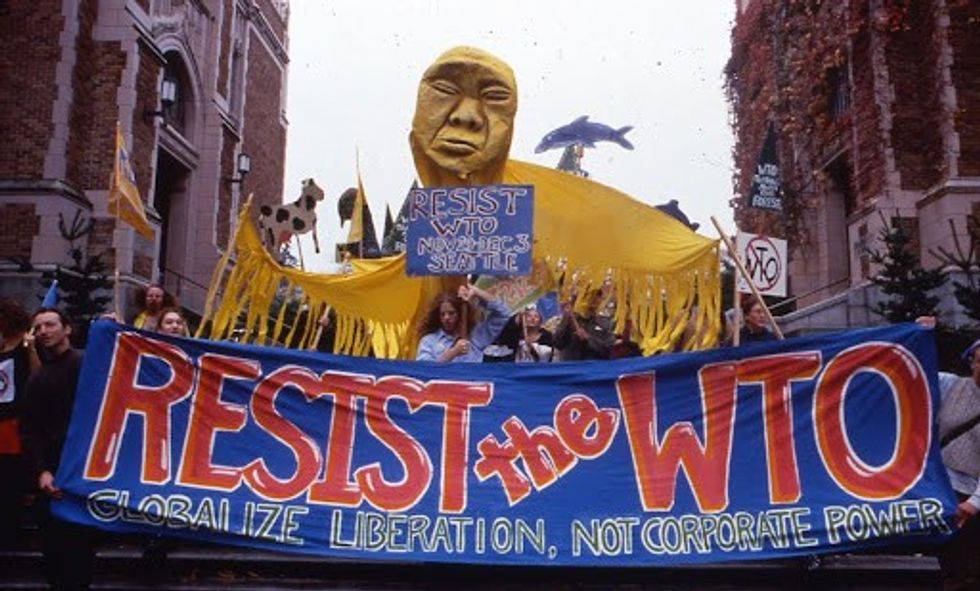 Neighborhood marches prepare for mass protest at the WTO in Seattle in 1999. (Photo: Dana Schuerholz)
DS: How has global corporate capitalism changed in 25 years—and the WTO?
I'm thinking of how much of the economy is (electronic) e-commerce and also Yanis Varoufakis' argument that Big Tech has changed everything—from "capitalism to techno-feudalism," in which the owners of platforms extract rent in the same way that feudal lords did.
Deborah James: At the time of the founding of the WTO, each major industry got an agreement to reshape, and really to rig, the global economy in its favor. Big agriculture got the agreement on agriculture; the financial industry got the GATS; big industry got the "non-agricultural market access agreement (NAMA)," etcetera. "Big Tech" was not yet a thing.
Since then, Apple, Meta/Facebook, Alphabet/Google, Microsoft, and Amazon have become five of the largest corporations in the history of the world. They would like an agreement, permanently binding on 164 countries, and enforceable in the World Trade Organization. They came up with a "digital two dozen" list of disciplines that they infiltrated into the Obama administration. These rules either give Big Tech corporations rights, such as: to enter whatever markets they want, even without a local presence; to sell whatever products they want; to collect all the data that they want, and move it around and process it in whatever ways they want; to maintain monopolies and integrate vertically; to maintain whatever legal form they want; etcetera. Their list also included restrictions on governments' ability to regulate them, such as limiting the collection or movement of data; limiting the ability of governments to collect taxes, either on their transactions or their profits; or requiring that local workers, the local economy, or local communities benefit in any way from their presence.
The WTO has been wildly successful for the purpose for which it was built: to rig the economy in favor of large corporations in powerful countries to further profit from developing countries, and workers, and consumers around the world.
In 2016, the United States introduced these proposals in the WTO, hijacking the slogan "ecommerce for development." Because of the dominance of U.S.-based Big Tech in the business lobbies around the world, most major industrialized countries followed suit. One can only imagine the asymmetry in negotiating power between developed countries with Big Tech lobbyists seconded to their delegations, backed by armies of lawyers and economists whose job was to invent ways to rig the economy for the power and profit of their corporations, compared with the negotiators of many developing countries, which lack universal access even to electricity, let alone highly-skilled domestic technological sectors to turn to for expertise.
However, the global network of civil society organizations that works together to stop the expansion of the WTO, Our World Is Not for Sale (OWINFS), learned of these proposals. Our members spent a year in deep analysis of the implications of these high-tech proposals and sharing that analysis with developing country trade negotiators, particularly through the Third World Network and the South Center.
At the WTO ministerial in December 2017, Big Tech made its push—for the launch of a multilateral round of negotiations on a digital trade agreement, then still referred to as e-commerce. Fortunately, the Africa group and several progressive Latin American countries held their ground. To this day there are still no multilateral negotiations on digital trade. Years later, the developed countries with a smattering of the most economically dependent, or pro-neoliberal, developing countries, launched "plurilateral" negotiations on digital trade. Likewise, these provisions are now found in every bilateral and regional trade agreement under negotiation. Fortunately, due to the extreme damages caused by this highly deregulated sector, governments have begun to realize the importance of "reining in Big Tech." Efforts are underway in many countries toward common sense public interest oversight over data flows, monopoly and competition issues, labor rights in the tech sector, taxation of Big Tech, discrimination and abuse (such as deep fakes), and many more issues.
If the digital trade agreement had been concluded as originally put forward by Big Tech under the Obama administration, the necessary policy space for democratic debate and public interest regulation worldwide of the largest, most profitable corporations in the history of the world would have been eviscerated.
DS: You wrote "In 46 of 48 cases in which countries tried to defend their public regulation based on the public interest exceptions in the WTO, the body decided in favor of the 'right to trade' over the 'right to regulate.'" Given its domination by rich countries and corporations, can the WTO be changed or must it be replaced?
Deborah James: The WTO has been wildly successful for the purpose for which it was built: to rig the economy in favor of large corporations in powerful countries to further profit from developing countries, and workers, and consumers around the world.
However this is not the institution that we need. As human beings on a shared planet, we need rules that discipline corporate behavior when they trade among countries, while ensuring that governments (which have the obligations to ensure the human, social, and economic rights of their citizens) have the policy space to achieve them. Thus, we need a global institution to discipline big agriculture, while allowing farmers a fair livelihood, people the right to food, and the ability of governments to promote rural development. We need rules that will discipline giant services corporations, while allowing governments the ability to guarantee quality, accessible public services, and the regulation of private services in the public interest. We need global health rules that guarantee access to medicine on a universal basis, while providing appropriate incentives for innovation in the health sector. We need binding rules so that large corporations pay their fair share of taxes worldwide. We need binding rules to ensure that we collectively make a Just Transition away from highly polluting fossil fuels and toward sustainable energy production in a way that promotes economic benefits from the bottom up. This, and more, is the Turnaround Agenda of global civil society. For each area of the economy, we call for: an assessment of the impact of the current rules on communities, countries, and our shared environment; a series of immediate steps to ameliorate the most damaging of the existing of WTO rules, in the short-term; and a completely different set of rules that will achieve our shared goals of environmental sustainability and shared prosperity.
Amazingly, the 13th Ministerial of the WTO in Abu Dhabi (MC13) was a clear victory for the Our World Is Not For Sale (OWINFS) global network.
In order to achieve the global economy that we deserve, we need a different institution. At the same time, it is extremely important to keep in mind that our opponents never stop working to expand corporate globalization. That is why so much of our work in the WTO is "on defense." If one were to say, for example, "I don't believe the WTO is reformable; therefore, I will stop working on it because that's reformist," that cedes the entire territory to the pro-corporate forces. In that scenario, we can only lose. It is only by actually stopping the harmful expansion of the WTO that we create space not only to fight for flexibilities to existing harmful rules, but for the space to eventually bring about the larger shifts toward a more balanced and fair institution, which will only come about under dramatic shifts in geopolitics—and when workers in the Global North and the Global South work together for the transformation toward more fair rules for everyone.
DS: What was your experience—and that of movements and civil society, confronting the WTO at the last 2024 ministerial in Abu Dhabi?
Deborah James: Amazingly, the 13th Ministerial of the WTO in Abu Dhabi (MC13) was a clear victory for the Our World Is Not For Sale (OWINFS) global network. Corporate interests had a number of agreements they were trying to push through on digital trade, investment, and regulation of domestic services. Due to the increasing opposition to Big Tech's harmful practices, the digital trade agreement was not finalized enough to be brought forward. On the plurilaterals on investment and services regulation, our technical experts successfully intervened to bolster opposition by developing countries and ensure more accurate media coverage. This prevented neoliberal proponents from being able to ram through these WTO-illegal agreements at MC13.
On agriculture, we have changes we'd like to see to the existing agreement—flexibilities to allow for more food security and food sovereignty. But this was not on the table coming into the ministerial. Thus, preventing an outcome that would have made the existing rules even more harmful for developing countries was a victory. There was similarly an anti-development text being negotiated on fisheries disciplines, which our member, the Pacific Network on Globalization, also supported developing countries to reject.
Some of the most pernicious proposals at MC13 were actually about the functioning of the WTO itself. After many years of failing to gain significant new rights and powers through the WTO, corporate proponents have been seeking to weaken the power of developing countries and civil society to resist. They had therefore put a number of proposals on the table for "WTO reform," which would have increased corporate power even further, while decreasing the power and leverage of developing countries and civil society in the negotiations. Fortunately, these were also rejected by the majority of the WTO membership.
In the end, most of the negotiations were simply punted back to Geneva.
How does civil society accomplish such a herculean task when facing opponents with thousands of times more resources than our scrappy bunch? First, we know our stuff. Many of our members, such as the experts at the Third World Network, have spent years poring over WTO texts and analyzing their potential implications, and sharing this information with developing country delegates. Over the years we have built a network of development advocates, public interest organizations, environmental groups, labor unions, and other economic justice advocates in the Global North and the Global South who are able to share information both about the technicalities of what's happening in Geneva, as well as the geopolitical shifts occurring in their home capitals. Within OWINFS, we create a dynamic where every person's talents and skills are seen, welcomed, and put to strategic use. People feel respected, so they give their very best to the collective effort.
OUR WORLD IS NOT FOR SALE NETWORK: The "Our World Is Not For Sale" (OWINFS) network is a loose grouping of organizations and social movements worldwide fighting the current model of corporate globalization embodied in the global trading system. OWINFS is committed to a sustainable, socially just, democratic, and accountable multilateral trading system. OWINFS operates primarily through our national members around the world. You can learn more about negotiations on Digital Trade; Trade & Environment; the Development Agenda; Fisheries, Food, & Agriculture; Intellectual Property/TRIPS, Investment, Services / GATS, and WTO Reform on our website. Our MC13 work is aggregated here.