

SUBSCRIBE TO OUR FREE NEWSLETTER
Daily news & progressive opinion—funded by the people, not the corporations—delivered straight to your inbox.
5
#000000
#FFFFFF
To donate by check, phone, or other method, see our More Ways to Give page.
Daily news & progressive opinion—funded by the people, not the corporations—delivered straight to your inbox.

We have arrived at a critical juncture in the history of this country and the world beyond, which is being buffeted by reactionary forces.
In principle, extremists primarily seek to harm people who do not share their race, religion, or nationality. In practice, they often harm the very people they claim to serve and protect, people with whom they share some supposedly sacred demographic.
Consider Minnesota, currently under siege by anti-immigrant extremists in the employ of the federal government, with ICE and CBP at the forefront. Immigrants have indisputably suffered the most from this program of harm, but we have seen a recent turn toward harming non-immigrants.
This change was starkly illustrated with the January 7 slaying of Renee Good by anti-immigration forces, which was followed by an escalating crackdown on protesters, observers, and people simply trying to go about their lives. On Saturday, January 24, ICE killed another Minnesotan, Alex Pretti, a registered nurse who worked to help veterans, who put his body between immigration officials and other citizens targeted for violence, as clearly seen in multiple videos of the slaying. Federal government agents are shown shooting Pretti in the back while he was pinned to the ground, immobilized, and disarmed.
It goes without saying that citizens and immigrants alike should be equally entitled to live with dignity and free of state violence, and it should be emphasized that citizens are not “more important” victims than immigrants. However, these recent attacks highlight an important dynamic and key vulnerability in any extremist movement.
Through their courage and solidarity, Minnesotans from all walks of life are asserting an authentic American identity based on inclusive ideals in the face of adversity and escalating violence.
To make sense of this, we must first discuss how and why extremists classify people according to their social identity. The broadest categories of identity are in-groups and out-groups. An in-group is the group to which one belongs, and an out-group is anyone excluded from that in-group. As defined in my MIT Press book on the subject, extremism is the belief that an in-group’s success or survival can never be separated from the need for hostile action against an out-group.
Enacting harm on out-groups is risky, difficult, and costly, so extremists almost always seek to make the task easier by enlisting the entire in-group. To understand how this works, it’s useful to break the in-group down into subcategories.
In the extremist context, eligibility refers to the traits that make someone eligible for in-group membership. For instance, according to the KKK, light-colored skin is the minimum requirement for eligibility in the category of “white people.” But eligibility implies a counterpart: ineligibility. To continue with the same example, the most obviously ineligible people are members of an out-group, such as those with dark-colored skin.
But eligible in-groups often rebuke the extremists who claim to represent them, throwing the extremist movement’s legitimacy into crisis. If the extremist movement can’t persuade the eligible in-group to enact harm on out-groups, it may try to change the composition of the in-group by declaring that dissenters have forfeited the right to their in-group identity.
Extremist movements are at their most dangerous during times of uncertainty or upheaval.
The ineligible in-group thus consists of people who possess the canonical qualifications for membership but whose actions put them at risk of expulsion. In white supremacist extremism, for example, the ineligible in-group usually includes white people who have sexual relations with non-white people and are therefore subjected to even harsher treatment than the out-group. For instance, the infamous “Day of the Rope” massacre described in the neo-Nazi novel “The Turner Diaries” refers to the gruesome public execution of white “race traitors,” while racial out-group members are killed without fanfare “off camera.”
Extremist movements are at their most dangerous during times of uncertainty or upheaval, when group boundaries can be suddenly redrawn, with control of the in-group hanging in the balance. An extremist movement that hasn’t consolidated control of the in-group often declares war against “ineligible” dissenters. We saw this play out in the mid-2010s, when the Islamic State organization (IS) attempted to consolidate its control of a large swath of Iraq and Syria. Sunni Muslims who opposed IS control were massacred mercilessly under the principle “nine bullets for the traitors, one for the crusader.”
Disturbingly, we’re seeing the early stages of this dynamic right now in Minnesota, although we can hope it will not evolve into atrocities of the same scale. Anti-immigrant extremists in the U.S. federal government have increasingly menaced and used violence against dissenters and observers who are U.S. citizens — members of the in-group that the extremists claim to serve and protect. In addition to the Good and Pretti shootings, federal agents have roughed up and detained observers without provocation, and have repeatedly used pepper spray on peaceful gatherings, sometimes at close range and in violation of safe operation guidelines. In one horrific incident, a car full of children was exposed to tear gas while their parents tried to drive them home from a school event. The extremists continue to escalate their program of harm against the ineligible in-group, with no end in sight.
One of the most important ways extremists seek control of the eligible in-group is by exploiting the socially constructed nature of reality. The theory of social construction is popularly understood as “consensus reality,” and its premise is simple enough: The world is too big and complicated for people to experience in its entirety. We can only understand the world through consultation with trusted others, who tell us what happens out of our sight and help us determine right from wrong. Put simply, we can only understand the world in dialogue with others.
In-groups and out-groups come into play during social construction. We tend to trust people whose experience of life is most like our own, typically those with whom we share some concept of identity — anything from race and religion to neighborhood and nationality. When this normal instinct congeals into an excessive attachment to a specific identity and a mandate to harm people who don’t share that identity, it becomes extremism. Almost everything done by authoritarians and fascists (for whom extremism is an essential tool) can be understood as an effort to control the social construction of reality by amplifying selected in-group views and entirely suppressing the views of out-groups through methods that range from discrimination to segregation to genocide.
To this end, the current generation of anti-immigration extremists is navigating turbulent waters, in part because its coalition is complex and not exclusively focused on immigration writ large. The alliance includes often-overlapping categories of racists, antisemites, misogynists, homophobes, and transphobes, and the priorities of its factions are not always aligned. This increasingly fractious coalition is ill-equipped to face down an increasingly cohesive coalition of Americans united by anger that our nation’s peace, progress, and safety have been intentionally undermined.
Minnesotans are courageously demonstrating this unity, mobilizing to defend neighbors whose race or national origin puts them at risk. In the process, they are communicating a strong in-group consensus to their persecutors by turning out in large numbers and loudly asserting their condemnation through shouting, blowing whistles, giving sermons, honking horns, posting signs, and painting graffiti. These expressions of in-group disapproval can help defuse the psychological drivers of violence and undermine competing narratives and political power structures that seek to validate an extremist orientation and the repressive tactics that it justifies.
In a globalized media environment like America’s, the in-group is never just local. People around the country can support Minnesotans using many of the same tactics — by speaking out and showing up in large numbers, both online and offline, as so many have already done. In conjunction — and perhaps even more importantly — we can fight the tide of hate by demanding that institutions, including politicians and the media, recognize the severity of the current crisis in American democracy and respond proportionately.
Those institutions are critically important precisely because America’s consensus reality is, again, too big and too diverse to observe directly. You could spend your entire life talking to Americans and still understand only a tiny fragment of the American experience. For in-groups larger than a neighborhood, the consensus is therefore described and defined by institutions and individuals in journalism, politics, and the arts. These portraits of the in-group consensus are distributed through traditional and new media platforms, and none of them are neutral.
The winner of this struggle will define what values the American in-group stands for, perhaps for generations to come.
It is no accident that the purveyors of hate have moved to take control of major news and social media platforms through a combination of money and pressure tactics, and to discredit and defund those they can’t control. In some cases, these platforms have been bought outright and subjected to blunt and obvious manipulation. In other cases, reporters have succumbed to flawed journalistic conventions, such as providing “both sides” of every controversy with equal weight, even when one side is obviously lying or otherwise detached from reality. This practice misleads the public by inflating the extremists’ appearance of strength and credibility under the guise of “balance.” (Imagine news programs inviting a flat-earth believer to weigh in whenever the subject of the globe comes up. That’s what happens now when the topic is immigration or vaccines.)
The in-group consensus can never be determined with perfect objectivity. The tools for measuring it, such as polls, are complex and subject to bias. Even if polls were perfectly composed and executed, they would still be open to wildly divergent interpretations. Look through the archives and ask which presidents won “with a mandate” over the last 100 years. Then compare their vote counts.
In other words, the consensus is won through perception. And when an authority figure, an institution, or an algorithm creates the perception that extremists are winning, it can become a self-fulfilling prophecy. People have a well-documented tendency to justify the legitimacy of the status quo as they perceive it.
Although we can reject those who would assign us to an out-group or an ineligible in-group, we cannot assume that our voices will be acknowledged. If America is to climb out of this era of rage and hate, those who stand against the extremist wave cannot just show up and expect to be counted. They must loudly demand their voices be acknowledged in every setting and institution of civic life, from business to politics, from news to the creative arts. With every death at the hands of anti-immigrant extremists, this assertion becomes more necessary and potentially more powerful.
Even so, a winning narrative or communication strategy may not be enough to defeat those who seek to control the in-group consensus using state violence. If the extremists can’t persuade the ineligible in-group to surrender, they will seek to intimidate and perhaps kill its members, an escalation that is now well underway. That is why the eligible in-group must defend its relevance with all available methods, including the courts, the ballot box, mutual aid, and more. Justice must be pursued, regardless of whether accused murderers wear a badge. And all of these in-group actions will build and reinforce support and mobilization networks that will be sorely needed before this is over.
We’ve arrived at a critical juncture in the history of this country and the world beyond, which is being buffeted by the same reactionary forces. The winner of this struggle will define what values the American in-group stands for, perhaps for generations to come. Through their courage and solidarity, Minnesotans from all walks of life are asserting an authentic American identity based on inclusive ideals in the face of adversity and escalating violence. For those values to prevail, we must stand together in their defense.
This piece was originally published by The MIT Press Reader and appears here at Common Dreams with permission.
Time to wake up, people. It's no longer just a dream—but a nightmare one step closer to happening.
One of the right’s favorite fever dreams over the years has been to gut the US Constitution of many of its checks and balances and officially turn America into a legal oligarchy with a strongman presidency, nearly bulletproof legal immunity for the morbidly rich, and full personhood for corporations.
As of this month, it’s no longer just a dream.
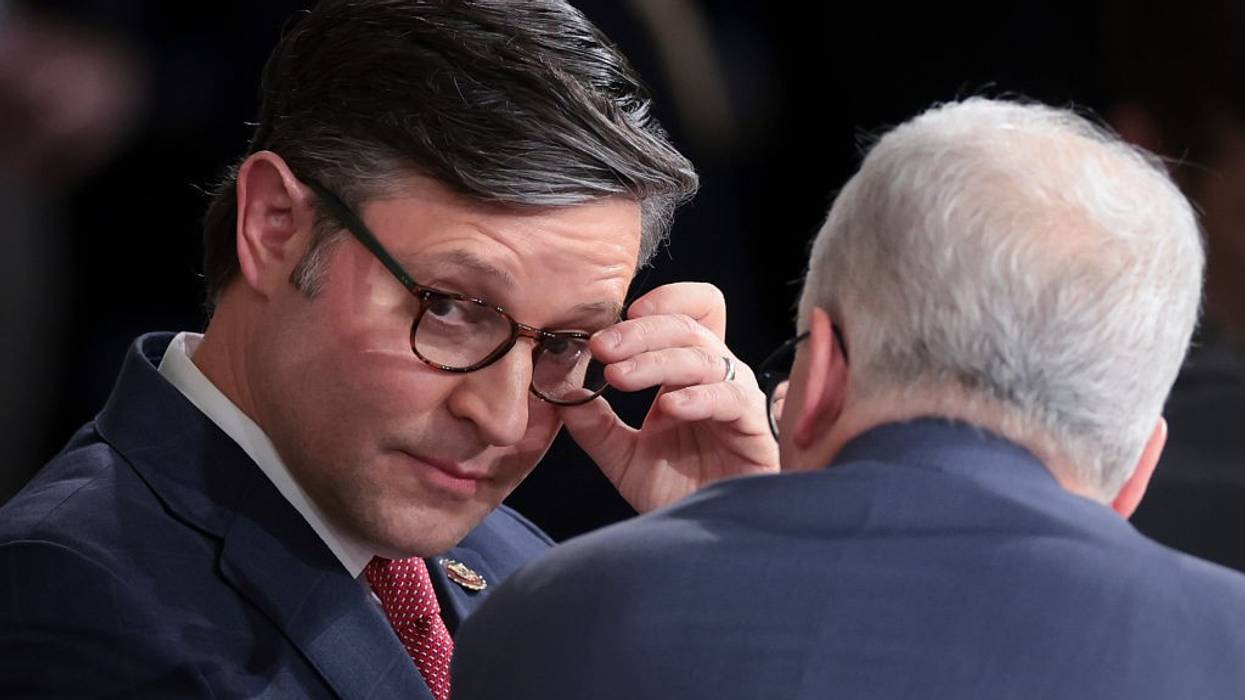
The American Legislative Exchange Council (ALEC) completed their winter “National Policy Summit” get-together in Scottsdale, Arizona last week with Speaker Mike Johnson as its keynote speaker. This is the group that’s brought “Stand Your Ground” and voter suppression “model legislation” to Red states across America and, for fifty years now, has been bringing together corporate lobbyists and Republican state-level politicians to make state after state more corporate- and billionaire-friendly.
If their plan works, these Republican toadies of the billionaires who fund and own them will rewrite our Constitution and state governors, the US Congress, and the President will have no say whatsoever in the process.
At this recent meeting they rolled out a new strategy to convene a Constitutional Convention, so they can finally remake America in their own image: they’re going to try to get the six corrupt Republicans on the Supreme Court — who all have direct or indirect ties back to ALEC, its related/affiliated organizations, and/or its funders — to go along with it.
Former Wisconsin Senator Russ Feingold (now a professor of law and president of the American Constitution Society) is not prone to hyperbole; he’s always been a thoughtful and measured speaker and writer. So, it’s worth taking him seriously when he recently said of MAGA Mike Johnson:
“It is alarming to have a speaker of the House who supports the extremist Convention of States movement, which is striving to radically rewrite the U.S. Constitution.”
Please consider the horrifying possibilities.
Morbidly rich billionaires and the groups they fund are working to rewrite our Constitution to do all this and more.
They want to provide corporations and the rich with more and more protections and benefits while chopping away at anything smelling of “socialism” like Social Security, child labor laws, or inheritance, income, and wealth taxes.
The Constitution provides for three ways to change or amend itself. The first is that Congress can propose a constitutional amendment, pass it with a supermajority in both houses, and have three-quarters of the states ratify it. This is the way it’s been done for every one of the existing 27 amendments.
The second strategy is done by using Article V of the Constitution and driving the process up from the states. The easiest way to do this is for three-quarters of the states to legislatively approve (with simple majority votes in the legislatures of each state) an amendment, in which case Congress is unnecessary and upon ratification by the 38th state, it becomes a permanent amendment to the Constitution.
While this strategy has never been used, it’s one process many of the good-government groups like Move To Amend and Public Citizen are pushing for a “Corporations are not people, and money is not speech” amendment to reverse Citizens United.
The third — and incredibly dangerous — strategy to amend the Constitution is to simply call a “Convention of the States,” again using Article V, and open the entire document itself up to rewriting and tinkering.
This third strategy is the one ALEC was pushing this month. If they can pull it off in the states (where it’s cheaper to buy politicians), then Congress, state governors, the president, and even the courts would have no say over it. And ALEC has spent the past 50 years becoming a major — some would say controlling — factor in Republican-controlled state legislatures.
Their barrier has been that it takes 34 states to call for a convention, and there have never been that many states calling call for one at the same time since the founding of our republic. However, as was pointed out at ALEC last week, every state except Hawaii has — at one time or another, starting with Virginia in 1788 — passed a resolution proposing a constitutional convention (there have been 400 such resolutions since the founding of our nation).
While most of history’s resolutions for a convention have been specific to one issue or another (New York’s 1789 resolution called for a Bill of Rights to be added to the Constitution, for example, something that Congress and the states did in 1791), a half-dozen were simply calls for a convention without specifics. These are sometimes referred to as “generic” convention resolutions.
The theory pushed at ALEC, first rolled out three years ago at an ALEC workshop by conservative activist David Biddulph but now apparently fully endorsed, is to combine the existing 28 Red state resolutions along with the six “generic” ones (going all the way back to 1789) to hit the magic number of 34 states to open the convention.
The key to the strategy is to get it before the Supreme Court and let the billionaire-owned Republican justices do ALEC’s work for it by ruling that those old resolutions are still valid, even though the people who proposed and passed them are all long dead.
Utah Republican State Rep. Ken Ivory told ALEC lawmakers it was imperative to get the issue before the Supreme Court:
“Please join us in the state of Utah as we look into the legal mechanisms that we have under the Constitution… to [get the Court to] declare that Congress must count the [old] applications. … And if, as we believe, we’ve already achieved 34 applications to Congress for a fiscal responsibility convention, call [it]… and hold a Convention of States.”
If their plan works, these Republican toadies of the billionaires who fund and own them will rewrite our Constitution and state governors, the US Congress, and the President will have no say whatsoever in the process. Only state legislatures are necessary for rewriting the Constitution and then ratifying their own work, according to Article V of the Constitution, and governors can’t veto their actions.
Much like the many cases that have suddenly burst onto the scene and then been used by the six corrupt Republicans on the Court to alter American law and take away citizens’ rights, this one could move quickly. Now that the ALEC meeting is over, expect to see states begin putting together the lawsuits or other legal actions necessary to get this proposal before the Court.
Alexander Hamilton was prescient: in the last sentence of Federalist 85, he warns us of efforts to re-write or replace our Constitution:
“I dread the more the consequences of new attempts, because I know that powerful individuals, in this and in other States, are enemies to a general national government in every possible shape.”
Common Cause and the Center for Media and Democracy have been at the forefront of sounding the alarm and I’ve hot-linked their names to their most recent articles about the work they’re doing to try to stop the billionaire machine devoted to rewriting our Constitution.
Please check them out, get on their mailing lists, and spread the word. This is one of those things that Republicans on the Court could use to seemingly spring out of nowhere and bring down our democracy once and for all.
Whenever lawmakers are debating a high-profile piece of legislation, the media returns to the easy description of pressures exerted by the far right and far left, as if these are similar forces.
Here’s how, in its lead story Thursday, The New York Times described the House’s vote to resolve Republicans’ self-imposed debt-ceiling crisis:
“With both far-right and hard-left lawmakers in revolt over the deal, it fell to a bipartisan coalition powered by Democrats to push the bill over the finish line, throwing their support behind the compromise in an effort to break the fiscal stalemate that had gripped Washington for weeks.”
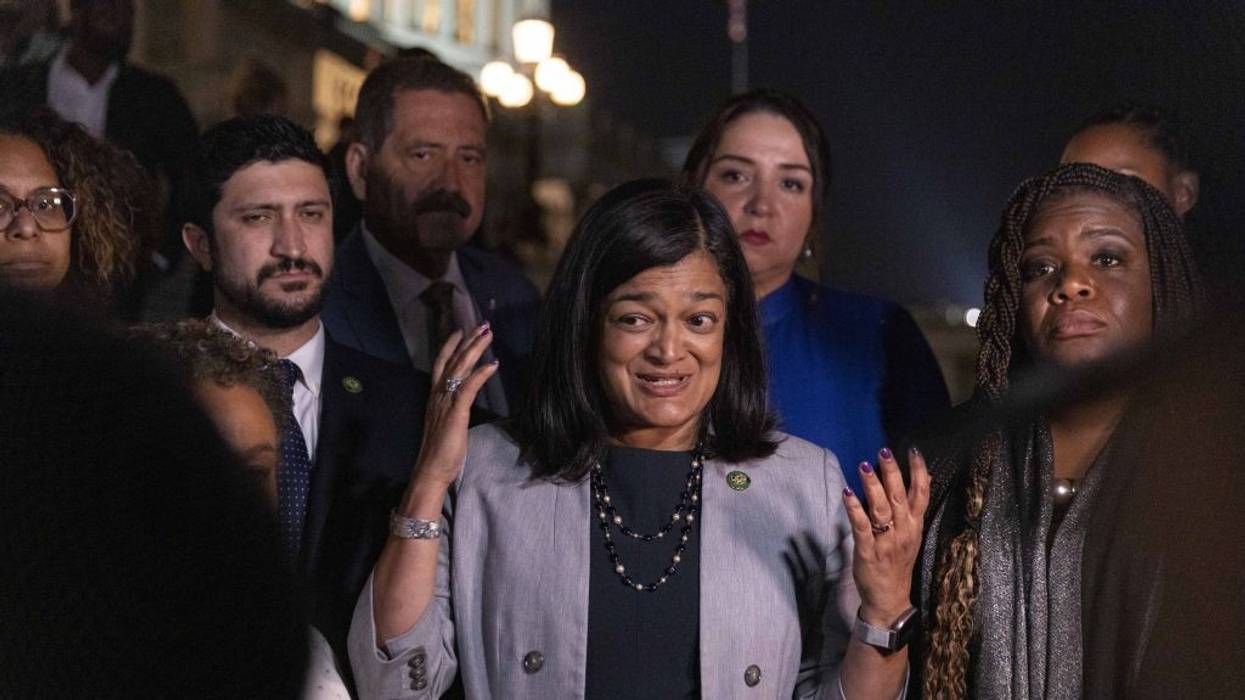
It’s not just the Times. This false equivalence between the two parties’ activist wings has been on display in press coverage throughout the debt-ceiling votes. Politico Playbook on Sunday described Congressional Progressive Caucus Chair Pramila Jayapal’s mixed reaction to the debt-ceiling compromise as indicating that the bill may have “a chance to win votes from some on the far left.” A Washington Post sub-headline that same day noted that “far-left and far-right corners of the House have criticized the compromise.”
These descriptions conjure a world in which the wing of the Republican Party defined by Reps. Marjorie Taylor Greene (R-Ga.), Matt Gaetz (R-Fla.), Elise Stefanik (R-N.Y.), Chip Roy (R-Ariz.), Lauren Boebert (R-Colo.) and Paul Gosar (R-Ariz.) is somehow balanced out by the wing of the Democratic Party defined by Alexandria Ocasio-Cortez (D-N.Y.), Jayapal (D-Wash.), Jamie Raskin (D-Md.), Greg Casar (D-Texas), Cori Bush (D-Mo.) and Jamaal Bowman (D-N.Y.).
On a scale of political ideology and positions from 100 to 0 (with 100 being the far left and 0 being the far right), and 50 being in the middle, even the most left-oriented Democrats (Ocasio-Cortez, Bush, Casar, Bowman, Raskin, Jayapal) are not extremists.
This idea is, of course, farcical—both in terms of the vote on the debt-ceiling bill and our politics more generally. Yet whenever Congress is debating a high-profile piece of legislation, the media returns to the easy description of pressures exerted by the far right and far left, as if these are similar forces.
In the case of the debt-ceiling compromise, 46 House Democrats and 71 House Republicans voted “no” on the legislation.
The Democrats who voted “no” range from liberals like Reps. Joaquin Castro (D-Texas) and Gerry Connolly (D-Va.) to progressives like Rosa DeLauro (D-Md.), Raúl M. Grijalva (D-Ariz.), Jayapal and Jan Schakowsky (D-Ill.) to democratic socialists like Ocasio-Cortez and Bush.
According to the Times’ own analysis, 40 of the 100 members of the Progressive Caucus (40%) voted “no,” while 34 out of 42 (81%) of hard-right Republicans (which the Times defines as members of the Freedom Caucus and those who opposed Speaker Kevin McCarthy’s election as speaker) voted “no.”
Two Republicans (Boebert and Jim Banks of Indiana) and two Democrats (Angie Craig of Minnesota and Deborah Ross of Pennsylvania) didn’t vote. Interestingly, two of the most reactionary Republicans, Greene and Stefanik, voted “yes”—a testament to their closeness with McCarthy, who appointed them to influential committees.
It is difficult to rank House members on an ideological scale because rankings look solely at voting records, and each organization that attempts to rank members selects different votes as crucial. The more important point, though, is not necessarily about voting records. It’s a question of how we define “extremism.”
On a scale of political ideology and positions from 100 to 0 (with 100 being the far left and 0 being the far right), and 50 being in the middle, even the most left-oriented Democrats (Ocasio-Cortez, Bush, Casar, Bowman, Raskin, Jayapal) are not extremists. They are different shades of social democrats; they espouse policies that are fairly mainstream across western democracies. They advocate for the rights of marginalized people and are pro-union, pro-choice, and concerned about climate change. They want to expand the social safety net, favor progressive taxation, and want to raise the minimum wage.
In contrast, the most right-wing Republicans are extremists and reactionaries. Many rub shoulders with, and speak in support of, white supremacists, Christian nationalists, and anti-Semites. In many cases, they want to repeal the political and cultural victories of the civil rights, feminist, gay rights, environmental, and labor movements. They deny that the 2020 election was legitimate, and took steps to overturn it. They support the January 6 insurrectionists, who they cast as freedom fighters. They have opposed the fundamentals of democracy—like the right to vote and the peaceful transition of power—and, in some cases, played active roles in the closest thing to a coup the U.S. has experienced in its nearly 250-year history.
It might be tempting to say that extremism is in the eye of the beholder. Ocasio-Cortez thinks that Greene is an extremist and vice versa. But for the media to continually create this false equivalence between the “far right” and the “far left” is misleading and distorts a crucial, critical reality of American politics in 2023—one that looms behind even the most anodyne legislative battle.
"There's not really another place in the U.S. that you could pick that would tap into these deep veins of anti-government hatred—Christian nationalist skepticism of the government," said one extremism expert.
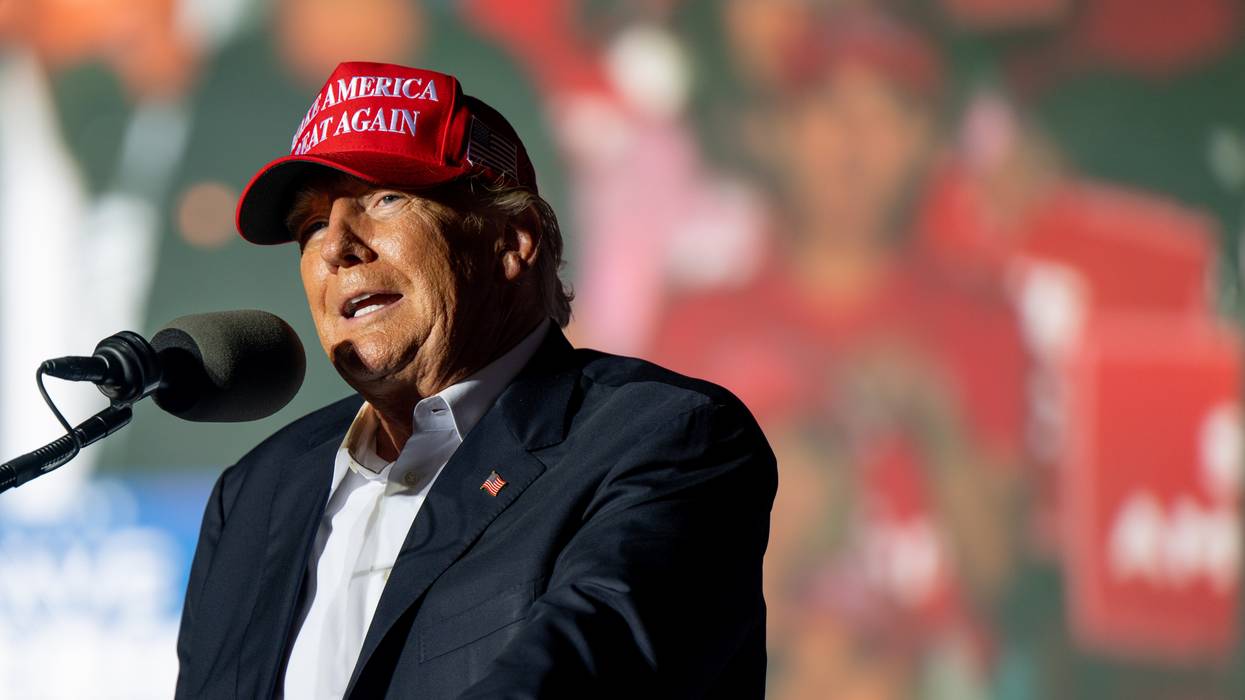
While former U.S. President Donald Trump's 2024 campaign insists it is purely coincidental that his planned Saturday rally in Waco, Texas falls during the 30th anniversary of a deadly 51-day siege targeting a religious cult, some Texans and extremism experts aren't buying it.
Since law enforcement—including Federal Bureau of Investigation (FBI) agents—carried out the botched operation at a Branch Davidian compound near Waco from February 28 to April 19 in 1993, the event has been a source of anti-government sentiment for the likes of Oklahoma City bomber Timothy McVeigh and U.S. militia movement members.
"When Donald Trump flies into Waco on Saturday evening for the first major campaign event of his 2024 reelection quest, dog ears won't be the only ones twitching," the Houston Chronicle editorial board argued Thursday. "Trump doesn't do subtle; dog-whistle messages are not his style. The more apt metaphor is the blaring air horn of a Mack 18-wheeler barreling down I-10."
"'Waco' has become an Alamo of sorts, a shrine for the Proud Boys, the Three Percenters, the Oath Keepers, and other anti-government extremists and conspiracists."
"The GOP-friendly city of Waco—Trump won McLennan County by more than 20 percentage points in 2020—has every right, of course, to host a former president, the leading contender for the 2024 Republican presidential nomination, but 'Waco,' the symbol... means something else entirely," the board stressed. "'Waco' has become an Alamo of sorts, a shrine for the Proud Boys, the Three Percenters, the Oath Keepers, and other anti-government extremists and conspiracists."
The twice-impeached former president faces potential legal trouble in multiple states and at the federal level for everything from a hush money payment to porn star Stormy Daniels to trying to overturn his 2020 electoral loss and inciting the January 6, 2021 attack on the U.S. Capitol.
Trump, a documented serial liar, took to his Truth Social platform last weekend to say that he would be arrested Tuesday—as part of a New York grand jury investigation into the hush money—and call for protests. Manhattan District Attorney Alvin Bragg said Thursday that Trump "created a false expectation that he would be arrested."
In a Truth Social post on Friday, Trump
warned of "death and destruction" if he is indicted—which led the watchdog Citizens for Responsibility and Ethics in Washington (CREW) to charge that "he's not being subtle, he's threatening prosecutors with violence."
The Chronicle board tied Trump's legal problems to his Waco trip:
Thirty years later, the anti-government paramilitary groups feeding off lies about the "deep state" and a stolen election periodically visit the modest, little chapel on the site of the sprawling, ramshackle building that burned to the ground. Although the Branch Davidians had nothing to do with anti-government conspiracists, chapel construction was funded by loud-mouthed conspiracy theorist Alex Jones.
Militia members and conspiracists know exactly what Trump's Waco visit symbolizes. They have heard him castigate the FBI and the "deep state," particularly after agents searched for classified documents at Mar-a-Lago. How they'll respond to his remarks, particularly if he shows up as the first former president in American history to face criminal charges, has law enforcement in Waco and beyond taking every precaution. What he says will likely set the tone for the presidential campaign to come. Every American should be concerned.
Trump campaign spokesperson Steven Cheung wrote Friday in an email to The New York Times that Waco was chosen "because it is centrally located and close to all four of Texas' biggest metropolitan areas—Dallas/Fort Worth, Houston, Austin, and San Antonio—while providing the necessary infrastructure to hold a rally of this magnitude."
The Chronicle board noted other local options, writing that "the Waco Regional Airport and an expected crowd of 10,000 or so fit the bill. Of course, Temple or Belton or Killeen (home to Fort Hood) would have fit the bill, as well—without the weight of symbolism."
The Texas newspaper was far from alone in sounding the alarm about Trump's upcoming trip to Waco.
"Waco is hugely symbolic on the far right," Heidi Beirich, co-founder of the Global Project Against Hate and Extremism, told USA TODAY. "There's not really another place in the U.S. that you could pick that would tap into these deep veins of anti-government hatred—Christian nationalist skepticism of the government—and I find it hard to believe that Trump doesn't know that Waco represents all of these things."
"Waco has a sense of grievance among people that I know he's got to be trying to tap into," Beirich added. "He's being unjustly accused, like the Branch Davidians were unjustly accused—and the deep state is out to get them all."
The newspaper pointed out that "though Trump has held more than 100 campaign rallies and similar events, and mounted a near-daily schedule of them during his campaigns, this week's appears to be the first one ever held in Waco."
Megan Squire, deputy director for data analytics at the Southern Poverty Law Center, also rejected the Trump campaign's suggestion that the trip isn't connected to the 1993 standoff and what means to many members of the far-right.
"Give me a break! There's no reason to go to Waco, Texas, other than one thing," Squire told USA TODAY. "I can't even fathom what that's about other than just a complete dog whistle—actually forget dog whistle, that is just a train whistle to the folks who still remember that event and are still mad about it."
Even some right-wing figures are openly making the connection, as TIME reported: "Posting on the messaging app Telegram, far-right activist and conspiracy theorist Laura Loomer called the rally in Waco 'very symbolic!' A few MAGA influencers on social media noted the choice of location, with one calling it 'a meaningful shot across the brow of the deep state.'"
Nicole Hemmer, a Vanderbilt University associate professor of history and author of Messengers of the Right: Conservative Media and the Transformation of American Politics and Partisans: The Conservative Revolutionaries Who Remade American Politics in the 1990s, wrote in a Friday opinion piece for CNN that Trump's trip is "a provocation of historic significance."
"When Trump became president in 2016, rather than becoming synonymous with the federal government as previous chief executives had done, he styled himself as both its victim and its adversary, promoting conspiracies about the deep state and encouraging supporters to keep him in power by any means necessary," Hemmer highlighted. "In choosing Waco as the kickoff site for his campaign rallies, he has signaled that his courtship of extremist groups will continue, and that he sees his role as a pivotal figure in the far-right mythos as central to his efforts to retake the presidency."
Applying adjectives like "moderate" to congressional Republicans is much worse than merely bad word choices.
The current notion of a "moderate Republican" is an oxymoron that helps to move the country rightward. Last week, every one of the GOP's so-called "moderates" voted to install House Speaker Kevin McCarthy, who won with the avid support of Donald Trump and got over the finish line by catering to such fascistic colleagues as Matt Gaetz and Lauren Boebert. Recent news reports by many outlets—including the Washington Post, USA Today, The Hill, Bloomberg, CNN, NBC, Reuters, HuffPost, and countless others—have popularized the idea of "moderate Republicans" in the House. The New York Times reported on "centrist Republicans." But those "moderates" and "centrists" are actively supporting neofascist leadership.
Notably, Joe Biden made this implausible claim while campaigning in May 2019: "The thing that will fundamentally change things is with Donald Trump out of the White House. Not a joke. You will see an epiphany occur among many of my Republican friends." During his celebratory victory speech in November 2020, Biden bemoaned "the refusal of Democrats and Republicans to cooperate with one another," proclaimed that the American people "want us to cooperate" and pledged "that's the choice I'll make."
Those who aid and abet right-wing extremism are part of the march toward fascism.
Later, as president, Biden came to a point when—in a ballyhooed speech last September—he offered some acknowledgment of ongoing Republican extremism, saying: "Donald Trump and the MAGA Republicans represent an extremism that threatens the very foundations of our republic. Now, I want to be very clear up front: Not every Republican, not even the majority of Republicans, are MAGA Republicans. Not every Republican embraces their extreme ideology. I know because I've been able to work with these mainstream Republicans. But there is no question that the Republican Party today is dominated, driven, and intimidated by Donald Trump and the MAGA Republicans, and that is a threat to this country."
But as with routine media coverage, Biden does not acknowledge that every Republican now in the House is functionally a "MAGA Republican." Claiming otherwise—calling some of them "moderate Republicans"—is like saying that someone who drives a getaway car during an armed robbery isn't a criminal. Those who aid and abet right-wing extremism are part of the march toward fascism.
If a handful of—by some accounts a half-dozen, by others as many as 20—House Republicans are "moderates," then such media framing normalizes and legitimizes their tacit teamwork with the likes of Trump and ultra-right Congresswoman Marjorie Taylor Greene that made McCarthy the speaker. In the process, the slickly evasive language makes possible the continual slippage of public reference points ever-further to the right.
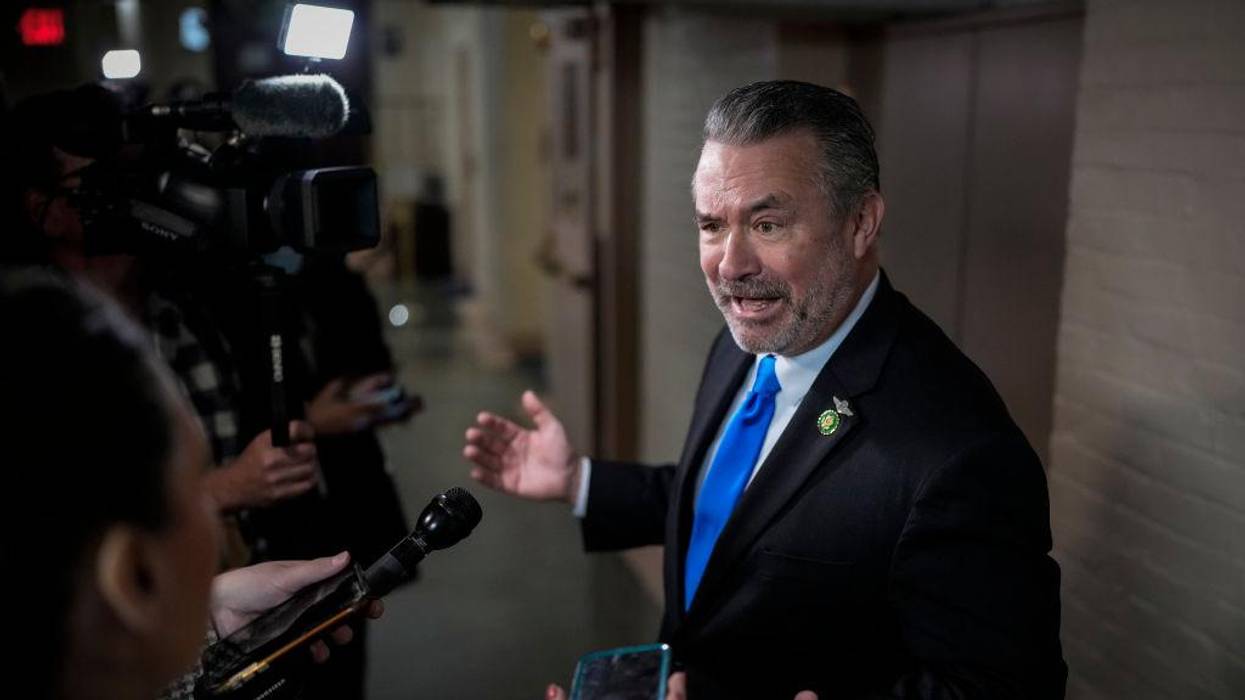
So, during last week's multiple ballots that concluded with McCarthy's win, Rep. Don Bacon of Nebraska was portrayed in the news as a "moderate Republican" who talked of seeking Democratic votes to help elect McCarthy and of possibly working with Democrats to find a "moderate" GOP speaker. Bacon labeled the anti-McCarthy holdouts "cowboys" and "the Taliban."
But if Bacon is a "moderate Republican," it's odd that he would help lead a rally before the 2020 election with MAGA firebrand and Students for Trump leader Charlie Kirk, which ended with a yell from Bacon: "Making America great again!" Or that he voted both times against impeaching President Trump, including after the Jan. 6 Capitol assault. Or that he cosponsors the extreme Life at Conception Act. Or that he has questioned climate science: "I don't think we know for certain how much of climate change is being caused by normal cyclical changes in weather versus human causes."
Looking ahead, you can bet that after years of being touted as "Republican moderates" in Congress, a few will be trotted out in prime time at the 2024 Republican National Convention to assure the nation that the party's nominee—whether Donald Trump or Ron DeSantis or some other extremist candidate—is a great fit for the presidency. The impacts of such deception will owe a lot to the frequent media coverage that distinguishes between the most dangerously unhinged Republican politicians who dominate the House and the "moderate" ones who make that domination possible.
Applying adjectives like "moderate" to congressional Republicans is much worse than merely bad word choices. Our language "becomes ugly and inaccurate because our thoughts are foolish," George Orwell wrote, "but the slovenliness of our language makes it easier for us to have foolish thoughts." And dangerous ones.
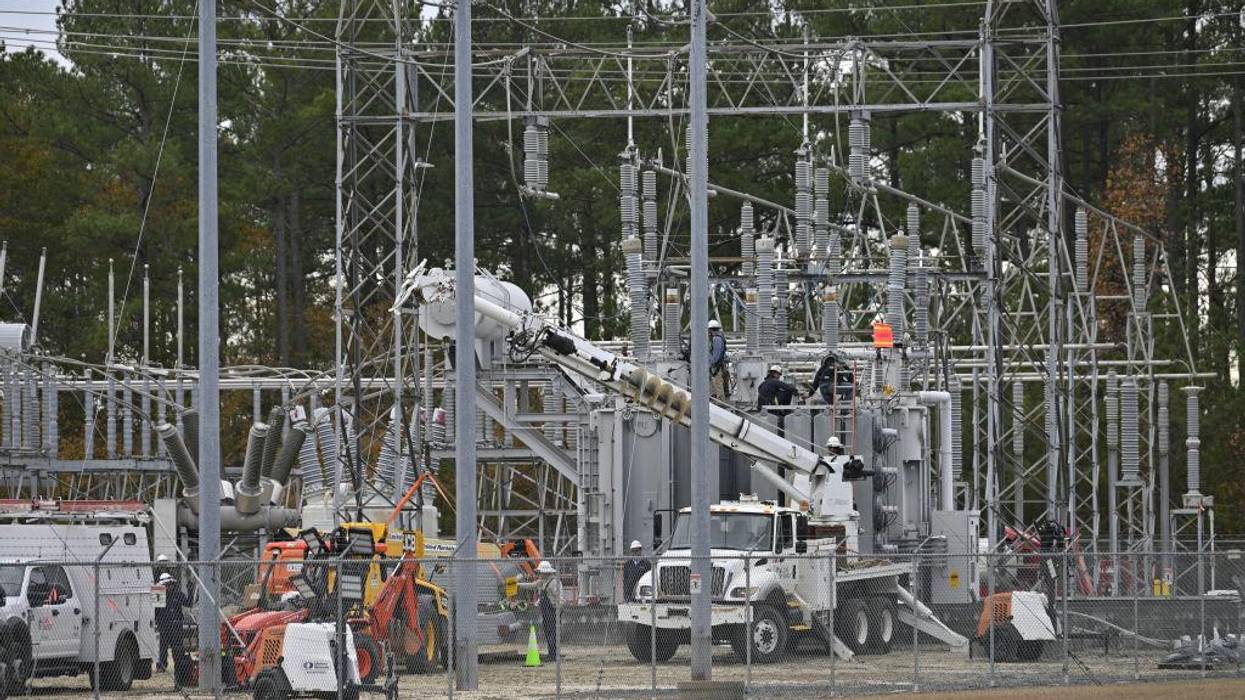
The MAGA cult may be embracing even more warmly the idea that political violence can be a more effective means of achieving the sinister goal that they are failing to reach through legal and political means.
Lost in the rush of political and climate-related news in the closing weeks of 2022 was the small but intriguing story of a December 3rd armed attack on two power substations in Moore County, North Carolina. The installations were severely damaged by gunfire, leaving 45,000 residents to suffer through the winter cold without power, many of them for several days.
A little over two weeks after the attack, a large, swastika-bedecked banner sporting the slogan “BRING IT ALL DOWN” was hung from an overpass on US Route 1, a few minutes’ drive from the substations. The banner included an internet address leading to a photo of an electrical substation under the same “BRING IT ALL DOWN” slogan. That photo had been posted following an earlier substation attack in Maysville, North Carolina, 170 miles away.
In the months leading up to these incidents, far-right elements had shown growing interest in sabotaging the nation’s electrical grid. The US Department of Energy reports “hundreds of physical attacks to electrical systems”—with “the most in the last decade” occurring in 2022. Intentional damage, sabotage, or vandalism accounted for more than one out of four power disruptions across the country during that period. Annual numbers of such attacks have doubled over the past 10 years.
"The rise in attacks on electrical distribution systems has been striking."
Because the North Carolina strikes caused an especially serious disruption, they broke into the national news cycle. These kinds of stories are typically covered only on the local 11 o’clock news, but this year’s surge in such incidents is coincident with, and potentially connected to, the politicization of energy and climate throughout extremist circles, so it’s a story we should all be keeping an eye on.
Coming off its recent losing streak in the federal courts, in Congress, and finally, at the polls, will the MAGA cult increasingly turn to violent local actions, including sustained assaults on the power grid? If so, what would be the potential consequences for the nation’s electricity supply—something that’s as essential to the maintenance of a high-tech industrial society as food and water, but is also a crucial factor in the global ecological emergency?
The rise in attacks on electrical distribution systems has been striking. In September, intruders broke into and damaged six substations in Florida, triggering power outages. In early November, someone riddled two substations in Ohio’s Knox and Licking Counties with dozens of rounds from a .308 caliber rifle. The attack resulted in “a power outage giving students a three-day weekend,” according to local reports.
November also saw attacks on at least a half-dozen substations in Oregon and western Washington. According to an FBI memo, the mayhem included “setting the control houses on fire, forced entry and sabotage of intricate electrical control systems, causing short circuits . . . , and ballistic attack with small caliber firearms.” This Pacific Northwest spree resumed on Christmas Day, when vandals broke into and disabled four substations in the Tacoma, Washington, area, plunging 14,000 households into holiday darkness. Two men were arrested on New Year’s Eve and charged with the sabotage.
Then, on January 4, a man allegedly drove a vehicle through the fence surrounding a solar power plant near Las Vegas, parked the vehicle next to a large transformer, and set it on fire. The solar farm—home to 300,000 panels with enough capacity to supply 27,000 U.S. homes—was knocked out of service for at least a week. The man was apprehended and charged with terrorism and arson.
Suspects have not been identified in any of the late 2022 substation attacks other than the Tacoma and Las Vegas incidents. In a November 22 bulletin sent to private industry and obtained by CNN, the FBI warned of a rise in such attacks and stressed that their purpose could well be “to create civil disorder and inspire further violence.” Citing the report, CNN noted that “anti-government groups in the past two years began using online forums to urge followers to attack critical infrastructure, including the power grid. They have posted documents and even instructions outlining vulnerabilities and suggesting the use of high-powered rifles.”
Writing for Newsweek in late October 2022, Tom O’Connor and Naveed Jamali reported on a corporate intelligence security memo describing at least 15 incidents, going back more than a year, in which online extremists urged attacks on electrical substations, cell towers, and pipelines. O’Connor and Jamali examined documents that, they wrote, “could serve to help groups and individuals in carrying out such attacks, including maps, manuals, and instructions on the vulnerabilities of electricity infrastructure and readily accessible methods to disrupt their operation.”
Law enforcement officials are noting that the nation’s 55,000 substations—essentially huge transformers that reduce the voltage of electricity delivered by long-distance lines before it’s distributed to customers—make for juicy targets. Most substations are located in isolated spots that punctuate the nation’s 160,000 miles of high-voltage power lines—places where saboteurs can break into the station or fire a few rounds at the equipment and then make a getaway without being seen. Indeed, it appears that none of this fall’s perpetrators has been identified yet.
Domestic terrorists, officials told the news site Insider, may “feel that disrupting the electrical supply will disrupt the ability of government to operate. . . . And, secondly, by conducting attacks against the communications and electrical infrastructure, [that] it will actually accelerate the coming civil war that they anticipate, because it will disrupt the lives of so many people that they will lose faith in government.”
Writing less than two weeks before Election Day 2022, O’Connor and Jamali argued that these far-right terrorists’ focus on energy infrastructure was no coincidence: “Adding to the volatility of the situation, inflation and rising gas prices have proven top issues among voters, making energy sites an attractive target for groups and individuals seeking to cause mayhem at a politically sensitive time for the nation.”
Without knowing who’s responsible for these attacks, we can’t know for certain if the perpetrators’ goals are connected to energy and climate or just general disruption and chaos. My guess is that most of the actions so far have been, like the North Carolina attacks, more pro-white than anti-green. But we have also seen how, in their reactionary fervor, far-right movements can be fluid when it comes to the specific causes they ally themselves with.
Think of the Proud Boys, who are currently on trial for seditious conspiracy in federal court. They came to prominence because of their associations with Trumpism and their central role in the January 6 attack on the Capitol, but they’ve since piggybacked on a broad array of cultural battles over Covid lockdowns, masks and vaccines, critical race theory, trans hate, and QAnon fever dreams.
"In their reactionary fervor, far-right movements can be fluid when it comes to the specific causes they ally themselves with."
Now, in ginning up their followers over the supposed loss of their “freedoms,” far-right leaders increasingly cite climate and energy issues alongside their usual appeals to white patriarchy. Speaking in September to the ultra-right student-led movement Turning Point USA, radio host and provocateur Alex Jones (who did more to assemble and mobilize the January 6 mob than just about anyone with a last name other than Trump) was asked by TPUSA’s Charlie Kirk how the Green New Deal and “environmental fascism” connect to what the far right has come to call the “Great Reset”: the claim that a global liberal elite is plotting to control humanity. Jones responded, “If energy was a chess piece for the globalist game plan, on the board, it’s the queen.” That, he said, means, “if you control energy, you control populations, you can bring them to their knees.”
Ted MacDonald of Media Matters writes,
While conspiracy theories related to the Great Reset as a whole are not new, issues of climate denial associated with the Great Reset have been gaining momentum across right-wing media in recent months, fueled by the global energy crisis and a summer of climate-fueled weather disasters. . . . Notorious climate denier Marc Morano was pushing this idea as early as 2020, when he stated on the December 21 edition of Fox News’ Tucker Carlson Tonight that the Biden administration will “go from COVID lockdowns to climate lockdowns.”
MacDonald quotes Carlson himself claiming, “Energy is civilization. . . . People don’t understand how threatening [Democrats’ climate policy] is and how close we are to being under the complete and total control of people who wish us ill.”
Rita Katz, the founder and executive director of the SITE Intelligence Group, told the reporters O’Connor and Jamali, “Immediately after the reports about the [December 3] attacks, we at SITE saw such communities praise what happened in North Carolina and call for more, while sharing more directives about what to target and how to do so. Some have specifically suggested large cities,” where you-know-what kinds of communities live.
Simon Purdue, director of the Domestic Terrorism Threat Monitor, told O’Connor and Jamali, “The situation in Moore County offers only a glimpse into the chaos that attacks such as this can cause, and larger scale assaults could bring disruption on a statewide or even national level.” Purdue has seen “a steady slew of manifestos, social media posts, videos, and even instruction manuals on this kind of attack being produced by extremists over the past few years.”
Today’s electric grid is highly complex, aimed at rerouting power to fully align supply with demand at every location in the country, continuously. That mission includes instantaneously and precisely adjusting for every supply interruption, large or small. Coordinated attacks by people with a good understanding of how the grid works could potentially overwhelm the system, triggering cascades of blackouts over broad areas.
CNN intelligence analyst John Miller believes that right-wing extremist groups’ ultimate aim is to take out large swaths of the national power supply: “Their theory is that if you identify the key nodes and you knock out one and they divert power to the next one, and you knock out the next one and the next one, a domino effect can actually start to topple the national grid and plunge the nation into darkness and chaos.”
"To make matters worse, a future, much greener power grid may be even more vulnerable to widespread breakdowns."
To make matters worse, a future, much greener power grid may be even more vulnerable to widespread breakdowns. Eliminating fossil fuels from the nation’s power supply will require the buildout of a vastly larger energy-delivery system. According to the National Renewable Energy Laboratory, a fully “decarbonized” electric grid would need to have two to three times the capacity of our current grid. It would also have to be even more comprehensively fine-tunable than today’s grid, to make a gazillion adjustments a minute, rerouting power across vast areas, from solar or wind farms that are at that moment enjoying plenty of sun or wind to areas where renewable power stations are not producing enough. And, as Politico observes,
the number of critical grid components vulnerable to attack will only grow as the U.S. expands the power grid over the coming decades and as more people and businesses buy electric vehicles. Wind and solar power plants in particular are often in remote areas where fewer grid protections may exist—and they offer more entry points for attack than a single power plant.
A less vulnerable power grid can be achieved, experts suggest, through fortification of power installations and armoring of all equipment that’s vulnerable to gunfire. Stepped-up surveillance is needed as well. But protecting 50,000 (or, in our more electrified future, perhaps 150,000) substations would be astronomically costly, and it still wouldn’t eliminate wider threats to the electrical system, much less our quests for ecological renewal and pluralistic democracy. Those carrying out such attacks, whoever they are, might simply move on to other targets in our technologically complex, increasingly fragile economy.
Having suffered serious setbacks in the political arena throughout last year, the MAGA cult may be embracing even more warmly the idea that political violence can be a more effective means of achieving the sinister goal that they are failing to reach through legal and political means: an authoritarian takeover of US society. Disinformation and violence failed to get them what they wanted on January 6, 2021, and they must not be allowed to prevail in 2023.
The original version of this article was published by City Lights Books as part of its ‘In Real Time’ series.

Less than a month ago, the candidate leading in the polls in the Brazilian presidential election was a jailed ex-politician who technically couldn't even run for office.
It gets even weirder. Brazilian voters have put corruption near the top of the list of their concerns this political season. Yet Luiz Inacio Lula da Silva, the country's most popular politician, has been jailed on corruption charges. And because of a law that Lula himself signed into law, politicians charged with crimes upheld by an appeals court can't run again for eight years.
Weirder still, in a country where only 14 percent of the population has any confidence at all in Donald Trump's global leadership, the voters have rallied around a candidate who's often tagged the Trump of the Tropics.
When Brazilians went to the polls this Sunday, nearly half of them voted for this pro-Trump and anti-Lula candidate. Jair Bolsonaro is a free-market ideologue who frequently goes on homophobic, misogynist, and racist rants. He loves guns, torture, and autocracy. Brazilians who fear a return to military rule refer to Bolsonaro as "the Thing."
Bolsonaro nearly won the race in the first round, coming only a few percentage points from capturing the simple majority required to declare outright victory. It's remotely possible that the opposition could pull together for the second round, scheduled for October 28, just as the French did to deprive Marine Le Pen of the presidency last year.
But I doubt it.
Brazil is on the verge of being Trumped. And given the perilous state of the country's economy -- unemployment over 12 percent, extreme poverty on the rise, widening gap between rich and poor -- Bolsonaro will wreak even greater devastation in Brazil than his gringo inspiration has already done in the United States.
The Thing's political success in Brazil demonstrates that the radical right is far from peaking in its global influence.
Elsewhere in the world, the right has certainly mobilized resentment against neoliberal globalization. But that doesn't explain the situation in Brazil. After all, Bolsonaro's chief economic advisor, banker Paulo Guedes, adheres to the same University of Chicago philosophy that gave the world Augusto Pinochet's brave new Chile in the 1970s. Thanks to Guedes, Bolsonaro has reversed his previously anti-liberal positions on economics. Now he promises widespread privatization and cuts in government spending, while also calling for fewer taxes.
I'm not sure that Bolsonaro's supporters, aside from the very wealthy ones, are paying much attention to his economic program. What Brazilians are disgusted with is the status quo, which is corrupt and economically unsustainable. They don't just want reform.
They want a Reformation.
Against the Globalists
In the sixteenth century, the Catholic Church aspired to control the world. Its influence spread well beyond Europe to the New World and, thanks to Jesuit missionaries, to Asia as well. Orthodox Christianity was well ensconced in Russia, and Islam controlled the Middle East and North Africa. But Rome was powerful, wealthy, and corrupt enough to compete with these rivals. The Pope commanded no armies, but he still claimed the allegiance of millions of people, including any number of kings and queens.
And then along came Martin Luther.
As a young monk and then a theologian, Luther absorbed the teachings of the Vatican. But he grew to despise what he saw as the corruptions of Catholicism, chiefly the sale of indulgences as a method of buying one's way into heaven. His attacks on the Catholic order attracted a flock of like-minded protesters and reformers. And thus was born Protestant theology and the Reformation.
Luther challenged the globalists of his era, a political order based on a bogus and highly polarizing economic system (the sale of indulgences). He assailed the bureaucracy of this order, asserting instead that individuals could have a personal relationship with God without the mediation of the priests. He preferred the language of the people, rather than Latin, and translated the Bible into German.
Even before nationalism became a coherent ideology, Luther was asserting national prerogatives against the demands of the global (Catholic) order. He wasn't a big fan of minorities either, considering the anti-Semitism of his treatise, "On the Jews and Their Lies."
Luther also effectively deployed the technology of the era. The printing press, invented in Europe by Johannes Gutenberg around 1439, had become a tool of mass production by the early sixteenth century. Thanks to this new technology, Luther's tracts and his German-language bible spread rapidly around Europe, undermining the Holy See's authority.
Protestantism has proven to be an enduring phenomenon. As a schism, it has itself broken into dozens of denominations. But Catholicism, too, has endured. It has instituted some reforms, like Vatican II, and has become even more globalized since Luther's time.
The Populist Reformation follows the same pattern as Luther's earlier revolution. It targets a global elite. It criticizes a corrupt economic order. It speaks in a national language that the average person can understand. It uses the latest technologies -- social media -- to spread its message. It is full of fire and fury. And with Donald Trump's victory in the 2016 presidential elections, it has spread to the very nerve center of the global order.
If it continues to follow the earlier example, this Populist Reformation will establish a powerful rival "church" that survives past the next election cycle. It may force some changes in the global order, but that order will survive as well. Protestants and Catholics generated one war after another in Europe. The current era looks to be equally contentious.
Modern Day Protestants
The modern-day Luthers are everywhere, railing against the globalists and tweeting their 95 theses around the world.
Eastern Europe is the center of this Reformation.
Poland's Law and Justice Party and Hungary's Fidesz are in firm control of their countries. In the Czech Republic, Prime Minister Andrej Babis, a corrupt media mogul, is trying to Berlusconi his country into submission, with the help of former leftist and current Islamophobe President Milos Zeman. In Bulgaria, the far right-wing United Patriots coalition named six ministerial positions as a reward for helping Prime Minister Boyko Borisov form a government. In Bosnia, the ultra-nationalist Miroslav Dodik was just elected as the Serbian member of the country's unwieldy three-person presidency.
Elsewhere in Europe, the right wing is also on the rise -- in control in Austria, sharing power in Italy, and racking up significant parliamentary numbers in Germany and Sweden. These insurgents are gearing up for the 2019 European Parliament elections in the hopes of securing a large enough minority to block legislation. "We are not fighting against Europe, but against the EU, which has become a totalitarian system," the National Front's Marine Le Pen has said. In France, the National Front polls just a fraction behind Emmanuel Macron's ruling party.
On the borders of Europe, Turkey has been ruled for 15 years by a right-wing autocrat with an Islamist cast -- Recep Tayyip Erdogan. Vladimir Putin, meanwhile, has been in charge in Russia for nearly two decades. This oligarch masquerading as a president aspires to create a vast conservative network -- corrupt, anti-liberal, nationalist, and anti-immigrant -- with Moscow at its center.
In Asia, right-wing nationalist Shinzo Abe is on track to become Japan's longest serving prime minister. After winning his party's presidency last month, Abe is expected to go after his long-sought prize: dismantling the country's "peace constitution."
Southeast Asia is full of right-wing militarists: in Thailand, Cambodia, and Myanmar. Rodrigo Duterte of the Philippines has a predilection for extrajudicial murder and other authoritarian policies that place him firmly among right-wing populists. The surprise presidential victory of 92-year-old Mahathir Mohamad in Malaysia in May suggests that this former authoritarian leader has figured out how to reinvent himself along populist lines. And, of course, Narendra Modi has been busy imposing his Hindu nationalism-inflected right-wing approach in India.
In Latin America, Bolsonaro is not alone. In Colombia, Ivan Duque won the presidential election last June. Like Bolsonaro, Duque embraces a neoliberal economic program of tax cuts and a pro-military approach to security. Daniel Ortega, though he started out as a leftist, has moved further and further toward right-wing clerical militarism in Nicaragua.
The wave of right-wing populism hasn't completely covered the world. Mexico took a long-heralded turn to the left with the election of Andres Manuel Lopez Obrador. South Korean progressive Moon Jae-in is charting a new course for his country after 10 years of conservative rule. Jacinda Ardern is doing great things in New Zealand as is Katrin Jakobsdottir in Iceland. More traditional conservative parties, like the Christian Democrats in Germany, are holding the line against the far right.
But globally speaking, that's a drop in the bucket compared to the influence of the right-wing populists.
The Roots of Right-Wing Radicalism
Some of the countries that have shifted hard to the right have done pretty well economically in recent years, like Poland and the Czech Republic. But the populist parties that did well at the polls still managed to mobilize the resentment of those who didn't benefit from that economic success. The task of appealing to the disgruntled is even easier in countries that haven't recovered fully from the financial crisis of a decade ago.
The actual economic programs of the populists are largely immaterial. They might advocate some kind of welfare state. They might prefer, as in Brazil, the same kind of neoliberal nostrums that pass for orthodoxy among international financial institutions.
In general, however, the populists are interested in state capture: using the mechanisms of state power to enrich themselves and their circle of supporters. It's crony capitalism raised to the nth degree.
Politically, the new right-wing populists are taking advantage of a widespread disgust for political elites. This disgust has been focused in particular on the corruption scandals that have engulfed so many countries. Because they're focused on corruption, voters are willing to embrace candidates who are also members of the political elite and personally corrupt to boot -- as long as these firebrands promise to "drain the swamp."
But it's perhaps hot-button cultural issues that provide the most direct method by which the right-wing populists can distinguish themselves from the competition.
Obviously this cultural populism takes different forms around the world. Duterte challenges the Catholic Church in the Philippines while Ortega embraces it in Nicaragua. But a common denominator is nationalism. It's not just an outward-facing nationalism against globalists and immigrations. These right-wing populists deliberately stoke the anger of majority populations who somehow feel left behind by a world of greater equality and diversity.
Martin Luther King Jr. once envisioned a Poor People's Campaign that brought together a rainbow coalition of the dispossessed. Right-wing populists have discovered an equally powerful coalition: the Privileged People's Campaign that brings together rich and poor on the basis of the color of their skin, not the content of their character. King emphasized the importance of dignity. The insurgent populists make a similar appeal but to the dignity of the dominant race, class, or gender.
The left is compromised on all three grounds. It remains committed to multiculturalism. Once in office, it has often proven just as corrupt (or, at least, status-quo-oriented) as any other political bloc. And left parties have pushed forward economic globalization as vigorously as the right, if not more so -- the Democrats under Clinton, Labor under Blair, the French Socialists under Mitterand, former Communist parties in Eastern Europe, and so on. No surprise, then, that None of the Above has become so popular.
What's remarkable about many of the new right-wing populists is how long they've managed to hold onto power through the ballot box. Putin, Erdogan, Ortega: They've all been in charge for more than a decade apiece. Viktor Orban's been the head of Hungary since 2010, Abe the head of Japan since 2012. Zeman has been the Czech president since 2013.
This Populist Reformation is no recent or temporary blip. Let that be a warning to the U.S. electorate. Even if Donald Trump manages to lose his reelection bid, the populist fury that produced his improbable 2016 victory is not going away any time soon.