SUBSCRIBE TO OUR FREE NEWSLETTER
Daily news & progressive opinion—funded by the people, not the corporations—delivered straight to your inbox.
5
#000000
#FFFFFF
To donate by check, phone, or other method, see our More Ways to Give page.
Daily news & progressive opinion—funded by the people, not the corporations—delivered straight to your inbox.
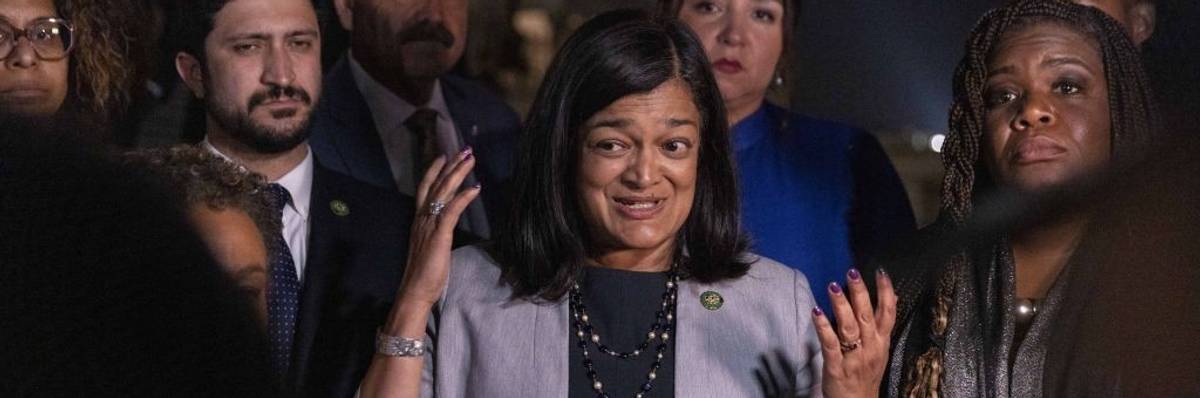
Congresswoman Pramila Jayapal speaks to the press after the U.S. House of Representatives passes the U.S. debt ceiling bill in Washington D.C. on May 31, 2023.
Whenever lawmakers are debating a high-profile piece of legislation, the media returns to the easy description of pressures exerted by the far right and far left, as if these are similar forces.
Here’s how, in its lead story Thursday, The New York Times described the House’s vote to resolve Republicans’ self-imposed debt-ceiling crisis:
“With both far-right and hard-left lawmakers in revolt over the deal, it fell to a bipartisan coalition powered by Democrats to push the bill over the finish line, throwing their support behind the compromise in an effort to break the fiscal stalemate that had gripped Washington for weeks.”
It’s not just the Times. This false equivalence between the two parties’ activist wings has been on display in press coverage throughout the debt-ceiling votes. Politico Playbook on Sunday described Congressional Progressive Caucus Chair Pramila Jayapal’s mixed reaction to the debt-ceiling compromise as indicating that the bill may have “a chance to win votes from some on the far left.” A Washington Post sub-headline that same day noted that “far-left and far-right corners of the House have criticized the compromise.”
These descriptions conjure a world in which the wing of the Republican Party defined by Reps. Marjorie Taylor Greene (R-Ga.), Matt Gaetz (R-Fla.), Elise Stefanik (R-N.Y.), Chip Roy (R-Ariz.), Lauren Boebert (R-Colo.) and Paul Gosar (R-Ariz.) is somehow balanced out by the wing of the Democratic Party defined by Alexandria Ocasio-Cortez (D-N.Y.), Jayapal (D-Wash.), Jamie Raskin (D-Md.), Greg Casar (D-Texas), Cori Bush (D-Mo.) and Jamaal Bowman (D-N.Y.).
On a scale of political ideology and positions from 100 to 0 (with 100 being the far left and 0 being the far right), and 50 being in the middle, even the most left-oriented Democrats (Ocasio-Cortez, Bush, Casar, Bowman, Raskin, Jayapal) are not extremists.
This idea is, of course, farcical—both in terms of the vote on the debt-ceiling bill and our politics more generally. Yet whenever Congress is debating a high-profile piece of legislation, the media returns to the easy description of pressures exerted by the far right and far left, as if these are similar forces.
In the case of the debt-ceiling compromise, 46 House Democrats and 71 House Republicans voted “no” on the legislation.
The Democrats who voted “no” range from liberals like Reps. Joaquin Castro (D-Texas) and Gerry Connolly (D-Va.) to progressives like Rosa DeLauro (D-Md.), Raúl M. Grijalva (D-Ariz.), Jayapal and Jan Schakowsky (D-Ill.) to democratic socialists like Ocasio-Cortez and Bush.
According to the Times’ own analysis, 40 of the 100 members of the Progressive Caucus (40%) voted “no,” while 34 out of 42 (81%) of hard-right Republicans (which the Times defines as members of the Freedom Caucus and those who opposed Speaker Kevin McCarthy’s election as speaker) voted “no.”
Two Republicans (Boebert and Jim Banks of Indiana) and two Democrats (Angie Craig of Minnesota and Deborah Ross of Pennsylvania) didn’t vote. Interestingly, two of the most reactionary Republicans, Greene and Stefanik, voted “yes”—a testament to their closeness with McCarthy, who appointed them to influential committees.
It is difficult to rank House members on an ideological scale because rankings look solely at voting records, and each organization that attempts to rank members selects different votes as crucial. The more important point, though, is not necessarily about voting records. It’s a question of how we define “extremism.”
On a scale of political ideology and positions from 100 to 0 (with 100 being the far left and 0 being the far right), and 50 being in the middle, even the most left-oriented Democrats (Ocasio-Cortez, Bush, Casar, Bowman, Raskin, Jayapal) are not extremists. They are different shades of social democrats; they espouse policies that are fairly mainstream across western democracies. They advocate for the rights of marginalized people and are pro-union, pro-choice, and concerned about climate change. They want to expand the social safety net, favor progressive taxation, and want to raise the minimum wage.
In contrast, the most right-wing Republicans are extremists and reactionaries. Many rub shoulders with, and speak in support of, white supremacists, Christian nationalists, and anti-Semites. In many cases, they want to repeal the political and cultural victories of the civil rights, feminist, gay rights, environmental, and labor movements. They deny that the 2020 election was legitimate, and took steps to overturn it. They support the January 6 insurrectionists, who they cast as freedom fighters. They have opposed the fundamentals of democracy—like the right to vote and the peaceful transition of power—and, in some cases, played active roles in the closest thing to a coup the U.S. has experienced in its nearly 250-year history.
It might be tempting to say that extremism is in the eye of the beholder. Ocasio-Cortez thinks that Greene is an extremist and vice versa. But for the media to continually create this false equivalence between the “far right” and the “far left” is misleading and distorts a crucial, critical reality of American politics in 2023—one that looms behind even the most anodyne legislative battle.
Dear Common Dreams reader, It’s been nearly 30 years since I co-founded Common Dreams with my late wife, Lina Newhouser. We had the radical notion that journalism should serve the public good, not corporate profits. It was clear to us from the outset what it would take to build such a project. No paid advertisements. No corporate sponsors. No millionaire publisher telling us what to think or do. Many people said we wouldn't last a year, but we proved those doubters wrong. Together with a tremendous team of journalists and dedicated staff, we built an independent media outlet free from the constraints of profits and corporate control. Our mission has always been simple: To inform. To inspire. To ignite change for the common good. Building Common Dreams was not easy. Our survival was never guaranteed. When you take on the most powerful forces—Wall Street greed, fossil fuel industry destruction, Big Tech lobbyists, and uber-rich oligarchs who have spent billions upon billions rigging the economy and democracy in their favor—the only bulwark you have is supporters who believe in your work. But here’s the urgent message from me today. It's never been this bad out there. And it's never been this hard to keep us going. At the very moment Common Dreams is most needed, the threats we face are intensifying. We need your support now more than ever. We don't accept corporate advertising and never will. We don't have a paywall because we don't think people should be blocked from critical news based on their ability to pay. Everything we do is funded by the donations of readers like you. When everyone does the little they can afford, we are strong. But if that support retreats or dries up, so do we. Will you donate now to make sure Common Dreams not only survives but thrives? —Craig Brown, Co-founder |
Here’s how, in its lead story Thursday, The New York Times described the House’s vote to resolve Republicans’ self-imposed debt-ceiling crisis:
“With both far-right and hard-left lawmakers in revolt over the deal, it fell to a bipartisan coalition powered by Democrats to push the bill over the finish line, throwing their support behind the compromise in an effort to break the fiscal stalemate that had gripped Washington for weeks.”
It’s not just the Times. This false equivalence between the two parties’ activist wings has been on display in press coverage throughout the debt-ceiling votes. Politico Playbook on Sunday described Congressional Progressive Caucus Chair Pramila Jayapal’s mixed reaction to the debt-ceiling compromise as indicating that the bill may have “a chance to win votes from some on the far left.” A Washington Post sub-headline that same day noted that “far-left and far-right corners of the House have criticized the compromise.”
These descriptions conjure a world in which the wing of the Republican Party defined by Reps. Marjorie Taylor Greene (R-Ga.), Matt Gaetz (R-Fla.), Elise Stefanik (R-N.Y.), Chip Roy (R-Ariz.), Lauren Boebert (R-Colo.) and Paul Gosar (R-Ariz.) is somehow balanced out by the wing of the Democratic Party defined by Alexandria Ocasio-Cortez (D-N.Y.), Jayapal (D-Wash.), Jamie Raskin (D-Md.), Greg Casar (D-Texas), Cori Bush (D-Mo.) and Jamaal Bowman (D-N.Y.).
On a scale of political ideology and positions from 100 to 0 (with 100 being the far left and 0 being the far right), and 50 being in the middle, even the most left-oriented Democrats (Ocasio-Cortez, Bush, Casar, Bowman, Raskin, Jayapal) are not extremists.
This idea is, of course, farcical—both in terms of the vote on the debt-ceiling bill and our politics more generally. Yet whenever Congress is debating a high-profile piece of legislation, the media returns to the easy description of pressures exerted by the far right and far left, as if these are similar forces.
In the case of the debt-ceiling compromise, 46 House Democrats and 71 House Republicans voted “no” on the legislation.
The Democrats who voted “no” range from liberals like Reps. Joaquin Castro (D-Texas) and Gerry Connolly (D-Va.) to progressives like Rosa DeLauro (D-Md.), Raúl M. Grijalva (D-Ariz.), Jayapal and Jan Schakowsky (D-Ill.) to democratic socialists like Ocasio-Cortez and Bush.
According to the Times’ own analysis, 40 of the 100 members of the Progressive Caucus (40%) voted “no,” while 34 out of 42 (81%) of hard-right Republicans (which the Times defines as members of the Freedom Caucus and those who opposed Speaker Kevin McCarthy’s election as speaker) voted “no.”
Two Republicans (Boebert and Jim Banks of Indiana) and two Democrats (Angie Craig of Minnesota and Deborah Ross of Pennsylvania) didn’t vote. Interestingly, two of the most reactionary Republicans, Greene and Stefanik, voted “yes”—a testament to their closeness with McCarthy, who appointed them to influential committees.
It is difficult to rank House members on an ideological scale because rankings look solely at voting records, and each organization that attempts to rank members selects different votes as crucial. The more important point, though, is not necessarily about voting records. It’s a question of how we define “extremism.”
On a scale of political ideology and positions from 100 to 0 (with 100 being the far left and 0 being the far right), and 50 being in the middle, even the most left-oriented Democrats (Ocasio-Cortez, Bush, Casar, Bowman, Raskin, Jayapal) are not extremists. They are different shades of social democrats; they espouse policies that are fairly mainstream across western democracies. They advocate for the rights of marginalized people and are pro-union, pro-choice, and concerned about climate change. They want to expand the social safety net, favor progressive taxation, and want to raise the minimum wage.
In contrast, the most right-wing Republicans are extremists and reactionaries. Many rub shoulders with, and speak in support of, white supremacists, Christian nationalists, and anti-Semites. In many cases, they want to repeal the political and cultural victories of the civil rights, feminist, gay rights, environmental, and labor movements. They deny that the 2020 election was legitimate, and took steps to overturn it. They support the January 6 insurrectionists, who they cast as freedom fighters. They have opposed the fundamentals of democracy—like the right to vote and the peaceful transition of power—and, in some cases, played active roles in the closest thing to a coup the U.S. has experienced in its nearly 250-year history.
It might be tempting to say that extremism is in the eye of the beholder. Ocasio-Cortez thinks that Greene is an extremist and vice versa. But for the media to continually create this false equivalence between the “far right” and the “far left” is misleading and distorts a crucial, critical reality of American politics in 2023—one that looms behind even the most anodyne legislative battle.
Here’s how, in its lead story Thursday, The New York Times described the House’s vote to resolve Republicans’ self-imposed debt-ceiling crisis:
“With both far-right and hard-left lawmakers in revolt over the deal, it fell to a bipartisan coalition powered by Democrats to push the bill over the finish line, throwing their support behind the compromise in an effort to break the fiscal stalemate that had gripped Washington for weeks.”
It’s not just the Times. This false equivalence between the two parties’ activist wings has been on display in press coverage throughout the debt-ceiling votes. Politico Playbook on Sunday described Congressional Progressive Caucus Chair Pramila Jayapal’s mixed reaction to the debt-ceiling compromise as indicating that the bill may have “a chance to win votes from some on the far left.” A Washington Post sub-headline that same day noted that “far-left and far-right corners of the House have criticized the compromise.”
These descriptions conjure a world in which the wing of the Republican Party defined by Reps. Marjorie Taylor Greene (R-Ga.), Matt Gaetz (R-Fla.), Elise Stefanik (R-N.Y.), Chip Roy (R-Ariz.), Lauren Boebert (R-Colo.) and Paul Gosar (R-Ariz.) is somehow balanced out by the wing of the Democratic Party defined by Alexandria Ocasio-Cortez (D-N.Y.), Jayapal (D-Wash.), Jamie Raskin (D-Md.), Greg Casar (D-Texas), Cori Bush (D-Mo.) and Jamaal Bowman (D-N.Y.).
On a scale of political ideology and positions from 100 to 0 (with 100 being the far left and 0 being the far right), and 50 being in the middle, even the most left-oriented Democrats (Ocasio-Cortez, Bush, Casar, Bowman, Raskin, Jayapal) are not extremists.
This idea is, of course, farcical—both in terms of the vote on the debt-ceiling bill and our politics more generally. Yet whenever Congress is debating a high-profile piece of legislation, the media returns to the easy description of pressures exerted by the far right and far left, as if these are similar forces.
In the case of the debt-ceiling compromise, 46 House Democrats and 71 House Republicans voted “no” on the legislation.
The Democrats who voted “no” range from liberals like Reps. Joaquin Castro (D-Texas) and Gerry Connolly (D-Va.) to progressives like Rosa DeLauro (D-Md.), Raúl M. Grijalva (D-Ariz.), Jayapal and Jan Schakowsky (D-Ill.) to democratic socialists like Ocasio-Cortez and Bush.
According to the Times’ own analysis, 40 of the 100 members of the Progressive Caucus (40%) voted “no,” while 34 out of 42 (81%) of hard-right Republicans (which the Times defines as members of the Freedom Caucus and those who opposed Speaker Kevin McCarthy’s election as speaker) voted “no.”
Two Republicans (Boebert and Jim Banks of Indiana) and two Democrats (Angie Craig of Minnesota and Deborah Ross of Pennsylvania) didn’t vote. Interestingly, two of the most reactionary Republicans, Greene and Stefanik, voted “yes”—a testament to their closeness with McCarthy, who appointed them to influential committees.
It is difficult to rank House members on an ideological scale because rankings look solely at voting records, and each organization that attempts to rank members selects different votes as crucial. The more important point, though, is not necessarily about voting records. It’s a question of how we define “extremism.”
On a scale of political ideology and positions from 100 to 0 (with 100 being the far left and 0 being the far right), and 50 being in the middle, even the most left-oriented Democrats (Ocasio-Cortez, Bush, Casar, Bowman, Raskin, Jayapal) are not extremists. They are different shades of social democrats; they espouse policies that are fairly mainstream across western democracies. They advocate for the rights of marginalized people and are pro-union, pro-choice, and concerned about climate change. They want to expand the social safety net, favor progressive taxation, and want to raise the minimum wage.
In contrast, the most right-wing Republicans are extremists and reactionaries. Many rub shoulders with, and speak in support of, white supremacists, Christian nationalists, and anti-Semites. In many cases, they want to repeal the political and cultural victories of the civil rights, feminist, gay rights, environmental, and labor movements. They deny that the 2020 election was legitimate, and took steps to overturn it. They support the January 6 insurrectionists, who they cast as freedom fighters. They have opposed the fundamentals of democracy—like the right to vote and the peaceful transition of power—and, in some cases, played active roles in the closest thing to a coup the U.S. has experienced in its nearly 250-year history.
It might be tempting to say that extremism is in the eye of the beholder. Ocasio-Cortez thinks that Greene is an extremist and vice versa. But for the media to continually create this false equivalence between the “far right” and the “far left” is misleading and distorts a crucial, critical reality of American politics in 2023—one that looms behind even the most anodyne legislative battle.