
SUBSCRIBE TO OUR FREE NEWSLETTER
Daily news & progressive opinion—funded by the people, not the corporations—delivered straight to your inbox.
5
#000000
#FFFFFF
To donate by check, phone, or other method, see our More Ways to Give page.


Daily news & progressive opinion—funded by the people, not the corporations—delivered straight to your inbox.
An investigation found that the anti-socialist group Promise to America has ties to a PAC funded by billionaires such as LinkedIn founder Reid Hoffman.
More than a dozen corporate Democrats last week responded to upstart progressive wins in primaries by pledging their support to a political manifesto called "Promise to America," which emphasizes support for capitalism, law enforcement, and "fiscal discipline."
A Thursday report published by Sludge about the Promise to America found that it "is closely tied to the Welcome Party, a group whose PAC has received more than half of its individual contributions from billionaires."
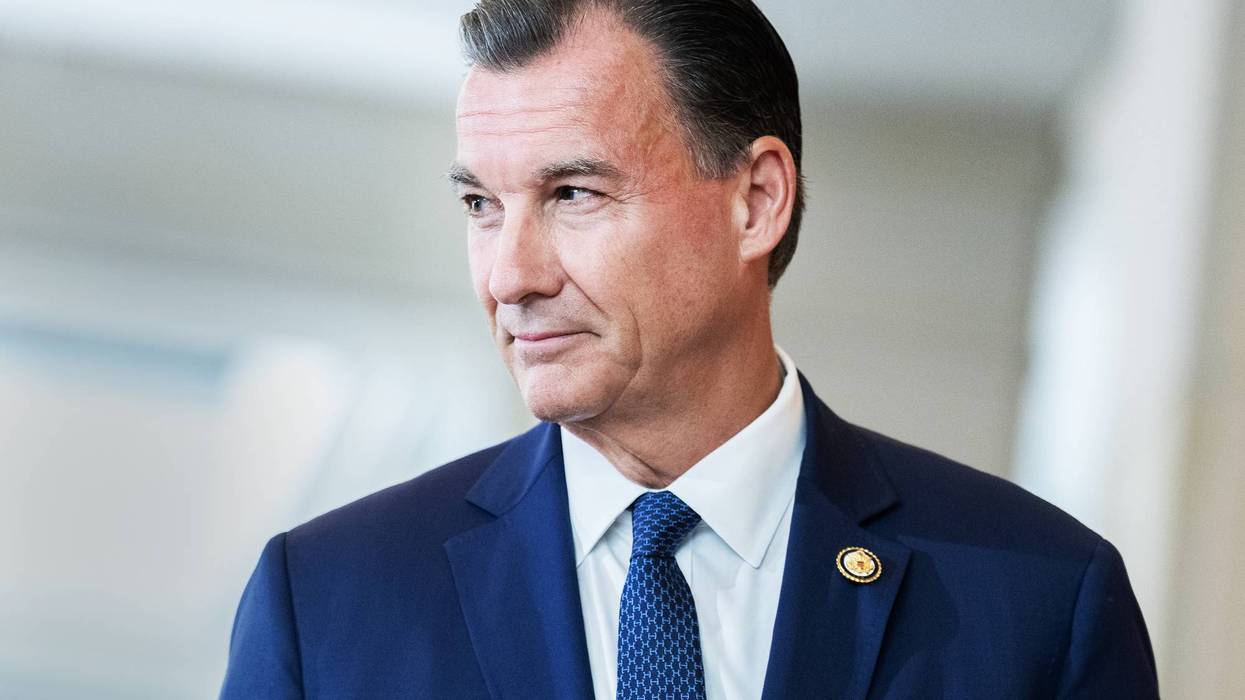
According to Sludge, the Promise to America appeared in public for the first time last month at Welcome Party's annual WelcomeFest conference, where it was signed by Reps. Tom Suozzi (D-NY) and Adam Gray (D-Calif.).
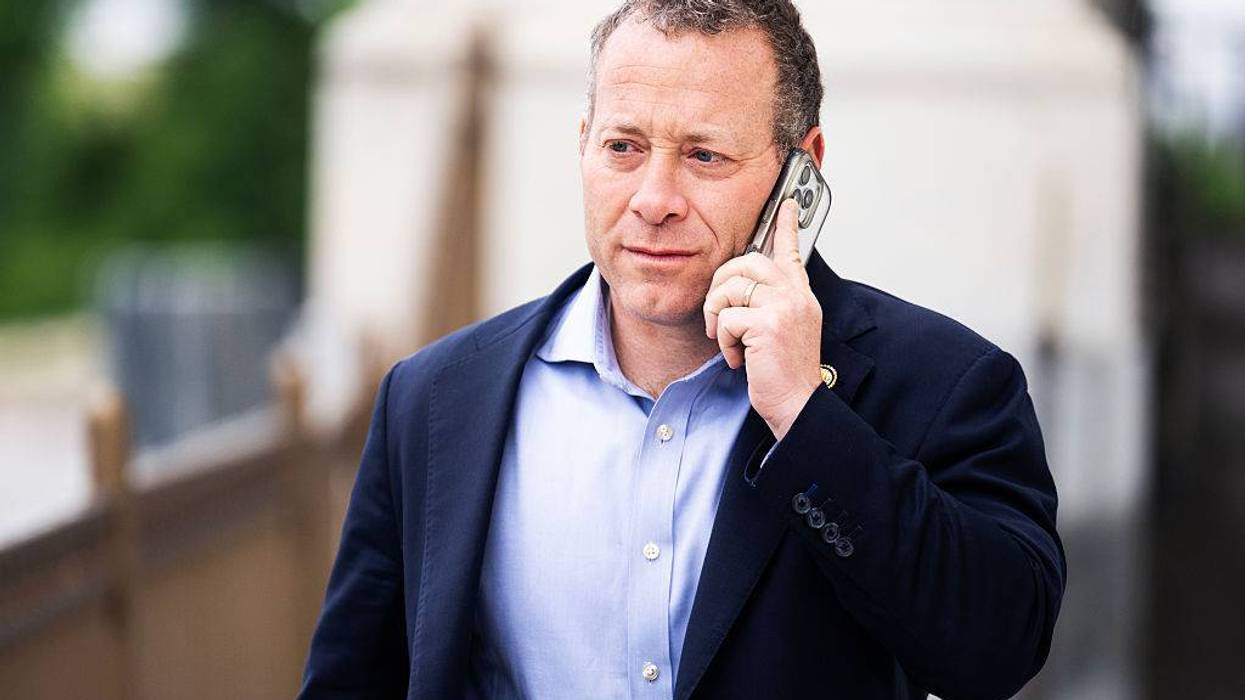
Other prominent Democrats who have signed the pledge include Reps. Josh Gottheimer (D-NJ), Vincente Gonzalez (D-Texas), and Don Davis (D-NC).
Although Sludge uncovered no evidence that Welcome Party is financially supporting the Promise to America, the manifesto's presence at the group's conference was notable given that billionaire donations account for more than 60% of the $10.8 million in donations that it has received over the last five years.
Major donors to the PAC include LinkedIn founder Reid Hoffman, who has donated a total of $1.8 million, and former 21st Century Fox CEO James Murdoch, who with his wife Kathryn has donated $2.5 million.
Other notable billionaires who have contributed to WelcomePAC include Bain Capital co-founder Joshua Bekenstein, former New York City Mayor Michael Bloomberg, and several members of the Walton family.
Sludge's investigation also found that "more billionaires may have donated to the Welcome Party’s two 'dark money' nonprofit arms, which do not disclose their donors publicly."
The Promise to America manifesto has drawn heavy criticism from progressives.
In a recent interview with political commentator Santita Jackson, Rep. Alexandria Ocasio-Cortez (D-NY) said that the corporate Democrats' pledge was a reactive document that lacked policy solutions to the problems facing Americans.
"Okay fine, if you’re against [democratic socialists], that’s okay. But what do you believe?" said Ocasio-Cortez. "And that I think is the core of the weaknesses from that wing at this moment. There’s no affirmative vision really coming from most places in the Democratic Party with the exception of democratic socialism."
Rep. Ro Khanna (D-Calif.) last week also challenged the corporate wing of the party in a speech on the floor of the US House of Representatives in which he defended the vision being laid out by progressive insurgents.
“The progressive movement is winning across the country, from the heart of New York to Michigan to Maine,” Khanna said. “The people are saying no to foreign wars and they’re saying no to genocide in Gaza. They’re saying no to the unfair and lopsided economy that has allowed a few people to hoard extreme wealth and power, and they’re saying yes to Medicare for All.”
There is simply no reason for the corporate Democratic establishment to be doing the right-wing's work for them.
President Donald Trump used red-scare rhetoric to denounce the progressive winners in New York's Democratic primary last week as "godless communists." Rather than explaining that the progressives are not communists in the vein of the Soviet Union or communist China but social democrats in the vein of Scandinavia, a group of so-called "moderate" Democratic politicians piled on to Trump's red-baiting.
Two days after the primaries, this group of 15 corporate Democrats (let's just call them what they are) attacked the winning Democrats in an open letter drafted by Democratic Rep. Tom Suozzi of New York proclaiming, "we are capitalist, not socialist." In an interview with the New York Times, Suozzi added “that message from Tuesday is not the message that I embrace.”
It's one thing for corporate Democrats and progressive Democrats to debate policy differences between them during primaries. But once Democratic voters have chosen their primary winners, it's destructive to continue to attack the winners as some kind of semi-commies. The right-wing will do plenty of that. If they want to win a majority, Democrats shouldn't be piling on. (I would add that after the primaries and before the general election, progressives shouldn't be ideologically attacking moderate Democratic nominees as corporate dupes, either.)
It's ignorant and deceptive for moderate Democrats to declare they are "capitalist." What do they mean by "capitalist" anyway? The US, like every developed democracy, is a mix of capitalist and socialist. Are the "moderates" opposed to such "socialist" policies as Social Security, Medicare, Medicaid, SNAP, free public education, anti-trust enforcement, and environmental regulation? If they are, they should say so. If they're not, they should stop declaring themselves as "capitalists" and denouncing "socialism."
Indeed, the Bernie Sanders-styled "democratic socialists" are not really socialists at all. They do not call for government ownership of the means of production. They are, as they largely identify, social democrats in the vein of Scandinavian countries and Democratic hero Franklin Delano Roosevelt.
In a recent email to his supporters, Sanders wrote: "Today, we have unprecedented income and wealth inequality with the rich getting much richer while working families struggle to survive. We have a corrupt campaign finance system which allows billionaires to buy elections and undermine our democracy. Our health care system is broken and wildly expensive. We have a major housing crisis with 800,000 homeless and millions of families spending half their incomes or more on housing. People are deeply worried about the impact that AI and robotics will have on their lives."
What part of this message do "moderates" like Suozzi think Democrats should not "embrace"? Are they opposed to Medicare for All, higher taxes on billionaires, strong anti-trust enforcement, and tough environmental regulations? If they oppose such progressive policies, then should have the courage to say so and propose what they consider to be more "capitalist" policies. It they can't do that, then they should stop their red-baiting rhetoric which only helps MAGA.
Brad Lander, a self-described democratic socialist who beat self-described "moderate" Dan Goldman in the New York primary and will almost certainly be going to Congress, said that he hoped Democrats would “spend more time building a unified Democratic message” than on “factional infighting.” Lander made clear that voters "want to see people who fight harder for working families. And that should unify the Democratic Party."
"That’s not progressives versus moderates," added Lander. "That’s fighters versus folders.”
The party leadership's aversion to building their own momentum to answer the basic questions “Whose side are you on?” and “What does the Democratic Party stand for?” remains as pathetic as it was in 2022 and 2024. Enough.
“How’s the Democratic Party’s ground game in Pennsylvania?” I asked a friend several weeks before the 2024 presidential election. He replied optimistically that there were far more door knockers this year than in 2022. It turned out these door knockers were just urging a vote for the Democrats without putting forth a compelling agenda attached to candidate commitments on issues that mean something to people where they live, work, and raise their families. There was no Democratic Party “Compact for the American People.” Biden visited Pennsylvania, which went Republican, many times, with his most memorable message being that he grew up in Scranton.
Once again, the vacuous, feeble Democratic Party is relying on the Republicans and the cruel, lawless dictator Trump to beat themselves to gain control of the Senate and the House.
Legendary reporter Seymour Hersh last week made the case for the Republicans taking themselves down, to wit: “I have been told by an insider that the internal polling numbers are not good …” and that “Anxiety in the White House that both the House and the Senate might fall to the Democrats is acute. Trump’s poll numbers are sliding …. The public lying of Cabinet members in defense of ICE has not helped the president or the party. Trump hasn’t delivered on the economy, except for the very rich, and he hasn’t made good on early promises to resolve the disastrous war between Russia and Ukraine.”
GOP operatives are assuming the Democrats will take back the House by a comfortable number and now think the Senate, where the GOP holds a three-seat majority. There are six seats in play. The GOP’s biggest fear is that their negatives continue to increase, propelled by a pile of unpopular Trumpian actions, ugly behavior, and corruption. The combination of all these things could create a critical mass and produce a landslide comparable to the Reagan-led victory in 1980. In this election, the Republicans defeated seemingly unbeatable Senate veterans like Senator Magnuson, Senator Nelson, and Senator Church, and gave the GOP control of the Senate.
Our Republic has been invaded by the Trumpsters, who are taking down its institutional pillars, its safety nets, and its rule of law. Our democracy is crumbling by the day.
So, what is the Democratic Party doing during this GOP slump? It is Déjà vu all over again. The Dems are furiously raising money from commercial special interests and relying on vacuous television and social media ads. They are not engaging people with enough personal events, and they are not returning calls or reaching out to their historical base – progressive labor and citizen leaders. Most importantly, they are not presenting voters with a COMPACT FOR AMERICAN WORKERS. Such a compact would spark voter excitement and attract significant media coverage.
Their aversion to building their own momentum to answer the basic questions “Whose side are you on?” and “What does the Democratic Party stand for?” remains as pathetic as it was in 2022 and 2024. Ken Martin, head of the Democratic National Committee (DNC), recently quashed a detailed report he commissioned about why the Democrats lost in 2024. He has refused to meet with leaders of progressive citizen organizations. We visited the DNC headquarters and could not even get anyone to take our materials on winning issues and tactics. We offered the compiled presentations of two dozen progressive civic leaders on how to landslide the GOP in 2022. This material is still relevant and offers a letter-perfect blueprint for how Democrats could win in 2026. (See winningamerica.net). (The DNC offices are like a mausoleum, except for visits by members of Congress entering to dial for dollars.)
Imagine a mere switch of 240,000 votes in three states (Pennsylvania, Michigan, and Wisconsin) would have defeated Trump in 2024. That margin would have been easily accomplished had the Democratic Party supported the efforts of AFL-CIO and progressive union leaders who wanted the Dems to champion a “Compact for Workers” on Labor Day, with events throughout the country. (See letter sent to Liz Shuler, President of AFL-CIO, on August 27, 2024).
The compact would have emphasized: raising the federal minimum wage from $7.25 to $15 per hour, benefiting 25 million workers and increasing Social Security benefits frozen for over 45 years, could have benefited over 60 million elderly, paid for by higher Social Security taxes on the wealthy classes. The compact would also include: a genuine child tax credit would help over 60 million children, cutting child poverty in half; repeal of Trump’s massive tax cuts for the super-rich and giant corporations (which would pay for thousands of public works groups in communities around the nation); and Full Medicare for All (which is far more efficient and life-saving than the corporate-controlled nightmare of gouges, inscrutable billing fraud, and arbitrary denial of benefits).
Droves of conservative and liberal voters would attend events showcasing winning politics, authentically presented, as envisioned for the grassroots Labor Day gatherings, suicidally blocked by the smug, siloed leaders of the Democratic Party in 2022 and 2024.
Clearly, this is a Party that thinks it can win on the agenda of Wall Street and the military/industrial complexes. (See Norman Solomon’s book The Blue Road to Trump Hell: How Corporate Democrats Paved the Way for Autocracy. It can be downloaded for free at BlueRoad.info.) The Democratic Party scapegoats the tiny Green Party for its losses again and again at the federal and state levels to the worst Republican Party in history – BY FAR.
It is fair to say that, with few exceptions, the Democratic Party apparatus is coasting, playing “it safe,” and expecting that the Trumpsters will deliver the Congress to it in November.
The exceptions are warning about this hazardous complacency, such as adopting James Carville’s ridiculous advice just to let the GOP self-destruct (though recently he also has urged a progressive economic agenda). There are progressive young Democrats challenging incumbent corporate Democrats in the House. They are not waiting for a turnover in the Party’s aging leadership. They believe the country can’t wait for such a transformation. Our Republic has been invaded by the Trumpsters, who are taking down its institutional pillars, its safety nets, and its rule of law. Our democracy is crumbling by the day.
As for the non-voters, disgusted with politics, just go vote for a raise, vote for health insurance, vote for a crackdown on corporate crooks seizing your consumer dollars and savings, and vote for taxing the rich. That’s what your vote should demand, and these are the issues that should be conveyed to the candidates campaigning in your communities.
Tell the candidates you want a shakeup, not a handshake. (See, the primer for victory, “Let’s Start the Revolution: Tools for Displacing the Corporate State and Building a Country that Works for the People” 2024).
This dark time should wake us up to the bankruptcy of the corporate Democratic Party and give rise to something people nationwide are yearning for: a People's Democratic Party.
The only upside to living through this dark time is it pushes us to rethink and perhaps totally remake things we once thought immutable.
Like the Democratic Party.
In case you hadn’t noticed, the current Democratic Party is dysfunctional if not dead.
Better dysfunctional than a fascist cult like the Trump Republican Party. But if there was ever a time when America needed a strong, vibrant Democratic Party, it’s now. And we don’t have one.
The brightest light in the Democratic Party is Zohran Mamdani, the 34-year-old member of the New York State Assembly who has a good chance of being elected the next mayor of New York City when New Yorkers go to the polls a week from Tuesday.
Mamdani poses a particular threat to New York’s corporate Democrats because he wants to tax the wealthy to pay for his plan to make New York more affordable to people who aren’t wealthy.
Mamdani is talking about what matters to most voters—the cost living. He says New York should be affordable to everyone.
He’s addressing the problems New Yorkers discuss over their kitchen tables. He’s not debating “Trumpism” or “capitalism” or “Democratic socialism.” He’s not offering a typical Democratic “10-point plan” with refundable tax credits that no one understands.
He’s proposing a few easy-to-understand things — free buses, free childcare, a four-year rent freeze for some two million residents, and a $30 minimum wage. He’s aiming to do what Franklin D. Roosevelt did in the 1930s — fix it.
You may not agree with all his proposals (I don’t) but they’re understandable. And if they don’t work, I expect that, like FDR, he’ll try something else.
The clincher for me is he’s inspiring a new generation of young people. He’s got them excited about politics. (My seventeen-year-old granddaughter is spending her weekends knocking on doors for him, as are her friends.)
Name a Republican politician who’s inspiring young people. Hell, I have a hard time coming up with a Republican politician since Teddy Roosevelt who has inspired young people.
You don’t have to reach too far back in history to find Democratic politicians who have inspired young people. Bernie Sanders (technically an Independent) and AOC. Barack Obama. (I was inspired in my youth by Bobby Kennedy—the real Bobby Kennedy—and Senator Eugene McCarthy.)
And Zohran.
What do all of them have in common? They’re authentic. They’re passionate. They care about real people. They want to make America fairer. They advocate practical solutions that people can understand.
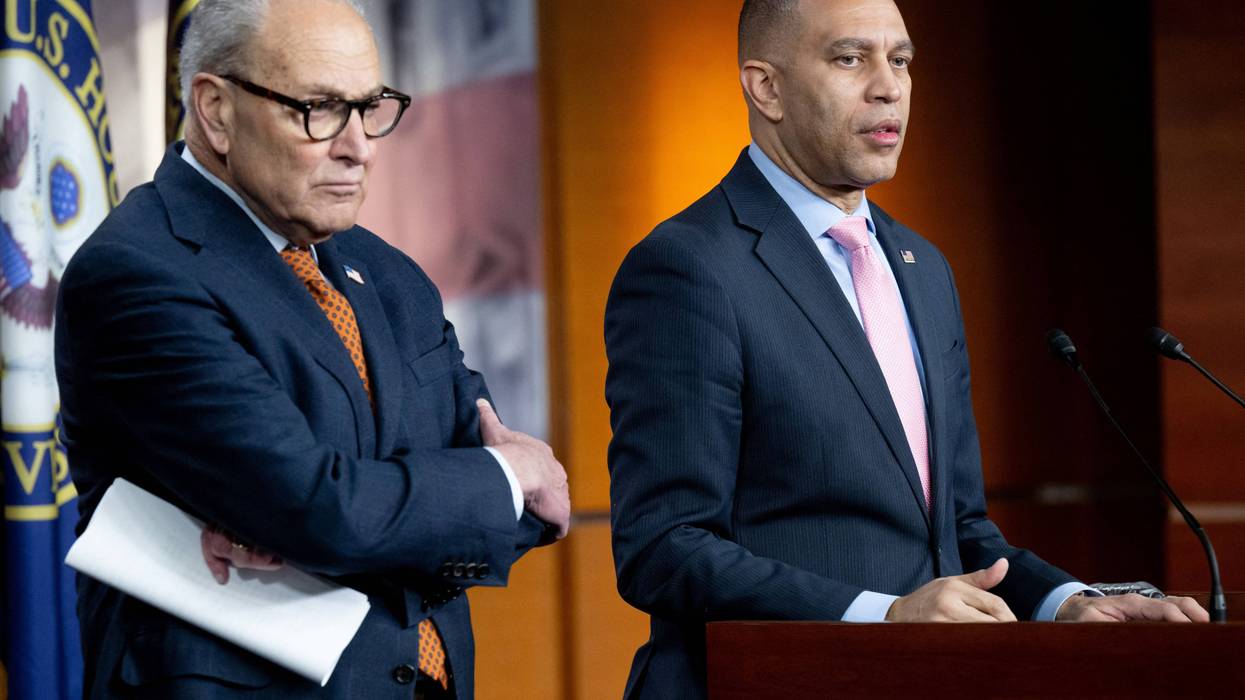
Nonetheless, Mamdani is horrifying the leaders of the Democratic Party. Chuck Schumer and Hakeem Jeffries haven’t endorsed him. Hillary Clinton has endorsed Andrew Cuomo, who’s spending what are likely to be the last days of his political career indulging in the kind of racist, Islamophobic attacks we’d expect from Trump.
Meanwhile, the editorial board of the New York Times counsels “moderation,” urging Democratic candidates to move to the “center.” Tell me: Where’s the center between democracy and fascism, and why would anyone want to go there?
In truth, the Times’s so-called “moderate center” is code for corporate Democrats using gobs of money to pursue culturally-conservative “swing” voters — which is what the Democratic Party has been doing for decades.
This is part of the reason America got Donald Trump. Corporate Democrats took the Party’s away from its real mission—to lift up the working class and lower middle class, and help the poor. Instead, they pushed for globalization, privatization, and the deregulation of Wall Street. They became Republican-Lite.
In 2016 and again in 2024, working and lower-middle class voters saw this and opted for a squalid real estate developer who at least sounded like he was on their side. He wasn’t and still isn’t—he’s on the side of the billionaires to whom he gave two whopping tax cuts. But if the choice is between someone who sounds like he’s on your side and someone who sounds like a traditional politician, guess who wins?
This is part of the reason America got Donald Trump. Corporate Democrats took the Party’s away from its real mission—to lift up the working class and lower middle class, and help the poor.
Trump also fed voters red-meat cultural populism — blaming their problems on immigrants, Latinos, Black people, transgender people, bureaucrats, and “coastal elites.” Democrats gave voters incomprehensible 10-point plans.
The Times tries to buttress its argument that Democrats should move to the “center” by citing Democrats who won election last year in places Trump also won.
But that argument is bunk. Democrats won in these places by imitating Trump. One mocked the term “Latinx” and was hawkish on immigration. Two wanted to crack down harder on illegal immigration. Two others emphasized crime and public safety. Another bragged about taking on federal bureaucrats.
This isn’t the way forward for Democrats. Red-meat cultural populism doesn’t fill hungry bellies or pay impatient landlords or help with utility bills.
Mamdani poses a particular threat to New York’s corporate Democrats because he wants to tax the wealthy to pay for his plan to make New York more affordable to people who aren’t wealthy.
He aims to generate $9 billion in new tax revenue by raising taxes on the city’s wealthiest residents and businesses. He’s calling for a 2% tax on incomes over $1 million, which would produce $4 billion in tax revenue. He wants to increase the state’s corporate tax rate to 11.5 percent to match New Jersey’s, generating about $5 billion annually.
He’s right. The wealthy have never been as wealthy as they are now, while the tax rate they pay hasn’t been as low in living memory.
Inequalities of income and wealth are at record levels. A handful of billionaires now control almost every facet of the United States government and the U.S. economy.
Even as the stock market continues to hit new highs, working class and lower middle class families across America are getting shafted. Wages are nearly stagnant, prices are rising. Monopolies control food processing, housing, technology, oil and gas.
The time is made for the Democrats. If the Party stands for anything, it should be the growing needs of bottom 90 percent—for affordable groceries, housing, and childcare. For higher wages and better working conditions. For paid family leave. For busting up monopolies that keep prices high. For making it easier to form and join labor unions.
Pay for this by raising taxes on the wealthy. Get big money out of politics.
This dark time should wake us up to the bankruptcy of the corporate Democratic Party.
It should mark the birth of the people’s Democratic Party. Zohran and others like him are its future.
A democratic socialist won by acknowledging what everyone already knows—life has become unaffordable—and saying we're going to build our way out of it. He's shown Democrats how to stop lying and start acknowledging what's broken. Provide solutions and talk about them relentlessly with excitement and enthusiasm.
Zohran Mamdani just beat Andrew Cuomo in NYC's mayoral primary by doing something Democrats forgot how to do: acknowledging reality and promising to build our way out of it.
Too few people can afford to live in America anymore. We've given up on the idea that hard work gets you anywhere. We're buying lottery tickets and praying we got into Bitcoin at the right time because that's the only path to stability we can see.
I co-founded Justice Democrats. I was AOC's Communications Director. I've watched the fire die out from Bernie to AOC to Jamaal Bowman and Cori Bush. I've seen movements and moments that seemed poised to take back our democracy and our economy for the people slow to a crawl. Partly because our leaders were too trusting of the Democratic party. They thought we were all on the same team.
We aren't. We never were.
It's time for a full court press on the party. It's time to reshape it in the image of a better FDR. Take it over from the inside. Primary every corporate Democrat who thinks extraction is an economic policy. We need a new party—not a third party, but a Democratic party willing to clean house—starting with those who forgot how to build.
The party establishment can't just steal Mamdani's message. They've spent 30 years telling us why we can't build things, why we can't have universal healthcare, why we can't afford what every other developed country has. If Chuck Schumer suddenly started talking like Mamdani tomorrow, everyone would know he's full of shit.
So they'll do what they always do. They'll join Republicans in calling him too radical, too far left. They'll wring their hands about needing to appeal to the "center."
The center ain't what they think it is. It's swing voters who went from Obama to Trump and they want change, not compromise. They want someone to acknowledge that the system is broken and promise to fix it. They want a plan that makes sense.
Only 22% of Americans believe government can improve their lives. Twenty-two percent. That's what happens when both parties spend 40 years making sure that public options aren't functional. They make sure we can't build our own housing, transit, childcare, or healthcare system. They made sure the public can't build anything except tax breaks for billionaires.
Democrats tell us it's complicated. Republicans tell us it's immigrants' fault. Working families are taking on credit card debt to buy groceries. Teachers are driving Uber at night. Parents are choosing between daycare and rent.
We've accepted that this is just how it is. That America doesn't build things anymore. That the best we can hope for is tweaking a broken system around the edges.
Mamdani just showed Democrats how to call bullshit on all of that.
He won by acknowledging what everyone already knows—life has become unaffordable—and saying we're going to build our way out of it. Housing that teachers can afford. Transit that actually works. Childcare centers so parents don't have to choose between working and raising their kids. And that the ultra wealthy are going to pay their fair share.
He hasn't even been elected yet. But he's shown Democrats how to stop lying about the problem.
Stop explaining why we can't. Start acknowledging what's broken. Then provide the solution. Talk about it relentlessly with excitement and enthusiasm.
The establishment endorsed Cuomo—a sexual predator who spent his career making life worse for working people—because he represents their vision: pretend everything's fine, blame messaging when voters don't believe you.
Bill Clinton, Bloomberg, Clyburn, Torres—they all backed the predator over the builder. Because predators don't threaten their business model. Someone who acknowledges reality does.
Wall Street is terrified of Mamdani because public building kills private extraction. Every public housing unit is one less rent check for Blackstone. Every public childcare center is one less profit center for private equity. Every public transit line that works means fewer Uber rides, fewer car loans, fewer opportunities to bleed working people dry.
Wall Street doesn't build anymore. They buy what exists, jack up prices, and extract until there's nothing left. Our economy runs on extraction now. Healthcare alone will suck up $75 trillion over the next decade—not to make us healthier, but to transfer wealth upward. Housing, childcare, education—they're all cash vacuums.
Mamdani's promising to build public alternatives. That scares the shit out of them. He's proving you can win by admitting what everyone already knows. You can say "housing is unaffordable and we're going to build more of it" instead of lecturing people about market dynamics.
Now someone wins by saying we can build the things people need? Their business model collapses. Democrats have spent 30 years helping corporations privatize everything—from healthcare to housing to transit. They've turned basic needs into profit centers for Wall Street.
Young people assume they'll never own homes. Parents quit jobs because childcare costs more than they earn. Families crowd into apartments they can't afford while Democrats lecture us about GDP growth.
We've been trained to see poverty as inevitable. To see suffering as complicated. To see solutions as impossible.
Mamdani showed Democrats a different way. Admit that life has gotten harder. Acknowledge that work doesn't pay. Stop pretending the game isn't rigged. Then promise to build the things that make life livable.
Public building doesn't kill capitalism—it saves it from itself. When government builds housing, private developers have to compete. When we build public childcare, private centers can't charge whatever they want. But healthcare? Build public hospitals and clinics, and suddenly private insurers can't extract $75 trillion while people die rationing insulin. That's how you restart real competition. That's how you force corporations to actually create value instead of just extracting it.
Build the things people need to live. Not tax credits. Not market solutions. Not complicated programs that take three years to maybe help some people.
Mamdani won because he's the first Democrat in years to talk about the affordability crisis like someone who's actually tried to pay rent.
Americans aren't stupid. We know when we're being fed bullshit. We know when politicians are pretending our problems don't exist. We know when they're lying about why rent costs $3,000 a month or why insulin costs $600. We've just stopped expecting anyone to acknowledge reality, let alone fix it. We've accepted that politicians are liars and they will keep explaining why suffering is actually prosperity if you squint right.
The lottery tickets and crypto gambling show we've given up on the normal paths working. We need a party willing to admit those paths are broken before we'll believe they can be fixed.
What really terrifies them is if Mamdani succeeds in NYC, it spreads. Other cities start asking why they can't build public housing. Other states wonder why they can't have public childcare. The entire extraction economy—$75 trillion in healthcare alone, trillions more in housing, education, childcare—starts to crack. Every public option is a private profit center destroyed. Every successful public project is proof that we don't need them.
Mamdani hasn't even been elected yet. But he's shown us how to stop lying about what needs fixing. He's shown that you can win by promising to build for everyone, not just donors.
The movement's next job is to help Mamdani actually build—to prove the model works. Then we replicate it. Primaries in NYC, NYS, the US House and Senate. Every corporate Democrat who backs extraction over building needs a challenger who can build. Every AIPAC-purchased politician needs a challenger. Then maybe we can win in Texas and Tennessee and West Virginia. Then maybe people will believe the words we say.
If you still believe in this party, prove it. Help us take it back.
This isn't about purity. It's about survival. Either we build our way out of this mess or we keep managing the collapse until there's nothing left to manage.
Democrats need to learn from this. Or get sent home. We're building anyway.
A Trump presidency will push progressives back on our heels, in a dire defensive position as we fight to protect rights and programs won during many previous decades. Regardless of who wins, the challenges for progressives will be enormous.
While the name of the next president is unknown, some outcomes of the election can be foreseen. For instance:
Both Donald Trump and Kamala Harris are supporters of boosting already-huge Pentagon budgets along with continuing U.S. warfare in many forms. Trump likes to pander to voters who don’t want endless wars, but his actual policies as president kept them going. Harris’s glimmers of senatorial interest in scaling back military largesse faded into standard bellicosity. Both candidates beat cold-war drums, with Trump focusing on China rather than Russia.
Progressive ideas, as usual, will be convenient scapegoats for the failures of Democratic Party elites.
The establishment is ever alert to the danger that progressive populism could majorly reduce income inequality and subdue corporate power.
The disasters with a second Trump administration will include unleashed nativism and official bigotry. As one liberal commentator observed weeks before the election, “More than ever, Trump’s rhetoric is steeped in racism, xenophobia and dehumanization. He routinely calls immigrants ‘vermin’ and says they are ‘poisoning the blood’ of the country. He claims they are ‘stone-cold killers,’ ‘animals’ and ‘the worst people’ who will ‘cut your throat.’ . . . He called migrants from Latin America, Congo and the Middle East ‘the most violent people on Earth.’ . . . He’s even suggested that nonwhite immigrants have ‘bad genes’ that make them genetically inferior.”
In October, this year’s Green Party presidential candidate Jill Stein campaigned in swing states and declared: “This is a very dire situation that will be continued under both Democrats and Republicans. So we say there is no lesser evil in this race.”
Really?
“For anyone who doubts Trump will be even worse than Biden is on Gaza,” Mehdi Hasan tweeted a mid-October video clip of Trump saying that Netanyahu “is doing a good job, Biden is trying to hold him back... and probably should be doing the opposite. I'm glad that Bibi decided to do what he had to do.’”
If Trump wins, virtually all Republicans and many Democrats in Congress will support his unequivocal backing for whatever Israel does. If Harris wins, we can expect her policies toward Israel to be dreadful, while she’ll be subject to increasing pressure from much of her party’s base and some Democratic members of Congress for an end to arming Israel.
The burden will be on activists to demand actions commensurate with the realities described in The 2024 State of the Climate Report: “We are on the brink of an irreversible climate disaster. This is a global emergency beyond any doubt. Much of the very fabric of life on Earth is imperiled. We are stepping into a critical and unpredictable new phase of the climate crisis.”
A Trump presidency will push progressives back on our heels, in a dire defensive position as we fight to protect rights and programs won during many previous decades. With a Harris presidency, progressives will have some space to organize, with potential to actually move some U.S. government policies in a positive direction.
"We should not assume that there is no room to trim the Pentagon budget," said one expert. "Doing it correctly would not only make us safer, it would free up funds to address other urgent national priorities."
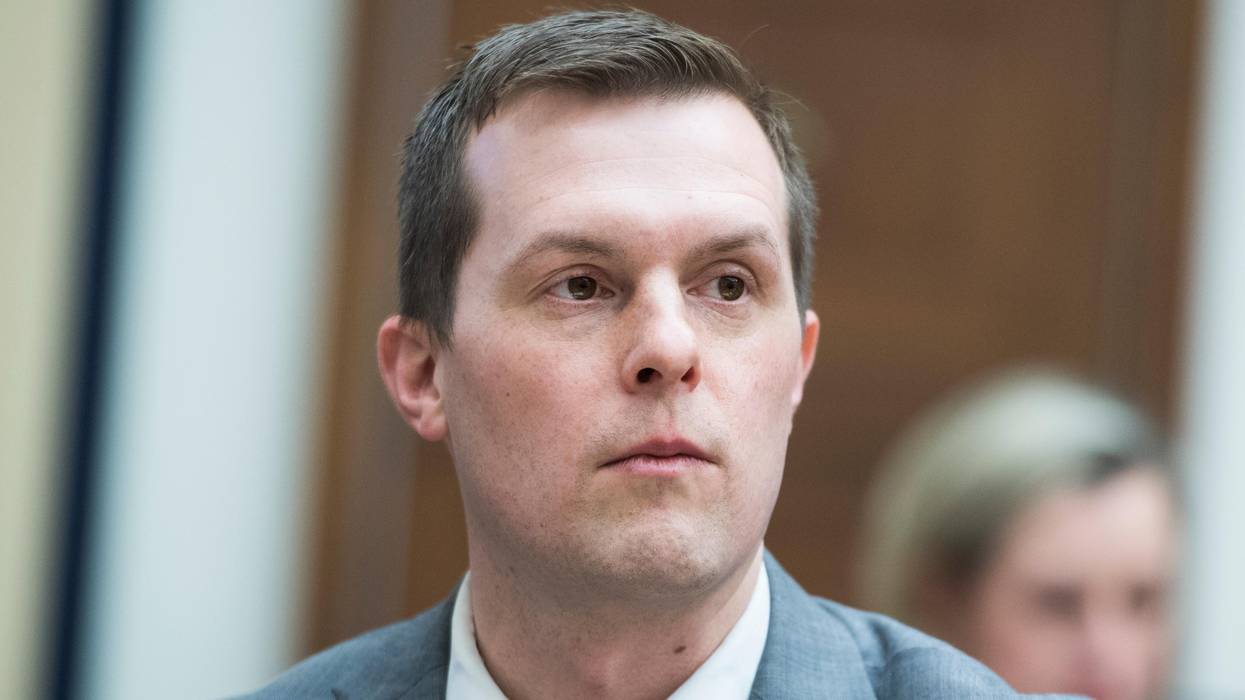
A group of corporate Democrats led by Rep. Jared Golden of Maine sent a letter Wednesday defending the out-of-control U.S. military budget and expressing concerns about looming attempts by House Republicans to cut it, even as several GOP lawmakers insisted the Pentagon would be safe from their coming austerity spree.
In their letter to House Speaker Kevin McCarthy (R-Calif.), Golden, Rep. Henry Cuellar (D-Texas), and other members of the right-wing Blue Dog Coalition celebrated the bipartisan vote last month to add $45 billion to the latest military budget proposed by President Joe Biden, claiming the extra money is necessary for "the procurement of additional naval ships at a time in which China has developed the world's largest navy" and for "strengthening the defense industrial base."
But the lawmakers voiced alarm over the House GOP majority's expressed support for capping federal outlays across the board at Fiscal Year 2022 levels—a move that would, in theory, cut tens of billions off the military budget in addition to slashing spending on education, healthcare, and other key areas.
The 12 Democratic signatories of the new letter focused their attention solely on the supposed national security implications of a spending cap, declaring "such a drastic cut in defense spending would not only undo this bipartisan consensus in support of our national defense, but would also endanger our long-term national security by injecting substantial uncertainty into the long-term defense budgetary planning necessary to ensure timely investments in personnel, procurement, readiness, and research and development."
The White House, too, weighed in on the side of maintaining the current military budget this week, calling any push for cuts "senseless and out of line with our national security needs."
But analysts have argued in recent days that such reflexive defenses of U.S. military spending don't stand up to scrutiny.
Far from a "drastic cut," $75 billion is less than 10% of the current military budget, which stands at $858 billion—much of which is likely to wind up in the coffers of defense contractors.
Progressive lawmakers, led by Reps. Barbara Lee (D-Calif.) and Mark Pocan (D-Wis.), argued last year that $100 billion could and should be cut from the Pentagon budget—which has long been rife with waste, abuse, and profitable giveaways to private industry—and redirected toward pressing needs, from healthcare to poverty reduction to climate programs.
Their proposed amendment to the National Defense Authorization Act was voted down in July by an overwhelming bipartisan margin.
William Hartung, a senior research fellow at the Quincy Institute for Responsible Statecraft, wrote in a blog post Tuesday that "the idea that dictators worldwide are basing their decisions on whether the Pentagon budget is an enormous $750 billion or an obscenely enormous $850-plus billion is ludicrous."
Hartung acknowledged that the kinds of across-the-board cuts floated by House Republicans "are never the best way to reduce government spending" because "they mean cutting effective and wasteful programs in the same proportions instead of making smart choices about what works and what doesn't."
"By all means we should debate how the federal budget should be crafted at this chaotic political moment," Hartung added. "But we should not assume that there is no room to trim the Pentagon budget. Doing it correctly would not only make us safer, it would free up funds to address other urgent national priorities."
Images of passing the torch can be stirring.
President John Kennedy reached heights of inaugural oratory when he declared that "the torch has been passed to a new generation of Americans." Three decades later, when Bill Clinton won the presidency, a Newsweek headline proclaimed "THE TORCH PASSES." The article underneath glorified "a film clip that made its way into a widely seen campaign ad: a beaming, 16-year-old Bill Clinton on a sun-drenched White House lawn, shaking the hand of his and his generation's idol, John F. Kennedy."
Weeks later, when Time magazine named Clinton "Man of the Year," its cover story carried the headline "THE TORCH IS PASSED."
The Clinton presidency went on to carry the torch for corporate-friendly measures. The NAFTA trade pact destroyed many well-paying union jobs; "welfare reform" harmed poor women and their families; a landmark crime law fueled mass incarceration; Wall Street deregulation led to the financial meltdown of 2007-2008.
Now, the top of the Democratic Party is passing torches on Capitol Hill. When Nancy Pelosi announced two weeks ago that she will no longer lead House Democrats, she said: "The hour has come for a new generation to lead." But in what direction?
Pelosi quickly endorsed Rep. Hakeem Jeffries to replace her as leader. NBC News offered the common media frame: "Pelosi made history as the first female speaker of the House, while Jeffries, the current Democratic Caucus chairman, would become the first Black leader of a congressional caucus and highest-ranking Black lawmaker on Capitol Hill."
You can count on much of the mass media to shower the 52-year-old Jeffries with accolades, largely supplied by fellow Democrats. But, overall, a closer look reveals a problematic record.
Early on, before becoming a New York state legislator, Jeffries worked for years as a corporate lawyer. In Congress--while he has taken a few progressive positions like cosponsoring Medicare for All and voting to cut 10 percent of the military budget--his emphasis has been in sync with the party establishment.
"I'm a Black progressive Democrat concerned with addressing racial and social and economic injustice with the fierce urgency of now," Jeffries told The Atlantic in August 2021. But during the same interview, Jeffries added: "There will never be a moment where I bend the knee to hard-left democratic socialism." (Ironically, Jeffries was echoing the "fierce urgency of now" phrase from Martin Luther King Jr., who was a democratic socialist.)
Jeffries likes to jab leftward. In 2016, he called Bernie Sanders a "gun-loving socialist with zero foreign-policy experience." A 2018 profile in The Economist--titled "High Hopes for Hakeem Jeffries" - concluded that he "is nearly as moderate as a safe-seat Democrat gets." The article pointed out: "Though he supports the principle of universal healthcare coverage, he speaks of 'the importance of market forces and getting things done in a responsible fashion.' Quoting Ronald Reagan approvingly, he suggests this means promoting a flourishing private sector outside the 'legitimate functions' of government."
Congressman Jeffries takes umbrage at negative press portrayals to such an extent that his office tries to quash critical assessments. When I wrote in a HuffPost piece in January 2019 that "Jeffries has been more attentive to serving corporate power than the interests of voters in his Brooklyn district," the response was swift and angry. Jeffries's communications director and senior advisor at the time, Michael Hardaway, fired off emails to HuffPost, claiming that my characterization was "factually inaccurate and easily disproven." Despite the escalating fulminations, the HuffPost editor explained that he saw "no reason to correct or update the piece."
Jeffries has not been a sponsor of the Green New Deal (which Pelosi famously denigrated in 2019: "The green dream or whatever they call it, nobody knows what it is, but they're for it, right?"). He also has not cosponsored the Green New Deal for Cities Act.
During the latest election cycle, Jeffries joined forces with one of the most corporate and vitriolic anti-progressive Democrats in the House, Josh Gottheimer, to form Team Blue PAC. Its priority - to protect the party's incumbents against Squad-like primary challengers - was summed up last winter in a Rolling Stone headline over an article about Jeffries's initiative: "Top House Democrat Unveils Plan to Beat Back Progressive Rebellion."
Last year, The American Prospect reported, Jeffries was conspicuously absent from efforts to support public housing in his home city. "When all [other] New York City House Democrats sent a letter to Pelosi urging her to protect all $80 billion for public housing in the BBB [Build Back Better bill], Jeffries was the only member not to sign that missive, especially surprising given that New York Dems are known to act as a bloc."
Jeffries is a member of the Congressional Progressive Caucus, the magazine noted, but that affiliation should not be taken at face value: "Jeffries is a mute member of the CPC, the largest caucus in the party, but has recently chosen to ally himself with its more conservative factions. And while the party's moderate wing has moved left on everything from foreign policy to social welfare, Jeffries has not moved with it."
In fact, Hakeem Jeffries is thoroughly corporate, As The Intercept reported four years ago, after he won a close race against Rep. Barbara Lee to become chair of the House Democratic Caucus, "Jeffries is heavily backed by big money and corporate PACs. Less than 2 percent of his fundraising comes from small donors, who contribute less than $200, according to Federal Election Commission records."
While in his fourth term, "Jeffries was the leading congressional recipient of hedge fund money in 2020," The American Prospect reported last year. "He banked $1.1 million from the financial sector, real estate interests, and insurance industry in the 2019-2020 cycle. Everyone from JPMorgan Chase to Goldman Sachs to Blackstone contributed. Zimmer Partners, a hedge fund, is one of Jeffries's top donors in 2021. From the outset, he has governed with those interests at heart. While Democrats were reconsidering their coziness with Wall Street, he broke ranks to vote with the financial services world, including on a high-profile measure literally written by Citigroup lobbyists in 2013 that killed the Dodd-Frank 'swaps push-out' rule, allowing banks to engage in risky trades backed by a potential taxpayer-funded bailout."
Thirty years younger than the outgoing speaker, Jeffries is a fitting symbol of media eagerness to herald generational change for Democrats in Congress. But investigative journalist Alexander Sammon has provided an apt sum-up: "Barely in his fifties, Jeffries is young numerically, but aligned with an older mode of Democratic politics, and has repeatedly distanced himself from the younger crop of Democrats that is almost categorically more progressive (and more popular). He's made a reputation for himself as the party's future by becoming a foremost representative of its past."
When a torch passes, we might be glad to "meet the new boss." But we should discard illusions. That way, hopefully, we don't get fooled again.
Rep. James Clyburn, the third-ranking Democrat in the House, said Thursday that he would be willing to support Sen. Joe Manchin's proposal to further restrict eligibility for the expanded child tax credit, a program that expired last month thanks in large part to the West Virginia senator's opposition.
In an interview with the Washington Post, Clyburn (D-S.C.) said that during negotiations over Democrats' stalled Build Back Better package, "Manchin made it very clear that he had a problem... not with the child tax credit per se, but he wanted to see it means tested."
"Means testing equals more bureaucracy, red tape, and waste."
"I'm not opposed to that," Clyburn said. "Who would oppose that? So, I would like to see him come forward with a bill for the child tax credit that's means tested. I think it would pass."
In fact, many--including dozens of Clyburn's fellow House Democrats--have voiced opposition to Manchin's demand for a lower income cut-off for the program, which lawmakers and the Biden White House are aiming to revive in some form.
In October, 27 members of the Congressional Progressive Caucus sent a letter to House Speaker Nancy Pelosi (D-Calif.) making the case for universal programs and warning against "complicated methods of means testing that the wealthy and powerful will use to divide us with false narratives about 'makers' and 'takers.'"
Manchin himself has made use of such pernicious narratives, telling colleagues behind closed doors that he believes some parents used the boosted child tax credit payments to buy drugs. Survey data shows parents largely used the monthly checks--up to $300 per child under the age of six and $250 per child between the ages of six and 17--for food and other necessities.
During an appearance on a West Virginia radio show on Thursday, Manchin reiterated his view that any child tax credit expansion Democrats pursue in the future must be "targeted" toward those who "make $75,000 or less" per year. According to Axios, Manchin had previously told the White House that "the child tax credit must include a firm work requirement and family income cap in the $60,000 range."
The expired, poverty-reducing program was already means tested, limiting eligibility to married couples who earned $150,000 or less annually and single parents who earned $75,000 or less.
After the boosted version lapsed at the end of 2021, the child tax credit reverted to its earlier form, which provides annual lump-sum payments but excludes the poorest families.
As Vox's Li Zhou wrote in October, Manchin's mean testing push "overlooks a few problems," including that "means-tested benefits can actually be more expensive to provide, harder to sell politically, and less effective than universal social programs, and they can place both a social stigma and discouraging bureaucratic requirements on Americans in need."
Rep. Alexandria Ocasio-Cortez (D-N.Y.) similarly argued at the time that "means testing equals more bureaucracy, red tape, and waste."
"That's why programs where means testing gets implemented are less popular, not more popular," she added. "It's also why many people who are eligible for means-tested programs still don't get healthcare or help at all--it's too hard."
As Matt Bruenig, founder of the People's Policy Project and a trenchant critic of means testing, put it recently, "There is literally not a single thing that the means-tested approach is better at than the universal approach."
"When understood properly, the means-tested approach costs the exact same amount of money and has a massive list of negatives that the universal approach does not," Bruenig wrote last month. "It is a completely indefensible approach to benefit design."
It's 'popularism' week in the commentariat, as pundits across the ideological spectrum discuss recent remarks by pollster David Shor. This problematic and imprecise term reflects a way of thinking about politics that is poised to reshape the Build Back Better debate, and other debates yet to come. That's potentially disastrous.
Shor has written and spoken extensively on the need for Democrats to back away from talking about unpopular ideas and listen more to pollsters like... well, like David Shor. Ezra Klein covered his ideas well, but the headline for his piece gets it wrong. Shor isn't "telling Democrats what they don't want to hear." Shor's words are music to the ears of Democratic centrists.
Shor seems like an engaging, bright guy. His 'popularism' concept is interesting, if not very well defined, and his framework makes the most sense when he's talking about phrases that poll badly in core Democratic demographics. "Defund the police" performs poorly among communities of color, for example, and it's easy to see why it's a problem.
The problem arises, as it always does, when Democrats craft tomorrow's policies on today's poll readings. That's like prescribing medication today based on what your temperature was last week. Poll results are transient and reflect the biases of the pollster. Most importantly, they fail to consider the political impact of policies that sound convincing when asked by a pollster, but which are infuriating and unfair once they're enacted.
Shor emphasized his own leftism in interviews and, to be fair, he doesn't say politicians should shape their policies on what polls well. He says they should talk about things that poll well and play down the things that don't. In the real world, however, there's not much difference between the two. You can't pass a law in Congress without talking about it. Even if you try, if it's unpopular you can bet your opponents will.
The problem with Build Back Better isn't that its vision is too grand. On the contrary. Millions of people in this country are facing eviction. Millions more--with and without health insurance--can't afford medical care. People are dying, going hungry, and doing without shelter.
In the real world, whether intentionally or not, 'popularism' becomes an argument for passing only policies that poll well. When seen in that light, 'popularism' sounds less like a canny electoral strategy and more like a post-millennial repackaging of a previous generation's centrism. As the meme goes, "How do you do, fellow kids?"
The Democratic debate over cuts to Biden's reconciliation bill is already starting to reflect something like 'popularism.' Sen. Joe Manchin's rhetorical attack--that it's "basically changing our whole society to an entitlement mentality"--reflects the poll-driven Democratic rhetoric of the past three decades. So does his demand that benefits be "needs-based with means-testing guardrails."
That didn't come out of nowhere. As Jamelle Bouie writes, "there was a point--in the very recent past--when (Manchin's) views were the dominant ideological position within the Democratic Party, both a consequence of and a driving force in the neoliberal transformation of the United States." That reflects another problem with 'popularism': the polls may change, but the thinking doesn't always change with it.
Shor also makes some important points. He recently pointed out that "If you were rank ordering purely on popularity then pharma drug negotiation, anti-usury laws, and adding dental/vision to Medicare would be at the top." He went on to say that "expanding Social Security and wealth taxes ... also do very well."
Why, then, has popularism already come to be defined as some sort of contrarian, bitter pill Democrats must be forced to swallow? A lot of that has to do with Shor's own presentation of the data. New York Times reporter Nate Cohn points out Shor's ideal campaign looks a lot like Obama's 2012 run. But, as Cohn points out, "The last ten years have had a huge effect on the partisan allegiance of millions of white working-class voters ... They don't default to Democrats anymore. Many are now just Republicans."
What Cohn doesn't say, but I will, is that those defections are due in part to Obama's policies.
When I wrote about the history and ideology of means testing for The American Prospect in 2019, the Democratic Party was in the throes of hashing out broad issues of inclusion and universality in its approach to public policy. The candidates most closely associated with the universalist approach, Bernie Sanders and Elizabeth Warren, lost. But the ideology itself made enormous gains, aided in part by the pandemic's role in exposing holes in the social safety net. Now, the Democratic holdouts in the House and Senate are reigniting that debate. As the Build Back Better debate rages on, there will be a strong temptation to fall back on its old posture.
The divisive nature of the 'popularist' approach has led to some surprising outcomes. Rep. Mikie Sherrill, a New Jersey Democrat whose district went for Trump in 2016, led the House effort to expand access to child care benefits. She didn't do it because she's a social democrat (hardly!), but because the divisive nature of the popularist strategy left too many of her middle-class constituents out. "I will not let another federal program pay less to New Jersey taxpayers than it does to all other Americans," Sherrill said.
That may not be a noble sentiment, but it illustrates another weakness in the popularist approach: it leads politicians toward public policy that divides the public, which weakens support for the policy itself. Social Security and Medicare are popular because they are universal. If they were being considered today, I suspect some people would argue against them from a 'popularist' perspective.
To be sure, means testing and other non-universal policies often poll well. "Should we give free stuff to rich people?" is a question that seems to answer itself. In practice, however, it is often inhumane, unjust, and counterproductive. Matt Bruenig's work on the child tax credit shows that it is unnecessary complex and difficult to apply for the benefit. As a result, 18 percent of the children who qualify for the credit are not receiving it.
But popularism isn't that popular. As Bruenig also notes, David Shor misunderstands or misrepresents the relative popularity of a universal vs. means-tested tax credit. The means-tested version only scored four points higher than the universal one. And sharper means testing of the kind Shor proposes would, in Bruenig's words, "massively increase overpayment problems" as well as bureaucratic drag, "which would then make the program less popular."
This is where it becomes important to read polls in context. First, four points is only slightly larger than the margin of error. Secondly, and more importantly, if Democrats enact a child tax credit that is complicated, time-consuming, and financially risky, it will quickly become unpopular. The small, momentary (and, I believe, mythical) boost they might get from passing a means-tested program now would cost them dearly later.
Shor rightly notes the deep educational and cultural divides between the Republican and Democratic parties. As others (most notably Thomas Frank) have pointed out, the Democrats have gone from being the party of the working class to the party of educated elites. Means testing will make that worse. After all, it's "educated elites" and not blue-collar workers who do the testing, and who are more likely to complete them successfully.
The problem with Build Back Better isn't that its vision is too grand. On the contrary. Millions of people in this country are facing eviction. Millions more--with and without health insurance--can't afford medical care. People are dying, going hungry, and doing without shelter.
To be sure, there are programs that require means testing, like antipoverty programs. If Joe Manchin is determined to focus on "needs-based" programs, there are plenty of proposals in Congress that fit the mold, from eviction moratoriums to rental assistance to canceling utilities debt and more. Or, he could target the 47 million Americans struggling with student debt.
These needs-based programs might not fit the 'popularist' mold. But if Democrats don't act quickly and boldly, well beyond the provisions of Build Back Better, the resulting tsunami of suffering could sweep a demagogue like Trump (maybe Trump himself) into power in 2024.
Shor says that "you want to be five years ahead of history, not 15 years." Unfortunately, he seems to be ten years behind it. We are on the brink of catastrophe, at a time when only bold ideas and action can save us. Popularism, however well-intentioned, feels less like fresh thinking and more like a road back to the stale centrism of the past.