SUBSCRIBE TO OUR FREE NEWSLETTER
Daily news & progressive opinion—funded by the people, not the corporations—delivered straight to your inbox.
5
#000000
#FFFFFF
To donate by check, phone, or other method, see our More Ways to Give page.
Daily news & progressive opinion—funded by the people, not the corporations—delivered straight to your inbox.
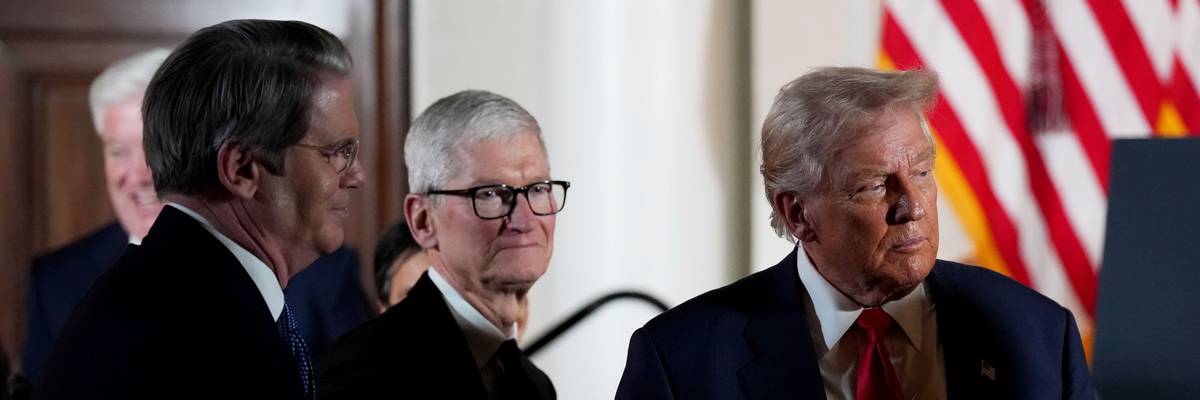
Apple CEO Tim Cook looks on as US President Donald Trump greets business leaders during a meeting on October 28, 2025 in Tokyo, Japan.
"Why would corporations spend millions on Trump's ballroom or Bitcoin? Because they're getting billions in unlegislated tax breaks," said one Democratic lawmaker.
The Trump administration is quietly waging an all-out regulatory war on a Biden-era corporate tax that aimed to prevent large companies from dodging their tax liabilities while reporting huge profits.
The corporate alternative minimum tax (CAMT) was enacted as part of the Inflation Reduction Act, Democratic legislation that former President Joe Biden signed into law in 2022. The CAMT requires highly profitable US corporations to pay a tax of at least 15% on their so-called book profits, the figures reported to shareholders.
As the Institute on Taxation and Economic Policy has explained: "Many of the special breaks that corporations use to avoid taxes work by allowing companies to report profits to the IRS that are much smaller than their book profits. Corporate leaders prefer to report low profits to the IRS (to reduce taxes) and high profits to the public (to attract investors)."
But since President Donald Trump took office in January, his administration has issued guidance and regulatory proposals designed to gut the CAMT. The effort is a boon to corporate giants and rich private equity investors at a time when the Trump administration is relentlessly attacking programs for low-income Americans, including Medicaid and nutrition assistance.
The New York Times reported Saturday that "with its various tax relief provisions, the administration is now effectively adding hundreds of billions of dollars in new breaks for big businesses and investors" on top of the trillions of dollars in tax cuts included in the Trump-GOP budget law enacted over the summer.
"The Treasury is empowered to write rules to help the IRS carry out tax laws passed by Congress," the newspaper added. "But the aggressive actions of the Trump administration raise questions about whether it is exceeding its legal authority."
Why would corporations spend millions on Trump's ballroom or bitcoin?
Because they're getting billions in unlegislated tax breaks.
We've gone from a system where the rich must pay taxes for public services, to one where they must pay the president for private favors.
— Tom Malinowski (@Malinowski) November 8, 2025
The administration's assault on the CAMT has drawn scrutiny from members of Congress.
In a September 8 letter to US Treasury Secretary Scott Bessent, a group of Democratic lawmakers and Sen. Angus King (I-Maine) warned that the administration's guidance notices "create new loopholes in the corporate alternative minimum tax for the largest and wealthiest corporations."
"Most troubling, Notice 2025-27, issued this June, allows companies to avoid CAMT if their income—under a simplified accounting method—is below $800 million," the lawmakers wrote. "The Biden administration previously set the safe harbor threshold precisely at $500 million in its proposed CAMT rule after calculating that a higher safe harbor threshold would risk exempting corporations that should be subject to CAMT under statute."
"Now, less than nine months later and with zero justification, this new guidance summarily asserts that an $800 million safe harbor will not run that risk," they continued. "We are seriously concerned that this cursory loosening of CAMT enforcement will simply allow more wealthy corporations to avoid paying their legally owed share."
Dear Common Dreams reader, It’s been nearly 30 years since I co-founded Common Dreams with my late wife, Lina Newhouser. We had the radical notion that journalism should serve the public good, not corporate profits. It was clear to us from the outset what it would take to build such a project. No paid advertisements. No corporate sponsors. No millionaire publisher telling us what to think or do. Many people said we wouldn't last a year, but we proved those doubters wrong. Together with a tremendous team of journalists and dedicated staff, we built an independent media outlet free from the constraints of profits and corporate control. Our mission has always been simple: To inform. To inspire. To ignite change for the common good. Building Common Dreams was not easy. Our survival was never guaranteed. When you take on the most powerful forces—Wall Street greed, fossil fuel industry destruction, Big Tech lobbyists, and uber-rich oligarchs who have spent billions upon billions rigging the economy and democracy in their favor—the only bulwark you have is supporters who believe in your work. But here’s the urgent message from me today. It's never been this bad out there. And it's never been this hard to keep us going. At the very moment Common Dreams is most needed, the threats we face are intensifying. We need your support now more than ever. We don't accept corporate advertising and never will. We don't have a paywall because we don't think people should be blocked from critical news based on their ability to pay. Everything we do is funded by the donations of readers like you. When everyone does the little they can afford, we are strong. But if that support retreats or dries up, so do we. Will you donate now to make sure Common Dreams not only survives but thrives? —Craig Brown, Co-founder |
The Trump administration is quietly waging an all-out regulatory war on a Biden-era corporate tax that aimed to prevent large companies from dodging their tax liabilities while reporting huge profits.
The corporate alternative minimum tax (CAMT) was enacted as part of the Inflation Reduction Act, Democratic legislation that former President Joe Biden signed into law in 2022. The CAMT requires highly profitable US corporations to pay a tax of at least 15% on their so-called book profits, the figures reported to shareholders.
As the Institute on Taxation and Economic Policy has explained: "Many of the special breaks that corporations use to avoid taxes work by allowing companies to report profits to the IRS that are much smaller than their book profits. Corporate leaders prefer to report low profits to the IRS (to reduce taxes) and high profits to the public (to attract investors)."
But since President Donald Trump took office in January, his administration has issued guidance and regulatory proposals designed to gut the CAMT. The effort is a boon to corporate giants and rich private equity investors at a time when the Trump administration is relentlessly attacking programs for low-income Americans, including Medicaid and nutrition assistance.
The New York Times reported Saturday that "with its various tax relief provisions, the administration is now effectively adding hundreds of billions of dollars in new breaks for big businesses and investors" on top of the trillions of dollars in tax cuts included in the Trump-GOP budget law enacted over the summer.
"The Treasury is empowered to write rules to help the IRS carry out tax laws passed by Congress," the newspaper added. "But the aggressive actions of the Trump administration raise questions about whether it is exceeding its legal authority."
Why would corporations spend millions on Trump's ballroom or bitcoin?
Because they're getting billions in unlegislated tax breaks.
We've gone from a system where the rich must pay taxes for public services, to one where they must pay the president for private favors.
— Tom Malinowski (@Malinowski) November 8, 2025
The administration's assault on the CAMT has drawn scrutiny from members of Congress.
In a September 8 letter to US Treasury Secretary Scott Bessent, a group of Democratic lawmakers and Sen. Angus King (I-Maine) warned that the administration's guidance notices "create new loopholes in the corporate alternative minimum tax for the largest and wealthiest corporations."
"Most troubling, Notice 2025-27, issued this June, allows companies to avoid CAMT if their income—under a simplified accounting method—is below $800 million," the lawmakers wrote. "The Biden administration previously set the safe harbor threshold precisely at $500 million in its proposed CAMT rule after calculating that a higher safe harbor threshold would risk exempting corporations that should be subject to CAMT under statute."
"Now, less than nine months later and with zero justification, this new guidance summarily asserts that an $800 million safe harbor will not run that risk," they continued. "We are seriously concerned that this cursory loosening of CAMT enforcement will simply allow more wealthy corporations to avoid paying their legally owed share."
The Trump administration is quietly waging an all-out regulatory war on a Biden-era corporate tax that aimed to prevent large companies from dodging their tax liabilities while reporting huge profits.
The corporate alternative minimum tax (CAMT) was enacted as part of the Inflation Reduction Act, Democratic legislation that former President Joe Biden signed into law in 2022. The CAMT requires highly profitable US corporations to pay a tax of at least 15% on their so-called book profits, the figures reported to shareholders.
As the Institute on Taxation and Economic Policy has explained: "Many of the special breaks that corporations use to avoid taxes work by allowing companies to report profits to the IRS that are much smaller than their book profits. Corporate leaders prefer to report low profits to the IRS (to reduce taxes) and high profits to the public (to attract investors)."
But since President Donald Trump took office in January, his administration has issued guidance and regulatory proposals designed to gut the CAMT. The effort is a boon to corporate giants and rich private equity investors at a time when the Trump administration is relentlessly attacking programs for low-income Americans, including Medicaid and nutrition assistance.
The New York Times reported Saturday that "with its various tax relief provisions, the administration is now effectively adding hundreds of billions of dollars in new breaks for big businesses and investors" on top of the trillions of dollars in tax cuts included in the Trump-GOP budget law enacted over the summer.
"The Treasury is empowered to write rules to help the IRS carry out tax laws passed by Congress," the newspaper added. "But the aggressive actions of the Trump administration raise questions about whether it is exceeding its legal authority."
Why would corporations spend millions on Trump's ballroom or bitcoin?
Because they're getting billions in unlegislated tax breaks.
We've gone from a system where the rich must pay taxes for public services, to one where they must pay the president for private favors.
— Tom Malinowski (@Malinowski) November 8, 2025
The administration's assault on the CAMT has drawn scrutiny from members of Congress.
In a September 8 letter to US Treasury Secretary Scott Bessent, a group of Democratic lawmakers and Sen. Angus King (I-Maine) warned that the administration's guidance notices "create new loopholes in the corporate alternative minimum tax for the largest and wealthiest corporations."
"Most troubling, Notice 2025-27, issued this June, allows companies to avoid CAMT if their income—under a simplified accounting method—is below $800 million," the lawmakers wrote. "The Biden administration previously set the safe harbor threshold precisely at $500 million in its proposed CAMT rule after calculating that a higher safe harbor threshold would risk exempting corporations that should be subject to CAMT under statute."
"Now, less than nine months later and with zero justification, this new guidance summarily asserts that an $800 million safe harbor will not run that risk," they continued. "We are seriously concerned that this cursory loosening of CAMT enforcement will simply allow more wealthy corporations to avoid paying their legally owed share."