SUBSCRIBE TO OUR FREE NEWSLETTER
Daily news & progressive opinion—funded by the people, not the corporations—delivered straight to your inbox.

5
#000000
#FFFFFF
To donate by check, phone, or other method, see our More Ways to Give page.

Daily news & progressive opinion—funded by the people, not the corporations—delivered straight to your inbox.
"It's time to invest in the American people, not endless war," said Sen. Bernie Sanders.
As expected, members of the Senate Democratic Caucus on Tuesday blocked debate on an annual military spending authorization bill over President Donald Trump’s ongoing illegal war of choice on Iran and provisions for closer US-Israeli military integration.
Upper chamber lawmakers voted 50-46, mostly along party lines, against proceeding with debate on the National Defense Authorization Act (NDAA) for fiscal year 2027.
The Trump administration’s broader national security proposal requests nearly $1.5 trillion in total defense-related spending for 2027, which includes $350 billion in supplemental funding for munitions production, shipbuilding, missile defense, drones, artificial intelligence, and other long-term military programs.
Sen. Bernie Sanders (I-Vt.), who along with Sen. Chris Van Hollen (D-Md.) led the effort to vote down the NDAA in its current form, said on social media: "At a time when millions struggle to pay the bills, virtually every Senate Republican voted for a staggering $1.15 trillion Pentagon bill, which includes funding for the illegal and immoral war in Iran and a special provision to provide even more weapons to Israel with almost zero oversight."
"It's time to invest in the American people, not endless war," he added.
"I’m a NO on the NDAA," Sen. Jeff Merkley (D-Ore.) said on social media. "I can’t support excessive military spending, de facto approval of Trump’s illegal war with Iran, and deeply troubling provisions that force deeper US-Israeli defense and intelligence sharing."
Sen. Ron Wyden (D-Ore.) said he "cannot support an outrageous $1.15 trillion in military spending while Donald Trump engages in an idiotic war with Iran that is doing nothing to make Americans safer, puts US servicemembers and civilians in harm's way, and spikes the price of gas."
“I also cannot support new authorities included in the bill, which seek to deepen and accelerate cooperation with Israeli contractors on surveillance and AI technologies that are ripe for abuse," Wyden added. "On [Israeli Prime Minister Benjamin] Netanyahu’s watch, surveillance technologies developed by Israeli companies have repeatedly been used by repressive regimes, contributed to human rights violations in Gaza, and have been used against Americans."
Republicans, on the other hand, denounced Tuesday's vote, with Sen. Bernie Moreno of Ohio accusing his Democratic colleagues of "holding America hostage" and Sen. John Cornyn of Texas alleging they're "once again playing politics with our national security instead of prioritizing the safety of the American people."
Progressive groups campaigners cheered Tuesday's vote.
"For once, the Senate refused to fast-track a $1.15 trillion Pentagon budget," Medea Benjamin, co-founder of the women-led peace group CodePink, said on social media following the vote. "After sustained grassroots pressure... people power made this vote possible. Now let’s make sure senators hold the line."
Taxpayers for Common Sense president Steve Ellis said, "The Senate just sent a clear signal to the Pentagon that its request for a $250 billion, 28% boost in its base budget is not going to fly."
"Taxpayers deserve a Pentagon budget that invests strategically in the essentials while cutting out outdated, unnecessary, and wasteful programs," he continued. "Instead, the Pentagon’s request would set a new baseline of unsustainable spending that would add more than $3 trillion to the debt over the next eight years."
"With the end of the fiscal year looming, lawmakers need to get realistic and work together to pass a bipartisan Pentagon budget aligned with our genuine needs, not this grab bag of ill-advised boondoggles," Ellis added.
At the consumer advocacy watchdog Public Citizen, co-president Robert Weissman called the vote "both a repudiation of throwing more money at the waste-and-fraud-ridden Pentagon while Republican cuts have forced millions to lose health coverage and food assistance, and a forceful rejection of the Trump’s Iran War."
“The American people are fed up with spending more on bombs and less on basic needs," Weissman continued. "And they are furious with a pointless, deadly, illegal, unconstitutional, and protracted war that is costing lives and driving up gas prices."
“Elected officials are beginning to listen," he added. "Today’s defeat of the procedural motion on... legislation that normally sails through Congress on a bipartisan basis is a sign that the Pentagon budget will no longer get a rubber stamp.”
Greg Williams, director of the Center for Defense Information at the Project on Government Oversight, said in a statement that "the Senate was right to reject the National Defense Authorization Act, particularly as the executive branch continues its illegal, unsanctioned war in Iran."
"The budget topline in the bill is recklessly high—bringing an increase in military spending not seen since World War II," Williams added.
In a bid to address that point, Sen. Ed Markey (D-Mass.) recently introduced the Slash the Pentagon Act, legislation that would cap military spending at what some critics say is a still staggering $750 billion.
"Trump’s good friend and staunch US ally, the United Arab Emirates dictatorship, run by one of the wealthiest families in the world—has financed and enabled this genocide for years."
As the world fears another massacre by the Rapid Support Forces in Sudan, Sen. Bernie Sanders emphasized that the rebel group’s string of atrocities is being funded by a nation with deep financial ties to President Donald Trump—the United Arab Emirates—and urged an end to US military support.
"In the midst of the wars in Gaza and Iran, we cannot forget the atrocities in Sudan," Sanders (I-Vt.) said Monday in a post to social media. "As many as 150,000 killed since 2023, 14 million driven from their homes, 30 million need humanitarian aid."
"All of this is fueled by the UAE—one of Trump's closest allies," the senator continued. "We cannot be complicit in genocide."
The warning came as RSF encircles El Obeid, a city of half a million people, including hundreds of thousands who have been displaced.
For weeks, the RSF has launched drone attacks that have killed dozens of civilians and damaged critical infrastructure including water facilities, markets, and hospitals. Food, water, and fuel supplies have been disrupted. Some civilians have begun to flee as many entry points to the city have been cut off.
The United Nations Security Council warned last month that there was an "imminent risk of mass atrocities" and demanded that the RSF halt its assault.
Human Rights Chief Volker Türk stressed that the siege tactics followed a familiar "playbook" to the RSF's October attack on El-Fasher in which at least 6,000 people were killed in just three days as part of a campaign that UN human rights experts said bore the "hallmarks of genocide," including ethnically targeted killings and sexual violence.
While the US State Department and other governments have similarly warned that the RSF could be on the verge of committing atrocities, Nicholas Kristof argued in a New York Times column this weekend that "officials won’t say openly... that the power behind the RSF is the United Arab Emirates."
Despite denials from Abu Dhabi, the UAE has been extensively documented as supporting the RSF through weapons shipments routed via Chad, financing the militia, and recruiting, training, and transporting mercenaries to fight alongside the group.
Kristof pointed out that the UAE "has particularly close financial ties to the Trump family," most notably the $2 billion investment by an Emirati firm last year that benefited his family's cryptocurrency venture, World Liberty Financial (WLF), which has been a major source for the unprecedented growth of the president's wealth during his second term.
Recent financial disclosures reported this month by the Wall Street Journal show that Trump received $263 million from selling half his stake in WLF to a fund backed by Sheikh Tahnoon bin Zayed Al Nahyan, one of the UAE's most powerful royals and the brother of its president.
During his second term, Trump has rewarded the UAE with more than a billion dollars in weapons sales that were fast-tracked to get around holds imposed by Congress, and made an agreement giving the Emirates unprecedented access to hundreds of thousands of advanced computer chips per year.
“Trump’s good friend and staunch US ally, the United Arab Emirates dictatorship, run by one of the wealthiest families in the world—has financed and enabled this genocide for years,” Sanders said in a statement last week. "And why is this happening? Billions of dollars of looted gold from Sudan is flowing straight into the pockets of Emirati oligarchs—making a multibillionaire family even richer."He added that "Congress must demand that the UAE cease its military support for the RSF and work with the international community and the Sudanese people to bring an end to this horrific conflict and provide the humanitarian aid that is desperately needed there."
As warnings about a brutal new RSF offensive have piled up, there has been a push in Congress led by Sen. Chris Van Hollen (D-Md.) and Rep. Sara Jacobs (D-Calif.) for restrictions on the United States' ability to provide weapons to the UAE.
Last month, with help from some Democrats, the GOP-controlled Senate Foreign Relations Committee blocked two amendments aimed at halting US weapons shipments to the UAE unless it stops supporting the RSF.
The committee has passed a weaker bill that allows the president to impose optional sanctions on individuals who supply weapons to Sudan's armed factions, which now awaits a full Senate vote. But the committee rejected Van Hollen's amendment prohibiting arms sales to the UAE.
A year ago Bezos declared that Post Opinions would now promote “personal liberties and free markets"; since then, the page has touted AI and data centers and lambasted wealth taxes and social safety net programs.
It’s been an eventful year since Washington Post owner Jeff Bezos tapped Adam O’Neal for the prestigious job of Post Opinions editor. O’Neal was an unusual hire, a 33-year-old with little by way of managerial experience. But O’Neal had a redeeming quality: He was ready to shill for Bezos, and the man Bezos has been desperately wooing, President Donald Trump.
It’s remarkable how far Bezos has come since 2013, when he said he purchased the Post from the Graham family out of a sense of civic duty.
Bezos was still singing a similar tune nearly midway through Trump’s first term, telling Axel Springer CEO Mathias Döpfner (4/28/18), “I would be humiliated to interfere” with the Post’s coverage. “I would be so embarrassed. I would turn bright red… It would feel icky; it would feel gross.”
But days before the 2024 election, with Trump looking like he might return to the White House, Bezos apparently got over his queasiness and personally spiked the Post’s endorsement of Kamala Harris (FAIR.org, 10/30/24). “Trump was thrilled, advisers said, and later thanked Bezos,” The Wall Street Journal (7/2/26) reported.
It’s a jarring listen; like the keys to a once-storied newspaper have been turned over to the manosphere.
Bezos followed up by declaring that Post Opinions would now promote “personal liberties and free markets,” while “viewpoints opposing those pillars will be left to be published by others.” Coming a month into Trump’s second term, this came across as another gift to the president (FAIR.org, 2/28/25).
To lead the newly oriented Opinions page, Bezos tapped O’Neal, who had been a correspondent for The Economist, editorial writer for The Wall Street Journal, and executive editor at the conservative Dispatch for just one year.
In that last role—apparently O’Neal’s only newsroom managerial experience—he quickly alienated the Dispatch staff. “He was a competent editor who had no idea how to talk to another human being,” a former associate of O’Neal’s told Status (7/18/25):
He was tough on reporters, sure, but that’s common in newsrooms. He just couldn’t express even the most minor thing without being abrasive, hostile, or raising his voice.
After being named to his post in June 2025, O’Neal declared that Post Opinions would be “unapologetically patriotic” and “communicate with optimism about this country.” This echoed Bezos, who declared a month into Trump’s second term, “I am of America and for America, and proud to be so.” Bezos was, of course, echoing Trump’s “America first” rhetoric.
O’Neal has demonstrated his patriotism by overseeing an editorial page that has backed Trump in destroying the East Wing of the White House (10/25/25), kidnapping the Venezuelan president (“one of the boldest moves a president has made in years”—1/3/26), militarily taking over DC (8/11/25; FAIR.org, 8/14/25), and unprecedented gerrymandering (8/20/25). (When Democrats responded in kind, the Post decried the “power grab”—4/21/26).
The Post’s pro-Trump boosterism under O’Neal has been so over the top, wrote Chris Lehmann (The Nation, 2/4/26), it’d “be a stretch for Pravda to pull off.”
“I try to avoid reading what the opinions section publishes,” a current Post staffer told Status (5/10/26). “I can’t tell if some of these arguments are being made in good faith or not. Sometimes it just seems like rage bait.”
While O’Neal’s predecessor, David Shipley, did everything Bezos could have asked for—spiking the Post’s Harris endorsement and a cartoon depicting Bezos and other tech moguls as Trump supplicants (FAIR.org, 1/7/25)—he did it without zeal, which Bezos found intolerable. “I suggested to him that if the answer wasn’t ‘hell yes,’ then it had to be ‘no,’” Bezos wrote, in explaining Shipley’s February 2025 resignation.
Shipley had voiced concern over the direction Bezos was taking the Post, warning the billionaire that spiking the Harris endorsement days before the election and yanking Opinions rightward could turn off subscribers. “I don’t care,” Bezos replied (New York Times, 3/14/26). (Shipley proved correct; Bezos’ interventions led to over 375,000 Post readers canceling their subscriptions—NPR, 1/30/26.)
Replacing Shipley, O’Neal wasted little time in transforming Opinions’ editorial outlook, and its personnel. In his first email to the Opinions desk, O’Neal encouraged his colleagues to get with the program or quit, mimicking Bezos’ message to Shipley. “Simply being reconciled to these changes is not enough,” O’Neal wrote. “We want those who stick with us to be genuinely enthusiastic about the new direction and focus.”
Seeing the writing on the wall, many of the Post’s centrist and left-of-center columnists took the generous buyouts on offer (which some had been contemplating since before O’Neal was hired). Gone in quick succession were Perry Bacon Jr., Philip Bump, Jonathan Capehart, Joe Davidson, Marc Fisher, Glenn Kessler, Ruth Marcus, Dana Milbank, Catherine Rampell, Eugene Robinson, Eduardo Porter, and others. “It’s just an absolute exodus,” a Post staffer told Politico (7/28/25).
The paper’s last full-time Black Opinions columnist, Karen Attiah, was fired in September 2025 (Golden Hour, 9/15/25; FAIR.org, 9/23/25). (Theodore R. Johnson of New America writes roughly once a week as a contributing columnist, but is not on staff.)
Bezos hollowed the Post out further in February when he laid off nearly half of the newsroom, in what “may have been the biggest one-day wipeout of journalists in a generation” (Washingtonian, 2/9/26).
Publicly, Bezos claimed he was doing this for the long-term viability of the paper. To be relevant, the Post has to be a “profitable enterprise that stands on its own two feet,” Bezos told Andrew Ross Sorkin (CNBC, 5/20/26). Otherwise, “it would be like poetry without rhyming.”
Privately, however, Bezos told Trump that Post employees “are terrible…. They don’t listen. My other companies, they listen,” according to New York Times reporters Maggie Haberman and Jonathan Swan’s new book Regime Change.
To make the Post more like his other companies, Bezos needed “hell yes” management, like Adam O’Neal (and former publisher Will Lewis).
O’Neal, in turn, needed fellow travelers, and seems to have hired exclusively MAGA-friendly columnists. According to media critic Adam Johnson (Real News Network, 5/22/26), the Post
purged its opinion page of its actually popular writers and replaced them with charmless Economist and Wall Street Journal also-rans so they can spew libertarian cliches [and] tedious anti-woke screeds.
O’Neal’s fealty to Bezos is most blatant in Opinions’ approach to artificial intelligence.
“All of the things that I work on today have something to do with AI,” Bezos told the Financial Times (6/11/26). “We’re in the middle of multiple golden ages right now, certainly with AI,” he continued, sounding every bit the snake oil salesman. “I think you’re going to see a whole bunch of incredible miracles unfold here in the next decade.”
And Bezos is banking on these miracles to expand his empire on Earth and in space. Despite being worth a quarter-trillion dollars, Bezos is presently scouring the globe to raise $100 billion for a new fund that plans to buy companies in industrial sectors and improve them using AI (Forbes, 3/19/26). Bezos’ latest effort aligns neatly with his new role as co-CEO of Project Prometheus, a low-profile AI company that’s raised $18 billion in funding (Morning Brew, 6/12/26).
Meanwhile, Amazon—the company Bezos founded, where he remains the largest shareholder and executive chair—“recently placed a series of staggeringly expensive bets on artificial intelligence, audacious even by the standards of Silicon Valley’s ongoing trillion-dollar AI bacchanalia,” Bloomberg reported (5/14/26).
With so much on the line, Bezos has little patience for doomsayers who fear AI will cause mass job loss—the very thing Wall Street is salivating over. Sure, AI will be “shrinking the number of people needed by 10x,” Bezos told The Wall Street Journal (6/11/26). But the technology will in fact create “more than 10x” as many jobs, he said. The suggestion seems to be that more than 90% of us will soon be in hitherto unimagined job categories made possible by artificial intelligence. (Bezos’ fellow tech titans recently started following his lead and saying similar things about AI job losses.)
Despite Bezos’ rosy outlook, “the public isn’t so reassured,” the Journal reported (6/13/26) two days later, citing a Pew Research Center survey from March. “Only 17% of Americans say AI will have an overall positive effect on the US over the next 20 years.”
And the data centers needed to power AI fare little better. “Americans have changed their minds about data centers. Decisively,” reported the outlet Heatmap (6/2/26), which conducted a recent poll. “At least 7 in 10 Americans would now oppose a data center being built near their home… a record low.”
Opposition to data centers—and their insatiable demand for power and water—has become “The Most Bipartisan Issue Since Beer,” according to a New York Times headline (5/1/26).
With the American people on one side of the AI divide, and Bezos and his fellow tech oligarchs on the other, O’Neal has rushed to his boss’ rescue (FAIR.org, 11/20/25). Here are some recent Opinions headlines (a couple have been subsequently altered):
Beyond the dutiful headlines themselves, the editorials also fail to disclose Bezos’ AI ties—which is not unusual. “What the Post’s data-center cheerleading only intermittently mentions is its owner’s vested interest in the topic,” noted Paul Farhi (Washingtonian, 6/23/26), the Post’s former media reporter. “I was unable to find a single editorial or opinion column opposing [AI data centers’] construction over the past six months.”
One of O’Neal’s top deputies, James Hohmann, took things a step further (while also failing to note Bezos’ ties to AI). Hosting an episode (5/26/26) of Opinions’ new flagship podcast, Make It Make Sense—headlined “Why Data Centers Don’t Deserve So Much Hate”—Hohmann “described climate activists as a ‘cult’ and argued that the media is ‘guilty’ of fueling ‘hysteria’ over climate change,” Status (6/7/26) summarized. It’s a jarring listen; like the keys to a once-storied newspaper have been turned over to the manosphere.
Even as Bezos hollows out the rest of the Post, money is flowing to Make It Make Sense, which has a well-appointed new studio. So far, however, “the investment has produced an astonishingly small audience,” Status reported (5/11/26). “It does feel like this is just for an audience of one,” a former Post staffer told the outlet.
As grassroots fights against AI data centers spring up from coast to coast, opposition in the Senate is led by Sen. Bernie Sanders (I-Vt.), who introduced a bill to place a two-year moratorium on the construction of new data centers.
Already a bête noire of the Post (FAIR.org, 3/8/16), Sanders’ critique of data centers has led to a renewed thrashing. In a March editorial (3/25/26) headlined “Bernie Sanders Doubles Down on His Dumbest Idea,” the Post placed Sanders at “the lunatic fringe” of society for “throwing sand into the gears of progress.” The editorial also called Sanders “the leading Luddite of the 2020s.”
Two weeks later, the Post (4/8/26) returned to the “L” word, this time in an editorial that didn’t mention Sanders, but did associate opposition to data centers with domestic terrorism:
The mob-like movement against data centers that’s been gaining traction across the country took a dark turn this week. Indianapolis Councilor Ron Gibson (D), who supports a project to build such a facility in his district, woke up early Monday to the sound of 13 gunshots fired at his home. The gunman left a note on the lawmaker’s doorstep: “NO DATA CENTERS.”
No one was injured, but the incident illustrates how opposition to artificial intelligence can metastasize into an irrational frenzy. It wouldn’t be the first time in history that deranged Luddites turn to violence to fight the advancement of frontier technology.
Later that month, the Post’s editorial page was back to attacking Sanders. Under a scowling picture of the senator, a Post editorial (4/30/26) charged that Sanders
is as naive now as he was during the Cold War. Rarely, if ever, has the socialist met an enemy of the United States who he doesn’t think he can partner with to advance his agenda. The same impulse that led Sanders to cozy up to the Soviets, the Sandinistas, and Fidel Castro in the 1980s was on display again Wednesday night at the Capitol as he invited two Chinese academics to urge Americans to slow-roll our pursuit of artificial intelligence.
“Of course that’s what Beijing wants Washington to do,” the Post continued, in a brazen attempt to paint skepticism of AI data centers—a view held by most Americans—as anti-American.
The Post’s inflammatory editorial mentioned neither Bezos or Amazon, per usual.
It’s not just Bezos’ financial interests that are advanced by O’Neal’s Opinions page, but also Bezos’ and his fellow billionaires’ broader ideological project (Real News Network, 5/22/26).
Under O’Neal’s watch, no tax on the wealthy seems to go uncensured. “The Post has weighed in on tax policy everywhere from Switzerland to Seattle, lambasting every attempt to reduce the grotesque inequality of our times,” Nathan Robinson wrote in a detailed review of the Post Opinions page for The Nation (4/21/26):
Almost no tax on the rich around the world escapes the paper’s notice—one might wonder why capital gains taxes in the Netherlands are a priority for a DC paper.
And no social program appears too small to earn O’Neal’s ire, not even diapers. In providing 400 free diapers to new parents, “California’s nanny state is taking infantilization to a new level,” decried a Post editorial (5/12/26).
Other recent Post editorials have “opposed minimum wage increases, tenant protections, social housing, rent control, free buses, caps on credit card interest rates, caps on the prices of staple foods, congestion pricing, and even the Railway Safety Act,” wrote Robinson.
But when government largesse flows to the rich, the Post is more open minded. The Trump administration’s request for another $200 billion for the Iran War, as well as a $1.5 trillion Pentagon budget for next year, both received the Post’s blessing (3/21/26, 5/12/26). “Peace doesn’t come cheap,” the Post wrote.
Left unmentioned in the editorials is that Bezos’ empire—via his space company Blue Origin and Amazon’s cloud computing arm, AWS—holds billions of dollars worth of Pentagon contracts.
"Restarting his reckless war with Iran won't make America stronger," said Sen. Bernie Sanders. "It will cost more lives and waste more taxpayer dollars."
Key progressives in Congress took aim at President Donald Trump on Wednesday amid his second straight night of attacks on Iran.
US Central Command (CENTCOM) first said Tuesday that its forces had "begun launching a series of powerful strikes against Iran," in response to attacks on commercial ships in the Strait of Hormuz. Then, Trump said Wednesday that the ceasefire established under the memorandum of understanding (MOU) signed last month was "over" and "I don't want to deal with" the Iranians.
As oil prices soared, CENTCOM announced later Wednesday that "at the direction of the commander in chief, US Central Command forces have started conducting additional strikes against Iran to further degrade their ability to threaten freedom of navigation in the Strait of Hormuz. The United States is holding Iran accountable for recent unjustified aggression against commercial shipping and civilian crews freely navigating a vital international waterway."
Minutes later, progressive Sen. Bernie Sanders (I-Vt.) declared: "After getting the United States into a war based on lies, Trump has now declared the ceasefire with Iran 'over' after less than a month. Restarting his reckless war with Iran won't make America stronger. It will cost more lives and waste more taxpayer dollars. END THIS WAR."
Meanwhile, Trump shared a series of videos of the bombings across Iran on his Truth Social platform Wednesday evening.
The National Iranian American Council (NIAC) said in a statement that "the Trump administration is steering the United States back toward an illegal and disastrous war with Iran. Rather than implementing the agreement it negotiated, it has chosen escalation over diplomacy."
"A return to war is illegal," NIAC emphasized. "Congress passed a war powers resolution directing the president to terminate hostilities, and a majority of Americans oppose another war with Iran. If President Trump wants to return to war, he must seek congressional authorization. If he refuses, Congress must enforce the law."
The US House of Representatives voted 215-208 in favor of a war powers resolution aimed at ending Trump's illegal war of choice on Iran early last month. After a few weeks, the Senate also passed it, with a 50-48 vote—but just a day later, under pressure from the president, Republican Sens. Bill Cassidy (La.) and Rand Paul (Ky.) helped the GOP block a subsequent measure.
Sen. Tim Kaine (D-Va.), sponsor of the blocked resolution, said at the time that "after both Republican-majority Houses took the historic step of voting that additional war against Iran is illegal without congressional authorization, President Trump came to the Capitol and tried to browbeat Republican senators for upholding their oaths of office."
"To appease his temper tantrum, Republicans agreed to defeat a superfluous motion to proceed to a separate War Powers Resolution currently pending before the Senate," he continued. "The vote is of no consequence and does not undo the expressed position of Congress that further war against Iran is illegal unless Congress votes for it."
Kaine also spoke out Wednesday morning, saying: "Congress voted against more war with Iran. The U.S. should not be launching new strikes without congressional authorization and restarting a war that has raised gas prices, killed Americans, and hurt the economy. The U.S. and Iran must return to a ceasefire."
Sen. Elizabeth Warren (D-Mass.) weighed in Wednesday afternoon: "Donald Trump's war with Iran has cost American lives, and jacked up prices on gas and groceries for millions across the globe. Congress voted against this war. Congress shouldn't allow Donald Trump to continue it."
Key House members have also spoken out since the strikes resumed Tuesday. Congressional Progressive Caucus (CPC) Chair Greg Casar (D-Texas) said that "Trump is extending his disastrous, illegal war with Iran. Congress and the American people have demanded the war end. Instead, Trump is choosing higher gas prices, more lives lost, and more instability. Outrageous."
Noting the new attacks and Trump's ceasefire comment, CPC Chair Emerita Pramila Jayapal (D-Wash.) similarly stressed that "this is another escalation in a war that the American people do not want. The House and Senate passed bipartisan war powers resolutions for this exact reason. This war must end NOW."
The senator said he spoke with the Democratic candidate "about the best path forward for Maine" and recommended that he leave the race.
US Sen. Bernie Sanders, among the earliest and most prominent congressional backers of Graham Platner's campaign to unseat Republican Sen. Susan Collins, has joined growing calls for the Maine Democrat to exit the race following sexual assault allegations.
"I have spoken with Graham Platner about the best path forward for Maine," Sanders (I-Vt.) said in a Tuesday statement. "In light of these very serious allegations, I have recommended that he step aside."
Jenny Racicot initially told The New York Times that Platner's behavior was "reckless" and "unsettling" during their on-and-off relationship in 2019-21, and that she cut off contact after he came to her Maine home drunk despite being told not to around five years ago. Politico reported Monday afternoon that the 41-year-old said he sexually assaulted her that night. Later Monday, Racicot appeared on CNN and said he "absolutely" raped her.
Platner, in a Monday video, denied "any accusation of nonconsensual behavior," but also said that his campaign was "taking the time to reflect on the best path forward" given "the political reality" resulting from the reporting—which followed other controversies, including offensive Reddit posts, a tattoo resembling a Nazi symbol, and allegations of physical aggression that he also denied.
After months of campaigning on progressive policies, the oyster farmer and combat veteran won last month's primary by over 50 points, beating Gov. Janet Mills, who remained on the ballot despite suspending her campaign in April. After Racicot's assault allegations broke, numerous groups and individuals—including other members of Congress who had endorsed Platner—called on him to immediately withdraw.
In a Tuesday statement revoking the Sierra Club's endorsement, political director Sarah Burton said that the green group's "thoughts are with Jenny Racicot for courageously sharing her story. Victims of sexual violence must be listened to and provided our caring and support. Their lives are not for political gamesmanship."
"Upholding basic standards of integrity, decency, and ethics is not a qualification to win the American electorate's trust; it is a requirement," Burton continued. "In light of yesterday's horrific and disturbing allegations, the Sierra Club has rescinded its endorsement of Graham Platner and calls on him to withdraw his candidacy.”
New York City Mayor Zohran Mamdani had not endorsed Platner, but some of his top aides played key roles in the effort to elect the Mainer. The Sanders-backed democratic socialist mayor told reporters on Tuesday that "I believe that it's time for him to drop out of the race."
According to Politico, when asked if he is concerned that the collapse of Platner's campaign could negatively impact the left more broadly, Mamdani responded, "I think the focus of today should be on the campaign coming to a close, and I think there will be many more days to have conversations about what it means beyond that."
Congressional Progressive Caucus Chair Greg Casar (D-Texas), who previously backed Platner, said late Monday that "I am horrified by the allegations against Graham Platner. He should drop out of the Senate race. Maine Democrats should replace him with an inspiring candidate who can best represent them."
Racicot told CNN and Politico that she didn't publicly accuse Platner of rape earlier in part because she agrees with his politics—and some progressives who previously supported the candidate have warned the Democratic establishment that "this is not your opening," as Our Revolution executive director Joseph Geevarghese said in a Monday statement calling for his withdrawal.
If Platner withdraws by July 13, he can be replaced on the ballot, and the Maine Democratic Party would have until July 27 to come up with a name. Already, Democrat Troy Jackson, a former Maine Senate president who campaigned for governor this cycle with Platner and Sanders, has filed paperwork.
We can safely predict that the Democratic Party, as it exists today, is doomed. What comes next for progressives and working-class politics will be much more interesting than what we've suffered over recent decades.
Historically, periods of widespread economic suffering have often seen a surge of left-wing organizing, and even notable victories. In 1789, desperation among the peasantry and urban working class helped catalyze the French Revolution. The 1880s and 1890s in the United States saw the Farmers’ Alliances and the People’s Party sweep the interior of the country, in a vast movement to overcome the exploitation and poverty of farmers and workers. During World War I, the miseries of the Russian peasantry and industrial proletariat provided the context for the overthrow of Tsardom and then, months later, the overthrow of an ineffectual parliamentary government. The Great Depression of the 1930s saw, in the US, the birth of the welfare state and the triumph of industrial unionism.
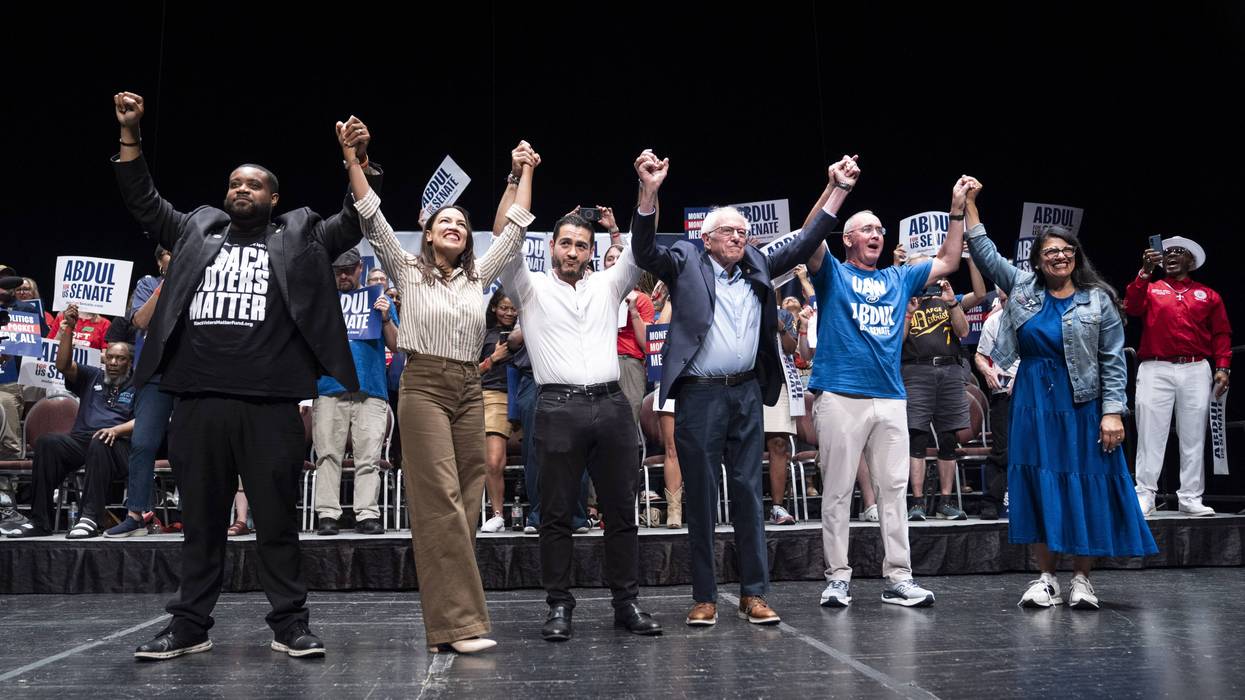
It is no surprise, then, that the suffering of a large proportion of Americans today is helping to bring forth a new left, which has lately been seeing electoral and policy victories. In just over a year, Zohran Mamdani has become a figure with national name-recognition, but it might not be long before more people have heard of Chris Rabb, a member of the Democratic Socialists of America in Pennsylvania who is headed to Congress this year; Janeese Lewis George, a DSA member who is set to become mayor of Washington, DC.; Brad Lander, Darializa Avila Chevalier, and Claire Valdez, New York leftists entering Congress; Nithya Raman, a socialist who might be the next mayor of Los Angeles; Melat Kiros, a socialist from Colorado who won her primary; Abdul El-Sayed, a leftist who may soon be the newest senator from Michigan; and others.
There isn’t anything like a French Revolution or a Russian Revolution on the horizon, but in the coming years, as the American economy continues to leave working people behind, it is certain that we’ll see more left-wing victories. By the 2030s, the stagnant center will be in dire condition, faced with a well-funded far-right and a left stronger than at any point since the 1960s.
What are the economic trends that forecast such an outcome? Some of them are almost universally acknowledged. Most obviously, inequality continues to skyrocket. Even before Elon Musk became a trillionaire—a fact, incidentally, that itself proves the insanity of American capitalism—the top 1% of American households owned 32% of all US wealth, about equal to the bottom 90% combined. America’s billionaires own more than $8 trillion. The income of the richest 1% averages to more than 100 times that of the bottom 20%. It is hardly surprising, then, that among peer countries, the US has the highest rate of poverty, the highest rate of infant mortality, and the second lowest life expectancy. Nor is it a surprise that a majority of Americans think a middle-class lifestyle is out of reach, or that less than half of families were able to afford medical expenses in 2025.
The picture is clear. There are good reasons that Bernie Sanders, the democratic socialist, is consistently one of the most popular politicians in the country. Mainstream liberal commentators fret that running leftist candidates may cost the Democratic Party votes, but such commentators are evidently far out of touch with voter sentiment. According to polls, three quarters of Americans think the country’s political and economic system needs major changes. The Democratic Party is viewed unfavorably by 59% of adults (not much different from the Republican Party’s 58%). Chuck Schumer, a veritable symbol of the centrist status quo, is disliked by 68% of voters. Left priorities like Medicare for All, a substantially higher minimum wage, strengthening unions, raising taxes on corporations and the wealthy, increasing affordable housing, doing more to protect the environment, and cutting the military budget regularly poll well.
Far from the left’s ascendancy being a threat to the Democratic Party’s power, it is more plausibly seen as the best way to save the party. From Franklin Roosevelt to Bernie Sanders, populism, especially economic populism, is popular. It is a little odd, therefore, to see a party’s leadership consistently doing everything it can to harm its own electoral prospects, by trying to crush populist insurgents and suppress a populist message.
Longer-term trends, too, look good for the left. It isn’t often enough remarked that the US is in many respects in a situation comparable to that of the late 1920s, just before the Great Depression. The soaring inequality is one parallel, as is the soaring stock market. It has become commonplace to observe that the AI boom has features of a bubble. Another parallel is the extreme weakness of organized labor both today and in the late 1920s. Actually, the union membership rate in the private sector today, 6%, is even lower than it was in 1929, about 10%. The weakness of unions has contributed mightily to the stagnation or decline of wages among the working class, and thus to the low purchasing power of consumers. In the 1920s, a huge expansion of consumer credit, such as installment buying, was necessary to maintain the economy’s rate of growth, because millions of people simply weren’t making enough money to buy the things they wanted. Today, likewise, total household debt is at a record level, over $18 trillion.
In fact, the top 10% of earners now account for half of consumer spending—which is reminiscent of the late 1920s. The economy, therefore, faces serious problems of aggregate demand. Altogether, these are ominous tendencies. Particularly because one of the major priorities of the Trump administration has been to accelerate the transfer of money from working people to the rich, thus further shrinking aggregate demand in the long run. One method of doing so has been to reduce taxes on the wealthy while increasing them on the lowest-income households. Another has been to slash the social safety net, for example SNAP and Medicaid benefits, which causes low-income households to cut back on their spending. Attacking unions and laying off hundreds of thousands of federal workers has been a third way Trump is harming the prospects of sustained economic growth. And the list goes on.
In short, it is virtually certain that in the not-too-distant future, very hard times are coming. Such times, of course, provide an ideal opportunity for left organizing and left politics. Millions of people will get “mad as hell” and they “won’t take it anymore.” A populism of class struggle will rise to the fore again, since it will resonate with people’s experiences and grievances. Organizations like the Democratic Socialists of America, the Working Families Party, and Justice Democrats will continue to cultivate a new generation of left leaders, doubtless with ever-greater success. Far-right populism will probably see victories too, and it’s impossible to predict how the conflicts between left populism and right populism will play out.
But what we can predict is that the Democratic Party, as it exists today, is doomed. The era of Clintonite centrism is passing, at long last. The future is much more interesting than that.
Tuesday's New York primary results are the latest sign that Americans are sick to death of a rigged economy and of billionaires buying their elections.
On Tuesday night, the establishment wing of the Democratic Party got a message it would prefer to pretend it didn’t hear. In New York, Mamdani-backed progressives swept the congressional primaries, ousting two sitting Democratic congressmen and taking an open seat in a single evening.
Former city comptroller Brad Lander beat Rep. Dan Goldman by more than 30 points. A 32-year-old democratic socialist named Darializa Avila Chevalier knocked off five-term Rep. Adriano Espaillat, the chair of the Congressional Hispanic Caucus, and state Assemblymember Claire Valdez won the seat Nydia Velázquez is vacating. House Minority Leader Hakeem Jeffries (a recipient of dark money and AIPAC money) campaigned hard against all three and watched all three win anyway.
As Sen. Bernie Sanders (I-Vt.) put it afterward, the message is pretty clear: Americans are sick to death of a rigged economy and of billionaires buying their elections.
The corporate press and just about every Republican in the country will tell you these candidates are “socialists,” and they’ll spit the word the way you’d say “arsonist.” A little history clears the fog.
This is what oligarchy looks like, and the people feeling it in their bank accounts, student loans, and their doctors’ offices understand it far better than the idiotic (or bought-off) Democratic National Committee consultants who keep telling Democrats to move to the “center.”
When a young public defender in upper Manhattan or a state assemblywoman in Brooklyn calls herself a democratic socialist today, she isn’t talking about Havana or the old Soviet Politburo (the way Republicans and much of the press want you to think). The three who won in New York ran on Medicare for All, affordable housing, stronger union protections, and an end to US military support for Israel’s assault on Gaza.
Strip away the scare word and what’s left is far more truly and anciently American than frightening: a country where a person who works 40 hours a week, no matter how complicated or how humble that work might be, can afford a home and a car, take the family on a vacation every year, put the kids through school and college, see a doctor without going bankrupt, and retire with dignity.
That’s the entire “radical” program that Republicans, corporate Democrats, and our billionaire oligarchs are so flipped out about.
Americans have wanted those things for a very long time. More than 120 years ago, Teddy Roosevelt stood up and called it the Square Deal: a fair shot for the worker, the consumer, and the “honest businessman” against the trusts and the railroad barons who’d swallowed the economy whole.
Franklin Roosevelt built the scaffolding of it with the New Deal, Lyndon Johnson finished the second story with the Great Society, and for about three decades we actually had it. The middle class in the postwar years grew faster and richer than any middle class in the history of the world. By 1980, it was two-thirds of us with a single paycheck (it’s about 41% now, and takes two paychecks to get there).
I grew up inside that promise. My father came home from the antifa war (aka WWII); got a job in a unionized tool-and-die shop in Michigan; and on that one paycheck he and my mother raised four boys, bought a house, kept a car in the driveway (new every three years), had a pension when he retired that let him travel the world, and never once feared that a hospital bill would take the whole thing down.
Nobody we knew was rich, but almost everybody we knew was secure. That security was the whole point, and it didn’t happen by accident. It happened because the country decided, through its government, to make it happen.
And then it was taken apart on purpose. As I lay out in The Hidden History of American the American Dream, the dismantling of that middle class wasn’t an unfortunate side effect of globalization or robots or some impersonal economic weather. It was a deliberate Republican neoliberal project that began with Ronald Reagan imitating Maggie Thatcher and following Heritage’s A Mandate for Leadership in 1981 and has been carried forward by both parties ever since.
The tools were straightforward. Going back to Taft-Hartley in 1947 and the spread of “right-to-work-for-less” laws, Republicans and their corporate funders handed states and giant companies the power to strangle unions, and a worker without a union is a worker without leverage.
They froze the federal minimum wage at $7.25 an hour, where it has sat untouched since 2009. America’s oligarchs fought, decade after decade, to keep the United States the only wealthy nation on Earth without national healthcare, herding us instead into the arms of insurance conglomerates and hospital and physician monopolies, more and more of them now owned by private equity firms that treat a sick patient as a line item to be squeezed.
The result, as the nonpartisan RAND Corporation recently calculated, is that roughly $79 trillion has been pumped upward from the bottom 90% of Americans into the money bins of the morbidly rich top 1% since Reagan, and the middle class has sunk below 50% of us and is hanging on—now requiring two paychecks—by its fingernails.
In that same span the share of national income going to the bottom 90% fell from about two-thirds to less than half, we’ve watched the largest upward transfer of wealth in the history of the American republic all the way back to George Washington, and every dollar of it was a choice some oligarch or his wholly-owned politician made.
The one fully socialized, fully government-run healthcare system we do have in this country, the Veterans Administration, works so well (it has the highest happiness-approval rating of any other healthcare system in America) precisely because it isn’t run for profit, which is exactly why the Republicans are now busy gutting it.
And during the George W. Bush years they took a run at Medicare itself, creating the Medicare Advantage scam through the 2003 Medicare Modernization Act and handing hundreds of billions of taxpayer dollars to private insurers to “manage” the care of our parents and grandparents.
We can see now how that’s going. A federal watchdog reported this month that the biggest for-profit insurers are denying pre-approval for post-hospital care at rates between 51-80%, with more than a third of those denials reversed the moment somebody appeals, which tells you the care should have been approved in the first place.
A Senate investigation found those same insurers overcharged taxpayers by $83 billion in a single year while denying sick seniors the rehabilitation they were promised. But the health insurance industry oligarchs made out like bandits; several are now billionaires or worth hundreds of millions.
And now the administration is importing that very same denial machinery into traditional Medicare through a “test” program in six states that literally pays contractors a bounty for every claim they refuse.
This is what oligarchy looks like, and the people feeling it in their bank accounts, student loans, and their doctors’ offices understand it far better than the idiotic (or bought-off) Democratic National Committee consultants who keep telling Democrats to move to the “center.”
Forty-five years of this has produced a country where, thanks to the Supreme Court’s corrupt Citizens United decision, with on-the-take Justice Clarence Thomas the deciding vote, billionaires can legally own politicians outright. And that’s exactly what they’re doing: Just look at the billions that flowed to President Donald Trump and the GOP in 2024 and ask yourself who that government really works for.
Oligarchy, as history teaches and as I write about at length in The Hidden History of American Oligarchy, is never a stable form of government. It’s a transitional stage because sooner or later ordinary people figure out they’ve been stripped of any real say, and they rebel.
When that moment comes—and, frankly, it’s here now in America—the oligarchs and the politicians they own face exactly two choices:
Donald Trump and the lickspittles who work for him have very plainly chosen the iron fist.
His Department of Justice (DOJ) is prosecuting anti-Immigration and Customs Enforcement protesters in Minnesota on conspiracy charges while the federal agents who shot and killed two American citizens during that same operation walk free, and a jury in Texas just handed protesters 50-100 years in prison on “terrorism” charges.
His DOJ even tried to drag Washington Post and Wall Street Journal reporters before a grand jury to force them to burn their sources, backing off only after the papers fought back in sealed court filings, an effort that can be reissued the instant he wants it back.
The blueprint for all of it, Project 2025, is the latest plan to drag America back to the dog-eat-dog, mostly poor and powerless country we were before Franklin D. Roosevelt, when the middle class was a sliver rather than a majority and the rich owned everything and made most of the decisions.
What the overpaid corporate Democratic Party consultants miss, and what Trump’s own pollsters figured out years ago, is the shape of the actual American electorate.
Political scientists who map voters find that the single largest bloc of white voters is neither “conservative” nor “liberal,” but both. As Trump’s former PR guy Anthony Scaramucci told us all a few months ago:
Trump told me something once that I haven’t forgotten. He said, "You Wall Street guys are imbeciles. You’re socially liberal and fiscally conservative. You know what MY base is? Socially conservative and fiscally liberal.”
A meaningful share of white voters (probably a bit over half, looking at Trump’s two successful elections) carry real prejudice—hate—against either non-whites, queer people, or both, which is precisely why Republicans run almost entirely on trans panic and on demonizing Black “welfare queens” and brown immigrants, because those are about the only issues left on which they’re aligned with that bloc.
On the economics, though, as Scaramucci and Trump noted, that same white voting bloc wants the FDR-Truman-Eisenhower-JFK-LBJ-Nixon-Ford-Carter-era middle class back, the secure one we had before Reagan started tearing it all down in 1981.
That’s why Republicans have to scream “socialism” at any candidate whose actual platform is “rent you can afford” and “a doctor you can see when you need to without going broke.” They can’t argue the economics (and their billionaire donors won’t let them even if they wanted to), so they change the subject to fear.
But the American people aren’t buying the GOP’s oligarchic bullshit anymore. The GOP got crushed in last year’s off-year elections on the simple issue of affordability—which I read as blowback against oligarchy—and Tuesday in New York the floor under corporate Dems who’re still singing the Reaganomics song gave way again.
And it isn’t only New York. Progressives took a House primary in Pennsylvania last month, swept races across Los Angeles and the District of Columbia, and on Tuesday night knocked off four incumbent state legislators in New York alone, while Bernie Sanders kept drawing the biggest crowds of his life on what he calls his Fighting Oligarchy Tour.
So we’re watching two parties move in opposite directions at once.
What these voters keep saying they want is fighters against neoliberalism, fascism, and a return to the New Deal and Great Society.
The Democratic base is trying hard to pull its party back toward its FDR and LBJ roots, away from the Clinton-era deals with Wall Street and the Davos set, away from Barack Obama’s bargain with the insurance giants, away from the bipartisan habit of bankrolling distant wars, including the weapons still flowing to Israel’s assault on Gaza, because people here can’t make rent, go to college, or see a specialist without a three-month wait and a homelessness-threatening bill.
Opposition to that war inside the Democratic coalition has gone lopsided, and the base has noticed that its leaders—mired in big money—missed the moral question entirely. What these voters keep saying they want is fighters against neoliberalism, fascism, and a return to the New Deal and Great Society.
The Republican Party, meanwhile, is bowing and scraping lower and lower to Trump, Project 2025, and their neofascist agenda.
Just look at the last two days: On Tuesday the Senate found the spine to pass a war powers resolution reining him in on Iran, and by Wednesday night, after Trump reportedly screamed at Sen. Bill Cassidy (R-La.) in a closed-door lunch, the Senate turned right around and reversed itself when Cassidy lost his spine and flipped his vote and Sen. Rand Paul (R-Ky.) ducked into a cowardly “present.”
November will tell us which direction the majority of Americans actually want to go, assuming Trump’s many efforts to rig the outcome don’t all succeed (and I’ll get into those efforts in detail in a future piece).
For now, though, we all should understand what these primaries and the wins that are shocking the Schumer-Jeffries crowd actually represent.
After 45 years in the wilderness, Americans are reaching back for the Square Deal that Teddy Roosevelt promised and the New Deal and Great Society that FDR and LBJ delivered, and no amount of red-baiting about Havana is going to talk them out of it.
We’ve been here before, and now at the end of the third of these 80-year cycles, Democrats must choose to kick the oligarchs out and let the people back in. We’ve done it before, and we can do it again, this time with Zoomers leading the way.
If any of this matters to you, don’t just nod and scroll. Call your senators and representative through the Capitol switchboard at 202-224-3121 and tell them where you stand on healthcare, on the minimum wage and free college, and on the right to protest.
Make sure you and everyone you know is registered and ready to vote in 2026 at vote.org, and find out who’s on your state and local ballot at openstates.org, because the people rigging the game are counting on you staying home.
And if this piece helped you see the pattern a little more clearly, share it, forward it, post it, and consider subscribing at hartmannreport.com so we can keep doing this work together.
Democracy, as Bernie used to say every Friday for 11 years on my radio program, isn’t a spectator sport, and the next three years are, I believe (if we all work hard enough), going to prove it.
Tag, you’re it!
"The American people—in New York and all across this country—are sick and tired of status quo politics... of a rigged economy... of billionaires and their super PACs buying elections."
Democratic socialist firebrand US Sen. Bernie Sanders on Wednesday welcomed a wave of progressive primary victories in New York as proof that Americans "are sick and tired of status quo politics" and "want to end the corrupt campaign finance system, which enables billionaires to spend huge amounts of money to elect candidates who will represent their interests and go to war against working-class people."
Sanders (I-Vt.) said so in a video posted on social media, as New York voters and progressives around the world celebrated Tuesday wins by Claire Valdez in New York's 7th Congressional District, Brad Lander in the 10th District, and Darializa Avila Chevalier in the 13th District.
As Common Dreams reported earlier Wednesday, the trio campaigned on affordable housing, Medicare for All, stronger union protections, and an end to US military support for Israel's genocidal assault on Palestinians—and all three were backed by New York City Mayor Zohran Mamdani, a democratic socialist supported and even sworn in by Sanders.
"What we saw last night in New York City and what we've been seeing for the last few months all across this country—the message is pretty clear," said the Brooklyn-born senator, who last year launched his Fighting Oligarchy Tour and this year has backed progressive candidates at various levels of government in the lead-up to the November midterm elections.
"People want change," asserted Sanders, who sought the Democratic presidential nomination in 2016 and 2020. "Our job is to grow that movement. Volunteer. Run for office. Stand up and fight. We can win this thing if we stand together."
While establishment Democrats in Washington, DC "downplayed the results, denying they reflected any major leftward shift nationally," according to NOTUS, other congressional progressives joined Sanders in cheering the results in New York.
Sen. Ed Markey (D-Mass.) said that "last night in New York, we saw progressives win. And win big. Voters are making their voices heard—they're done with the status quo, and they're ready for a progressive majority. Happy to see our movement rising and to see the power of true grassroots organizing. Congratulations."
Another Massachusetts Democrat, Rep. Ayanna Pressley, declared: "That’s right, a little louder for the folks in the back NY! The people demand and deserve elected officials who fight for working families, stand against genocide, reject corporate greed, and reject anti-Blackness. A more just America is possible, we're building it together."
Congratulating the trio along with Micah Lasher, the Democratic primary winner in New York's 12th District, Congressional Progressive Caucus Chair Emerita Pramila Jayapal (D-Wash.) said that "something powerful happened in New York last night. Four bold, people-powered candidates took on the Democratic establishment and won."
"They ran on Medicare for All. On a public option for housing. On a foreign policy that centers human dignity over political convenience. And they won," she continued. "This is what happens when movements build power. People-powered movements win."
Rep. Alexandria Ocasio-Cortez, a New York Democrat who has become a leading progressive voice in Congress since her 2018 primary upset and overwhelmingly won in the 14th District on Tuesday, congratulated those four, plus Cait Conley in the 17th District, "on their impressive primary victories."
"I look forward to working together as a delegation as we fight for working families across New York," she said.
Beyond Capitol Hill, Ben Davis—who worked on the data team for Sanders' 2020 campaign and is an active member of the Democratic Socialists of America (DSA)—tied the developments in New York to Chris Rabb's win in Pennsylvania's 3rd Congressional District last month, after which "the left won across Los Angeles" and "swept the elections in the District of Columbia."
Noting that in New York on Tuesday, DSA's "down-ballot slate also swept across the board, taking out four incumbent state legislators," Davis wrote for The Guardian that "the Democratic electorate has moved radically to the left over the past four years, and this will shape politics this year and for decades to come. There are a number of factors at play here, many of them long-term, but the magnitude of this shift shows a rapid movement among Democratic primary voters. This is spurred first by the second Trump administration."
"The second major factor that needs to be mentioned is the impact of Israel's assault on Gaza and its mass exposure," he continued. "Democratic voters have turned sharply against Israel—within the Democratic coalition, this is now an 80/20 issue, while the party establishment and elected officials trail, having completely missed the moral outrage felt by the Democratic base and across the political spectrum."
"Democrats are also moving to the left because of a generational shift. Sanders won large margins with Democrats under 35 in 2016. The oldest of those voters are now 45, but still voting the same," he added. "Lastly, the left surge is based on a return to mass politics, specifically, DSA as a democratically run, member-funded organization."
He concluded that "after the last month, Democratic leadership should be seriously taking stock of their position. The energy is on their left. The people are on their left. Democrats want fighters, and they want a politics rooted in the collective struggles of the masses, not decided in smoke-filled rooms. We still need moderate Democrats to win those pesky median voters, for now. But the party's leadership is deeply out of touch with its base. A leftist wave is cresting across the country."
Current Affairs editor in chief Nathan Robinson wrote Wednesday that "I feel like I've been waiting for this moment for 10 years. Back in 2016, it was frustratingly obvious that Sanders-style leftism, which centered the material needs of working people, was the best way to fight back against the Trumpian right. But Sanders could not defeat the party establishment in 2016 or 2020."
During Democratic former President Joe Biden's sole term, he noted, "DSA membership declined. Mamdani's victory was an exciting moment, and he's showing how democratic socialist politicians can both win and govern effectively. But I’m almost more excited by the congressional victories, because they show that the movement is growing beyond Mamdani, albeit with his help."
"There is little room for error here," he warned. "Socialists in power must be hyper-competent, so that voters can immediately see a clear contrast between the feckless Democratic establishment, which does not care about them, and the movement that prioritizes their most urgent needs and embodies their aspirations for a livable country. These candidates get that. They know that winning elections is actually the easy part, even though it is very hard. The most difficult work comes after, when you have to demonstrate that socialism is not a bunch of impossible 'pie in the sky' promises, but a set of workable ideas that will achieve results."
"We are facing a once-in-a-generation opportunity to test our politics in practice," Robinson added. "At last, the left has a real shot at taking power in places around the country. It is an exciting, unprecedented, and uncertain moment. Hopefully this new generation of socialists is up for the challenge. But the signs, so far, are encouraging."
The senator said his legislation aims to ensure "that AI benefits humanity, not just the richest people on the planet."
US Sen. Bernie Sanders on Thursday introduced legislation that would give the American public a 50% ownership stake in the largest artificial intelligence companies, a move that comes as AI capitalism is rewarding a handful of plutocrats with unprecedented wealth at the eventual expense of many millions of jobs—and possibly humanity's very existence.
Sanders' American AI Sovereign Wealth Fund Act would give the public a direct ownership stake in the largest AI companies in America via a one-off 50% tax on the companies' stock. The taxed shares would be deposited into the sovereign wealth fund, a state-owned investment vehicle similar in purpose to Norway's Government Pension Fund, which is funded by oil revenue.
The senator estimates that the tax would generate around $7 trillion for the fund.
“The principle is simple: When a public resource generates wealth, the public should share in that wealth,” Sanders said in a statement. “The future of AI and the fate of humanity must not be decided behind closed doors in Silicon Valley by billionaires seeking to maximize their power and profit. It must be decided by workers, parents, teachers, artists, scientists, communities, and the American people.”
Sanders' proposal comes as AI and related companies have generated trillions of dollars for their shareholders and executives. Meanwhile, AI deployments have resulted in thousands of lost jobs per month in the United States, with that number expected to increase dramatically as the technology improves exponentially.
Eventually, recursive self-improvement—AI that evolves independently of human control—is widely expected to result in Artificial General Intelligence, a tipping point when AI matches or exceeds human capabilities across virtually all cognitive tasks. Experts say that this could lead to wildly varying outcomes, ranging from a "golden age" of AI-driven prosperity to techno-authoritarian government to malicious artificial intelligence wiping out humanity.
In addition to the sovereign wealth fund proposal, Sanders is also calling for a nationwide moratorium on AI data centers, which cause tremendous environmental harm while consuming a staggering amount of energy amidst a worsening climate emergency.
“As a society, we can no longer sit back and allow a handful of Big Tech oligarchs to determine the future of this revolutionary technology with no democratic input," Sanders said Thursday.
"AI was not created out of thin air. It was not a brilliant idea that just popped into Mark Zuckerberg’s head or Elon Musk’s imagination," he added. "The foundation of AI is based on the collective knowledge of humanity and the creative work of tens of millions of people. The American people must have the ability to slow it down and make sure that AI benefits humanity, not just the richest people on the planet. That’s precisely what this legislation does.”
“The American people deserve a foreign policy that serves American interests and American values," said another critic, "not legislation that places the priorities of a foreign government above American sovereignty."
US Sen. Bernie Sanders on Monday urged congressional lawmakers to strike a highly controversial provision from next year's military spending authorization bill that is aimed at deepening integration of the US and Israeli armed forces under the guise of reducing aid.
A provision of the proposed $1.15 trillion National Defense Authorization Act (NDAA) for fiscal year 2027 originally titled Section 224 but now renumbered Section 219 would establish a formal “United States–Israel Defense Technology Cooperation Initiative” requiring the US defense secretary to designate a Pentagon executive agent responsible for coordinating and expanding US-Israel defense technology collaboration.
Israeli Prime Minister Benjamin Netanyahu—who is wanted by the International Criminal Court for alleged war crimes and crimes against humanity in Gaza—has called the section his personal plan.
"Only 16% of Americans support arming Israel without restrictions. So what is Congress doing? Burying a provision in the defense bill that would give Israel more military integration than any NATO ally," Sanders (I-Vt.) said on social media. "We must strip Section 224 from the Pentagon budget."
Earlier this month, members of the House Armed Services Committee from both parties rejected an amendment introduced by Rep. Ro Khanna (D-Calif.) to remove the integration provision from the 2027 NDAA. The committee then advanced the broader defense package. The Senate Armed Services Committee subsequently voted to advance the proposed NDAA.
Rep. Thomas Massie (R-Ky.)—an anti-interventionist libertarian who recently lost his reelection primary to a challenger backed by President Donald Trump—said Sunday that he and Khanna have submitted an amendment to strip Section 219 from the proposed NDAA. Massie's measure requires the assent of seven of the House Rules Committee's 13 members to get a vote.
In addition to Section 219, another provision of the proposed NDAA, Section 622, would "expand and enhance intelligence sharing" with Israel, including "information relating to cybersecurity threats, terrorism, sanctions evasion, plans and intentions of state and nonstate actors, adversarial technology proliferation, missile threats, unmanned aerial systems, cruise missiles, ballistic missiles, air and space domain awareness, and other aerial threats relevant to the defense of Israel, United States forces and interests in the region, and regional security partners."
Section 622, which was introduced by Sen. Tom Cotton (R-Ark.), also limits restrictions on intelligence sharing with Israel.
"This proposal is one of several recent moves by those in Washington who carry the Israeli government’s water to keep the United States tied to Israel despite plummeting support for the country among the American public," Paul Pillar wrote last week for Responsible Statecraft.
"The most salient form of US support to Israel has been more than $300 billion in economic and especially military assistance. Israeli Prime Minister Benjamin Netanyahu has tried to get ahead of the declining public support and avoid embarrassing losses by suggesting it would be fine with him to phase out the military aid," he continued.
"Israel’s strategy and that of its US supporters is now to rely on ties with, and support from, the United States that are not as salient as the military aid with its prominent price tag," Pillar added. "The strategy includes forms of military integration that are less visible than congressionally appropriated grant aid and therefore less publicly accountable. Section [219] of a defense authorization bill currently in the House of Representatives embodies this form of integration."
Sections 219 and 622 come in the wake of the Pentagon's warning of growing espionage threats posed to the United States by Israel, which has a long history of spying on the US. Recent concerns center on Israel's alleged attempts to sabotage efforts to end the Iran War.
Responding to the proposed Sections 219 and 622, Robert McCaw, director of government affairs at the Council on American-Islamic Relations, recently said in a statement that “Congress must act to block these Israel‑first bills that would force a deeper US and Israel military and intelligence merger, a merger that will weaken independent American oversight, compromise US national interests, and pull the country into foreign conflicts without democratic consent."
“The American people did not elect Congress to merge our military infrastructure, intelligence systems, defense technologies, artificial intelligence capabilities, cyber operations, and regional security architecture with a foreign government accused of genocide, apartheid, war crimes, crimes against humanity, ethnic cleansing, collective punishment, torture, starvation policies, and the unlawful targeting of civilians," he continued.
"Instead of demanding accountability... Congress is seeking to reward the Israeli government with even deeper access to American military capabilities, technologies, intelligence resources, and strategic infrastructure," McCaw added. "The American people deserve a foreign policy that serves American interests and American values, not legislation that places the priorities of a foreign government above American sovereignty, accountability, and self-government.”