
SUBSCRIBE TO OUR FREE NEWSLETTER
Daily news & progressive opinion—funded by the people, not the corporations—delivered straight to your inbox.
5
#000000
#FFFFFF
To donate by check, phone, or other method, see our More Ways to Give page.


Daily news & progressive opinion—funded by the people, not the corporations—delivered straight to your inbox.
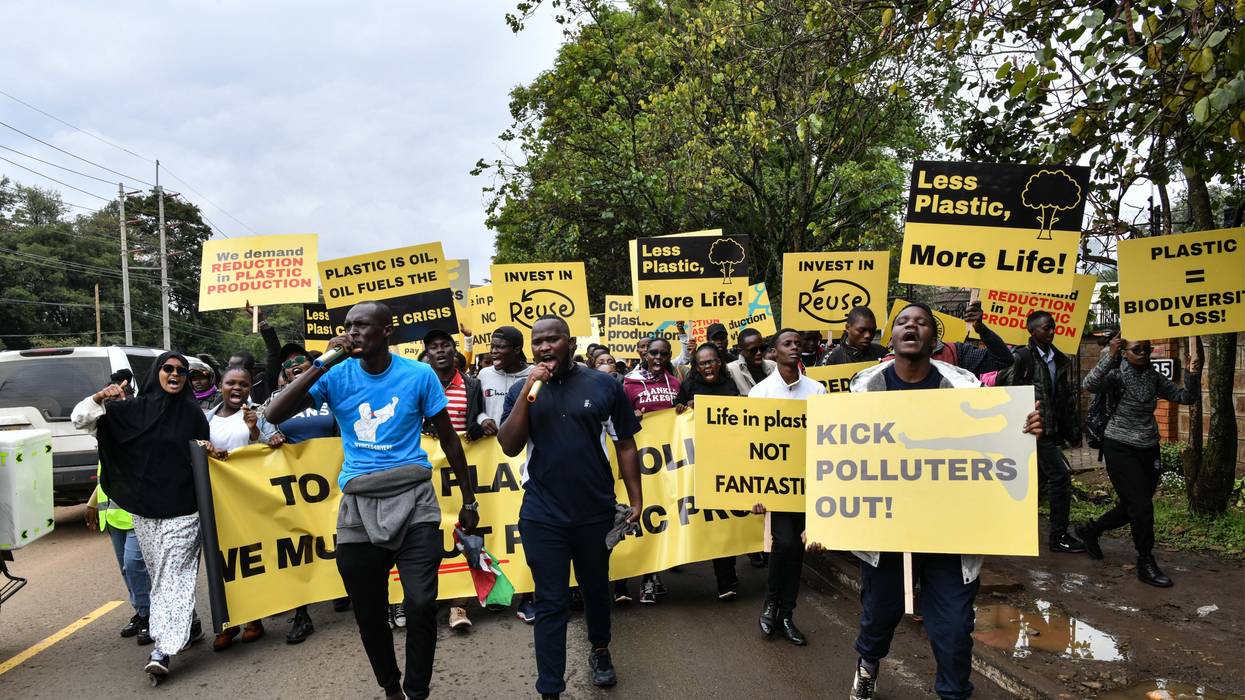
"The only way to curb our catastrophic plastic pollution problem is to cut plastic production, but the industry is spending big to block action at every level to protect their profits," said one campaigner.
Major multinational corporations attending negotiations for a global plastics treaty in an effort to weaken the agreement spent tens of millions of dollars on lobbying and political contributions during the 2022 election cycle, revealed an analysis published Friday by the Center for Biological Diversity.
As Common Dreams reported this week, 143 fossil fuel and chemical industry lobbyists registered to attend the third session of the Intergovernmental Negotiating Committee (INC-3) in Nairobi, Kenya, which is scheduled to run through Sunday. That's more than the combined delegations from 70 nations, and far surpasses the 38 members of a scientists' coalition participating in the negotiations.
Representatives of companies including ExxonMobil, Chevron, Coca-Cola, PepsiCo, and Dow are among the registered attendees. Industry lobby groups representing hundreds of companies are also attending the talks, including the American Chemistry Council, the American Fuel and Petrochemical Manufacturers, and the International Council of Beverages Associations.
"These companies came to Nairobi to make sure the world doesn't get strong protections against the plastic havoc they've been wreaking."
With over $20 million spent on lobbying and campaign contributions during the 2022 election cycle, the American Chemistry Council topped the Center for Biological Diversity's (CBD) list, which is based on data from the government watchdog group OpenSecrets. Boeing spent more than $17 million, while Chevron shelled out nearly $15 million.
"These companies came to Nairobi to make sure the world doesn't get strong protections against the plastic havoc they've been wreaking," David Derrick, a CBD attorney attending INC-3, said in a statement. "We knew that industry had way too much influence over the global plastics treaty as well as our political system at home, but these dollar amounts highlight how far petrochemical and consumer goods companies will go to keep polluting."
INC-3 is focused on the so-called zero draft of the legally binding plastics treaty. On Thursday, the fourth day of talks, delegates completed a first reading of the zero draft, with participating nations submitting suggestions for what they believe should be included in the treaty's first draft, which will be the basis of negotiations at INC-4, scheduled to take place next October and November in Ottawa, Canada.
Susan McCarthy, media and external affairs director at World Wildlife Fund U.S., said that "what is worrying... is the voluminous amount of suggestions that member states have submitted."
"This creates the temptation for member states to veer towards compromises that have the potential of watering down the eventual treaty in an effort to include as many suggestions as possible," she continued. "Whittling down a massive list to a number of key priorities can also be onerous, and can result in the convergence we're seeing now fragmenting as member states push for their suggested items."
"Fragmentation can occur as different member states may have different priorities, such as political affiliations or a preference to base decisions only on scientific evidence, which could drive the decision-making process in opposing directions," McCarthy added.
Derrick asserted that "the only way to curb our catastrophic plastic pollution problem is to cut plastic production, but the industry is spending big to block action at every level to protect their profits."
"The world has a historic chance to make a difference in the relentless flood of plastic pollution that's harming so many," he added. "We can't let a relatively small number of profit-hungry companies derail such an important opportunity to fix our plastic problem at its source."
Our new research uncovers the potential scale of their efforts—and the cost to the public.
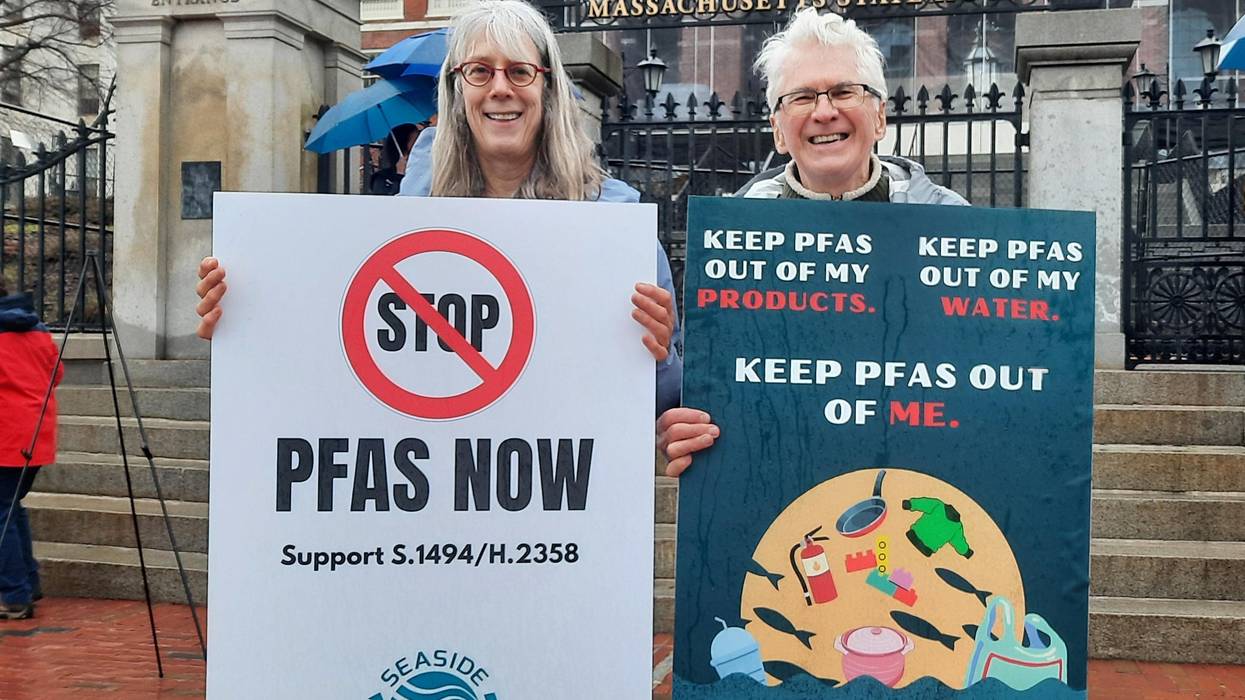
For decades, chemical companies have pumped out products that are poisoning families nationwide. Now, PFAS “forever chemicals” have infiltrated our homes, water, environment, and bodies.
Long-overdue federal actions to address this crisis have finally been set in motion. But at the same time, companies are pouring millions of dollars into lobbying on PFAS and other issues. Our new research uncovers the potential scale of their efforts—and the cost to the public.
PFAS (per- and polyfluoroalkyl substances) are also known as “forever chemicals” because they don’t easily break down in the environment. Chemical companies like Dupont and 3M have manufactured them for decades; today, there are nearly 15,000 different PFAS found in products we use every day.
As a result, they’ve spread throughout our drinking water (including bottled water), our environment, and the blood of 97% of people who live in the United States.
This is a public health crisis. Research has linked PFAS to all sorts of health problems, from reproductive harm to cancers. To add insult to injury, we’re also seeing growing evidence that chemical companies concealed the risks of PFAS and misled the public. And as support grows for regulating these chemicals, companies are throwing money into influencing lawmakers and regulators.
To find out the extent of the chemical companies’ campaigns, we dug into quarterly lobbying reports for companies that were or are current major producers of PFAS. We also looked at reports for the American Chemistry Council, the industry’s biggest trade group. We focused on Congress’s 2019-20 and 2021-22 sessions, which saw over 60 and 70 bills introduced with language on PFAS, respectively.
Of those, only four became law, along with four Defense Authorization Acts that included PFAS amendments. None came close to fully addressing PFAS pollution or holding polluters accountable.
So far, the chemical industry has succeeded in turning its profits into political power.
During this time, the lobbying disclosures of eight major PFAS-producing companies mentioning “PFAS” total $55.7 million. The American Chemistry Council also lobbied on PFAS, with reports mentioning PFAS totaling $58.7 million. And companies that use or whose products may contain PFAS (including oil majors like Shell and Exxon and food giant Nestlé) lobbied on PFAS during this time, too.
We also dug into campaign contributions from PFAS backers to members of the Senate Committee on Environment and Public Works. This committee reviewed the PFAS Action Act of 2019 and 2021, which included some of the strongest measures to protect us from PFAS. Though it passed the House in both sessions, the bill died in the Senate Committee.
We found that during the same time frame (2019-2022), two-thirds of Committee members received donations from the eight major chemical companies we reviewed. More than half received money from the American Chemistry Council.
For decades, chemical companies took advantage of our weak chemical regulations to mislead the public and continue profiting off of PFAS. Now, we have a public health crisis that demands strong regulations.
One of our most powerful clean-up laws in the country is the Superfund program. Under the program, companies using chemicals deemed “hazardous” must monitor and report on them. The program also allows the Environmental Protection Agency (EPA) to direct a clean-up and get polluters to pay for it.
The EPA has recently proposed to regulate some forms of PFAS under the Superfund program. However, trade groups helmed by the American Chemistry Council have directly opposed Superfund status for PFAS. Polluters know the clean-up costs will be huge.
Communities shouldn’t have to choose between unaffordable water bills and toxic water. Polluters need to pay their fair share to clean up what they contaminated.
Another enormous cost will be cleaning up, monitoring, and protecting families from PFAS specifically in drinking water. In 2023, the EPA proposed nationwide standards that limit some PFAS in drinking water. The agency estimates that complying with these rules would cost water systems up to $1.2 billion over 80 years.
If PFAS polluters dodge accountability, the public will be left with these costs. Water systems forced to pay the entire cost of PFAS monitoring and treatment would likely raise water rates, pulling from families’ pockets. If the community can’t afford the costs, households will be left with toxic water.
This would be unconscionable during a water affordability crisis that hits low-income families hardest. Moreover, low-income communities are more likely to face PFAS pollution problems.
Communities shouldn’t have to choose between unaffordable water bills and toxic water. Polluters need to pay their fair share to clean up what they contaminated.
So far, the chemical industry has succeeded in turning its profits into political power. We’ve seen few policies that protect families from more PFAS and hold PFAS polluters accountable. But we can’t allow the industry to get away with this any longer.
That’s why we’re exposing the chemical industry and fighting for the policies that will finally protect us. We’re calling for laws and rules that:
So far, attempts to address PFAS have been a morbid game of whack-a-mole. Companies have phased out some PFAS, only to introduce other, slightly different ones. However, research shows that newer PFAS have similar impacts on public health and the environment.
The EPA needs to establish a broad definition of PFAS, and regulations must cover them all together. The agency must also finalize its rules to put two PFAS under the Superfund program and set enforceable limits on PFAS in drinking water. Ultimately, it must ban all non-essential uses of all PFAS.
Small municipal water systems have so far borne the brunt of costs for PFAS clean-up, monitoring, and protections. Federal legislation has begun mobilizing funds, but it’s not enough.
That’s why we need the WATER Act. This wide-ranging bill provides needed funds to address PFAS, as well as historic funding for other water infrastructure needs.
The chemical industry is trying to narrow the scope of regulations, and various polluters are seeking to dodge responsibility for PFAS clean-up. This would shift the burden to the public, who would pay through their water bills or threats to their health.
Congress and the EPA need to reject efforts to narrow the definition of PFAS or limit the scope of liability for clean-up. Polluters should pay to clean up their toxic PFAS mess.
More than 200 civil society groups sent a letter to members of the United States Senate on Monday urging them to eschew sponsorship of potential industry-backed bills that critics say rebrand polluting technologies as "advanced recycling" in a bid to keep burning plastic waste.
"The industry is attempting to position itself for a nationwide build-out of plastic burning infrastructure under the guise of so-called 'advanced recycling.'"
The letter--which was signed by environmental, science, and consumer advocacy groups--implored senators to reject so-called advanced recycling legislation being promoted by the American Chemistry Council (ACC), an industry group seeking to "change existing law so that plastics incinerators can operate without meeting the environmental and health protections of the Clean Air Act."
"Under the guise of offering a solution to the global plastic waste crisis, the American Chemistry Council has invented an Orwellian new name for decades-old incineration technologies," the signers stated. "It seeks to rebrand pyrolysis and gasification incinerators as 'advanced recycling,' even though there is nothing advanced about them and nothing gets recycled."
At least 18 states in recent years have passed legislation promoting the technology, which uses chemicals to "recycle" plastic waste.
Opponents, however, argue that what's needed is legislation like U.S. Sen Jeff Merkley's (D-Ore.) Break Free From Plastic Pollution Act of 2021, which would amend the Solid Waste Disposal Act to reduce plastic use and environmental contamination.
Less than 10% of U.S. plastic waste is recycled annually. Meanwhile, microplastics, so-called "forever chemicals," and other plastic pollutants permeate the planet, the atmosphere, and even human bodies.
The new letter continued:
In reality, the plastic trash that enters pyrolysis and gasification incinerators gets burned, creating dioxins and other harmful air pollution. What's left is toxic chemical waste that gets burned again later at hazardous waste disposal facilities or as a dirty fuel.
Far from 'recycling' the plastic waste they get paid to accept, gasification and pyrolysis incinerators are turning plastic into highly toxic air pollutants and generating hundreds of thousands of pounds of hazardous waste.
Plastic contains hundreds of toxic chemicals, including heavy metals, phthalates, flame retardants, bisphenol A, and PFAS. The process of burning plastic via pyrolysis and gasification generates even more toxic pollution, including chemicals known to cause cancer, birth defects, and other serious health harms. Emissions include dioxins, benzene, cadmium, arsenic, lead, polycyclic aromatic hydrocarbons (PAHs), and mercury.
Removing existing Clean Air Act limitations on burning plastic will allow chemical manufacturers to produce and release these toxic chemicals into our communities without limitation.
"For chemical industry lobbyists," however, "the concept of 'advanced recycling' is a dream come true," the letter said. "Having an eco-sounding way to make plastic waste vanish from sight helps the industry justify exponential growth in plastics production, which is expected to triple over the next 40 years."
Last year, Neil Tangri, science and policy director at the Global Alliance for Incinerator Alternatives, called the false promise of advanced recycling a "pipe dream."
"This is the continuation of an industry strategy of saying recycling can solve the problem and we don't need to reduce production," he told Politico, which noted that the fossil fuel industry plans to spend around $400 billion on new plastic manufacturing capacity.
The signers of the new letter stated that "while the plastics industry claims that the process of burning plastic via pyrolysis and gasification meets state and federal environmental standards, the whole point of the 'advanced recycling' legislation they are promoting is to allow pyrolysis and gasification incinerators to evade these very protections."
"Changing the legal definition of incineration or waste so that chemical companies can burn plastic in poor and minority communities without controlling the toxic pollution they emit is environmental injustice at its worst," they argued.
"It would be unconscionable for any member of Congress to endorse and enable the chemical manufacturers' plans to evade federal health protections for incinerating plastic," the groups added, "particularly in the face of a global plastic pollution crisis and the projected tripling of plastic waste."
U.S. lawmakers have just passed legislation to finally update how toxic chemicals are regulated, but, according to watchdog groups, the changes to "the worst environmental law on the books" still leave consumers at risk.
The House voted to update the 1976 Toxic Substances Control Act (TSCA) last month, and the Senate passed the measure Tuesday in a voice vote.
As Reuters sums up,
The bill would update the Toxic Substances Control Act amid complaints that its 40-year-old provisions hobble the U.S. Environmental Protection Agency from effectively regulating chemicals, including those ranging from asbestos and flame retardants to everyday household products.
It got thumbs up from groups like National Association of Chemical Distributors, the National Association of Manufacturers, and "industry champion" and lead Republican author of the act, Sen. David Vitter (La.).
In addition to that backing, though, Senate Environment and Public Works Chairman Jim Inhofe (R-Okla.) said ahead of his chamber's vote, "I've never seen a more diverse crowd in total agreement than we are with TSCA." The Associated Press also reports that lawmakers on both sides of the aisle "spoke enthusiastically about the legislation."
Indeed, it's been widely described as compromise. Inhofe, for example, told Politico, "You had people who liked it because it was a major environmental achievement and then people who liked it for just the opposite reason."
When it passed the House on May 24, co-sponsor John Shimkus (R-Ill.) said it was "a vast improvement over current law."
On that point, the Environmental Working Group (EWG) agrees. But making a few adjustments to what it describes as a severely flawed law still means it falls quite short, the advocacy group argues. EWG senior vice president for government affairs Scott Faber explains some of its specific shortcomings:
The law that Congress now sends to President Barack Obama's desk will give EPA the direction and resources to review and regulate, at most, a few hundred chemicals over the next decade -- out of thousands used in the market. The new bill will do nothing to require the FDA to review and regulate the chemicals routinely used in food and cosmetics. While pesticide residues on produce have been reviewed, thousands of other pesticides have escaped meaningful government oversight. The net result is that consumers will continue to be exposed to a witches' brew of unregulated chemicals that have been linked to serious health problems, including cancer.
Faber further argues that
The legislation is certainly better than the Toxic Substances Control of Act of 1976, which is viewed by both industry and public health advocates as badly broken. In particular, the bill headed for the president's signature requires EPA to assess the safety of new chemicals before they enter the market and directs EPA to review old chemicals that have been used for decades without consideration of safety. The bill also gives EPA the power to collect data on chemical use and toxicity, and requires chemical companies to back up their trade secret claims. But these reforms say more about the weakness of the "worst environmental law on the books" than about the merit of the bill itself.
According to Karuna Jaggar, executive director of Breast Cancer Action, it's a "compromise bill [...] puts industry interests first and lets down women at risk of and living with breast cancer."
She notes that "the Senate version of the bill was written by the American Chemistry Council, the chemical industry's biggest lobbying group."
"One of the biggest problems," she continues,
is a provision, referred to as the "pause" provision, that would block a state's ability to protect their residents from toxic chemicals--even when federal action is years away. This provision would stop the ability of states to create and implement laws around a toxic chemical as soon as that chemical went under review by the federal government--a process that can take years! During that time, states cannot protect their residents from exposure to these chemicals of greatest concern.
And the chemical industry's support of the bill is not surprising, adds Carli Jensen, toxics campaign director at U.S. PIRG, as
It handcuffs state regulators, who have been the top cops on the toxic beat for decades. This proposal could best be characterized as one step forward and two steps back. Congress should have done better to protect public health.
Further, as Bloomberg reports:
implementing the proposed law will be a herculean task for an agency with scarce resources, former officials and lawyers say. By the time EPA finishes work on the chemicals it has prioritized, the children of today's children will have been exposed to them -- probably for years.
According to a press statement from Sen. Vitter, "the White House confirmed that President Obama would sign the bill into law."