

SUBSCRIBE TO OUR FREE NEWSLETTER
Daily news & progressive opinion—funded by the people, not the corporations—delivered straight to your inbox.
5
#000000
#FFFFFF
To donate by check, phone, or other method, see our More Ways to Give page.
Daily news & progressive opinion—funded by the people, not the corporations—delivered straight to your inbox.
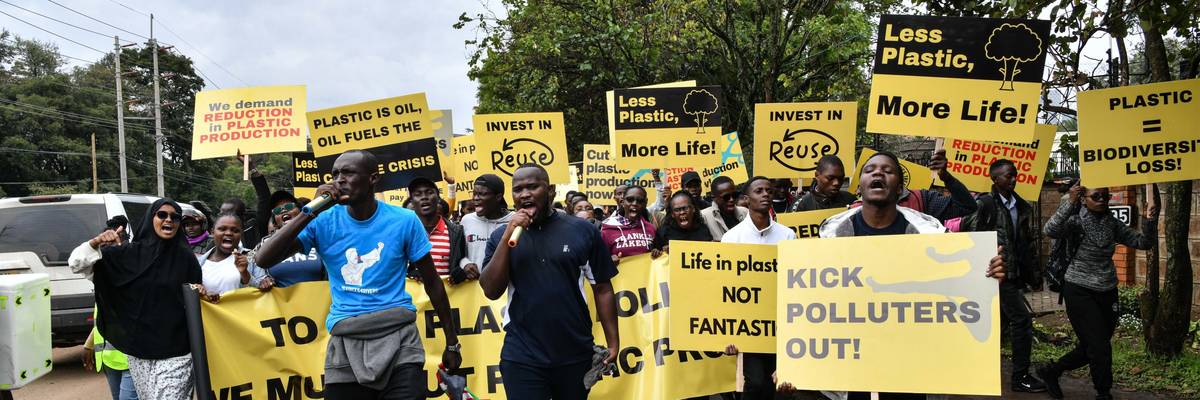
Green campaigners organized by the "BreakFreeFromPlastic movement" march through the streets in Nairobi, Kenya on November 11, 2023.
"The only way to curb our catastrophic plastic pollution problem is to cut plastic production, but the industry is spending big to block action at every level to protect their profits," said one campaigner.
Major multinational corporations attending negotiations for a global plastics treaty in an effort to weaken the agreement spent tens of millions of dollars on lobbying and political contributions during the 2022 election cycle, revealed an analysis published Friday by the Center for Biological Diversity.
As Common Dreams reported this week, 143 fossil fuel and chemical industry lobbyists registered to attend the third session of the Intergovernmental Negotiating Committee (INC-3) in Nairobi, Kenya, which is scheduled to run through Sunday. That's more than the combined delegations from 70 nations, and far surpasses the 38 members of a scientists' coalition participating in the negotiations.
Representatives of companies including ExxonMobil, Chevron, Coca-Cola, PepsiCo, and Dow are among the registered attendees. Industry lobby groups representing hundreds of companies are also attending the talks, including the American Chemistry Council, the American Fuel and Petrochemical Manufacturers, and the International Council of Beverages Associations.
"These companies came to Nairobi to make sure the world doesn't get strong protections against the plastic havoc they've been wreaking."
With over $20 million spent on lobbying and campaign contributions during the 2022 election cycle, the American Chemistry Council topped the Center for Biological Diversity's (CBD) list, which is based on data from the government watchdog group OpenSecrets. Boeing spent more than $17 million, while Chevron shelled out nearly $15 million.
"These companies came to Nairobi to make sure the world doesn't get strong protections against the plastic havoc they've been wreaking," David Derrick, a CBD attorney attending INC-3, said in a statement. "We knew that industry had way too much influence over the global plastics treaty as well as our political system at home, but these dollar amounts highlight how far petrochemical and consumer goods companies will go to keep polluting."
INC-3 is focused on the so-called zero draft of the legally binding plastics treaty. On Thursday, the fourth day of talks, delegates completed a first reading of the zero draft, with participating nations submitting suggestions for what they believe should be included in the treaty's first draft, which will be the basis of negotiations at INC-4, scheduled to take place next October and November in Ottawa, Canada.
Susan McCarthy, media and external affairs director at World Wildlife Fund U.S., said that "what is worrying... is the voluminous amount of suggestions that member states have submitted."
"This creates the temptation for member states to veer towards compromises that have the potential of watering down the eventual treaty in an effort to include as many suggestions as possible," she continued. "Whittling down a massive list to a number of key priorities can also be onerous, and can result in the convergence we're seeing now fragmenting as member states push for their suggested items."
"Fragmentation can occur as different member states may have different priorities, such as political affiliations or a preference to base decisions only on scientific evidence, which could drive the decision-making process in opposing directions," McCarthy added.
Derrick asserted that "the only way to curb our catastrophic plastic pollution problem is to cut plastic production, but the industry is spending big to block action at every level to protect their profits."
"The world has a historic chance to make a difference in the relentless flood of plastic pollution that's harming so many," he added. "We can't let a relatively small number of profit-hungry companies derail such an important opportunity to fix our plastic problem at its source."
Dear Common Dreams reader, It’s been nearly 30 years since I co-founded Common Dreams with my late wife, Lina Newhouser. We had the radical notion that journalism should serve the public good, not corporate profits. It was clear to us from the outset what it would take to build such a project. No paid advertisements. No corporate sponsors. No millionaire publisher telling us what to think or do. Many people said we wouldn't last a year, but we proved those doubters wrong. Together with a tremendous team of journalists and dedicated staff, we built an independent media outlet free from the constraints of profits and corporate control. Our mission has always been simple: To inform. To inspire. To ignite change for the common good. Building Common Dreams was not easy. Our survival was never guaranteed. When you take on the most powerful forces—Wall Street greed, fossil fuel industry destruction, Big Tech lobbyists, and uber-rich oligarchs who have spent billions upon billions rigging the economy and democracy in their favor—the only bulwark you have is supporters who believe in your work. But here’s the urgent message from me today. It's never been this bad out there. And it's never been this hard to keep us going. At the very moment Common Dreams is most needed, the threats we face are intensifying. We need your support now more than ever. We don't accept corporate advertising and never will. We don't have a paywall because we don't think people should be blocked from critical news based on their ability to pay. Everything we do is funded by the donations of readers like you. When everyone does the little they can afford, we are strong. But if that support retreats or dries up, so do we. Will you donate now to make sure Common Dreams not only survives but thrives? —Craig Brown, Co-founder |
Major multinational corporations attending negotiations for a global plastics treaty in an effort to weaken the agreement spent tens of millions of dollars on lobbying and political contributions during the 2022 election cycle, revealed an analysis published Friday by the Center for Biological Diversity.
As Common Dreams reported this week, 143 fossil fuel and chemical industry lobbyists registered to attend the third session of the Intergovernmental Negotiating Committee (INC-3) in Nairobi, Kenya, which is scheduled to run through Sunday. That's more than the combined delegations from 70 nations, and far surpasses the 38 members of a scientists' coalition participating in the negotiations.
Representatives of companies including ExxonMobil, Chevron, Coca-Cola, PepsiCo, and Dow are among the registered attendees. Industry lobby groups representing hundreds of companies are also attending the talks, including the American Chemistry Council, the American Fuel and Petrochemical Manufacturers, and the International Council of Beverages Associations.
"These companies came to Nairobi to make sure the world doesn't get strong protections against the plastic havoc they've been wreaking."
With over $20 million spent on lobbying and campaign contributions during the 2022 election cycle, the American Chemistry Council topped the Center for Biological Diversity's (CBD) list, which is based on data from the government watchdog group OpenSecrets. Boeing spent more than $17 million, while Chevron shelled out nearly $15 million.
"These companies came to Nairobi to make sure the world doesn't get strong protections against the plastic havoc they've been wreaking," David Derrick, a CBD attorney attending INC-3, said in a statement. "We knew that industry had way too much influence over the global plastics treaty as well as our political system at home, but these dollar amounts highlight how far petrochemical and consumer goods companies will go to keep polluting."
INC-3 is focused on the so-called zero draft of the legally binding plastics treaty. On Thursday, the fourth day of talks, delegates completed a first reading of the zero draft, with participating nations submitting suggestions for what they believe should be included in the treaty's first draft, which will be the basis of negotiations at INC-4, scheduled to take place next October and November in Ottawa, Canada.
Susan McCarthy, media and external affairs director at World Wildlife Fund U.S., said that "what is worrying... is the voluminous amount of suggestions that member states have submitted."
"This creates the temptation for member states to veer towards compromises that have the potential of watering down the eventual treaty in an effort to include as many suggestions as possible," she continued. "Whittling down a massive list to a number of key priorities can also be onerous, and can result in the convergence we're seeing now fragmenting as member states push for their suggested items."
"Fragmentation can occur as different member states may have different priorities, such as political affiliations or a preference to base decisions only on scientific evidence, which could drive the decision-making process in opposing directions," McCarthy added.
Derrick asserted that "the only way to curb our catastrophic plastic pollution problem is to cut plastic production, but the industry is spending big to block action at every level to protect their profits."
"The world has a historic chance to make a difference in the relentless flood of plastic pollution that's harming so many," he added. "We can't let a relatively small number of profit-hungry companies derail such an important opportunity to fix our plastic problem at its source."
Major multinational corporations attending negotiations for a global plastics treaty in an effort to weaken the agreement spent tens of millions of dollars on lobbying and political contributions during the 2022 election cycle, revealed an analysis published Friday by the Center for Biological Diversity.
As Common Dreams reported this week, 143 fossil fuel and chemical industry lobbyists registered to attend the third session of the Intergovernmental Negotiating Committee (INC-3) in Nairobi, Kenya, which is scheduled to run through Sunday. That's more than the combined delegations from 70 nations, and far surpasses the 38 members of a scientists' coalition participating in the negotiations.
Representatives of companies including ExxonMobil, Chevron, Coca-Cola, PepsiCo, and Dow are among the registered attendees. Industry lobby groups representing hundreds of companies are also attending the talks, including the American Chemistry Council, the American Fuel and Petrochemical Manufacturers, and the International Council of Beverages Associations.
"These companies came to Nairobi to make sure the world doesn't get strong protections against the plastic havoc they've been wreaking."
With over $20 million spent on lobbying and campaign contributions during the 2022 election cycle, the American Chemistry Council topped the Center for Biological Diversity's (CBD) list, which is based on data from the government watchdog group OpenSecrets. Boeing spent more than $17 million, while Chevron shelled out nearly $15 million.
"These companies came to Nairobi to make sure the world doesn't get strong protections against the plastic havoc they've been wreaking," David Derrick, a CBD attorney attending INC-3, said in a statement. "We knew that industry had way too much influence over the global plastics treaty as well as our political system at home, but these dollar amounts highlight how far petrochemical and consumer goods companies will go to keep polluting."
INC-3 is focused on the so-called zero draft of the legally binding plastics treaty. On Thursday, the fourth day of talks, delegates completed a first reading of the zero draft, with participating nations submitting suggestions for what they believe should be included in the treaty's first draft, which will be the basis of negotiations at INC-4, scheduled to take place next October and November in Ottawa, Canada.
Susan McCarthy, media and external affairs director at World Wildlife Fund U.S., said that "what is worrying... is the voluminous amount of suggestions that member states have submitted."
"This creates the temptation for member states to veer towards compromises that have the potential of watering down the eventual treaty in an effort to include as many suggestions as possible," she continued. "Whittling down a massive list to a number of key priorities can also be onerous, and can result in the convergence we're seeing now fragmenting as member states push for their suggested items."
"Fragmentation can occur as different member states may have different priorities, such as political affiliations or a preference to base decisions only on scientific evidence, which could drive the decision-making process in opposing directions," McCarthy added.
Derrick asserted that "the only way to curb our catastrophic plastic pollution problem is to cut plastic production, but the industry is spending big to block action at every level to protect their profits."
"The world has a historic chance to make a difference in the relentless flood of plastic pollution that's harming so many," he added. "We can't let a relatively small number of profit-hungry companies derail such an important opportunity to fix our plastic problem at its source."

