SUBSCRIBE TO OUR FREE NEWSLETTER
Daily news & progressive opinion—funded by the people, not the corporations—delivered straight to your inbox.
5
#000000
#FFFFFF
To donate by check, phone, or other method, see our More Ways to Give page.
Daily news & progressive opinion—funded by the people, not the corporations—delivered straight to your inbox.
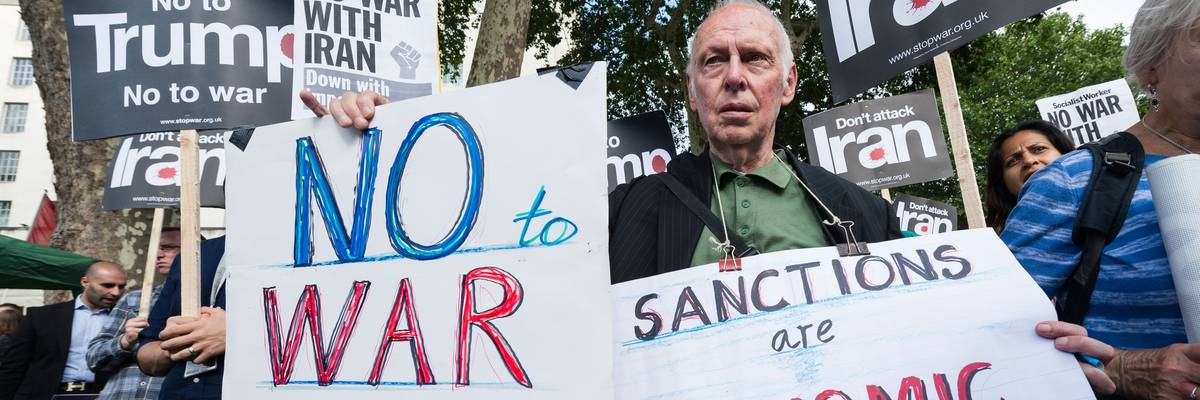
Anti-war demonstrators gather outside Downing Street on 26 June, 2019 in London, England, to call on the government to publicly oppose the escalation of conflict between Donald Trump's administration and Iran and demand that military action is ruled out.
The supposedly unlimited freedom of action attained by disdaining and trampling international law and institutions has proved to be a double-edged sword.
On May 24, Iran rejected President Trump’s latest fake peace deal, confirming that he had misrepresented what Iran had agreed to and that the two sides are still very far apart, on nuclear enrichment, on control of the Strait of Hormuz, on peace in Palestine and Lebanon, and on lifting US sanctions, paying war reparations, and Iran’s $100 billion in frozen assets.
Iran’s conditions for a peace agreement are necessarily uncompromising, in response to the US record of using negotiations as cover for sneak attacks, and the charade of one-sided “ceasefires with Israeli characteristics,” in which the US and Israel routinely ignore and violate every ceasefire they agree to, including the present ones in Gaza, Lebanon, and Iran.
Since no agreement with the United States or Israel is worth the paper it’s written on, it’s hard to imagine an agreement that would really protect Iran from future attacks. Without a more radical change in US policy, the United States and Israel will keep attacking Iran, in open violation of the UN Charter, no matter what they all agree to.
The only effective ways Iran has found to protect its land and its people are to build strong military defenses, including the capacity for devastating retaliation, and to retain control of the Strait of Hormuz, regardless of the impact on the world’s oil and gas supply and the global economy. By attacking Iran, the United States and Israel forced it to defend itself and triggered a war that is reshaping the Middle East and possibly the world.
The final sinking of the neocon dream in the troubled waters of the Persian Gulf provides the US and the world with a historic chance to recommit to a more peaceful and democratic international order.
Losing this war is forcing the United States to finally start reevaluating the neoconservative tactics it has blindly substituted for a rational US foreign and military policy since the 1990s: sanction; threaten; bomb; kill; destroy; occupy; escalate; leave countries mired in violence and chaos—in Afghanistan, Iraq, Haiti, Somalia, Libya, Syria, Yemen, Ukraine, Palestine and Lebanon—never admit defeat; never question American exceptionalism or superiority.
The systematic US disdain for the rule of international law that undergirds this policy appears to make peace impossible in today’s world. But the final sinking of the neocon dream in the troubled waters of the Persian Gulf provides the US and the world with a historic chance to recommit to a more peaceful and democratic international order.
Since the end of the Cold War, the United States has effectively exempted itself from the entire system of treaties, international laws and agreements that are supposed to govern international affairs, starting with the UN Charter, which prohibits the threat or use of force between countries, and the Geneva Conventions, which protect civilians, prisoners-of-war and wounded soldiers and sailors from the impacts of war.
These treaties were drawn up and universally adopted in the wake of the Second World War, to “save succeeding generations from the scourge of war,” as the UN Charter says in its preamble. President Roosevelt returned from his Yalta conference with Churchill and Stalin in 1945 to tell a joint session of Congress that they were designing the United Nations as a “permanent structure of peace.”
“It ought to spell the end of the system of unilateral action, the exclusive alliances, the spheres of influence, the balances of power, and all the other expedients that have been tried for centuries—and have always failed,” FDR told Congress. “We propose to substitute for all these, a universal organization in which all peace-loving Nations will finally have a chance to join.”
The UN Charter codified and strengthened the age-old common law prohibition against international aggression, and the renunciation of war as an instrument of national policy in the 1928 Kellogg Briand Pact, which German leaders tried at Nuremberg were sentenced to death for violating.
However, amid overblown Western triumphalism after the end of the Cold War, a new generation of US leaders, like Madeleine Albright and Dick Cheney, came to see the UN Charter and Geneva Conventions as obstacles to their ambitions to further expand US global power by more widespread and unrestricted use of military force.
Believing that the new imbalance in military power freed them from compliance with post-1945 treaties and conventions based on the hard-earned wisdom of past leaders in two world wars, the US and its allies unleashed their armed forces to attack and invade other countries, torture, rape and kill prisoners, and massacre civilians.
US officials assumed that the new military imbalance so greatly favored the United States that neither the UN, international courts, other powerful countries, nor even the entire people of the world could enforce the rules of international law and the laws of armed conflict on the United States if it chose to ignore them.
It is ironic, and deeply frustrating and confusing to US officials, to find out that what they hailed as a position of overwhelming power and impunity has led them to squander America’s day in the sun and waste the chance that its great good fortune provided to improve the quality of life for Americans and their neighbors.
The supposedly unlimited freedom of action attained by disdaining and trampling international law and institutions has proved to be a double-edged sword. There is no such thing as unlimited military power, short of the mass suicide of nuclear war. The idea that America’s virtually unlimited investment in weapons and war would give it the final word in every dispute was a mirage, as even Trump is now finding out.
As Americans reexamine the state of the world and the conflicts by which warmongering US leaders have tried to define it, it is obvious that war and military power do not lead to peace or prosperity, for Americans or anyone else. The more countries the Pentagon and the CIA take aim at, the more people they kill, and the more resources our leaders throw at them, the more other people all over the world rightly come to see the United States as a threat to their own lives and futures.
Governments around the world face difficult choices between meeting the needs and aspirations of their own people or complying with the hegemonic and undemocratic demands of the United States.
After holding itself up as the champion of democracy and freedom for 250 years, the United States is only accelerating its own decline by wasting trillions of dollars, and what little is left of the world’s good will, on this failed, ill-fated bid for global imperial power.
When the United States rose to great power in the first half of the 20th century, its leaders were wise enough to recognize that exercising naked imperial power would not succeed in a world still fighting to free itself from the ravages of European colonialism. So FDR and his colleagues based the UN system on sovereign equality between nations, and created a framework for international relations that the whole world could agree to.
While the United States and Israel commit systematic and barbaric war crimes, presuming themselves immune from accountability, the world is slowly—too slowly—coming to grips with the international cooperation needed to enforce the “permanent structure of peace” that all countries have agreed to live by.
Like all legal and political systems, the success or failure of the UN system rests on whether the most powerful countries will agree to live by the same rules as the others. The veto is a poison pill that corrupts the system, as Albert Camus predicted when it was unveiled in 1945.
“If this report is accurate, … it would effectively put an end to any idea of international democracy,” Camus wrote in Combat, the underground French Resistance newspaper he edited. “The world would be ruled by a directorate of five powers… The Five would thus retain forever the freedom of maneuver that would be forever denied the others.”
However, the UN has developed the “Uniting For Peace” process, which allows the General Assembly to hold Emergency Special Sessions (ESS) on international problems when a veto prevents the Security Council from acting to resolve them. The General Assembly used that process to resolve the Suez Crisis in 1956, and it has been using it, albeit intermittently and inadequately, to address the crisis in Palestine since 1997.
In response to a request from the General Assembly in its Emergency Special Session on Palestine, the International Court of Justice ruled that the Israeli occupation is illegal and must end without delay. And so, the General Assembly passed a resolution demanding that Israel must bring “to an end without delay its unlawful presence in the Occupied Palestinian Territories… and do so no later than” September 2025.
Israel did not comply, so the General Assembly must take further steps, such as an arms embargo and an economic boycott. But it does have the means to do so and just needs to muster the political will.
While the United States and Israel commit systematic and barbaric war crimes, presuming themselves immune from accountability, the world is slowly—too slowly—coming to grips with the international cooperation needed to enforce the “permanent structure of peace” that all countries have agreed to live by, and on which the lives of millions of vulnerable people and the future of humanity depend.
While US leaders are finally realizing that they do not have the power to intimidate and conquer the whole world, the American people are gradually understanding that we have an even greater power, the power to refuse to fight their criminal wars, and to insist on making peace and cooperating with all our neighbors on this small planet that we all share.
Dear Common Dreams reader, It’s been nearly 30 years since I co-founded Common Dreams with my late wife, Lina Newhouser. We had the radical notion that journalism should serve the public good, not corporate profits. It was clear to us from the outset what it would take to build such a project. No paid advertisements. No corporate sponsors. No millionaire publisher telling us what to think or do. Many people said we wouldn't last a year, but we proved those doubters wrong. Together with a tremendous team of journalists and dedicated staff, we built an independent media outlet free from the constraints of profits and corporate control. Our mission has always been simple: To inform. To inspire. To ignite change for the common good. Building Common Dreams was not easy. Our survival was never guaranteed. When you take on the most powerful forces—Wall Street greed, fossil fuel industry destruction, Big Tech lobbyists, and uber-rich oligarchs who have spent billions upon billions rigging the economy and democracy in their favor—the only bulwark you have is supporters who believe in your work. But here’s the urgent message from me today. It's never been this bad out there. And it's never been this hard to keep us going. At the very moment Common Dreams is most needed, the threats we face are intensifying. We need your support now more than ever. We don't accept corporate advertising and never will. We don't have a paywall because we don't think people should be blocked from critical news based on their ability to pay. Everything we do is funded by the donations of readers like you. When everyone does the little they can afford, we are strong. But if that support retreats or dries up, so do we. Will you donate now to make sure Common Dreams not only survives but thrives? —Craig Brown, Co-founder |
On May 24, Iran rejected President Trump’s latest fake peace deal, confirming that he had misrepresented what Iran had agreed to and that the two sides are still very far apart, on nuclear enrichment, on control of the Strait of Hormuz, on peace in Palestine and Lebanon, and on lifting US sanctions, paying war reparations, and Iran’s $100 billion in frozen assets.
Iran’s conditions for a peace agreement are necessarily uncompromising, in response to the US record of using negotiations as cover for sneak attacks, and the charade of one-sided “ceasefires with Israeli characteristics,” in which the US and Israel routinely ignore and violate every ceasefire they agree to, including the present ones in Gaza, Lebanon, and Iran.
Since no agreement with the United States or Israel is worth the paper it’s written on, it’s hard to imagine an agreement that would really protect Iran from future attacks. Without a more radical change in US policy, the United States and Israel will keep attacking Iran, in open violation of the UN Charter, no matter what they all agree to.
The only effective ways Iran has found to protect its land and its people are to build strong military defenses, including the capacity for devastating retaliation, and to retain control of the Strait of Hormuz, regardless of the impact on the world’s oil and gas supply and the global economy. By attacking Iran, the United States and Israel forced it to defend itself and triggered a war that is reshaping the Middle East and possibly the world.
The final sinking of the neocon dream in the troubled waters of the Persian Gulf provides the US and the world with a historic chance to recommit to a more peaceful and democratic international order.
Losing this war is forcing the United States to finally start reevaluating the neoconservative tactics it has blindly substituted for a rational US foreign and military policy since the 1990s: sanction; threaten; bomb; kill; destroy; occupy; escalate; leave countries mired in violence and chaos—in Afghanistan, Iraq, Haiti, Somalia, Libya, Syria, Yemen, Ukraine, Palestine and Lebanon—never admit defeat; never question American exceptionalism or superiority.
The systematic US disdain for the rule of international law that undergirds this policy appears to make peace impossible in today’s world. But the final sinking of the neocon dream in the troubled waters of the Persian Gulf provides the US and the world with a historic chance to recommit to a more peaceful and democratic international order.
Since the end of the Cold War, the United States has effectively exempted itself from the entire system of treaties, international laws and agreements that are supposed to govern international affairs, starting with the UN Charter, which prohibits the threat or use of force between countries, and the Geneva Conventions, which protect civilians, prisoners-of-war and wounded soldiers and sailors from the impacts of war.
These treaties were drawn up and universally adopted in the wake of the Second World War, to “save succeeding generations from the scourge of war,” as the UN Charter says in its preamble. President Roosevelt returned from his Yalta conference with Churchill and Stalin in 1945 to tell a joint session of Congress that they were designing the United Nations as a “permanent structure of peace.”
“It ought to spell the end of the system of unilateral action, the exclusive alliances, the spheres of influence, the balances of power, and all the other expedients that have been tried for centuries—and have always failed,” FDR told Congress. “We propose to substitute for all these, a universal organization in which all peace-loving Nations will finally have a chance to join.”
The UN Charter codified and strengthened the age-old common law prohibition against international aggression, and the renunciation of war as an instrument of national policy in the 1928 Kellogg Briand Pact, which German leaders tried at Nuremberg were sentenced to death for violating.
However, amid overblown Western triumphalism after the end of the Cold War, a new generation of US leaders, like Madeleine Albright and Dick Cheney, came to see the UN Charter and Geneva Conventions as obstacles to their ambitions to further expand US global power by more widespread and unrestricted use of military force.
Believing that the new imbalance in military power freed them from compliance with post-1945 treaties and conventions based on the hard-earned wisdom of past leaders in two world wars, the US and its allies unleashed their armed forces to attack and invade other countries, torture, rape and kill prisoners, and massacre civilians.
US officials assumed that the new military imbalance so greatly favored the United States that neither the UN, international courts, other powerful countries, nor even the entire people of the world could enforce the rules of international law and the laws of armed conflict on the United States if it chose to ignore them.
It is ironic, and deeply frustrating and confusing to US officials, to find out that what they hailed as a position of overwhelming power and impunity has led them to squander America’s day in the sun and waste the chance that its great good fortune provided to improve the quality of life for Americans and their neighbors.
The supposedly unlimited freedom of action attained by disdaining and trampling international law and institutions has proved to be a double-edged sword. There is no such thing as unlimited military power, short of the mass suicide of nuclear war. The idea that America’s virtually unlimited investment in weapons and war would give it the final word in every dispute was a mirage, as even Trump is now finding out.
As Americans reexamine the state of the world and the conflicts by which warmongering US leaders have tried to define it, it is obvious that war and military power do not lead to peace or prosperity, for Americans or anyone else. The more countries the Pentagon and the CIA take aim at, the more people they kill, and the more resources our leaders throw at them, the more other people all over the world rightly come to see the United States as a threat to their own lives and futures.
Governments around the world face difficult choices between meeting the needs and aspirations of their own people or complying with the hegemonic and undemocratic demands of the United States.
After holding itself up as the champion of democracy and freedom for 250 years, the United States is only accelerating its own decline by wasting trillions of dollars, and what little is left of the world’s good will, on this failed, ill-fated bid for global imperial power.
When the United States rose to great power in the first half of the 20th century, its leaders were wise enough to recognize that exercising naked imperial power would not succeed in a world still fighting to free itself from the ravages of European colonialism. So FDR and his colleagues based the UN system on sovereign equality between nations, and created a framework for international relations that the whole world could agree to.
While the United States and Israel commit systematic and barbaric war crimes, presuming themselves immune from accountability, the world is slowly—too slowly—coming to grips with the international cooperation needed to enforce the “permanent structure of peace” that all countries have agreed to live by.
Like all legal and political systems, the success or failure of the UN system rests on whether the most powerful countries will agree to live by the same rules as the others. The veto is a poison pill that corrupts the system, as Albert Camus predicted when it was unveiled in 1945.
“If this report is accurate, … it would effectively put an end to any idea of international democracy,” Camus wrote in Combat, the underground French Resistance newspaper he edited. “The world would be ruled by a directorate of five powers… The Five would thus retain forever the freedom of maneuver that would be forever denied the others.”
However, the UN has developed the “Uniting For Peace” process, which allows the General Assembly to hold Emergency Special Sessions (ESS) on international problems when a veto prevents the Security Council from acting to resolve them. The General Assembly used that process to resolve the Suez Crisis in 1956, and it has been using it, albeit intermittently and inadequately, to address the crisis in Palestine since 1997.
In response to a request from the General Assembly in its Emergency Special Session on Palestine, the International Court of Justice ruled that the Israeli occupation is illegal and must end without delay. And so, the General Assembly passed a resolution demanding that Israel must bring “to an end without delay its unlawful presence in the Occupied Palestinian Territories… and do so no later than” September 2025.
Israel did not comply, so the General Assembly must take further steps, such as an arms embargo and an economic boycott. But it does have the means to do so and just needs to muster the political will.
While the United States and Israel commit systematic and barbaric war crimes, presuming themselves immune from accountability, the world is slowly—too slowly—coming to grips with the international cooperation needed to enforce the “permanent structure of peace” that all countries have agreed to live by, and on which the lives of millions of vulnerable people and the future of humanity depend.
While US leaders are finally realizing that they do not have the power to intimidate and conquer the whole world, the American people are gradually understanding that we have an even greater power, the power to refuse to fight their criminal wars, and to insist on making peace and cooperating with all our neighbors on this small planet that we all share.
On May 24, Iran rejected President Trump’s latest fake peace deal, confirming that he had misrepresented what Iran had agreed to and that the two sides are still very far apart, on nuclear enrichment, on control of the Strait of Hormuz, on peace in Palestine and Lebanon, and on lifting US sanctions, paying war reparations, and Iran’s $100 billion in frozen assets.
Iran’s conditions for a peace agreement are necessarily uncompromising, in response to the US record of using negotiations as cover for sneak attacks, and the charade of one-sided “ceasefires with Israeli characteristics,” in which the US and Israel routinely ignore and violate every ceasefire they agree to, including the present ones in Gaza, Lebanon, and Iran.
Since no agreement with the United States or Israel is worth the paper it’s written on, it’s hard to imagine an agreement that would really protect Iran from future attacks. Without a more radical change in US policy, the United States and Israel will keep attacking Iran, in open violation of the UN Charter, no matter what they all agree to.
The only effective ways Iran has found to protect its land and its people are to build strong military defenses, including the capacity for devastating retaliation, and to retain control of the Strait of Hormuz, regardless of the impact on the world’s oil and gas supply and the global economy. By attacking Iran, the United States and Israel forced it to defend itself and triggered a war that is reshaping the Middle East and possibly the world.
The final sinking of the neocon dream in the troubled waters of the Persian Gulf provides the US and the world with a historic chance to recommit to a more peaceful and democratic international order.
Losing this war is forcing the United States to finally start reevaluating the neoconservative tactics it has blindly substituted for a rational US foreign and military policy since the 1990s: sanction; threaten; bomb; kill; destroy; occupy; escalate; leave countries mired in violence and chaos—in Afghanistan, Iraq, Haiti, Somalia, Libya, Syria, Yemen, Ukraine, Palestine and Lebanon—never admit defeat; never question American exceptionalism or superiority.
The systematic US disdain for the rule of international law that undergirds this policy appears to make peace impossible in today’s world. But the final sinking of the neocon dream in the troubled waters of the Persian Gulf provides the US and the world with a historic chance to recommit to a more peaceful and democratic international order.
Since the end of the Cold War, the United States has effectively exempted itself from the entire system of treaties, international laws and agreements that are supposed to govern international affairs, starting with the UN Charter, which prohibits the threat or use of force between countries, and the Geneva Conventions, which protect civilians, prisoners-of-war and wounded soldiers and sailors from the impacts of war.
These treaties were drawn up and universally adopted in the wake of the Second World War, to “save succeeding generations from the scourge of war,” as the UN Charter says in its preamble. President Roosevelt returned from his Yalta conference with Churchill and Stalin in 1945 to tell a joint session of Congress that they were designing the United Nations as a “permanent structure of peace.”
“It ought to spell the end of the system of unilateral action, the exclusive alliances, the spheres of influence, the balances of power, and all the other expedients that have been tried for centuries—and have always failed,” FDR told Congress. “We propose to substitute for all these, a universal organization in which all peace-loving Nations will finally have a chance to join.”
The UN Charter codified and strengthened the age-old common law prohibition against international aggression, and the renunciation of war as an instrument of national policy in the 1928 Kellogg Briand Pact, which German leaders tried at Nuremberg were sentenced to death for violating.
However, amid overblown Western triumphalism after the end of the Cold War, a new generation of US leaders, like Madeleine Albright and Dick Cheney, came to see the UN Charter and Geneva Conventions as obstacles to their ambitions to further expand US global power by more widespread and unrestricted use of military force.
Believing that the new imbalance in military power freed them from compliance with post-1945 treaties and conventions based on the hard-earned wisdom of past leaders in two world wars, the US and its allies unleashed their armed forces to attack and invade other countries, torture, rape and kill prisoners, and massacre civilians.
US officials assumed that the new military imbalance so greatly favored the United States that neither the UN, international courts, other powerful countries, nor even the entire people of the world could enforce the rules of international law and the laws of armed conflict on the United States if it chose to ignore them.
It is ironic, and deeply frustrating and confusing to US officials, to find out that what they hailed as a position of overwhelming power and impunity has led them to squander America’s day in the sun and waste the chance that its great good fortune provided to improve the quality of life for Americans and their neighbors.
The supposedly unlimited freedom of action attained by disdaining and trampling international law and institutions has proved to be a double-edged sword. There is no such thing as unlimited military power, short of the mass suicide of nuclear war. The idea that America’s virtually unlimited investment in weapons and war would give it the final word in every dispute was a mirage, as even Trump is now finding out.
As Americans reexamine the state of the world and the conflicts by which warmongering US leaders have tried to define it, it is obvious that war and military power do not lead to peace or prosperity, for Americans or anyone else. The more countries the Pentagon and the CIA take aim at, the more people they kill, and the more resources our leaders throw at them, the more other people all over the world rightly come to see the United States as a threat to their own lives and futures.
Governments around the world face difficult choices between meeting the needs and aspirations of their own people or complying with the hegemonic and undemocratic demands of the United States.
After holding itself up as the champion of democracy and freedom for 250 years, the United States is only accelerating its own decline by wasting trillions of dollars, and what little is left of the world’s good will, on this failed, ill-fated bid for global imperial power.
When the United States rose to great power in the first half of the 20th century, its leaders were wise enough to recognize that exercising naked imperial power would not succeed in a world still fighting to free itself from the ravages of European colonialism. So FDR and his colleagues based the UN system on sovereign equality between nations, and created a framework for international relations that the whole world could agree to.
While the United States and Israel commit systematic and barbaric war crimes, presuming themselves immune from accountability, the world is slowly—too slowly—coming to grips with the international cooperation needed to enforce the “permanent structure of peace” that all countries have agreed to live by.
Like all legal and political systems, the success or failure of the UN system rests on whether the most powerful countries will agree to live by the same rules as the others. The veto is a poison pill that corrupts the system, as Albert Camus predicted when it was unveiled in 1945.
“If this report is accurate, … it would effectively put an end to any idea of international democracy,” Camus wrote in Combat, the underground French Resistance newspaper he edited. “The world would be ruled by a directorate of five powers… The Five would thus retain forever the freedom of maneuver that would be forever denied the others.”
However, the UN has developed the “Uniting For Peace” process, which allows the General Assembly to hold Emergency Special Sessions (ESS) on international problems when a veto prevents the Security Council from acting to resolve them. The General Assembly used that process to resolve the Suez Crisis in 1956, and it has been using it, albeit intermittently and inadequately, to address the crisis in Palestine since 1997.
In response to a request from the General Assembly in its Emergency Special Session on Palestine, the International Court of Justice ruled that the Israeli occupation is illegal and must end without delay. And so, the General Assembly passed a resolution demanding that Israel must bring “to an end without delay its unlawful presence in the Occupied Palestinian Territories… and do so no later than” September 2025.
Israel did not comply, so the General Assembly must take further steps, such as an arms embargo and an economic boycott. But it does have the means to do so and just needs to muster the political will.
While the United States and Israel commit systematic and barbaric war crimes, presuming themselves immune from accountability, the world is slowly—too slowly—coming to grips with the international cooperation needed to enforce the “permanent structure of peace” that all countries have agreed to live by, and on which the lives of millions of vulnerable people and the future of humanity depend.
While US leaders are finally realizing that they do not have the power to intimidate and conquer the whole world, the American people are gradually understanding that we have an even greater power, the power to refuse to fight their criminal wars, and to insist on making peace and cooperating with all our neighbors on this small planet that we all share.