SUBSCRIBE TO OUR FREE NEWSLETTER
Daily news & progressive opinion—funded by the people, not the corporations—delivered straight to your inbox.
5
#000000
#FFFFFF
To donate by check, phone, or other method, see our More Ways to Give page.
Daily news & progressive opinion—funded by the people, not the corporations—delivered straight to your inbox.
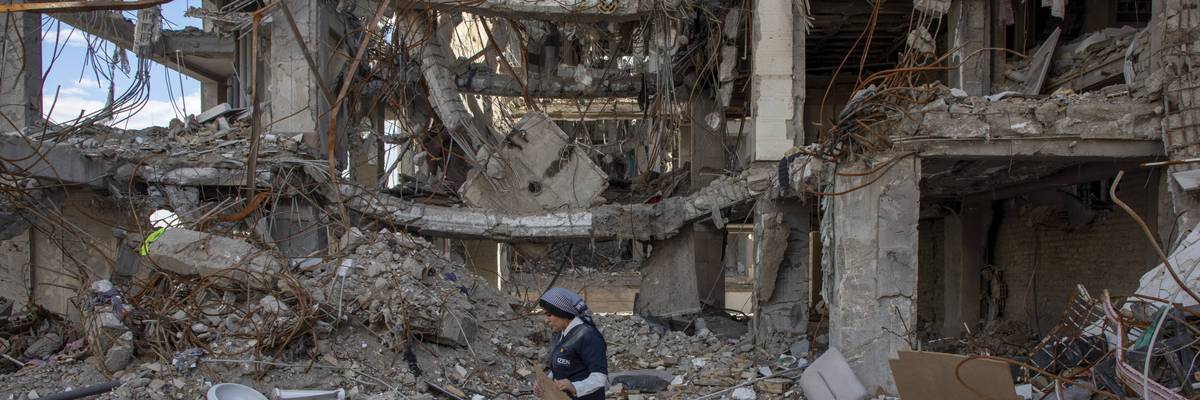
A woman walks among buildings destroyed in a joint attack by Israel and the United States on April 6, 2026, in Tehran, Iran.
"Any actions that violate US and international law regarding the conduct of war must be thoroughly investigated and appropriate accountability pursued," said the head of NIAC.
As President Donald Trump's Tuesday night deadline for Iran to reopen the Strait of Hormuz or face more war crimes approached, the National Iranian American Council on Monday urged Congress to investigate the Republican leader's remarks as well as the US-Israeli destruction of Iran's civilian infrastructure that has already occurred.
"The US-Israel war on Iran increasingly appears aimed not at defeating a military adversary but instead at breaking the nation of Iran," said NIAC president Jamal Abdi in a statement. "The past days have seen repeated US-Israeli attacks on civilian targets in Iran, including Sharif University of Technology in Tehran, one of the world's preeminent universities; a major petrochemical plant in Asaluyeh; and the B1 bridge in Karaj, Iran."
Since the US and Israel launched the war—which has not been authorized by Congress—on February 28, they have struck at least tens of thousands of civilian sites, including energy infrastructure, homes, hospitals, and schools. While surrounded by children at a White House event on Monday, Trump attempted to defend his threat to consider "blowing everything up" in Iran if the government doesn't reopen the key shipping route by 8:00 pm Eastern time Tuesday.
Abdi argued that "as Americans, we should be outraged that our government and Israel's have so blurred the lines between civilian and military targets and are openly threatening to engage in war crimes that have little to no military value while inflicting disproportionate civilian harm."
"NIAC calls on the US Congress to thoroughly investigate the targeting and threatening of civilian sites in Iran, including by utilizing all tools at Congress' disposal including subpoena power to secure documentary evidence and testimony from relevant officials," he said. "Any actions that violate US and international law regarding the conduct of war must be thoroughly investigated and appropriate accountability pursued. We cannot allow such brazen disregard for civilian life to be normalized."
So far, nearly all congressional Republicans—who have majorities in both chambers—and a short list of Democrats have blocked attempts to end Trump's illegal assault on Iran via war powers resolutions, even though the US Constitution explicitly empowers only Congress to declare war. Similar measures for Trump's military misadventures elsewhere have also failed.
Still, Abdi said that "NIAC also reiterates that Congress must pass a war powers resolution directing the president to remove US forces from Iran as soon as possible, including by ending the congressional recess early. Moreover, NIAC calls on the United Nations and other international institutions to intervene and put a stop to these advertised crimes before they take place."
United Nations figures—including Secretary-General António Guterres, High Commissioner for Human Rights Volker Türk, and special rapporteurs—have repeatedly called for an end to the regional war, which critics argue violates the UN Charter. However, as one of the five permanent members of the Security Council, the US has veto power, which hamstrings the body's ability to respond.
Iran has responded to the barrage by bombing Israel and various Gulf states, while Israeli forces have renewed attacks on Lebanon and again restricted the flow of humanitarian aid into the Gaza Strip, where they are accused of engaging in genocide. At least 13 US service members and thousands of people across the Middle East have been killed.
"President Trump can and should halt all bombing of Iran immediately, which would do far more to bring the war to a close than his reckless threats to attack more power plants, bridges, and civilian infrastructure," said Abdi. "The United States should pursue a permanent negotiated end to the war and must be prepared to use its leverage by putting sanctions relief on the table."
"While proposed mediations like a reported 45-day ceasefire proposal promulgated by Pakistan would not be without some merit," he continued, "they remain disconnected from the realities of the war and the past experience of Iran being attacked twice by the US and Israel amid negotiations."
"Iran is extremely unlikely to surrender its own leverage just to allow the US and Israel with time and space to attack once again," he added. "This deficit of trust amid war is difficult to overcome, but it must if this war is to end before more civilians are harmed."
Citing a senior Iranian official, Drop Site News reported Monday that "Tehran rejects any agreement for a temporary ceasefire to end the war" and "would only accept an agreement that leads to a permanent end to the fighting."
Dear Common Dreams reader, It’s been nearly 30 years since I co-founded Common Dreams with my late wife, Lina Newhouser. We had the radical notion that journalism should serve the public good, not corporate profits. It was clear to us from the outset what it would take to build such a project. No paid advertisements. No corporate sponsors. No millionaire publisher telling us what to think or do. Many people said we wouldn't last a year, but we proved those doubters wrong. Together with a tremendous team of journalists and dedicated staff, we built an independent media outlet free from the constraints of profits and corporate control. Our mission has always been simple: To inform. To inspire. To ignite change for the common good. Building Common Dreams was not easy. Our survival was never guaranteed. When you take on the most powerful forces—Wall Street greed, fossil fuel industry destruction, Big Tech lobbyists, and uber-rich oligarchs who have spent billions upon billions rigging the economy and democracy in their favor—the only bulwark you have is supporters who believe in your work. But here’s the urgent message from me today. It's never been this bad out there. And it's never been this hard to keep us going. At the very moment Common Dreams is most needed, the threats we face are intensifying. We need your support now more than ever. We don't accept corporate advertising and never will. We don't have a paywall because we don't think people should be blocked from critical news based on their ability to pay. Everything we do is funded by the donations of readers like you. When everyone does the little they can afford, we are strong. But if that support retreats or dries up, so do we. Will you donate now to make sure Common Dreams not only survives but thrives? —Craig Brown, Co-founder |
As President Donald Trump's Tuesday night deadline for Iran to reopen the Strait of Hormuz or face more war crimes approached, the National Iranian American Council on Monday urged Congress to investigate the Republican leader's remarks as well as the US-Israeli destruction of Iran's civilian infrastructure that has already occurred.
"The US-Israel war on Iran increasingly appears aimed not at defeating a military adversary but instead at breaking the nation of Iran," said NIAC president Jamal Abdi in a statement. "The past days have seen repeated US-Israeli attacks on civilian targets in Iran, including Sharif University of Technology in Tehran, one of the world's preeminent universities; a major petrochemical plant in Asaluyeh; and the B1 bridge in Karaj, Iran."
Since the US and Israel launched the war—which has not been authorized by Congress—on February 28, they have struck at least tens of thousands of civilian sites, including energy infrastructure, homes, hospitals, and schools. While surrounded by children at a White House event on Monday, Trump attempted to defend his threat to consider "blowing everything up" in Iran if the government doesn't reopen the key shipping route by 8:00 pm Eastern time Tuesday.
Abdi argued that "as Americans, we should be outraged that our government and Israel's have so blurred the lines between civilian and military targets and are openly threatening to engage in war crimes that have little to no military value while inflicting disproportionate civilian harm."
"NIAC calls on the US Congress to thoroughly investigate the targeting and threatening of civilian sites in Iran, including by utilizing all tools at Congress' disposal including subpoena power to secure documentary evidence and testimony from relevant officials," he said. "Any actions that violate US and international law regarding the conduct of war must be thoroughly investigated and appropriate accountability pursued. We cannot allow such brazen disregard for civilian life to be normalized."
So far, nearly all congressional Republicans—who have majorities in both chambers—and a short list of Democrats have blocked attempts to end Trump's illegal assault on Iran via war powers resolutions, even though the US Constitution explicitly empowers only Congress to declare war. Similar measures for Trump's military misadventures elsewhere have also failed.
Still, Abdi said that "NIAC also reiterates that Congress must pass a war powers resolution directing the president to remove US forces from Iran as soon as possible, including by ending the congressional recess early. Moreover, NIAC calls on the United Nations and other international institutions to intervene and put a stop to these advertised crimes before they take place."
United Nations figures—including Secretary-General António Guterres, High Commissioner for Human Rights Volker Türk, and special rapporteurs—have repeatedly called for an end to the regional war, which critics argue violates the UN Charter. However, as one of the five permanent members of the Security Council, the US has veto power, which hamstrings the body's ability to respond.
Iran has responded to the barrage by bombing Israel and various Gulf states, while Israeli forces have renewed attacks on Lebanon and again restricted the flow of humanitarian aid into the Gaza Strip, where they are accused of engaging in genocide. At least 13 US service members and thousands of people across the Middle East have been killed.
"President Trump can and should halt all bombing of Iran immediately, which would do far more to bring the war to a close than his reckless threats to attack more power plants, bridges, and civilian infrastructure," said Abdi. "The United States should pursue a permanent negotiated end to the war and must be prepared to use its leverage by putting sanctions relief on the table."
"While proposed mediations like a reported 45-day ceasefire proposal promulgated by Pakistan would not be without some merit," he continued, "they remain disconnected from the realities of the war and the past experience of Iran being attacked twice by the US and Israel amid negotiations."
"Iran is extremely unlikely to surrender its own leverage just to allow the US and Israel with time and space to attack once again," he added. "This deficit of trust amid war is difficult to overcome, but it must if this war is to end before more civilians are harmed."
Citing a senior Iranian official, Drop Site News reported Monday that "Tehran rejects any agreement for a temporary ceasefire to end the war" and "would only accept an agreement that leads to a permanent end to the fighting."
As President Donald Trump's Tuesday night deadline for Iran to reopen the Strait of Hormuz or face more war crimes approached, the National Iranian American Council on Monday urged Congress to investigate the Republican leader's remarks as well as the US-Israeli destruction of Iran's civilian infrastructure that has already occurred.
"The US-Israel war on Iran increasingly appears aimed not at defeating a military adversary but instead at breaking the nation of Iran," said NIAC president Jamal Abdi in a statement. "The past days have seen repeated US-Israeli attacks on civilian targets in Iran, including Sharif University of Technology in Tehran, one of the world's preeminent universities; a major petrochemical plant in Asaluyeh; and the B1 bridge in Karaj, Iran."
Since the US and Israel launched the war—which has not been authorized by Congress—on February 28, they have struck at least tens of thousands of civilian sites, including energy infrastructure, homes, hospitals, and schools. While surrounded by children at a White House event on Monday, Trump attempted to defend his threat to consider "blowing everything up" in Iran if the government doesn't reopen the key shipping route by 8:00 pm Eastern time Tuesday.
Abdi argued that "as Americans, we should be outraged that our government and Israel's have so blurred the lines between civilian and military targets and are openly threatening to engage in war crimes that have little to no military value while inflicting disproportionate civilian harm."
"NIAC calls on the US Congress to thoroughly investigate the targeting and threatening of civilian sites in Iran, including by utilizing all tools at Congress' disposal including subpoena power to secure documentary evidence and testimony from relevant officials," he said. "Any actions that violate US and international law regarding the conduct of war must be thoroughly investigated and appropriate accountability pursued. We cannot allow such brazen disregard for civilian life to be normalized."
So far, nearly all congressional Republicans—who have majorities in both chambers—and a short list of Democrats have blocked attempts to end Trump's illegal assault on Iran via war powers resolutions, even though the US Constitution explicitly empowers only Congress to declare war. Similar measures for Trump's military misadventures elsewhere have also failed.
Still, Abdi said that "NIAC also reiterates that Congress must pass a war powers resolution directing the president to remove US forces from Iran as soon as possible, including by ending the congressional recess early. Moreover, NIAC calls on the United Nations and other international institutions to intervene and put a stop to these advertised crimes before they take place."
United Nations figures—including Secretary-General António Guterres, High Commissioner for Human Rights Volker Türk, and special rapporteurs—have repeatedly called for an end to the regional war, which critics argue violates the UN Charter. However, as one of the five permanent members of the Security Council, the US has veto power, which hamstrings the body's ability to respond.
Iran has responded to the barrage by bombing Israel and various Gulf states, while Israeli forces have renewed attacks on Lebanon and again restricted the flow of humanitarian aid into the Gaza Strip, where they are accused of engaging in genocide. At least 13 US service members and thousands of people across the Middle East have been killed.
"President Trump can and should halt all bombing of Iran immediately, which would do far more to bring the war to a close than his reckless threats to attack more power plants, bridges, and civilian infrastructure," said Abdi. "The United States should pursue a permanent negotiated end to the war and must be prepared to use its leverage by putting sanctions relief on the table."
"While proposed mediations like a reported 45-day ceasefire proposal promulgated by Pakistan would not be without some merit," he continued, "they remain disconnected from the realities of the war and the past experience of Iran being attacked twice by the US and Israel amid negotiations."
"Iran is extremely unlikely to surrender its own leverage just to allow the US and Israel with time and space to attack once again," he added. "This deficit of trust amid war is difficult to overcome, but it must if this war is to end before more civilians are harmed."
Citing a senior Iranian official, Drop Site News reported Monday that "Tehran rejects any agreement for a temporary ceasefire to end the war" and "would only accept an agreement that leads to a permanent end to the fighting."