
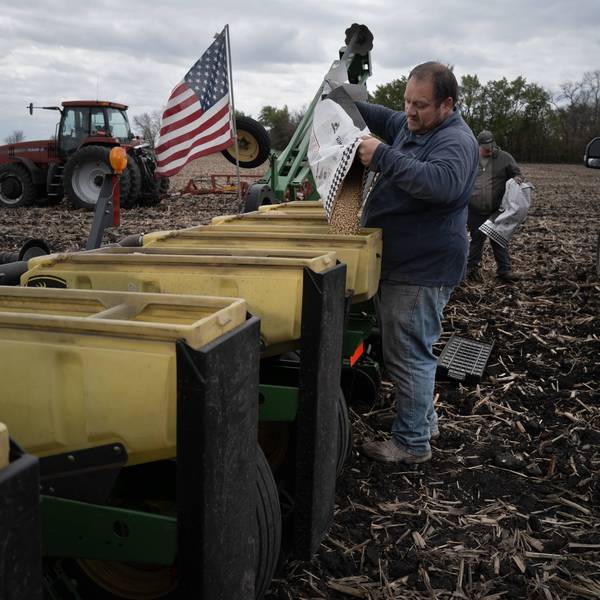

"Working-class voters and family farmers sensed that the party’s priorities were changing long before Chuck Schumer said the quiet part out loud," writes Leopold.
Billionaires Have Two Parties. Why Do the People of America's Great Plains Have Only One?
Abandoned by the party they once considered their own, many Democrats across vast areas of the nation's heartland turned to the Republicans to vent their anger at a system that was screwing them.
Not so long ago the Democrats wielded significant power in the Great Plains states. In 1990, 10 of the 18 Senators from Oklahoma, Kansas, Nebraska, Missouri, Iowa, South Dakota, North Dakota, Montana, and Idaho were Democrats. Today, none are.
In much of this area, the Democrats are no longer functioning as a competitive second party. They lose by 25 percent or more in 21 of the 30 congressional districts in these states. By my rough count, the Democrats did not even run candidates in about 40 percent of the region’s 1,400 state legislative races. Clearly, something has gone profoundly wrong.
What happened?
During the Reagan era (from his election in 1980 and up through the early 1990s) Great Plains Democrats resurrected the populist traditions of the late 19th-century People’s Party, the progressives of the early 20th century, and the Nonpartisan league a few years later. The core ideology of this tradition focused on protecting family farmers and workers from the rapaciousness of big corporations and banks. The political opponents of the Reagan Revolution followed in their path and enough of them were in Congress in 1983 to form the Congressional Populist Caucus.
"It is political malpractice to abdicate so much of America’s heartland."
These 14 congresspersons adopted the populist moniker and fought against corporatized free trade deals, the high Federal Reserve interest rates, plant closings, anti-union legislation, and farm foreclosures. And they did so in alliance with, and in support of, dozens of community groups including abortion and gay rights organizations.
But in 1990, a powerful segment of the Democratic establishment created the centrist Democratic Leadership Council and made a firm decision to embrace corporations, agribusiness, free trade, and Wall Street deregulation, while moving away from labor unions and family farmers. In the 1992 presidential primaries, Bill Clinton was the Democratic Leadership Council’s representative, while Senator Tom Harkin of Iowa represented the progressive populists. As we know, Clinton won.
In When the Democrats Lost the Heartland Corey Haala shows that this turn to neoliberalism was not the inevitable result of technological advances, nor was it predetermined by the iron laws of capitalism. Rather, it was a victory by one interest group within the Democratic Party over another, and the consequences were felt immediately.
After the centrists won, they starved the Great Plains Democrats of funds and legislative victories, leaving them with little to offer their constituents—the populist-oriented farmers and workers struggling to survive against corporate power.
Working-class voters and family farmers sensed that the party’s priorities were changing long before Chuck Schumer said the quiet part out loud:
“For every blue-collar Democrat we lose in western Pennsylvania, we will pick up two moderate Republicans in the suburbs of Philadelphia, and you can repeat that in Ohio and Illinois and Wisconsin.”
The same logic could easily have been applied to the Great Plains.
Abandoned by the party they once considered their own, many Democrats turned to the Republicans to vent their anger at a system that was screwing them.
Rebuild the old or build something new?
Despite this fundamental ideological shift, it’s hard for progressives to move away from the Democratic Party, especially given the rise of MAGA. Don’t we have to do everything we can to support Democratic candidates in order to win back Congress and stop the fascist takeover of America?
Of course, defeating the MAGA Republicans is crucial. And the fortunes of the Democrats are a real concern in blue and marginal districts where new seats can be won and old seats can be held. Third-party candidates in those competitive districts would only serve as spoilers likely to help elect MAGA Republicans.
But that’s not the case in the ruby red states in which the Democrats have given up on 40 percent of the local races, and where they lose congressional seats by 25 percent or more.
In these areas there is nothing to spoil.
It is political malpractice to abdicate so much of America’s heartland. One strategy is for progressives to recapture the Democratic Party in the Great Plains and elsewhere, infuse it with new energy, change its neoliberal brand, and run new working-class candidates across the board.
But a new survey by the Center for Working Class Politics shows that many of those who have given up on Trump show little interest in voting for Democrats. And a recent New York Times/Siena survey reports 43 percent of registered voters nationally are dissatisfied with both parties. That’s a hell of a headwind to overcome, given how tarnished the Democratic Party brand has become.
Something new that isn’t blue?
Dan Osborn’s race for the US Senate in Nebraska points in another direction. This former local labor leader is running against both parties, what he calls “the two-party doom loop,” in an unabashed progressive populist campaign—the Nebraska Fairness Plan. As he says “It’s not a party’s platform or written by consultants. It’s written for the people who punch a clock and wonder why nobody in Washington is fighting for them.”
Osborn is appealing to independents, disaffected Democrats, and even disgruntled Republicans. So far, the race is a toss-up in a state where Republicans outnumber Democrats by nearly two to one. The Democratic nominee, Cindy Burbank, has said she will avoid playing the spoiler by dropping out before ballots are printed if she doesn’t see a path to victory.
Osborn’s effort (and the polling we report on in The Billionaires Have Two Parties, We Need a Party of Our Own) strongly suggests that the best path forward in the Great Plains districts largely abanoned by the Democrats is to create a new organization by and for working people to run independent candidates.
That requires a break from the Democrats. Osborn says he will not caucus with either major party, and attacks both billionaire parties that have left so many working people high and dry. Independent working-class candidates will need to take strong progressive populist positions that protect jobs, create new ones, and save what’s left of family farming—positions with strong support across the Great Plains.
Working people can build independent political power even in places where the Democratic Party has ceased to function as a competitive second party.
And progressive political activists will need to get comfortable with turning neoliberalism on its head—putting people instead of capital in the center of our economy. That means promoting real job creation, not public-private partnerships that enrich corporations and rarely produce new jobs.
We will need to promote strong policies like “the right to a job at a living wage, provided by the public sector if the private sector fails to do so.”
As radical as this policy seems, polling shows again and again that it is very popular. People want stable, secure jobs even if the government has to step in to provide them.
Rebuilding progressive populism in the Great Plains requires the kind of boldness that challenged corporate power from the 1880s onward. Those populists were able to grow their appeal nationally, and their efforts led to progressive reforms like the graduated income tax, anti-monopoly moves against the robber barons, the formation of public universities and colleges, and even a public bank in North Dakota, among other successes.
We must escape the corporatist framework that governs today’s Democratic Party, which appeals to wealthy donors, admires the billionaire class, and has given up on the working class it considers socially backward.
Can it be done? Not quickly. Not easily. But the Great Plains once produced some of the most powerful populist movements in American history that challenged concentrated wealth, built durable institutions, and won reforms that reshaped the country. We won’t know what is possible until we try again.
We need to leave our blue bubbles, talk face-to-face with alienated working people, and rebuild an independent politics rooted in work, community, and economic security.
And really, where better to spread populism than in America’s heartland, “where the wind comes sweeping down the plain.”
If we dare to act boldly, perhaps we can once again become the wind.
*****
The questions raised in this essay are explored in much greater depth in my new book, The Billionaires Have Two Parties, We Need One of Our Own: How Working People Can Build Independent Political Power.
The book examines why so many working people have abandoned the Democratic Party, why independents are now the largest political bloc in many states, what voters in the heartland actually want from politics, and whether a new working-class political organization can be built without acting as a spoiler.
Drawing on new polling and historical research, it argues that working people can build independent political power even in places where the Democratic Party has ceased to function as a competitive second party.
If these arguments resonate with you, I hope you’ll take a look at the book.
All book proceeds support our Reversing Runaway Inequality educational programs for working people.
We are at a crossroads
This country and this world are at a monumental crossroads. In a few short weeks, US voters will have an opportunity to beat back the forces of fascism and confront the billionaires who are rigging the economy, our media system, and our democracy, making it increasingly impossible for ordinary people to get by. We’re not just talking about the election. We’re talking about what must be done once these fascist elements are vanquished from power. We need a bolder set of solutions than what either major party has so far been willing to offer and a working-class movement ready to fight like hell for it. Trump didn't emerge from nowhere. The conditions that fueled MAGA authoritarianism were created by decades of radical neoliberal economic policies and a corrupt political system dominated by corporate interests. They slashed taxes on the super-rich, promising that the benefits would trickle down. They said giveaways to the corporate titans would make life more affordable for the rest of us. It was all bullshit. And when a bitter, betrayed populace searches for someone to blame, right-wing demagogues have little trouble finding scapegoats. People know when they're being lied to, but you won't hear any of this from the corporate media. Only independent journalism—powered and funded by people who believe in building a better world—can deliver truly trustworthy daily news. Our Fall Campaign is underway, and we need your help. To power our newsroom through the rest of the year, we need to raise $125,000 by midnight on October 31. So if you share our vision, please contribute whatever you can to sustain our work. |
Les Leopold is the executive director of the Labor Institute and author of the new book, “The Billionaires Have Two Parties, We Need a Party of Our Own” (2026). His previous books include: “Wall Street’s War on Workers: How Mass Layoffs and Greed Are Destroying the Working Class and What to Do About It" (2024); "Runaway Inequality: An Activist's Guide to Economic Justice" (2015); and “The Man Who Hated Work and Loved Labor: The Life and Times of Tony Mazzocchi” (2007). Read more of his work on his substack here.
Not so long ago the Democrats wielded significant power in the Great Plains states. In 1990, 10 of the 18 Senators from Oklahoma, Kansas, Nebraska, Missouri, Iowa, South Dakota, North Dakota, Montana, and Idaho were Democrats. Today, none are.
In much of this area, the Democrats are no longer functioning as a competitive second party. They lose by 25 percent or more in 21 of the 30 congressional districts in these states. By my rough count, the Democrats did not even run candidates in about 40 percent of the region’s 1,400 state legislative races. Clearly, something has gone profoundly wrong.
What happened?
During the Reagan era (from his election in 1980 and up through the early 1990s) Great Plains Democrats resurrected the populist traditions of the late 19th-century People’s Party, the progressives of the early 20th century, and the Nonpartisan league a few years later. The core ideology of this tradition focused on protecting family farmers and workers from the rapaciousness of big corporations and banks. The political opponents of the Reagan Revolution followed in their path and enough of them were in Congress in 1983 to form the Congressional Populist Caucus.
"It is political malpractice to abdicate so much of America’s heartland."
These 14 congresspersons adopted the populist moniker and fought against corporatized free trade deals, the high Federal Reserve interest rates, plant closings, anti-union legislation, and farm foreclosures. And they did so in alliance with, and in support of, dozens of community groups including abortion and gay rights organizations.
But in 1990, a powerful segment of the Democratic establishment created the centrist Democratic Leadership Council and made a firm decision to embrace corporations, agribusiness, free trade, and Wall Street deregulation, while moving away from labor unions and family farmers. In the 1992 presidential primaries, Bill Clinton was the Democratic Leadership Council’s representative, while Senator Tom Harkin of Iowa represented the progressive populists. As we know, Clinton won.
In When the Democrats Lost the Heartland Corey Haala shows that this turn to neoliberalism was not the inevitable result of technological advances, nor was it predetermined by the iron laws of capitalism. Rather, it was a victory by one interest group within the Democratic Party over another, and the consequences were felt immediately.
After the centrists won, they starved the Great Plains Democrats of funds and legislative victories, leaving them with little to offer their constituents—the populist-oriented farmers and workers struggling to survive against corporate power.
Working-class voters and family farmers sensed that the party’s priorities were changing long before Chuck Schumer said the quiet part out loud:
“For every blue-collar Democrat we lose in western Pennsylvania, we will pick up two moderate Republicans in the suburbs of Philadelphia, and you can repeat that in Ohio and Illinois and Wisconsin.”
The same logic could easily have been applied to the Great Plains.
Abandoned by the party they once considered their own, many Democrats turned to the Republicans to vent their anger at a system that was screwing them.
Rebuild the old or build something new?
Despite this fundamental ideological shift, it’s hard for progressives to move away from the Democratic Party, especially given the rise of MAGA. Don’t we have to do everything we can to support Democratic candidates in order to win back Congress and stop the fascist takeover of America?
Of course, defeating the MAGA Republicans is crucial. And the fortunes of the Democrats are a real concern in blue and marginal districts where new seats can be won and old seats can be held. Third-party candidates in those competitive districts would only serve as spoilers likely to help elect MAGA Republicans.
But that’s not the case in the ruby red states in which the Democrats have given up on 40 percent of the local races, and where they lose congressional seats by 25 percent or more.
In these areas there is nothing to spoil.
It is political malpractice to abdicate so much of America’s heartland. One strategy is for progressives to recapture the Democratic Party in the Great Plains and elsewhere, infuse it with new energy, change its neoliberal brand, and run new working-class candidates across the board.
But a new survey by the Center for Working Class Politics shows that many of those who have given up on Trump show little interest in voting for Democrats. And a recent New York Times/Siena survey reports 43 percent of registered voters nationally are dissatisfied with both parties. That’s a hell of a headwind to overcome, given how tarnished the Democratic Party brand has become.
Something new that isn’t blue?
Dan Osborn’s race for the US Senate in Nebraska points in another direction. This former local labor leader is running against both parties, what he calls “the two-party doom loop,” in an unabashed progressive populist campaign—the Nebraska Fairness Plan. As he says “It’s not a party’s platform or written by consultants. It’s written for the people who punch a clock and wonder why nobody in Washington is fighting for them.”
Osborn is appealing to independents, disaffected Democrats, and even disgruntled Republicans. So far, the race is a toss-up in a state where Republicans outnumber Democrats by nearly two to one. The Democratic nominee, Cindy Burbank, has said she will avoid playing the spoiler by dropping out before ballots are printed if she doesn’t see a path to victory.
Osborn’s effort (and the polling we report on in The Billionaires Have Two Parties, We Need a Party of Our Own) strongly suggests that the best path forward in the Great Plains districts largely abanoned by the Democrats is to create a new organization by and for working people to run independent candidates.
That requires a break from the Democrats. Osborn says he will not caucus with either major party, and attacks both billionaire parties that have left so many working people high and dry. Independent working-class candidates will need to take strong progressive populist positions that protect jobs, create new ones, and save what’s left of family farming—positions with strong support across the Great Plains.
Working people can build independent political power even in places where the Democratic Party has ceased to function as a competitive second party.
And progressive political activists will need to get comfortable with turning neoliberalism on its head—putting people instead of capital in the center of our economy. That means promoting real job creation, not public-private partnerships that enrich corporations and rarely produce new jobs.
We will need to promote strong policies like “the right to a job at a living wage, provided by the public sector if the private sector fails to do so.”
As radical as this policy seems, polling shows again and again that it is very popular. People want stable, secure jobs even if the government has to step in to provide them.
Rebuilding progressive populism in the Great Plains requires the kind of boldness that challenged corporate power from the 1880s onward. Those populists were able to grow their appeal nationally, and their efforts led to progressive reforms like the graduated income tax, anti-monopoly moves against the robber barons, the formation of public universities and colleges, and even a public bank in North Dakota, among other successes.
We must escape the corporatist framework that governs today’s Democratic Party, which appeals to wealthy donors, admires the billionaire class, and has given up on the working class it considers socially backward.
Can it be done? Not quickly. Not easily. But the Great Plains once produced some of the most powerful populist movements in American history that challenged concentrated wealth, built durable institutions, and won reforms that reshaped the country. We won’t know what is possible until we try again.
We need to leave our blue bubbles, talk face-to-face with alienated working people, and rebuild an independent politics rooted in work, community, and economic security.
And really, where better to spread populism than in America’s heartland, “where the wind comes sweeping down the plain.”
If we dare to act boldly, perhaps we can once again become the wind.
*****
The questions raised in this essay are explored in much greater depth in my new book, The Billionaires Have Two Parties, We Need One of Our Own: How Working People Can Build Independent Political Power.
The book examines why so many working people have abandoned the Democratic Party, why independents are now the largest political bloc in many states, what voters in the heartland actually want from politics, and whether a new working-class political organization can be built without acting as a spoiler.
Drawing on new polling and historical research, it argues that working people can build independent political power even in places where the Democratic Party has ceased to function as a competitive second party.
If these arguments resonate with you, I hope you’ll take a look at the book.
All book proceeds support our Reversing Runaway Inequality educational programs for working people.
Les Leopold is the executive director of the Labor Institute and author of the new book, “The Billionaires Have Two Parties, We Need a Party of Our Own” (2026). His previous books include: “Wall Street’s War on Workers: How Mass Layoffs and Greed Are Destroying the Working Class and What to Do About It" (2024); "Runaway Inequality: An Activist's Guide to Economic Justice" (2015); and “The Man Who Hated Work and Loved Labor: The Life and Times of Tony Mazzocchi” (2007). Read more of his work on his substack here.
Not so long ago the Democrats wielded significant power in the Great Plains states. In 1990, 10 of the 18 Senators from Oklahoma, Kansas, Nebraska, Missouri, Iowa, South Dakota, North Dakota, Montana, and Idaho were Democrats. Today, none are.
In much of this area, the Democrats are no longer functioning as a competitive second party. They lose by 25 percent or more in 21 of the 30 congressional districts in these states. By my rough count, the Democrats did not even run candidates in about 40 percent of the region’s 1,400 state legislative races. Clearly, something has gone profoundly wrong.
What happened?
During the Reagan era (from his election in 1980 and up through the early 1990s) Great Plains Democrats resurrected the populist traditions of the late 19th-century People’s Party, the progressives of the early 20th century, and the Nonpartisan league a few years later. The core ideology of this tradition focused on protecting family farmers and workers from the rapaciousness of big corporations and banks. The political opponents of the Reagan Revolution followed in their path and enough of them were in Congress in 1983 to form the Congressional Populist Caucus.
"It is political malpractice to abdicate so much of America’s heartland."
These 14 congresspersons adopted the populist moniker and fought against corporatized free trade deals, the high Federal Reserve interest rates, plant closings, anti-union legislation, and farm foreclosures. And they did so in alliance with, and in support of, dozens of community groups including abortion and gay rights organizations.
But in 1990, a powerful segment of the Democratic establishment created the centrist Democratic Leadership Council and made a firm decision to embrace corporations, agribusiness, free trade, and Wall Street deregulation, while moving away from labor unions and family farmers. In the 1992 presidential primaries, Bill Clinton was the Democratic Leadership Council’s representative, while Senator Tom Harkin of Iowa represented the progressive populists. As we know, Clinton won.
In When the Democrats Lost the Heartland Corey Haala shows that this turn to neoliberalism was not the inevitable result of technological advances, nor was it predetermined by the iron laws of capitalism. Rather, it was a victory by one interest group within the Democratic Party over another, and the consequences were felt immediately.
After the centrists won, they starved the Great Plains Democrats of funds and legislative victories, leaving them with little to offer their constituents—the populist-oriented farmers and workers struggling to survive against corporate power.
Working-class voters and family farmers sensed that the party’s priorities were changing long before Chuck Schumer said the quiet part out loud:
“For every blue-collar Democrat we lose in western Pennsylvania, we will pick up two moderate Republicans in the suburbs of Philadelphia, and you can repeat that in Ohio and Illinois and Wisconsin.”
The same logic could easily have been applied to the Great Plains.
Abandoned by the party they once considered their own, many Democrats turned to the Republicans to vent their anger at a system that was screwing them.
Rebuild the old or build something new?
Despite this fundamental ideological shift, it’s hard for progressives to move away from the Democratic Party, especially given the rise of MAGA. Don’t we have to do everything we can to support Democratic candidates in order to win back Congress and stop the fascist takeover of America?
Of course, defeating the MAGA Republicans is crucial. And the fortunes of the Democrats are a real concern in blue and marginal districts where new seats can be won and old seats can be held. Third-party candidates in those competitive districts would only serve as spoilers likely to help elect MAGA Republicans.
But that’s not the case in the ruby red states in which the Democrats have given up on 40 percent of the local races, and where they lose congressional seats by 25 percent or more.
In these areas there is nothing to spoil.
It is political malpractice to abdicate so much of America’s heartland. One strategy is for progressives to recapture the Democratic Party in the Great Plains and elsewhere, infuse it with new energy, change its neoliberal brand, and run new working-class candidates across the board.
But a new survey by the Center for Working Class Politics shows that many of those who have given up on Trump show little interest in voting for Democrats. And a recent New York Times/Siena survey reports 43 percent of registered voters nationally are dissatisfied with both parties. That’s a hell of a headwind to overcome, given how tarnished the Democratic Party brand has become.
Something new that isn’t blue?
Dan Osborn’s race for the US Senate in Nebraska points in another direction. This former local labor leader is running against both parties, what he calls “the two-party doom loop,” in an unabashed progressive populist campaign—the Nebraska Fairness Plan. As he says “It’s not a party’s platform or written by consultants. It’s written for the people who punch a clock and wonder why nobody in Washington is fighting for them.”
Osborn is appealing to independents, disaffected Democrats, and even disgruntled Republicans. So far, the race is a toss-up in a state where Republicans outnumber Democrats by nearly two to one. The Democratic nominee, Cindy Burbank, has said she will avoid playing the spoiler by dropping out before ballots are printed if she doesn’t see a path to victory.
Osborn’s effort (and the polling we report on in The Billionaires Have Two Parties, We Need a Party of Our Own) strongly suggests that the best path forward in the Great Plains districts largely abanoned by the Democrats is to create a new organization by and for working people to run independent candidates.
That requires a break from the Democrats. Osborn says he will not caucus with either major party, and attacks both billionaire parties that have left so many working people high and dry. Independent working-class candidates will need to take strong progressive populist positions that protect jobs, create new ones, and save what’s left of family farming—positions with strong support across the Great Plains.
Working people can build independent political power even in places where the Democratic Party has ceased to function as a competitive second party.
And progressive political activists will need to get comfortable with turning neoliberalism on its head—putting people instead of capital in the center of our economy. That means promoting real job creation, not public-private partnerships that enrich corporations and rarely produce new jobs.
We will need to promote strong policies like “the right to a job at a living wage, provided by the public sector if the private sector fails to do so.”
As radical as this policy seems, polling shows again and again that it is very popular. People want stable, secure jobs even if the government has to step in to provide them.
Rebuilding progressive populism in the Great Plains requires the kind of boldness that challenged corporate power from the 1880s onward. Those populists were able to grow their appeal nationally, and their efforts led to progressive reforms like the graduated income tax, anti-monopoly moves against the robber barons, the formation of public universities and colleges, and even a public bank in North Dakota, among other successes.
We must escape the corporatist framework that governs today’s Democratic Party, which appeals to wealthy donors, admires the billionaire class, and has given up on the working class it considers socially backward.
Can it be done? Not quickly. Not easily. But the Great Plains once produced some of the most powerful populist movements in American history that challenged concentrated wealth, built durable institutions, and won reforms that reshaped the country. We won’t know what is possible until we try again.
We need to leave our blue bubbles, talk face-to-face with alienated working people, and rebuild an independent politics rooted in work, community, and economic security.
And really, where better to spread populism than in America’s heartland, “where the wind comes sweeping down the plain.”
If we dare to act boldly, perhaps we can once again become the wind.
*****
The questions raised in this essay are explored in much greater depth in my new book, The Billionaires Have Two Parties, We Need One of Our Own: How Working People Can Build Independent Political Power.
The book examines why so many working people have abandoned the Democratic Party, why independents are now the largest political bloc in many states, what voters in the heartland actually want from politics, and whether a new working-class political organization can be built without acting as a spoiler.
Drawing on new polling and historical research, it argues that working people can build independent political power even in places where the Democratic Party has ceased to function as a competitive second party.
If these arguments resonate with you, I hope you’ll take a look at the book.
All book proceeds support our Reversing Runaway Inequality educational programs for working people.