5
#000000
#FFFFFF
To donate by check, phone, or other method, see our More Ways to Give page.
Daily news & progressive opinion—funded by the people, not the corporations—delivered straight to your inbox.
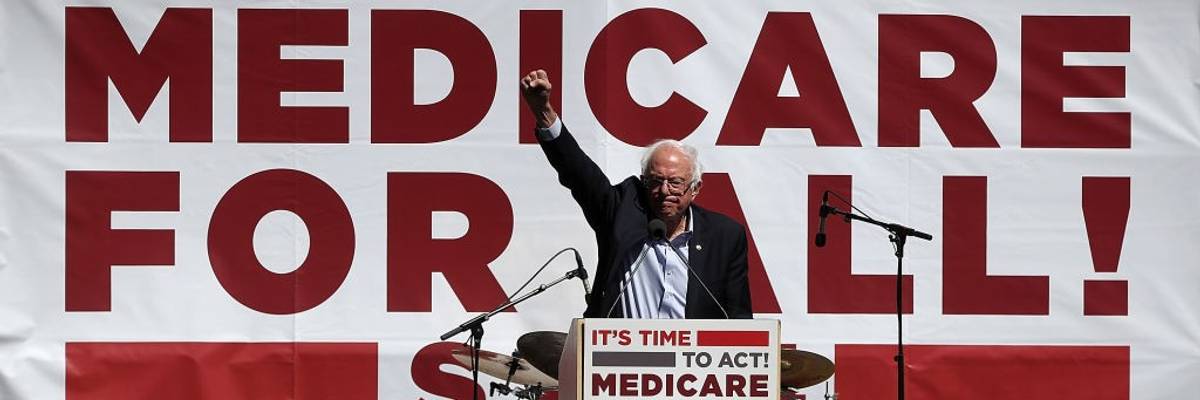
US Sen. Bernie Sanders (I-Vt.) speaks during a health care rally at the 2017 Convention of the California Nurses Association/National Nurses Organizing Committee on September 22, 2017 in San Francisco, California. Sen. Bernie Sanders addressed the California Nurses Association about his Medicare for All Act of 2017 bill.
Everyone who wants Improved Medicare for All to become law should reach out to friends, family, and neighbors and urge them to get involved and we should create Improved Medicare for All clubs nationwide to galvanize this movement.
Reaching our destination won’t be easy. Americans have been fighting for universal, government-sponsored national health insurance for over 100 years. Progress was made in 1965 and 1972, when Medicare was enacted and expanded. Since, then, though, not only was Medicare not expanded; frustratingly, its opposition has succeeded in partially privatizing it.
The moment in which the nation finds itself does not appear particularly hopeful even for the country to remain the United States. Not since the Civil War has the nation been so divided.
Almost 100 years ago, the Great Depression brought economic collapse and with it, a serious threat to democracy. Like today, there was hostility to those perceived to be elites. The economic turmoil opened the door to widespread radical movements and demagogues.
Like today, “others” were scapegoated, along with the “elites.” Jews were a particular target. One extremely powerful, influential anti-Semite was radio preacher Father Charles E. Coughlin. At the height of his popularity, his Sunday radio show, Golden Hour of the Little Flower, which was broadcast over dozens of radio stations around the country, was heard by nearly one in four Americans and had a larger share of the listening audience than the more recent broadcasters Howard Stern, Rush Limbaugh, Paul Harvey, and Larry King put together. Before the 1936 Presidential election, he asserted. “This is our last election. It is fascism or communism. We are at the crossroads. I take the road to fascism.”
Another leader of the time seeking radical change was Louisiana Governor and then Senator Huey Long, who targeted the extreme income and wealth inequality which exploded during the so-called Roaring Twenties. His Share Our Wealth plan proposed confiscatory income, wealth, and inheritance taxes on the wealthiest and generous federal benefits for working and middle-income families. Just one year after announcing the plan, there were 27,000 Share Our Wealth local clubs, mainly in the South, with over 7.5 million members.
Long planned to run for president as a third-party candidate, even setting out his plans and strategy in his 1935 novel, My First Days in the White House. His plans came to an abrupt end, though, in September, 1935, when he was assassinated by the son-in-law of a political opponent whom Long had targeted and slandered.
Another radical leader of the time was socialist author and journalist, Upton Sinclair, who sought to expose corruption in business and government, while shining a spotlight on the horrendous working conditions at the time. In 1934, he ran for Governor of California on his “End Poverty in California” (EPIC) plan, which, like Long, he set out in a novel, the 1933 I, Governor of California, and How I Ended Poverty: A True Story of the Future. His plan called for the state to seize idle factories, farms, movie studios, and other businesses and convert them to worker-run co-ops, financed with progressive revenue. Two dozen candidates who ran on the EPIC plan won seats in the state legislature, including lawyer and journalist Culbert Colson, who successfully ran for Governor four years later, becoming the first Democrat in 40 years to win the office.
At base, people were suffering and open to radical solutions to address their misery. Franklin Roosevelt was undoubtedly the right person to meet that moment. He was extremely politically savvy, pragmatic, and smart. His speeches were inspiring and visionary. His famed fireside chats, named to convey a sense of cozy familiarity, established a strong personal connection between the president and the American people. He radiated optimism. Perhaps most importantly, he exuded compassion and empathy.
Though he enjoyed extraordinary wealth and privilege, his paralysis, resulting from contracting polio at age 39, was apparently transformative. His close colleague Frances Perkins, who became the first woman to serve as a Cabinet secretary to a president, described his transformation in her book, The Roosevelt I Knew. She witnessed Roosevelt undergo, she wrote:
“a spiritual transformation during the years of his illness….The man emerged completely warmhearted, with humility of spirit and with a deeper philosophy. Having been in the depths of trouble, he understood the problems of people in trouble.”
The brilliant achievements of the charismatic Roosevelt can continue to be felt today. His Social Security program was carefully crafted to embody basic American values, containing both progressive and conservative elements that continue to appeal to Americans across the ideological divide. Roosevelt’s legacy provides good news in today’s troubling time. As polarized and hostile as Americans are in general, we are overwhelmingly united in our support for Social Security and Medicare, which grows out of Roosevelt’s legacy. A 2025 Bipartisan Policy Center poll, for example, found that 91 percent of Americans believe that Medicare is valuable. That same poll found that 93 percent believe Social Security is valuable. Numerous other polls, taken over many years by groups across the ideological spectrum, have found similar results of unanimity of support.
Despite how divided and combative the American people are generally, these numbers provide a ray of hope. Supporters of Improved Medicare for All must build on this support systematically. The cause and its success may have the byproduct of helping to bring the country back to more normal, less fractured, and hostile times.
Notwithstanding Joe Biden’s 2020 victory, none of the Democratic presidential nominees in the last few election cycles nor the mainstream leaders of today’s Democratic Party appear to match Roosevelt’s political insights or capabilities. Senator Bernie Sanders (I-Vt.) showed that he can garner enthusiastic support, as has New York Mayor Zohran Mamdani, but the Democratic leadership has not embraced them or similar charismatic progressive leaders. Consequently, the Democratic Party has not spoken with one single clear voice and capitalized effectively on the broad support for Medicare and Social Security.
Unfortunately, unlike Roosevelt, the current politicians who appear most likely to win the 2028 Democratic presidential nomination do not appear to have the vision or charisma to capitalize on the popularity of Medicare and Social Security. There is no candidate with Franklin Roosevelt’s many gifts who is in a position to fully embrace Improved Medicare for All and ride it to victory, together with an expanded Social Security program. At this moment, the Democratic Party does not seem united in a path forward, certainly not one that would embrace as bold a vision as Improved Medicare for All.
Nevertheless, the political movements of the 1930s provide evidence that those policy goals can be achieved without a political leader. While the Share the Wealth and End Poverty in California grassroots movements had high-profile personalities leading the efforts, another astoundingly successful grassroots movement did not.
While policymakers in Washington were primarily focused on unemployment in the early years of the Great Depression, they apparently did not fully appreciate that hidden in the shadows of the unemployment numbers were impoverished, aged parents reluctantly dependent on their adult children for support. When Social Security became law in 1935, every state but New Mexico had poorhouses (sometimes called almshouses or poor farms). The vast majority of the residents were elderly. Most of the “inmates,” as they were often labeled, entered the poorhouse late in life, having been independent wage earners until they were no longer able to work.
Although official Washington was not focused on the plight of the elderly, ordinary people were. In September 1933, a Long Beach, California doctor, Francis E. Townsend, found himself at age 66 unemployed with no savings. He was gazing out his window when he spotted two elderly women, dressed in rags, rummaging through his garbage, searching for anything edible. It so upset Dr. Townsend that he sent a letter to the Long Beach Press-Telegram, his local newspaper.
His letter, published on September 30, proposed a plan. He proposed that the federal government provide every person aged 60 or older a pension of $200 per month, a princely sum in the 1930s. The only requirement, in addition to being retired and not a criminal, was that the recipient had to spend every penny within 30 days of receipt. He claimed that his plan would not only eradicate old-age poverty; it would so stimulate the economy that it would create jobs and end the Depression.
The idea spread around the country at a rate astonishing to believe in that pre-Internet, pre-social media world. A year after Townsend wrote his letter to the newspaper, Time magazine reported in its October 15, 1934, issue:
By last week the flow of money…was enough to pay the wages of 50 people….There were Townsend Clubs in every State except Delaware…. Between 2,000,000 and 5,000,000 people had put their names to petitions begging their Congressmen to vote the Plan into effect at once.
Even in the short time between the publication of Townsend’s letter and the establishment of Roosevelt’s Committee on Economic Security (CES), his interagency task force to develop the Social Security Act, supporters of the Townsend proposal were exerting considerable pressure on the Administration and Congress. At the height of CES’s work, mail from Townsendites averaged about 1,500 letters a day. In some congressional districts, a candidate’s position on the Townsend plan determined the outcome of the election.
By mid-October 1934, Townsend had acquired two million signatures on petitions urging congressional action on his plan. Just three months later, he was claiming to have 25 million signatures. The number of Townsend clubs had climbed to 25,000 across the country. The plan’s popularity was not hard to fathom. As political columnist, Mark Sullivan with The New York Herald Tribune explained: “The zeal of those promoting the plan is evangelical, almost fanatic.”
A Time magazine piece explained the political climate surrounding the plan:
The good doctor’s Old Age Revolving Pensions scheme, better known as the Townsend Plan, had by last week become one of the biggest political facts in the US. The early California groundswell of sentiment in its favor had grown to a tidal wave, battering at nearly every door in House and Senate Office Buildings.
In the end, the Townsend plan, which policy experts understood to be unworkable—benefits would have cost half the income of the United States, for example—was instrumental in enacting Social Security, because it provided the widespread pressure to address old age insecurity. That is the kind of pressure that today could get Improved Medicare for All enacted, as well.
To build such a movement is both easier and harder than it was almost 100 years ago. While American news consumption is much more siloed, social media, email chains, and the internet generally allow people to connect much more easily and effectively. Of course, people are drawn to a variety of important issues, including climate change, gun violence, and immigration. Nevertheless, similar to the 1930s with respect to old age insecurity, Americans appear to be reaching the end of their rope with respect to the nation’s health insurance companies, as was demonstrated by the strong, instantaneous outpouring of frustration with commercial health insurance in response to the murder of the UnitedHealthcare executive.
The movement for Improved Medicare for All already has powerful, effective, knowledgeable and resourceful leaders. They are members of a far-reaching, forceful coalition, the National Coalition for Medicare for All. The coalition meets regularly to strategize and advance the issue. They are doing a spectacular job in championing and pushing forward Improved Medicare for All. To help them succeed in its enactment, the rest of us should provide them with an overwhelming army of passionate, dedicated grassroots supporters.
The goal, as impossible as it might seem, is to build a broad-based, energized, and determined Townsend-like grassroots movement. Everyone who wants Improved Medicare for All to become law should reach out to friends, family, and neighbors and urge them to get involved. In addition to joining already-existing groups, such as MoveOn, Public Citizen, and Indivisible, supporters should create Improved Medicare for All clubs.
Those clubs should play a number of roles. First, the clubs could educate members and others about why Improved Medicare for All is so important. They could discuss at club meetings how health care is a right, not a privilege and how Improved Medicare for All is the only realistic way to get us there. Just as the Townsend clubs hounded their elected representatives, supporters should flood offices with phone calls, keep track of when their Senators and representatives are home from Washington, DD, and attend their town halls if they host them. If they don’t, the clubs can seek meetings with their members and staff. If their members won’t commit to cosponsoring Improved Medicare for All legislation, they should put pressure on them, including picketing their offices.
With or without membership in an Improved Medicare for All club, those wanting to help the effort have many other steps they can take. On this and many other issues, there are a multitude of effective civic and social organizations active on political issues, such as Indivisible, MoveOn, Public Citizen, and many more. If you have access to a union, they remain extremely important and effective actors with which to engage. With or without engagement with these organizations, it is perhaps most important to educate family, friends, and neighbors. Writing letters to the editor and posting on social media are helpful actions. If possible, there may be an opportunity to hold an event at a school, perhaps through the PTA, as well as at assisted care facilities, libraries, and other spaces. If you want to organize an event but want experts to be the speakers and/or panelists, that is relatively easy these days, particularly, if the speakers can appear virtually.
Moreover, because healthcare costs affect everyone, the issue of Improved Medicare for All can be tailored to a variety of organizations and groups. School groups may be concerned about the impact of healthcare costs on their budget. Women’s groups may be concerned about reproductive rights. Again, the point is to make the movement for Improved Medicare for All as large a mass movement as possible.
This moment in history may make enactment of Improved Medicare for All appear as far away as it possibly could be. However, the mythological phoenix should be the symbol of the effort. The phoenix, an immortal bird that continually arose from the ashes of its predecessor, symbolizes renewal after a period of hardship.
Dear Common Dreams reader, It’s been nearly 30 years since I co-founded Common Dreams with my late wife, Lina Newhouser. We had the radical notion that journalism should serve the public good, not corporate profits. It was clear to us from the outset what it would take to build such a project. No paid advertisements. No corporate sponsors. No millionaire publisher telling us what to think or do. Many people said we wouldn't last a year, but we proved those doubters wrong. Together with a tremendous team of journalists and dedicated staff, we built an independent media outlet free from the constraints of profits and corporate control. Our mission has always been simple: To inform. To inspire. To ignite change for the common good. Building Common Dreams was not easy. Our survival was never guaranteed. When you take on the most powerful forces—Wall Street greed, fossil fuel industry destruction, Big Tech lobbyists, and uber-rich oligarchs who have spent billions upon billions rigging the economy and democracy in their favor—the only bulwark you have is supporters who believe in your work. But here’s the urgent message from me today. It's never been this bad out there. And it's never been this hard to keep us going. At the very moment Common Dreams is most needed, the threats we face are intensifying. We need your support now more than ever. We don't accept corporate advertising and never will. We don't have a paywall because we don't think people should be blocked from critical news based on their ability to pay. Everything we do is funded by the donations of readers like you. When everyone does the little they can afford, we are strong. But if that support retreats or dries up, so do we. Will you donate now to make sure Common Dreams not only survives but thrives? —Craig Brown, Co-founder |
Nancy Altman is president of Social Security Works and chair of the Strengthen Social Security Coalition. She is co-author of two books and author of three, including her most recent, The Road to Medicare for All: A Call to Action.
Reaching our destination won’t be easy. Americans have been fighting for universal, government-sponsored national health insurance for over 100 years. Progress was made in 1965 and 1972, when Medicare was enacted and expanded. Since, then, though, not only was Medicare not expanded; frustratingly, its opposition has succeeded in partially privatizing it.
The moment in which the nation finds itself does not appear particularly hopeful even for the country to remain the United States. Not since the Civil War has the nation been so divided.
Almost 100 years ago, the Great Depression brought economic collapse and with it, a serious threat to democracy. Like today, there was hostility to those perceived to be elites. The economic turmoil opened the door to widespread radical movements and demagogues.
Like today, “others” were scapegoated, along with the “elites.” Jews were a particular target. One extremely powerful, influential anti-Semite was radio preacher Father Charles E. Coughlin. At the height of his popularity, his Sunday radio show, Golden Hour of the Little Flower, which was broadcast over dozens of radio stations around the country, was heard by nearly one in four Americans and had a larger share of the listening audience than the more recent broadcasters Howard Stern, Rush Limbaugh, Paul Harvey, and Larry King put together. Before the 1936 Presidential election, he asserted. “This is our last election. It is fascism or communism. We are at the crossroads. I take the road to fascism.”
Another leader of the time seeking radical change was Louisiana Governor and then Senator Huey Long, who targeted the extreme income and wealth inequality which exploded during the so-called Roaring Twenties. His Share Our Wealth plan proposed confiscatory income, wealth, and inheritance taxes on the wealthiest and generous federal benefits for working and middle-income families. Just one year after announcing the plan, there were 27,000 Share Our Wealth local clubs, mainly in the South, with over 7.5 million members.
Long planned to run for president as a third-party candidate, even setting out his plans and strategy in his 1935 novel, My First Days in the White House. His plans came to an abrupt end, though, in September, 1935, when he was assassinated by the son-in-law of a political opponent whom Long had targeted and slandered.
Another radical leader of the time was socialist author and journalist, Upton Sinclair, who sought to expose corruption in business and government, while shining a spotlight on the horrendous working conditions at the time. In 1934, he ran for Governor of California on his “End Poverty in California” (EPIC) plan, which, like Long, he set out in a novel, the 1933 I, Governor of California, and How I Ended Poverty: A True Story of the Future. His plan called for the state to seize idle factories, farms, movie studios, and other businesses and convert them to worker-run co-ops, financed with progressive revenue. Two dozen candidates who ran on the EPIC plan won seats in the state legislature, including lawyer and journalist Culbert Colson, who successfully ran for Governor four years later, becoming the first Democrat in 40 years to win the office.
At base, people were suffering and open to radical solutions to address their misery. Franklin Roosevelt was undoubtedly the right person to meet that moment. He was extremely politically savvy, pragmatic, and smart. His speeches were inspiring and visionary. His famed fireside chats, named to convey a sense of cozy familiarity, established a strong personal connection between the president and the American people. He radiated optimism. Perhaps most importantly, he exuded compassion and empathy.
Though he enjoyed extraordinary wealth and privilege, his paralysis, resulting from contracting polio at age 39, was apparently transformative. His close colleague Frances Perkins, who became the first woman to serve as a Cabinet secretary to a president, described his transformation in her book, The Roosevelt I Knew. She witnessed Roosevelt undergo, she wrote:
“a spiritual transformation during the years of his illness….The man emerged completely warmhearted, with humility of spirit and with a deeper philosophy. Having been in the depths of trouble, he understood the problems of people in trouble.”
The brilliant achievements of the charismatic Roosevelt can continue to be felt today. His Social Security program was carefully crafted to embody basic American values, containing both progressive and conservative elements that continue to appeal to Americans across the ideological divide. Roosevelt’s legacy provides good news in today’s troubling time. As polarized and hostile as Americans are in general, we are overwhelmingly united in our support for Social Security and Medicare, which grows out of Roosevelt’s legacy. A 2025 Bipartisan Policy Center poll, for example, found that 91 percent of Americans believe that Medicare is valuable. That same poll found that 93 percent believe Social Security is valuable. Numerous other polls, taken over many years by groups across the ideological spectrum, have found similar results of unanimity of support.
Despite how divided and combative the American people are generally, these numbers provide a ray of hope. Supporters of Improved Medicare for All must build on this support systematically. The cause and its success may have the byproduct of helping to bring the country back to more normal, less fractured, and hostile times.
Notwithstanding Joe Biden’s 2020 victory, none of the Democratic presidential nominees in the last few election cycles nor the mainstream leaders of today’s Democratic Party appear to match Roosevelt’s political insights or capabilities. Senator Bernie Sanders (I-Vt.) showed that he can garner enthusiastic support, as has New York Mayor Zohran Mamdani, but the Democratic leadership has not embraced them or similar charismatic progressive leaders. Consequently, the Democratic Party has not spoken with one single clear voice and capitalized effectively on the broad support for Medicare and Social Security.
Unfortunately, unlike Roosevelt, the current politicians who appear most likely to win the 2028 Democratic presidential nomination do not appear to have the vision or charisma to capitalize on the popularity of Medicare and Social Security. There is no candidate with Franklin Roosevelt’s many gifts who is in a position to fully embrace Improved Medicare for All and ride it to victory, together with an expanded Social Security program. At this moment, the Democratic Party does not seem united in a path forward, certainly not one that would embrace as bold a vision as Improved Medicare for All.
Nevertheless, the political movements of the 1930s provide evidence that those policy goals can be achieved without a political leader. While the Share the Wealth and End Poverty in California grassroots movements had high-profile personalities leading the efforts, another astoundingly successful grassroots movement did not.
While policymakers in Washington were primarily focused on unemployment in the early years of the Great Depression, they apparently did not fully appreciate that hidden in the shadows of the unemployment numbers were impoverished, aged parents reluctantly dependent on their adult children for support. When Social Security became law in 1935, every state but New Mexico had poorhouses (sometimes called almshouses or poor farms). The vast majority of the residents were elderly. Most of the “inmates,” as they were often labeled, entered the poorhouse late in life, having been independent wage earners until they were no longer able to work.
Although official Washington was not focused on the plight of the elderly, ordinary people were. In September 1933, a Long Beach, California doctor, Francis E. Townsend, found himself at age 66 unemployed with no savings. He was gazing out his window when he spotted two elderly women, dressed in rags, rummaging through his garbage, searching for anything edible. It so upset Dr. Townsend that he sent a letter to the Long Beach Press-Telegram, his local newspaper.
His letter, published on September 30, proposed a plan. He proposed that the federal government provide every person aged 60 or older a pension of $200 per month, a princely sum in the 1930s. The only requirement, in addition to being retired and not a criminal, was that the recipient had to spend every penny within 30 days of receipt. He claimed that his plan would not only eradicate old-age poverty; it would so stimulate the economy that it would create jobs and end the Depression.
The idea spread around the country at a rate astonishing to believe in that pre-Internet, pre-social media world. A year after Townsend wrote his letter to the newspaper, Time magazine reported in its October 15, 1934, issue:
By last week the flow of money…was enough to pay the wages of 50 people….There were Townsend Clubs in every State except Delaware…. Between 2,000,000 and 5,000,000 people had put their names to petitions begging their Congressmen to vote the Plan into effect at once.
Even in the short time between the publication of Townsend’s letter and the establishment of Roosevelt’s Committee on Economic Security (CES), his interagency task force to develop the Social Security Act, supporters of the Townsend proposal were exerting considerable pressure on the Administration and Congress. At the height of CES’s work, mail from Townsendites averaged about 1,500 letters a day. In some congressional districts, a candidate’s position on the Townsend plan determined the outcome of the election.
By mid-October 1934, Townsend had acquired two million signatures on petitions urging congressional action on his plan. Just three months later, he was claiming to have 25 million signatures. The number of Townsend clubs had climbed to 25,000 across the country. The plan’s popularity was not hard to fathom. As political columnist, Mark Sullivan with The New York Herald Tribune explained: “The zeal of those promoting the plan is evangelical, almost fanatic.”
A Time magazine piece explained the political climate surrounding the plan:
The good doctor’s Old Age Revolving Pensions scheme, better known as the Townsend Plan, had by last week become one of the biggest political facts in the US. The early California groundswell of sentiment in its favor had grown to a tidal wave, battering at nearly every door in House and Senate Office Buildings.
In the end, the Townsend plan, which policy experts understood to be unworkable—benefits would have cost half the income of the United States, for example—was instrumental in enacting Social Security, because it provided the widespread pressure to address old age insecurity. That is the kind of pressure that today could get Improved Medicare for All enacted, as well.
To build such a movement is both easier and harder than it was almost 100 years ago. While American news consumption is much more siloed, social media, email chains, and the internet generally allow people to connect much more easily and effectively. Of course, people are drawn to a variety of important issues, including climate change, gun violence, and immigration. Nevertheless, similar to the 1930s with respect to old age insecurity, Americans appear to be reaching the end of their rope with respect to the nation’s health insurance companies, as was demonstrated by the strong, instantaneous outpouring of frustration with commercial health insurance in response to the murder of the UnitedHealthcare executive.
The movement for Improved Medicare for All already has powerful, effective, knowledgeable and resourceful leaders. They are members of a far-reaching, forceful coalition, the National Coalition for Medicare for All. The coalition meets regularly to strategize and advance the issue. They are doing a spectacular job in championing and pushing forward Improved Medicare for All. To help them succeed in its enactment, the rest of us should provide them with an overwhelming army of passionate, dedicated grassroots supporters.
The goal, as impossible as it might seem, is to build a broad-based, energized, and determined Townsend-like grassroots movement. Everyone who wants Improved Medicare for All to become law should reach out to friends, family, and neighbors and urge them to get involved. In addition to joining already-existing groups, such as MoveOn, Public Citizen, and Indivisible, supporters should create Improved Medicare for All clubs.
Those clubs should play a number of roles. First, the clubs could educate members and others about why Improved Medicare for All is so important. They could discuss at club meetings how health care is a right, not a privilege and how Improved Medicare for All is the only realistic way to get us there. Just as the Townsend clubs hounded their elected representatives, supporters should flood offices with phone calls, keep track of when their Senators and representatives are home from Washington, DD, and attend their town halls if they host them. If they don’t, the clubs can seek meetings with their members and staff. If their members won’t commit to cosponsoring Improved Medicare for All legislation, they should put pressure on them, including picketing their offices.
With or without membership in an Improved Medicare for All club, those wanting to help the effort have many other steps they can take. On this and many other issues, there are a multitude of effective civic and social organizations active on political issues, such as Indivisible, MoveOn, Public Citizen, and many more. If you have access to a union, they remain extremely important and effective actors with which to engage. With or without engagement with these organizations, it is perhaps most important to educate family, friends, and neighbors. Writing letters to the editor and posting on social media are helpful actions. If possible, there may be an opportunity to hold an event at a school, perhaps through the PTA, as well as at assisted care facilities, libraries, and other spaces. If you want to organize an event but want experts to be the speakers and/or panelists, that is relatively easy these days, particularly, if the speakers can appear virtually.
Moreover, because healthcare costs affect everyone, the issue of Improved Medicare for All can be tailored to a variety of organizations and groups. School groups may be concerned about the impact of healthcare costs on their budget. Women’s groups may be concerned about reproductive rights. Again, the point is to make the movement for Improved Medicare for All as large a mass movement as possible.
This moment in history may make enactment of Improved Medicare for All appear as far away as it possibly could be. However, the mythological phoenix should be the symbol of the effort. The phoenix, an immortal bird that continually arose from the ashes of its predecessor, symbolizes renewal after a period of hardship.
Nancy Altman is president of Social Security Works and chair of the Strengthen Social Security Coalition. She is co-author of two books and author of three, including her most recent, The Road to Medicare for All: A Call to Action.
Reaching our destination won’t be easy. Americans have been fighting for universal, government-sponsored national health insurance for over 100 years. Progress was made in 1965 and 1972, when Medicare was enacted and expanded. Since, then, though, not only was Medicare not expanded; frustratingly, its opposition has succeeded in partially privatizing it.
The moment in which the nation finds itself does not appear particularly hopeful even for the country to remain the United States. Not since the Civil War has the nation been so divided.
Almost 100 years ago, the Great Depression brought economic collapse and with it, a serious threat to democracy. Like today, there was hostility to those perceived to be elites. The economic turmoil opened the door to widespread radical movements and demagogues.
Like today, “others” were scapegoated, along with the “elites.” Jews were a particular target. One extremely powerful, influential anti-Semite was radio preacher Father Charles E. Coughlin. At the height of his popularity, his Sunday radio show, Golden Hour of the Little Flower, which was broadcast over dozens of radio stations around the country, was heard by nearly one in four Americans and had a larger share of the listening audience than the more recent broadcasters Howard Stern, Rush Limbaugh, Paul Harvey, and Larry King put together. Before the 1936 Presidential election, he asserted. “This is our last election. It is fascism or communism. We are at the crossroads. I take the road to fascism.”
Another leader of the time seeking radical change was Louisiana Governor and then Senator Huey Long, who targeted the extreme income and wealth inequality which exploded during the so-called Roaring Twenties. His Share Our Wealth plan proposed confiscatory income, wealth, and inheritance taxes on the wealthiest and generous federal benefits for working and middle-income families. Just one year after announcing the plan, there were 27,000 Share Our Wealth local clubs, mainly in the South, with over 7.5 million members.
Long planned to run for president as a third-party candidate, even setting out his plans and strategy in his 1935 novel, My First Days in the White House. His plans came to an abrupt end, though, in September, 1935, when he was assassinated by the son-in-law of a political opponent whom Long had targeted and slandered.
Another radical leader of the time was socialist author and journalist, Upton Sinclair, who sought to expose corruption in business and government, while shining a spotlight on the horrendous working conditions at the time. In 1934, he ran for Governor of California on his “End Poverty in California” (EPIC) plan, which, like Long, he set out in a novel, the 1933 I, Governor of California, and How I Ended Poverty: A True Story of the Future. His plan called for the state to seize idle factories, farms, movie studios, and other businesses and convert them to worker-run co-ops, financed with progressive revenue. Two dozen candidates who ran on the EPIC plan won seats in the state legislature, including lawyer and journalist Culbert Colson, who successfully ran for Governor four years later, becoming the first Democrat in 40 years to win the office.
At base, people were suffering and open to radical solutions to address their misery. Franklin Roosevelt was undoubtedly the right person to meet that moment. He was extremely politically savvy, pragmatic, and smart. His speeches were inspiring and visionary. His famed fireside chats, named to convey a sense of cozy familiarity, established a strong personal connection between the president and the American people. He radiated optimism. Perhaps most importantly, he exuded compassion and empathy.
Though he enjoyed extraordinary wealth and privilege, his paralysis, resulting from contracting polio at age 39, was apparently transformative. His close colleague Frances Perkins, who became the first woman to serve as a Cabinet secretary to a president, described his transformation in her book, The Roosevelt I Knew. She witnessed Roosevelt undergo, she wrote:
“a spiritual transformation during the years of his illness….The man emerged completely warmhearted, with humility of spirit and with a deeper philosophy. Having been in the depths of trouble, he understood the problems of people in trouble.”
The brilliant achievements of the charismatic Roosevelt can continue to be felt today. His Social Security program was carefully crafted to embody basic American values, containing both progressive and conservative elements that continue to appeal to Americans across the ideological divide. Roosevelt’s legacy provides good news in today’s troubling time. As polarized and hostile as Americans are in general, we are overwhelmingly united in our support for Social Security and Medicare, which grows out of Roosevelt’s legacy. A 2025 Bipartisan Policy Center poll, for example, found that 91 percent of Americans believe that Medicare is valuable. That same poll found that 93 percent believe Social Security is valuable. Numerous other polls, taken over many years by groups across the ideological spectrum, have found similar results of unanimity of support.
Despite how divided and combative the American people are generally, these numbers provide a ray of hope. Supporters of Improved Medicare for All must build on this support systematically. The cause and its success may have the byproduct of helping to bring the country back to more normal, less fractured, and hostile times.
Notwithstanding Joe Biden’s 2020 victory, none of the Democratic presidential nominees in the last few election cycles nor the mainstream leaders of today’s Democratic Party appear to match Roosevelt’s political insights or capabilities. Senator Bernie Sanders (I-Vt.) showed that he can garner enthusiastic support, as has New York Mayor Zohran Mamdani, but the Democratic leadership has not embraced them or similar charismatic progressive leaders. Consequently, the Democratic Party has not spoken with one single clear voice and capitalized effectively on the broad support for Medicare and Social Security.
Unfortunately, unlike Roosevelt, the current politicians who appear most likely to win the 2028 Democratic presidential nomination do not appear to have the vision or charisma to capitalize on the popularity of Medicare and Social Security. There is no candidate with Franklin Roosevelt’s many gifts who is in a position to fully embrace Improved Medicare for All and ride it to victory, together with an expanded Social Security program. At this moment, the Democratic Party does not seem united in a path forward, certainly not one that would embrace as bold a vision as Improved Medicare for All.
Nevertheless, the political movements of the 1930s provide evidence that those policy goals can be achieved without a political leader. While the Share the Wealth and End Poverty in California grassroots movements had high-profile personalities leading the efforts, another astoundingly successful grassroots movement did not.
While policymakers in Washington were primarily focused on unemployment in the early years of the Great Depression, they apparently did not fully appreciate that hidden in the shadows of the unemployment numbers were impoverished, aged parents reluctantly dependent on their adult children for support. When Social Security became law in 1935, every state but New Mexico had poorhouses (sometimes called almshouses or poor farms). The vast majority of the residents were elderly. Most of the “inmates,” as they were often labeled, entered the poorhouse late in life, having been independent wage earners until they were no longer able to work.
Although official Washington was not focused on the plight of the elderly, ordinary people were. In September 1933, a Long Beach, California doctor, Francis E. Townsend, found himself at age 66 unemployed with no savings. He was gazing out his window when he spotted two elderly women, dressed in rags, rummaging through his garbage, searching for anything edible. It so upset Dr. Townsend that he sent a letter to the Long Beach Press-Telegram, his local newspaper.
His letter, published on September 30, proposed a plan. He proposed that the federal government provide every person aged 60 or older a pension of $200 per month, a princely sum in the 1930s. The only requirement, in addition to being retired and not a criminal, was that the recipient had to spend every penny within 30 days of receipt. He claimed that his plan would not only eradicate old-age poverty; it would so stimulate the economy that it would create jobs and end the Depression.
The idea spread around the country at a rate astonishing to believe in that pre-Internet, pre-social media world. A year after Townsend wrote his letter to the newspaper, Time magazine reported in its October 15, 1934, issue:
By last week the flow of money…was enough to pay the wages of 50 people….There were Townsend Clubs in every State except Delaware…. Between 2,000,000 and 5,000,000 people had put their names to petitions begging their Congressmen to vote the Plan into effect at once.
Even in the short time between the publication of Townsend’s letter and the establishment of Roosevelt’s Committee on Economic Security (CES), his interagency task force to develop the Social Security Act, supporters of the Townsend proposal were exerting considerable pressure on the Administration and Congress. At the height of CES’s work, mail from Townsendites averaged about 1,500 letters a day. In some congressional districts, a candidate’s position on the Townsend plan determined the outcome of the election.
By mid-October 1934, Townsend had acquired two million signatures on petitions urging congressional action on his plan. Just three months later, he was claiming to have 25 million signatures. The number of Townsend clubs had climbed to 25,000 across the country. The plan’s popularity was not hard to fathom. As political columnist, Mark Sullivan with The New York Herald Tribune explained: “The zeal of those promoting the plan is evangelical, almost fanatic.”
A Time magazine piece explained the political climate surrounding the plan:
The good doctor’s Old Age Revolving Pensions scheme, better known as the Townsend Plan, had by last week become one of the biggest political facts in the US. The early California groundswell of sentiment in its favor had grown to a tidal wave, battering at nearly every door in House and Senate Office Buildings.
In the end, the Townsend plan, which policy experts understood to be unworkable—benefits would have cost half the income of the United States, for example—was instrumental in enacting Social Security, because it provided the widespread pressure to address old age insecurity. That is the kind of pressure that today could get Improved Medicare for All enacted, as well.
To build such a movement is both easier and harder than it was almost 100 years ago. While American news consumption is much more siloed, social media, email chains, and the internet generally allow people to connect much more easily and effectively. Of course, people are drawn to a variety of important issues, including climate change, gun violence, and immigration. Nevertheless, similar to the 1930s with respect to old age insecurity, Americans appear to be reaching the end of their rope with respect to the nation’s health insurance companies, as was demonstrated by the strong, instantaneous outpouring of frustration with commercial health insurance in response to the murder of the UnitedHealthcare executive.
The movement for Improved Medicare for All already has powerful, effective, knowledgeable and resourceful leaders. They are members of a far-reaching, forceful coalition, the National Coalition for Medicare for All. The coalition meets regularly to strategize and advance the issue. They are doing a spectacular job in championing and pushing forward Improved Medicare for All. To help them succeed in its enactment, the rest of us should provide them with an overwhelming army of passionate, dedicated grassroots supporters.
The goal, as impossible as it might seem, is to build a broad-based, energized, and determined Townsend-like grassroots movement. Everyone who wants Improved Medicare for All to become law should reach out to friends, family, and neighbors and urge them to get involved. In addition to joining already-existing groups, such as MoveOn, Public Citizen, and Indivisible, supporters should create Improved Medicare for All clubs.
Those clubs should play a number of roles. First, the clubs could educate members and others about why Improved Medicare for All is so important. They could discuss at club meetings how health care is a right, not a privilege and how Improved Medicare for All is the only realistic way to get us there. Just as the Townsend clubs hounded their elected representatives, supporters should flood offices with phone calls, keep track of when their Senators and representatives are home from Washington, DD, and attend their town halls if they host them. If they don’t, the clubs can seek meetings with their members and staff. If their members won’t commit to cosponsoring Improved Medicare for All legislation, they should put pressure on them, including picketing their offices.
With or without membership in an Improved Medicare for All club, those wanting to help the effort have many other steps they can take. On this and many other issues, there are a multitude of effective civic and social organizations active on political issues, such as Indivisible, MoveOn, Public Citizen, and many more. If you have access to a union, they remain extremely important and effective actors with which to engage. With or without engagement with these organizations, it is perhaps most important to educate family, friends, and neighbors. Writing letters to the editor and posting on social media are helpful actions. If possible, there may be an opportunity to hold an event at a school, perhaps through the PTA, as well as at assisted care facilities, libraries, and other spaces. If you want to organize an event but want experts to be the speakers and/or panelists, that is relatively easy these days, particularly, if the speakers can appear virtually.
Moreover, because healthcare costs affect everyone, the issue of Improved Medicare for All can be tailored to a variety of organizations and groups. School groups may be concerned about the impact of healthcare costs on their budget. Women’s groups may be concerned about reproductive rights. Again, the point is to make the movement for Improved Medicare for All as large a mass movement as possible.
This moment in history may make enactment of Improved Medicare for All appear as far away as it possibly could be. However, the mythological phoenix should be the symbol of the effort. The phoenix, an immortal bird that continually arose from the ashes of its predecessor, symbolizes renewal after a period of hardship.